


B-Roll available: AAA_PAEB Systems-Hi-Vis Clothes B-Roll (FINAL 10.2025)
New research from AAA shows significant improvements in nighttime performance of pedestrian automatic emergency braking (PAEB) systems available in new cars, but the systems are still far from foolproof.
The study, which followed up on earlier research by AAA, revealed nighttime performance of PAEB systems improved from 0% avoidance in 2019 to 60% in 2025.
The systems, which are designed to detect pedestrians and automatically apply the brakes to slow and potentially stop a vehicle, were also evaluated to determine whether pedestrians wearing high visibility clothing were more easily detected. The clothing, defined as ANSI Class 3, is typically worn by roadside assistance providers — and the results were mixed. During the day, there was no negative effect, but at night, some systems saw performance improve while others saw a complete loss of detection.
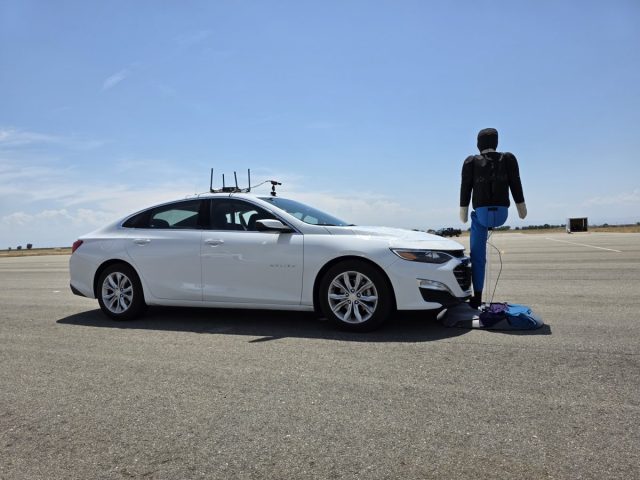
AAA researchers tested four vehicles equipped with PAEB on a closed course using a robotic pedestrian in front of the test vehicle traveling at 25 mph. Tests were conducted during the day and night with the pedestrian dressed in both standard and ANSI Class 3 high-visibility clothing.
The effectiveness of PAEB systems, especially at night, could have a significant impact on pedestrian fatalities as more vehicles are equipped in the future. More than 75% of all pedestrian fatalities occur after dark, and recent findings from the AAA Foundation for Traffic Safety show that pedestrian deaths have risen by more than 80% in the past 15 years, mostly due to incidents on urban arterial roads after dark.
“While improvements in pedestrian detection systems show great promise, the nighttime failure rates and spotty performance when pedestrians are wearing high-visibility clothing serve as a reminder that drivers must remain highly engaged at all times,” said Mark Schieldrop, senior spokesperson for AAA Northeast. “Further refinement and testing of these systems by automakers is essential to prevent more crashes and save more lives.”
AAA urges automakers to continue testing PAEB systems, including at night and with ANSI Class 3 high-visibility safety clothing. On average, 23 roadside assistance providers are killed while assisting stranded drivers every year, and improved PAEB detection when pedestrians are wearing high-visibility gear could save lives.
For drivers of newer vehicles with PAEB systems, AAA recommends reviewing the owner’s manual to fully understand how the systems function. Drivers are responsible for yielding to pedestrians and must be extra vigilant at night.
Last updated on October 29, 2025 by AAA Staff

Mark Schieldrop is a senior spokesperson for AAA Northeast. Based in Rhode Island, Mark is regularly interviewed on topics ranging from travel to traffic safety and is also a certified child passenger safety technician.


