


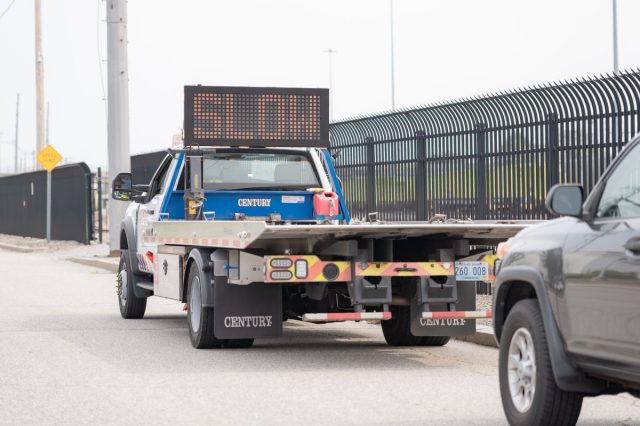
Last year, 46 emergency responders died while assisting others at the roadside — including police officers, firefighters, EMTs and tow truck operators, according to the Emergency Responder Safety Institute. These tragedies happened despite Slow Down, Move Over (SDMO) laws in all 50 states. A new study by the AAA Foundation for Traffic Safety found that confusion about the laws and driver noncompliance are leaving first responders at continued risk.
Several troubling trends emerged from the research.
- More than a third of drivers aren’t moving over or slowing down for roadside workers. Based on real-world footage of drivers passing roadside incidents, 64% of vehicles either slowed down or moved over. The remaining 36% did neither. Changing lanes was more common than reducing speed, suggesting that many drivers focus on only half the law.
- Many drivers don’t fully understand what SDMO laws require. A national survey conducted as part of the study found that two-thirds of drivers said they’ve heard of SDMO laws, but many couldn’t say whether their state has one or what the law entails.
- Tow truck drivers face the greatest risk. Only 58% of drivers observed in surveillance video slowed down or moved over when a tow truck was stopped at the roadside, compared to 66% who slowed down or moved over for police vehicles.
- Intentions don’t match actions. Most drivers say they comply with SDMO laws, but roadside videos show otherwise — especially when it comes to reducing speeds.
Connecticut’s Slow Down Move Over law requires drivers approaching emergency vehicles (including tow trucks) with their lights flashing to slow down to “reasonable level below the posted speed limit” and, if safe to do so, move over a lane. Drivers must also move over, if safe, for nonemergency vehicles on the shoulder.
Massachusetts’s Slow Down Move Over law requires drivers approaching emergency vehicles, maintenance vehicles, and tow trucks with their lights flashing to proceed with due caution, change lanes if safe to do so, and reduce their speed if unable to change lanes.
New Jersey’s Slow Down Move Over law applies not only to emergency vehicles, but tow trucks and disabled vehicles on the shoulder as well. A SDMO law violation incurs a fine of $100 to $500.
Both New York and New Jersey’s Slow Down Move Over laws apply not only to emergency vehicles, but tow trucks and disabled vehicles on the shoulder as well. In New York, a SDMO law violation carries a fine between $130 and $450, two points on a driver’s license and an $88 surcharge. In New Jersey, a violation incurs a fine of $100 to $500 and a possible 90-day license suspension.
New York’s Slow Down Move Over law applies not only to emergency vehicles, but tow trucks and disabled vehicles on the shoulder as well. In New York, a SDMO law violation carries a fine between $130 and $450, two points on a driver’s license and an $88 surcharge.
Rhode Island’s Slow Down Move Over law applies not only to emergency vehicles, but tow trucks and disabled vehicles on the shoulder as well.
“Clear and consistent laws, visible enforcement and education that resonates with drivers are needed to help every roadside responder make it home safely,” said Mark Schieldrop, senior spokesperson for AAA Northeast. “When everyone understands what ‘slow down, move over’ really means, we can make our roads safer for those who protect us every day.”
AAA encourages policymakers, enforcement agencies and safety partners to strengthen and align their approaches to Slow Down, Move Over laws, making them clearer, more consistent and easier for drivers to follow.

Mark Schieldrop is a senior spokesperson for AAA Northeast. Based in Rhode Island, Mark is regularly interviewed on topics ranging from travel to traffic safety and is also a certified child passenger safety technician.


