


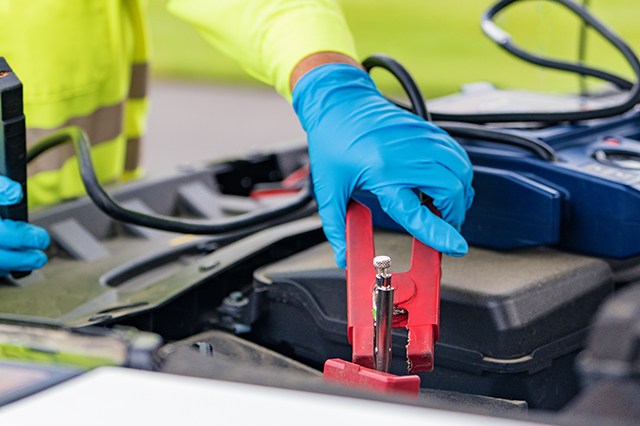
Jumping a car battery doesn’t have to be a stressful process. You can always call for roadside assistance — that’s what AAA is here for, but it’s also a good idea to know the basics yourself. Here’s how to jump a car battery safely so you can be on your way as soon as possible.
AAA Mobile Battery Service makes buying a new battery easy. Our technicians will even test your current battery and charging system at your home or job.
Step-by-Step Guide to Jump Start a Car
Safety First
Jump-starting a car safely begins with these important first steps.
- Consult your owner’s manual to make sure you’re following the manufacturer’s recommendations. Some newer vehicles, including hybrid and electric vehicles, may require manufacturer-specific jump-starting or battery replacement procedures.
- Make sure that other vehicles are at a safe distance and that you’re in a spot that’s out of danger’s way.
- If you have any doubts, call AAA Roadside Assistance for help.
Have the Right Tools on Hand
All you need are positive and negative jumper cables. You should have these on-hand, tucked away for that inconvenient moment when your battery fails. They come in anywhere between 10 and 20 feet long with longer cables being easier to use. The extra length means less maneuvering to get the cables to reach from your car to the car providing the jump-start.
There are also portable car jump starters, which are essentially the jumper cables with a built-in battery pack so you don’t need another car to help with the process. These are a bit bulkier and shouldn’t be stored in a hot car.

Car Maintenance for All Seasons
Positioning the Vehicles
Ideally, you want both cars to face each other head-on about 18 inches apart. Depending on where the breakdown happens, this might not be possible. Do your best to get as close to head-on as possible without letting the vehicles touch. Err on the side of caution. Be careful of car doors if the positioning isn’t ideal. You don’t want to open the door and have the two cars accidentally touch.
Some batteries are located under the back seat or in the trunk; consult the owner’s manual if you have trouble finding it.
Once the cars are positioned, put both cars in park for an automatic transmission or neutral for a manual transmission. Set the parking brakes, turn off the ignition and remove the keys.
Attach the Jumper Cables
This is the part about jumping a car battery safely that makes people nervous, but there is no need to worry. Start by opening the hoods of both cars and finding the battery terminals. Usually, the terminals on the battery are red or black and you will see a + (red) and – (black) sign on the top. Make sure you can clearly see these signs; if the terminals are dirty, use a rag or brush to knock off any dirt or debris.
Where to Put the Positive Cable When Jumping a Car
If you’re wondering which jumper cable goes on first, think positive. Attach the red, positive cable clamp to the red, positive terminal of the dead battery. You want this connection to be secure so wiggle around the clamp to get a tight grip if it feels loose. Next, attach the opposite end of the red, positive cable to the working vehicle’s positive battery terminal.
Where to Put the Negative Cable When Jumping a Car
Attach the black, negative clamp to the working car’s black, negative battery terminal but do not attach the negative clamp to the negative battery terminal of the dead battery. Instead, attach it to an unpainted metal part of the car like a bolt or the engine block. Dead batteries can produce hydrogen gas — if there’s a spark you want it away from the battery.

Start the Car
Start the engine of the working car and let it run a minute or two before trying to start the dead car. If the car won’t turn over at first, wait a few more minutes and give it another try. Speeding up the idle for a minute or so can sometimes help.
If the car still doesn’t start, then you may need to call for roadside assistance. It could be a number of problems like battery corrosion, fuses or the starter. A professional can diagnose the problem and recommend a repair.
Disconnect the Jumper Cables
There’s an order to disconnecting the cables, too. Remove the black, negative clamps and do not let them touch while the other cables are attached to the car. Next remove the red, positive clamps. Do not let the red and black cables touch. You can now close the hoods and stow your jumper cables. Once your car is running, take it to a local repair shop to have the battery fully charged and tested.
See, it’s easy to learn how to jump a car battery. With a set of jumper cables and the help of someone with a running car, you can do the job yourself in no time.
Do you have an interesting story about a time you needed a jump-start? Share it with us in the comments below.
Last updated on June 4, 2026 by AAA Staff

Related Articles




Trending Articles



NEWEST ARTICLES



11 Thoughts on “How to Jump a Car Battery Safely Every Time”
Leave A Comment
Comments are subject to moderation and may or may not be published at the editor’s discretion. Only comments that are relevant to the article and add value to the Your AAA community will be considered. Comments may be edited for clarity and length.

I have a second car that doesn’t get driven very often, so if it sits for too long the battery dies. I haven’t used jumper cables since I bought a car battery jumper pack (NOCO GB40). It’s small, lightweight and easy to use. It works even when the battery is completely dead, as happened last winter when the car got buried in snow and I didn’t get around to shoveling it out for several weeks.
Any time I have used jumper cables the doner car needed to be running at fast idle. This stands to reason because the few extra volts beyond the base 12 volts in the battery will help overcome loss in the cables and the extra load from the dead battery.
This casts doubt on how effective those little jumper batteries will be. The one time I used one it failed to start the car.
I bought an electronic battery tester mostly for evaluation. At the time I had a 13 year old battery, a ten year old battery and a 7 year old battery.
The 7 year one tested good in spite of the fact that it had been idle for weeks in cold weather. It’s still in service. The 13 year old showed low state of health, replace. Charging it didn’t change the outcome. It failed about a week later.
The tester recommended replacing the 10 year old, which I did.
So jumper cables..yea, battery tester..yea, little jumper battery nay!
A neighbor contacted me today about needing a jump-start. I had recently had a new battery put in by a AAA road service company. When I went to hook up the cable to my battery I discovered that the new AAA battery had a red plastic device covering it. Lifting the lid of the device revealed the positive terminal, which I knew was the case. But the red plastic device does not allow a jumper cable clamp to attach itself to the positive terminal and I found no way to easily remove the red device. Any thoughts on why the red plastic device would be made in such a way as to prevent a jumper cable’s jaws from clamping on any part of the positive terminal? Is this AAA standard practice?
I leave my. Car in Florida parked for 9 months, what should I do about battery ?
Hi, thanks for your question. Here’s an answer from our Car Doctor John Paul: When storing a car for 9 months the battery is only part of the equation.
Disconnect the battery or better yet maintain the battery with a float stye battery charger (Battery Tender is one brand). This will keep the battery charged without overcharging it. Cover the car with a car cover even if parked in a garage or carport. Use moisture absorbing dry packs to remove humidity (people will put them in closets and you can buy them at “dollar-stores”). Air up the tires to the maximum on the tire sidewall (the tires will lose a little air over time). Fill the gas tank and add fuel stabilizer (Sta-bil is one brand). Wash and wax the car and vacuum the interior. Take to small blocks of wood (1/2 inch thick) and place them under wiper blades so the summer heat doesn’t damage the blades. Change the oil and check all the fluid levels before putting the car away.
If the battery is worn out and will not hold a charge as opposed to just being discharged, the black jumper cable, (negative) will need to be attached to the unpainted metal of the vehicle in order to start. This is because the batter is dead because it is internally shorted. If your place the jumper cables on the battery terminal, the current will travel the path of least resistance and travel through the shorted battery rather than the starter motor.
I have a 2006 Miata which spends most but not all of the winter in the garage. I purchased a Weego jump start battery and have been able to use to jump start the car when the battery is low.
When I bought my first car my father made me jumper cables and I always keep them in my car. One day I was in my driveway and the mailman drove by in his truck, stopped, and asked if I had jumper cables because a neighbor was in need. He borrowed them and then returned them. You never know when you’ll need them.
Thanks I am printing this out.
great advice for diy’s
very useful article