AAA: New Vehicle Ownership Costs Hit $12,863 Annually 

The average annual cost to own and operate a new vehicle is $12,863, according to AAA’s newest Your Driving Costs analysis. This reflects the higher cost of fuel, depreciation and finance charges. 

In response to the growing share of electric vehicles in the new car market, this year’s Your Driving Costs analysis added some popular EVs and hybrids into standard vehicle categories that previously listed only gasoline-powered models. 

“By including EVs, hybrids and traditional gasoline-powered vehicles within the same categories, consumers can more easily compare total ownership costs across powertrains,” said Robert Sinclair, senior manager, public affairs for AAA Northeast. “Looking at the full ownership picture — including depreciation and other expenses — can help consumers better understand the true total cost of purchasing a new vehicle.” 

Key Cost Factors 

  • Fuel Prices Gasoline prices are up significantly this year, with a national average of $4.15 per gallon of regular at the time of the study. That price is nearly 32% higher than 2025. Electricity for home EV charging averaged 18 cents per kilowatt hour, about 8% more than a year ago, improving the relative affordability of EVs and hybrids given the larger increase in gas prices. But fuel economy was far from the most important factor in determining the most affordable vehicle to own. 
  • Depreciation — The difference between a car’s purchase price and resale value remains the single largest ownership cost, with vehicles losing an average of $4,422 per year. Electric vehicle buyers should prepare themselves for a rapid and significant loss of value on their new wheels. EV medium sedans had about twice the depreciation of gasoline-powered models, helping push total ownership costs 29% higher in that category. 
  • The Price — The average retail price of a new vehicle this year is $39,376. While manufacturer’s suggested retail prices have increased slightly, incentives, demand and rebates can affect what consumers actually pay. The final purchase price is used to calculate finance costs and depreciation. 

EV and Hybrid Comparison Takeaways 

By comparing select electric and hybrid models within the same categories as gas-powered vehicles, AAA gives shoppers a more practical view of how their ownership costs compare. 

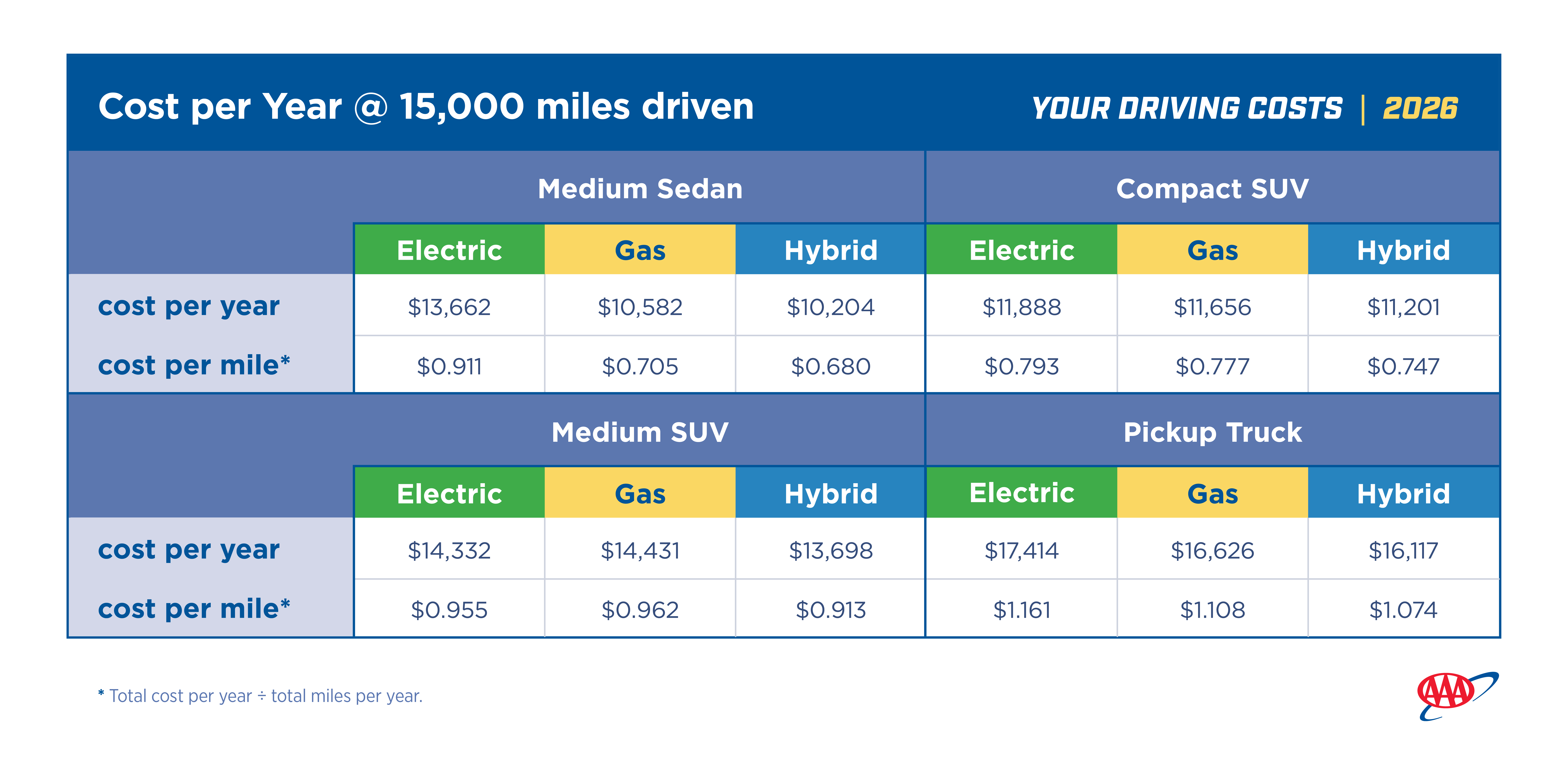
  • Gas-powered vehicles: Overall, gas models offered savings compared to EVs and hybrids in cost categories affected by purchase price, like finance charges, taxes and fees, and depreciation. For example, gas-powered medium sedans cost $10,582 per year to own, $3,080 less than comparable EV medium sedans, which had significantly higher depreciation, fees and finance costs. 
  • Electric vehicles: EVs delivered the lowest fuel costs, with charging costs for EVs between 66% and 70% lower than fuel for traditional gas vehicles across the categories studied. However, those savings were often outweighed by higher depreciation, fees and finance costs. For example, EV medium sedans cost 29% more to own annually than gas-powered models. 
  • Hybrids: Hybrids were the most consistently lower-cost alternative to gasoline powered models in the comparison categories. They combined meaningful fuel savings with smaller ownership-cost tradeoffs, costing less annually than gas-powered medium sedans, compact SUVs, medium SUVs and pickup trucks. 
PA chart

Car Buying Advice 

Vehicle category makes a major difference in operating expenses. A half-ton pickup costs $1.10 per mile to operate — 48 cents more than small sedans — adding an average of $7,191 per year. In comparison, purchasing an EV may help offset annual fuel costs, but higher depreciation can increase total ownership costs over time. Choosing a vehicle that best fits actual transportation needs can help buyers manage long-term spend. 

  • Vehicle shoppers should create a monthly and annual budget that includes ownership and operating costs before purchasing. 
  • Keep the vehicle price, finance rate and trade-in value as separate negotiations. 
  • Get preapproved by a financial institution, such as a bank, credit union or AAA, before discussing financing with the dealer. 

The Your Driving Costs calculator helps shoppers compare ownership costs by vehicle category, powertrain, location and driving habits. 

Methodology and Overall Analysis 

AAA’s Your Driving Costs analysis estimates the cost of owning and operating a new vehicle for personal transportation over five years and 75,000 miles. Actual driving costs vary based on driving habits, location, operating conditions and other factors. 

AAA evaluated seven vehicle categories and 34 top-selling models across fuel, maintenance, repair and tire costs as well as license, registration and taxes, depreciation and finance charges.  

EV and Hybrid Cost Comparisons 

For EV and hybrid comparisons, AAA evaluated selected top-selling models in four categories — medium sedans, compact SUVs, medium SUVs and pickup trucks — alongside gas-powered models to show how ownership costs vary by powertrain within the same vehicle categories. 

For a full breakdown of the methodology and cost comparisons, download and review the Your Driving Costs fact sheet and brochure

Frequently Asked Questions 

1. What is the average annual cost to own and operate a new vehicle in 2026? 

According to AAA’s 2026 Your Driving Costs analysis, the average annual cost to own and operate a new vehicle is $12,863. 

2. Why are vehicle ownership costs increasing? 

Ownership costs have increased due to higher fuel prices, vehicle depreciation, finance charges, and elevated new-vehicle purchase prices. 

3. Why don’t electric vehicles always cost less to own? 

While electric vehicles generally have lower fueling costs, those savings can be offset by higher depreciation, purchase prices, taxes, fees, and financing expenses. 

4. How much can EV owners save on fuel? 

The study found that charging costs for electric vehicles were approximately 66% to 70% lower than fuel costs for comparable gasoline-powered vehicles. 

5. Which vehicle ownership expense has the greatest impact on total cost? 

Depreciation remains the largest ownership expense, averaging $4,422 annually and often exceeding fuel costs. 

6. Are hybrid vehicles a cost-effective alternative? 

Hybrid vehicles can be a cost-effective option. In several vehicle categories, hybrids delivered lower overall ownership costs than comparable gasoline-powered vehicles by combining improved fuel efficiency with more moderate depreciation and financing expenses. 

7. What should consumers consider before buying a new vehicle? 

Rather than focusing solely on monthly payments or anticipated fuel savings, consumers should evaluate total ownership costs, including depreciation, financing, insurance, fuel or charging costs, maintenance, registration fees, and expected resale value. 

8. How does vehicle type affect ownership expenses? 

Vehicle category can significantly influence costs. For example, AAA found that a half-ton pickup truck costs substantially more per mile to operate than a small sedan. 

9. How can consumers compare ownership costs for different vehicles? 

AAA’s Your Driving Costs Calculator allows shoppers to compare estimated ownership costs by vehicle category, powertrain, location, and driving habits. 

AAA Northeast is a not-for-profit auto club with offices in Rhode Island, Massachusetts, Connecticut, New Jersey, New Hampshire and New York providing more than 6.9 million local AAA members with travel, insurance, financial and auto-related services. 

Subscribe to Your AAA Newsletter

Sign up and receive updates for all of the latest articles on automotive, travel, money, lifestyle and so much more!

Fall Activities in New England, New Jersey and New York

The Northeast is known for many things (our accents, sports, clam chowder … ), but autumn is when we really shine. From some of the most awe-inspiring fall foliage to the best seasonal activities to enjoy, it’s truly an exceptional place to be this time of year.

Here are some of our favorite fall activities in New England, New Jersey and New York.

Wherever the season takes you, join AAA for dependable roadside assistance, insurance, travel planning and more.

Fall Activities Across New England, New York and New Jersey: Quick Reference Guide

Destination Featured Fall Activity What to Expect
Connecticut Apple picking and cider Explore Lyman Orchards and B.F. Clyde’s Cider Mill for apples, cider and classic farm fun.
Maine Pumpkin festivals and orchards See giant pumpkins at Damariscotta Pumpkinfest or pick apples and pumpkins at Treworgy Orchards.
Massachusetts Spooky attractions and fall fairs Experience Salem’s witch-history attractions or enjoy rides, music and contests at Topsfield Fair.
New Hampshire Apple picking and pumpkins Pick fresh fruit at Alyson’s Orchard or enjoy the Laconia Pumpkin Festival.
New Jersey Oktoberfest Enjoy live music, food trucks, a pumpkin patch, hayrides and a corn maze in Hamilton.
New York Harvest festivals and jack-o’-lanterns Visit Fishkill Farms for fall harvest fun or see thousands of carved pumpkins at the Great Jack O’Lantern Blaze.
Rhode Island Fall harvest festivities Browse seasonal decor, enjoy hayrides and join the Fall Harvest Festival at The Farmer’s Daughter.
Vermont Small-town fall festival Take in foliage, local crafts, live music and classic fall food at Autumn on the Green.

Fall Activities in Connecticut

Lyman Orchards

Middlefield

As a 10th generation farm, Lyman Orchards has been growing everything from apples to corn since 1741, and today, it’s one of the most popular places to enjoy in fall among locals and visitors alike. Besides its reputation for excellent apple picking, it also creates a themed corn maze every year, offers horse-drawn hayrides and has a stocked farm marketplace for all the essentials. The farm also hosts a variety of vendors throughout the year from breweries to petting zoos, and even dueling piano performances.

🍎 Check out more Northeast apple-picking spots.

B.F. Clyde’s Cider Mill

Mystic

Fall is the time for hot beverages — chai, pumpkin spice lattes and, of course, apple cider. But have you ever had cider that’s freshly pressed, right in front of you? At B.F. Clyde’s Cider Mill, the last standing steam-powered cider mill in the United States, you can watch an apple-pressing demonstration before purchasing your own beverage (plus an apple cider doughnut or two). Also available are eight versions of hard cider and 14 apple wines, all aged to perfection in oak whiskey barrels.

Fall Activities in Maine

Damariscotta Pumpkinfest & Regatta

The Damariscotta Pumpkinfest & Regatta is just as fun as it sounds. The four-day event is completely volunteer-led, from the third graders who plant the pumpkin seeds in spring to the more than 400 folks who grow the pumpkins over several weeks. Once the giant pumpkins have grown to size, the festival commences with such events as the pumpkinboat regatta, where enormous hollowed-out pumpkins are raced in the Damariscotta Harbor. Other featured events include the pumpkin derby, pumpkin pie eating contests, the pumpkin drop and who can forget the pumpkin catapult, where 20-pound pumpkins are hurled high into the air. A quintessential New England fall activity!

Treworgy Orchards

Levant

A farm that’s all about community, Treworgy Orchards’ mission since 1983 has been to give friends and neighbors the opportunity to pick their own fruit — and so they have, plus much more. Come to pick your own pumpkins, apples and squash, get delightfully lost in the corn maze (which can also be enjoyed at night), enjoy an apple cider doughnut paired with cider, take a relaxing hayride or even book a mini family portrait session. And that’s just seasonal fun! All year round, visitors can get ice cream, pet farm animals and browse the gift shop full of Maine and farm-themed goods.

Fall Activities in Massachusetts

Salem

We’d be remiss not to mention one of the most popular fall destinations, well, ever. With over 1 million visitors to the town every year, Salem has a reputation for everything spooky, witchy and all-around fall. Known for its role in the witch trials of 1692, Salem has become a favorite fall activity in New England for everyone from kids to adults. Learn about the town’s sordid history at one of numerous museums, take a spooky ghost tour, do a little shopping, get your fortune told or even have dinner inside one of the most haunted buildings in town.

Topsfield Fair

As America’s oldest county fair, this massive 10-day event has been running every fall since 1818. From live music, carnival rides, contests and pumpkin weigh offs to pig racing, parades, cooking demonstrations and woodcarving, it’s simply everything you’d want a fall fair to be — and there’s something to enjoy for everyone in the family. Make sure to check the daily calendar for updates on the alternating entertainment schedule before your trip.

Fall Activities in New Hampshire

Alyson’s Orchard

Walpole

Alyson’s Orchard boasts over 50 acres of fruit-bearing trees, offering fresh fruit from midsummer to late fall. With 50 apple varieties, seven types of peaches and various berries, plums, pears, pumpkins, gourds and winter squash, it’s a paradise for pick-your-own enthusiasts. Visitors can create lasting memories among the tranquil farm setting, which includes ponds, playgrounds and even a bocce ball court. After you’ve picked your bounty, visit the farm stand for locally made products and treats.

Laconia Pumpkin Festival

Laconia

With its iconic jack-o’-lantern pyramid rising above the festival like an autumnal beacon, the New Hampshire Pumpkin Festival calls all pumpkin enthusiasts, costume-wearers, foodies and game lovers to its event. Folks of all ages are welcome as there’s plenty of fun to be had from craft shows and food trucks to a beer garden and zombie walk – a spooky “choreographed jaunt” down the festival streets. And did we mention it’s free?

Fall Activities in New Jersey

Oktoberfest

Hamilton

Put on your Lederhosen and pay homage to the German tradition at the Hamilton Township Oktoberfest celebration this October. Enjoy craft beer gardens, food trucks and live music performances. The event is kid-friendly, so bring the whole family to enjoy an array of activities from a pumpkin patch to hay rides, a corn maze and more.

fall activities

Fall Activities in New York

Fishkill Farms

Hopewell

Rolling hills, shimmering lakes and idyllic farms make the Hudson Valley the perfect stop during fall when leaves are at their peak. In particular, Fishkill Farms is more than worth the drive. Every weekend in September and October, this Insta-worthy farm celebrates its Fall Harvest Festival. Ticketed events include everything from pick-your-own apples, wagon rides, a corn maze and live music. While you’re there, enjoy a panoramic view of the farm from their on-site cidery or grab a bite to eat from the Fishkill Farms Grill.

The Great Jack O’Lantern Blaze

Croton-on-Hudson

Taking a spooky stroll through the Great Jack O’Lantern Blaze will have you constantly asking, “How did they do that?” Thousands of carved pumpkins take the shape of anything you can imagine on the grounds of the historic Van Cortlandt Manor.

Fall Activities in Rhode Island


The Farmer’s Daughter

South Kingstown

The Farmer’s Daughter has the fall season mastered. If you’re not convinced by the expertly arranged pumpkins, gourds and squash upon entry, walking through back-to-back greenhouses filled to the brim with fall decor, pottery and plants of every size and genus will certainly change your mind. Even better, their Fall Harvest Festival takes place every weekend through October and features hayrides, a pumpkin dunk tank, scavenger hunts and more.  

Fall Activities in Vermont

Autumn on the Green

Danville

If you’re seeking the epitome of small-town fall, look no further. Held by the Danville Chamber of Commerce, Autumn on the Green is a festival designed to showcase the works of small local businesses from artists to crafters and antique sellers. Stroll along the booths, admire the beautiful foliage around you and listen to live music before partaking in delicious food, like burgers, pulled pork, stews and whoopie pies.

Need a ride? AAA members can save on Hertz car rentals.
What did we miss? Tell us your favorite fall activities in New England and New York in the comments below.

Subscribe to Your AAA Newsletter

Sign up and receive updates for all of the latest articles on automotive, travel, money, lifestyle and so much more!

Why Life Insurance Belongs in the Estate Planning Conversation

When you think about estate planning, what comes to mind?

If your first thought is that it sounds complicated, you wouldn’t be alone. Many people think estate planning is for only a certain income bracket, but the reality is much simpler. Estate planning, at its core, is a set of decisions that determine what happens to your home, your savings and the people who depend on you.

Perhaps without realizing it, most people already have the beginnings of a plan in motion. If you have life insurance, or are thinking about life insurance, that includes you.

What Is Estate Planning?

Boiled down, estate planning answers a few basic questions:

  • Which family members or friends receive what when you’re gone?
  • Who is in charge if you’re ever unable to make decisions for yourself?
  • Who will look after anyone who depends on you?
  • How will your bills and expenses be handled?

Having a will can answer these questions, but a won’t control everything you own. Some things, like life insurance and retirement accounts, go directly to the person you named as the beneficiary on the account, no matter what your will says. If that name happens to be out of date or inaccurate, your will does not take precedence.

For this reason, it’s important to remember that estate planning is a broad term encompassing an array of plans and legal documents (including wills) — not just any one thing. In essence, estate planning is more than the sum of its parts.

Life Insurance as Part of an Estate Plan

Adding life insurance to your estate plan helps to ensure a more seamless transition of funds in the event of your passing by covering final expenses, alleviating any ongoing expenses your family may encounter.

While a life insurance beneficiary is often a person, trust or estate, you can also plan for your death benefit to cover funeral expenses. The average cost of a traditional full-service burial in the U.S. is $8,595 in the U.S., according to Funeralocity, with full-service cremation rounding out to $6,253 on average. If unprepared, costs of this size can be a burden on families during an already difficult time. Setting aside funds in your life insurance policy to defray any final expenses ultimately means less worry for your loved ones.

In the case of ongoing expenses, the death benefit of a life insurance policy can be used to keep life moving, whether that means taking care of an elderly loved one or a child with special needs. In some cases, this sort of death benefit would be managed in a trust by a trustee.

Types of Life Insurance Used in Estate Planning

Term life insurance

A term life insurance plan is temporary, offering a fixed premium that provides coverage for a predetermined period, typically 30 years from the issued date. Because it offers a more limited scope of protection, term life insurance policies are often used if finances are expected to come from another source, like investments, and can be used to help cover obligations like mortgages, income replacement, education costs or other financial responsibilities.

Universal or whole life insurance

Permanent life insurance is designed to provide coverage for a lifetime. Universal life insurance offers the flexibility to adjust premiums and the death benefit value for the duration of the policy, while whole life insurance does not. Whichever coverage you choose, both types of permanent life insurance ensure your legacy is covered no matter when you pass away.

Where to Start

Estate planning may seem overwhelming, but you don’t need to have all the answers before having the conversation. A licensed AAA Life Insurance agent can work with you to see how your coverage fits into the bigger picture.

Get a Life Insurance Quote

Subscribe to Your AAA Newsletter

Sign up and receive updates for all of the latest articles on automotive, travel, money, lifestyle and so much more!

Roofing Options to Update Your Home

Article overview: A new roof can boost your home’s protection, curb appeal and marketability while potentially lowering homeowners insurance costs. Compare roofing materials, prioritize upgrades and talk with your insurance agent before you replace your roof or add solar panels.

Homeowners today have more roofing options than ever before, but roofing can be pricey. The average roof-replacement cost in 2025 was around $18,000, according to Verisk’s State of America’s Roofs report.

While there are ways to cut costs like evaluating roofing materials, always hire a professional to do the work, even if it means a higher price tag, said Scott Richards, insurance manager for AAA Northeast.

“This type of serious work should always be handled by a professional roofer, so you don’t encounter any problems later on,” Richards said.

Richards also recommends asking for estimates from more than one reputable contractor before hiring someone to do the work.

If getting a new roof is on your to-do list, read on.

Get a homeowners insurance quote from AAA and find the protection that fits your home.

Understanding Your Roofing Options

You might not invite a friend over to see your new roof like you would a new kitchen, but replacing an aging roof can improve your home’s curb appeal, protection and marketability.

As far as types of roofing materials go, asphalt shingles remain one of the most popular and generally affordable residential roofing options. Depending on the type of shingle, asphalt shingle roofs can last around 20 to 30 years, according to the International Association of Certified Home Inspectors, although installation, climate and maintenance can affect their lifespan.

Premium asphalt shingles, including so-called “architectural” or laminated shingles, have a more dimensional appearance than traditional three-tab shingles and can offer enhanced durability and wind resistance. Many current architectural shingles carry limited lifetime warranties, although the terms and coverage vary by manufacturer.

Some premium asphalt shingles are designed for severe-weather applications and can carry high wind warranties of 100 mph or more when installed according to the manufacturer’s requirements. These higher-performance products generally cost more.

Other roofing options include slate and cedar shakes. Both can offer distinctive appearance and long service lives, but they are generally more expensive and may require specialized installation or maintenance.

For energy efficiency, look for cool roofs, which reflect sunlight instead of absorbing it. Roofing products like reflective shingles, tile and appropriately coated metal can reduce heat gain, according to Energy Star.

Which Roofing Material Is Right for Your Home?

Roofing material Typical lifespan/ consideration Cost notes Key benefits
Asphalt shingles About 20–30 years Generally one of the more affordable residential options Popular, practical and widely available
Architectural shingles Varies by product Costs more than basic three-tab shingles More dimensional appearance, enhanced durability and wind resistance
Slate Long service life Generally more expensive Distinctive appearance and durability
Cedar shakes Long service life Generally more expensive Distinctive appearance with specialized installation or maintenance needs
Cool roofing products Varies by product Varies by material and product Reflects sunlight and can reduce heat gain

Roofing Upgrades Worth the Money

Venting

Proper attic ventilation helps remove heat and moisture, and installing a ridge vent during a roof replacement can improve airflow when paired with adequate intake ventilation, such as soffit vents. Proper ventilation, insulation and air sealing can also help improve comfort and energy efficiency.

Drip Edge and Flashing

Often made from metal, drip edge runs along the edges of your roof to help direct rainwater away from your home. Flashing helps keep water out around areas where the roof meets walls, chimneys and other openings.

Other Roofing Considerations

Tree Trimming

Look for any tree limbs that could eventually fall and damage your roof. Consider having some limbs removed to prevent damage.

Solar Panels

If you’re thinking about solar panels to help lower your electricity bill, you may want to replace your roof at the same time. If the roof needs replacement soon after the panels are installed, removing and reinstalling the panels can add significant costs.

Gutters

While evaluating new roof styles, you may also want to replace your gutters, especially if they are dirty or misaligned. The average life of galvanized steel gutters is 20 years, estimates the National Association of Home Builders — about the lifespan of a typical roof.

Hurricane-Proofing

In hurricane-prone areas, replacing a roof can also be an opportunity to strengthen the connection between the roof and the walls with metal straps or other reinforcements to help the roof better withstand high winds.

roofing options

Roofing FAQs

Will a new roof lower my homeowners insurance?

Your roof can affect how much you pay for your homeowners insurance premium, with its age and condition as the two most important factors. Its shape is another.

“If I had a flat roof, I would consider having a roofer put a pitch on it because it can make a big difference by preventing leaks and damage,” said Richards.

Many insurance providers offer discounts to homeowners who have replaced their home’s roof within the past two years, so if you plan on replacing yours, make sure you talk to your agent about it.

You should also talk to your agent about how your new roof could affect the value of your home. Your homeowners insurance is what helps you rebuild should disaster strike and you want to make sure it would pay you enough to do so if necessary.

Should I replace my roof before installing solar panels?

In many cases, replacing an aging roof before installing solar panels makes financial sense. If the roof needs replacement soon afterward, removing and reinstalling the panels can add significant costs.

If you choose to put solar panels on your roof, do your research; many companies who lease solar panels will pay to insure them too.

Is it better to replace gutters when replacing a roof?

Replacing gutters at the same time can make sense when they are aging, damaged, dirty or misaligned. Coordinating the projects can help protect the new roof and manage related installation work efficiently.

Should I get multiple estimates for a new roof?

Yes. Get estimates from more than one reputable roofing contractor before choosing a professional. Comparing proposals can help clarify the scope of work, materials, warranties and total cost.

Installing a new roof is an expensive purchase, but choosing the right materials, upgrades and contractor can help protect your home and prevent costly problems down the road.

Get a Homeowners Insurance Quote

Have you recently done a roofing renovation to your house? Tell us about it in the comments.

Subscribe to Your AAA Newsletter

Sign up and receive updates for all of the latest articles on automotive, travel, money, lifestyle and so much more!

Pump Prices Surge Across the Northeast  

As oil prices rise in response to escalating tensions between the United States and Iran, pump prices across the Northeast have reached record highs for this time of year. Over Labor Day weekend, drivers nationwide paid more than $4 a gallon on average for the first time on record as crude prices return to the mid-$90-per-barrel range. Prices in global petroleum markets have risen steadily for about three weeks, following renewed attacks across the Persian Gulf and pessimism about the Strait of Hormuz reopening soon. 

Along with geopolitical volatility, gasoline prices are facing additional pressure from increasingly tight inventories. In a typical year, gas prices usually peak in mid-summer and are already on the decline by this time as demand cools and refiners replenish domestic stockpiles with surplus production. However, according to the Energy Information Administration (EIA), gasoline inventories for the week ending Aug. 28 fell by 1.2 million barrels, leaving them 6% below the seasonal average, despite U.S. refineries operating at 98% of capacity and at their highest weekly rate since August 2018. Inventories have fallen below 206 million barrels for the first time since November 2022, primarily due to continued strong export demand since the early weeks of the war.  

Domestic gasoline demand slid to 8.9 million barrels a day in the week prior to the Labor Day travel period, according to the EIA, continuing a summer-long streak of weaker demand compared to year-ago levels. EIA data show weekly demand topped the 9 million barrels per day benchmark six times between Memorial Day and Labor Day this year, compared to nine times last year.  

“When it comes to pump prices, the combination of rising oil prices and declining inventories is pressing down on the accelerator pedal,” said Jillian Young, director of public relations for AAA Northeast. “Along with gasoline prices, petroleum products of all types are facing upward pressure, including diesel, which reached a record national average price of $5.90 per gallon over the weekend.” 

AAA’s Sept. 8 survey of fuel prices found the national average up 6 cents from last week ($4.09), averaging $4.15 per gallon. Today’s national average price is 13 cents higher than the prior month ($4.02) and 96 cents higher than this day in 2025 ($3.19)

As of Sept. 8, Indiana and Texas had the lowest prices in the nation at $3.42 and $3.67, respectively. California and Washington had the highest prices in the nation at $5.86 and $5.51, respectively.  

Region Current Price* One Week Ago One Month Ago One Year Ago 
Connecticut $4.33 $4.23 $4.12 $3.20 
Massachusetts $4.22 $4.13 $4.05 $3.12 
New Jersey $4.27 $4.16 $4.03 $3.17 
New York $4.31 $4.23 $4.17 $3.26 
Rhode Island $4.25 $4.15 $3.98 $3.15 
Gas Prices by State Over Time

Gas Prices by State Over Time

Prices as of Sept. 8, 2026

$5.00
$4.50
$4.00
$3.50
$3.00
$3.20
$4.12
$4.23
$4.33
CT
$3.12
$4.05
$4.13
$4.22
MA
$3.17
$4.03
$4.16
$4.27
NJ
$3.26
$4.17
$4.23
$4.31
NY
$3.15
$3.98
$4.15
$4.25
RI
$3.19
$4.02
$4.09
$4.15
US
One Year Ago
One Month Ago
One Week Ago
Current

*Prices as of Sept. 8, 2026 

The AAA Gas Prices website is your resource for up-to-date fuel price information. Search for average gas prices on national, state and metro levels by regular, plus, premium and diesel.  

AAA Northeast is a not-for-profit auto club with offices in Rhode Island, Massachusetts, Connecticut, New Jersey, New Hampshire and New York, providing more than 6.9 million local AAA members with travel, insurance, financial and auto-related services. 

Subscribe to Your AAA Newsletter

Sign up and receive updates for all of the latest articles on automotive, travel, money, lifestyle and so much more!

Where To Go Apple Picking in the Northeast

We’re sharing some of our favorite apple-picking orchards across the Northeast, from Connecticut to Vermont, so you know where to go to pick apples this fall.

Once you’ve filled your bags, put that harvest to work with easy recipes for cider, pie and more.

Heading out to an orchard this fall? Join AAA before you go, so help is always close by if your road trip hits a bump.

Apple-Picking Orchards in the Northeast

Quick Reference Guide

State Orchard Town What Makes It Worth the Trip
Connecticut Beardsley’s Cider Mill & Orchard Shelton Dwarf apple trees make picking easy for all ages, with 14,000+ trees to explore.
Connecticut Lyman Orchards Middlefield A themed corn maze and horse-drawn hayrides round out the picking.
Maine Treworgy Orchards Levant 42 acres of scenic countryside dedicated purely to the you-pick apple orchard experience.
Maine McDougal Orchards Springvale Seventh-generation family farm with a historic home as your backdrop.
Massachusetts Honey Pot Hill Orchards Stow Dozens of apple varieties plus hayrides, a hedge maze and fresh cider doughnuts.
Massachusetts Tougas Family Farm Northborough A steadfast local favorite known for its beautiful grounds and quality fruit.
New Hampshire Mack’s Apples Londonderry The largest pick-your-own destination in the state, with whimsical farm displays.
New York Masker Orchards Warwick Drive right up to the trees and picnic among the groves.
Rhode Island Sweet Berry Farm Middletown A beloved former hobby farm with pick-your-own flowers alongside apples.
Rhode Island Barden Family Orchard North Scituate Over 90 years of orchard expertise in the peaceful western Rhode Island countryside.
Vermont Shelburne Orchards Shelburne Pick your own, buy pre-picked or take home your very own apple tree sapling.
apple picking

Connecticut

Beardsley’s Cider Mill & Orchard

Shelton

Known for their dwarf apple trees that make for super easy picking for folks of all ages, Beardsley’s has been a fall staple since 1849. With over 14,000 trees and a wide variety of apples to choose from, you’ll certainly have your pick!

Lyman Orchards

Middlefield

Come for the superb you-pick apple orchard, stay for the annual themed corn maze, horse-drawn hayrides and stocked farm marketplace for all the essentials. A visit to Lyman is a must in the fall.

Maine

Treworgy Orchards

Levant

Who wouldn’t want to pick apples on 42 acres of scenic countryside? At Treworgy Orchards, you can. Since its inception in 1983, its apple-picking orchard experience has been the main focus, and that dedication makes their apples some of the best in the area.

McDougal Orchards

Springvale

As a seventh generation family farm, McDougal Orchards specializes in growing only the highest-quality apples. That legacy paired with acres of scenic countryside and a beautiful historic home as the backdrop, apple picking here is an unmatched experience.

Massachusetts

Honey Pot Hill Orchards

Stow

Boasting dozens of apple varieties, your favorite is sure to be found here. Founded in 1926, this fourth-generation family farm spans nearly 200 acres and has earned a reputation as one of the region’s most beloved fall destinations, complete with hayrides, farm animals and a hedge maze to wander after you’ve filled your bag. Pair your apples with fresh-picked pears and blueberries, then swing by the farm store for a warm cider doughnut before you go.

Tougas Family Farm

Northborough

Consistently one of the most-reviewed apple orchards in Massachusetts, it’s clear that Tougas Family Farm is a steadfast frontrunner for apple picking in Massachusetts, and considering their beautiful grounds and quality of the apples they grow, we’d agree.

New Hampshire

Mack’s Apples

Londonderry

As the largest pick-your-own destination in New Hampshire, there’s certainly endless charm at Mack’s Apples, between the whimsical displays across the farm and the sheer enormity of their apple offerings.

New York

Masker Orchards

Warwick

If you’re searching for a memorable apple-picking orchard experience for the whole family, look no further. Masker Orchards allows you to drive right up to the apple trees you want to pick from and have your own picnic among the groves. It doesn’t get more picturesque than that.

Rhode Island

Sweet Berry Farm

Middletown

What began as a hobby farm and quickly turned into one of the most popular in the state, Sweet Berry Farm offers a plethora of beautiful pick-your-own offerings, including flowers.

Barden Family Orchard

North Scituate

After growing fruit trees for over 90 years, it’s no surprise that the team at Barden Family Orchard are experts in their field. Enjoy a huge variety of apples to pick from surrounded by the peaceful surroundings of the western Rhode Island countryside.

Vermont

Shelburne Orchards

Shelburne

At Shelburne Orchards, not only can you pick your own apples, you can also grab some pre-picked from their market or even buy your very own apple tree sapling right on the premises. Talk about a-peel-ing.

Apple Picking FAQs

When is the best time to go apple picking in the Northeast?

Late September through mid-October hits the sweet spot across most of the Northeast, when peak varieties are ripe and fall foliage is at its best. Many orchards open as early as late August for early varieties like Gala and Ginger Gold, and some stay open into November for late-season apples like Crispin and Braeburn. Since exact timing shifts with weather each year, call your chosen orchard or check its website before you head out.

How much does apple picking usually cost?

Most orchards charge by the bag, box or pound rather than an entry fee, and prices typically fall between $20 and $40 for a half-bushel or peck bag that yields around 10 to 20 pounds of apples. Some orchards add a small admission fee for extras like hayrides, mazes or petting zoos. Cash is still king at many smaller family farms, so it’s worth bringing some along even if the farm store takes cards.

What should you bring to an apple orchard?

Comfortable closed-toe shoes are a must, since orchard rows often mean uneven, sometimes muddy ground. Layers help too, since fall mornings run cool but afternoons can warm up fast. Bring cash for smaller farms, a reusable bag or wagon for hauling your haul, and sunscreen even on cloudy days. A picnic blanket is a smart add if your orchard allows outdoor dining among the trees.

where to go to pick apples

How do you pick an apple correctly without damaging the tree?

Cup the apple in your palm and gently twist while lifting up and away from the branch, rather than pulling straight down. A ripe apple releases easily with this motion. Yanking or tugging can damage the fruit spur, which is the small stem that produces next year’s apples on that same spot.

How long do fresh-picked apples last?

Stored in the refrigerator, fresh apples generally stay crisp for four to six weeks, and some firmer varieties like Northern Spy or Rome can last even longer. Keep them in a perforated bag in the crisper drawer, away from other produce, since apples release ethylene gas that speeds ripening in nearby fruits and vegetables. At room temperature, plan to eat them within about a week.

Can you bring your dog apple picking?

Pet policies vary widely from farm to farm, and many orchards restrict animals for food-safety reasons or because of on-site livestock. Check the specific orchard’s website or call ahead before loading up the car, since policies can also change seasonally around petting zoos or corn maze events.

What’s the difference between a farm stand apple and a pick-your-own apple?

Farm stand apples are pre-picked by staff and typically sorted for size and appearance, offering convenience if you’re short on time. Pick-your-own apples let you choose exactly what looks best straight off the branch, and many visitors find the fruit tastes noticeably fresher since it hasn’t sat in storage. Pick-your-own is also simply part of the fall experience, offering the walk through the orchard as much as the apples themselves.

where to go apple picking

Apple Recipes

Now that you’ve gathered your goods, it’s time to enjoy! From sweet to savory, here are a few fun, creative and versatile recipes to try.

Preserving

Apples from the supermarket are alright, but they never taste as good as when they’re freshly picked from the tree. The good news is you can put that flavor into a jar and revisit it all year long. While apples are at their autumn best, cook up a big batch of applesauce or apple butter, then follow the instructions below to learn how to safely can and preserve.

Make your jarred apple goods now and serve on Thanksgiving. To give as gifts for the holidays, customize with labels and dress up by placing a square of patterned fabric over the lid and fasten with a ribbon or twine.

Drink Your Apples

Hot or cold, mulled or plain, apple cider is a seasonal staple. Here are a few more delicious and creative ways to drink cider this season other than straight from the glass.

Apples for Dinner (or Breakfast or Lunch)

From full meals to side dishes, sweeten up your next meal with apples.

More Than Apple Pie

When it comes to desserts, apple pie is king. You probably already have a go-to apple pie recipe, so we’ve provided an assortment of other apple indulgences. Deep-fried apple fries, anyone?

Apple Applications

Which apple is the best pick for your recipe? Click a category to see.

Which orchard are you heading to this apple-picking season? What’s your favorite apple recipe? Tell us in the comments below. 
AAA members get 24/7 roadside assistance wherever the season takes you. Join AAA now.

Subscribe to Your AAA Newsletter

Sign up and receive updates for all of the latest articles on automotive, travel, money, lifestyle and so much more!

Merging Into Life: How to Teach Kids About Money

SEASON 3: EPISODE 7
Episode Feedback

Tools and behaviors to help your children grow into confident spenders and savers.


EPISODE SUMMARY

The money habits your children carry into adulthood are being shaped right now — through dinner-table conversations, the choices they watch you make at the grocery store and how your household handles money when things get tight. In this episode of Merging Into Life, host Sabrina Pierotti sits down with Jasmine Paul, certified financial education instructor, author and founder of The Wealth Playground, to talk about how to raise kids who feel confident spending, saving and managing money. Topics include when to start the money conversation, the appropriate allowance for chores, letting kids fail safely and building a village of financial role models. It’s a must-listen for any parent who wants to learn more about building financial literacy for kids.


KEY TAKEAWAYS
  • Financial habits are set earlier than most parents realize. Research shows children can begin learning about money as early as age 5, with their financial habits largely formed by age 13. Everyday moments like a birthday gift, a broken toy or a trip to the grocery store are all teaching opportunities hiding in plain sight.
  • Allowance for kids works best when it comes with a conversation, not just a handout. Whether you tie it to chores or not, the more important question is what happens after the money is given. Talking through goals, choices and trade-offs turns a weekly allowance into a real financial literacy lesson.
  • If your child won’t hear it from you, build a village. Teenagers, in particular, often tune out financial advice from parents, and that’s normal. Mentors, aunts and uncles, or coaches can carry the message when a parent can’t. Fostering those relationships and quietly steering them toward financially grounded adults is one of the most effective tools a parent has.
  • Teaching kids about money starts with the basics: earning, saving, spending and giving. For young children, physical spend, save and give jars make abstract concepts tangible. As kids get older, the conversations naturally deepen  but the foundation is always the same: Income doesn’t all go in one place.

TRANSCRIPT

[00:00:02] Jasmine Paul: So, research shows that kids can learn as early as the age of 5, and they have their financial habits set by 13. I think that it’s been a bit of a challenge for some young people because there are so many traps that are around that can really impact a young person’s financial future. It’s really critical that young people have financial education but also financial understanding and being able to comprehend what they’re being sold.

[00:00:34] Sabrina Pierotti: As I’ve gotten older, I’ve spent a lot more time reflecting on how much my family’s viewpoints have shaped mine as I grew into an adult. And when I started my career and started making money, I quickly started to see the same patterns play out that my mom and dad exhibited growing up. And one of the money traits I observed my mom making that I’m very grateful I now also share is this idea of a good value. And now I do the same thing. I don’t buy the first item I see. I do my homework, also at the grocery store, my mom and dad bought store brand name items instead of the brand, because most of the time it’s the same thing for much cheaper. Like little innocent actions like this that we pick up as children seep into our adult lives, whether we realize it or not. And that’s why, as adults with influence in a child’s life, it’s so important to set healthy examples with money. I sat down with someone who has made it her life’s work to change that. So, let’s get into it.

[00:01:32] Sabrina Pierotti: Welcome back to Merging Into Life. I’m your host, Sabrina Pierotti. Joining me today is Jasmine Paul, a certified financial education instructor, author and founder of The Wealth Playground, where she helps families make money conversations feel more approachable, practical and fun through her books and her own personal experience. She’s passionate about helping parents raise kids who feel confident with money from an early age. Jasmine, I’m so glad you’re here. So, as we all know, like, growing up, conversations that we are witness to or a part of about money really shape how we view money. So, I’m curious for you growing up, was money something that was talked about openly in your house?

[00:02:18] Jasmine Paul: I feel like when I think of money conversations now, it’s like very black and white, like this is a budget, this is an allowance, this has income versus expenses. For example, my dad had a coin jar, and I remember taking the coins from the jar because I wanted to grab something at the convenience store. And so that was a conversation like, one, don’t take things that are not yours, right? I got a debit card when I was, I believe in middle school, and I was like, dad, the card stopped working. And he was like, yeah, because there’s no more money on it. And so, we had like conversations like that, but it wasn’t like so formal in like, this is a budget, this is saving, this isn’t investing. It was just more so instances that would happen in my life and growing up and my parents would try to kind of shape those conversations and shape my I guess my outcomes of those interactions with money.

[00:03:14] Sabrina Pierotti: Were there stories that you heard your parents talking about related to money?

[00:03:19] Jasmine Paul: So, I grew up Caribbean household, so I’m first-generation American. Excellence was something very, very important. Having integrity was very important, and I think those are solid principles. But the character building that occurred in my household was something that has carried me throughout adulthood and that has helped me shape the decisions I’ve made in the future. I think there’s such a big conversation around generational wealth and legacy building, but I know for me personally and for my siblings, that character building was very pivotal.

[00:03:58] Sabrina Pierotti: I love that, I can see the smile on your face. Now, when you started becoming more financially independent as you got older, high school, college, what gaps did you start to notice between what you’d been taught about money and then what you actually needed to know about money?


RESOURCES

Merging Into Life

Join AAA

Start Saving With AAA and Bread Financial

AAA Insurance

The Wealth Playground


You can be featured on our podcast!

Have a question for our experts? Leave us a voice message. Whether it’s about money, insurance, wellness or everyday life, ask away — and keep listening. Your call could be featured on Merging Into Life.


*The views and opinions expressed in this podcast do not constitute medical advice and are not necessarily the views of AAA Northeast, AAA and or its affiliates.

Subscribe to Your AAA Newsletter

Sign up and receive updates for all of the latest articles on automotive, travel, money, lifestyle and so much more!

6 Surprising Things Your Eyes Reveal About Your Overall Health

Eyes have been called the windows to the soul, but they also can provide clues about underlying health conditions. Signs of diabetes, high blood pressure and autoimmune diseases all can be detected through a routine eye exam.

In addition to annual checkups with your primary care doctor, regular eye exams are an important part of preventive care, helping identify and monitor chronic conditions early.

If you are a AAA Northeast member living in Rhode Island, DeltaVision® offers exclusive access to discounted vision insurance plans, with affordable, comprehensive coverage on exams, eyeglasses, contacts and more.

Dental and Vision Insurance for Rhode Island AAA Members

Comprehensive coverage at exclusive rates for AAA members in Rhode Island

Check Rates

Eye Exams Can Uncover Early Signs of Diabetes

While vision problems are often one of the last signs of diabetes to appear, changes in retinal blood vessels can sometimes be an early warning sign. During an exam, a doctor may notice these changes and recommend follow-up care with your primary care provider.

High Blood Pressure Leaves Visible Signs in the Retina

High blood pressure or hypertension doesn’t just strain the heart, it damages small blood vessels throughout the body, including in the eyes. During an exam, doctors can spot narrowing or bleeding retinal vessels that point to elevated cardiovascular risk.

Eye Deposits May Signal Elevated Cholesterol

Eye doctors can also spot another cardiovascular warning sign: cholesterol deposits in the cornea. These deposits may reveal elevated cholesterol levels before a person even knows it. Anyone with corneal deposits should follow up with their primary care doctor, as this can signal an increased risk of heart disease.

Eye Inflammation Can Be an Early Cue to Autoimmune Disease

Not all red, inflamed eyes are just allergies or irritation. Uveitis, a type of eye inflammation, can be caused by several illnesses, including the autoimmune disease rheumatoid arthritis. Eye doctors can spot the inflammation and start treatment, reducing the risk of vision damage.

Thyroid Disorders Affect Eye Comfort and Appearance

Thyroid disease can cause inflammation that affects the eye muscles and eyelids, leading to bulging, dryness or discomfort. Early identification and intervention can reduce the swelling and pain.

Neurological Conditions May Appear as Vision Changes First

Variations in your eyesight like double vision and blind spots could be the first signs of a neurological problem, according to the American Optometric Association. A thorough eye examination may prove to be a valuable diagnostic tool, not just a vision check.

If you are a AAA Northeast member living in Rhode Island and have been postponing getting an eye exam, now is a good time to take advantage of vision insurance offered through DeltaVision®. It’s easy to sign up, find an eye care professional and make an appointment. Enroll now.

Subscribe to Your AAA Newsletter

Sign up and receive updates for all of the latest articles on automotive, travel, money, lifestyle and so much more!

Gran Canaria: The ‘Miniature Continent’ Waiting for You

Picture an island where you can watch the sunrise over golden desert dunes, drive twenty minutes into a pine forest and end the day at a black-sand beach, all without leaving the same coastline. That’s Gran Canaria, a Spanish island in the Atlantic Ocean and part of the Canary Islands.

Sitting off the northwest coast of Africa, it is geographically closer to Africa than to mainland Europe, which helps explain its extraordinary range of landscapes and its famously mild, spring-like climate all year long.

Locals call it a miniature continent, and the nickname holds up. Few destinations let travelers move between so many distinct worlds so closely together — making Gran Canaria an ideal fit for North American travelers craving a warm-weather escape with real variety.

Visit Gran Canaria

One island. An entire continent's worth of landscapes.

Learn More

Easy to Reach from North America

Gran Canaria is easily accessible for U.S. and Canadian travelers, typically reached by connections through major European hubs like Madrid or Barcelona. And there will soon be another option: For the first time, Canadian airline Air Transat is launching nonstop flights from Montreal and Toronto from December through early April 2027.

With average temperatures hovering around the mid-70s, Gran Canaria is one of the most reliable winter escapes in the Atlantic and a welcome contrast to the weather at home.  

ejeda Basin and Roque Nublo.
Tejeda Basin and Roque Nublo. Courtesy of Gran Canaria.

What to See

A handful of landmarks anchor most first-time visits.

The Maspalomas Dunes are the island’s signature image. A rolling expanse of golden sand backed by the sea, they are unlike anything else in Europe.

In Las Palmas, the historic Vegueta quarter offers cobblestone streets, colonial-era architecture and a glimpse of the island’s centuries-old role as an Atlantic crossroads.

And inland, Roque Nublo — a towering volcanic rock formation — rewards the climb up with some of the best panoramic views on the island.

For travelers who want to go further off the beaten path, the Barranco de Guayadeque ravine is a standout. The dramatic gorge is dotted with cave dwellings and traditional restaurants built directly into the rock face, offering a side of the island most visitors never see.

Masapalomas Dunes. Courtesy of Gran Canaria.

Where to Stay

Gran Canaria’s hotel scene ranges from adults-only luxury retreats to expansive family resorts. For refined stays, Bohemia Suites & Spa, Seaside Grand Hotel Residencia and Lopesan Costa Meloneras Resort & Spa rank among the island’s top luxury properties.

Traveling with kids? Lopesan Baobab Resort is a top family pick, built around amenities and space for younger travelers.

What to Eat

No visit is complete without papas arrugadas con mojo — small, wrinkled potatoes served with the island’s signature red and green mojo sauces. It’s simple, deeply Canarian, and found on nearly every menu across the island, from beachside chiringuitos to upscale restaurants in Las Palmas.

Courtesy of Gran Canaria
Courtesy of Gran Canaria.

Beach Time

Playa de Maspalomas is the island’s most iconic stretch of sand. Framed by towering dunes and running along the southern coast, it is especially photogenic. Though popular, it rarely feels crowded given its expansive size.

Plan the Trip

Whether flying from the U.S. or taking advantage of Canada’s new nonstop service from Montreal and Toronto this winter, there’s never been an easier time for North American travelers to discover Gran Canaria’s dunes, mountains, historic quarters and coastline in one trip.

Book your Gran Canaria vacation with a AAA travel advisor.

You’ve Read About It — Now Experience It

AAA travel advisors will turn your inspiration into a memorable vacation, providing trusted guidance and exclusive member benefits. Connect with us to learn more.
Call 888-780-5185 ☎️  |  Find a AAA Branch  |  Contact Online

Featured image: Courtesy of Gran Canaria.

Subscribe to Your AAA Newsletter

Sign up and receive updates for all of the latest articles on automotive, travel, money, lifestyle and so much more!

5 Hidden Dangers of Skipping Dental Checkups

Life gets busy, and routine appointments can easily slip down the priority list. But when it comes to your oral health, skipping your regular dentist visit can have consequences you may not see or feel right away. Many dental problems develop quietly, without pain or obvious warning signs, allowing seemingly minor issues to become more serious over time.

Here are five things a missed checkup can cost you — and why routine dental exams are worth keeping on the calendar.

With Altus Dental, AAA members living in Massachusetts have easy access to affordable dental care.

Minor Issue Today, Major Procedure Tomorrow

Dental problems tend to get more expensive the longer they’re ignored. A cavity caught early might mean a simple filling. Left alone, that same cavity can work its way toward the nerve, turning a routine procedure into a root canal or eventually an extraction and implant. Each step up costs more in time, money and discomfort than the one before it. Regular dental X-rays spot cavities in their tracks while the fix is still easier and cheaper.

Gum Disease Can Hide in Plain Sight

You can brush twice daily, floss most mornings and still have periodontal disease quietly progressing underneath the surface. Gum disease develops when the tissue and bone supporting your teeth become inflamed and infected, according to the Centers for Disease Control and Prevention, often with few early warning signs. Left untreated, diseases including gingivitis can damage the gums and the bone holding teeth in place, eventually threatening the teeth themselves. Regular oral exams can help to identify these problems before they get worse.

Your Dentist May Spot Warning Signs You Can’t

Oral cancer in its initial stages often does not cause discomfort. Dentists are trained to spot unusual sores, patches and lumps that you might not notice on your own, and get them evaluated before they progress. Early detection can improve treatment outcomes.

Dry Mouth Can Increase the Risk of Tooth Decay

Saliva does more work than most people give it credit for — it neutralizes acid, washes away food debris and helps keep bacteria in check. Without it, the risk of cavities, tooth sensitivity and oral infections goes up. Certain medications and health problems can decrease saliva production, causing dry mouth. Dentists are trained to identify the presence and risks of dry mouth and recommend preventive strategies.

Dental Work Can Deteriorate Over Time

Regular dental exams help protect both your natural teeth and any dental work you’ve had done. Crowns, bridges, fillings and dental implants require ongoing monitoring, because damage may not cause any symptoms at first.

Prioritizing preventive care can pay off in the long run. With affordable dental coverage through Altus Dental, AAA members in Massachusetts can stay on top of routine appointments, maintain a healthy smile and help prevent bigger problems before they start.

Subscribe to Your AAA Newsletter

Sign up and receive updates for all of the latest articles on automotive, travel, money, lifestyle and so much more!

Surging E-Bike Crashes Highlight Emerging Roadway Crisis

E-bikes and e-scooters are surging in popularity, alongside an alarming spike in crashes and injuries associated with their use.

Battery-powered bicycles and scooters — which fall under a category called micromobility devices — can be fast, efficient and affordable modes of transportation. But unsafe riding and driving behaviors, confusion about where certain devices are allowed and limited public understanding regarding their sale and use have created a new traffic safety crisis on our roadways.

According to the U.S. Consumer Product Safety Commission, emergency department visits nationwide for injuries caused by micromobility crashes rose from 37,300 in 2017 to 149,100 in 2024, a 300% increase. Over that period, at least 533 people were killed, with fatalities rising from five in 2017 to 135 in 2024.

“Troublingly, many injured e-bike riders are children who lack the skill and experience to ride at high speeds, or the training and practice to operate what is essentially a motor vehicle on public roads,” said Mark Schieldrop, senior spokesperson for AAA Northeast. “And all too often, they gained access to an e-bike or scooter as a gift from a parent or caregiver who was unaware of just how fast — and risky — these devices can be.”

Meanwhile, the rules that determine who can ride e-bikes and where vary between states, and sometimes even from town to town. There is no singular national standard to classify e-bikes and scooters, nor is there widespread uniformity in existing laws about age restrictions, helmet usage or licensing and insurance requirements. Knowing whether an e-bike is safe, legal and appropriate for a particular rider is difficult.

Current State Regulations

Connecticut E-Bike Laws at a Glance
ClassesClass 1: Pedal-assist, up to 20 mph
Class 2: Throttle-assisted, up to 20 mph
Class 3: Pedal-assist, up to 28 mph
Minimum Riding AgeClass 1 and 2: No age restriction
Class 3: Must be at least 16 years old
Helmet RequirementRequired for all e-bike riders
Where E-Bikes Are AllowedClass 1: Multi-use trails and paths
Class 2: Surfaced multi-use trails
Class 3: Not permitted on multi-use trails
License, Insurance and RegistrationNot required
DUI LawsNot applicable
Connecticut E-Scooter Laws at a Glance
Maximum Speed20 mph
Helmet RequirementRequired for riders under 16
Riding LocationsStreet and sidewalk riding allowed
Rhode Island E-Bike Laws at a Glance
ClassesClass 1: Pedal-assist, up to 20 mph
Class 2: Throttle-assisted, up to 20 mph
Class 3: Pedal-assist, up to 28 mph
Minimum Riding AgeAll e-bike riders must be at least 16 years old
Helmet RequirementRequired for riders under the age of 21
Where E-Bikes Are AllowedAll classes allowed on roads and in bike lanes
Class 1: Allowed on bike paths
Class 2 and 3: Subject to local regulations
License, Insurance and RegistrationNot required
DUI LawsNot applicable
Rhode Island E-Scooter Laws at a Glance
Local RulesSubject to local regulations
Helmet RequirementRequired for riders under the age of 21
Current Massachusetts E-Bike Law
Recognized ClassesClass 1: Pedal-assist, maximum speed 20 mph, motor under 750 watts
Class 2: Throttle-actuated, maximum speed 20 mph, motor under 750 watts
Helmet RequirementRequired for riders ages 16 and younger
Proposed Massachusetts Legislation
ClassesClass 1: Pedal assist, up to 20 mph
Class 2: Throttle-assisted, up to 20 mph
Class 3: Pedal-assist, up to 28 mph
Additional ClassificationFour-tier speed framework ranging from 0 mph to 40+ mph
Minimum Riding AgeAll e-bike riders must be at least 16 years old
Helmet RequirementRequired for all e-bike riders
Where E-Bikes Are AllowedAccess determined by speed tier; Current law prohibits riding on sidewalks and natural surface trails
License, Insurance and RegistrationRegistrar may establish regulations covering registration, licensing, insurance requirements and fines
DUI LawsNot applicable
New Jersey E-Bike Laws at a Glance
CategoriesPedal-assist: Less than 20 mph
Throttle: Less than 28 mph
High-speed: Greater than 28 mph
Minimum Riding AgePedal-assist and throttle e-bikes: 15+
High-speed e-bikes follow motorcycle laws
Helmet RequirementPedal-assist: Required for riders under the age of 17
Throttle and high-speed: Required for all riders
Where E-Bikes Are AllowedPedal-assist e-bikes allowed on bike paths
E-bikes prohibited on interstates and highways
License, Insurance and RegistrationRequired for all categories except low-speed e-bikes, which do not require insurance
DUI LawsApplicable to all categories except low-speed e-bikes
New Jersey E-Scooter Laws at a Glance
Maximum Speed20 mph
Helmet RequirementRequired for riders under the age of 17
Riding LocationsStreet riding allowed
New York State E-Bike Laws at a Glance
ClassesClass 1: Pedal-assist, up to 20 mph
Class 2: Throttle-assisted, up to 20 mph
Class 3: Throttle-assisted, up to 25 mph (only allowed in New York City)
Minimum Riding AgeAll e-bike riders must be at least 16 years old
Helmet RequirementClass 1 or 2: No requirement
Class 3: Required for all riders
Where E-Bikes Are AllowedAllowed on streets with speed limits below 30 mph
No sidewalk riding
Class 1 and 2: E-bikes allowed on paved and improved trails
License, Insurance and RegistrationNot required
DUI LawsApplicable to all e-bike classes
New York State E-Scooter Laws at a Glance
Maximum Speed15 mph
Minimum Riding Age16 years old
Helmet RequirementRequired for riders under 18
Riding LocationsStreet riding allowed
New York City Additional Requirements
Speed Limit15 mph for all e-bikes, e-scooters and pedal-assist commercial bikes
Class 3 E-BikesAllowed with a top operating speed of 15 mph and a maximum capability of 25 mph
Helmet RequirementClass 1 or 2 e-bikes: Required if under 18 or working Class 3 e-bikes: Required for all riders E-scooters: Required if under 18
Minimum Riding AgeAll riders must be 16 or older
Sidewalk RidingProhibited unless specifically allowed by local rules

If you’re exploring buying an e-bike or e-scooter for yourself or a child, consider the following before making a purchase:

  • Buy from a local bike shop, if possible. They should be able to provide guidance about what bikes might work best for your environment and will help you avoid purchasing devices that are marketed as e-bikes but are technically illegal.
  • Understand the difference between e-bike classes and consider whether throttle-only or Class 3 e-bikes are appropriate for the rider’s skill level.
  • Never purchase an e-bike for a child younger than the minimum age requirement listed for that vehicle, or for their first bicycle.
  • Understand that riding a bicycle is not the same as riding an e-bike; e-bikes are heavier, much faster and harder to steer and stop than traditional bicycles.
  • Educate children about the rules of the road and take practice rides alongside them before allowing unsupervised rides. If they engage in risky behaviors, have a conversation with your child about safety.
  • Know that e-scooters are less stable than e-bikes due to smaller wheels and are more likely to tip over on bumpy roads.

AAA Northeast urges e-bike and e-scooter riders to:

  • Always wear a helmet, regardless of age, skill level or legal requirements. The higher speeds attainable on an e-bike increase the risk of traumatic brain injuries.
  • Stay alert. The faster you go, the less time there is to react to obstacles. Stay focused, avoid distractions and resist the temptation to speed.
  • Stay visible. Wear reflective clothing at night and use lights and reflectors.
  • Be predictable. Don’t weave around cars, ignore traffic signals or ride close to pedestrians.
  • Be wary of parked cars. When approaching parked cars, anticipate that a door may open and cause a severe crash.
  • Be careful on hills. Due to their increased weight, e-bikes can reach dangerous speeds downhill and can be difficult to stop.

“As the presence of e-bikes and e-scooters rapidly increases in our communities, it’s never been more important for drivers to slow down and ensure they are driving without distraction,” said Schieldrop. “These devices are often traveling at higher speeds than drivers might expect and can be difficult to see, especially from larger vehicles. Always double-check for e-bikes before turning, opening your door or entering an intersection. Anticipate unpredictable behaviors, especially from younger riders. The best way to increase safety for all road users is to be patient and give yourself more time to react to sudden and unexpected situations.”

State E-Bike and E-Scooter Crash Data

In Massachusetts, there were 889 crashes involving motorized bicycle and scooter riders between 2023 and 2025, according to the Massachusetts IMPACT Crash Data Portal. More than 90% of those crashes involved injuries, and four were fatal. Crashes involving motorized bicycle and scooter riders increased more than 33% from 2024 to 2025.

In Connecticut, there were 144 crashes involving e-bikes and e-scooters between 2021 and 2025, according to data from the UConn Crash Data Repository. Of those crashes, 124 resulted in injuries and one was fatal. More than 25% of those involved were under 18. These figures likely underrepresent the scope of the problem and reflect only crashes in which an e-bike or scooter was explicitly identified in the crash report, even though a AAA Northeast analysis found that many e-bike crashes are classified as traditional bicycle crashes.

In New York, comprehensive statewide data on e-bike crashes is not readily available, but data from New York City’s Open Data Portal paints a clear picture of the increasing problem. Between 2020 and 2025, there were more than 19,000 e-bike and e-scooter crashes in New York City. More than 15,800 of those crashes resulted in injuries — representing an injury rate above 80% — and 128 were fatal. Crashes increased more than 57% from 2020 to 2024.

In New Jersey, crashes involving motorized bicycles increased by more than 464% between 2020 and 2025, according to Numetric. A total of 948 crashes occurred over the
five-year period, of which 551 resulted in injuries and 11 were fatal. More than 30% of those involved in the crashes were under 18.

Subscribe to Your AAA Newsletter

Sign up and receive updates for all of the latest articles on automotive, travel, money, lifestyle and so much more!

Luxury Getaways the Whole Family Can Enjoy

Today’s family vacations are changing. Travelers are looking for more than a place to sleep between sightseeing stops. They want the opportunity to reconnect, experiences everyone can enjoy and a level of luxury that makes the trip feel exceptional from start to finish.

That doesn’t mean having to choose between sophisticated stays and kid-friendly fun, either. In fact, the right vacation offers both.

Luxury travel leaves plenty of room to vacation your way, whether that means exploring an unfamiliar city, sharing a new culture with the kids or simply slowing down somewhere beautiful. By planning with an experienced AAA travel advisor, you’ll spend less time compromising and more time making memories through destinations, hotels and activities that suit your family.

What Luxury Looks Like for Families

When you’re traveling as a family, luxury means having flexibility. Connecting rooms can give you and the kids separate space to unwind. A kids’ club might mean an adventure for them and a few quiet hours at the spa or pool for you. A resort with plenty to choose from — and the service to guide you — gives everyone more freedom to spend their time as they please.

With Luxe by Travel Impressions, your AAA travel advisor can help make your family’s luxury hotel vacation feel uniquely yours. Arranging an in-room movie setup, coordinating a private yoga session for the adults, requesting private transportation from the airport or securing a culinary tour with a local expert are a handful of ways you can customize your getaway.

Luxury Family Getaways

Discover sophisticated family escapes with customized experiences everyone can enjoy.

Book Now

Choose Your Family Adventure

Where you go matters just as much as where you stay. Whether your family is drawn to city adventures, cultural experiences, resort escapes or glamping in the great outdoors, luxury looks different around the world.

Here are a few destinations that bring elevated family-friendly travel to life.

Rooftop terrace at Tokyo Toranomon Hills
Rooftop terrace at Tokyo Toranomon Hills.

Japan: Big Adventures, Comfortable Returns

Japan unfolds in colorful neighborhoods and larger-than-life attractions, offering plenty to discover around every corner. A family trip can take you from the imaginative immersion of Super Nintendo World™ in Osaka to the magic of Tokyo Disney Resort®, in between ancient cultural sites and futuristic restaurants.

For families staying in Tokyo, Conrad Tokyo welcomes younger guests with teddy bears, rubber ducks and toddler slippers, while its location near Shiodome Station makes exploring the city convenient. Nearby, Andaz Tokyo Toranomon Hills provides roomy accommodations, featuring children’s amenities such as pajamas, plus dining choices suited to younger palates.

Anantara Convento di Amalfi Grand Hotel

Italy: History You Can Get Your Hands On

Italy pairs iconic sights with hands-on activities, allowing younger travelers to experience the culture for themselves. Pasta- and pizza-making, for example, can break up visits between historic landmarks.

In Rome, Anantara Palazzo Naiadi Rome Hotel offers suites, connecting rooms and babysitting services, and is also located near many of the city’s attractions and Termini Station. Along the southern coast, Anantara Convento di Amalfi Grand Hotel provides larger suites with extra beds, as well as dining options for children. For quick convenience, Amalfi’s center and harbor are a short 10-minute walk away.

Nobu Hotel Los Cabos - Sunset Pool Cabana
Pool cabana at Nobu Hotel Los Cabos.

Mexico: Your Own Kind of Fun

Mexico makes it easy to balance family time with the freedom to explore. Resort days can give kids and teens experiences of their own while the adults slow down. Beaches, snorkeling and nearby towns offer plenty to explore as a family.

Grand Velas Riviera Maya has multi-bedroom family suites and dedicated clubs for kids and teens, while its dining ranges from gourmet experiences to menus geared toward children. At Nobu Hotel Los Cabos, multi-bedroom residences with full kitchens work well for larger groups, complemented by heated family pools, children’s menus and the Kizzu Kids Club.

Sheraton Waikiki Beach Resort

Hawaii: Adventure Meets Island Time

Blend active fun and slow-paced relaxation seamlessly in Hawaii. Here, families can explore the islands and get out on the water, then return to a resort where an afternoon by the pool can be just as valuable.

At Grand Hyatt Kauai Resort & Spa, families can float along a lazy river, take on the water slide or spend time in the saltwater lagoon before gathering for an evening luau. Adults-only pool areas offer a quiet break. On Oahu, The Royal Hawaiian, a Luxury Collection Resort, Waikiki offers family-friendly room arrangements and special welcomes for young guests, with the Helumoa Playground Family Pool at the neighboring Sheraton Waikiki Beach Resort adding another nearby option.

A Better Fit for the Family

There’s no single formula for a luxury family vacation. The one thing they all have in common? Meaningful experiences customized to your unique needs.

That kind of flexible luxury can take you anywhere. From the energy of urban Japan to the tranquility of Hawaiian beaches, Luxe by Travel Impressions helps your AAA travel advisor pair one-of-a-kind adventures with luxurious accommodations designed for all.

Create an itinerary that reflects how your family wants to spend their time. No matter where the next trip leads, luxury is at its best when everyone feels seen and celebrated.

You’ve Read About It — Now Experience It

AAA travel advisors will turn your inspiration into a memorable vacation, providing trusted guidance and exclusive member benefits. Connect with us to learn more.
Call 888-780-5185 ☎️  |  Find a AAA Branch  |  Contact Online

Featured image: Grand Hyatt Kauai

Subscribe to Your AAA Newsletter

Sign up and receive updates for all of the latest articles on automotive, travel, money, lifestyle and so much more!

Word Search: Fall Travel Destinations

Subscribe to Your AAA Newsletter

Sign up and receive updates for all of the latest articles on automotive, travel, money, lifestyle and so much more!

Northeast Gas Prices Increase, August Ends as Most Expensive on Record 

Oil prices finished the week lower on Friday, with domestic West Texas Intermediate and Brent crude falling by $3.66 and $5.08, respectively, on hopes that negotiations between Iran and Oman to reopen the Strait of Hormuz to oil tanker traffic could eventually ease global supply concerns. However, with no signs that peace talks to end the six-month war will resume, and following renewed U.S. attacks on Iranian targets over the weekend, pressure on oil prices remains, pushing them sharply higher early Monday. 

Along with higher crude costs, gasoline prices are under increasing pressure from continued high exports and tightening supply. The Energy Information Administration (EIA) last week reported a 2.5-million-barrel decrease in domestic gasoline inventories, which now sit at the lowest level since August 2012. The decline came even as U.S. refinery output continued at high levels and despite middling domestic gasoline demand throughout summer. Last week, domestic refiners operated at 97.4% of capacity, according to the EIA. That’s the highest weekly utilization rate since September 2018 and the 17th straight week that utilization has topped 90%. Meanwhile, gasoline demand did climb by 355,000 barrels per day last week to reach 9.04 million barrels a day — but still trailed the comparable week last year by 197,000 barrels a day. It was the fifth time since late May that demand topped the 9 million barrels per day benchmark. 

“Gasoline prices are facing pressure from multiple fronts, including higher oil prices resulting from the ongoing war and increased exports that are helping to put the squeeze on U.S. supply,” said Jillian Young, director of public relations for AAA Northeast. “The national average in August has been above $4 a gallon for the entire month, setting a record for the most expensive August at the pump. 

AAA’s Aug. 31 survey of fuel prices found the national average down a penny from last week ($4.09), averaging $4.08 per gallon. Today’s national average price is two cents lower than the previous month ($4.10) and 90 cents higher than this day in 2025 ($3.18)

As of Aug. 31, Indiana and Texas had the lowest prices in the nation at $3.39 and $3.61, respectively. California and Hawaii had the highest prices in the nation at $5.68 and $5.42, respectively.  

Region Current Price* One Week Ago One Month Ago One Year Ago 
Rhode Island $4.13 $4.04 $4.10 $3.08 
Massachusetts $4.11 $4.07 $4.13 $3.07 
New Jersey $4.09 $4.03 $4.15 $3.05 
New York $4.21 $4.16 $4.22 $3.17 
Connecticut $4.21 $4.13 $4.21 $3.13 
Gas Prices by State Over Time

Gas Prices by State Over Time

$5.00
$4.50
$4.00
$3.50
$3.00
$3.13
$4.21
$4.13
$4.21
CT
$3.07
$4.13
$4.07
$4.11
MA
$3.05
$4.15
$4.03
$4.09
NJ
$3.17
$4.22
$4.16
$4.21
NY
$3.08
$4.10
$4.04
$4.13
RI
$3.18
$4.10
$4.09
$4.08
US
One Year Ago
One Month Ago
One Week Ago
Current

*Prices as of Aug. 31, 2026 

The AAA Gas Prices website is your resource for up-to-date fuel price information. Search for average gas prices on national, state and metro levels by regular, plus, premium and diesel.  

Subscribe to Your AAA Newsletter

Sign up and receive updates for all of the latest articles on automotive, travel, money, lifestyle and so much more!

6 Hudson Valley Activities With Spectacular Scenery

Leave the fast pace of city life behind and wind down in New York’s historic Hudson Valley. This rustic, rugged region is remarkable in every season and home to some of the best scenery the state has to offer. If you are looking for outdoor Hudson Valley activities, consider one of these short hikes, walks or drives.

Hudson Valley Hikes

The expansive view from the summit of Dater Mountain. (Photo: James De Franco)

Dater Mountain Park

Sloatsburg

This Hudson Valley hiking area was among Google’s most trending in 2024, according to Travel and Leisure, and for good reason. In Rockland County, just 45 minutes from Manhattan, it offers a relatively quiet but expansive network of trails with lots of birds and other wildlife to spot. For a bit of a challenge with a great payoff, try the Blue Disc Trail. This 1.3-mile loop starts as a flat, easy stroll, then turns steep briefly before a final ascent to a spacious 944-foot summit with sweeping views of the lower Hudson Valley. The trailhead is easily accessible from a circular parking area at the end of Johnsontown Road, just off Interstate-287.

A Pileated Woodpecker seen excavating a fallen log at the preserve. (Photo: James De Franco)
A Pileated Woodpecker seen excavating a fallen log at the Rockefeller State Park Preserve.
(Photo: James De Franco)

Rockefeller State Park Preserve

Pleasantville and Sleepy Hollow

Rockefeller State Park Preserve is an excellent choice for a day trip because of how far-removed it is from the hustle and bustle, despite its proximity to New York City. The park encompasses 1,771 acres and features 45 miles of well-maintained carriage roads that take visitors through a beautiful blend of mature forest, meadows and rolling countryside. The preserve is also a popular eBird Hotspot, with 200-plus species reported. The Big Tree Double Loop is a 1.5-mile easy hike within the Sleepy Hollow portion of the preserve, where three stately stone bridges can be found. Find parking nearby and start exploring.

Long exposure capture of Stony Brook after heavy spring rainfall. (Photo: James De Franco)

Stony Brook Trail, Harriman State Park

Sloatsburg

This peaceful, forested Hudson Valley hike is highlighted by the soothing soundtrack of Stony Brook. There are plenty of openings in the trees along the trail to view the water flowing over the many rocks. Be sure to arrive here early on nice days; the parking lot at the Reeves Meadow Visitor Center off the scenic Seven Lakes Drive fills up fast. There are multiple trail options here so you can hike for as long or short as you wish.

The Weekend in Westchester

With its historic sites, idyllic main streets and outdoor adventures, Westchester is the ideal spot for a day trip or weekend escape.

Read now

More Scenic Walks and Drives

Long exposure capture of the New Croton Dam on a November morning.  (Photo: James De Franco)
Long exposure capture of the New Croton Dam on a November morning. (Photo: James De Franco)

Croton Gorge Park

Croton-On-Hudson

If you want to experience the refreshing rush of an incredible waterfall, plan a trip to the magnificent 297-foot New Croton Dam. This massive marvel of masonry is the third largest hand-hewn structure in the world. It was completed in 1906 and supplies New York City with approximately 10% of its daily drinking water. In addition to taking in great views from the field and lower bridge, visitors can walk over the dam bridge for a stunning bird’s-eye view of the dam and Croton Reservoir. 

The view at Little Stony Point looking north to Breakneck Ridge with the Catskills far off. (Photo: James De Franco)
The view at Little Stony Point looking north to Breakneck Ridge.
(Photo: James De Franco)

Little Stony Point, Hudson Highlands State Park

Cold Spring

Little Stony Point is a picturesque piece of land jutting into the Hudson River less than a mile north of the charming village of Cold Spring in Putnam County. Park in the lot, then follow the 1-mile Little Stony Point Short Loop Trail through the forest until one of the most breathtaking views in the Hudson Valley emerges. From this 108-foot stony outcrop, you can take in sweeping views of Breakneck Ridge and Storm King Mountain to the north and Cold Spring to the south. On a clear day you can even see the Catskills in the distance. Take the trail down to the beach where you can appreciate the grandeur of the mid-Hudson Valley from the river’s edge.

Brilliant peak foliage along Storm King Highway. (Photo: James De Franco)

Storm King Highway

Cornwall

A drive on Storm King Highway (New York Route-218) is a must-do Hudson Valley activity that will leave you speechless. This 3-mile paved two-lane road hugs the edge of Storm King Mountain and offers jaw-dropping views of the Hudson River and the surrounding Highlands. The excitement builds as you leave the forested stretch and ascend the mountain toward the main panoramic viewpoint at an elevation of 420 feet. This ride is especially breathtaking when fall foliage is at its peak. The road closes during inclement weather, so plan your trip accordingly. Always check NY511 for current conditions.

Safe Hiking Tips

Whenever you set out on an outdoor adventure, always prioritize safety. Take a moment to review these tips from the New York State Department of Environmental Conservation.

What’s your favorite thing to do in the Hudson Valley? Tell us in the comments below.

Featured image: A stone bridge on a crisp autumn morning at Rockefeller State Park. (Photo: James De Franco)

Subscribe to Your AAA Newsletter

Sign up and receive updates for all of the latest articles on automotive, travel, money, lifestyle and so much more!

2026 AAA Labor Day Travel Trends: Cruises, National Parks and European Cities Lead Holiday Weekend Demand 

As summer comes to an end, many travelers are taking advantage of the last long holiday weekend of the season. AAA booking data shows Seattle, Orlando, Boston, Denver and New York are the top domestic destinations, while Rome, Vancouver, London, Dublin and Paris top the international list.  

“AAA members are embarking on Alaska cruises and river cruises, touring national parks across the U.S. and sightseeing in Europe,” said Jillian Young, director of public relations for AAA Northeast. “Many of our members are also looking ahead and booking cruises and tours for 2027.”  

AAA’s Top Labor Day Weekend Destinations 

RANKING  DOMESTIC  INTERNATIONAL  
1  Seattle  Rome, Italy 
2  Orlando  Vancouver, Canada 
3  Boston London, England 
4  Denver Dublin, Ireland  
5  New York City Paris, France 
6  Chicago Calgary, Canada 
7  Los Angeles/Anaheim Barcelona, Spain 
8  Las Vegas Athens, Greece 
9  Anchorage Amsterdam, Netherlands 
10  Atlanta Halifax, Canada  

The Great Outdoors: Alaska Cruises & U.S. National Parks  

Labor Day weekend travelers are looking to squeeze the most out of the unofficial end of summer, and the ideal weather at this time of year in many places. AAA bookings show that Seattle, Anchorage and Vancouver are top destinations, and there’s a common thread: Alaska cruises. U.S. national parks are popular too, with many travelers renting cars and driving from Denver to Rocky Mountain National Park or from Las Vegas to Arches, Zion and Grand Canyon national parks. AAA car rental partner Hertz says Friday, Sept. 4 will be the busiest rental pickup day. 

Whether travelers choose domestic versus international trips depends on their budget, schedule and interests. Labor Day weekend travelers who are staying in the U.S. are paying 2% more for roundtrip flights compared to last year, while international flights are 4% cheaper this Labor Day weekend.  

Labor Day Road Trip Readiness 

For travelers taking road trips, gas prices are higher this Labor Day weekend compared to last year. In Connecticut, Massachusetts, New Jersey, New York and Rhode Island, drivers are paying about $1 more per gallon. Before hitting the road, AAA recommends checking your tires, battery, and fluids to ensure your vehicle is in optimal condition. Packing an emergency kit with water, snacks, first-aid supplies and essential tools like flashlights and jumper cables is also important. Last Labor Day weekend, AAA responded to more than 400,000 roadside assistance calls for flat tires, dead batteries and towing.  

Best and Worst Times to Drive During Labor Day Weekend 

Travel over Labor Day weekend tends to be concentrated within a short window, according to transportation data and insights provider INRIX. Many travelers will hit the road after work on Thursday or during the day on Friday, bringing holiday traffic onto roads that are already carrying normal commuter volumes.  


Date  Best Travel Time  Worst Travel Time  
Thursday, Sept. 3  Before 1 p.m.  2-7 p.m. 
Friday, Sept. 4  Before noon  Noon-8 p.m.  
Saturday, Sept. 5  Before 10 a.m. 1-5 p.m.  
Sunday, Sept. 6  Minimal Traffic Impact Expected 
Monday, Sept. 7  Before noon 2-5 p.m.  

Subscribe to Your AAA Newsletter

Sign up and receive updates for all of the latest articles on automotive, travel, money, lifestyle and so much more!

Why Life Insurance Claims Get Denied

Life insurance is one of the primary resources people rely on to provide surviving family members with financial stability after their death. To have a life insurance claim denied creates the very dilemma that the policy’s existence was intended to prevent.

Before you run the risk of your policy’s rejection, here’s a crash course on how your coverage could get derailed.

Making a Life Insurance Claim

Once the insured has passed away, the beneficiary should notify the life insurance company of the death. A copy of the death certificate will be needed, but other claim requirements may vary based on the policy you have and the beneficiary designation. After the documentation is submitted, the insurance carrier typically has 30 days to respond, but this may vary based on the state.

After all requirements have been received, the beneficiary will await the payment of their claim. This insurance payout represents the insurance company’s fulfillment of the contract. There are instances in which the the insurance company might opt to delay payment based on the need for additional information or deny the life insurance claim. Both outcomes require immediate action from the beneficiary. In the event that the insurance claim is denied, the beneficiary may need to take additional steps to dispute the carrier’s decision.

Let’s go over some of the main reasons for claim denial.

Misrepresentation and Inaccurate Information

Any time false or incomplete personal data is provided to a life insurance company by an applicant, claims are at risk of denial due to material misrepresentation. In this scenario, an applicant may be accused of falsifying information — whether intentionally or not — in order to ensure that the policy is approved. An example of this would be omitting details about a serious medical condition. A word of advice: Double-check your application before you submit it to ensure that you’re being as truthful as you can be.

The Contestability Period

Many life insurance policies feature a contestability period during the first two years after the purchase date. If the insured passes away during this period, the insurance company has the right to reassess information provided at the time of application. If the review reveals conflicting information or information that would have affected the policy at the time of sale, the insurance company may delay or contest the payment of the claim.   

Lapsed Policies and Overdue Premiums

If you stop paying your electric bill, eventually your home’s lights will go out. The same principle applies to life insurance coverage. If you fail to pay your premiums on time (or within the designated grace period), this may result in a lapsed policy. If the insured passes away after this happens, while an unpaid premium remains outstanding, any claim payments may be at risk of denial or a reduction in benefits payable. Overdue premiums should be addressed right away to ensure the full payment of any claims.

Life Insurance Exclusions and Uncovered Causes

It’s important to note that not all circumstances may be covered by the insurance company, but additional information concerning non-covered scenarios can be found in the exclusions section of a policy. If the circumstances surrounding the insured’s death are excluded, this may result in a denied death benefit. Review your policy carefully to understand your coverage fully.

When To Contest Denied Death Benefit

If a beneficiary believes that a claim decision was made in error, the decision can be disputed with the insurance company by doing any of the following:   

  • Seek legal counsel concerning the facts of the claim and next steps for engaging with the insurance company.
  • Beneficiaries are encouraged to contact the insurance company to see if an amicable resolution can be reached.  
  • The state’s insurance department may be able to review the decision and provide aid to the beneficiary.

Life Insurance Claim Denial FAQs

Is there a time limit for filing a life insurance claim?

Most policies don’t set a strict deadline for beneficiaries to file, but it’s best to notify the insurance company as soon as possible after the insured’s death. Delaying the claim can slow down the payout process and may complicate access to required documentation.

Can an insurance company deny a claim after the contestability period ends?

Yes, though it’s less common. Once the contestability period passes, insurers generally cannot dispute the policy based on application errors. However, claims can still be denied for reasons like lapsed premiums, policy exclusions, or fraud discovered at any time.

How long does it take to receive a life insurance payout after approval?

Once a claim is approved, most insurance companies issue payment within a few days to a couple of weeks. Choosing direct deposit or an electronic payout option can often speed up the process compared to a mailed check.

Is a life insurance payout taxable?

Life insurance death benefits are generally not subject to federal income tax for the beneficiary. However, interest earned on a delayed payout, or a policy that’s part of a larger taxable estate, may trigger tax obligations. A tax professional can offer guidance specific to your situation.

What happens if a claim is denied a second time after an appeal?

If an appeal doesn’t resolve the dispute, beneficiaries can escalate the matter by filing a formal complaint with the state’s insurance department or pursuing legal action against the insurer. An attorney experienced in insurance law can help determine the strongest next step.

Have any other life insurance questions? Contact a AAA Insurance agent.

Get a Life Insurance Quote

Subscribe to Your AAA Newsletter

Sign up and receive updates for all of the latest articles on automotive, travel, money, lifestyle and so much more!

Gas Prices Rise Across the Northeast, Bucking Seasonal Trend 

Oil prices have risen for two straight weeks as markets react to the lack of progress toward a peace deal that would end the six-month war and reopen the strait to oil tanker traffic. Ongoing concerns about the impact on global oil supplies sent crude prices higher by about 6% last week, with West Texas Intermediate ending the week above $85, and Brent settling above $94 — levels last seen in late July.  

Along with higher oil prices, pump prices are under steady pressure from tighter-than-average domestic gasoline inventories — even as demand figures from the Energy Information Administration (EIA) show signs of the summer driving season beginning to slow down. Regional gasoline stockpiles are 8% lower than last year and 9% lower than in 2024 even as refinery activity and gasoline production last week rose above year-ago levels, according to the EIA. Demand, on the other hand, eased to the lowest level since late May, settling at 8.68 million barrels a day. While softer demand is typical in the final weeks of summer, exports of U.S. gasoline remain above average as foreign countries seek alternate sources of fuel amid the ongoing closure of the Strait of Hormuz. 

“In a typical year, gasoline prices gradually ease through August as the summer driving season rides into the sunset and children head back to school,” said Jillian Young, director of public relations for AAA Northeast. “This year, families are wrapping up their back-to-school shopping amid rising pump prices, which remain about 25% higher than this time last year.” 

AAA’s Aug. 24 survey of fuel prices found the national average up 3 cents from the previous week ($4.06), averaging $4.09 per gallon. The Aug. 24 national average price was a penny lower than last month ($4.10) and 94 cents higher than last year ($3.15)

As of Aug. 24, Indiana and Texas had the lowest prices in the nation at $3.50 and $3.61, respectively. California and Hawaii had the highest prices in the nation at $5.62 and $5.41, respectively.  

Region Current Price* One Week Ago One Month Ago One Year Ago 
Connecticut $4.13 $4.06 $4.18 $3.10 
Massachusetts $4.07 $4.02 $4.10 $3.05 
New Jersey $4.03 $3.96 $4.17 $3.06 
New York $4.16 $4.12 $4.21 $3.15 
Rhode Island $4.04 $3.94 $4.11 $3.03 
Gas Prices by State Over Time

Gas Prices by State Over Time

$5.00
$4.50
$4.00
$3.50
$3.00
$3.10
$4.18
$4.06
$4.13
CT
$3.05
$4.10
$4.02
$4.07
MA
$3.06
$4.17
$3.96
$4.03
NJ
$3.15
$4.21
$4.12
$4.16
NY
$3.03
$4.11
$3.94
$4.04
RI
$3.15
$4.10
$4.06
$4.09
US
One Year Ago
One Month Ago
One Week Ago
Current

*Prices as of Aug. 24, 2026 

The AAA Gas Prices website is your resource for up-to-date fuel price information. Search for average gas prices on national, state and metro levels by regular, plus, premium and diesel.  

Subscribe to Your AAA Newsletter

Sign up and receive updates for all of the latest articles on automotive, travel, money, lifestyle and so much more!

Where to Go Kayaking and Paddling in the Northeast

A gentle kayaking or canoe trip can be a fun outing or activity for a Northeast outdoor getaway, especially if you don’t have to hoist a boat onto your vehicle.

The region is rich with calm and family-friendly paddling spots and there are dozens of outfitters who can provide the gear you need to get out on the water.

Here are 10 great locales for a kayaking or canoe trip, with information on boat rentals for each. Grab a paddle and meander where the water takes you.

Connecticut

Housatonic River

This 132-mile river flows from western Massachusetts into western Connecticut and offers long stretches of placid waters. The Appalachian Trail runs along the west bank of the river for 5 miles, and the river passes under two bridges featured on the National Registry of Historic Places.

Where to Rent:

In Massachusetts, Arcadian Shop provides kayak and paddleboard rentals, including multiday rentals. Clarke Outdoors in West Cornwall, Connecticut, also offers canoe and kayak rentals to paddle picturesque parts of the river.

Lake Waramaug

Nestled partly within a state park in Kent, this lake is considered one of the most photogenic in New England. Its shores are especially beautiful as the fall foliage begins to sprinkle vibrant colors along the lake shoreline.

Where to Rent:

Litchfield Paddle provides canoes, kayaks and paddleboards within the park on a first-come, first-served basis.

The Quinnipiac River

This emerald gem of a river is slow-moving and gentle, with many great stretches for spotting wildlife.

Where to Rent:

Quinnipiac River Marina in New Haven offers kayak and canoe rentals to help explore the lower tidal section of the river. Be sure to time your paddle to the tides.

Massachusetts

Hopkinton Reservoir at Hopkinton State Park

Less than an hour’s drive west of Boston, this 181-acre reservoir in Hopkinton and Ashland was originally created to provide a water supply for the city. Now, it offers undeveloped splendor, good fishing and sheltered waterways. Paddlers can hop out on a pair of islands for a swim.

Where to Rent:

Regatta Point Community Sailing offers canoe, kayak and paddleboard rentals.

The Ipswich River

This riverway north of Boston offers some 30 miles of calm, navigable water with multiple branches to explore. It also connects to a handful of lakes and ponds, with great opportunities for birding and fishing.

Where to Rent:

Mass Audubon provides canoe rentals at the Ipswich River Wildlife Sanctuary in Topsfield and also hosts several guided canoe trips. Foote Brothers Canoe & Kayak in Ipswich also has canoe and kayak rentals, as well as shuttle service.

New Jersey

The Delaware and Raritan (D&R) Canal

This calm waterway was once a vital link that helped maritime commerce flow between Philadelphia and New York City. It now is perfect for a gentle and scenic paddle, one that is just the right size and difficulty level for families and beginners.

Where to Rent:

Griggstown Canoe and Kayak Rental and Princeton Canoe and Kayak Rental in Princeton have boats to rent for as short as an hour at a time, should you want to test the waters. 

kayaks

New York

Lake Superior

It may share a name with one of the Great Lakes, but this 250-acre lake is dwarfed by its 20.3-million-acre namesake. It is located within a large and popular state park in Bethel, and visitors often combine paddling with swimming, hiking, and picnicking at the park.

Where to Rent:

Affordable kayak and canoe rentals are available through the park.

Nissequogue River

This tidal river is one of the most important tributaries for Long Island Sound and offers a 5.3-mile stretch leading out to the sound. Given its tidal ecology, the scenic Nissequogue draws many birders to spot species feasting in the intertidal zone.

Where to Rent:

Nissequogue River Canoe and Kayak Rentals in Smithtown offers canoe and kayak rentals, as well as shuttle service.

Rhode Island

Olney Pond

This pond, located within Lincoln Woods State Park, is easily accessible to those who live in Providence and is connected to a city bus route. It can get crowded during peak hours, but the 126-mile reservoir offers tranquil scenery and an easy paddle.

Where to Rent:

Providence-based Ocean State Kayak provides kayak and canoe rentals at the park.

The Pettaquamscutt River

Known locally as the Narrow River, this tidal estuary empties into the Atlantic Ocean, and provides great habitat for migratory fish, coastal birds and several species of crabs. Most of the 6-mile river is navigable, but it can get quite shallow at low tide.

Where to Rent:

Narrow River Kayaks offers canoe, kayak and paddleboard rentals that can be launched right from its Narragansett location. 

Where is your favorite place to go kayaking and paddling in the Northeast? Tell us in the comment.

Subscribe to Your AAA Newsletter

Sign up and receive updates for all of the latest articles on automotive, travel, money, lifestyle and so much more!

Why Is Mahjong So Popular Now?

The Chinese game of mahjong, long a favorite of older Chinese and Jewish women, is developing a whole new — younger — fan base.

Members of Gen Z, the group born between 1997 and 2012, can’t get enough of mahjong, and they are playing with friends, in cafes, on teams, in tournaments or in weekly game sessions. Mahjong was named a trend for 2026 by Yelp, which saw searches for the game increase on its site by 4,467% from September 2024 to August 2025. The number of people eager to learn grew as well; searches for mahjong lessons rose 819%. (It’s not the easiest game to master.)  

In the past, mostly women played, but research by the International Council of Shopping Centers shows that more men are taking up the game now. 

What Is Mahjong?

Similar to the card game rummy, mahjong or mah-jongg, developed in China in the mid-1800s, came to the U.S. with immigrants and was wildly popular by the 1920s, spreading beyond the Asian community.  

Many Jewish women took up mahjong as a social and charitable activity. In the 1930s, Jewish businesswoman Dorothy Meyerson helped develop a simplified American version of the game, which eventually led to the creation of the National Mah Jongg League, according to Smithsonian. The version used a new scoring card each year, which affluent Jewish women sold to raise money for charity.

A mahjong set includes 152 or 160 decorated tiles. The goal of each of the four players is to build a winning hand with 14 tiles, which includes four melds — sets of between two and four tiles, and a pair of two identical tiles. Play involves picking a tile and discarding a tile. Different versions have evolved, including Chinese, American and Hong Kong editions.

Listen to Our Podcast

Making new friends takes more intention as we get older, but that doesn't mean it's too late. Listen to Season 3, Episode 4 of Merging Into Life: Making Friends as an Adult.

Tune In

While there are multiple reasons the game appeals to Gen Z, the primary one is the desire to participate in a real-life activity, said Dr. Annelise Heinz, associate professor of history at the University of Oregon, and the author of “Mahjong: A Chinese Game and the Making of Modern American Culture.

Gen Z spent much of their teens and early 20s in lockdown during the COVID-19 pandemic and became accustomed to socializing online. Now, they are looking for a change. 

“This is a generation that’s been particularly shaped by the isolation that comes with digital life,” Heinz said. “They like having an activity that balances socializing and intellectual challenge.”

Aesthetics is also a draw.

“It is kind of the epitome of analog or sensory satisfaction in the way that the tiles feel, the way they sound and the way they look,” Heinz said. Today most mahjong tiles are made of sturdy plastic; in the past they were carved from ivory, bamboo or bone.

Young people are starting careers and moving frequently, so mahjong helps people connect in a new city.

“It’s a way to bring a regular group of four people together. Over time, those relationships really deepen and strengthen. And it’s a powerful vehicle for building community,” Heinz said.

playing mahjong

Returning to Roots, Crossing Cultures

For young Asian Americans, mahjong is a way to discover or rediscover their heritage, Heinz said, embracing a pastime their mothers and grandmothers used for socializing.

“They are connecting, sometimes reconnecting, sometimes connecting for the first time with a game that is really part of Chinese and Chinese American history, but also the larger Asian diaspora.”

Heinz became interested in mahjong while living in China before starting her doctoral program. An aunt with Jewish friends growing up visited and asked Heinz why so many Jewish women played mahjong. When an internet search failed to produce a conclusive answer, Heinz began her research about the game’s role in American life and how it transcended cultures to become an American game, one that not only has spread across cultures, but ages as well.

Players’ mental health and cognitive abilities also get a boost from mahjong, according to studies.

“I think the game is pretty special in the way that it hits on a lot of different registers,” Heinz said. “It is connected to history. It’s connected to community. And it’s something that can really enrich people’s lives in lots of different contexts.”

How To Play Chinese Mahjong

How To Play American Mahjong

How To Get Started Playing Mahjong

Ready to pull up a chair? Follow these steps to find a card, a class or a club, no matter where the search for a game leads. Most clubs welcome complete beginners and offer a lesson before jumping into open play. Showing up curious is the only prerequisite.

Where To Play Mahjong in the Northeast

The Northeast’s mahjong scene is booming right alongside the rest of the country. From casino resort tournaments in Connecticut to candlelit lounges in Manhattan, there’s a table — and a community — waiting in every corner of the region. Here’s a starting point for finding a game close to home, organized by state.

Club schedules and locations change often, so it’s worth confirming details directly with the venue before heading over. And don’t be shy about asking whether tiles and cards are provided or if you should bring your own.

State Where to Play Good to Know
Connecticut Mah Jongg Fever at Foxwoods Resort Casino in Mashantucket hosts a multi-day competitive tournament every summer that draw players from across the region. This event sells out fast, so reserve a spot well ahead of the date.
Massachusetts Mass Riichi runs free, open practice sessions and tournaments across Boston, Central Mass and the North Shore for players of every level. No reservation needed. Anyone can drop in and learn at a meet.
New Jersey Let’s Play Mahjong runs beginner series and guided open-play nights in Fair Haven and along the Jersey Shore, and the JCC of Middlesex County hosts seasonal tournaments. A current National Mah Jongg League card is typically needed for American-style games, including the beginner/open-play sessions listed here. Check with the event organizer before attending a tournament to confirm whether a card is provided or required.
New York Chop Suey Club’s Mahjong Nights at the Ace Hotel bring open play, private tables and lessons to a lively lounge setting, while Green Tile Social Club hosts monthly games built for a younger crowd. Hong Kong–style games are easiest to find in Chinatown and Flushing; American mahjong clusters on the Upper East Side and in the suburbs.
Rhode Island The Gilded Birds host group lessons and free-play sessions at Track 15 in Providence and Union & Main in East Greenwich, complete with tiles and cards provided. A fun, social entry point for total beginners. No need to own a set before the first visit.
Do you play mahjong? Would you like to learn? Tell us in the comments.

Subscribe to Your AAA Newsletter

Sign up and receive updates for all of the latest articles on automotive, travel, money, lifestyle and so much more!