When to Visit Scotland: A Seasonal Guide

Long before Scotland became the backdrop for blockbuster films and television series, it built its reputation through stories. Legends of kelpies and giants, tales of clan rivalries and centuries of folklore are woven into the country’s history, making every loch, glen and castle feel like it has something to say.

Like any good story, Scotland reveals itself a little differently each time you return. The settings remain familiar, but the mood shifts with the turning pages of the calendar.

In summer, daylight stretches late into the evening across much of the country. Autumn paints the Highlands in copper and gold. Winter brings festive traditions and snow-capped peaks. Spring welcomes longer days and fresh blooms. Timing a trip isn’t about finding the best month to visit, it’s about choosing which version of Scotland you want to experience.

For New Englanders, Scotland may feel a little closer to home these days. Boston and Glasgow became sister cities this June, sparking new interest in travel between the two. And JetBlue’s direct flights out of Boston Logan International Airport and John F. Kennedy International Airport make it easy to plan a trip.

Inverness Castle looking over the River Ness
Inverness Castle looking over the River Ness.

Summer: More Daylight, More Adventure

With some of the longest days of the year, summer makes it easy to fit an incredible amount into every itinerary. June is an ideal time to discover East Lothian, where golden beaches, championship golf courses and the John Muir Way invite visitors outdoors, while landmarks like Tantallon Castle overlook the dramatic coastline. In July, Glasgow buzzes with energy as its thriving arts and music scene awaken. Come August, you can experience the world-famous Edinburgh Festivals, while farther north, Inverness, Loch Ness and Nairn offer a blend of Highland history, coastal scenery and legendary tales of Scotland’s most famous monster. The recently opened Inverness Castle Experience offers an immersive journey into fascinating stories of the landscapes, people and heritage.

Enjoy Scotland’s iconic landscapes on a rail adventure with Brendan Vacations.
Explore now: 7-Day Scotland’s Cities & Natural Landscapes by Rail
Explore now: 6-Day Scotland’s Capital and Highland by Rail
The Queen's View in Highland Perthshire which overlooks Loch Tummel
The Queen’s View in Highland Perthshire which overlooks Loch Tummel.

Autumn: Scotland at its Most Colorful

As temperatures cool, Scotland trades bright greens for the rich reds, oranges and golds of autumn. September is an ideal time to visit Wigtown, Scotland’s National Book Town, where independent bookshops and literary heritage pair perfectly with nearby coastal escapes in Stranraer and the Rhins of Galloway. By October, Highland Perthshire earns its reputation as “Big Tree Country,” with places like The Hermitage near Dunkeld and Loch Faskally showcasing brilliant autumn colors. November brings a quieter charm to Edinburgh, where museums, historic closes and celebrations honoring St. Andrew create an atmosphere that feels both festive and distinctly Scottish.

Your Scotland Adventure Starts Here

Discover Scotland with local travel experts and enjoy exclusive AAA member benefits.

Book Now

Up Helly Aa Viking during the Torchlight Procession as part of Edinburgh s Hogmanay celebrations
Up Helly Aa Viking during the Torchlight Procession part of Edinburgh’s Hogmanay celebrations.

Winter: A Season Worth Embracing

Winter offers a completely different perspective on Scotland. December fills towns and cities with twinkling lights, festive markets and cozy gatherings, setting the stage for the holiday season. In January, visitors can journey to Shetland for Up Helly Aa, the centuries-old fire festival where Viking heritage comes alive through torchlit processions and the dramatic burning of a ceremonial galley. By February, the snow-covered landscapes of Cairngorms National Park invite skiers and snowboarders onto the slopes, while ancient Caledonian forests can be explored on foot to keep watch for native wildlife.

Highland Dancer; The Ballater Highland Games
Highland Dancer; The Ballater Highland Games.

Spring: Rise and Shine

Scotland come alive in new ways in spring. In Aberdeenshire, travelers can follow Scotland’s Castle Trail, exploring grand fortresses like Huntly Castle before heading to the coast in search of fresh local seafood. By April, the islands call, with the Isle of Mull offering rugged coastlines, abundant wildlife and easy ferry connections to historic Iona. By May, warmer weather makes it an ideal time to explore the Highlands, whether by bike, on foot or with a stop at one of the region’s renowned whisky distilleries. May is also when the Highland games season begins, continuing through the end of summer.

Experience Scotland at your own pace on a 6-day, 9-day or 10-day self-drive adventure with Brendan Vacations.

The landscapes that inspired centuries of legends don’t lose their magic when the calendar changes, they simply reveal it in different ways. From spring blooms and summer festivals to autumn color and winter traditions, Scotland rewards travelers who arrive with curiosity and leave with stories of their own.

You’ve Read About It — Now Experience It

Let AAA Travel make your dream vacation a reality. Connect with a travel advisor for free trip planning, custom itineraries, exclusive perks and expert guidance every step of the way.

Call 888-780-5185 |  Find a AAA Branch  |  Contact Online

Featured image: Edinburgh Castle as viewed from Blackford Hill.

Subscribe to Your AAA Newsletter

Sign up and receive updates for all of the latest articles on automotive, travel, money, lifestyle and so much more!

Things To Do the Summer Before College

Caps in the air and diplomas in hand, high school graduates embark on the next chapter of their lives filled with feelings of both excitement and sadness. Some students will be moving away for college in the coming months, while others will stay closer to home. Either way, it’s a time of major transition.

This summer is a bridge between the past and the future. It may include goodbyes to childhood friends, family members and pets, but new friends, routines and responsibilities lie ahead.

Now the question stands: How should you spend the summer before college? What can you do to make the most of it?

Of course, checklists will be made and double-checked, suitcases will be packed and hundreds of detergent pods will be added to the online shopping cart. Yet time also needs to be set aside for making memories. You want to hit all the family-favorite traditions one last time and maybe start planning a few new ones as well.

Making the Most of Summer Before College

There’s no right or wrong list of things to do the summer before college. It’s a personal blend of nostalgia and new beginnings.

having dinner
Love the Ones You’re With

Whether you’re moving 10 miles away or 1,000, spending time with the ones you love is essential. Have family dinners and make cherished dishes. Mom’s home-cooked spaghetti and meatballs carry so much weight when microwavable mac and cheese becomes your new normal.

Soak Up Places That Feel Like Home

Take as many trips as you can to your favorite diner, coffee shop or restaurant. Visit the local hidden gems, the beach, the state park. Make sure to snap photos and get them printed; college dorms make the perfect blank canvas for hanging memories that remind you of home.

Start Discovering New Favorites

Although your hometown spots will always hold a special place in your heart, you’ll find new favorite places at college. Do some research on the types of foods and activities you like near campus to acclimate yourself with the area and create a list of places you want to go.

Support their education goals

Give them a strong financial start with reliable student loan solutions.

Learn More

Establishing New Traditions

Creating new traditions is also important during the summer before college. Try picking up a different hobby or taking a trip. You never know, it might become something you can bring with you to school or return to in the summers ahead.

Start Learning

Finally take a dance class, learn to play pickleball or pick up crochet. College students average 20 hours a week of free time, according to the National Library of Medicine, so you’ll have plenty of time to continue something you like as an extracurricular activity or club during the year.

young women on train
Take a Trip

The last summer before college is also great time to visit a bucket-list destination. Whether it’s a weekend road trip with friends or family or a solo trip abroad, taking a trip gives you new perspectives, experiences and conversation starters. Vacations can also be a perfect relaxer before your exciting college journey begins.

Master Everyday Basics

Get a head start on the essential life skills that all college students need, like laundry, cooking simple recipes and managing money.

No matter how you spend this season, make it one to remember!

How will you be making the most of your (or your child’s) last summer before college? Tell us in the comments.

Subscribe to Your AAA Newsletter

Sign up and receive updates for all of the latest articles on automotive, travel, money, lifestyle and so much more!

AAA Northeast Urges Homeowners to Prepare for 2026 Atlantic Hurricane Season: Key Insurance and Safety Tips

Hurricanes are among the costliest natural disasters in the United States, causing billions of dollars in damage each year. AAA Northeast is urging property owners in Rhode Island, Massachusetts, Connecticut, New Jersey, New Hampshire, and New York to take proactive steps ahead of peak hurricane season to protect themselves before the next major storm.

Key Facts for Homeowners

  • The average annual cost of all U.S. weather and climate disasters from 2020 to 2024 was $149.3 billion, according to the National Oceanic and Atmospheric Administration (NOAA).
  • NOAA is predicting a below-normal hurricane season for the Atlantic basin this year, but early preparation remains critical.
  • In a recent AAA survey, 73% of respondents reported the same level of concern as last hurricane season, yet only 18% have taken steps to prepare their property and just 20% have reviewed their insurance coverage.

“In addition to securing loose outdoor furniture and collecting emergency supplies like flashlights, batteries and chargers, reviewing your insurance policy should be just as much a part of your hurricane prep,” said Greg Smolan, Vice President of Insurance Operations for AAA Northeast. “Having the right coverage can make all the difference when a storm hits.”

Insurance Preparation Tips

AAA Northeast offers the following advice about insurance for property owners.

  • If you don’t already have homeowners flood insurance, consider it. Most standard homeowners insurance policies don’t cover damage caused by flooding. A good rule of thumb is that any damage caused by water outside the home will not be covered without flood insurance. Typically, flood insurance has a 30-day waiting period before activation, so it’s essential to have the right coverage before a named hurricane is bearing down on the region.
  • Be aware of insurance moratoriums that temporarily restrict policy changes when a storm is imminent. Review your policies now and make any updates to ensure you have coverage when you need it most.
  • Understand your deductible. Many homeowners don’t realize that hurricane deductibles can differ from regular insurance deductibles. Instead of a fixed amount, they can be based on a percentage of your home’s assessed value.

Property Fortification Tips to Limit Damage

The best way to avoid filing an insurance claim is to mitigate the potential for severe damage. AAA Northeast’s Hurricane Preparedness Guide provides a comprehensive checklist.

Some essential tips include:

  • Caulk gaps and cracks around windows, doors and vents.
  • Anchor or bring outdoor furniture inside.
  • Trim trees and remove loose branches that could become airborne.
  • Consider replacing doors with impact-rated and/or wind-rated doors, including your garage door.
  • Have an escape plan. Don’t delay routine vehicle maintenance to ensure your ride is ready in case you have to evacuate.

Vehicle and Evacuation Preparedness

  • Keep a full tank of gas, test your battery, check your tires and brakes and replace any worn components like wiper blades.
  • Always keep an emergency kit inside your vehicle that includes first-aid supplies, batteries, high-visibility vests and jumper cables or a battery booster pack.

AAA Northeast is a not-for-profit auto club with offices in Rhode Island, Massachusetts, Connecticut, New Jersey, New Hampshire and New York, providing more than 6.9 million local AAA members with travel, insurance, financial and auto-related services.

USA 250th Anniversary Celebrations in and Around the Northeast

The United States of America is celebrating its 250th anniversary, and there’s no time like a semiquincentennial to explore the places and stories that shaped the nation.

From fireworks and festivals to tall ships and aerial displays, cities across the country are pulling out all the stops to honor U.S. history and heritage in a big way. Here are a few 250th anniversary happenings near you, or worth a road trip.

Keep the celebration going all year long and beyond by adding these must-visit American icons to your travel bucket list.

Boston

Boston has been hosting events all year, and the celebrations will reach a crescendo on July Fourth weekend — and then keep going. So, if you can’t make it to Beantown for the Fourth of July, there is plenty going on the rest of the year. Harborfest kicks off July 2, with several days of concerts, fireworks and public readings. Museums in and around Boston are hosting American Revolution-related exhibits, and visitors can soak up local history while walking the Freedom Trail and taking other local tours.

Save on Go City Boston Attractions Pass with AAA Tickets.

Bristol, Rhode Island

Home to the nation’s oldest continuous Independence Day celebration, Bristol is planning a party to remember. Events include a Miss and Little Miss Fourth of July Pageant, a summer concert series, fireworks on July 3, a parade, an interfaith service, tours of Navy and Coast Guard ships and a carnival.

Let's plan something wonderful

Book your next trip with AAA Travel now or call 888-780-5185 to speak with a travel advisor.

Book Now

Williamsburg, Virginia

What better place to spend the nation’s 250th birthday than Colonial Williamsburg, where they party like it’s 1776 every day? Williamsburg has events scheduled for the whole year, but on tap for July Fourth weekend are three days of live concerts, theater productions, family-friendly activities, historical presentations and fireworks. In between events, experience colonial life by strolling through the village and visiting 89 original 18th-century buildings and hundreds more that have been reconstructed.

Save on Colonial Williamsburg tickets with AAA.

Hartford, Connecitcut

Connecticut’s capital is hosting Hartford Bonanza 2026 on July Fourth in Bushnell Park, featuring music, food, vendors and cultural programming. As part of the commemoration of America’s 250th anniversary, the Hartford Symphony Orchestra is scheduled to give a free concert in the park, shortly before a dazzling fireworks display.

This view from Weehawken, New Jersey looks across the Hudson River toward Midtown Manhattan with July 4 fireworks in the background. The fireworks were launched above the East River on the other side of Manhattan.

Jersey City, New Jersey

The Jersey City Freedom & Fireworks Festival kicks off at noon on July Fourth along the Hudson waterfront at Exchange Place with 60 vendors, three DJ stages, two beer gardens and a kids’ zone. At night, enjoy Macy’s fireworks display across the river in New York City.

New York City

No one throws a party quite like the Big Apple. Among the highlights of the Independence Day weekend is Sail4th 250, from July 3 to 8, one of the largest international parades of tall sailing ships. After passing through New York Harbor, ships will dock to host visitors along the New York and New Jersey shorelines. The U.S. Navy Blue Angels air aerobatics team is scheduled to lead more than 100 U.S. and allied aircraft in an aerial display. Later, watch the 50th Macy’s 4th of July Fireworks Show light up the skies over the East River.

Save on Go City New York Attraction Pass with AAA Tickets.

Sturbridge, Massachusetts

The largest outdoor living history museum in the Northeast, Old Sturbridge Village is gearing up for an authentic early-American July Fourth celebration. Enjoy a parade, fife and drum music, performances, cannon demonstrations, a reading of the Declaration of Independence, crafts and games. As part of the celebration, new Americans will take the Oath of Allegiance during a citizen naturalization ceremony on our nation’s birthday.

Philadelphia

The city where America was born is having a yearlong birthday celebration, but locals and visitors can anticipate even more exciting events during the 16-day Wawa Welcome America festivities, including six days of fireworks. Add to that concerts, free museum days, community programs, parades and performances by musical superstars, including Idina Menzel, Queen Latifah, Eve and Kirk Franklin.

Save on Go City Philadelphia Attraction Pass with AAA Tickets.
july 4

Washington, D.C.

America’s capital has been preparing for months and is ready to welcome the nation and the world. Concerts, presentations, exhibits, parades and food are just some of the highlights. And you can see the original Declaration of Independence, U.S. Constitution and the Bill of Rights in the National Archives. From June 25 to July 10, enjoy the Great American State Fair on the National Mall, where all 50 states as well as territories and federal agencies will showcase their foods and cultures. Of course, capping off the July Fourth festivities is the Salute to America: The Nation’s 250th Birthday Fireworks Celebration, accompanied by musical performances and flyovers.

You’ve Read About It — Now Experience It

Let AAA Travel make your dream vacation a reality. Connect with a travel advisor for free trip planning, custom itineraries, exclusive perks and expert guidance every step of the way.

Call 888-780-5185 |  Find a AAA Branch  |  Contact Online
How will you be celebrating the USA’s 250th anniversary? Share with us in the comments.

Want to bring some Revolutionary-era flavor to your July 4 festivities this year? Check out our post on how to party like it’s 1776.

Subscribe to Your AAA Newsletter

Sign up and receive updates for all of the latest articles on automotive, travel, money, lifestyle and so much more!

Merging Into Life: How to Take an Analog Vacation and Actually Unplug

SEASON 3: EPISODE 2
Episode Feedback

A truly restorative getaway starts with small, intentional rituals that help you slow down, step away from screens and be fully present.


EPISODE SUMMARY

What does it actually mean to take a vacation from your screen, and do you really need to go off-grid to feel the difference? In this episode of Merging Into Life, host Sabrina Pierotti sits down with Frank, creator of the YouTube channel Stationery At 4, to explore why so many of us struggle to truly unwind and what it looks like to plan a peaceful vacation in a digital world. From quietcations to small daily rituals that create genuine rest, Frank shares how choosing to slow down can transform the way you travel, connect and recharge.


KEY TAKEAWAYS
  • An unplugged getaway doesn’t have to mean vanishing into a monastery. An analog vacation is simply about being intentional about your time and choosing activities that demand your full presence.
  • True disconnection takes time, so don’t expect to arrive at your destination and immediately feel relaxed. Giving yourself the runway to fully unplug is part of the process, which is why booking relaxing weekend getaways with even a few extra days away can make all the difference.
  • Convenience and rest are not the same thing. The promise of the smartphone is connectivity, but if you want to know how to actually relax on vacation without checking notifications and email, you have to choose presence. Tactile experiences like journaling, board games or learning to paddleboard engage your whole mind and body in a way that scrolling simply can’t.
  • Small, unplugged habits at home can be more powerful than one big digital detox. Building intentional lifestyle routines — like an hour of analog activities in the morning, setting screen time boundaries in the evening or simply making your devices inconvenient to reach — can quietly transform your mental health and your relationships over time.
  • When planning a digital detox trip, seek out quieter tour options, slower schedules and destinations that make unplugging feel natural. Incorporating board games and dedicated phone-free times during family travel can completely shift the energy of a trip and foster deeper connections.

TRANSCRIPT

[00:00:00] Frank: The promise of the smartphone was the immediacy of connectivity, but we’ve been sold the lie of convenience. I think we’ve lost something in our pursuit of convenience. I remember a time before the smartphone, where I had connections that were more profound and meaningful with my loved ones, my family and friends, because I was forced to connect with them in a more analog way.

[00:00:23] Sabrina Pierotti: This episode is for the person whose brain won’t slow down, for the person who feels constantly stimulated, for the person who feels like they just can’t take a deep, cleansing breath. When people think of a relaxing vacation, the first thought that comes to mind for you is no doubt on a beach. Personally, I think this is an outdated perspective, because what is also with us on that beach? Our phones. And with our phones, carries all of the stressors of daily life, that’s why there is this rise in quietcations, or what our guest today, Frank, calls an analog vacation, which is a vacation with the intention of disconnecting. Welcome back to Merging Into Life. I’m your host Sabrina Pierotti. We live in a world where we are so conditioned to look at our phone in every spare second we have that it feels like we never get to reset, rejuvenate and relax. Frank, who you actually may know from his YouTube channel, Stationery At 4, he explores how an analog lifestyle and slower routines can help people reconnect with themselves in a world that often feels too fast, too loud and too online.

[00:01:45] Sabrina Pierotti: Hi Frank. Thank you so, so much for sitting down with me and spending time with me today. It’s so nice to meet you.

[00:01:50] Frank: Likewise, Sabrina. Thank you.

[00:01:52] Sabrina Pierotti: We live in just this like busy, urgent, fast-paced world. And I really believe, as a result of that, people are starting to crave this like presence and this calm living. I just think there’s still a disconnect of how to disconnect, relax, recharge, but also still live in this very digital society. So, your YouTube page is Stationery At 4, and you talk a lot about analog living. How do you define analog living, and specifically, what does an analog vacation mean to you?

[00:02:27] Frank: In the comparison of modern terminology, it’s easy to just say analog versus digital, right? Typically, the first thing that most people think about is the smartphone. That’s ingrained into basically every moment of our lives these days. But analog, to me, is more of a step back, not just from the technology perspective, but to routines and structures and tools that predate the digital device presence in our lives. And an analog vacation, to me, is intentionally, here’s that word again, intentionally, taking the opportunity to disconnect completely. So, if you do have to be online, it’s with intention. There’s time brackets around it where you’re plugging in a little bit, and then taking the opportunities to plan your days on vacation to not be in front of a digital device or in front a screen. So, I really try to structure my vacations from that perspective of challenging myself to not do that, but also challenging myself to, you know, go forest bathing, so to speak, if there’s a forest around. Picking activities that are very forceful from the perspective of your entire presence of being is focused on that activity. So, just to give you a recent example from a trip I did earlier on this year in Mexico, I have wanted to learn how to paddleboard for years. And that was pretty incredible to just put myself in a situation where I could go out into the middle of the ocean and paddleboard. But you’re so focused on that activity, there’s no reason to be plugged in.

[00:03:57] Sabrina Pierotti: I’m really curious, Frank, what got you into this analog way of life and starting your YouTube channel and wanting to share your lessons and your journey with the world?


RESOURCES

Merging Into Life

Join AAA

AAA Travel

Is It Time for a Digital Detox

Frank (Stationery At 4)


You can be featured on our podcast!

Have a question for our experts? Leave us a voice message. Whether it’s about money, insurance, wellness or everyday life, ask away — and keep listening. Your call could be featured on Merging Into Life.


*The views and opinions expressed in this podcast are not necessarily the views of AAA Northeast, AAA and/or its affiliates.

Subscribe to Your AAA Newsletter

Sign up and receive updates for all of the latest articles on automotive, travel, money, lifestyle and so much more!

How to Book Travel Like a Pro This Summer 

It’s hard to miss headlines about the rising cost of travel, but that doesn’t mean the trip you’ve been dreaming of has to stay a dream. For those who want to travel this year while managing overall cost, AAA Northeast travel advisors are leveraging creative strategies — and their insider expertise — to make vacations a reality. 

“Right now, we are seeing our members continue to prioritize travel, but with a more strategic approach,” said Wendy Marley, travel advisor for AAA Northeast. “Travelers are increasingly interested in trips with clear costs and added value, like guided vacations and group travel, cruises and shoulder-season vacations.”

How can you go beyond the same old tips to travel on a budget? Consider the following:

  • Reverse your booking patterns: When booking a trip, we usually start with a specific destination in mind. But if the experience of travel is your priority and the location is flexible, travel advisors recommend looking for the best airfare or promotional offers and building the trip around that value.
  • Take advantage of secondary airports or nearby gateways: Slight shifts in departure cities can deliver meaningful savings.
  • Split trip components strategically: A little bit of legwork to determine the best pricing for all elements of your trip can maximize value. Sometimes it’s beneficial to package certain pieces, while there may be other times that specific promotions or rewards make it worth it to book separately. 
  • Use shoulder season to your advantage: While it’s often mentioned, traveling just outside of peak season is still an underutilized way to experience destinations when the weather is still very favorable — but with noticeably lower prices and fewer crowds. Shoulder season often delivers a better overall experience, more access, more flexibility and more value, without sacrificing the quality of the trip.
  • Choose your airline based on the big picture: For international trips, there are a few important considerations when selecting an airline. European carriers typically operate under different consumer protection frameworks than U.S. carriers, which can offer additional reassurance when it comes to reimbursements and refunds. On the other hand, U.S. carriers may provide stronger loyalty program benefits for frequent travelers. Before you book, evaluate the full picture including price, schedule, routing and overall experience to make a choice that aligns with budget and other travel priorities. 
  • Advisor exclusives: Many travel companies and cruise lines offer bundled perks that aren’t always available to consumers booking on their own — make sure to take advantage of travel advisors’ insider knowledge.

Subscribe to Your AAA Newsletter

Sign up and receive updates for all of the latest articles on automotive, travel, money, lifestyle and so much more!

Ask An Agent: Should I Get Life Insurance Before Traveling?

Even after choosing what to pack, booking your transportation and selecting your activities, there could be one more thing to decide before you start your vacation: Should you be covered by a life insurance policy before you travel?

To get an experienced point of view, we asked AAA life insurance agent Candice Burroughs.

Would you recommend getting life insurance before a trip? How soon in advance?

“Life insurance before a trip can be beneficial, but it’s not necessary,” said Burroughs. “Accidents can happen anytime, anywhere and life insurance provides protection for that.”

Having life insurance coverage is a smart safeguard for anyone, no matter your lifestyle or age. If you don’t already have a policy, frequent travel or knowing you have upcoming vacation plans could be a good motivator to finally put one in place.

If you do choose to get life insurance before a trip, consider the timeline and plan ahead. Depending on multiple factors, including the type of coverage you’re seeking, securing a policy with a licensed life insurance agent could take longer than you think — up to a few months in some cases.

While its coverage is different from life insurance, travel insurance is also worth considering and can help with specific travel-related incidents, like trip cancellations, emergency medical transport, lost baggage and more. Learn about getting travel insurance through AAA.

Does traveling affect your life insurance in any way?

When applying for life insurance, you may be asked about your past and planned travel.

Frequent trips to destinations considered high-risk for crime, conflict or natural disasters, may increase your chances of receiving a higher premium or coverage denial. That said, most travel plans won’t prevent you from getting approved.

The duration of a trip can affect your coverage as well.

“A standard one- to two-week trip won’t affect things, but the longer you are abroad, the more prone to risk you become,” said Burroughs.

If you will be abroad for an extended period of time — think a month or more — your carrier may choose to underwrite you as a foreign national, even if you are a U.S. citizen.

All in all, honesty is the best policy when it comes to life insurance. Being upfront about your plans, past and present, gives your insurance carrier the full picture and allows them to be able to create a policy that works with you and everywhere you want to go.

For answers to more of your insurance questions, check out our Ask an Insurance Agent series.

Get a Life Insurance Quote

Subscribe to Your AAA Newsletter

Sign up and receive updates for all of the latest articles on automotive, travel, money, lifestyle and so much more!

10 Summer Break Activities in the Northeast

It can be difficult to find activities the whole family can enjoy over summer break, especially when there’s an age gap between children. While the little ones may be easier to entertain, the best memories happen when you choose something that everyone likes.

From retro arcades to quirky day trips, there are plenty of summertime activities in the Northeast that are fun for all, regardless of age. Here are 10 of our favorite summer break ideas.

Remember, AAA members can get exclusive savings on all types of activities with AAA Tickets.

Connecticut

If you want to flex the family’s problem-solving muscles, try escape rooms, which offer groups a room-size puzzle to solve. Some escape room complexes cater to adults, while others are designed more for grade-school birthdays, but Escapology in Danbury is one of the few that seeks to please all ages. It has rooms that can be set to “kid mode,” as well as more complex rooms for older guests.

Sometimes, fun can be found in unlikely places. Jordan’s Furniture in New Haven claims to have the world’s largest indoor ropes course. The complex has four levels filled with more than 100 obstacles and includes a ropes course area for little climbers.

Everyone will appreciate this summer break idea, not just for the challenge, but for the air conditioning.

Massachusetts

A family hike can be tricky to navigate. If the hike is too strenuous or too far, you might end up carrying a child. And, if it’s too easy, it might become monotonous. The unique topography at Purgatory Chasm State Reservation in Sutton threads the needle for some families. Hikers don’t have to walk far to enjoy some goat-like opportunities on the trails’ many low-to-the-ground boulders. The area also has good picnic spots near the reservation’s parking lots.

Another fun day trip is Old Sturbridge Village in Sturbridge, a living history museum that offers a glimpse into rural daily life during the early 19th century. Visitors can wander among the village’s 40 historical buildings and speak to costumed historians who can answer questions. Visitors can also meander trails over more than 200 acres, shop for handcrafted items and enjoy live music.

family in car

New Hampshire

For all the fun that amusement parks offer, they can feel like endurance competitions for families with small children. Canobie Lake Park in Salem is the rare exception. While the park offers more than 80 rides, it is small enough to navigate within a day. Canobie Lake Park is also home to Castaway Island water park, for little ones to enjoy on a hot day. This can be an asset for caregivers who choose to divide and conquer activities as they watch over children of different ages.

New Jersey

If you’re looking to deepen your family’s connection to food systems, consider visiting one of the many small farms throughout the region. Many of these farms have family-friendly activities during the growing and harvest seasons.

Alestede Farm in Chester is family-owned and offers opportunities to pick your own fruits and vegetables. Families can also visit with the farm animals and enjoy homemade ice cream. And the farm hosts wagon rides, food trucks, corn mazes and live music throughout the summer and fall.

New York

Baseball fans young and old must make a pilgrimage to the National Baseball Hall of Fame Museum in Cooperstown at least once in their lives. Remarkably unassuming for the storied collections it contains, the museum is packed with three-dimensional exhibits of Major League Baseball, the All-American Girls Professional Baseball League, the Negro Leagues and more. While visitors can learn a lot about baseball, this museum can be a great way to learn about U.S. history, too.

Train lovers might want to hop aboard the Adirondack Railroad for scenic railway excursions of the Adirondack Mountains. The railroad operates two stations in Utica and one in Thendara. In addition to the standard scenic trips, the train company also hosts specially themed rides for families, including a fancy tea party train ride. 

Rhode Island

A seaside cruise can be a good chance for a family to explore nature together, and a large boat makes for a smoother ride. Rhode Island Bay Cruises in North Kingston offers 90-minute lighthouse cruises on one of New England’s largest catamarans. Those who climb aboard can take a waterside tour of 10 historic lighthouses and 10 Narragansett Bay islands, spy sea life from the deck and learn about Newport Harbor’s history.

Golf lovers of all ages can easily while away the day at Mulligan’s Island in Cranston. This 64-acre sports complex is home to two creative 18-hole minigolf courses, a driving range and an eight-hole short golf course. The complex also houses batting cages, a volleyball area and a snack hut.

What are some of your favorite family activities during summer break? Share them in the comments.

Subscribe to Your AAA Newsletter

Sign up and receive updates for all of the latest articles on automotive, travel, money, lifestyle and so much more!

Federal Student Loan Changes: What Families Need to Know Before July 

For students and families taking out new college loans or repaying existing federal loans, major changes are right around the corner. Starting July 1, new borrowing limits and repayment plans go into effect.  

Don Kerr, AAA Northeast’s director of student lending and college services, is guiding families through the changes and what they mean for covering the growing cost of higher education. 

Loan TypePrevious StructureNew Rules (Starting July 1)
Parent PLUS LoansNo formal annual cap$20,000 per year; $65,000 per student
Grad PLUS LoansAvailable for graduate studentsEliminated for new borrowers
Graduate Unsubsidized LoansHigher borrowing flexibility$20,500 annual / $100,000 aggregate (nonprofessional)
Repayment PlansMultiple income-driven optionsRepayment Assistance Plan (RAP) becomes primary option

What are the biggest changes? 

  • Parent PLUS loans have new limits. Starting July 1, new Parent PLUS loans will be capped at $20,000 per year and $65,000 per student. Parents who borrowed prior to July 1 are not subject to the new limits for up to three additional academic years. 
  • Grad PLUS loans are no more. New borrowers are now limited in the amount they can borrow for graduate school attendance. The new annual unsubsidized loan limit for “nonprofessional” graduate degrees is set at $20,500, with an aggregate limit of $100,000. Students borrowing to pursue “professional” graduate degrees have higher limits, $50,000 per year and $200,000 aggregate. Graduate students with existing loans are not subject to the new limits for up to three additional academic years. 
  • Repayment plans will be significantly different. Borrowing limits for undergraduate students are not changing, but students who take out their own federal loans to pay for college are going to have limited repayment options beginning July 1. The length of standard repayment plans will vary from 10 to 25 years based on how much the student owes, rather than the previous 10-year standard term. Those who needed repayment assistance previously had several options available, but starting next month, the only option will be the Repayment Assistance Plan (RAP), where monthly payments are based on adjusted gross income. Existing borrowers who have already graduated will maintain access to old repayment programs but must sign up for them prior to July 1.  

“These major changes to borrowing and repayment are right around the corner, and borrowers need to know that they must take action before the end of the month to access the plans changing or being eliminated starting in July,” said Kerr. 

What other financing options do students and their families have? 

With borrowing limits decreasing at a time when the cost of college is increasing, Kerr says students and families are searching for alternative resources, including scholarships, private student loans and, for parents fortunate to have equity in their homes, home equity loans. Parents and students considering private loans should prioritize their credit scores to secure the best possible rates.  

Kerr says the changes to federal loans are making scholarships even more competitive, but given that they do not require repayment, investing time and energy into identifying and applying for scholarships could be well worth it.  

Frequently Asked Questions About Federal Student Loan Changes

1. What federal student loan changes take effect on July 1?
Beginning July 1, new borrowing limits apply to Parent PLUS and graduate loans, and federal repayment options will be restructured for new borrowers.

2. How do the new Parent PLUS loan limits affect families?
New Parent PLUS loans will be capped at $20,000 per year and $65,000 per student, which may require families to seek additional financing sources.

3. Are existing borrowers affected by these changes?
Borrowers with loans issued before July 1 may retain access to prior borrowing limits and repayment programs for a limited transition period.

4. What happened to Grad PLUS loans?
Grad PLUS loans will no longer be available to new borrowers. Graduate students will instead rely on capped unsubsidized federal loans.

5. How are repayment plans changing for students?
New borrowers will have fewer repayment options, with the Repayment Assistance Plan (RAP) becoming the primary income-based alternative.

6. Do undergraduate borrowing limits change?
No. Federal borrowing limits for undergraduate students remain the same.

7. What alternatives can families consider if federal limits fall short?
AAA Northeast recommends exploring scholarships, private student loans, and home equity loans, while paying close attention to credit quality.

Subscribe to Your AAA Newsletter

Sign up and receive updates for all of the latest articles on automotive, travel, money, lifestyle and so much more!

Q&A With AAA’s Car Doctor: June 2026

Q. How much should we expect to pay at a Toyota dealer to address a knock sensor code? Either the sensor, the harness, or both?

A. The answer varies based on the model and year, as well as how accessible the sensor is. In many Toyota engines, the knock sensor is mounted under the intake manifold, which adds labor time. As a general example, on a RAV4 the knock sensor may cost around $190 and take about an hour to install. On a mid-size sedan such as a Camry, the part cost is similar — around $195 — but labor can stretch to more than two hours depending on engine layout. If the wiring harness is also damaged, that adds parts cost and additional labor. Keep in mind there will also be diagnostic time to confirm whether the issue is the sensor itself, the harness, or even a false code triggered by another problem such as engine noise or poor fuel quality.

Q. We own a 2016 Hyundai Sport with the 1.6L turbo and dual-clutch automatic transmission. It has just turned 100,000 miles and still has the original battery. It starts fine, even in sub-10-degree weather. Are we harming the car by keeping this battery?

A. That engine typically uses a 650 CCA AGM battery, which is more robust than a conventional flooded battery. Even so, at around 10 years old, you are likely on borrowed time. Batteries can lose a significant portion of their reserve capacity while still appearing to crank normally, especially in a small-displacement engine. Cold starts are demanding, but summer heat is actually harder on battery chemistry and accelerates internal breakdown. While you are not harming the car by continuing to use it, the risk is sudden failure with little warning. Replacing the battery proactively — particularly before a long trip — is a sensible approach to avoid inconvenience or a roadside breakdown.

Q. I drive a 2003 Pontiac Bonneville SSEi with just 49,000 miles. The headlight assemblies are cracked and need replacement. My mechanic wants $220 in labor, saying it will take two hours. Is this reasonable?

A. That estimate is reasonable. While the assemblies themselves may appear to be held in with only a few fasteners, proper replacement involves more than simple removal and installation. Typically, it will take about 1 to 1.2 hours to remove and reinstall both units, plus additional time — often 20 to 30 minutes — to correctly aim and align the headlights. Proper alignment is critical for both safety and legal compliance. As for parts, original equipment (OEM) units generally provide the best fit and clarity. If you choose aftermarket parts, look for CAPA-certified components, which have been tested for fit, performance and durability.

Q. I have a 1970 Chevy Impala and am thinking of switching all the exterior lights to LEDs. Since the car has no computer system, is this safe?

A. In an older vehicle without electronic control modules, converting to LED lighting is generally straightforward. However, it is not entirely without considerations. Some LED bulbs draw significantly less current, which can cause issues with older-style thermal turn-signal flashers, leading to rapid flashing or no flashing at all. This can usually be corrected by replacing the flasher with an electronic unit. Additionally, some LED conversions can generate heat in unintended areas, potentially damaging sockets or housings if the design is poor. Always verify the bulbs are approved for on-road use and designed for the specific application.

Q. I noticed white powder around the battery hold-down area in my 2015 Subaru, although the battery tests fine. What could be causing this?

A. The white, powdery residue is typically battery acid corrosion caused by electrolyte outgassing. This can occur when a battery is overcharging or simply aging. Some Subaru models have had charging system updates to address undercharging, but corrosion is more often associated with overcharging or normal battery wear. The best approach is to clean the affected area with a baking soda and water solution to neutralize the acid, rinse thoroughly, and dry the area. Inspect the hold-down hardware for rust and treat as needed. Continue to monitor the battery and charging system, especially if the corrosion returns.

Q. My wife broke the side mirror on her 2021 VW Atlas. The dealer quoted $1,000, but we found a used matching mirror online for $150 and installed it ourselves. Was this a good move?

A. Using a quality used OEM part is often an excellent way to save money without sacrificing durability. Modern mirrors can include features such as heating elements, blind-spot monitoring, and power folding, all of which add cost to new replacements. Salvage parts, when properly matched and in good condition, can offer the same functionality at a fraction of the price. Additionally, factory parts tend to be better engineered than some aftermarket alternatives. As long as the installation was done correctly and all features function properly, this was a smart and cost-effective repair.

Q. My wife’s 2011 VW Tiguan is consuming oil — about a quart every 2,000 miles. The dealer says this is normal. Does that sound right?

A. While it may not sound acceptable to most drivers, this level of oil consumption has been considered “within normal limits” by some manufacturers, including Volkswagen, particularly for certain turbocharged engines from that era. In some cases, manufacturers have even defined acceptable consumption as high as one quart per 1,000 miles. This makes it essential to check oil levels regularly—ideally every 1,000 miles or sooner. Extended oil-change intervals can make the situation worse, as it is possible to run the engine low on oil without realizing it. While it may not indicate imminent failure, it does require vigilance to avoid engine damage.

Q. We are considering replacing one of our two cars with an electric vehicle, such as a Tesla Model 3 or Hyundai Ioniq. What are your thoughts, particularly regarding charging?

A. A two-car household is often the ideal scenario for adding an electric vehicle. One vehicle can handle long trips — whether gasoline, hybrid or plug-in hybrid — while the EV is used for daily commuting and local driving. This setup minimizes range anxiety and maximizes convenience. Home charging is key to making EV ownership practical. A Level 2 charger using a 240-volt outlet allows for reasonably quick overnight charging. Public charging is improving, but it still requires planning for longer trips. Vehicles like the Hyundai Ioniq 5 and Ioniq 6 have been well received for their range, charging speed, and overall refinement. The Tesla Model 3 is also a strong contender, particularly due to Tesla’s charging network. Ultimately, the decision comes down to your driving habits and access to reliable charging at home.

Q. My 2021 Ram pickup had a dead battery after sitting for a week, and I found the rear seat area soaked. What could cause this?

A. This is a known issue in some trucks equipped with sliding rear windows. Over time, the window frame or seal can develop cracks or leaks, allowing water to enter the cabin. That moisture can reach wiring and electronic components, potentially leading to parasitic battery drain. The proper repair typically involves replacing the rear window assembly and ensuring all water-damaged materials — such as carpet padding or insulation — are thoroughly dried or replaced. Addressing both the leak and the electrical impact is essential to prevent ongoing problems.

Q. I store my 2016 Nissan Altima outside for part of the year and have problems with rodents nesting in the engine compartment. What can I do?

A. Rodent intrusion is a common issue for stored vehicles, especially in warm climates. Physical barriers are among the most effective solutions. A full vehicle enclosure that seals to the ground can prevent access, although it must be securely installed to withstand weather conditions. Chemical and scent-based repellents can help, but they require periodic reapplication. Another practical step is to remove the decorative plastic engine cover, as it can create a warm, sheltered space that attracts rodents. Keeping the engine bay as open and uninviting as possible, combined with deterrents, offers the best protection over extended storage periods.

Subscribe to Your AAA Newsletter

Sign up and receive updates for all of the latest articles on automotive, travel, money, lifestyle and so much more!

Gas Prices Continue Their Decline as Peace Talks Continue 

Crude oil and gasoline prices have steadily declined for about a month on building anticipation that the war with Iran might be nearing its end, and cargo flow through the Strait of Hormuz could resume. Last week’s announcement of a preliminary peace agreement helped nudge petroleum prices even lower. By the end of trading on Friday, crude prices were 6% lower week-over-week, settling between $75 and $80 a barrel — the lowest level since early March and more than $30 a barrel lower than their peak in April. 

But tightening inventories of oil and gasoline are keeping some pressure on pump prices: U.S. crude inventories fell by 17.2 million barrels last week, reaching the lowest level since March 1985, according to the Energy Information Administration (EIA). Inventories of gasoline also declined by 900,000 barrels and are now 6% below the five-year average, the EIA reported. The drawdown came even as gasoline production climbed 356,000 barrels a day to more than 10 million barrels a day — the highest rate in more than 10 months — as refiners ramp up output to meet summer demand. Total domestic demand last week reached 9.21 million barrels a day, the highest level in three weeks. Exports remain elevated as countries around the world turn to the U.S. to replace product previously delivered via the Strait of Hormuz. Over the past four weeks, gasoline exports have trended about 20% higher than last year. Oil exports have averaged 23% higher over the same period. 

“Recent declines in oil and gas prices have coaxed the national average below $4 a gallon for the first time since March — welcome relief at the pump,” said Jillian Young, director of public relations for AAA Northeast. “While prices have decreased significantly, markets remain uncertain about the timetable for Persian Gulf exports to return to prewar levels.” 

AAA’s June 22 survey of fuel prices found the national average was down 14 cents from the previous week ($4.06), averaging $3.92 per gallon. The June 22 national average price was 63 cents lower than a month ago ($4.55) and 71 cents higher than last year ($3.21)

As of June 22, Indiana and Oklahoma had the lowest prices in the nation at $3.32 and $3.41, respectively. California and Hawaii had the highest prices in the nation at $5.57 and $5.52, respectively.  

Region Current Price* One Week Ago One Month Ago One Year Ago 
Connecticut $4.06  $4.21  $4.64  $3.16 
Massachusetts $4.05  $4.17  $4.49  $3.08 
New Jersey $3.97 $4.10 $4.53 $3.14 
New York $4.23 $4.36 $4.60 $3.20 
Rhode Island $3.91  $4.05  $4.49 $3.06 

Gas Prices by State Over Time

$5.00
$4.50
$4.00
$3.50
$3.00
$3.16
$4.64
$4.21
$4.06
CT
$3.08
$4.49
$4.17
$4.05
MA
$3.14
$4.53
$4.10
$3.97
NJ
$3.20
$4.60
$4.36
$4.23
NY
$3.06
$4.49
$4.05
$3.91
RI
$3.21
$4.55
$4.06
$3.92
US
One Year Ago
One Month Ago
One Week Ago
Current


*Prices as of June 22, 2026 

The AAA Gas Prices website is your resource for up-to-date fuel price information. Search for average gas prices on national, state and metro levels by regular, plus, premium and diesel.  

Subscribe to Your AAA Newsletter

Sign up and receive updates for all of the latest articles on automotive, travel, money, lifestyle and so much more!

Why Life Insurance Through Work Isn’t Enough

It’s easy to believe that the group life insurance offered through your employer is sufficient coverage for you and your family. After all, what’s good for the goose is good for the gander, right? Well, not necessarily.

While group life insurance is generally affordable and convenient, it has its shortcomings. Relying solely on your life insurance through work could mean there isn’t enough to support your family’s needs.

Listen to Our Podcast

Have insurance questions? Listen to Episode 3 of our podcast, Merging Into Life: Insurance 101.

Tune In

How Group Life Insurance Limits Your Coverage

Employee-provided life insurance only offers a fixed amount of coverage for a specified period of time. The coverage amount is often a multiple of your salary, but doesn’t consider factors such as outstanding debts, mortgage obligations or a variety of future expenses.

Plus, group life coverage isn’t portable. When you leave your job — whether by choice or circumstances beyond your control — your life insurance coverage may end, leaving you and your family without protection during a period when financial stability is needed most. Starting a new policy at that point may come with higher premiums, as well, particularly if your health has changed since your initial enrollment in the employer plan.

Another significant drawback of life insurance through work is the lack of customization. These plans are designed to cater to a diverse group of employees, and as a result may not address everyone’s specific needs. Your financial situation, lifestyle, responsibilities and future plans are unique, and a one-size-fits-all approach to life insurance may not be sufficient. The great thing about individual policies is that some offer cash value, which is a great way to help plan for your retirement at the same time.

Get the Best of Both Worlds

Should you get life insurance through work? Sure, work life insurance is a valuable benefit, but it shouldn’t be considered a stand-alone solution for comprehensive coverage. Getting a personalized, individual life insurance plan ensures that your unique circumstances are accounted for in addition to being portable and offering the flexibility to adapt to life’s changing stages. You also get to choose whether you’d like a term or permanent policy.

Regular assessments of your coverage and consulting with a life insurance agent can help ensure that your life insurance strategy remains aligned with your evolving needs, providing you and your loved ones with the peace of mind they deserve.

Get a AAA Life Insurance Quote

Subscribe to Your AAA Newsletter

Sign up and receive updates for all of the latest articles on automotive, travel, money, lifestyle and so much more!

AAA: 72.2 Million Americans Expected to Travel Over July Fourth Week

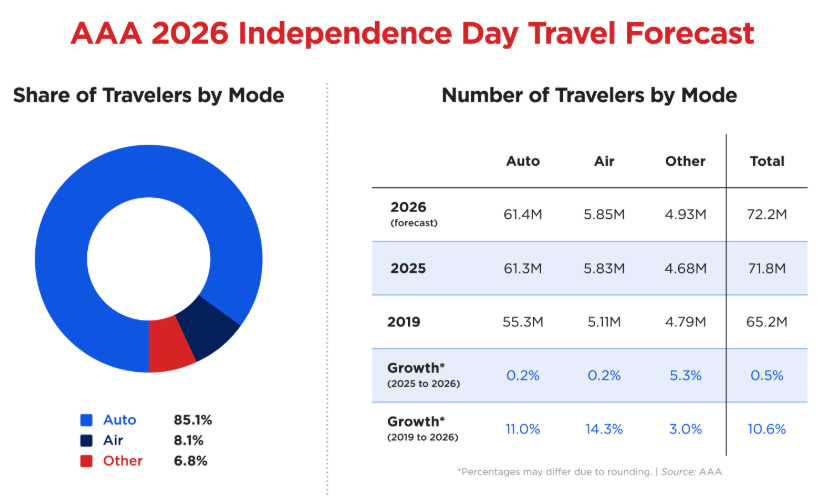
AAA projects 72.2 million Americans will travel at least 50 miles from home for Fourth of July between Saturday, June 27, and Sunday, July 5. While domestic travel this year is forecast to surpass last year’s record of 71.8 million travelers, the increase is smaller than recent year-over-year gains. The number of travelers driving and flying to their destinations is relatively flat compared to last year, while travel by other modes, including cruises, is the category seeing the biggest increase.

“While the overall number of Independence Day travelers appears to be plateauing, traveling during the week of July Fourth remains a tradition for many,” said Jillian Young, director of public relations for AAA Northeast. “Whether they’re vacationing for the full week or just getting away for the long weekend, we still expect to see high volumes of travelers taking advantage of the holiday.” 

Independence Day Travelers by Mode of Transportation

By Car

AAA projects 85% of travelers — 61.4 million people — will drive to their destinations, nearly the same number as last year, when 61.3 million travelers took road trips. While gas prices have fallen over the past few weeks, the average price remains higher than last year. Despite higher prices at the pump, filling up the tank during a road trip is still cheaper than purchasing flights for many travelers. 

For travelers renting cars, AAA car rental partner Hertz expects Thursday, July 2, to be the busiest pickup day. 

AAA urges drivers to prioritize safety during their holiday festivities:

  • Drive sober: Nearly one in three summertime traffic deaths involves an impaired driver, according to a AAA crash data analysis. AAA, in partnership with Mothers Against Drunk Driving (MADD), reminds anyone who plans to drink or use impairing substances to arrange a sober ride before going out.
  • Slow Down, Move Over: Drivers play a huge role in preventing tragedies by reducing speed and changing lanes whenever they approach a vehicle on the side of the road. 
  • Don’t skip car maintenance: Last year during Independence Day week, AAA responded to more than 687,000 roadside assistance calls. Half of those required towing services, and nearly 30% of those calls were for battery replacement and flat tires. Stay on top of routine oil changes, plus check battery condition and tire pressure before hitting the road.
By Air

AAA projects 5.85 million travelers will take domestic flights over July Fourth week, a 0.2% increase over last year. Air travelers make up 8% of the share of holiday travelers. 

By Other Modes

Travel by other modes is seeing the biggest year-over-year growth compared to car and air travel. AAA projects 4.93 million Americans will take buses, trains and cruises over Independence Day week, a 5.3% increase from last year. Travelers are drawn to cruise vacations because they know how much the trip will cost upfront thanks to all-inclusive dining, various entertainment options and multiple destinations in one package.

AAA’s Top Independence Day Destinations

AAA members are heading to major U.S. cities and flying internationally to Canada and Europe during the holiday period. July Fourth fireworks and festivities in New York and Boston draw big crowds, and peak Alaskan cruise season brings travelers to Seattle, Anchorage, Fairbanks and Vancouver.

RankingDomesticInternational
 Seattle, WA Vancouver, Canada 
Orlando, FL Rome, Italy 
Anchorage, AK Dublin, Ireland 
Miami, FL Paris, France 
New York City London, England 
Chicago, IL Calgary, Canada 
Fort Lauderdale, FL Reykjavik, Iceland 
Fairbanks, AK Amsterdam, the Netherlands 
Denver, CO Athens, Greece 
10 Boston, MA Barcelona, Spain 

Best and Worst Times to Drive

The weekend of July Fourth will be the busiest on the roads, starting Thursday, July 2, according to transportation data and insights provider INRIX. Drivers looking to avoid the heaviest traffic should leave early in the day or consider traveling on Monday or Tuesday.

Best and Worst Times to Travel by Car
DateWorst Travel TimeBest Travel Time
Saturday, June 27 12 to 5 p.m. Before 10 a.m. 
Sunday, June 28 2 to 4 p.m. Before 11 a.m. 
Monday, June 29 2 to 6 p.m. Before 12 p.m. 
Tuesday, June 30 3 to 6 p.m. Before 2 p.m. 
Wednesday, July 1 12 to 9 p.m. Before 12 p.m. 
Thursday, July 2 2 to 6 p.m. Before 12 p.m. 
Friday, July 3 12 to 7 p.m. Before 11 a.m. 
Saturday, July 4 10 a.m. to 2 p.m. After 3 p.m. 
Sunday, July 5 12 p.m. to 6 p.m. Before 11 a.m. 

Subscribe to Your AAA Newsletter

Sign up and receive updates for all of the latest articles on automotive, travel, money, lifestyle and so much more!

What To Do if Your Data Has Been Breached

These days, it seems like everyone has experienced at least one data breach. You get a letter, email or text informing you that hackers broke into the records of an institution you use and your personal information may be at risk. What exactly was exposed and how much is often unclear.

More than 22,000 confirmed data breaches were analyzed in the 2026 Verizon Data Breach Investigations Report, representing the largest volume of incidents examined in the report’s 19-year history.

As data breaches become more common, consumers should know how to protect their information and act quickly when a breach threatens their privacy.

What Is a Data Breach?

Cybercriminals are constantly evolving their tactics to swipe personal information, but data breaches are large-scale attacks that can compromise thousands — or even millions — of records at once, often by targeting big organizations like banks, health care institutions and major retailers. Hackers are becoming increasingly sophisticated, studying organizations’ data systems and cybersecurity programs to find ways to break in.

Information leaked in a data breach can include Social Security numbers, bank account and credit card numbers, passwords, birth dates, addresses and passport numbers, according to Experian. Cyber thieves use the information to set up accounts and run up bills in your name without your knowledge — or sell it to other people who will do the same.

The top methods used to commit data breaches include stealing login credentials, exploiting software vulnerabilities and phishing. Unsurprisingly, a growing prevalence of artificial intelligence-enabled cyberattacks is also raising new alarms across the cybersecurity landscape.

Be proactive and protect your tech. AAA members can get exclusive discounts on device security and online protection with Norton 360. Norton 360 offers members antivirus, malware, ransomware and hacking protection, plus a password manager, parental controls, VPN private internet connection and more. Get offer.

Get 50% off every year

Keep your devices secure all summer long.

Save now

What To Do if Your Data Has Been Breached

If you receive a data breach notice, follow these steps recommended by Experian.

  • First, don’t ignore data breach notifications. Follow up as soon as possible.
  • If the organization that had the breach offers you free fraud and identity theft monitoring services, take them.
  • Run a privacy scan and a dark web search to see if your information is on any illicit or hidden websites.
  • Monitor your bank accounts, credit cards and Social Security account for any fraudulent activity.
  • Check your credit reports with all three credit bureaus — Experian, TransUnion and Equifax — to ensure there is no activity you don’t recognize.
  • Place a fraud alert or a credit freeze on your credit report. A fraud alert requires creditors to confirm your identity before approving an application, while a credit freeze blocks new credit accounts from being opened in your name.
  • If no one has opened an account in your name or made unauthorized purchases, you don’t need to report credit or identity theft. If they have, contact the organizations involved, as well as the Federal Trade Commission, the FBI’s Internet Crime Complaint Center and local law enforcement agencies.

Listen to Our Podcast

Get tips to outsmart scammers and protect your personal data. Listen to Episode 12 of our podcast, Merging Into Life: Identity Theft.

Tune In

How to Prevent Data Breaches

While protecting your personal and work data from large-scale breaches at corporations is difficult, you can safeguard your information as best as possible with these tips.

  • At work, always follow the company’s security protocols and make sure all virus protection programs are current, use passwords that are not easy to guess and promptly report any missing hardware.
  • Follow the same steps with your personal information, including purging old information from devices and shredding paper documents with sensitive information.
  • Open an E-Verify account to confirm your legal authorization to work in the U.S. and lock your Social Security number to prevent others from using it to get a job.
  • Subscribe to comprehensive cybersecurity protection through a service like Norton 360.
  • Sign up for ProtectMyID from AAA and Experian. ProtectMyID actively monitors your credit and identity around the clock, alerting you right away if it detects any suspicious activity involving your personal information. All AAA membership levels include Essential monitoring for free!
Have you experienced a data breach? How were you able prevent or minimize damage?

Subscribe to Your AAA Newsletter

Sign up and receive updates for all of the latest articles on automotive, travel, money, lifestyle and so much more!

8 Must-Haves for a Game Day Watch Party

This summer, soccer fans will gather in front of TVs around the world to watch their favorite teams play for the big prize. While the players are putting their best foot forward on the field, put your best foot forward as the watch party GOAT (greatest of all time).

Here are eight must-haves to make your game day watch party as good as winning gold.

1. Plenty of seating

Rule No. 1 for hosting a game day watch party? Every seat should be a good seat. Arrange couches, tables and chairs so that no matter where someone decides to settle in, they have easy access to the food and can see the score without getting up.

Be creative with it, and don’t be afraid of mismatching the types of seating. This is less about aesthetics and more about comfort. If you’re running low on seating options, you could even ask your guests to BYOC (bring your own chair). This is especially good for outdoor watch parties where guests may opt to sit in their own beach or camping chairs.

2. Snacks

Sometimes the best part of game day is good snacks. Impress your guests with lots of mouthwatering bites, like:

A focaccia slab sandwich big enough to share:

Cast iron skillet pizza:
Sweet chili wings:

If you love Buffalo wings, we have an entire post dedicated to those!

French onion mac and cheese:
Handheld strawberry cheesecake bars for dessert:

You can also try mixing things up with bites from around the world to honor each country’s team. Think sushi for Japan, pretzel bites and beer cheese for Germany, tacos for Mexico and so on.

If you’re bringing a dish to a game day watch party, make it easy on yourself with something that’s portable and won’t be a chore to pack up at the end of the night. When it comes to easy transport, dip is always a winner.

Try this easy pickle dip that uses its own pickle jar as a container (complete with a secure, screw-top lid!):

3. A drink everyone will love

A good hosting tip for a game day party (or any party, for that matter) is to make sure your guests have a drink in hand within five minutes of their arrival. Not only does this ensure they won’t have to go looking for one on their own, but it helps people feel more comfortable, too.

Keep lots of options available, especially beverages that are non-alcoholic. Water, soda and a yummy mocktail are all good choices and ensure everyone can enjoy the fun.

This “kickless” mojito brings together the bright, summery flavors of mango, lemon, lime and mint for a booze-less take on the classic cocktail.

Watch how to make it:

For one mocktail, you’ll need:

  • Juice of 1 lemon
  • Juice of 1 lime (plus a slice for garnish)
  • Fresh mint
  • 1/2 cup fresh mango, or frozen and thawed
  • Seltzer or sparkling water
  • Simple syrup to taste

Blend the mango until smooth. Muddle a few mint leaves with the lemon and lime juice to infuse the flavor. To a glass filled with ice, add the lemon/lime/mint mixture, simple syrup if you’d like it sweetened and then the mango puree. Top with seltzer or sparkling water and garnish with fresh mint and a slice of lime.

4. A good playlist

Before the game’s on and your guests are milling about, have a playlist running in the background that’ll get people pumped up for the match. If you’re stumped, ask each guest for their five favorites beforehand and shuffle the songs. This is a good way to get everyone’s tastes in the mix and also makes for lots of laughs when you try to guess who picked which song.

5. Conversation starters

In a group setting, it’s typical for not everyone to know each other. Get the conversations going with un-boring questions to kick things off, like:

  • What’s a fun fact you recently learned?
  • Do you have a hot take?
  • What subject are you an expert on?
  • Do you have a hidden talent?
  • Who can make you laugh the hardest?
  • What’s the best meal you’ve ever had?

6. Something for the non-fans

It’s true; not everyone comes to a game day watch party to watch the game —  some of us are there as begrudging plus-ones. Make sure you’re involving any non-fans as best you can with something interactive like bingo. Fill up the squares with fun instances they can keep track of, like when the home team scores its first goal, when someone commits a party foul like spilling a drink or when the most passionate guest inevitably cries over their team’s win or loss. Their prize for getting “Bingo!”? A free pass to never have to attend a sports-related party again.

7. A parting gift

No matter what the score ends up being, a party favor will make everyone happy. Go heavy on the theme here, incorporating elements like chocolate soccer balls or cupcakes with soccer ball-shaped frosting, mini toy versions of favorite players or official host city posters.

8. A game plan

Nobody likes to think about the worst possible scenarios — especially not on game day — but it’s always a good idea to be prepared for potential liabilities when hosting an event. These are a few things to keep in mind:

  • Have a fire extinguisher on hand in case of cooking mishaps. Check beforehand to know whether yours is expired.
  • Make sure any shared space is easily accessible for all guests and any spills are cleared quickly to avoid tripping hazards.
  • If you are serving alcohol, assign a designated driver so those who overindulge have a safe ride home.
What are you watch party tips? Share them in the comments!

Subscribe to Your AAA Newsletter

Sign up and receive updates for all of the latest articles on automotive, travel, money, lifestyle and so much more!

How To Party Like It’s 1776

It’s a milestone year for the United States of America — 250 years of independence! Here’s what might have been on the table in the late 18th century, and how it can inspire your own Fourth of July spread.

While pigeon pie and potted meat aren’t exactly crowd-pleasers, incorporating a few ingredients or traditions from the Revolutionary era can add a historical twist to your barbecue and make it a truly American celebration.

Seasonal Menus

Meals in colonial America varied by location, the seasons and income.

“Foods were changing all through the year,” said Frank Clark, master of historic foodways at Colonial Williamsburg in Virginia, where, according to the living-history museum’s website, “he researches, prepares and demonstrates18th-century cooking styles.”

Save on Colonial Williamsburg tickets with AAA!

Although, there were certain foods over most hearth fires, at the time of the American Revolution, about 80% of Virginians ate stew and bread or rice, according to Clark.

The stew would be cooked in one cast iron pot, sometimes transforming into soup or porridge. Depending on the time of year, it could have included salt pork, dried peas, squash, cabbages, beets, potatoes and carrots.

Families in rural areas survived on what they grew and caught. The earliest settlers brought carrots to Virginia, and since they were tasty and easy to grow, they appeared in a lot of dishes. Corn became a staple after Native Americans taught colonists how to grow it. Some raised cows and pigs.

People fished and hunted local game, such as deer, rabbits, ducks, turkeys and passenger pigeons, which were served in a variety of ways, including baked in pies. The popularity of pigeons as entrees, unfortunately, contributed to their extinction by 1914. Not surprisingly, many recipes had British roots, but local influences were taking hold.

Johnnycakes, thin, cornbread pancakes, were popular, tasty and portable, often carried by soldiers and travelers. Another dish passed on from Native Americans, its name derives from colonists mishearing Shawnee as Johnny, some have speculated.

Molasses, which was imported, was a common ingredient in baking and rum making and less expensive than sugar.

Fancier Options

Upper class families hosted more lavish, varied meals.

“The more meat, the better,” Clark said. “Often there were three meats at each of the two main courses.”

Meat dishes could include chicken cooked in wine, meat pie, roasted beef, duck, ham and venison. Breakfast foods, such as eggs, were served as side dishes. What guests didn’t eat for dinner was served for breakfast.

Desserts tended to be light, such as jam and candied fruit. One favorite dessert was syllabub, made with wine, brandy, lemon juice, sugar and heavy cream.

Cheers!

Colonists did enjoy boozy beverages. (In all fairness, the water often was not safe to drink.) They believed alcohol could cure various ailments and even considered it healthy, according to Clark.

In the early days of the colonies, most families brewed their own beer. They also drank tea and rum. Wealthier families often drank a punch concocted of sugar, citrus juices and spirits.

A traditional beverage in colonial pubs was a Flip, a beer cocktail. After strong ale was mixed with spices and a raw egg, the bartender plunged a hot rod from the fire into the mug, which was a dramatic way to cook the egg, heat, froth and finish the drink. The mixture was then poured several times between two mugs to thicken and mixed with rum.

Whether testing historic recipes or sipping more modern cocktails, always drink responsibly and plan for a sober ride.

american flags

Establishing New Traditions

As the Revolutionary War progressed and victory by the Continental Army seemed more likely, Colonial cuisine underwent a revolution of its own. People began moving away from their British roots, embracing regional foods and incorporating Native American and African ingredients, such as black-eyed peas and squash.

“In the last days of the war, colonists stopped drinking rum and moved on to bourbon (which was made in Kentucky), ate chocolate, turned away from tea and began drinking coffee,” said Clark. “Cider took over from beer and corn took over from wheat.”

It also wasn’t long before corn and pork were firmly established as staples of the new country’s diet. Think about that when your enjoying your corn on the cob and pulled-pork sandwiches.

“Food is a quick and easy way of showing patriotism,” Clark said.

Are you inspired to party like its 1776 this Fourth of July? Tell us in the comments.

Subscribe to Your AAA Newsletter

Sign up and receive updates for all of the latest articles on automotive, travel, money, lifestyle and so much more!

Northeast Gas Prices Continue to Decline as U.S. and Iran Reach Tentative Peace Deal 

After peaking in mid-April, oil and gas prices have been on a steady decline for the past three weeks in anticipation of a ceasefire and the resumption of oil tanker traffic through the strait. The strait has been effectively closed since the start of the war in late February, resulting in massive disruption to global oil markets. After the peace deal was announced on Sunday, crude prices immediately fell nearly 4% in overnight trading to about $80 a barrel — a level last seen in early March, immediately after the war began. Domestically produced West Texas Intermediate (WTI) is now down about $30 a barrel from recent highs but still elevated compared with prewar levels: WTI sat at $66 a barrel on Feb. 27, one day before the war. 

Strong U.S. refinery activity and continued high export demand continue to pressure crude supplies, which fell by 15.2 million barrels last week to reach their lowest level since October 2023, according to the Energy Information Administration (EIA). Domestic refiners operated at 95.3% of capacity — the highest weekly utilization rate since early January. They produced 9.72 million barrels of gasoline a day, an increase of 296,000 barrels a day from the prior week. The uptick in production helped boost gasoline supplies for a second straight week. They climbed by 200,000 barrels to 215.1 million barrels, according to the EIA. The build-in inventories came even as demand rose by an average of 137,000 barrels a day to 8.73 million barrels a day, and exports rose by 208,000 barrels a day to 1.14 million barrels a day. 

“Drivers across the Northeast have seen slow and steady relief at the pump since mid-May and the potential for peace could bring even lower prices in the coming weeks,” said Jillian Young, director of public relations for AAA Northeast. “Markets will likely remain impacted for some time as supply routes gradually resume, facilities are repaired and global emergency reserves are refilled after being depleted during the war.” 

AAA’s June 15 survey of fuel prices found the national average down 10 cents from the previous week ($4.16), averaging $4.06 per gallon. The June 15 national average price was 46 cents lower than the previous month ($4.52) and 93 cents higher than last year ($3.13). 

Region Current Price* One Week Ago One Month Ago One Year Ago 
Connecticut $4.21 $4.37 $4.64 $3.09 
Massachusetts $4.17 $4.29 $4.48 $2.99 
New Jersey $4.10 $4.24 $4.51 $3.05 
New York $4.36 $4.44 $4.60 $3.11 
Rhode Island $4.05 $4.18 $4.48 $2.97 

*Prices as of June 15, 2026 

As of June 15, Indiana and Texas had the lowest prices in the nation at $3.34 and $3.50, respectively. California and Hawaii had the highest prices in the nation at $5.74 and $5.56, respectively.  

The AAA Gas Prices website is your resource for up-to-date fuel price information. Search for average gas prices on national, state and metro levels by regular, plus, premium and diesel.  

Subscribe to Your AAA Newsletter

Sign up and receive updates for all of the latest articles on automotive, travel, money, lifestyle and so much more!

Where To Stay on Game Day

If you’ve finally secured tickets to a sporting event you’ve been looking forward to, you want everything to go smoothly. Before the big event, you might check out the view from your seats online, plan transportation and strategize where to eat.

One way to make the experience even easier is to stay close to the stadium or arena. When you book a room with Choice Hotels for the night before the game, you can avoid a lot of traffic and expensive parking fees. You can also relax if the game goes long, or you feel like celebrating a victory.

Here are six Choice Hotels stays near major venues in the biggest sports destinations in the eastern United States. 

New York City

Whether you’ve got tickets for Yankee Stadium, Citi Field, Madison Square Garden or MetLife Stadium over the river, there’s a Choice Hotel for you.

Blue Angel Hotel NYC copy
Blue Angel Hotel NYC

Blue Angel Hotel NYC, an Ascend Collection Hotel

This boutique hotel offers a comfortable stay near some of New York City’s most storied attractions, including Central Park, the Metropolitan Museum of Art and Radio City Music Hall. Closest to the Garden, it also offers good access to all the major stadiums and is a short walk to Rockefeller Center and MoMA. This cozy hotel also features a modern design and contemporary amenities.

Cambria Hotel New York - Chelsea Rooftop copy
Cambria Hotel New York — Chelsea

Cambria Hotel New York — Chelsea

This 18-story gem of a property includes unforgettable rooftop lounge views of The Big Apple’s skyline. Just a short walk to Madison Square Garden, it’s also close to the Empire State Building and Chelsea Market. The hotel is less than an hour by public transportation to MetLife and the city’s baseball stadiums. Cambria Hotel New York – Chelsea features a full-service restaurant and fitness center, and you can book meeting space here, as well.

comfort inn bronx
Comfort Inn & Suites near Stadium

Comfort Inn & Suites near Stadium

If you stay at this Bronx hotel, you only have a half-hour walk or a short subway ride north to Yankee Stadium, and it’s about the same distance to Central Park. Your stay is also less than an hour by public transportation to the Garden. You can start your day off right at the hotel’s fitness center, followed by a complimentary buffet breakfast.

Boston

Whether you want to take public transportation to Fenway or TD Garden or make Boston your home base for a match or game at Gilette Stadium, Choice Hotels has you covered. Here are two great options for a stay.

Cambria Hotel Boston Somerville copy
Cambria Hotel Boston — Somerville

Cambria Hotel Boston — Somerville

Across the famed Charles River from Boston, this hotel is just a short walk away from the Green Line of the Boston subway system, which can connect you directly to Fenway Park and TD Garden. Somerville and neighboring Cambridge are famous for their squares, and this hotel is located near several, including storied Harvard Square. During your stay, get a taste of Greater Boston’s Italian culinary scene at Josephine’s, a restaurant at the hotel, and enjoy 24-hour access to the hotel’s fitness center.

Cambria in Boston, Downtown copy
Cambria Hotel Boston Downtown — Seaport

Cambria Hotel Boston Downtown — Seaport

With great access to Boston’s T subway system, you can be deposited steps away from Fenway Park or TD Garden, and it’s a short ride to see colonial history at historic Boston Common and Faneuil Hall. Kids might love to play at the nearby children’s museum or spill the tea at the floating Boston Tea Party attraction. The hotel also offers shuttle service to Boston’s cruise terminal and the metro area’s casino. With a 24-hour fitness center, complimentary breakfast buffet and terrace views, it’s a great place to stay in the heart of the city.

Philadelphia

Philadelphia packs in a lot of sports venues within its borders, with Lincoln Financial Field, Xfinity Mobile Arena, and Citizens Bank Park all located in the South Philadelphia Sports District in the southern part of the city near the Delaware River. For history buffs, the City of Brotherly Love is a great city to linger, as well. 

Cambria Hotel Philadelphia Downtown copy
Cambria Hotel Philadelphia Downtown City Center

Cambria Hotel Philadelphia Downtown — City Center

It’s a short and straight drive or bus ride from this hotel to the sports district, and you can even walk from your stay to see historic Independence Hall, too. Sitting on the Avenue of the Arts, this 223-room hotel has its own ballroom and two restaurants, the Treble & Bass Bar & Restaurant and the Attico Rooftop Bar & Restaurant.

You’ve Read About It — Now Experience It

AAA travel advisors will turn your inspiration into a memorable vacation, providing trusted guidance and exclusive member benefits. Connect with us to learn more.
Call 888-780-5185 |  Find a AAA Branch  |  Contact Online

Subscribe to Your AAA Newsletter

Sign up and receive updates for all of the latest articles on automotive, travel, money, lifestyle and so much more!

Where To Travel Next — and What Currency You’ll Need

Looking for travel inspiration? These are some of the most popular destinations right now, based on AAA Travel booking trends. Discover what makes each one worth the trip and find out which currency you’ll need before you go.

AAA recommends bringing the equivalent of $50–$100 US dollars in local currency per person, per day for small expenses such as taxi fares, snacks, souvenirs and purchases at businesses that may not accept credit cards.

To avoid long lines, added fees and less favorable exchange rates abroad, arrive prepared by getting your foreign currency ahead of your trip. Stop by at any AAA Northeast branch and place your order at least three days before departure. Happy travels!

japan

Japan

Local Currency: Yen

Experience centuries of traditions and the latest technology while touring Japan. Explore Kyoto, the country’s imperial capital for more than 1,000 years, where historic temples, shrines and gardens offer a glimpse into the country’s rich heritage.

Tokyo is a must-see. Stroll through the Ginza shopping district, visit the Meiji Shrine, browse stores showcasing the latest in anime and experience teamLab Planets, an immersive digital art museum. And no trip to Japan is complete without setting aside time to see iconic Mt. Fuji.

Looking for souvenirs? Popular keepsakes include name stamps or hanko, shaped postcards, miniature figurines, chopstick rests and omamori — a blessing inside an envelope found at shrines. Don’t forget to keep some change handy for Japan’s famous gacha machines, which deliver random prizes for a few coins.

switzerland

Switzerland

Local Currency: Swiss Franc

Switzerland’s stunning landscapes seem almost too beautiful to be real, from its crystal-clear lakes and snow-capped peaks to its rolling green meadows. Much of Switzerland’s appeal lies outdoors, whether you’re hiking scenic trails or visiting its many lakes and waterfalls. It’s charming towns are just as captivating.

Visit Lucerne for waterfront streets, quaint shops and cafes, or take a gondola to Aletsch Glacier, the largest glacier in the Alps. You can also tour a castle, visit a watchmaker’s studio or explore the Open Art Museum, one of many.

If you’re looking to bring a piece of Switzerland home with you, Swiss chocolate tops most travelers’ lists. Watches and Swiss Army knives are also common choices.

peru

Peru

Local Currency: Sol

In Peru, Machu Picchu — the world’s most famous Incan monument — is a top attraction.

Another must-see destination is Arequipa, known as the White City for its buildings made of pale volcanic stone. Surrounded by three volcanoes, it is also home to one of Peru’s most beautiful town squares. In Lima, the nation’s capital, visitors can explore world-class museums and enjoy a renowned culinary scene.

Tourists like to shop for hats, scarves, sweaters and blankets made from alpaca wool, as well as vibrant handwoven placemats and wall hangings. Handwoven finger puppets and brightly colored ceramic bulls also are also often purchased as souvenirs, reflecting Peru’s rich artistic heritage.

south africa

South Africa

Local Currency: Rand

Wind through the jungle to spot the amazing native wildlife on safari in South Africa. Johannesburg, the country’s largest city, houses numerous museums as well as game farms and nature reserves.

Continue on to the Cape Peninsula, where you can visit Boulders Beach Penguin Colony to see thousands of African penguins, and explore the dramatic scenery of the Cape of Good Hope.

When shopping, look for locally made stone carvings, hand-painted ostrich eggs, carved wooden masks, beaded jewelry, and woven bowls and bags.

Croatia

Local Currency: Euro

A remarkable blend of exquisite scenery and centuries of history, Croatia has something for everyone. Many visitors enjoy the country’s beautiful beaches and eight national parks, some with multiple waterfalls.

“Game of Thrones” fans often head to the walled city of Dubrovnik, which served as a filming location for King’s Landing. In the capital city of Zagreb, travelers will find ancient ruins, museums and lively outdoor cafes.

When it’s time to hit the stores, look for lavender products. Croatia has grown lavender for centuries. Its olive oil is also considered among the best in the world. Other popular items include statues, bowls and jewelry made with white stone from the island of Brač.

Learn more about AAA foreign currency exchange.

You’ve Read About It — Now Experience It

AAA travel advisors will turn your inspiration into a memorable vacation, providing trusted guidance and exclusive member benefits. Connect with us to learn more.
Call 888-780-5185 |  Find a AAA Branch  |  Contact Online

Subscribe to Your AAA Newsletter

Sign up and receive updates for all of the latest articles on automotive, travel, money, lifestyle and so much more!

Merging Into Life: Identifying Burnout and How To Know if It’s Time for a Career Change

SEASON 3: EPISODE 1
Episode Feedback

Unpack the realities of job pivots, burnout and why today’s careers look more like mosaics than ladders.


EPISODE SUMMARY

Thinking about a career change can feel equal parts exciting and terrifying, but what if the hardest part is just giving yourself permission to do it?

In this episode of Merging Into Life, host Sabrina Pierotti opens up about her own journey leaving the fashion industry. She is joined by career coach and returning guest Sam DeMase. Together, they break down the myths that keep people stuck and discuss how to figure out if it’s time for a career change and how to pivot thoughtfully without feeling like you’re starting over.

From how to identify the real signs of burnout at work to escaping toxic culture and making low-risk career moves in a tough job market, this episode serves as your actionable checklist for knowing when to quit your job and making your next big move.


KEY TAKEAWAYS
  • Career changes are more common than you think. Traditional career ladders have given way to mosaic careers, where freelancing, job-hopping and portfolio-building are the new normal. Recognizing the signs of job burnout and choosing to pivot isn’t a failure; it’s a strategy.
  • Chronic workplace stress, value mismatches and unused skills are the biggest drivers behind career pivots. If you’ve been losing interest in your hobbies or feeling disconnected from your life for months on end, you are likely dealing with deep physical vs. emotional job exhaustion, which is a clear sign that it’s time for a change.
  • Making a career change at ages 30, 40 or beyond isn’t too late; it might actually be your advantage! Studies show an 82% success rate for midlife career shifters over 45, with higher job satisfaction and wage increases. Think of it as an encore career, not a second chance.
  • The easiest pivot is an “A to C” move, not “A to Z”. Rather than overhauling your entire professional identity, look for a parallel pivot that lets you lean into existing skills in a new context. You’re more qualified than you think; it’s just about how you tell your story.
  • In a tough job market, the specialist beats the generalist every time. Narrow your job search, niche down your resume, and apply only to roles that match your specific skill sets. A targeted approach gets more interviews than a scattered one, and anyone can learn to specialize.

TRANSCRIPT

[00:00:02] Sam DeMase: A lot of us have identities tied to our jobs, and that is a really difficult to lose. It feels very stressful. It feels like a loss of self. It’s very ingrained in our culture, unfortunately, for work to equal life. So, since many of us are still actively deconstructing that, this idea of a career change means changing everything, changing your entire identity, your entire life.

[00:00:25] Sabrina Pierotti: If you would have told me 10 years ago that I’d leave my career in fashion, become a voice actor, I’d have not believed you for a second. But the reality is I no longer glorified grinding it out, and I started to prioritize my mental health over everything else. I was having panic attacks, I was crying almost every day and woke up with a sense of dread and just no longer excited for my life. I felt deep in my bones that I would be living an unfulfilled life if I didn’t make that change. Hey, everyone, welcome back to the new season of Merging Into Life. I’m your host, Sabrina Pierotti. You know, when people talk about career changes, the advice can sound pretty simple: Update your resume, network more, take the leap. But for most people, it’s not that straightforward. There’s the anxiety of leaving something familiar, the pressure to make the right move and the very real question of how do I even do this? Well, today we’re talking about what career change actually looks like now. The myths that keep people stuck, the signs that maybe it’s time to move on and how to pivot thoughtfully without feeling like you’re starting from scratch. Our guest is career coach, Sam DeMase, who you probably remember from Season 2 where she shared her advice on building career confidence. I am so excited to have her on the show again. So, let’s dive in.

[00:01:55] Sabrina Pierotti: Hi, Sam, welcome back. We are so excited to have you. Your episode from Season 2 was such a hit, so thank you for agreeing to hop back on with me today.

[00:02:05] Sam DeMase: Thank you so much, Sabrina, for having me, I’m excited.

[00:02:07] Sabrina Pierotti: I’m really curious to get your opinion on something that we all inevitably go through at some point in our life, which is a career transition. So, before we dive in to all the nitty-gritty and the how-to, Sam, what is one main message you want our friend listening, who is currently in a transition, to take away from our conversation today?


RESOURCES

Merging Into Life

Join AAA

A Power Mood (Sam DeMase)

Merging Into Life S2E10: Building Career Confidence

What Causes Burnout and How to Prevent It

7 Side Hustles to Put Extra Money in Your Savings


You can be featured on our podcast!

Have a question for our experts? Leave us a voice message. Whether it’s about money, insurance, wellness or everyday life, ask away — and keep listening. Your call could be featured on Merging Into Life.

*The views and opinions expressed in this podcast are not necessarily the views of AAA Northeast, AAA and/or its affiliates.

Subscribe to Your AAA Newsletter

Sign up and receive updates for all of the latest articles on automotive, travel, money, lifestyle and so much more!