


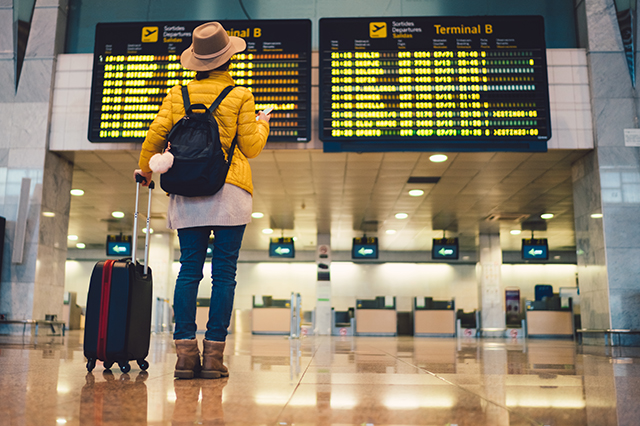
Today, an average traveler may never need to know an airport code. Your airline, destination and departure time are often all you need to find your gate and flight status. Although, it’s best to know your flight number too.
You may be at least subliminally aware of the three letters that accompany your flight information on your tickets, boarding passes, luggage tags and the airport’s arrival-departure board.
If you’re headed to Boston, it’s no big deal. The code BOS is straightforward. But if you’re going to Chicago, you may need to know whether you’re landing at Midway (MDW) or O’Hare (ORD). If it’s the latter, you might also find yourself wondering: Why ORD?
It’s a question many of us have pondered at some point. Thankfully, we’ve never mistaken the Windy City in March for sunny Orlando, Florida, airport code MCO. Or have we? The codes for O’Hare and Orlando are perhaps the most puzzlingly familiar. But with hundreds of airports across the U.S., each with its own unique code, they’re not alone.

Top Travel Destinations
Explore the most popular getaways booked by AAA Northeast members, from the historic landmarks of Europe to the sunny shores of the Caribbean.
Read nowThe Origin of Airport Codes
The codes air passengers most often see are from the International Air Transport Association (IATA), which established the three-letter system for commercial airlines starting in the 1960s. Airports may be assigned different codes by the Federal Aviation Administration (FAA) and the International Civil Aviation Organization (ICAO). Airports can request specific codes, but they’re not always granted.
There’s no decoder ring, all we can do is follow a few rules and some clues.
Formerly Known As
Some airports that predate the IATA codes had well-established two-letter codes that were incorporated into their three-letter identifiers. Or an IATA code may correspond to an airport’s previous name. IATA codes are permanent. Just imagine how disruptive changing airport codes could be. Here are some examples.
- BNA: Tennessee’s Nashville International Airport was once Berry Field.
- MCO: Florida’s Orlando International Airport was formerly McCoy Airforce Base. ORL belongs to Orlando Executive Airport.
- MSY: It may seem a mystery, but the code for Louisiana’s Louis Armstrong New Orleans International Airport is short for Moisant Stock Yards, where it was built.
- ORD: Chicago’s O’Hare International Airport was Orchard Field Airport until 1949, when it was renamed to honor a World War II pilot.
- SDF: Kentucky’s Louisville Muhammad Ali International Airport was once Standiford Field, named for the owner of the land where it was built. It was Louisville International Airport from 1995 to 2019, when it was renamed to honor local son and boxing legend Muhammad Ali.
No N’s Allowed
The U.S. Navy reserves codes beginning with the letter N. K and W are also reserved for U.S. radio call letters. That’s why these airports have peculiar codes.
- EWR: Newark Liberty International Airport, New Jersey.
- EYW: Key West International Airport, Florida
- HVN: Tweed New Haven Airport, Connecticut.
- ICT: Wichita Dwight D. Eisenhower National Airport, Kansas
- ORF: Norfolk International Airport, Virginia.
- OME: Nome Airport, Alaska.
Ends With an X
An X at the end of an IATA airport code could be an extension of an existing two-letter code, as in:
- LAX: Los Angeles International Airport, California.
- PHX: Phoenix Sky Harbor International Airport, Arizona.
- PDX: Portland International Airport, Oregon, not to be confused with Portland International Jetport in Maine (PWM).
But sometimes an X has greater meaning.
- JAX: Unlike other X-ending airports, Florida’s Jacksonville International Airport code reflects the city’s nickname for itself. Jacksonville, North Carolina’s Albert J. Ellis Airport is OAJ. JAC belongs to Jackson Hole Airport in Wyoming.
- SUX: The code for Iowa’s Sioux Gateway Airport may have an unfortunate pronunciation, but the letters do reflect its name. Sioux Falls Regional Airport in South Dakota may have given it a little more thought when it requested FSD, which stands for Falls, Sioux, Dakota.
All-American
- USA: It’s hard to believe that the country’s most patriotic IATA airport code didn’t come into being until 2013. And it was bestowed on North Carolina’s Concord–Padgett Regional Airport, which has only two airlines with limited flights to Florida and the Northeast. This is also an example of an airport’s IATA code not matching its ICAO code (KJQF) or its FAA code (JQF).
Top 20
Now that we know a little about airport codes, let’s make a list of those you’re most likely to see. In 2024, these were the 20 busiest airports by passengers, according to the FAA.
- ATL: Hartsfield–Jackson Atlanta International Airport, Georgia.
- DFW: Dallas Fort Worth International Airport, Texas.
- DEN: Denver International Airport, Colorado.
- ORD: O’Hare International Airport, Illinois.
- LAX: Los Angeles International Airport, California.
- JFK: John F. Kennedy International Airport, New York.
- CLT: Charlotte Douglas International Airport, North Carolina.
- LAS: Harry Reid International Airport, Nevada.
- MCO: Orlando International Airport, Florida.
- MIA: Miami International Airport, Florida.
- PHX: Phoenix Sky Harbor International Airport, Arizona.
- SEA: Seattle–Tacoma International Airport, Washington.
- SFO: San Francisco International Airport, California.
- EWR: Newark Liberty International Airport, New Jersey.
- IAH: George Bush Intercontinental Airport, Texas.
- BOS: Boston Logan International Airport, Massachusetts.
- MSP: Minneapolis–Saint Paul International Airport, Minnesota.
- FLL: Fort Lauderdale–Hollywood International Airport, Florida.
- LGA: LaGuardia Airport, New York.
- DTW: Detroit Metropolitan Wayne County Airport, Michigan.
Are you ready to put your newfound knowledge to the test? Try our Decipher the Airport Code word search.
What’s your local airport code, and does it have special meaning? Tell us in the comments.

Aimée Carrier is a copy editor for Your AAA and an occasional writer covering various topics. She most enjoys doing people profiles, human-interest pieces and stories about her fly-and-drive adventures around the U.S. with her husband. They live in Rhode Island and enjoy its subtle beauty and proud heritage.

Related Articles


Trending Articles


NEWEST ARTICLES



4 Thoughts on “A Key to Deciphering Airport Codes”
Leave A Comment
Comments are subject to moderation and may or may not be published at the editor’s discretion. Only comments that are relevant to the article and add value to the Your AAA community will be considered. Comments may be edited for clarity and length.

At one point the story indicates codes are forever. They don’t change if the name of the airport is changed. Yet JFK is the code for Kennedy airport which was re-named in 1963 for our late President.
I had the same question. It was called Idlewild Airport. Not seeing any of its name in the letters “JFK.”
I was pondering the same thing. I suspect it did not have an airport code during the time it was called Idlewild, since naming only began in the 1960s. Perhaps the authors can shed some light on this.
Hi Gerard. Great observation! JFK was indeed one of the rare instances when an airport code was changed. It wasn’t easy, and it would be near impossible today.