The holiday season is a time for celebration and good tidings, but it can also present a specific set of worries if you have a pet. From tempting but dangerous foods to harmful decorations, there are lots of unsuspecting risks that could put your beloved furry friend in danger.
Whether you’re staying home for the holidays or bringing your pet along to a gathering, stay cognizant of these potential hazards to keep your pet safe this holiday season.
Decorations
Decorations can be mesmerizing to pets, and that’s part of the problem. Because it stays packed away for most of the year, pets are curious and more likely to tamper with holiday decor. Christmas trees, for example, are notorious for attracting curious kitties. In this instance, find a way to secure your tree to prevent it from toppling over and potentially harming your pet as a result. Avoid using breakable ornaments at the bottom of the tree and opt for shatterproof decorations.
Tinsel and ribbon are also irresistible for pets, but if ingested can cause serious intestinal blockages that may require surgery. Keep these types of decorations out of reach or avoid using them altogether. When wrapping presents, designate a wrapping room or area that’s inaccessible to your pets where ribbon and the like are safely stored away.
If using string lights indoors, make sure to tape down or cover cords to discourage any chewing, which could result in electrical burns or shock. Speaking of mood lighting – while balsam and cinnamon scented candles are a staple for the season, always place them in areas of your home that are out of reach from your pets to avoid a potentially dangerous fire hazard.
Holiday Plants
Many traditional holiday plants, while lovely to look at, are toxic to pets.
Poinsettias, although less dangerous than commonly thought, can still cause irritation to the mouth and stomach if chewed. Mistletoe and holly are more harmful, leading to serious gastrointestinal upset or even cardiovascular issues. Lilies are particularly lethal to cats, even in small quantities.
If you have pets in your home, consider using artificial plants made from silk or plastic to decorate, or make sure any real plants are kept far out of reach from any curious paws.
At The Dinner Table
One of the most common holiday temptations for pets comes from the kitchen. Rich, fatty foods like turkey skin and gravy can lead to pancreatitis, a painful and potentially life-threatening condition. In addition, bones from holiday meals – no matter how big – can splinter and cause choking or internal punctuation, which could lead to bleeding.
Many pet owners are aware that chocolate is dangerous to consume, but what about raisins? How about xylitol? All of these ingredients commonly found in holiday sweet treats are extremely toxic and can cause liver failure, even in small amounts. To avoid any mishaps, make sure to inform your guests about the importance of not feeding table scraps to your pets, and keep snacks and sweets away from table edges where they could be stealthily snatched.
Travel Safety
For some, the holidays are synonymous with travelling, and if you’re taking your pet with you on the road there are some safety measures to keep top of mind.
When driving, put your pet in a secure crate or use a pet seatbelt. Never let your pet roam freely in the car, as sudden stops can lead to serious injury. Before you leave, double check that your pet’s pet ID and microchip are up to date with your correct contact information.
If you’re flying for the holidays, check with your airline for their pet travel policies and consult with your vet about how to make the trip as stress-free as possible.
No matter how diligent you are when it comes to your pet’s safety, accidents can still happen. In these unpredictable moments, a pet insurance policy through AAA can provide the ultimate peace of mind. With pet insurance, you’ll have coverage for unexpected vet visits and emergencies, ensuring that your pet gets the care they need without causing financial strain.
Before we dive into Hot Wheels history and the backstory of these beloved toy cars, let us set the scene:
Prior to the 1968 New York Toy Fair, the Mattel company invited a Kmart executive to its Los Angeles headquarters for a preview of its newest product. The toy maker was hoping to get a head start on its goal of securing 5 million orders from retailers. After watching a 1/64-scale muscle car replica shoot down a track and across the floor, the executive ordered 50 million cars on the spot.
By perfectly merging technical excellence and cultural significance, these toys became an immediate hit. And though Hot Wheels history began more than a half-century ago, those attributes have made the miniature toys as popular today as they have ever been.
“The car has always been more than just a mode of transportation,” says Bruce Pascal, owner of the world’s largest Hot Wheels collection. “It’s a thing of beauty. It’s a thing of awe. The automobile is something that’s so relevant and many times it’s one of the first things children do – learn the names of the car and identify cars as they drive by. And many times, they get that education through Hot Wheels.”
Hot Wheels History Begins
Toy cars were anything but a novel idea in the 1960s. Tens of millions, including Matchbox, Husky and Budgie models, were already being produced each year. The market was so saturated, in fact, that when Mattel co-founder Elliot Handler suggested the toy maker manufacture its own line of cars, he was met with healthy doses of apprehension and opposition from his colleagues. Even his wife and Mattel’s second-in-command, Ruth, had her doubts.
But Handler saw something the others didn’t. Or, more precisely, he saw what wasn’t there. Toy cars of the day were more miniature automobile replicas appealing to collectors than exciting toys for kids to play with and enjoy. Elliott knew there wasn’t room for another toy car similar to those already on the shelves – so he set out to create a better one. His dream was to manufacture a radical, yet realistic-looking toy car that could move on its own.
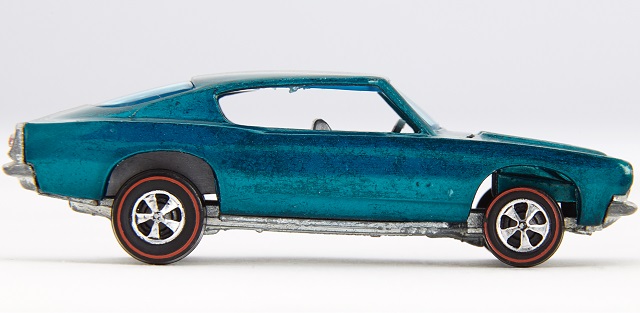
1967 Custom Barracuda Hot Wheel
A Car That Shines …
Knowing the success of these new cars depended on their design and functionality, Elliot recruited talent from outside the toy world to help in development. This included Harry Bentley Bradley, a car designer from General Motors, and Jack Ryan, a Yale-educated missile systems engineer. They became two members of Mattel’s uniquely diverse employee pool. The company was known for hiring the best and brightest, regardless of sex, race, religion or background. In this sense, it was an outlier in the mid-1900s. But a diverse workforce brought new ideas and fresh perspectives, which is precisely what would be needed if the toy maker wanted to create a product the world had never seen.
Elliot encouraged his employees to take their own approach to solving problems. This philosophy gave the Hot Wheels team the creative freedom to take inspiration from popular culture. Fast, funs cars were all the rage in the 1960s. The Ford Mustang and Chevy Camaro were born. Steve McQueen was racing through the streets of San Francisco in “Bullitt.” The Beach Boys were owning the airwaves with odes to their coupes, T-birds and 409 engines. Amid this cultural backdrop, designers homed in on the evolving Southern California hot rod world. Not only did these race cars have the eye-catching aesthetic Mattel was looking for, they were custom-built for the same thing the toy maker aspired for its cars: speed.
… And Moves
To outpace past the competition, Mattel wanted its cars to not only be able to move on their own, but move with speed.
Engineers went to work building a miniature car that could accelerate like a life-sized one. This was accomplished with a series of design tweaks, including wide tires, mag racing wheels and a torsion-bar suspension that provided shock absorbency and wheel bounce. Designers also developed a low-friction wheel/axle assembly, which required a bit of ingenuity. In order to get the wheels to spin freely, the axle was made from a mandolin string, which had a small rolling surface to create less friction against the wheel. It was coupled with bushings constructed from Delrin, a low-friction plastic material developed by DuPont just a few years prior.
The end result was a toy car that could reach a scale of 200 mph. When Elliot first saw a demo of one of these cars zooming across the floor, he had a simple yet ultimately enduring response: “Those are some hot wheels!” The name stuck.
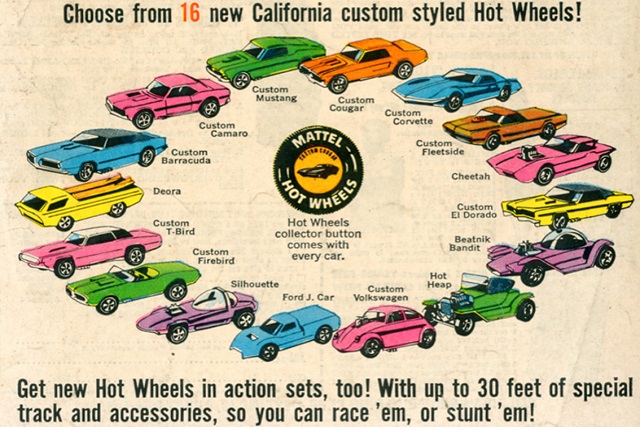
The original Sweet 16 Hot Wheels
Hot Wheels Make Their Debut
The Hot Wheels Custom Camaro hit shelves in May of 1968. It was quickly followed by 15 other models: Beatnik Bandit, Custom Barracuda, Custom Corvette, Custom Cougar, Custom Eldorado, Custom Firebird, Custom Fleetside, Custom Mustang, Custom T-Bird, Custom Volkswagen, Deora, Ford J-Car, Hot Heap, Python and the Silhouette. These first edition cars became known as the “Sweet 16.” They consisted of revamped versions of the day’s notable muscle cars, as well as custom designs inspired by real-life hot rods. Each was adorned with Mattel’s Spectraflame metallic paint and red-lined wheels, the latter of which would become a trademark feature.
Flexible, plastic racing tracks complete with the now iconic loop were sold alongside Hot Wheels cars. Together they made for a toy that, just as Elliot predicted, became overwhelmingly popular. More than 16 million were purchased in the first year. Sales only increased as the calendars turned. Mattel manufactured its 1 billionth Hot Wheels in 1991. Today, it reigns as one of the best-selling toys of all-time and is as popular as ever.
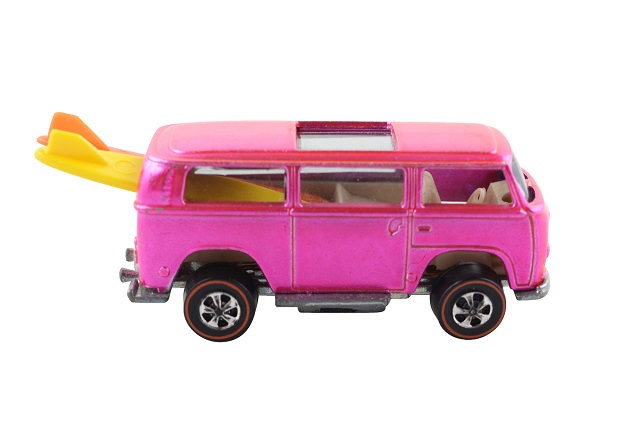
The rear-loading Pink Beach Bomb
Are Hot Wheels Worth Collecting?
You betcha. It’s not uncommon for individual Hot Wheels to fetch hundreds and even thousands of dollars. And there’s a vast market of collectors vying for the opportunity to get their hands on these valuable miniature cars. The most prominent — and expensive — known collection belongs to Pascal. All total, his 5,000 cars and 3,000 pieces of Hot Wheels memorabilia are valued at approximately $2 million.
The crown jewel of Pascal’s collection, and the most expensive model in Hot Wheels history, is the rear-loading Pink Beach Bomb. The value of this Volkswagen-inspired bus with two surfboards sticking out the back stems from its scarcity. In development, Mattel discovered that placing the surfboards in the back threw off the car’s balance and prevented it from properly functioning on the Hot Wheels track. The toy manufacturer went back to the drawing board, redesigning the van with surfboards on the side. As a result, only two rear-loading versions were ever produced. Pascal’s, which is said to be in the best condition, is valued in the neighborhood of $175,000 today. For context, that same sum could fetch you five Volkswagen Jetta’s, with money left over.
With billions of Hot Wheels roaming the Earth, discerning which miniature cars are valuable can be difficult without any Hot Wheels history insight. “If you don’t know anything about baseball cards and I put a Mickey Mantle card in front of you, how are you going to know it’s valuable?” Pascal says.
With that in mind, the renowned collector does offer up some guidance. “In the same way diamonds have the three C’s — cut, clarity, and carat –—[Hot Wheels] have condition, casting and year,” he says. “If the condition is mint, and it’s the right year and the right model and the right color and the right interior, then you have a bingo.” In regards to year, generally the older the better. Of particular value are “Redline” Hot Wheels. These cars were manufactured during the first decade of production, when nearly all Hot Wheels cars featured a red stripe on the tires, similar to those found on muscle cars of the day.
Even something as objective as age, however, can be hard to discern, Pascal warns. The year printed on the bottom of each Hot Wheel isn’t always indicative of when the car was manufactured. That number corresponds to the year Mattel first made that casting. But the toy maker famously reuses the same castings for many years.
If you have a potentially valuable Hot Wheels, you’re best bet is utilize what Pascal says is the best free guide available: eBay. To get an idea of how much your model may be worth, put on your detective hat to match the wheels, patterns, color and other features to those up for sale.
There’s also money to be had in Hot Wheels found on the toy shelves today. Such models fall into two categories. First are known as treasure hunts or super treasure hunts. These are limited-quantity cars randomly inserted into distribution boxes that catch fetch a quick profit. Costing just a few dollars, they typically can be resold for at least $20. Treasure Hunt Hot Wheels are distinguished by a circle flame logo located somewhere on the car. Super Treasure Hunt cars have a “TH” logo.
The second, and harder to find variety, are error cars. Like any other manufacturer, Mattel makes mistakes. Snag a Hot Wheels in the wrong direction, in the wrong package, missing paint, etc. and you’ve got a worthwhile commodity. Those errors can add up to hundreds of dollars of value.
Whatever you’re plan of attack — happy collecting!
Has Hot Wheels history got you hooked? Visit our Auto History page for backstories on everything from glove compartments to ice cream trucks.
This article has been updated and republished from a previous version.
When it comes to Texas fun, Grapevine and Frisco deliver. Grab a rental car and hit the road for nonstop entertainment in these lively Lone Star cities.
Live It up on Main Street
Just 15 minutes from Dallas Fort Worth International Airport, Grapevine offers big-city fun in a small-town atmosphere. As you stroll down Main Street, you can pop into locally owned shops for souvenirs, apparel and more. One stop you don’t want to miss is Dr. Sue’s Chocolate. Featuring gourmet dark chocolates in flavors like blueberry ancho chile and ginger fig, each treat is crafted with health in mind by its namesake, a practicing physician.
For panoramic views of Grapevine and the surrounding area, take an elevator ride to the observation tower at Grapevine Main Station, a rail station that includes a European-style food hall, an entertainment and event venue, an outdoor plaza and a hotel. While you’re at the rail station, don’t skip out on a ride on the Grapevine Vintage Railroad. You’ll find a variety of excursions that include a trip to the historic stockyards in Fort Worth, a short-line excursion and even seasonal trains like the Christmas wine train and Santa’s North Pole Express.
Near the train station, Vetro Glassblowing Studio & Fine Art Gallery provides an opportunity to watch artisans at work as they turn glass shards into unique souvenirs. You can create your own through the studio’s Community Help Create events. Check the website to see what events are taking place during your visit, and you could return home with a new tumbler, bowl or seasonal souvenir.
As you might expect from such a bustling city, Grapevine boasts an impressive culinary scene. Grab breakfast at Main Street Bistro & Bakery and lunch at Mister 01 Extraordinary Pizza (get the star pizzas for an extra burst of ricotta!). For dinner, try Teatro Bistro from acclaimed chef Carla Pellegrino. Her menu includes many Italian standards such as penne vodka and rigatoni Bolognese, as well as such entrees as lamb lollipops and New York strip.
When you’re ready, head about 35 minutes northeast to Frisco. A great starting point is The Star in Frisco, home of the Dallas Cowboys. You don’t have to be a Cowboys or football fan to enjoy a guided tour behind the scenes of the Cowboys’ world headquarters and practice facility. Afterward, you can grab Cowboy swag at the pro shop and snap photos on the Tostitos Championship Plaza.
The Star is also home to a variety of restaurants, ranging from casual to elegant. At Sidecar Social, try your hand at pingpong and darts in between bites of birria tacos and barbecue chicken flatbreads
For a different kind of football, the National Soccer Hall of Fame showcases the history of soccer through informative exhibits and artifacts such as iconic jerseys, soccer balls, trophies and more. Using interactive displays, you can show off your skills by trying to shoot the ball, test your trivia knowledge of the sport, build your own national team and even design your own uniform.
Golf lovers can have their moment at PGA Frisco. The facility features two championship courses. If you’re still learning or want help improving your swing, book some time at the PGA of America Coaching Center, which utilizes cutting-edge technology to make the most of your instruction. For family or casual fun, check out The Swing, a 10-hole, par-3 course, or The Dance Floor, a 2-acre putting course, where you can enjoy as little or as much golf as you like.
If your gaming skills lean toward the technical, check out the National Videogame Museum. Not only can you see the evolution of the gaming system and games, but you also can play some of your favorites in the interactive exhibits and the accompanying arcade.
Like Grapevine, Frisco has a thriving culinary scene for all taste buds. The menu at The Glen is filled with seafood, steaks, pasta and more. And barbecue diehards can’t miss Hutchins Barbecue, where you can fill your plate with chopped brisket, house-made sausages, pork ribs and pulled pork. Located in a historic home, The Heritage Table offers country-fried chicken and spaetzle, prairie farmstead pork pie and Texas striped bass, each crafted using locally sourced ingredients.
You can find all this and much more in these Texas cities. Plan a few extra days so you’ll have time to take everything in.
Whether you’re hosting holiday celebrations this year or have been tasked with bringing a beverage to the gathering, you’ve got plenty of options. From soda to eggnog, the drink selection should be as varied as the guests themselves, and since everyone’s got different tastes, it’s good to switch it up.
Choosing to make a mocktail adds some sugar and spice to the usual drink options — plus, they’re fun for kids, designated drivers and anyone who prefers not to drink alcohol.
Try your hand at shaking things up with these crafty mocktails this holiday season.
Blood Orange Cranberry Fizz
Makes two servings.
1 blood orange, for slicing
1/2 cup blood orange juice
1/3 cup sugar
3-4 sprigs of fresh thyme
1 can ginger beer
1/2 cup cranberry juice
6 fresh cranberries, for garnish
Add the blood orange juice and sugar to a small saucepan and bring to a simmer. Add the fresh thyme and stir for 2 minutes or until it slightly thickens, and all sugar is dissolved. Remove from heat and let cool.
In a glass with ice, add the syrup, cranberry juice and ginger beer. Top with a blood orange slice and fresh cranberries.
First, make the cinnamon vanilla maple syrup by combining all ingredients in a measuring cup and whisking until combined. Next, add all mocktail ingredients together in a cocktail shaker with ice. Pour in the cinnamon vanilla maple syrup mixture. Cover and shake until cold and combined, then distribute among six cocktail glasses of your choice.
Spiced Pear Sour
Makes one serving.
2 ounces nonalcoholic whiskey
2 ounces pear juice
3/4 ounces lime juice
2 teaspoons maple syrup
Orange bitters (to taste)
Cinnamon stick, for garnish
Add all ingredients to a cocktail shaker full of ice and shake. Pour into the glass of your choice and add the cinnamon stick garnish.
Start by rolling the rim of two cocktail glasses in frosting, then dip the rim into the edible glitter and sprinkles. If you’d like, add some glitter to the bottom of the glass as well. Set aside.
Combine coconut milk, blue curacao syrup, pineapple juice and cream of coconut inside a cocktail shaker filled with ice. Shake vigorously for about 5 seconds, then pour into your prepared glasses.
Sugarpomme Twist
Makes three to four servings.
1 cup water
1 cup lemon juice
3/4 cup elderflower tonic
2 cups pomegranate juice
1 1/2 cups tonic water (chilled)
1 1/2 cups club soda (chilled)
Pomegranate seeds, to garnish
Pour all ingredients, except for the tonic water and club soda, into a pitcher and stir. When ready to serve, add the chilled tonic water and club soda to the mixture so that it is perfectly bubbly and cold.
December is National Impaired Driving Prevention Month, an initiative led by MADD. If you choose to drink this holiday season, or any time, do not drive intoxicated.
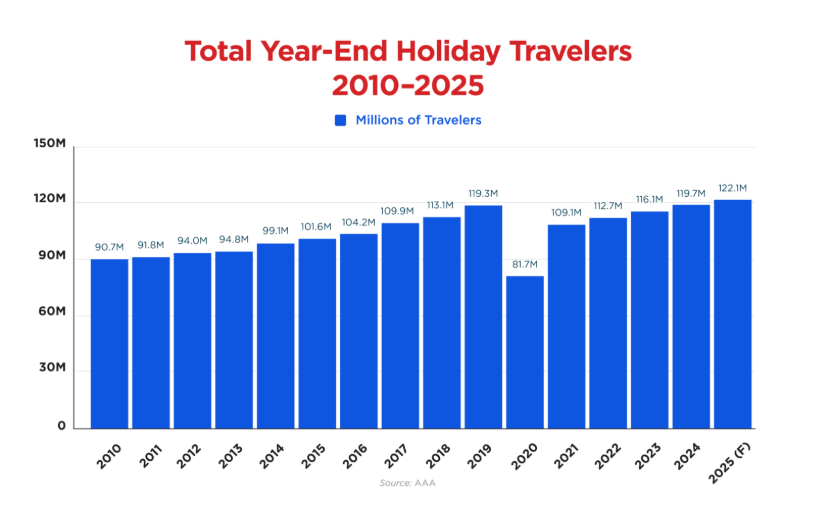
AAA projects 122.4 million Americans will travel at least 50 miles from home over the 13-day year-end holiday period beginning Dec. 20 and ending Jan. 1. This year’s forecast represents a 2.2% increase over 2024, surpassing last year’s record of 119.7 million travelers.
“Year-end travel is a mix of family road trips, friend getaways and tropical vacations,” said Jillian Young, director of public relations for AAA Northeast. “Holiday celebrations look different for everyone, but a common thread is the desire to travel, whether it’s returning to your hometown or exploring new destinations.”
Year-End Travelers by Mode of Transportation
By car:
AAA projects 109.5 million Americans — 89% of holiday travelers — will travel by car for their year-end trips, an increase of 2% compared to last year. For travelers who are renting cars, AAA car rental partner Hertz says Saturday, Dec. 20 is expected to be the busiest pick-up day.
With a record number of travelers on the road, AAA urges drivers to prioritize safety. December is National Impaired Driving Prevention Month, which serves as a timely reminder to make safe choices and stay vigilant. AAA and MADD (Mothers Against Drunk Driving) encourage travelers to plan safe rides home during the holiday season, one of the most dangerous times of year to be on the road.
During 2024’s year-end holiday period, AAA responded to more than 860,000 roadside assistance calls to help drivers with issues like dead batteries, flat tires and empty fuel tanks. When AAA responds to roadside incidents, it’s incumbent upon all of us to keep everyone safe. Slow Down, Move Over requires you to reduce your speed and change lanes when you see stopped vehicles on the side of the road, which gives roadside technicians, law enforcement officials and others room to complete their work safely.
By air:
AAA projects a record 8.03 million travelers taking domestic flights this holiday season, a 2.3% increase from last year. This will be the first time that the number of domestic air travelers over the year-end holiday period exceeds 8 million.
By other modes:
Travel by other modes is expected to increase by 9% with 4.9 million people traveling by bus, train or cruise. This category has seen a 25% increase since 2019, mainly due to the record-setting demand for cruises post-pandemic.
AAA’s Top Year-End Destinations
The top holiday destinations listed below are based on AAA booking data for year-end travel.
Domestic
International/Caribbean
Orlando
Cancun, Mexico
Fort Lauderdale
Punta Cana, Dominican Republic
Miami
Cozumel, Mexico
Los Angeles/Anaheim
San Jose, Costa Rica
Honolulu
Puerto Vallarta, Mexico
Tampa
San Juan, Puerto Rico
New York City
Nassau, Bahamas
Maui
Rome, Italy
Dallas/Fort Worth
Oranjestad, Aruba
Las Vegas
Sydney, Australia
Best/Worst Times to Drive
While both Christmas week and New Year’s week will see days of increased traffic, INRIX, a provider of transportation data and insights, expects Christmas week to be the busiest. Interstates will be extra congested the weekend before Christmas, as travelers hit the road on Saturday and Sunday, Dec. 20 and 21, ahead of the holiday. Friday, Dec. 26, is also expected to be busy with post-Christmas Day travelers. Christmas Eve, Christmas Day, New Year’s Eve and New Year’s Day typically have the lightest traffic, but crashes or severe weather could create delays.
With auto loan delinquencies at record highs, consumers are looking for ways to reduce or refinance their debts and experts say options are out there.
Why Auto Loan Default Rates Are Up
“The increasing price of vehicles both new and used has really created an affordability problem for many,” according to Ted Lyons, vice president of financial services for AAA Northeast. “Couple that with higher costs for just about everything out there and the resumption of student loan payments, then you have a bit of a perfect storm.”
To put it into perspective, the average cost of a new car was about $48,699 in July 2025, according to CarEdge. Interest rates for loans for new cars average 6.51% for buyers with good credit, but those with the worst credit scores can pay as much as 15.85%, U.S. News & World Report reported.
Age Groups Struggling Most With Car Loan Payments
Millennials, Gen Z and subprime borrowers (borrowers with lower than optimal credit scores) have the highest auto loan default rates, probably for many of the reasons Lyons cited.
Americans between ages 18 to 29 had the highest loan delinquency rate in 2025, according to WalletHub, and nearly 5% of car loans in the U.S. are more than 90 days past due.
Younger people were the most aggressive in taking out car loans after the pandemic, when interest rates were lower, and stimulus checks were rolling in. Now, with the increasingly high price of car ownership and other compounding debts, many of these borrowers are having a hard time keeping up.
Can’t Afford Your Car Payment? These Are Your Options
If you are in default on a car loan, turning the situation around is possible, but it requires a bit of creativity and discipline.
As soon as you miss a payment or think you will, contact the lender immediately. Under some contracts, a lender can repossess a car after one missed payment.
It’s possible that the loan can be put on hold, or the terms renegotiated to extend the time to repay it. Even changing the loan due date might help. But this will not work for everyone. “If the borrower is already delinquent, getting an approval [to refinance] may be difficult,” said Lyons. Apply to refinance with AAA.
Ask family members or friends for financial help or a short-term loan and prepare an agreement for paying them back.
Sell the car and buy a cheaper one. A used car will be less expensive and have a lower insurance rate, but if you don’t net enough to pay off the loan, you could be stuck.
If the car is dangerously close to being repossessed, consider surrendering it to the lender. Your credit rating will still take a hit, but it won’t be as severe as it would be if the car were repossessed. You might still owe money if a balance is left after the car is sold at auction.
Look for a side job so you can put that money toward the car payment.
Review all your expenses and make adjustments, Lyons suggested. “See if there is anything you can cut out of your monthly spending that isn’t necessary.”
Need help financing a car? AAA has you covered with our great auto loan products.
This article has been updated and republished from a previous version.
Life insurance is an investment that offers a safety net for your loved ones and peace of mind for you, but finding an affordable plan may seem a bit daunting. High cost is the reason why 42% of consumers have not purchased life insurance. But there are many ways to get a low monthly premium and still have the coverage you need.
These are four tips you can employ to help save you money on your life insurance policy.
Start Early and Lock In Rates
More Millennials and Gen Z are looking into life insurance, and that’s a good thing; one of the best ways to pay less for life insurance is to start as early as possible. Age is a significant factor in determining life insurance premiums, as the risk of health complications increases as you age. Securing a policy when you’re young and healthy allows you to lock in lower rates for the duration of your coverage.
Maintain a Healthy Lifestyle
Insurers assess your overall health when calculating life insurance premiums, and the results can significantly impact your rate.
Adopting a healthy lifestyle that includes regular exercise, a balanced diet and the avoidance of tobacco products are key factors that contribute to lower premiums. In fact, being a smoker can actually double your rate in comparison to a nonsmoker.
Choose the Right Type and Amount of Coverage
Selecting a life insurance policy that best aligns with your goals is crucial, and sometimes a pricier policy doesn’t necessarily mean it’s the best option for you. Typically, you can opt to purchase either a term or permanent policy.
While permanent life insurance benefits are available anytime and have intrinsic cash value, term life insurance often allows you to purchase more coverage for less money. Because of this, a term life insurance policy is ideal for those purchasing life insurance with a budget in mind.
Compare Quotes
Life insurance quotes can vary significantly among providers, so taking the time to “shop” and compare is time well spent when it comes to your wallet.
When looking, consider factors such as coverage limits and exclusions, the carrier’s financial strength rating and what living benefits the policy carries (benefits the policyholder can access before a health event or death occurs) before making your choice.
Being proactive in your search allows you to make the best, most informed decision, leading to a good amount of savings over the life of your policy.
Watch as AAA Roadside Assistance technicians share heartfelt messages of gratitude from our members.
AAA Northeast provides roadside service to millions of members every year. Hearing that we’ve made a difference truly makes our day, every day — and we thank you right back.
Do you have a story or a note of thanks to give? Share it with us on our new membership story page, Hey AAA!
’Tis the season of searching for the perfect Christmas tree!While finding the right one may be tricky, getting it home safely can be challenging, too. AAA Northeast reminds drivers that, with a little preparation, the right tools and the right vehicle, transporting a Christmas tree is easy, and you’ll be decking the halls in no time!
An improperly secured Christmas tree can scratch vehicle paint, tear door seals or bend window frames. Even worse, a tree can fly off or out of a vehicle and cause a traffic crash. AAA research shows that road debris causes crashes directly, when vehicles are struck by falling debris or strike debris, and contributes to crashes indirectly, when drivers crash while swerving or stopping short to avoid debris.
From 2018 to 2023, road debris was a factor in an estimated 319,724 crashes nationwide, resulting in 32,802 injuries and 433 fatalities, according to a new study from the AAA Foundation for Traffic Safety.
AAA offers the following tips to ensure Christmas trees are transported safely.
Plan ahead. Before heading out to buy a real Christmas tree, make sure to bring strong rope or ratchet straps, an old blanket and gloves. A vehicle with a roof rack is ideal, but a pickup truck, van, minivan or SUV large enough to fit the tree can work just as well.
Wrap and cover it. Have the lot wrap the tree in netting before loading it. Loose branches can also be secured with rope or twine to help protect the tree from damage. Prior to loading the tree, cover the car’s roof with an old blanket to prevent scratches to the paint and protect the car from any damage.
Tree trunk in front. Place the tree on the roof rack or in the bed of the truck with the trunk facing the front of the car. If the vehicle doesn’t have a roof rack and is large enough, place the tree inside.
Secure it. Tie down the tree at its bottom, center and top using strong rope or nylon ratchet straps. Avoid using the nylon string offered by many tree lots, which may not be strong enough to secure the tree. Use fixed vehicle tie-down points and loop the rope or strap around the tree trunk above a branch to prevent any side-to-side or front-to-rear movement.
Tug test. Once tied down, give the tree several strong tugs from various angles to make sure it’s secured in place and won’t come loose.
Nice and easy. Drive slowly and take back roads, if possible. Higher speeds can create significant airflow that can damage your tree or challenge even the best tie-down methods. Remember that your car will work a little harder to transport the tree, and you might feel the added drag from the additional wind resistance caused by the tree.
State-specific data:
In Connecticut, road debris contributed to roughly 380 crashes in 2024, up nearly 19% from 2023, according to the Connecticut Crash Data Repository. Over 60 of those crashes resulted in injuries.
In Massachusetts, road debris contributed to roughly 280 crashes in 2024, an 8% decrease from 2023, according to the Massachusetts IMPACT Crash Data Portal. Over 50 of those crashes resulted in an injury.
In New York, road debris contributed to over 3,400 crashes in 2024, a 6% increase from 2023, according to the Institute for Traffic Safety’s Traffic Safety Statistical Repository. More than 470 of those crashes resulted in injuries and five resulted in a fatality.
In New Jersey, road debris contributed to 1,645 crashes in 2024, up nearly 7% from 2023, according to Numetric. Over 180 of those crashes resulted in injuries and three resulted in a fatality.
More than half of drivers (54%) feel safer operating a gas-powered car than an electric vehicle, according to a survey from AAA Northeast, while 31% say they’d be fine in either vehicle. Road trip logistics, cost and home charging continue to be barriers to EV adoption, but safety is nearly as large of a concern.
As a result, only 4% say they plan to purchase a fully electric vehicle for their next car, while 62% say they won’t purchase one. The remainder of drivers range from slightly interested (10%), moderately interested (11%) and very interested (13%). So, although EV boosters have their work cut out for them, there’s still reason for optimism. Another positive sign: 98% of EV owners will buy an EV again.
“The ending of federal tax incentives has made the market less favorable for electric vehicles, but the biggest challenge for manufacturers continues to be consumer sentiment,” said Alec Slatky, managing director of public and government affairs, AAA Northeast. “The good news for the industry is that the vast majority of electric vehicle owners have no intention of going back to gasoline cars.”
The 1,056 survey respondents consisted of a random sample of AAA Northeast members aged 18+. AAA Northeast covers a region of the country with an above-average market share of electric vehicles, including Connecticut, Massachusetts, New Jersey, New York and Rhode Island. There were 67,656 EVs registered in Connecticut as of July 1, according to DMV data, an increase of 15,000 vehicles from the year prior. At the start of this year, there were over 139,000 EVs registered in Massachusetts, according to state data, an increase of 35,000 from the year prior. In New Jersey, EVs accounted for 11.4% of new light-duty registrations year to date through July 22, according to the EValuateNJ dashboard. In New York, EVs accounted for 8.9% of new registrations year to date through Nov. 7, according to the EValuateNY dashboard. In Rhode Island, the DRIVE EV rebate program has awarded 829 rebates year to date through October.
Other findings of the survey include:
Fire is the biggest safety concern, followed by EV’s relatively short time on the market: Among respondents who said they would feel safer operating a gas-powered car than an electric car, 63% said that risk of fire was one of their top safety concerns, followed by EV’s time on the market (40%), crash safety concerns (32%) and lack of experience driving an EV (22%). There is no evidence that EVs are more likely to catch fire than internal combustion engine vehicles, but when fires occur, they are more difficult for first responders to extinguish and generally burn longer. EVs are also similar to gasoline cars for crash test safety; as with other types of vehicles, crash test ratings are more vehicle-specific than engine-specific.
The biggest barriers to EV adoption are home charging, road trips and cost…: Most surveys find these three concerns to be paramount among consumers, and this survey is no exception. Excluding the respondents who definitely plan to purchase an EV for their next car, the lack of home charging is the most cited concern (53%), followed by lack of suitability for road trips (51%) and cost (51%). Consumers feel relatively confident that EVs can fit into their daily routines, with only 17% expressing trepidation about that issue.
…but some people just simply don’t like electric vehicles: Among the respondents who said they definitely would not buy an EV for their next car, 43% said they “just don’t like” electric vehicles. Even if the EV industry can address concerns about cost and charging over the next decade, these consumers likely won’t be assuaged, whether due to a personal connection to gasoline vehicles or a gut aversion to EVs. Indeed, 57% of respondents said they never plan to buy a fully electric vehicle.
EV owners have better road trip experiences than non-owners expect: Most EV owners said they never (31%) or rarely (37%) had to change road trip plans due to public charger availability, and only 5% said they did so most of the time. Non-owners have the opposite prediction: 43% guessed that EV owners have to adjust plans most of the time, while only 2% said they never do so.
“Car buyers generally believe that EVs can handle their daily commute — they just want to feel as confident about their occasional road trip,” said Slatky. “The EV industry should continue building out the charging network, but innovations in battery safety may be just as crucial for getting consumers to make the switch.”
If you play Wordle or Lingo, you’ll love WordroW. In this guessing game, you get six attempts to spell out the hidden words, with clues about the correct letters.
For December, we put together a series of puzzles featuring events and activities taking place this month. You can play them all or come back another day.
But most of all — have fun!
December Co-Workers
To open a new puzzle, pick a title from the list. To return to the list after opening a puzzle, click the three horizontal lines at the top-left of the puzzle and select “more puzzles.”
How to keep it together when everything feels like it’s falling apart.
EPISODE SUMMARY
A mental health crisis doesn’t always manifest like a car crash. Sometimes, it appears as a slow unraveling caused by exhaustion, disconnection or a quiet, nagging sense that something isn’t right.
In this deeply personal episode of Merging Into Life, host Sabrina Pierotti opens up about her own recent health scare. She is joined by psychologist Vassia Sarantopoulou, founder of AntiLoneliness, to discuss how we can build lasting emotional resilience even when life doesn’t go according to plan.
From recognizing the subtle signs of emotional burnout to understanding the benefits of therapy, this episode offers powerful insights on how to sit with uncomfortable emotions. Tune in to learn how to move through a crisis — rather than just surviving it.
KEY TAKEAWAYS
Burnout symptoms can sneak up on you. Detachment, exhaustion, brain fog and a loss of joy are major warning signs. Don’t wait for a total breakdown to start your healing journey.
Your feelings aren’t “bad” — they are data. Sadness, anger and loneliness are not problems to fix; they are signals asking for care rather than suppression.
The benefits of therapy are vast, but it isn’t one-size-fits-all. If your first therapist isn’t a match, keep looking. Finding the right fit can change your entire recovery process.
Dealing with loneliness isn’t just about being physically alone; you can feel isolated in a crowded room. True connection starts with knowing yourself and reaching out from that grounded place.
Self-connection is just as vital as social connection. True healing requires a balance of both time alone to reflect and time with others to feel seen, supported and understood.
In a mental health crisis, don’t wait to feel ready for self-care. Your brain may resist rest, movement or joy, but these habits are the foundation of emotional resilience during hard times.
Emotional resilience isn’t a fixed trait, it’s a practice. By accepting discomfort, checking in with yourself and giving your emotions space, you build the strength to rise again.
TRANSCRIPT
[00:00:02] Sabrina Pierotti: The thing about life is that it’s hard, and it can be very scary at times. Things can either pop up out of nowhere that can totally derail your life, or it can be an accumulation of unprocessed emotions that can lead to a breaking point. I know for me personally, last year I went through a breast cancer scare where I literally thought I had breast cancer at 30. It was horrible, and it was a monthslong process of MRIs and biopsies. And at times, it felt like I was never going to come out on the other side. And I don’t mean to quote Kelly Clarkson, but it is true. Through my life’s most challenging moments, I have grown the most. Because of my breast cancer scare, I now know what it means to really, really take care of my health. And I also have a huge why to stay motivated with my health goals and to get into the gym. It is in our darkest days where resilience is built. Every time you fall, it is easier to get back up. So, my friend, face your life’s challenges with courage and your head held high. Acknowledge that, yeah, it is hard, but at the same time, know that you will become stronger because of it. Welcome back to Merging Into Life. I’m your host, Sabrina Pierotti. And today we’re talking about something that we all go through, but we rarely feel ready for, which is crisis. Whether it’s a job loss, a breakup, or just a slow unraveling of the plan we had for our lives, those curveballs can hit hard, and they can be painful. But luckily, our guest today is Vassia. Vassia Sarantopoulou is a psychologist, an educator, and founder of AntiLoneliness. Her work focuses on helping individuals and communities address perfectionism, loneliness, emotional resilience and burnout. So, thank you so much, Vassia, for joining me, and I’m excited to jump in. So, today, we’re going to talk about something a little tough, which is personal crisis. So, specifically starting and speaking to an emotional crisis, whether it’s mental health challenges or psychological challenges or emotional turmoil. What are some of the warning signs that someone might be in an emotional crisis or on their way to one?
[00:02:28] Vassia Sarantopoulou: Warning signs that can be signs of an emotional burnout, you don’t understand, but then one day you wake up and you feel, oh, I don’t like my job anymore. And last year, actually I loved it. But now I feel completely detached from my work and why I’m doing it. Also, the same thing happens with the joy and the meaning you feel in life. One day, suddenly you feel, nothing fulfills me. I am not happy with anything. Like I remember an example of a client that I had, and she came to me because she realized that at the end of the day, she would finish her project, but also her house chores, anything that fits under the umbrella of duty and responsibility, and then she would sit down to play with your children, and she would not feel anything. No connection, no joy. And she came to me in terror, like, oh my God, what is happening? Why I don’t feel any connection with my children anymore, and how I did not see that happening or coming to my life. So, that was what her sign, the detachment, the disconnection, the not feeling joy or happiness with what used to give us joy. Another mental symptom can be that fog inside our head. We’re struggling to remember something. We’re struggling to finish a project. We know that we used to finish that in one hour, but why that now does it take five? Another sign can be the physical manifestation. Like you, even though you sleep, you wake up and you’re feeling tired still. And you wonder, but why I had 10 hours sleep and still I don’t feel rested? There are many clients that come with burnout, and they tell me, I think I’m in a burnout the last year. And then when I tell them the symptoms of burnout, they say, Oh, then probably I’m in a burnout for the last five years.
[00:04:32] Sabrina Pierotti: In addition to emotional-burden burnout, what are some of the other common challenges that your clients come to you with?
[00:04:38] Vassia Sarantopoulou: I think we go to therapy for everything that we haven’t learned at school, and we should have. Like relationships. We didn’t learn anything about relationships at school. We go into adulthood, we meet our partner, we don’t know how to communicate any kind of loss, like grief. We never know about grief, we never hear about grief. Only when we reach, I don’t know, an older age, when we start losing our friends or our partner or our parents, then we know of this concept. And in loss, everything loss, I think loss is a big umbrella. We’re talking about any kind of loss, like moving to a new country. Loneliness as well. We lose a friend, or we lose a partner. People even felt shame to talk about loneliness.
READ MORE
[00:05:26] Sabrina Pierotti: Why do you think there is so much shame around therapy?
[00:05:33] Vassia Sarantopoulou: So, from my perspective, I think the projections and biases we carry from the previous generation. I mean, even now, my mom doesn’t know what I’m doing. Every time she’s asking me, are you OK with money? Do you want me to send you some money? Because you’re a psychologist. OK, mom. The value that we put on therapy is different between the generations, and that’s one reason for this shame that we carry.
[00:05:57] Sabrina Pierotti: So what would you say to somebody who’s listening that has been considering therapy for a while, and they are just for all the concerns and fears and narratives that you just said, that’s the reason that’s holding them back from signing up for therapy. What would you say to that person?
[00:06:17] Vassia Sarantopoulou: Find a format and the person that suits you. You know, because when you’re 40, 50, 60, you don’t want to go to a therapist who is 25. You know, you feel like even life experience is different. So, find somebody who is at your own age. They know your own struggles. And connection is more important than mental health, per se, for you. So, choose whatever format or person that you feel more aligned and suits your style. I think that’s the first tip that I would give to them. But also, it takes a little bit of discomfort in the beginning, because it’s very new. All these self-perceptions, I’m not strong enough, I’m not strong enough, or I’m taking somebody else’s place. Because I’ve heard that also, you know, you have other people who struggle more. I don’t want to take their slot. All this self-abandonment and sacrifice is very much this pattern of this generation.
[00:07:17] Sabrina Pierotti: So, I actually had a therapist for the, she was my very first therapist for the first like six months. And we were just not clicking. Like I knew right away I was not really looking forward to going to therapy to see her. Like there were just signs along the way. And then a therapist like literally like popped into my life that was so exactly what I needed.
[00:07:43] Vassia Sarantopoulou: Just because you had one negative experience or not an aligned experience with a therapist, it doesn’t mean that everybody’s like that or every experience that you will have is like that. There’s so many different styles, different therapeutic approaches, modalities, personalities. Every therapist has their own personality.
[00:08:00] Sabrina Pierotti: Now, say somebody finds that perfect therapist, and they’re super happy. When it comes to actually healing, it can take a while. So, what does it actually look like when you’re in a therapy session?
[00:08:15] Vassia Sarantopoulou: What we do before we get into therapy is automatically we learn or we tend to escape the discomfort. You’re feeling sad, but you don’t want to feel sad, so immediately you call your friends, you go out and party. We think that these are negative feelings. We name them negative feelings, as if they are the bad, and we should have the good. But in reality, they’re not negative or positive, they’re just uncomfortable feelings. And what we don’t know is how to sit with them, because we feel scared. What if I sit with my sadness? And then I’m going to feel even more sad. However, the price we pay is that this escaping and pushing out of these feelings comes with loss of energy. Like when you push yourself to be happy while you’re really, really sad, that’s double the energy you need in order to go through your day. How can you be happy when you’re grieving, when you just broke up, when you lost a friend? You’re not happy, but you pretend to be happy. Your whole body is putting a performance, and that performance is costing energy. So, how to stay with that discomfort? It means, first of all, taking the negative connotation out of this feeling. It’s not bad. It’s not going to make you worse. So, first take out the fear of the feelings. And stop pushing and spending the energy that I can change that feeling. What I also explain to my clients is that your feeling comes from inside you. It’s a part of you. So when you say, I don’t want that feeling, actually, it’s like saying you don’t want a part of you. And we don’t do that. We love every part of you. Every single part of you is loved, worthy of love, worthy of attention, worthy of care. You shout at your partner or whatever you’re doing, well, that’s what we need to change, but not your anger. The anger is fantastic. We love it. What we need to do at that moment is to make sure that we’re not stepping into negative assumptions, self-criticism. Oh, I’m lonely. Maybe because I am a terrible friend. Yeah, I mean, if I was a good friend, maybe I would have friends by now, and probably my loneliness says that I am a very unimportant, boring or terrible person. So then that’s a different thing than the loneliness, per se. Loneliness is the feeling that says, hey, we need connection. Thank God we have loneliness that sends us this message.
[00:11:12] Sabrina Pierotti: And you’ve referred to a loneliness before as the pandemic of our era. What do you think people often misunderstand about loneliness, and why do people feel lonely even when they’re physically surrounded by people?
[00:11:27] Vassia Sarantopoulou: So, we have feeling lonely and being alone. One is a feeling, the other one is being. And we sometimes misunderstand these two. So, the reality, though, is that you can be surrounded by people and feel lonely. You can be all by yourself and feel very much connected and not lonely at all. That’s the paradox. So, it’s about feeling unseen, feeling disconnected. You can be sitting with your partner on the couch, watching a movie, and normally somebody would say, ‘Oh, they’re so connected.’ But you might feel very, very deeply disconnected and lonely in there, because there’s something in that connection that doesn’t work or hasn’t been working for a long time. So, that’s the main misunderstanding about loneliness.
[00:12:22] Sabrina Pierotti: Why is social connection imperative for personal healing? And how can we push through that reluctance to connect when we’re going through a really dark time?
[00:12:32] Vassia Sarantopoulou: I think when we’re going through a dark time, we both need me time and connection time. We do need to stay by ourselves. We need to figure out who we are. Because actually, the first step of recovering or healing from loneliness is not again connection with others, is connection with ourselves first. First, I have to get to know myself, because there are many people who live for decades without knowing who they are. So, first, I have to get to know myself, introduce to myself again, become my best friend, and then I can go out and water all these relationships that I have in my life, start new, or go back, revisit some of the old relationships. We are social beings. We’re wired for connection. We cannot live without connection. It doesn’t mean that we always need a partner. That’s far away from that, but we need to be seen. So, we definitely need to be seen to belong in order to have this healthy perspective of life. But especially in, as you said, the dark places of our life, we need both. We need to go and be by ourselves and then go out, meet our friends and then come back. Kind of do this dual process of in and out, both.
[00:14:04] Sabrina Pierotti: How can we best prepare ourselves for these big life changes without getting swept away by the emotions of everything?
[00:14:13] Vassia Sarantopoulou: We talked about acceptance. So, accepting that it’s not going to be glamorous. It’s not going to be smooth. Maybe we will learn new parts of ourselves in there. We’re going to be challenged. That’s part of the game. That’s not a malicious plan, you know, of the universe against us. It’s not. It’s just the human experience. And we just roll with it. So having this reminder, this acceptance, what we said before that maybe there’s a lesson for me to learn there and keep in mind also to be connected with yourself. It can be very overwhelming. So, come back to yourself, have a me time, a review time once a week, once a month, or both, where you can say, how was that week? How did I feel? What did I want it to do, but then I didn’t want? I didn’t do it, for example. Keep in touch with your own desires and needs, your own hobbies, your own values. You want to be a better father, for example? Have this review meeting with yourself and be like, oh, what kind of father was I? Why was I not present? Yeah, maybe because too much work, or maybe I’m a perfectionist. I want to do everything perfect. So, have this review meeting with yourself. Journaling helps. Asking for help. And when we get really overwhelmed, our brain goes into fight or flight mode. And in that mode, it convinces us that we don’t have energy for self-care. Your therapist, for example, said, you have to go and walk every day, yeah? That’s important. But then your brain, because you are in a survival mode, will say, Oh, I’m so tired today. Even though you didn’t do anything, you were just sitting the whole day and behind a computer. No, no physical strain, nothing. But it’s the brain, because it thinks that we need energy, in case things go worse, because we are in the fight or flight. It protects your energy. So, don’t listen to your brain and continue with these habits of self-care. That’s your sleep, that’s your diet, your exercise, breath-work.
[00:16:32] Sabrina Pierotti: Thank you so, so much for sitting with me and chatting with me. I am so glad and grateful for this conversation. Like, I love the society that we’re in where like mental health is a lot more open. However, we still have a lot of work to do in terms of really just normalizing it even more. So, and I have a feeling this episode and this chat together really did wonders in accelerating that. So, thank you so much. You are such a joy to talk to.
[00:17:04] Vassia Sarantopoulou: Thank you so much for the invitation. And I have a special gift for your listeners because I know how overthinking can take over sometimes, and we are just in a loop, ruminating, ruminating, and we cannot stop. So, I have just a one pager that they can print, and they can have next to them with seven ways to stop overthinking.
[00:17:23] Sabrina Pierotti: Thank you. Oh my gosh. I will definitely be using that, printing it out, putting it on the side of my desk.
[00:17:30] Vassia Sarantopoulou: We all need it. We all need it.
[00:17:32] Sabrina Pierotti: We sure do. Thank you so much, Vassia.
[00:17:34] Vassia Sarantopoulou: Thank you.
[00:17:37] Sabrina Pierotti: We covered a lot today, from identifying what crises look like to learning how to sit with it and sit with those painful emotions. And most importantly, how to move forward with resilience. These are topics that don’t always get space in everyday conversations, but they’re at the core of how we build emotional resilience and move forward when life doesn’t go as planned. If you’re enjoying the show, do us a quick favor. Hit that like button, leave a review, and share it with a friend who’d love it too. It helps more than you know and keeps the good stuff coming your way. Thanks for being part of the ride.
The views and opinions expressed in this podcast are not necessarily the views of AAA Northeast, AAA, and or its affiliates.
It’s the most wonderful time of the year, as twinkling lights fill the night, the scent of chestnuts roasting drifts through the air and joy seems to be around every corner.
The holidays are all about traditions, old and new, and this year is the perfect chance to start a few fresh ones. So, hit the road for an exciting seasonal adventure with plenty of magic and surprises in store.
Here are our top picks for road trips that will spark new holiday traditions and create memories to treasure with your loved ones.
‘It’s a Wonderful Life’ Festivals
Indiana, Pennsylvania
Saturdays, Nov. 22-Dec. 20, 2025
A classic holiday tale of the profound impact one person can have on others’ lives, “It’s a Wonderful Life” and its timeless message live on at two festivals in the Northeast each holiday season. As the birthplace of the film’s star, Jimmy Stewart, Indiana, Pennsylvania, takes great pride in celebrating the classic holiday movie’s legacy in a big way. Known as the Christmas Tree Capital of the World, the downtown area transforms into a winter wonderland for the ‘It’s a Wonderful Life’ Festival. Meander the streets to discover vintage light displays, local shops that go all out with holiday window displays and an oversize live Christmas tree presiding over it all.
Seneca Falls, New York
Dec. 12-14, 2025
Seneca Falls is often referred to as The Real Bedford Falls, as many believe it inspired the setting of “It’s a Wonderful Life.” Step into the nostalgic charm of the town during the ‘It’s a Wonderful Life’ Festival and enjoy days packed with horse-drawn wagon rides through town, interactive screenings of the film and an annual George Bailey Award ceremony, which honors people in the spirit of George’s kindness and selflessness.
A fun twist on the traditional holiday fir, Lobster Trap Christmas Trees have become must-see crafty creations throughout New England. The pop-up trees, built by volunteers, are adorned with lights, buoys and other nautical-inspired garlands. Route through Maine to spot three of the most notable structures in Rockland, Cape Porpoise and Jonesport-Beals. Then check out Connecticut’s Stonington Lobster Trap Tree (Nov. 22, 2025, to Jan. 4, 2026; admission is free), one of the largest, with a unique hollowed-out interior perfect for being wrapped in the festive glow.
Three Unique Ways to Meet Santa This Year
Dine with Santa in the North Pole (North Pole, New York, that is!)
Saturdays and Sundays, Nov. 22-Dec. 21, 2025
Set within the Adirondack Mountains, Santa’s Workshop theme park is one of the oldest continuously operating Christmas-themed parks. The best time to visit the North Pole is at night when the Village of Lights fest is aglow with fire pits and caroling cheer. Reserve your spot in advance to dine with Santa at the Northern Lights Restaurant.
See Santa Scuba at the Adventure Aquarium in Camden, New Jersey
Nov. 21-Dec. 24, 2025
Santa trades the chimney for fins each holiday, wowing visitors as he swims with sharks and sea turtles at Camden’s Adventure Aquarium. Kids of all ages delight in this unexpected and fun twist on a typical Santa encounter. The aquarium also features a dry meet-and-greet, for gift requests and photo opportunities with the jolly man.
Journey with Santa on the Santa Express at the Railroad Museum of New England in Thomaston, Connecticut
Nov. 22-Dec. 23, 2025
All aboard for a wondrous rail journey with two special guests along for the ride, Santa and Mrs. Claus. The Santa Express is a daytime holiday train ride suitable for all ages, gliding through the wintery landscapes of the Naugatuck River Valley. The ride includes fun sing-alongs, caroling and an enchanting visit with Santa and Mrs. Claus. Every child receives a bell along with a special gift from Santa’s toy bag.
Christmas at the Newport Mansions in Newport, Rhode Island
Nov. 22, 2025-Jan. 1, 2026
Decked out with opulence and grandeur beyond compare, Newport’s mansions (The Breakers, Marble House, Chateau-sur-Mer and The Elms) boast unmatched Christmas interiors. Christmas extravagance at its best, these Gilded Age estates shimmer with lavish lights, ornate garlands and picture-perfect Christmas trees. Wander the halls as you go back in time through these historic mansions and experience the holiday season as it was celebrated in a bygone era.
Gardens Aglow at Heritage Museums & Gardens in Sandwich, Massachusetts
Select nights from Nov. 28-Dec. 27, 2025
Get immersed in one of New England’s biggest light events at the Gardens Aglow nights. More than 10 miles of lights weave through the varied terrain for a most magical glowing stroll. There is plenty of fun for all ages here, with a reindeer scavenger hunt, fire pits for marshmallow roasting, a model train display and food trucks.
Holiday Train Show at New York Botanical Gardens in New York City
Nov.15, 2025-Jan.11, 2026
A marvel of size and scope, The Holiday Train Show at New York Botanical Gardens is a top family-friendly destination in New York City each holiday season. More than 30 G-scale model locomotives and trolleys traverse 200 scale models of New York City landmarks. Holiday Train Nights are a favorite, as atmospheric lighting adds a mystical layer to the display, accompanied by music and seasonal treats. AAA Members get access to exclusive savings on their visit to the New York Botanical Gardens.
Share your favorite holiday activities in the comments below.
Flying without a REAL ID is about to get more expensive.
Beginning Feb. 1, 2026, the Transportation Security Administration (TSA) will require passengers without a REAL ID, passport or other acceptable identification to pay a $45 fee to clear security checkpoints.
Travelers who choose to pay the fee will have to establish their identity through TSA’s identity verification system, TSA Confirm.ID, prior to entering the security line. Once verified, TSA checkpoint access is available for up to 10 days.
TSA’s modernized screening system leverages biometric or biographic information to confirm a passenger’s identity. It can take 10 to 30 minutes, so completing the process and paying online in advance is recommended. Airport processing will be available, but delays are expected. TSA also warns that identity verification is not guaranteed.
For the smoothest travel experience possible, the best option is to get your REAL ID now.
Get Your REAL ID at AAA
Currently, 94% of U.S. airline passengers have a REAL ID, according to TSA.
If you still don’t have yours, AAA members in Connecticut, Massachusetts, Rhode Island and New York can apply at select AAA branches. Make a reservation online and come to your AAA REAL ID appointment prepared with all necessary documentation.
Learn more about REAL ID requirements and applications.
To get through airport security even faster, you can also sign up for TSA PreCheck at select AAA branches.
Did you get your REAL ID? What do you think about TSA’s new $45 fee?
Do your teeth feel more sensitive in cold weather? It’s not your imagination.
Winter’s chill can make teeth and gums more vulnerable to inflammation and irritation.
If left unchecked, these issues can become more serious over time. Regular dental checkups can help you stay ahead of any oral pain or discomfort. AAA Northeast has partnered with Altus Dental to bring Massachusetts members exclusive savings on dental coverage — helping you protect your smile in every season.
Cold Weather’s Effects on Oral Health
Low temperature can cause tooth enamel to shrink, exposing sensitive nerves and triggering pain.
Cold constricts blood vessels in the gums, reducing circulation and leading to sensitivity, inflammation and even bleeding.
Dry air and dehydration can irritate gum tissue.
Repeated expansion and contraction of teeth can increase the risk of cracks and fractures, which could require dental procedures such as crowns or fillings.
Stock up before a storm. Make sure you have an adequate supply of toothpaste, floss and mouthwash in case transportation or access to stores is disrupted.
Address dental issues before severe weather. If prolonged snowy or icy weather is predicted, consider visiting your dentist to address any issues to prevent an emergency when offices may be closed.
Keep a small dental emergency kit. Include pain relievers, temporary dental cement for fillings or crowns that may fall out and sugar-free gum to help stimulate saliva flow in case of dry mouth.
Check your vitamin D intake. Vitamin D helps your body absorb calcium, which is essential for maintaining strong teeth and gums.
Use toothpaste for sensitive teeth. If you are experiencing frequent irritation, ask your dentist whether a sensitivity-relief formula might help.
Stay hydrated. Drinking water keeps your mouth moist. Saliva helps wash away bacteria and neutralize acids.
Breathe through your nose. This reduces your mouth’s exposure to freezing air. Wearing a scarf over your mouth adds extra protection.
Maintain regular dental visits. Routine checkups help identify early signs of damage before they become more serious.
When to See a Dentist
Be sure to contact the dentist if you notice:
Sharp or prolonged tooth sensitivity and pain.
Tooth cracks or fractures.
Bleeding or swollen gums.
Chronic dry mouth that doesn’t improve with hydration.
Persistent bad breath.
Supporting your oral health contributes to your overall well-being. Learn how dental plans from Altus Dental, exclusively for AAA Northeast members in Massachusetts, provide convenient and affordable access to oral health care.
Sneezing, coughing and fever are classic flu symptoms — but eye irritation can also indicate a viral infection. Don’t dismiss persistent redness, swelling, tearing or light sensitivity as just a cold or allergies.
With flu season here and other respiratory illnesses circulating, it’s important to stay attentive to early warning signs. After last year’s record-high number of flu and respiratory illnesses, the Centers for Disease Control has a similar outlook for 2025-2026.
Routine eye exams offer important benefits — including helping detect issues that may relate to seasonal illness — so keeping up with your appointments matters.
AAA Northeast members in Rhode Island can sign up for both dental and vision insurance through Delta Dental of Rhode Island.
How Flu Affects the Eyes
The flu impacts your entire body. When your immune system detects the virus, it releases chemicals to fight the infection, which can lead to eye redness, itching, tearing and light sensitivity. Swollen sinuses may add to the irritation, and dehydration from fever can also leave your eyes feeling dry.
When illness leaves your eyes feeling sore, dry or swollen, these simple steps can help soothe irritation and prevent further discomfort.
Apply cool compresses to the eyes several times a day to reduce swelling. Use a washcloth soaked in cool water or cucumber slices placed directly on the eyes.
Stay hydrated. Drink water and other clear liquids.
Hands off! Rubbing your eyes will make the irritation worse.
Use non-prescription lubricating eye drops to relieve the discomfort.
Check all your medications. Some drugs, including decongestants and antihistamines, can dry out eyes.
Don’t wait too long to see a doctor if you have eye pain. Usually flu-related eye irritation is mild and does not last long, but in some cases could lead to complications like uveitis, an inflammation of the eye’s middle layer. Symptoms include blurred vision, redness and eye pain and may require treatment.
Sleep with your head slightly elevated to help drain your sinuses and reduce facial swelling.
Some people who have the flu develop conjunctivitis, also known as pink eye, which causes redness, itching and tearing. Antibiotic eye drops usually clear up conjunctivitis in a few days.
Preventing Eye Irritation
Taking a few proactive steps can go a long way toward reducing your risk of eye irritation, especially during cold and flu season.
Get a flu vaccine.
Be vigilant about hygiene. Keep tissues handy and use them to cover your face and nose when you sneeze or cough.
Wash your hands thoroughly and frequently.
To reduce sinus irritation, try using a humidifier to keep the air damp.
Talk to your doctor about adding more omega-3 fatty acids to your diet. Some studies suggest they may help reduce eye and eyelid inflammation. Good sources include fatty fish such as salmon or tuna.
Stay on top of your yearly vision exams and don’t wait to see a doctor if dry, itchy or watery eyes continue this flu season. Rhode Island AAA members can also sign up for affordable dental and vision insurance through Delta Dental of Rhode Island.
Q&A With AAA Northeast’s Car Doctor: December 2025
Q. I am thinking about an old vehicle, specifically an early 1960’s Dodge Power Wagon. I found a few that are in decent to good shape, what do you think of buying this truck as an investment? A. The Dodge Power Wagons according to Hagerty Collector Car insurance are going up in value. That being...
Q. I am thinking about an old vehicle, specifically an early 1960’s Dodge Power Wagon. I found a few that are in decent to good shape, what do you think of buying this truck as an investment?
A. The Dodge Power Wagons according to Hagerty Collector Car insurance are going up in value. That being said, I would buy a Power Wagon, because it is good looking, capable and can be practical for trips to the home improvement store. Buying almost any vehicle as an investment can be disappointing. Even very collectable cars like the Chevrolet Corvette and Plymouth Superbird have lost money according to auction reports. Buy something you like, use it and enjoy it. When the time comes to sell it, if it has gone up in value, great if it has not, well at least you were able to enjoy it.
Q. We spend winters in Florida, and I purchased a very nice 2014 Toyota Corolla to leave there for a spare car. The Corolla only has 45,000 miles on it. A friend starts once a week and lets it run for about 10-15 minutes. He does not drive it anywhere because I’m cheap and cancel the insurance. He said the ‘check engine light’ now goes on when he starts the car. Any thoughts why it would go on when it hasn’t been driven for a while.
A. The check engine light could be on for any number of reasons, from a loose gas cap to a faulty sensor. The other issue is that a rodent (quite common in Florida) could have damaged a hose or wiring. At this point, the best thing to do would be bring the car to a good repair shop for a checkup. Also you actually may be doing more harm than good starting the car and letting it run every week without driving it. It would be better to drive the car every three weeks or so for 30 minutes. If this is impossible then I would fill the fuel tank and add a fuel stabilizer, fully inflate the tires, top off all the vital fluids and disconnect the battery. When you return to Florida expect the battery will need recharging and bring the car to a good repair shop for a check-up before any long-distance trips.
Q. I had four new tires installed and the wheels aligned on my six-year-old car with all the work performed at the dealer. During the road test, the mechanic noted a shuttering suggested replacing the transmission fluid. I have never noticed anything and wonder if the work really needs to be performed or if they were trying to sell me a “bill of goods”?
A. The technician could have noticed a bit of a “chuggle” when the transmission was shifting. This can happen when the transmission fluid loses its friction additives. Certainly, at this point and age with your car it can’t hurt to change the fluid.
Q. It seems Subaru “finds” things when I come in for routine and scheduled service. Last time was fuel injection cleaning, today, it is a thermo coupler, though they said it is fully covered by Subaru, and it will take three to four hours to repair. It seems like this is something they should send out a notice and considering the time needed, to plan accordingly. Not something to just “wait and see”. Your thoughts on this.
A. This is basically a silent warranty extension for thermo control valve. This is Subaru’s version of a thermostat, an expensive complex thermostat. There should be no cost to you. If you want to read more about it go to: https://static.nhtsa.gov/odi/tsbs/2024/MC-10253930-0001.pdf
Q. During my recent visit to the Chrysler dealer for a state inspection; they suggested that I replace all six of the sparkplugs for a cost of $1339.44 plus tax. The car has only 23,000 miles on it as most of the mileage has been local driving. Is this replacement necessary and is the cost fair for the work to be done? They also stated that the two rear sway bar links need replacement as they found them to be “visibly worn”. The cost for this would be $473.38 plus tax. Please let me know your feelings regarding these suggested repairs and their cost.
A. The spark plug replacement on the six-cylinder engine is recommended by Chrysler at 100,000 miles. Regarding the price, perhaps the dealer is adding ignition coils as well as spark plugs to the estimate. If the engine is running well and there is no indication of anything wrong, I am not sure why this work would be necessary. The rear links are $89 each and it takes about an hour to replace them. If it were my car I would get a second opinion. Visible wear is a pretty subjective term, everything wears as it ages.
Q. On a recent road trip to South Carolina, we came upon many different places to get gas. On a few occasions we stop at Sheetz for gas. My question is about the different octane choices at the pump. My Subaru uses 87 octane but there was 88 octane that was available and was at least 10 cents cheaper, yes cheaper, than 87 octane. I was a little hesitant to try the higher octane not knowing if it was okay to use. Any thoughts on being able to use this fuel in my Subaru?
A. The 88-octane gasoline sold at Sheetz is 15 percent ethanol rather than the 10 percent ethanol that is in most gasoline. Most cars made since 2001 can use E15 gasoline without any issues. Subaru models vary a bit. In most models you can use reformulated gasoline with up to 15% ethanol, but with the 2.5-liter engine Subaru states to use gasoline with only 10 percent ethanol. In my own car I have tried E-15 gasoline, the car ran fine, but I found fuel economy went down slightly.
Q. I replaced both wiper blades at same time. One wipes clean, the other streaks. Is there a product the rejuvenates blade quality? Good quality blades are not cheap, and I would prefer to buy another set.
A. Alcohol wipes can do a decent job of cleaning wiper blades and can restore some life. The streaks or chatter can sometimes be related to the windshield. I recently used a glass cleaner and water repellent, the glass was clean, but the wipers chattered. The issue could also be the wiper arms. The wiper blades should be perpendicular to the windshield. Sometimes a slight tweak to the wiper arms can solve blade streaking. Also keep in mind most wiper blades near the end of their useful life in about a year of use.
Do you have a car question? Email the Car Doctor for a personal reply: jpaul@aaanortheast.com.
The simplicity of twinkling white lights during the holidays may be enough to get some of us into the holiday mood. Then there’s the rainbow-hued, Noah’s Ark-size and over-the-top musical light performances from eager neighbors who secure spirit in the heartiest of Scrooges for an entire six weeks. Whatever you’re feeling, these 2025 holiday light displays will help to spread a little faith, hope and joy to you and your family this year.
Find a holiday light display near you in the list below or jump in the car for a festive road trip.
Holiday Light Displays in Connecticut
The Fantasy of Lights at Lighthouse Point Park in New Haven, a 31-year tradition, is a dazzling drive-through attraction with more than 100,000 lights and 60 animated displays. Rent a pair of 3D glasses for a next-level experience. Through Dec. 31. Admission is $10 per passenger vehicle, $25 for minivans with more than 15 people and $50 per full bus.
The Stonington Lobster Trap Tree is a magical large-scale art installation by local artists using recycled materials. Through Jan. 4. Admission is free.
Or find the biggest Christmas tree in the state at Glow Hartford in the Connecticut Convention Center. This dazzling, indoor holiday light display features one million lights in an interactive light garden, illuminated structures, a trackless “Glow-comotive” train and visits with Santa. Through Dec. 23. Admission: Adults (16-64), $34; children (5-15), $24; senior, military, veteran, police, EMS, $24.
Holiday Light Displays in Massachusetts
When it comes to Christmas lights in Massachusetts, Springfield’s annual Bright Nights at Forest Park is a drive-through extravaganza you don’t want to miss, featuring a Seuss Land section, as well as Hanukkah and Kwanzaa displays. Through Jan. 4. Admission: $27 per car, tickets must be purchased in advance.
Check out some displays in the neighborhoods around Boston, including Dorchester’s Adams Street, in the Fields Corner neighborhood, which is lit with a colorful spectacle of lights, including LED fireworks, blinking Christmas trees and flying angels, by the father-son team of Trong and Hoa Nguyen. Free.
Holiday Light Displays in New Jersey
Park on Briarwood Drive West in Warren, with only your parking lights on, and tune into 92.7 FM for Christmas in Warren’s music and lights performance. Its 14-year legacy of dancing lights, which are energy-efficient LED bulbs, is a true spectacle. Free.
Hop aboard a train ride through millions of lights in DiDonato’s Magical Holiday Express. Meet Santa and his elves in their workshop, share stories and chat with Mrs. Claus, and walk through a holiday village. Select dates through Dec. 23. Admission: $22.95 per person Sunday-Friday and $26.95 on Saturday.
Holiday Light Displays in New York
Nearly one million lights, plus illuminated Santas and snowmen, brighten the Keeler Christmas Light Display on Luigi Road in Putnam Valley, which was also a Season 11 contender in “Great Christmas Light Fight.” Kids can leave a letter for Santa as they walk through or buy a T-shirt with proceeds donated to local charities. Through Christmas, 6-10 p.m. Free.
The LuminoCity Festival transforms the 12-acre Eisenhower Park in East Meadow into a shimmering winter wonderland each holiday season. Through Jan. 1. Admission: Adults, $41.12; kids (4-12) $33.04.
Holiday Light Displays in Rhode Island
The MacDonald family, on Ellery Road in Newport, has decorated their home for Halloween and Christmas for more than three decades. The walkable yard display features dozens of lit trees, dioramas featuring scenes from “Mickey’s Christmas Carol” and Santa’s workshop, as well as elves and Frosty the Snowman. Free.
Roger Williams Park Zoo, in Providence, has 3.5 million sparkly bulbs and nearly 100 structural elements in its Holiday Lights Spectacular. Starting in 2020 as a drive-through, the annual event has become a huge attraction that spans the zoo’s entire 40 acres. In the Wetlands Trail, visitors are completely immersed, with lights overhead and music playing. A surprising alien abduction of presents is new this year. “Every tree and bush in the rainforest area has lights on it,” said horticulture manager David Albaugh. “It’s so powerful to walk under the lights. They’re literally everywhere.” Through Jan. 4. $12-$14.
Sparkling Lights at the Breakers has become an ongoing tradition at this Newport mansion, where thousands of lights, trees, a 50-foot lighted tunnel and even illuminated sailboats adorn the majestic mansion grounds. It’s one of the most magical light shows in New England. Nov. 21-Dec. 28.Adult, $45; child (6-17), $14, includes mansion entry.Reservations required.
Save on holiday events and attractions with AAA Tickets.
Did we forget your favorite holiday light display? Add it to the list in the comments below.
Featured image: Courtesy of Roger Williams Park Zoo
This article has been updated and republished from a previous version.