Winter Continues to Bring Declining Gas Prices for the Northeast
Like snow in January, gasoline prices are falling and inventories are piling up across the Northeast as U.S. refiners maintain steady production through the winter.
Gasoline demand and production typically wane in the winter, but so far this year, domestic refiners have been running at summer-like levels. Last week, refinery runs — a measure of how much crude is processed by refineries — reached 17.3 million barrels a day according to the Energy Information Administration (EIA). That level, last reached in mid-August, is contributing to sizable inventory builds across the country.
An uptick of 134,000 barrels a day brought gasoline demand to 8.3 million barrels a day, according to the EIA. But production outweighed that demand: Refiners last week produced 8.9 million barrels a day. That helped total domestic supplies of gasoline climb by 9 million barrels, of which 3 million went into storage in the Northeast.
“Gasoline prices typically reach their lowest point this time of year as Americans drive less than in the warmer months,” said Jillian Young, director of public relations for AAA Northeast. “This year, stronger-than-usual production continues to push prices lower; and time will tell when prices eventually reach seasonal lows.”
AAA’s Jan. 19 survey of fuel prices found the national average up 3 cents from last week ($2.79), averaging $2.82 per gallon. The Jan. 19 national average price was 6 cents lower than a month ago ($2.88) and 30 cents lower than this day last year ($3.12).
Region
Current Price*
One Week Ago
One Month Ago
One Year Ago
Connecticut
$2.85
$2.87
$2.99
$3.08
Massachusetts
$2.89
$2.91
$2.98
$3.02
New Jersey
$2.76
$2.77
$2.89
$3.09
New York
$2.97
$2.99
$3.07
$3.16
Rhode Island
$2.82
$2.83
$2.91
$2.99
*Prices as of Jan. 19, 2026
As of Jan. 19, Oklahoma and Texas had the lowest prices in the nation at $2.31 and $2.41, respectively. Hawaii and California held the highest prices in the nation at $4.39 and $4.21, respectively.
The AAA Gas Prices website is your resource for up-to-date fuel price information. Search for average gas prices on national, state and metro levels by regular, plus, premium and diesel.
Q. I see many Tesla vehicles on the road. In the back of many, it states Dual Motor. What does that mean? Are there indeed two motors? I know electric cars are fast, but how fast?
A. Yes, the single motor Tesla is rear wheel drive, the dual motor is all wheel drive, and the high-performance Plaid uses three motors (one front, two rear) for extreme acceleration. The Plaid model claims 0-60 in two seconds and over 1000 horsepower, so very fast.
Q. My 2023 Honda CRV Hybrid Sport continues to drift to the right. Since I last contacted you about it, the following have been done. Multiple tire rotations, wheel alignment done by Honda and the tires are wearing evenly. When I asked service manager at Honda, his response was that all Florida roads have a crown to the right. Well driving from Florida to New York the car still drifted right. The car is still under warranty, any thoughts?
A. The service manager is correct, all roads are crowned to allow water runoff. On your Honda, the front and rear toe-in and front camber are adjustable. What a good alignment tech will do is add a bit more (still keeping within the specification) positive camber to the left front wheel to compensate for the crown in the road. I would ask if that was performed to try to eliminate the drifting. Additionally a good alignment shop will swap the tire left to right. If now the car drive straight or drift left, the issue is a tire problem.
Q. I have a 2018 Chevrolet Cruze Hatchback with only 29,000 miles on it. I purchased the car brand new and have had nothing but emissions issues with check engine light going on. Chevrolet has changed out oxygen sensors on couple of occasions, and spark plugs. The car was fine for some time until about a month ago, when the check engine light came back on. This time I took the car to my mechanic, who cleared the code, the check engine light went away, but he also told me the car will not pass Inspection until you put car through a complete drive cycle. Sure enough it failed Inspection! Both my mechanic and Chevrolet told me due to lack of highway driving; you will continue to have these emissions issues. I drive regularly but only local driving, hence the very low mileage. My question to you is how or what do I have to do to get this car to pass emissions portion of inspection, and what is drive cycle I have to put car through?
A. First off, clearing the code does not fix the problem and does nothing other than temporarily turning off the check engine light. All newer cars that need emissions inspection have monitors that need to be completed before the car can be inspected. When the code was cleared, it also reset the monitors to incomplete. To complete the driving cycle, the fuel tank should be between one quarter and three quarters full. Then start the vehicle from a cold start, let the engine run on idle. Turn the A/C and rear defroster on. The next step is to get on the road and accelerate to 55 mph. Hold a steady speed of 55 mph for three minutes. Next, coast until the vehicle hits 20 mph. Don’t apply brakes to slow down. Then accelerate again to 60 mph. Hold steady for five minutes at 60 mph. Coast to slow down. This is the typical driving cycle that will set the monitors. The important part of all of this is, the this drive cycle should be completed after the repair is performed that caused the check engine light to come on in the first place. Based on what you have told me, that repair has not been completed.
Q. There is a rattling sound for two seconds when I start my car in the morning. During the day there is no rattling. My car is a 2012 Honda CRV. I called the dealer, and I was told it’s common in winter. This noise started recently and was not there in past winters. Any ideas, other that it “is common in winter” and do I need to fix it?
A. Your car’s engine, like many, uses variable valve timing. More than likely the variable valve timing actuator has worn which is fairly common on this Honda engine. This happens when the oil drains from the engine overnight and until the engine builds oil pressure the actuator will cause a rattle. Typical repair costs are $900 to $1500 depending on labor rates. Regarding do you need to fix it, recently I received an email from a reader who mentioned that the VVT actuator in his Honda Accord has been noisy for 100,000 miles. My suggestion is if the noise stats to last minutes rather than seconds, then get it repaired.
Q. My 2014 Honda CRV takes five to six turning the key to get my car to start. I replaced the battery and starter earlier this year because I was having the same problem. The engine does not crank and only clicks. Also the weird thing is once I get it started; it will start up fine again for the rest of the day. Wondering if it is something that I can fix or if its due to the freezing weather?
A. Certainly this is something you can fix. At this point, you need to go over the basics once again. You or a technician should start with testing the battery and then perform a voltage drop test. The voltage drop test will test for poor connections from the battery to the starter. The technician should also perform the same test on the negative side of the battery. Now it is possible that the replacement starter is faulty (not unusual these days with some aftermarket parts). But I would be looking at poor wiring to the starter and ground circuit. The is best done with a voltmeter looking at voltage drop. After the starter and battery failure the most common issue is a battery cable with high resistance due to corrosion.
Below are the most popular Car Doctor questions asked in 2025.
Q. My question is that I recently switched my oil changes from regular oil to synthetic. My car is a 2009 Camry LE with about 145,000 miles on it. The shop where I had the work done said that once I switch to synthetic oil, I can’t go back to using regular oil. Is the shop correct? Why would they say this?
A. There is no reason you can’t switch back to conventional oil although you may not want to. In most cases synthetic oil starts life as conventional oil and then is highly processed with different additive packages. Many shops are only using synthetic or blends these days. Synthetic oil offers better lubrication at all temperatures and easier engine starting in cold weather.
Q. My car battery is 7-years-old and the car starts just fine. Should I change it or can it go longer?
A. The average life of a battery in the Northeast is just under five years. Recently AAA replaced a 15-year-old battery. I have personally had a battery last seven years and also replaced one at four years old My advice is unless you test your battery on a regular basis, replace it before it leaves you stranded.
Q. When I talk with people about maintaining their cars I hear all kinds of advice. Even when I go to the dealership the personnel don’t always agree on when regular service should be performed. As an example, I have been told with my Toyota Corolla the oil should be changed every 3000 miles. I have also been told the oil should be changed yearly. How do I know what is right?
A. Whenever in doubt, I refer to the vehicles owner’s manual. In the case of your Toyota the owner’s manual could list an annual oil change yearly or every 10,000 miles whichever comes first. What is important with long service intervals is that you routinely/monthly check vital fluids, tires and tire pressure as well as drive belts and coolant hoses. Spending a few minutes every month checking these items can help prevent a breakdown on the road.
Q. As I get older, I’m finding it a bit more challenging to drive at night. I’m going to use one of the headlight restoration kits to clean the headlight lenses on my Camry (I did them approximately 3 or 4 years ago and it seemed to help a bit). I’m also thinking of changing the headlight bulbs. I typically would just but whatever they have at the local auto parts store for comparable bulbs. However, I did some research on the internet and came across LED headlights; they get very good reviews and are supposedly “brighter” than the regular halogen bulbs that came with the vehicle. My question is – is it ok to use LED type bulbs in place of the regular halogen type bulbs? I plan to replace all four bulbs.
A. Unfortunately as we age, we need more light to see. In fact we need three times as much light to see at age 60 than at age 20. Aftermarket LED bulbs that replace conventional headlights are actually illegal and violate the Federal Motor Vehicle Safety Regulations. The issue is they are brighter but not particularly well focused. This extra light, dazzle and poor beam pattern also can blind oncoming drivers. Personally I have had good results with Sylvania Silver Star Plus bulbs. The Sylvania bulbs seem brighter and whiter. Although like most high-performance products, they don’t last as long as the stock blub. The other issue with LEDs replacement bulbs is that sometimes they can cause electronic issues. These issues can be minor such as a warning light illuminated or in some cases, I have seen the body control computer fail due to a poorly made LED bulb.
Q. I recently purchased a new Genesis GV70 which to date has been the nicest vehicle I have ever owned. The dealer told me that I need to have it served at a Genesis dealer to maintain the warranty. This was not the case with my last car, is this true?
A. That is false. You can have an independent shop do repairs and perform regular maintenance. You can even perform the service yourself. What is important is that you use original or a quality aftermarket part that meets the original specification. Also document all service performed with the date and mileage. This way if there is a warranty question you will have the documentation that the work was performed as required.
Q. When I step on the brake, I get a vibration. The steering wheel shakes a bit. I took the car into my local shop, and they said the brakes were okay but the brake rotors were out of round. I had the brakes replaced and now all if fine. How do I avoid this from happening again.
A. The number one reason that brake rotors become distorted is due to poorly tightened wheels. Whenever a tire/wheel is installed on a vehicle it should be tightened with a torque wrench to the specified “tightness”. Fully tightening a wheel with an impact wrench or even improperly by hand can cause a brake vibration. The vibration may not happen immediately but will show up over time.
Securing financial aid can seem like a daunting task, but it doesn't have to be. AAA pros provide all the answers you need to successfully navigate the process.
The average yearly cost of tuition, fees, room and board at U.S. colleges is currently $38,270. If you’re after a four-year degree, it will cost you more than $150,000. This is all to say that you’ll likely need help paying for school in the form of student loans.
But taking out a loan is usually unchartered territory for teenagers. And more questions can arise when beginning to pay back the loan. To help guide you through the process, we asked Donald Kerr, AAA Northeast’s director of student lending, to answer some of the most common student lending questions.
When should I apply for a loan to cover the next school year?
Usually after May 1 is a good time to start looking around at options.
What are the qualifications to be approved and get a good rate?
Most loans are based on income and credit so the stronger your income and credit is the better chance you have of being approved and getting a good rate.
Are the interest rates variable or fixed?
Most lenders will let you choose from either fixed or variable rates.
Do I need a co-signer?
This is a popular student lending question, as most applicants are still quite young. While co-signers are not required they are usually needed to meet the income and credit eligibility guidelines, as most students do not work full time or have credit established.
There are no stupid questions when it comes to loans. Listen to Season 2, Episode 3 of our podcast, Merging Into Life: Buy Now, Pay Later? The Ultimate Guide to Loans
Most lenders allow you to choose from five years, seven years, 10 years or 15 years with the most common being 10 years.
Do I apply for a loan for the whole year or by semester?
Most people apply for a loan for the entire academic year and the funds are sent by the school’s semester schedule.
Can I use the loan to pay for expenses related to college such as off-campus housing or books?
Yes, you can use the loan funds to cover expenses related to the cost of education but all the funds are sent to your school so it is a good idea to ask them what the refund policy is so you have an idea what to expect.
How long does the application take and when does my school receive the money?
You can apply online in as little as 15 minutes and your school will choose the date they want the lender to send them the money.
The school awarded me the subsidized and unsubsidized loan. Should I use them?
Yes, these are government loans and they usually have the lowest rates and best terms so we always recommend that if you have to borrow you should use these loans first and then look at other options to cover any remaining balances.
Do I have to apply every year and will I have multiple loans when I graduate?
The most common option is to apply every year but you might find a lender that will allow you to apply for all four years at once. Keep in mind that if you have multiple loans all with the same lender, they will offer you a combined bill so you only have to make one payment and they will split it up to the individual loans. You can also consolidate all your loans into one after you graduate.
Can I defer my payments until after I graduate?
Yes, most lenders will give you a choice of paying your loan immediately while you’re in school, interest-only payments while in school or defer all payments until six months after graduation. But interest does add up during the deferment period.
How does the One Big Beautiful Bill impact student loans?
On July 4, 2025, the president signed the One Big Beautiful Bill Act into law, which makes changes to some federal loans used to pay for college, effective July 1, 2026.
For current and prospective borrowers:
The Graduate PLUS loan is being eliminated. This is a loan program that graduate students could borrow to cover the cost of attending without the need for a co-signer or help from their parents. This loan did not have any annual limits and only required a light credit check for approval, making it possible for many students to find a way to pay for college.
Graduate students can still borrow the same unsubsidized loan they used as an undergraduate student, but these loans now come with borrowing caps: a standard annual limit of $20,500 and a lifetime limit of $100,000. Students pursuing professional degrees, such as medicine or law, will have higher limits — $50,000 annually and $200,000 over a lifetime.
Changes are also coming to the Parent PLUS Loan program, which is a loan parents can borrow to pay for their child’s undergraduate degree. Parents will now be limited to borrowing $20,000 annually, with a lifetime cap of $65,000, versus today’s annual limit of the cost of education with no lifetime limit.
With today’s cost of college, eliminating the Graduate PLUS loan and putting limits on the loans parents and graduate student can borrow will force families to find new ways to pay for college or place more focus on choosing a college that is affordable for them. Families and students will have to turn to private student loans or home equity loans and lines of credit which rely on credit and income to determine eligibility. It will be important for families to get their credit into shape now so they can access these options later. Of course, the sooner you can start saving for college the less of an impact all of these changes will have on you.
For graduates:
For borrowers who have graduated or left college and are in repayment, the number of repayment plans they have to choose from will be reduced to two options by July 1, 2028. Some of the safety nets to help them when they cannot make payments will be limited as well.
Today, borrowers can choose from a variety of repayment plans that are based on their current income. There are lots of them, including the Saving on a Valuable Education (SAVE) Plan, Pay As You Earn (PAYE), Income-Based Repayment (IBR) and Income-Contingent Repayment (ICR) plans.
Borrowers will have only two repayment plans to choose from in the future. The standard repayment plan or the repayment assistance plan (RAP), which will replace all income-based repayment plans.
The standard repayment plan will be a 10- to 25-year loan term based on the total amount you owe in federal loans. So, those with higher amounts of debt will have more time to repay the loan.
The RAP loan will base your monthly loan payments on 1% to 10% of your adjusted gross income with a $10 per month minimum. In most cases this will result in a higher monthly payment than the older income-based repayment plans.
Hardship forbearances are a way for a struggling borrower to temporarily postpone loan payments if they are unemployed, working part time or cannot make payments for some reason. Today they have up to three years of this type of relief to use. Under the new rules, they will be limited to using no more than nine months in a two-year period.
Recently, the Department of Education resumed all collection activities such as garnishing wages, taking portions of tax refunds and even Social Security checks. When combined with the changes to loan repayment, borrowers should be as prepared as they can be to pay back their student loans.
What is the difference between refinancing a loan and loan consolidation?
Consolidation is the act of combining multiple loans into one and refinancing is getting a lower rate and different terms on a single or multiple loans.
Is now a good time to refinance my loans?
Whenever you are ready. College Ave Student Loans and AAA Northeast have partnered to provide members with a better student loan experience and help them save. AAA Northeast Members receive 0.50%, up to $599.99, off the loan amount paid back to the borrower on all refinanced loans. Learn more.
Are there any costs to consolidate or refinance my loans?
No application fees, no origination fees and no closing costs.
If I change the term of my loan from 10 years to 15 or 20, am I locked into this?
No, if you refinance your loans into a longer-term loan you can always refinance again and change it back into a shorter-term loan.
If I have a co-signer can they be removed from the loan?
Some lenders do offer this as an option but it is important to note that in order for a co-signer to be removed you have to have the income and credit to support the loan on your own. Once you do, you can always refinance the loan again in your own name and remove the co-signer.
How long does the refinance process take?
You can apply online and receive an initial credit decision in as little as 15 minutes. If you are approved and want to move forward with the loan you will go into a loan closing process in which you will have to supply documents such as a pay stub, driver’s license or other documents such as a payoff letter. You will then sign the contract for the loan electronically and the lender will pay off your existing loans and create the new loan. So from the initial application to when your new loan goes into effect can be on average 30 days or longer.
Puzzle Day is Jan. 29, a time to celebrate brain teasers of all types.
The date was designated decades ago by professional puzzle maker and syndicated columnist Jodi Jill, who dedicated her birthday as an occasion of shared enthusiasm, and it has grown to a monthlong celebration.
It’s mainly celebrated by schools and libraries with activities posted on the official Puzzle Day website, though it is gaining popularity worldwide. In recognition of Puzzle Day, here are a few new games to try.
Jigsaw
Put scattered pieces together to form a complete photo.
Click the arrow to open the jigsaw puzzle.
For how to play, click the three horizontal lines on the top left of the puzzle.
Sudoku
Use logic to figure out the correct placement of numbers in a grid.
Click the arrow to open the Sudoku puzzle.
For how to play, click the three horizontal lines on the top left of the puzzle.
Word Search
Find given words amid a grid of random letters.
Click the arrow to open the word search puzzle.
For how to play, click the three horizontal lines on the top left of the puzzle.
WordroW
Guess a hidden term in six or fewer attempts.
Click the arrow to open the WordroW puzzle.
For how to play, click the three horizontal lines on the top left of the puzzle.
Word Flower
Make as many words as possible from given letters within a time limit.
Click the arrow to open the Word Flower puzzle.
For how to play, click the three horizontal lines on the top left of the puzzle.
One of the best parts about living in the Northeast is getting to see the leaves change once summer winks out and fall makes her grand entrance towards the end of September. Even if you don’t live here, making the Northeast a road trip destination is more than worth it during this time of year when everything feels a bit more like a Hallmark movie.
And what’s a quintessential leaf peeping road trip without a seasonal drink to go with it?
These are our picks for quaint leaf peeping road trips paired with the best places to grab a pumpkin-spice-something on the way.
Need a ride? AAA members can save on Hertz car rentals.
Your first thought when you hear Hartford may not be pretty fall foliage, but this loop takes you from city to scenic pretty quick.
From Hartford, head west until you hit Granby, then continue through to the Hartlands, then Riverton and ultimately through People’s State Forest where you can hike to see the foliage from up above the treetops.
From there, head southeast through New Hartford, Canton, Avon and Farmington — all picturesque towns that are sure to be decorated for the season.
Once you’ve had your fill of charm, head back to Hartford to close the loop.
A bit off the beaten path (you’ll spot it from the line of eager patrons snaking out the door, however), Julien’s Farm Store is an ideal spot to satisfy any countryside craving from their special house blend coffee to pastries and lunch offerings. The café and shop is nestled between two horse farms with a blossoming garden on its grounds making it a scenic pit stop to your leaf peeping adventure.
Rhode Island – Massachusetts
Leaves🍂
Beginning in South Dartmouth, Massachusetts, take in the views of Apponagansett Bay before heading west toward Destruction Brook Woods. There, enjoy a walk, hike, mountain biking or just a short peek at the changing leaves around you.
Continue heading west until you cross into Rhode Island and enter the historic village of Adamsville where you’ll find orchards, vineyards and beaches nearby. Pick up a bag of johnnycake meal from Grays’ Grist Mill before heading toward Little Compton. Make sure to visit the elusive Sakonnet Garden, a lush cottage garden with twenty sections of flora and fauna throughout the year.
Lattes☕
Right before you make your way over the border into Rhode Island, make a stop at Wild Honey Cafe. There they offer everything you need to fuel up on your leaf peeping road trip including honey lattes, chai, matcha, sandwiches, salads and lots of other yummy choices.
Maine – New Hampshire – Vermont
Leaves🍂
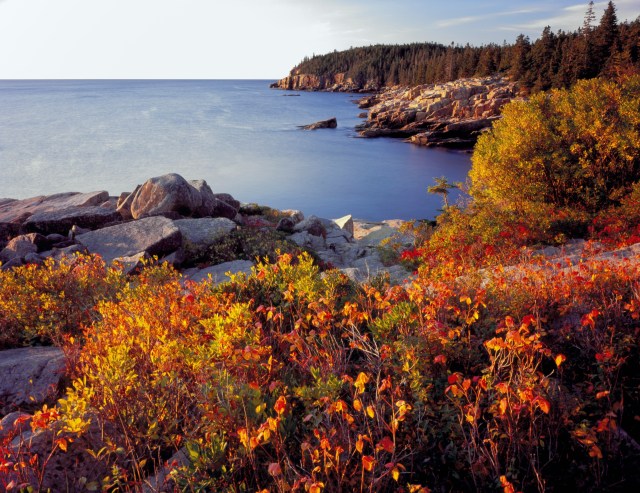
Start in stunning Acadia National Park where cliffs and ocean views are perfectly framed by the changing fall foliage. The Park Loop Road in particular offers beautiful vistas, especially around Jordan Pond and Cadillac Mountain.
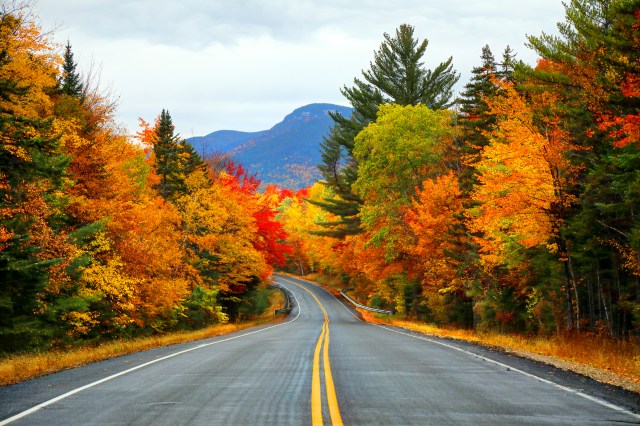
Next, head southwest into New Hampshire where you’ll enter the heart of the White Mountains. If timed correctly, the foliage will be breathtaking along the Kancamangus Highway, a 34-mile scenic byway that winds through the dense forest and over spectacular mountain passes. Take a respite at Sabbaday Falls or take in the views from Sugar Hill Overlook.
Wrap up your journey in Vermont where winding country roads, old barns and covered bridges create scenes out of a postcard. Make your way to Stowe and the Smugglers’ Notch Pass before continuing south to Woodstock. There, take in the town on foot as you pass historic homes, quaint shops, cozy restaurants and more framed by the falling leaves.
Lattes☕
In Maine, check out Acadia Perk for their wide selection of seasonal drinks and convenient proximity to downtown Bar Harbor.
In North Conway, New Hampshire, stop at The Moon Bakery & Cafe for a cinnamon-dusted cappuccino and house-made pastries.
While you’re visiting Stowe, Vermont, have a revitalizing cup of Joe from Black Cap Coffee, a women-owned specialty coffee shop famous for their maple latte.
In the ideal valet scenario, you pull up like one of the cool guys in the movies, toss your keys to the driver with a wink and ask him to “keep it close.”
What happens in reality? Not so smooth.
In what is often a confusing and sometimes hectic situation, many are left guessing when it comes to proper valet protocol. How much should you tip the valet? Do you tip at drop off or pick up? What we should do and what’s right to do is not always clear-cut.
We spoke to lifestyle and etiquette expert Elaine Swann, aka “The Etiquette Lady,” for her advice.
Although trusting a stranger with the keys of one of your most expensive possessions can be a bit unnerving, valet service is offered at high-end hotels and restaurants to elevate your overall experience at the establishment and can make it even more enjoyable.
Let’s be honest — it’s pretty nice to walk out of a restaurant completely full and not have to lift a finger to get your car. Even better when it’s pouring or freezing outside.
If you choose to take advantage of valet service (keyword: service), it is not a question of if you should tip, but how much to tip valet.
“It is always a good idea to tip the driver,” said Swann, who suggests leaving the gratuity when you return to pick up your car. Tips are commonly pooled so you don’t usually have to worry about tipping twice if the person who parked your car is different than the one who retrieved it.
Of course, if you want any extra attention, like if you want them to “keep it close,” a slightly larger gratuity beforehand is the norm. I’m pretty sure that’s how the cool guys in the movies make it look so easy. I don’t know about the wink though. Maybe you shouldn’t do that.
In general, how much to tip valet depends on the level of help and accommodation provided.
“The tip can be anywhere between three to five dollars depending on the service,” says Swann. Sometimes the valet will go above and beyond for you, carrying bags or gifts, going back to your car to get something you forgot, or even helping with directions and information about where you are going. “If they do anything for you other than just parking your car, then definitely give a larger tip.”
Also, consider the circumstances. A little extra during times of inclement weather or bitter cold is always nice.
Swann recommends checking in with the hotel or restaurant in advance to see if valet service is included or can be added to your credit card. For example, some hotels will allow you to add the valet tip to your room charge. But most of the time, tips are earned and collected by the valets themselves, so you want to make sure that you have enough cash on hand.
Naturally, common courtesy goes a long way in determining the level of service you will receive. Simply being polite helps the entire process go smoother for the valet and everyone in the lot.
Swann goes back to the basics, stressing the importance of saying “please” and “thank you” and establishing a friendly relationship with the valet. “If they’re wearing name tags use their first name so that way you have a connection with them. It will make them feel better about taking care of your car and taking care of you.”
To make parking as seamless possible, avoid distractions, stay alert and as Swann suggests, make eye contact with the valet as you are pulling in for direction. “If you’re looking around, getting distracted on your cellphone or talking to someone, you’re not paying attention. Making eye contact with that valet will help you in terms of getting instructions on where to stop your car.”
And finally, if you know you are going to valet park, turn down your radio, make sure the seat area is cleared of clutter, remove any valuables, and turn off the GPS and exit the navigation. Even if it’s just taking a minute to throw everything into the trunk, make sure your car is clean. “It makes it easier for the valet to get in and out without them having to worry about your phone charger hanging down … or having to fight with your GPS repeating and rerouting,” said Swann.
Tell us your tips on how to tip valet in the comments below.
This article has been updated and republished from a previous version.
It’s the time of year when visitors flock to U.S. national parks. While there may be 63 to choose from, certain parks are more popular than others during summer. Want to see America’s beauty with fewer crowds? AAA travel advisor Lori Reilly has been assisting travelers for nearly 30 years. She says knowing when to visit the parks and where to stay makes a huge difference.
There seems to be an uptick in travel to national parks. Why the spike in interest?
It does seem that more people are flocking to our national parks. As a AAA travel advisor, I often hear people say they travel to unplug and unwind, and our national parks offer those opportunities. Many travelers tell me they want domestic vacations that offer breathtaking views. Young people love showcasing the stunning scenery on social media, like Instagram and TikTok. With several national park programs offering free or discounted entrance fees, as well as many of the reservation systems ending, visiting these national treasures is becoming easier.
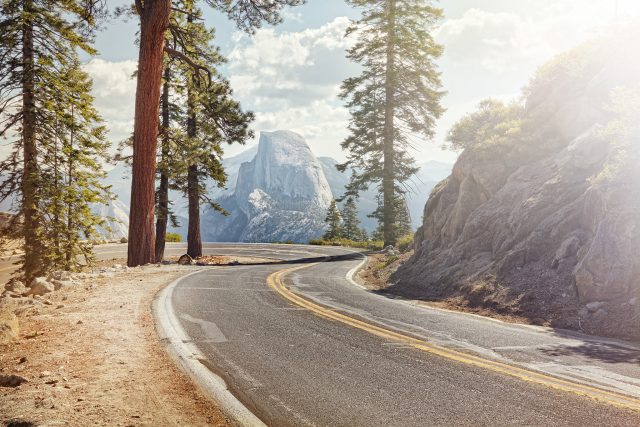
In the western United States, Yellowstone in Wyoming and Yosemite in California are two of the most popular. Yosemite attracts many domestic and international visitors. Both parks offer iconic scenery, from the majestic Half Dome and waterfalls in Yosemite to Old Faithful and the bison in Yellowstone.
In the eastern U.S., Acadia National Park in Maine is popular and one of the spots where you’ll be the first to see the sun rise in the east! Great Smoky Mountains National Park along the North Carolina/Tennessee border offers some of the best fall colors and a portion of the Appalachian Trail.
Acadia National Park
What are some lesser-known national parks for travelers who want to avoid big crowds?
North Cascades National Park in Washington is a beautiful, rugged park for those looking to get away from it all. It offers hiking and biking trails and opportunities for mountaineering and horseback riding.
For those really looking to disconnect, consider visiting Stehekin in North Cascades National Park in Washington. This lake community is only accessible by boat, foot or floatplane. Visitors can camp or stay at the Lodge at Stehekin, which offers beautiful rooms or private cabins.
Another lesser known, off-the-beaten-path park is Great Basin National Park in Nevada. Here you will find an array of activities from hiking, bird watching, fishing and stargazing. The park is home to Lehman Caves where you can take tours to view the stalagmites and stalactites. Great Basin also offers a number of astronomy events throughout the year.
What’s your advice for families visiting national parks with young kids?
Investigate the Junior Ranger program for the park you are planning to visit. Lot of parks have programs designed to enrich children’s experiences and kids can even earn patches and badges when completing tasks inside the park! Many of the programs have printable programs on their website that allow for planning in advance and increasing your child’s interest prior to arrival. Also, purchase your child a national parks passport to have stamped when traveling to the parks, especially if you have more than one park on your planned itinerary.
Another thing to consider: If you’re bringing snacks, be sure you have a way to pack your trash after you’re done eating. When walking on trails, garbage cans are not always readily available, so you may have to carry wrappers and other trash with you until you leave the park.
Where should people stay when they visit national parks?
While it is the most expensive option, I recommend visitors stay inside the national parks. It will save you time and maximize your visit to the park. People often only think about the distance from a hotel to the park entrance, but traffic is an issue as well. Lots of visitors trying to get in on the same day will cause your commute time to increase.
If staying inside the park is not an option, consider staying in an area that is not the main entrance of the park itself. For example, in Yellowstone, many travelers stay in Cody, just over an hour drive to the eastern entrance to the park. Another option is Jackson, just south of the Tetons National Park and approximately an hour and a half from the southern entrance to Yellowstone.
Glacier National Park
Most families travel during the summer because kids are off from school. But what are some other good times of the year to visit national parks?
Autumn is a lovely time to visit Acadia in Maine, Glacier in Montana, Cuyahoga Valley in Ohio and Shenandoah in Virginia for cooler weather and fall foliage. Winter is a great time for visitors interested in skiing and snowshoeing up north and for those looking for milder temperatures in the parks in the south.
What’s your favorite national park?
My favorite national park is Yosemite, especially in the fall when the trees are beginning to turn.
Yosemite offers so many incredible views, from the tunnel view as you first enter the park, to Glacier Point giving unparalleled views of Half Dome, a massive rock formation. We enjoy the trails that go out to Mirror Lake or the Mist Trail that takes you right next to Vernal Falls. We love the views of the Merced River and Phono Bridge, which reminds me of a bridge in a fairytale – you almost expect a troll to be living under it! Another great place to get views of Half Dome is from Stoneman Meadow, where in the early evening before sunset you may find deer eating. A visit close to sunset can make for some stunning photographs!
There was a time when drivers had to trudge outside on cold winter mornings to give their cars a head start and warm them up for a while before leaving.
Fast forward to modern cars and improvements to fuel and fuel systems and you may be wondering: Do you still need to warm up your car? Not really.
Synthetic oil and fuel injection technology have eliminated the need for extended warm up times, said Robert Sinclair, senior manager of public affairs for AAA Northeast. Synthetic fuel can effectively lubricate the engine quickly even in frigid weather.
So, how long should you warm up your car in winter?
“After starting the vehicle, in the time that it takes to put on the seat belt, the vehicle will be ready to drive,” Sinclair said in an interview with Fox Weather.
Allowing just enough time to warm up the interior and defrost the windshield is sufficient, according to Consumer Reports. Thanks to upgrades in technology, it takes only 20 to 30 seconds to fully lubricate an engine.
At the same time, avoid going from zero to 60 immediately.
“The key is to drive the vehicle gently until the engine reaches operating temperature, which a gauge, if the car is equipped with one, will show. In fact, gentle driving helps to circulate the engine oil more effectively and warm the transmission and related components which remain cold while idling,” according to Sinclair.
Older cars that still have carburetors do need to warm up, he added. And if the car has trouble starting or doesn’t start at all, it’s time to have the battery checked.
AAA Car Battery Service will come to you wherever you are, seven days a week, to test or replace your battery.
Note: Due to high demand because of cold weather, the wait times for mobile battery service may be longer than usual.
Do EVS Need to Warm Up?
When it comes to electric vehicles, you should warm them up in freezing weather to preserve battery power and range. They may have the latest technology, but that technology prefers to be warm.
EV batteries deplete more rapidly in colder temperatures. Chemical reactions that store and release energy in the battery slow down when the temperature drops. Because EVs don’t have engines to produce heat, the heating system also requires a lot of energy from the battery and reduces range. Using the HVAC system on a 20-degree day cuts the range by about 41%, according to AAA research.
The best way to prepare your EV for wintry weather is to start it while it is still plugged into your home charger so you can warm the interior without draining the battery. Plus, you can turn down the heat while you are driving and preserve driving range.
As soon as the first snowflake falls, homeowners are already thinking about how to remove the ice and snow from their property. But did you know that snow melt solutions, especially rock salt, can damage your outdoor surfaces?
When spring arrives, and the effects of the brutal winter become more apparent, homeowners are often surprised to see pitted driveways, cracked walkways and deteriorated wood decking.
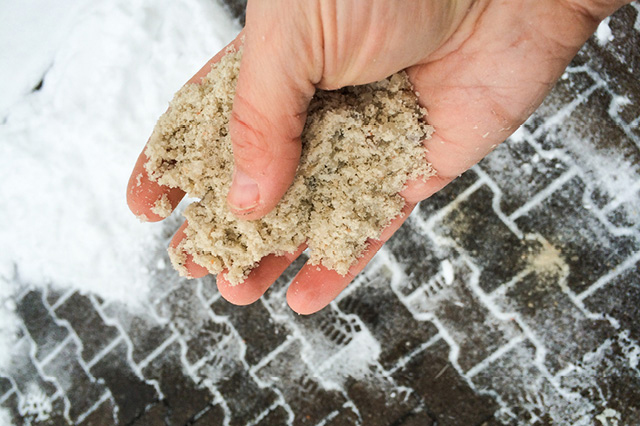
Here is our guide to the most common forms of ice melt, and the pros and cons of each, according to Consumer Reports.
Calcium Chloride
This is the fastest-acting ice melt of the bunch. If you’re a homeowner in a time crunch, this is the ice melt for you. But be cautious – calcium chloride can harm grass and plants when over-applied, and can cause minimal to moderate damage to asphalt and concrete.
Sodium Chloride
Also known as rock salt, sodium chloride is the most common – and inexpensive – choice. But it’s also the most likely to damage your concrete, asphalt, wooden, brick, stone and metal surfaces. It’s especially dangerous to newer concrete; Consumer Reports recommends that you don’t use rock salt on concrete less than 1 year old. In addition, rock salt is lethal to pets if ingested.
Magnesium Chloride
This is another snow melt to use if you’re pressed for time. It’s environmentally-friendly, safer for pets and more effective than rock salt. However, magnesium chloride can cause even more damage to asphalt or concrete than rock salt.
Potassium Chloride
Pet owners often choose potassium chloride because it’s one of the safer ice melt options. As far as benefits go, potassium chloride is more or less the same as magnesium chloride, but safer for your asphalt and concrete. However, exercise caution if you have a pet with kidney disease; ingesting this ice melt can be lethal to pets that suffer from the disease.
Urea/Carbonyl Diamide
This is also a common snow and ice melt for pet owners. It’s also the least likely to cause damage to your asphalt or concrete, and one of the most inexpensive options next to rock salt. However, it’s the least effective – with urea, you sacrifice efficiency for caution.
Winter in the Northeast is anything but dreary thanks to vibrant winter festivals that light up the season with frosty cold-weather fun. From dazzling ice sculptures to thrilling snow sports, these festivals celebrate all things winter and offer a much-needed escape from the dreary doldrums of the season.
So, get ready to bundle up and join in the excitement of these nine magical winter celebrations.
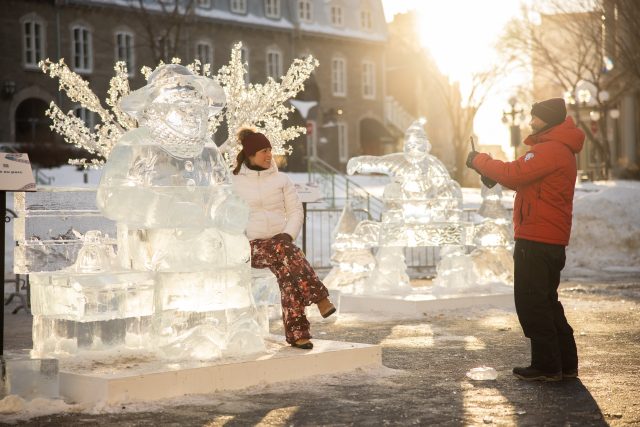
The annual Fire & Ice Festival in Putnam is the place to go for all things fire and ice. We’re talking stunning ice sculptures and mesmerizing ice carving demonstrations, as well as fire-breathing acts. Glowing fire torches light up downtown Putnam, showcasing more than five dozen intricate ice carvings. This festival hosts the largest single ice block competition in all of New England. Warm up by the cozy fire pits or the heart-shaped bonfire. Epic fire acts and roaming entertainers, like stilt walkers and magicians, make perfect photo ops. There’s even a super-size igloo to explore. A performance by Forever Young, an acoustic tribute to the music of Neil Young, is scheduled for this year.
Get ready for a frosty adventure complete with ice sculptures, a polar plunge at Camden Harbor and an adorable dog fashion show at the annual Camden Winterfest, which is put on by the Camden Public Library. Watch talented professional ice carvers or join in on the fun by signing up to create your own sparkling ice sculpture from a 300-pound block of ice. Kids will love the face painting and winter crafts, making it a perfect family outing. When you need to warm up, there will be plenty of delicious hot food on hand, like hot dogs, cookies, chili and toasty hot chocolate.
A winter wonderland awaits at the Lowell Winterfest. This glorious celebration of winter features live music, ice carvings, magical fire sculptures and plenty of roaming street performers to keep you entertained. One of the festival’s standout events is the Soup Bowl Competition, in which local restaurants showcase their best soups and chowders, and you get to vote for your favorite. It’s a fun and flavorful way to warm up during the frosty festivities. There’s so much more too, like a scavenger hunt, ax throwing, food trucks and a chocolate festival. You may just want to block off your entire weekend for this festival.
Get ready for some winter fun at the Concord NH Winter Fest. This family-friendly New England winter festival brings the magic of winter to life and features an ice carving competition right on the State House lawn. Revel in dazzling ice sculptures, food trucks, a beer garden and a variety of fun outdoor activities, like curling, snow-ga (that’s yoga in the snow) and wine tastings. Don’t forget to bring your best dance moves for the family dance party, as well as your doggo for the doggie meet and greet, because even pups deserve some winter fun. If you miss festival weekend, don’t worry, the stunning ice carvings will be on display as part of a weeklong ice sculpture garden.
The annual Fire & Ice Festival wows festival-goers with ice carving demonstrations, where talented sculptors transform blocks of ice into stunning masterpieces right before your eyes. One of the festival’s highlights is the Chili Cook-Off, where local chefs compete to wow — and warm up — hungry festival attendees with the very best chili. Come hungry, since you’ll definitely want to sample them all and cast your vote for your favorite. There’s plenty of fun for the kiddos too, like fire engine rides, a petting zoo, kids’ crafts and dogsled demonstrations.
The Saranac Lake Winter Carnival is one of the oldest winter celebrations in the U.S., dating all the way back to 1897 when the festival began as a way to bring people together to shake off the winter chill and celebrate outdoor sports and activities. The carnival features an iconic ice palace, fireworks, a curling competition, live music, ski races, a royal court and a frying pan toss. There’s something for everyone at this 10-day celebration in the heart of New York’s Adirondacks. One of the carnival’s cherished traditions is its collectible buttons, each year featuring a unique design to commemorate the festivities.
The Newport Winter Festival is a 10-day celebration packed with live music, an ice carving demonstration, a comedy show, a hot drink contest and plenty of kid-centric activities, like a science show, a princess party and a reptile show. The annual Mac & Cheese Smackdown, where local restaurants battle it out for the title of best mac and cheese in town, is a festival favorite. Come hungry since there’s also a Chili Cook-Off. With over 150 events spread across 10 days, you’ll no doubt leave the winter blues behind.
Stowe Winter Carnival. Photo courtesy of Go Stowe.
The Stowe Winter Carnival is a fan favorite, boasting a range of winter activities, like ski-in movies, a snow volleyball tournament, and of course, ice carving demonstrations with wildly talented ice sculptors. The first winter carnival was held in 1921 as a way to lift the spirits of locals during the cold winter months. It took a break for a few decades, but was revitalized in 1974 and has been going strong ever since. Today, ice carving is the star of the show. Festival-goers can even sign up for classes to learn the tricks of the ice carving trade.
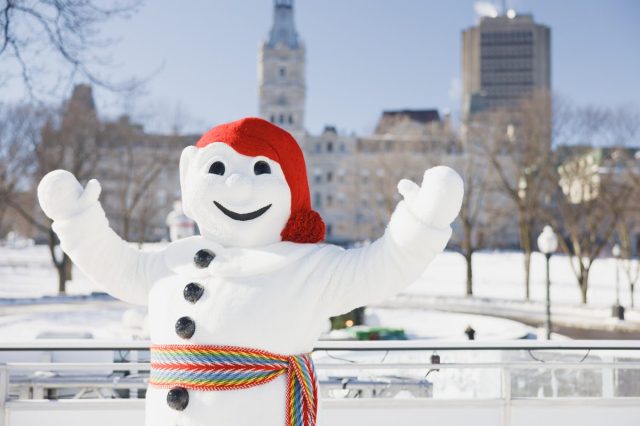
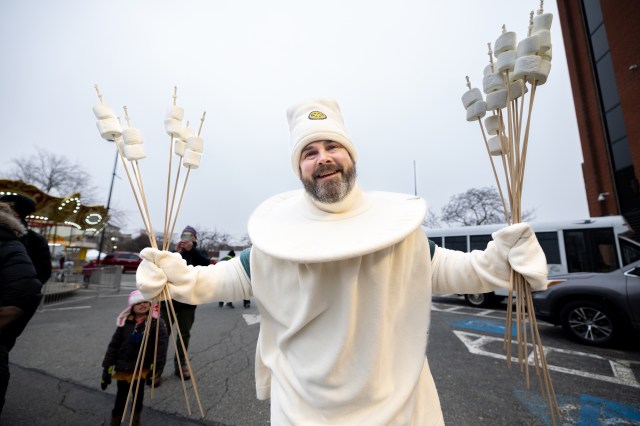
For extra winter fun, cross the border into Canada for Carnaval de Quebec, a spectacular winter festival that’s been enchanting visitors for more than 70 years. This iconic festival, billed as the world’s largest winter carnival, features live music, ice and snow sculptures, magical evening parades, an ice palace and everyone’s favorite snowman mascot, Bonhomme. It’s a magical event that showcases the vibrant culture of Quebec, making it a must-visit for winter enthusiasts. If you’re looking for souvenirs, there’s plenty of merch, like beanies, blankets and scarves.
Tell us your favorite winter festival in the comments below.
With temperatures predicted to plummet this weekend and the potential for a major snowstorm in the forecast, AAA is encouraging drivers to understand the impact of these extreme conditions on their vehicles and homes — and prepare accordingly.
Know How the Coldest Temperatures Affect Vehicles
Freezing temperatures can negatively impact vehicle performance in several ways, including:
Drained batteries: A typical battery requires 30% more power to start a vehicle when the temperature reaches 32 degrees. Additionally, a battery can lose up to 50% of its capacity when the temperature approaches zero degrees. This combination of cold-diminished batteries requiring more energy to start a vehicle is why many cars fail to start during cold snaps. Consider having the battery and charging system tested at an AAA Approved Auto Repair facility if your battery is older than three years old or you’ve noticed recent difficulty starting your vehicle in the cold. If you have a dead battery and need a replacement, AAA members have access to mobile car battery replacement.
Decreased tire pressure: Cold also negatively affects tires, which lose about one PSI (pound per square inch) of pressure for every 10 degrees the air temperature drops. Tires also normally lose one PSI per month due to aspiration. Before hitting the road, drivers should make sure tires are properly inflated according to information on the sticker inside the driver’s door jamb.
Frozen fuel lines: Any moisture in a vehicle’s fuel lines can freeze, preventing gasoline from reaching the engine. Drivers should keep their gas tanks at least half full during the winter so that there will be no room for air or water vapor. If drivers suspect there is water in the fuel tank, they can use a gas line antifreeze.
Stay Safe on the Roads, and Stay Home if You Can
AAA recommends travelers consider adjusting their travel plans, if possible, to avoid driving during or immediately after peak periods of snowfall. If you really don’t have to go out during or right after a storm, don’t! Even if you think you can drive well in bad weather, it’s better to avoid taking unnecessary risks by venturing out. Otherwise, driving in ice and snow requires an adjustment to driving habits:
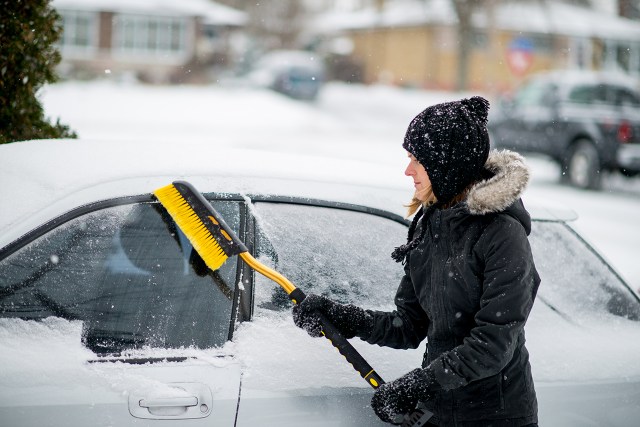
Remove snow and ice from their vehicles before driving. This is critical for maximum driver visibility and to prevent blowing snow and ice from possibly blinding other drivers.
Slow down. Always adjust your speed down to account for lower traction when driving on snow or ice. Curbing your speed provides you with more time to react.
Accelerate and decelerate slowly. Apply the gas slowly to regain traction and avoid skids. Don’t try to get moving in a hurry and take time to slow down for a stoplight. Remember: it takes longer to slow down on icy roads.
Increase your following distance. Allow five to six seconds of following distance between your vehicle and any vehicle in front of you. This space allows time to stop safely if the other driver brakes suddenly.
AAA also urges all drivers to keep a cold-weather emergency kit in their vehicles, complete with warm clothing, blankets, extra water and food, extra chargers, an ice scraper and any medications they may need in the event of an emergency.
Protecting Your Home From Winter’s Worst
The frigid temperatures can also bring winter-related damage for homeowners. The most common types of insurance claims related to severe winter weather include frozen pipes, ice dams building up along roof edges, damage from falling trees and limbs and even house fires.
AAA Insurance recommends that all homeowners take these steps to effectively winterize their homes for safety and to avoid costly repairs:
Clear gutters and downspouts of debris to allow melting snow and ice to flow freely. To help prevent ice dams from forming, keep the attic well-ventilated and the attic floor well-insulated. Heat tape may also help prevent ice buildup and can facilitate melting.
To prevent pipes from freezing and bursting, insulate exposed pipes, seal cracks in outside walls near pipes, keep cabinet doors on exterior walls open and keep a slow trickle of water flowing through unprotected pipes during cold spells.
Know the location of the main water shutoff valve: If your pipes freeze, the faster you shut off the water, the better chance you have of preventing them from bursting and causing major damage.
Ensure your heating system is up to snuff by having the furnace, boiler or chimney serviced at least once a year. Be sure to have ducts, vents and filters inspected.
Check your smoke and carbon monoxide detectors: Residential fires and carbon monoxide poisonings increase in the winter as people rely on indoor fires and heating systems. Detectors should be checked at least twice a year.
Follow all safety guidelines when using supplemental space heaters to prevent electrical fires or fires caused by the placement of heaters too close to flammable materials.
Trim trees and remove dead branches: Ice, snow, wind and rain can cause weak trees and tree limbs to fall and damage your car or home – or fall on people walking on or near your property.
Clear your driveway and walkway of snow as soon as possible to prevent slips and falls.
Hobbies like crocheting, collecting or craftmaking evolve with the times giving them long-lasting appeal. Others, like flagpole sitting, come and go, never to return. Today’s pastimes may have surprising longevity — like 30 years of Pokemon. But will they outlast this trending word guessing game?
In WordroW, like Wordle or Lingo, you get a limited number of attempts to correctly guess the hidden term, in this case, the names of some of today’s favorite pastimes.
1. Enter your guess. After submitting your guess, you will receive hints based on the color of the letters:
Green: The letter is correct and is in the correct position in the target word.
Yellow: The letter is correct but is in the wrong position in the target word.
Gray: The letter is not in the target word at all.
2. Using this color feedback, refine your next guess.
3. Continue until you correctly guess the word or run out of attempts.
For more instructions, click the three horizontal lines in the top left corner of the game.
With predicted temperatures well below freezing and a major snowstorm predicted for much of the Northeast this weekend, AAA is encouraging drivers to understand the impact of these extreme conditions on their vehicles — and prepare accordingly.
Freezing temperatures can negatively impact vehicle performance in several ways, including:
Drained batteries: Vehicle batteries lose 30% of their power when the outside air temperature hits 32 degrees. At 0 degrees, batteries can drain 60% of their cranking power. This is because the cold slows the chemical reaction that creates an electrical charge, which makes starting a vehicle more difficult — especially with batteries that are three to five years old or those that previously went dead and needed a jump-start. If drivers have batteries older than three years or that have been previously jump-started, they should have their battery tested and, if necessary, replaced.
Decreased tire pressure: Cold also negatively affects tires, which lose about one PSI (pound per square inch) of pressure for every 10 degrees the air temperature drops. Tires also normally lose one PSI per month due to aspiration. Before hitting the road, drivers should make sure tires are properly inflated according to information on the sticker inside the driver’s door jamb.
Frozen fuel lines: Any moisture in a vehicle’s fuel lines can freeze, preventing gasoline from reaching the engine. Drivers should keep their gas tanks at least half full during the winter so that there will be no room for air or water vapor. If drivers suspect there is water in the fuel tank, they can use a gas line antifreeze.
Extreme winter weather also impacts electric vehicles; the main issue is that cold temperatures may reduce the distance an EV can travel on a full charge. Research by AAA found the average EV’s driving range decreases by 41% when the outside temperature dips to 20 degrees and the car’s heating system is on.
EV drivers can improve their vehicle’s performance in the winter by utilizing the following tips:
Don’t let the battery charge drop too low: An EV reserves about 15-20% of its charge capacity to heat the battery itself, so it’s critical to be well above that level before hitting the road.
Use heat efficiently: Warming an EV creates a significant drain on the battery. If the vehicle has heated seats and steering wheels, that functionality offers a more efficient option to provide warmth than heating the entire cabin. Some EVs connect to a smartphone app that allows drivers to warm the vehicle’s cabin to an optimum temperature at a preset time before use, positively affecting range and leading to consistent vehicle performance.
Park your electric vehicle in a garage, if possible: Garage storage helps to ensure that harsh weather conditions do not affect the vehicle and helps maintain a warmer temperature, which will aid battery performance. And, with zero tailpipe emissions, EVs can be safely warmed up while indoors.
Plug in when parked for extended time periods: Keeping your vehicle plugged in helps maintain battery health and prevent range loss. This also helps to keep the battery above freezing to help optimize battery performance; this occurs whether the vehicle is actively charging or not.
Ensure tires are at the proper pressure: Due to their weight, tire pressure is critical to an EV’s handling and performance. Proper tire pressure also helps to maximize range and ensure the correct amount of tire surface grips the road. Overinflated or underinflated tires can lead to range degradation and compromise safety.
Slow down: Higher speeds can negatively impact range in all types of weather. More power is needed to overcome the increased wind resistance, especially in denser, colder air.
Know your vehicle: Some EVs have one motor and function as rear-wheel drive. This can lead to handling challenges in slippery conditions. Dual-motor EVs function as all-wheel drive, providing superior traction and performance.
Drivers of all vehicles should always remove snow and ice from their vehicles before driving. This is critical for maximum driver visibility and to prevent blowing snow and ice from possibly blinding other drivers. For EVs, removing snow is important to reduce weight and air resistance while driving, both of which can negatively impact range.
AAA also urges all drivers to keep a cold-weather emergency kit in their vehicles, complete with warm clothing, blankets, extra water and food, extra chargers, an ice scraper and any medications they may need in the event of an emergency.
Is a AAA membership worth it? For generations, members have sworn by the peace mind that AAA Roadside Assistance provides, but there are even more perks and services that can make your annual membership worthwhile.
How Much Is AAA Membership?
Basic membership starts as low as $4.30 per month with a one-time $15 enrollment fee. Plus and Premier memberships go up incrementally (as do the perks), but even the highest level of membership is never more than $14 a month.
Teen drivers in your home between the ages of 16 and 19 can receive a free Associate membership for one year. Family members ages 20 and up are eligible for the same offer.
Don’t have a car but still want to enjoy AAA membership benefits? AAA Everyday membership gives you everything but roadside assistance for just $2.50 a month.
AAA Roadside Assistance may be more comprehensive than what you can get from a dealership or your insurance company. Your AAA membership will cover you in any car that you are driving or riding in. And the perks don’t end at the roadside.
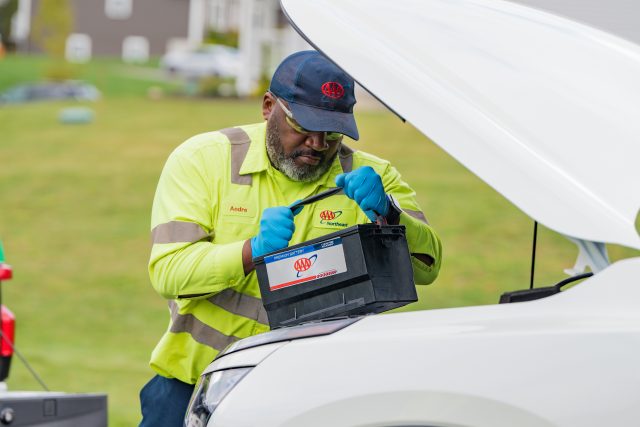
AAA Battery Service can get you back on the road in a hurry. Technicians provide on-site battery testing and replacement wherever you are. Batteries come with a three-year warranty and members get a $25 discount.
For car repairs and maintenance, visit your nearest AAA Approved Auto Repair facility. Members can save up to $75 per visit — that pays for your membership!
AAA Manhattan branch. Photo by Adam Glanzman.
Branch Services
From passport photos to foreign currency exchange, there’s a lot your can do at your local AAA branch.
Select locations even offer DMV and RMV services. Make an appointment to renew your driver’s license or registration and take advantage of other offerings.
In the branch or online, you can also book your next vacation with a AAA travel advisor. These travel pros have been around the world, are experts at planning trips and will work to find you the best deals and exclusive member savings. It’s a free service with your membership, so take advantage!
AAA has policies for all of your insurance needs: Not just for auto, home and life, but also for jewelry, pets, small businesses and even classic cars. Members can save an average of $506 on car insurance over other plans. Sleep well knowing you have insurance for a special event or even an engagement ring. Agents will work with you to get you the best coverage at the best price.
Are you ready to buy a home or car? Or maybe you’re getting ready to pay for college tuition? Let AAA’s Financial Services team help you find the best loan or refinance an existing loan.
Members can call, chat online or meet with a counselor in a branch.
Discounts and Rewards
AAA members can enjoy exclusive savings on all of the services mentioned above, plus discounts on everything from entertainment and amusement parks to auto parts and restaurants.
Need a ride for your next road trip? AAA members get exclusive savings on Hertz car rentals.
More
All AAA members get free identity theft monitoring from Experian with Protect My ID.
You can also work with AAA employees on projects in your community, such as beach cleanups and volunteering in a food pantry.
So, what do you think? Is a AAA membership worth it? If you are already a member, what are some of your favorite benefits? Tell us your AAA story in the comments below.
This article has been updated and republished from a previous version.
In a time of economic uncertainty marked by soaring prices, Americans are nevertheless optimistic about the financial outlook for 2026: 63% said they expect to do better financially in 2026 than in 2025, according to a NerdWallet survey. And 82% reported feeling either partially or very confident about meeting 2026 financial resolutions, noted another survey from 401K Specialist magazine.
Americans’ top financial goals for 2026 include paying down debt, increasing income and saving more, noted Edward Jones.
Whatever the goals, whether someone is aspiring to save more money, buy a car or a house or pay down student loans, they should start by assessing their income and spending, according to Ted Lyons, vice president of financial services for AAA Northeast.
Build That Emergency Fund
One of the places those savings should go is an emergency fund. This is money put aside in the event of an unexpected expense, such as a major car repair, a medical procedure, a broken appliance or a job loss. Some experts say you should have enough money saved to cover six months of household expenses, but if you can’t manage that, base your savings on what you spent on your last significant expense. One way you can guarantee regular savings is by having money taken out of your paycheck each time you are paid. Without an emergency fund, if something breaks, you will be forced to turn to credit cards and could start accumulating debt.
When it comes to meeting specific financial goals, such as buying a house or car, first take stock of your financial situation, Lyons said. Tally how much you currently earn, spend and save.
“Ideally, you don’t want to make rash decisions on any of these large purchases,” he added. “If the car is acting up, start doing research. Look into your credit report to make sure it’s accurate and resolve any items that may be on your report in error.”
Decide if you want to lease or buy a car. Once you know, determine what you can afford, factoring in other expenses, such as gas, maintenance and insurance.
Research cars, get member pricing on in-stock dealer inventory and apply for an auto loan all in one place with the AAA Auto Buying Program.
Identify the car you want and start looking at what they are selling for. Shop around for the best loan interest rates and then get pre-approved for a loan.
“If you do all those things, you can be prepared to act when that unicorn shows up,” Lyons said. Otherwise, if you see a car on a lot that you like, but haven’t researched or still need financing, you will be at a disadvantage to negotiate. If you don’t act and leave to do your homework, the car may be gone when you return.
Unfortunately, when it comes to cars, you don’t always have time to plan. If your car suddenly stops working or is totaled in a crash, you may have little choice when it comes to securing a loan or maybe even getting your first-choice car. Although there is the potential to refinance a higher-interest loan you may have taken with the dealer.
The process is similar if your goal is to buy a house. First determine what you can afford. The total value of the house should not exceed three to five times your annual household income, according to Fidelity. Saving money for a down payment is critical, added Lyons. The larger your down payment, the lower your monthly mortgage payment. Pay off credit cards balances, starting with the ones with the highest interest rates, to improve your credit rating and enable you to save more money.
Shop around to get the best mortgage rate, and if you can, get preapproved for a mortgage. Buyers need to be ready.
Refinancing private student loans is another issue that gets a look as a new year starts. Unfortunately, the current interest rates for private loans are likely higher than what customers already are paying, said Donald Kerr, director of student lending and college services for AAA Northeast. The interest rates for a private student loan currently start at 2.89%.
If you still want to consider refinancing, research lenders to find the best interest rates. A higher credit score is usually necessary to get the lowest rate. If you have multiple loans, consolidating them into one payment can save money and make repaying easier. Once you are approved for a loan and complete any necessary paperwork, the new lender will pay off the loan and set you up with a new rate and payment terms.
If you have a federal student loan, refinancing it usually is not advantageous, Kerr said. You may get a lower rate, but you will lose the protections and perks that come with a government loan, such as the opportunity to apply for deferrals and loan forgiveness programs.
Learn about affordable and flexible student loan options with AAA.
Whatever your financial goals, AAA Northeast is available to help. Contact AAA Financial Services.
Did you set any financial resolutions for the new year?
This article has been updated and republished from a previous version.
From covering the cost of funeral and burial services to contributing to your child’s college fund in your absence, the protections life insurance provides for your family are far-reaching. Without it, you risk leaving your loved ones with significant financial challenges.
Plus, the earlier you start thinking about life insurance, the less you can expect to pay. Below, we’ll explore what life insurance is, the best time to purchase it and the cost of not having a life insurance policy.
What Is Life Insurance?
Life insurance is a type of coverage that protects your loved ones from the costs associated with your death. It can also help fill the financial gap left when your income is no longer available. Life insurance is a key aspect of retirement planning that’s often overlooked.
Over half of Americans believe life insurance costs more than they can afford, according to LIMRA, but often, this isn’t the case.
The Cost of Not Having Life Insurance
From funeral arrangements to unpaid debts and end-of-life care, the unfortunate reality is that there are often significant costs when a person passes. Life insurance can help alleviate this burden for loved ones. Here’s a breakdown of the cost of not having coverage.
Funeral and Burial Costs
The cost of cremations, burials and services is often significant — the average funeral with a burial or cremation is $7,848, according to the latest stats from the National Funeral Directors Association. Choose to be buried in a different state, and this can increase even more.
Life insurance can relieve this financial burden. In some instances, it can even help cover the cost of travel expenses so your out-of-state loved ones can say goodbye. If your family can’t afford to cover the cost of a funeral, a coroner may perform a cremation without holding a family service.
Unpaid Loans
Without life insurance, the burden of mortgage debts, car loans or unpaid student loans may fall on your loved ones. With car loans alone averaging around $50,000, according to Consumer Reports, this cost can be significant.
End of Life Care
In some cases, end-of-life care may be necessary. Without life insurance, your loved ones may be responsible for any outstanding costs.
Family Members Dependent on Your Income
Without your income, your family may not be able to continue living in the family home. Stay-at-home partners should not underestimate their monetary value, either. In your absence, additional child care, cleaning or meal preparation services may be necessary. Life insurance can help cover the cost of these essential services, relieving your family of financial stress.
Children’s Education
In the event of your passing, you may not be able to accumulate the savings you’d planned for your child’s education. In your absence, life insurance benefits can help fund their education.
When Should You Consider Life Insurance?
The cost of not having insurance is significant. But is life insurance for everyone? And when is the best time to buy? We’ll dive into these questions below.
When You’re Young
Young people need life insurance, too — in fact, it’s often the best time to buy. For a healthy, 20-year-old nonsmoker, life insurance averages only $14.75 per month. After this, premiums increase an average of 8% to 10% per year. Plus, the younger you are, the easier your approvals will be.
You Have Debt
It’s not unusual to pass away with unpaid debt. With Gen Z’s total debt averaging over $34,000, according to Experian data, this is unlikely to change. To avoid passing debt to your loved ones, consider a life insurance policy.
Others are Dependent on Your Income
If your income suddenly disappeared tomorrow, could your family afford to stay in your current home? Or would your spouse be able to retire as planned if you were no longer in the picture? In some cases, your income may be essential to keep your family afloat.
You’re Not Self-Insured
Some people may choose self-insurance, meaning they save money to protect their family after they pass. If this doesn’t apply to you, life insurance is likely your best option.
Facing up to the reality of life after we’re gone can be overwhelming. But failing to plan for your family’s future can put them at a major financial disadvantage.
Fortunately, once you’ve purchased a life insurance policy, you can rest assured knowing your family will be protected. Purchase life insurance when you’re young, and your policy may even cost less than your favorite streaming service.
Be sure to reassess your policy if and when you incur new debt. This will help ensure adequate coverage in the event your policy goes into effect.
When AAA Northeast roadside technician Kenny DiPina responded to a call for a flat tire from a member in Rhode Island, he never expected to be featured in a newspaper article.
To DiPina, it was just business as usual. But to Providence Journal columnist Mark Patinkin, it was service worthy of widespread gratitude.
Patinkin, a AAA member for more than 20 years, was so impressed by DiPina’s calm demeanor and swift action that he wrote about the encounter in his weekly column. He shared the full story on Facebook. Providence Journal subscribers can also read the story here.
The story unfolded just as he wrote, Patinkin said. He was driving through a Providence neighborhood when he hit a sharp curb that ripped apart his tire.
“Thump. Flat,” Patinkin recounted.
He called AAA. The member service counselor asked if he had a spare tire, an easy replacement that would get him back on the road quickly. He told them yes. But when he looked in his 2026 Honda CR-V Hybrid, all he found was “just one of those useless inflator kits,” he said.
Now he needed a tow, and he was told it would be about an hour.
“Then Kenny arrives early. Calm, upbeat, reassuring,” Patinkin said. “He tells me he won’t leave me stranded. He finds a nearby tire shop with a matching used tire for $65, loads my car and gets me there fast.”
And just like that, a bad day turned into a good one.
Before leaving, DiPina asked if Patinkin was OK
“I am. Because of him,” Patinkin wrote.
In the four years DiPina has been a technician for AAA, he has treated every member the same way.
“It’s super nice to engage with someone the way I engage with everyone every day and have them feel like it was special,” DiPina said.
But not everyone is like Patinkin.
“Not every person I get is a journalist,” DiPina said. “Otherwise, how would I know how much of a difference I made without his article?”
DiPina appreciated the recognition and reflected on the bigger picture.
“I think we (AAA) make a big difference in how breakdowns go,” he said. “This is like the worst moment for some people, and you’re going to remember this for the rest of your life.”
As Patinkin expressed, these efforts should not go unnoticed.
“We take for granted the people who show up when our day suddenly collapses,” Patinkin wrote, closing with “Thank goodness for the Kenny DiPinas among us.”
For more stories like this — or to share your own — visit “Hey, AAA!,” our collection of member-submitted emails, photos and videos that capture the real moments AAA has been a part of.
Photo credit: Mark Patinkin; Courtesy of the Providence Journal.
Forget about new year, new you — how about new year, new hobbies?
Trying a new hobby can help you relax, learn something, get in shape or even make friends.
Today’s hobby choices are not limited to legacy pastimes, such as stamp collecting, birdwatching or fishing. Not that there is anything wrong with those. People are thinking outside the hobby box, taking up everything from tossing axes to throwing themed dinner parties, so finding something that interests you should be easy.
The Benefits of Having a Hobby
Hobbies have numerous physical and mental health benefits, according to UCLA health. These include boosting your mood, improving your overall health, reducing your risk of chronic diseases and enhancing your cognitive abilities, not to mention the perks tied to specific activities.
Before choosing a hobby, reflect on your interests, goals, strengths, what you enjoy doing and the type of pastime that interests you. Do you want to get in shape, meet more people, develop a skill or just need a reason to quit streaming at night?
Start by revisiting the leisure activities you enjoyed when you were younger and see if you want to pursue any of those interests. Also ask friends and relatives for suggestions and why they enjoy their hobbies.
8 New Hobbies to Try
Painting
Besides being relaxing, painting is good exercise for your hands and fingers and is a way to boost creative thinking and problem-solving skills. It is also inexpensive and provides artwork for your home and gifts for others. If you want to socialize, attend or host a paint night, where people often snack and sip while they paint. Well-known people, like former President George W. Bush, took up painting as a hobby later in life.
Knitting and Crocheting
Studies have shown that knitting and crocheting benefit both the mind and body. The movements help keep hands and fingers nimble and learning complex stitches and patterns challenges the brain. Knitting and crocheting have also been shown to reduce stress and lower blood pressure. Besides that, you don’t need much to get started and you can knit and crochet almost anywhere. Check in your community for in-person classes that teach knitting and crocheting or learn from online tutorials. Plus, once you start completing projects, they can be given as gifts or donated.
Running
Of course, running has physical benefits — burning calories, increasing stamina, building muscle and decreasing your risk for heart disease. It also is a great stress reducer, releasing endorphins that help regulate mood. Running outside is even more beneficial, allowing you to escape from work or home pressures, get a taste of nature and a dose of vitamin D if it’s sunny. Plus, the initial investment in equipment is minimal. Listen to this episode of our podcast “Merging Into Life” to learn more about getting started as a runner.
Cooking
Cooking can be more than just getting food on the table. It’s a low-cost, creative, practical hobby that can involve the whole family. Not to mention, cooking reduces stress and can improve your well-being, since you will know everything that goes into your food. If, initially, you find cooking stressful, make sure you have all the ingredients and tools you need before starting a recipe. Experiment and develop your own dishes or add personal touches to some of your favorites. Or pick a favorite cuisine and focus on that. Get inspired by some of the trending recipes on TikTok.
Exercising
Exercising and going to the gym can often feel excruciating, but the trick is to find a workout you really enjoy. If you like music and being around people, consider aerobics, Zumba or dance. If not, pop in your earbuds and start cycling or hit the treadmill. Once you get into a routine and start to see results from regular exercise, such as more energy, better mood and more-toned muscles, continuing will be easy. Challenging yourself with goals, such as spending one more minute on the treadmill or completing another repetition also builds confidence and a sense of accomplishment.
AAA Northeast members can find their perfect gym with the Active&Fit Direct™ Program, which provides access to more than 12,700 gyms, wellness coaching and workout videos for a monthly fee of $28. There are no long-term contracts, so it’s easy to change gyms. After a year, members get back 10% of their membership fees.
Traveling
Some consider travel more of an interest than a hobby, but either way, it’s a wonderful way to spend your time. If you are new to traveling or plan to expand your horizons, AAA Travel can help you plan every aspect of a trip: booking flights, hotels, cruises and things to see and do. Experiencing new places spurs personal growth and appreciation of other cultures. It expands your knowledge base, recharges you and creates indelible memories.
Travel can also inspire another hobby — photography. No vacation is complete without a collection of stunning photos of the places you don’t want to forget. Photos give you a chance to tell stories and see the world differently. Research cameras to see which type is best for you. Mobile phones have excellent cameras, but you may want something more.
Simple Sculpting
You can create permanent works of art in 24 to 48 hours with air-dry clay, which doesn’t require a kiln. Clay kits with tools and paints, like this one, make it easy to start. Your air-dry clay creations can include magnets, jewelry and small trays. A few cautions: Objects made with this type of clay are not waterproof, cannot hold food and can be fragile.
Rock Climbing
If you can’t picture yourself dangling over a cliff, no worries. Indoor and outdoor rock climbing have been growing in popularity, and many rock-climbing gyms offer classes on how to do it safely. Climbing provides both physical and mental workouts. It builds strength and benefits your heart. Plus, mapping out the best route to the top exercises your problem-solving skills. Climbing gyms also provide a chance to socialize.
And with thousands of hobbies to try, if you don’t like your first pick, you can always move on.
Word guessing games have become a popular pastime in recent years. See if you can guess some other modern hobbies and pastimes in this WordroW puzzle.
Do you have a new or favorite hobby? Tell us about it in the comments.
If you like skiing in the daytime, you'll love it at night. More and more ski resorts throughout the Northeast are keeping their trails open after sunset.
Nothing beats a bright winter day spent carving up the slopes. But the fun doesn’t have to end when the sun goes down. More and more ski resorts throughout the Northeast are keeping their trails open after sunset to add another element of fun to the winter experience. And it’s not just for skiing and snowboarding. Parks have a host of exciting activities to keep your adrenaline pumping well into the night. These are a few of the top spots for night skiing, night snowboarding and much, much more.
Check out AAA member deals at ski resorts nationwide.
Sunday River’s South Ridge and North Peak trails stay open until 6:30 p.m. on weekends and during holiday weeks. All-season passes and daytime lift tickets are valid for night skiing, and specific night skiing tickets are available as well.
Stratton Mountain doesn’t have night skiing, but it does offer just about every other nighttime snow activity you can imagine. The Resort’s Coca-Cola Tubing Park features four lanes of lift-serviced snow tubing, plus a warming hut with light refreshments and fire pit. The park is open Friday through Monday until 8 p.m., and 7 p.m. on Thursdays.
Stratton’s snowshoeing season runs through mid-March. Evening guided tours are available for all skill levels on the resort’s Nordic trails. Stratton also offers ice skating Thursday through Monday until 6 p.m.
New Hampshire’s Crotched Mountain turns night skiing into an event. On select nights through the end of February, the mountain hosts Midnight Madness, when trails stay open to 12 a.m. Skiers can enjoy fire pits, giveaways and drink specials, all while listening to music from a live DJ.
Jiminy Peak offers night skiing until 10 p.m. on 26 of its 45 trails and all three of its terrain parks. Jiminy’s Mountain Coaster, one of the first in the country, is also open late on weekends and holidays. You can control the speed of your descent, allowing you to take a leisurely ride down the mountain or speed up to 23 mph through 3,600 feet of twisting, turning excitement through the woods.
While snow tubing has become a popular activity at ski resorts across the country, nobody does it quite like Camelback Mountain. With more than 40 lanes, Camelback is the largest snow tubing park in the country. Two magic carpet lifts take you to the top of the mountain where you zip down 100 feet. When the sun goes down the tubing park turns into an LED light show. If that wasn’t enough, the snow tubing park has its own lodge and dining options, as well as a waffle cabin on weekends and holidays. The park is open until 9 p.m. daily.
Smugglers’ Notch may not have night skiing, but it certainly offers more than enough nighttime activities to keep you busy. Glow Tubing on Sir Henry’s Hill is open until 8 p.m., as is the natural outdoor ice skating rink located next to the Nordic Ski & Snowshoe Adventure Center.
What are your favorite ski resorts in the Northeast? Share them with us in the comments below.
This article has been updated and republished from a previous version.