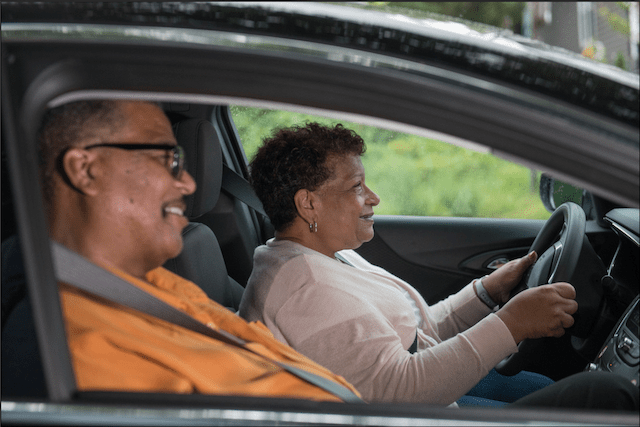
No Deal: Parents Urged to Avoid Counterfeit and Used Car Seats
Raising children is expensive, so every parent appreciates a good deal. When it comes to selecting the right car seat, however, deals that seem too good to be true often are.
In recent years, reports of the prevalence of counterfeit and unsafe car seats and harnesses being sold online have been on the rise, putting children at risk. Unwitting parents might think they’ve found a great price on a name brand car seat only to end up buying a knockoff that hasn’t been crash-tested. Bogus seats might look nearly identical to genuine seats, but a close inspection usually reveals troubling details, such as flimsy plastic, lack of crash-absorbing padding, low-grade belts and weak clasps and clips — all of which mean the child is less protected.
To determine whether a seat is real or counterfeit, AAA Northeast offers parents and caregivers the following tips:
Genuine seats come with a detailed instruction booklet and registration card, usually tucked inside a compartment or placed on the seat itself in the shipping box.
All car seats approved for use in the U.S. are clearly marked with regulatory compliance and safety information labels. Approved seats are required to list the manufacturer and date of manufacture and often include an expiration date. Newer seats include QR codes that will take you to the manufacturer’s website. Seats should also include a sticker that states: “This child restraint system conforms to all applicable federal motor vehicle safety standards,” as well as a date of manufacture and often an expiration date.
All car seats sold in the U.S. are required to have a three-point harness.
Check every label for misspellings, off-center text or odd use of English language possibly caused by poor translation.
If you’re still uncertain, provide the serial number to the manufacturer and ask for help confirming whether the seat is real or a dupe.
To avoid buying a counterfeit car seat in the first place, parents and caregivers should keep the following in mind:
Buying car seats directly from the manufacturer is a safe way to avoid unscrupulous sellers.
If buying from a major retailer, only shop from authorized sellers listed on car seat manufacturer websites.
If buying online from a store that features a marketplace, make sure the car seat is shipped and sold from the first-party seller, like Amazon or Walmart, not a third-party reseller. A seller’s customer service number should be an 800 number or have a U.S. area code.
Consider buying a car seat in person from an established retailer.
Avoid auction, drop-ship and foreign deal sites, like Temu, Wish, eBay and Alibaba, and be skeptical before buying from an advertisement on Facebook, Instagram or TikTok that isn’t clearly from the manufacturer or authorized seller.
Never buy a used seat from garage or yard sales, Facebook Marketplace or Craigslist since there’s no way to guarantee it hasn’t been involved in a crash.
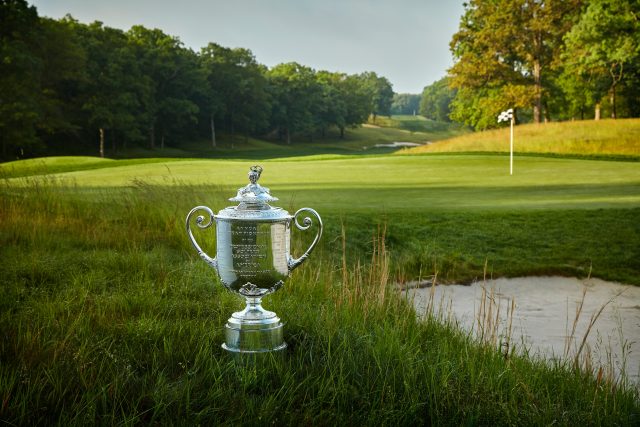
The PGA Championship, one of professional golf’s four majors, has been played at many of America’s great golf courses. Fortunately, many of the courses are located in the Northeast. In fact, it has been held in the State of New York 13 times, more than any other state. Here are some of the top local PGA Championship Golf Courses, including a few that are open to the public.
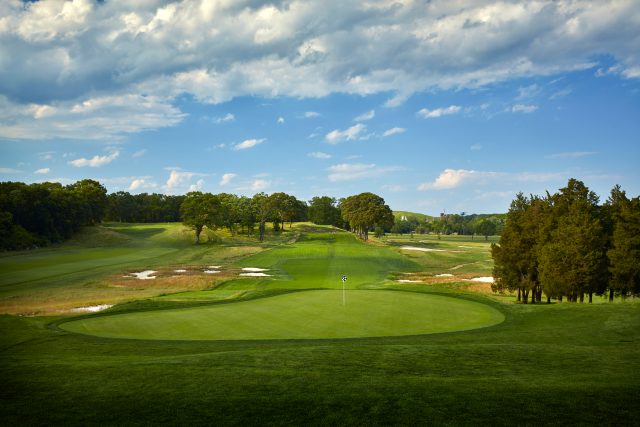
The Baltusrol Golf Club is located at the base of the Baltusrol Mountains in northern New Jersey. It consists of two 18-hole courses – the upper and the lower – but it is the lower course that held the 2005 and 2016 PGA Championships.
Built in 1922, the par-72 course is spread out over rolling parkland. Ponds and other man-made and natural hazards come into play. The course has undergone small renovations over recent years, including minor adjustments to several greens, the lengthening of holes from the tee and re-positioning or adding bunkers.
A view from the 18th hole of Bethpage State Park Black Course. (Photo: Courtesy of PGA of America)
There are five 18-hole regulation golf courses at Bethpage State Park. The Black course is the most difficult. In 2002, it became the first public course to host the U.S. Open, which returned in 2009. In 2019, it welcomed the PGA Championship for the first time, becoming one of the few public golf courses to have that honor.
Built in 1936 as part of the Depression Era public-works project, the Black Course was designed by famed golf architect A.W. Tillinghast. The course conditions today, however, are largely a product of a major restoration led by architect Rees Jones ahead of the 2002 Open.
Bethpage Black is noted for being one of the most difficult courses in the country, putting every shot to the test. After competing there in 2016, then two-time major champion Jordan Spieth said, “The course is up there with the hardest, probably, top five courses I’ve ever played in my life.”
For those looking for an opportunity to play on a world-class course, this may just be your best opportunity. Not only is it open to the public, but because it’s operated by a government agency (the New York State Parks Department), it offers reasonable fees for a course of its caliber.
About 30 minutes south of Boston sits Canton, Mass., home of the Blue Hill Country Club. Blue Hill held the PGA Championship back in 1956.
The Championship Course was designed in 1925 and restored by renowned designer Ron Prichard in 2003. With its tree-lined fairways and lush rolling terrain, this par-72 course remains as picturesque as ever.
The Salisbury Golf Club in East Meadow, N.Y., was a prominent golf and social club in the early 1900s. It consisted of five 18-hole courses. But during the Great Depression, the club couldn’t pay its taxes and Nassau County took over the property. It has since been renamed Eisenhower Park and has three courses: Blue, Red and White. The Red Course is the only original course remaining from the Salisbury Golf Club. It also happens to be the course on which Hall-of-Famer Walter Hagen won the 1926 PGA Championship.
While it may not be widely considered among the top courses in the Northeast, Eisenhower Park is open to the public, guaranteeing every golf enthusiast a chance to hit the links where the pros have played.
Located on the outskirts of Rochester, N.Y., Oak Hill Country Club features two courses – East and West. It’s the East course that has hosted the PGA Championship four times – 1980, 2003, 2013 and 2023.
The club has a prestigious history of hosting major golfing events. It is the only golf club to have hosted four PGA Championships, the Ryder Cup, three United States Opens, two United States Amateurs, the United States Senior Open and the Senior PGA Championship.
The Shawnee Inn & Golf Resort, Shawnee on Delaware, Pa.
Nestled right along the Delaware River – just across the way from northern New Jersey – is the Shawnee Inn & Golf Resort. Back in 1938, the golf world descended on this picturesque resort when its golf course became the setting for that year’s PGA Championship. Nowadays, guests of the resort and the general public are free to go for a round.
The course was the first to be designed by Tillinghast, who would go one to work on more than 260 courses. Shawnee is classically designed and uniquely flat compared to other courses in the surrounding Pocono Mountains. Another distinction is that 24 of its 27 holes are located on an island in the Delaware River.
The par-69 course at Wannamoisett Country Club was built in 1914 before hosting the PGA Championship in 1931. Wannamoisett is known as a challenging course to maneuver. It’s built on fewer than 100 acres but is filled with bunkers and small greens. The fairways are lined with thick rough and the large, rolling greens are difficult to read.
Members of the club recently invested $3 million to improve the golf course. This investment enhanced playability for golfers of all skill sets, including the installation of a state-of-the-art computerized irrigation system, the rehabilitation of bunkers and the addition of new forward and back tees.
About an hour drive north of Manhattan lies the Winged Foot Golf Club, which celebrated its centennial in 2023. The club has hosted several major golf events, including the 2020 U.S. Open and the 1997 PGA Championship. The club consists of two courses, but it’s the West Course that consistently ranks as one of the top golf courses in the country.
Over the past decade, extensive renovations of the golf courses were overseen by Gil Hanse, the preeminent architect of his generation, to restore the greens to their original state. The clubhouse, built in a Tudor architectural style, also received a makeover.
Have you played any of these courses? Let us know in the comments below.
This article has been updated and republished from a previous version.
Ready to start planning your next theme park outing? From Dollywood to Walt Disney World, the East Coast is home to some amazing parks.
Before you go, don’t forget to check for any discounts or rewards you may be entitled to.
Here are 14 East Coast theme parks you can save on with AAA Tickets.
Six Flags
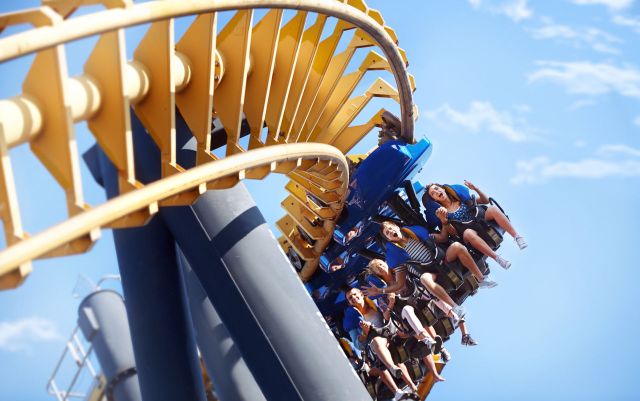
There are three Six Flags parks on the East Coast and they are each unique in their own ways.
Six Flags New England
Six Flags New England in Agawam, Mass., is billed as “New England’s most exciting theme park,” featuring Superman The Ride, The Joker 4D Free Fly Coaster, Wicked Cyclone and more. You can also enjoy Hurricane Harbor water park, special events and live entertainment. AAA members can save up to 56% on admission.
Six Flags Great Adventure
Six Flags Great Adventure in Jackson, N.J., boasts rides like the famous wooden coaster El Toro, the hypercoaster Nitro, THE FLASH: Vertical Velocity super boomerang coaster and the themed coaster Skull Mountain, among others. Check out their special events, like Six Flags Slam Fest, Summer Vibes Festival and Thrill-a-Thon. While you’re there, try their Wild Safari Drive-Thru Adventure, which features 1,200 animals. AAA members can save up to 56% on admission.
Six Flags Over Georgia
Traveling a little further away from home? Six Flags Over Georgia in Atlanta, Ga., offers rides like the fan-favorite Monster Mansion, the classic Dahlonega Mine Train, the enchanting Riverview Carousel, the Great American Scream Machine and more. Getting a little warm in the Georgia sun? Head over to their water park, Hurricane Harbor. AAA members can save up to 56% on admission.
Busch Gardens
Busch Gardens Williamsburg
Busch Gardens Williamsburg in Williamsburg, Va., is widely-recognized as the most beautiful theme park in the world (a title it has held for over 30 years). Its landscaping and gorgeous themed environments based on European villages will make you feel much farther from home. As for rides, you can try the Pantheon roller coaster, the scenic Busch Gardens Railway, the twisty Tempesto and more. Visitors can also enjoy their water park, Water Country USA. AAA members can save on admission.
Busch Gardens Tampa Bay
If you want even warmer weather, head down to Busch Gardens Tampa Bay in Tampa, Fla., which offers a bevy of rides to choose from, like the Iron Gwazi, the extreme Sheikra and the family-friendly Cobra’s Curse. The Serengeti Express Train will transport you to the wilds of the Seregenti, where you might catch a glimpse of free-roaming herds of African animals like giraffes and zebra. If it’s getting too hot to handle, you can cool off in their water park, Adventure Island. AAA members can save on admission.
LEGOLAND
LEGOLAND New York Resort
LEGOLAND New York in Goshen, N.Y., is every LEGO fan’s dream. Visitors can enjoy kid-friendly rides like The Dragon roller coaster, LEGO NINJAGO the ride, Merlin’s Flying Machines, the LEGO Factory Adventure Ride and more. One of the park’s main attractions is Miniland, a miniature country made of LEGO Bricks! AAA members can save up to 50% on admission.
LEGOLAND Florida Resort
Located in Winter Haven, Fla., LEGOLAND Florida Resort features the LEGOLAND theme park, SEA LIFE Florida Aquarium, a water park, and a Peppa Pig theme park. At the main LEGOLAND park, you can enjoy rides and play areas like Battle of Bricksburg, Lost Kingdom Adventure and Coastersaurus. And of course, you can visit Miniland USA, which features tiny LEGO replicas of the most stunning and important American landmarks — and also pirates. AAA members can save up to 45% on admission.
Hersheypark
Since its founding in 1906, Hersheypark has been a delicious destination. Visitors can enjoy delectable rides like the classic Comet, the wooden Wildcat, the Candymonium coaster and more. Don’t forget to stop by Hershey’s Chocolate World and take the factory tour ride, which blissfully smells of chocolate. Bring a swimsuit and towel if you want to enjoy one of Hersheypark’s many water rides in the Boardwalk section of the park. AAA members can save up to 37% on admission.
Dollywood
Dollywood in Pigeon Forge, Tenn., is one of the most beloved theme parks in the country, boasting attractions like Blazing Fury, Lightning Rod, Lumberjack Lifts, Mystery Mine and more. Visit Dolly’s Tennessee Mountain Home, a life-sized replica of Dolly Parton’s childhood home. And of course, since it’s Dollywood, the entire park is full of music and live entertainment. Visitors can also enjoy the water park, Dollywood’s Splash Country. AAA members can save up to 10% on admission.
Sesame Place
Can you tell me how to get to Sesame Street? Sesame Place in Philadelphia, Pa., is a theme park and water park filled with kid-friendly rides and experiences like Big Bird’s Tour Bus, Sunny Day Carousel, Oscar’s Rotten Rusty Rockets and Elmo’s Silly Splashy Slides. Plus, you can meet all of your friends from Sesame Street. AAA members can save on admission.
Dorney Park
People have been coming to Dorney Park in Allentown, Pa., since 1884 — and it’s still a destination to write home about today! Try one of their 60 amazing rides, like the Antique Carousel, Steel Force or Thunderhawk. Thunder Creek Mountain, their log flume ride, is built straight into a mountain and drops riders down 210 feet. It’s the longest log flume drop in the world. If you’re not soaking wet after that ride, check out Wildwater Kingdom, Dorney Park’s water park. AAA members can save on admission.
Kings Dominion
Kings Dominion in Doswell, Va., has a lot of roller coasters to offer. Ride the steel coaster Tumbili, the wooden Grizzly, the hybrid Twisted Timbers, the Intimidator 305, Racer 75 and more. There are also rides for the little ones, like Blue Ridge Tollway, the Kite Eating Tree and Snoopy’s Junction. Afterward, you can cool down at the water park, Soak City. AAA members can save up to 46% on admission to Kings Dominion.
Walt Disney World
How do you even summarize Walt Disney World? Well, it’s the happiest place on Earth, but you know that already. This massive resort boasts four theme parks, two water parks, a shopping center and hundreds of activities spread across dozens of hotels. It’s not only the most popular theme park on the East Coast, it’s the most popular theme park in the world. From the Tower of Terror all the way down to It’s a Small World, there’s something for everyone. AAA members can save on gate prices.
Universal Orlando Resort
Once upon a time, Universal was just the park that you would go to if you were in town for Disney. But now, Universal Orlando Resort is a notable theme park in its own right. With four theme parks, including the brand-new Epic Universe, and a water park, you’ll never run out of things to do. Here you can step into the Wizarding World of Harry Potter, Super Nintendo World or Dark Universe, dedicated to classic Universal monsters. Coaster enthusiasts will love the Hollywood Rip Ride Rockit and Revenge of the Mummy, while kids will go wild for Despicable Me Minion Mayhem and The Cat in the Hat. AAA members can save on tickets to all the fun.
Looking for theme park discounts and more? AAA members can get exclusive savings at concerts, theme parks, events, museums and attractions! Go to AAA.com/Tickets.
Do you have a favorite theme park? What’s your favorite ride? Tell us in the comments below.
This article has been updated and republished from a previous version.
Weekly figures reported by the Energy Information Administration (EIA) last week suggest that the summer driving season made a pit stop after the holiday weekend with demand for gasoline falling more than 1.1 million barrels a day from the prior week to 8.26 million barrels a day. While demand typically falls in the days following a holiday weekend, markets were rattled by the lower-than-expected reading, which sent wholesale gasoline prices lower immediately after the EIA released its report.
With the weak demand came a sizable build up of inventory as domestic production continues to flirt with record levels. Refiners, last week, increased their capacity utilization —a measure of how much refinery output potential is being used —to 93.4%, up from 90.1% a week before. Inventories of gasoline across the country swelled by 5.2 million barrels, with a whopping 3.4 million of those landing in the Northeast, according to EIA data. Meanwhile, the EIA said domestic oil production in May averaged 13.46 million barrels a day, just slightly behind the record 13.48 million barrels a day set in March.
“After strong demand leading up to Memorial Day, markets deflated last week after weaker-than-expected demand readings sparked fears about the strength of the summer driving season,” said Jillian Young, director of public relations for AAA Northeast. “While it’s too early to tell how the rest of the summer will play out, folks who are traveling now will enjoy substantially lower pump prices than last year.”
AAA Northeast’s June 9 survey of fuel prices found the current national average down 2 cents from last week ($3.14), averaging $3.12 per gallon. The June 9 national average price was 2 cents lower than a month ago ($3.14) and 32 cents lower than this day last year ($3.44).
Region
Current Price*
One Week Ago
One Month Ago
One Year Ago
Connecticut
$3.08
$3.09
$3.06
$3.58
Massachusetts
$2.99
$3
$2.97
$3.47
New Jersey
$2.98
$3.01
$2.98
$3.43
New York
$3.10
$.3.11
$3.10
$3.62
Rhode Island
$2.97
$2.98
$2.96
$3.44
*Prices as of June 9, 2025
As of June 9, Mississippi and Oklahoma had the lowest prices in the nation at $2.62 and $2.69, respectively.California and Hawaii held the highest prices in the nation at $4.70 and $4.46, respectively.
The AAA Gas Prices website is your resource for up-to-date fuel price information. Search for average gas prices on national, state and metro levels by regular, plus, premium and diesel.
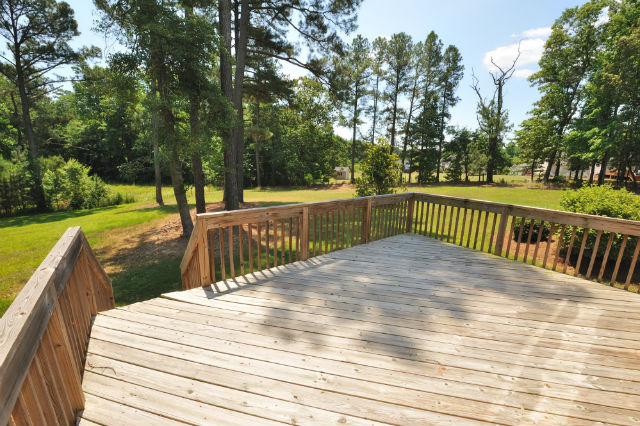
For many Americans, the backyard deck is a favorite recreational area to get together with family.
It doesn’t feel like a dangerous place, but if it’s not built correctly or properly maintained it could become one. Collapses and failures of decks, porches and balconies accounted for about 2,900 injuries between 2016 and 2019, according to the most recent research from the Consumer Product Safety Commission.
Let’s explore some of the culprits that might be making your deck unsafe and what you can do to address these potential issues.
Dangerous Backyard Decks Are More Common Than You Think
Injuries due to collapsing or unsound decks often occur because a deck is either built in a way that violates current housing codes or has deteriorated over time.
If your deck was built before 1980, it’s likely that it was made with wood that wasn’t properly treated to prevent termite infestation. Aside from this, the average lifespan of a deck is around 15 years. If your home has a backyard deck that was built 30 or 40 years ago, make sure to have it inspected by a professional to identify and fix any hazards.
If you’re planning on spending time and dining out on your deck with family and friends, it’s especially important to make sure it is in top shape ahead of time. It’s never a good idea to test the limits of an old deck and put your loved ones at risk.
How to Inspect Your Backyard Deck for Wood Damage
If you built your deck yourself, it was constructed more than 15 years ago or if you simply suspect it might not be in the best shape, take some time to inspect the wood and other elements. One of the most obvious signs that your backyard deck is damaged is if you notice large cracks in the boards or posts, which could lead to more serious issues down the road.
You should also check the entire deck for rotting wood and termite holes. While it might not be obvious at first, use a screwdriver to poke around in any areas that look weak. If the wood feels spongy or soft inside, you’ll need to remove the rotten area and consult a professional to evaluate the extent of the damage.
Rotting wood can be caused by water damage and fungi, and in general, the elements can take a toll on wood over time. After all, your deck is subject to the weather 24/7; rain, snow, sun and wind can all be factors in causing your deck to decay, especially over decades of exposure and without proper maintenance.
Structural Signs Your Backyard Deck Might Be Unsafe
Pay close attention to any strange noises or movements you notice while spending time on your backyard deck, such as loud creaking, warped or weak boards and wobbly railings. While a weak railing might not seem as crucial to fix as the main body of the deck, these can pose a particular hazard for children or the elderly. If a piece of the railing suddenly becomes loose, people are at risk of falling. In the same way, make sure to keep a close eye on the stairway to verify the steps aren’t loose or damaged.
Examine your deck to confirm it has the proper structural connections. If you don’t see the standard bolts and metal connector plates supporting your deck and only see nails, your deck is structurally unsound. Finally, take a look at the wood posts supporting the weight of your deck and make sure they’re not off-center on their concrete footing. If you don’t have any concrete footing at all and your posts are touching the ground, this is usually a coding violation.
Insurance Considerations
“If someone were to get injured on your deck, your homeowners liability coverage should cover that up to the limits. If you have sufficient underlying limits and an umbrella policy, the umbrella policy would also provide excess coverage if that’s needed,” said Jodi DeSantis, vice president of insurance sales at AAA Northeast.
DeSantis advises homeowners to have their backyard deck inspected before any problems arise. If you suspect your deck shows any of these warning signs, don’t attempt to handle the problem yourself. Hire a professional who’s familiar with the coding laws in your area.
Although it might seem like a hassle to have repairs done on your deck when you’d rather be barbecuing, you’ll feel better knowing your family is safe from danger.
Learn more about AAA home and condo insurance in your state.
This article has been updated and republished from a previous version.
Celebrated for its relaxed pace, French Polynesia is the perfect place to slow down. Here, time revolves around food, drink, culture and revelry, inviting guests to embrace a more leisurely way of living — even if only for a few days.
The Islands of Tahiti, including gems like luxurious Bora Bora, are treasures waiting to be discovered, each with its own signature style, promising unique and unforgettable experiences. Here are some of the top spots to visit among its 118 islands and atolls.
Tahiti
The largest of the Society Islands, Tahiti was formed by two volcanoes — the older, larger Tahiti-Nui in the northwest, and Tahiti-Iti in the southeast — resulting it its distinctive figure-eight shape and mountainous terrain.
Tahiti is the economic, cultural and political center of French Polynesia. The island has a beautiful waterfront where yachts, ferries and cargo boats come and go, and a thriving market full of South Pacific atmosphere. Those who fly commercially typically begin their journey in Tahiti by landing in Papeete.
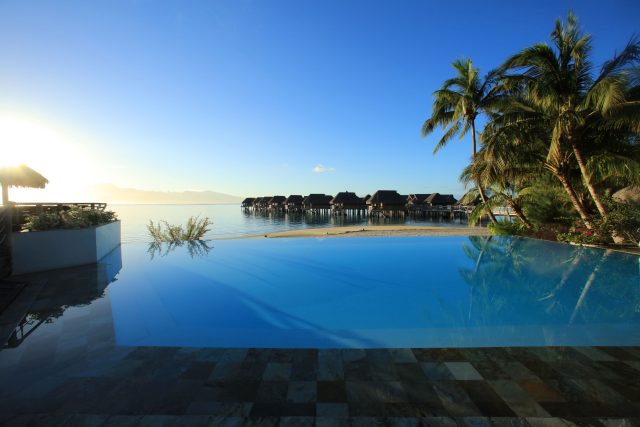
Sofitel Kia Ora Moorea Beach infinity pool.
Moorea
Moorea is close to Tahiti and offers its coral reefs as a distinguishing characteristic popular with tourists. While snorkeling or diving, you can see the beautiful and vibrant colors of the reef fish in their natural habitat. Moorea’s topography includes Mount Rotui which lies between two enormous inlets, Cook’s Bay and Opunohu Bay.
Raiatea
The second-largest island in the Society Islands chain, Raiatea is a popular destination for sailing and deep-sea fishing and shares a coral reef and lagoon with neighboring island Taha’a.
Taha’a
Taha’a is known for its spice production. It is commonly known as the Vanilla Island because of the many fragrant vanilla orchids. The island is mostly dense forest and shaped like a flower.
Tetiaroa is the private island that was home to actor Marlon Brando. The island is now home to The Brando, the resort that carries his namesake, which celebrates and preserves Tetiaroa’s pristine beauty, offering the ultimate sustainable luxury for discerning travelers.
Huahine
A natural wonderland steeped in authentic Tahitian tradition, Huahine is home to copious marine life and is surrounded by coral. Culturally preserved and surrounded by lush vegetation, there’s an assortment of hidden temples scattered throughout the island.
Bora Bora
Bora Bora is the Society Islands’ honeymoon retreat. It is also where the overwater bungalow style of residence originated. The lagoon on Bora Bora is pristine, a veritable paradise where snorkeling and diving are common pastimes. With a romantic atmosphere popular with couples and newlyweds, the beaches of Bora Bora offer year-round opportunities for watersports and a relaxing scene for lounging in the tropical sun.
Rangiroa
Rangiroa is the largest atoll (a low tropical island created by coral rising up above the sea level) in the Tuamotu islands and the second largest in the world. From the air, it appears like a pearl necklace laid upon the water. More than 200 tiny motus (islands) wind along a fragile reef where infinite schools of marine life fill the iridescent waters.
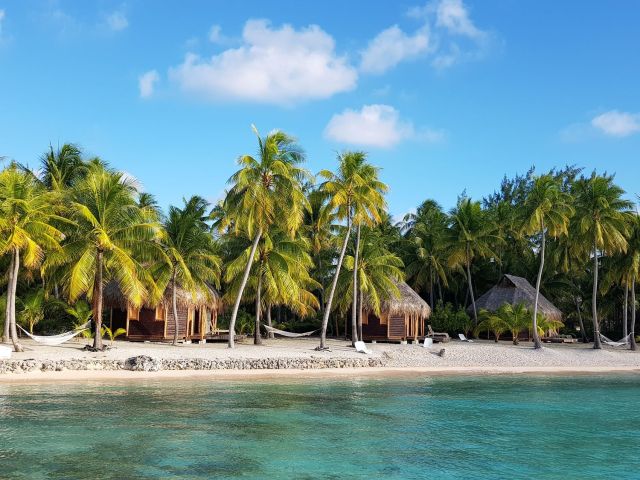
Tikehau by Pearl Beach Resort.
Tikehau
Approximately seven miles from Rangiroa, Tikehau is an oval-shaped atoll that consists of a series of flat motus, surrounding a pristine, magnificent lagoon packed with thriving and varied species of marine life. The real draws here are the fishing, beaches and incredible snorkeling and scuba diving opportunities. If you enjoy miles of beautiful pink sand beaches, sparkling turquoise water and a peaceful atmosphere, you will love Tikehau.
The Marquesas
The Marquesas are considered some of the most remote islands in the world. Nuku Hiva, the largest of the Marquesas Islands, is a mountainous bounty of forests and stunning beaches. With the Vaipo waterfall, one of the tallest in French Polynesia, and a volcano, Nuku Hiva is difficult to beat for adventure and sights.
Visiting Multiple Islands
While some travelers prefer to stick to one island and make the most of resort living, others prefer to spend their visit island hopping. With ample air and sea transfers available, you can see as much as French Polynesia as you desire. If you enjoy cruising, ask you AAA travel advisor about booking one of several cruise lines offering French Polynesia itineraries.
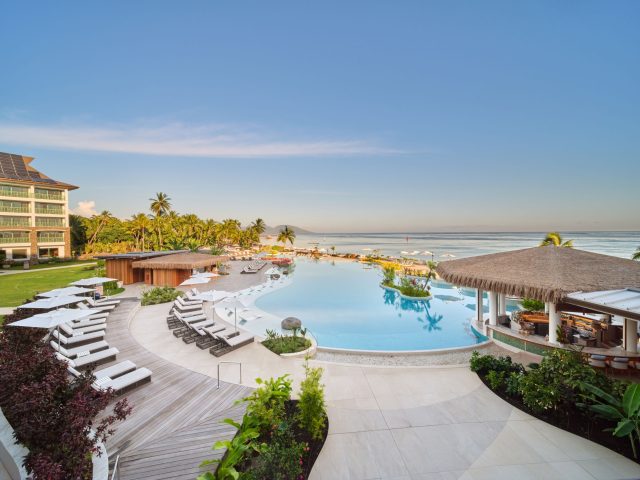
Poolside at Hilton Hotel Tahiti.
Where to Stay
Make the most of your time on the Islands of Tahiti with a stay that captures French Polynesian tranquility and charm. Book now and save.
This resort recently completed a multi-million dollar refurbishment and features 122 rooms and overwater suites, six restaurants, spa, fitness center and Kid’s Club. The King Pool Overwater Villas are 1,302 square feet with a private pool and incredible sunset views.
A prime waterfront location just five minutes from Faa’a International Airport, the city center and the maritime port. The The Hilton Hotel Tahiti’s restaurants and bars offer convenient spaces to indulge in local and international cuisine, while its casual marketplace makes it easy for guests to stock up on snacks and supplies before a day of adventure. The resort also features a spa and the largest outdoor pool in French Polynesia.
This secluded resort features a garden, beach and overwater bungalows on the edge of the second largest lagoon in the world. The restaurant offers continental cuisine with barbecues on Wednesdays and Sundays with a Polynesian dance show.
Set at the edge of a lagoon (ideal for snorkeling) on the longest white-sand beach on Moorea, Sofitel Kia Ora Moorea Beach Resort is a perfect place for honeymooners and anniversaries. Overwater, beachfront and garden bungalows embody the pristine beauty of the destination with natural materials and luxurious amenities. The resort also boasts an on-site restaurant, a spa, two shops, an excursions desk and diving and nautical center.
Located on the secluded Motu Tautau facing the island of Taha’a on one side and stunning views of Bora Bora on the other, Le Taha’a is a luxury hideaway inspired by Polynesian architecture and style. Its overwater bungalows feature wrap-around decks with steps down to the crystal-clear waters below. Surrounded by tropical gardens, 12 beach villas include plunge pools and direct beach access, while affording privacy within their walled gardens. Three restaurants, a spa, fitness center, tennis court, outdoor swimming pool, scuba diving center and a helipad are also among the standout amenities.
This Polynesian-style resort offers 37 very spacious beach bungalows, overwater bungalows and suites with access to isolated pink-sand beaches and a lagoon teeming with tropical marine life. The bungalows are constructed with natural wood and feature private verandahs. The bar and restaurant are located poolside with views of the translucent lagoon.
Let AAA Travel make your dream vacation a reality. Connect with a travel advisor for free trip planning, custom itineraries, exclusive perks and expert guidance every step of the way.
With summer-like temperatures in the forecast this week, AAA Northeast is sounding the alarm that vehicular heatstroke can happen quickly — especially given that child deaths inside hot cars increased by nearly 35% last year.
In 2024, 39 children died in hot cars across the U.S., according to the National Highway Traffic Safety Administration, including a 2-month-old infant who died on a 77-degree June day. That’s a significant increase over 2023, when 29 children succumbed to vehicular heatstroke. On average, 37 children die each year as a result of vehicular heatstroke.
The inside of a car can become lethally hot even on a mild but sunny day: Although most deaths occur when temperatures exceed 80 degrees, a child has succumbed to vehicular heatstroke in 70- to 80-degree temperatures in each of the past 11 years.
On a typical 80-degree summer day, the interior temperature of a vehicle climbs by 20 degrees in only 10 minutes and reaches a deadly 109 degrees in 20 minutes. On hotter days, the interior temperature can easily reach 120- to 140-degrees, and cracking the windows has little effect.
“While every family wants to believe this could never happen to them, the reality is a child dying from vehicular heatstroke is an unimaginable tragedy that can happen to any family,” said Jillian Young, director of public relations for AAA Northeast. “We urge families to take action to ensure children’s safety. Establish firm guidelines about heatstroke safety with family members and caregivers and put processes in place to ensure children — and pets — are never left behind. In some cases, a sticky note affixed to the steering wheel or a smartphone screen can help prevent a fatality.”
To prevent hot car deaths, AAA Northeast recommends caregivers practice the following:
Stop and look at the backseat before exiting a parked vehicle. Make it a habit to check the entire vehicle before locking the doors and walking away. Place personal items, like a purse or briefcase, on the floor in the back seat as another reminder to look before you lock. Ask childcare providers to immediately call if your child doesn’t show up for care as expected and always seek confirmation that your child was removed from the vehicle safely by anyone transporting them — including spouses, grandparents, other family members and close friends.
Lock your vehicle to prevent unsupervised access and a child getting trapped inside. Keep car keys away from children and teach them that the inside of a car should never be used as a play area.
Act fast, call 911 and take action if you see a child alone in a locked car. A child in distress should be removed as quickly as possible.
Statistics about hot car deaths:
Over 52% of deaths are caused by a caregiver forgetting the child in the vehicle, according to NoHeatStroke.org. And it’s often not a parent: 29% of the deaths related to children forgotten in vehicles involve a caregiver other than a parent. Be especially vigilant whenever there is a change in your childcare or drop-off routine.
Nearly 22% of deaths result when a caregiver knowingly leaves a child in the car (typically to run a quick errand or let the child finish a nap). The majority of the temperature rise occurs within the first 15 to 30 minutes, and caregivers may mistakenly assume that cracking the windows is sufficient to cool and ventilate the vehicle.
Nearly 25% of cases are related to the child gaining access to the vehicle without adult supervision and becoming trapped in the vehicle. An innocent game of hide-and-seek can lead to such tragedies; often the child enters the vehicle and closes the door or trunk and cannot get out. It is important for all drivers, not just parents, to lock their vehicles in driveways and parking lots.
Statistics about pets dying in hot cars are not tracked as closely, but the American Veterinary Medical Association reports that every year, hundreds of pets die of heatstroke in parked vehicles. Exercise the same care with a pet as you would with a child.
The wide variety of electric vehicle models now available — over 75 options introduced in the past four years — isn’t moving the needle for buyers. That’s according to AAA’s latest survey, which found only 16% of U.S. adults report being “very likely” or “likely” to purchase a fully electric vehicle as their next car, the lowest percentage of EV interest recorded since 2019. The percentage of consumers indicating they would be “unlikely” or “very unlikely” to purchase an EV rose from 51% to 63%, the highest since 2022.
Key Barriers to Going Fully Electric
High battery repair costs (62%) and purchase price (59%) are cited as key barriers to going fully electric. Other top concerns identified in this year’s survey were the perceived unsuitability of EVs for long-distance travel (57%), a lack of convenient public charging stations (56%) and fear of running out of charge while driving (55%). Just over 30% of those undecided or unlikely to buy an EV have safety concerns, 27% reported challenges installing charging stations at their residences, and 12% cited the potential reduction or elimination of tax credits and rebates. According to AAA’s 2024 Your Driving Cost analysis, EVs had the second highest total ownership costs due to depreciation, purchase prices and finance charges.
Motivating Factors
Respondents cited gas savings, environmental concerns and lower EV maintenance costs as their top motivations to purchase. Last year’s Your Driving Cost analysisfound that EVs had the lowest fuel cost and lowest maintenance cost of any vehicle type.
Future of EVs
Despite advancements in the EV industry and the growing number of models, the percentage of U.S. drivers who believe that most cars will be electric within the next 10 years has significantly declined from 40% in 2022 to 23% this year.
AAA EV Resources
AAA Car Guide: For those in the market for newer EVs, the online resources also contain links to the two prior editions in 2022 and 2023.
AAA’s EV Website: For anyone looking to learn more about EVs, the website features a guide to getting started, cost calculators, news and insights.
We’ve all been there. You’re cruising along, when suddenly, you get a warning that you’re low on gas. You were counting on getting home without a pit stop, but now you’re wondering if you’ll make it.
Exactly how far can you drive with the gas light on? For almost every car built in the past 25 years, E is a sign you’re down to your car’s fuel reserves, according to NAPA Auto Parts, and you can drive usually another 30 to 50 miles.
So, there is no reason to panic, but try not to push it.
How Much Gas Is Left?
How much fuel remains in your tank when the fuel light is on depends on several factors, including the make and model of the car, the type of road you are on, whether it’s flat or mountainous, the temperature and how much additional weight you are carrying.
“In the cars I have test driven, most can travel anywhere from 30 to 50 miles after the light turns on,” said AAA’s Car Doctor John Paul. “In most cars, depending on engine size and miles per gallon, when the light comes on, there is typically a useable 1 to 2 gallons of fuel left in the tank. Fuel tanks never completely run dry, but the little fuel left in the tank is not enough for the fuel system to use.”
Dashboard fuel gauges rely on a floating sensor that’s attached to an arm inside the gas tank. A fuel pump, also known as the sending unit, is involved as well. As gas burns, the floating sensor’s arm begins to drop, signaling the dashboard gauge that the fuel volume is decreasing.
While 30 to 50 additional miles is a good estimate, it’s always better to err on the low end, according to NAPA, and get gas as soon as possible. The gas light should serve as a warning, not be a casual reminder to buy gas.
“It’s always a good idea to fill up as soon as possible to avoid running out completely, which could potentially damage the fuel pump,” Paul said. “Electric fuel pumps, in many cases, are mounted in the fuel tank and are cooled by the fuel in the tank. Consistently running low on fuel can lead to the pump overheating and cause a premature failure of what can be an expensive part.”
Repeatedly using the last bit of gas in the tank can also cause gunk from the bottom of the tank to pass into the engine, with the potential for causing damage.
Getting Better Numbers
Owners of cars with a multifunction dashboard may have access to more detailed information through the calculated range or distance-to-empty which can more accurately show fuel levels.
To find out precisely how much fuel you have when gas is low, read the owner’s manual to find the exact volume of the gas tank. The next time your needle is on E, fill up the tank. Then subtract the number of gallons needed to reach full from the fuel tank’s total capacity.
Once you have an idea of how much gas you have left, try to drive at a consistent speed to preserve fuel.
To prevent “unscheduled” stops and keep your vehicle operating smoothly, NAPA recommends filling the tank regularly and not letting the gas level drop below one-eighth of a tank.
Northeast Gas Prices Decline Despite Major Surge in Demand
Pump prices in the Northeast took a breather following a busy run-up to the Memorial Day holiday, which pushed gasoline demand to the highest level of the year so far.
The surge in demand during the week ending May 23 reached 9.45 million barrels a day, an increase of more than 800,000 barrels a day, or 9%, over the prior week, according to the Energy Information Administration. That’s the highest demand reading for the week leading into Memorial Day since 2018, and it contributed to a sizable drop in gasoline inventories across the nation, including a nearly 3-million-barrel decline in the Northeast. Supplies of gasoline now sit at a 2025 low and are down 5.8 million barrels from the comparable week of last year.
Normally, strong demand and tightening inventories would spur price increases at the pump, but oil prices remained suppressed thanks to market expectations for more crude production around the world, especially from OPEC+ member nations. The group last week agreed to increase production in July by about 400,000 barrels a day — the third straight month of production increases. Uncertainty about global demand and trade also are quelling market activity that could push prices higher.
“Based on gasoline demand, the lead up to the Memorial Day holiday kicked off the summer driving season with gusto,” said Jillian Young, director of public relations for AAA Northeast. “But one strong week isn’t enough to significantly move retail gasoline prices, especially with domestic production continuing near record levels.”
AAA Northeast’s June 2 survey of fuel prices found the national average down 3 cents from the previous week ($3.17), averaging $3.14 per gallon. The June 2 national average price was 4 cents lower than a month prior ($3.18) and 39 cents lower than this day last year ($3.53).
Region
Current Price*
One Week Ago
One Month Ago
One Year Ago
Connecticut
$3.09
$3.11
$3.07
$3.62
Massachusetts
$3
$3.01
$2.98
$3.51
New Jersey
$3.01
$3.06
$3
$3.48
New York
$3.11
$3.12
$3.10
$3.65
Rhode Island
$2.98
$3.01
$2.97
$3.49
*Prices as of June 2, 2025
As of June 2, Mississippi and Texas had the lowest fuel prices in the nation, at $2.64 and $2.70, respectively.California and Hawaii held the highest prices in the nation at $4.77 and $4.47, respectively.
The AAA Gas Prices website is your resource for up-to-date fuel price information. Search for average gas prices on national, state and metro levels by regular, plus, premium and diesel.
Alarming fact: More than 48 million Americans hear so poorly that their quality of life significantly suffers as a result.
The problem: Most wait too long to act, hoping their hearing will improve on its own. Sadly, it never does.
But now, a game-changing device is revolutionizing the hearing aid industry, and experts say it’s the biggest breakthrough they’ve seen in over a decade.
It’s the perfect solution at the perfect time — when more and more people are eager to maintain their quality of life and overcome these limitations.
No wonder since its release Horizon IX has taken the U.S. by storm and brought hope and unprecedented clarity to thousands across America.
1. Unparalleled, Crystal Clear Sound
Horizon IX is one of the world’s first hearing aids with dual processing. This is special because it’s the first time engineers have been able to pack not one but two state-of-the-art computer chips into a device this small.
The result?
An unprecedented amount of power and clarity.
2.Superhuman Hearing Even in the Noisiest Environment
Thanks to the Horizon IX, hearing has never been as sharp, clear and natural. This game-changing device can recognize and enhance at least three people’s voices at once while also significantly reducing background noise.
The result?
Effortless conversations even in the noisiest of environments.
Tested by top-rated audiologists in America and Germany and backed by a 45-day money-back guarantee, Horizon IX is scientifically proven to improve hearing. In 2025, hear.com’s customers reported a staggering 95% increase in their hearing ability using this life-changing device.
The result?
More than 540,000 people have trusted hear.com with their hearing.
4. It’s the Most Discreet Hearing Aid in the World
Smaller than a coffee bean, the Horizon IX is designed to be virtually invisible. Available in behind-the-ear and in-the-ear models, both styles are among the most discreet and reliable hearing aids in the world.
The result?
Friends and family say, “I can’t believe you are wearing hearing aids.”
5. Naturally Comfortable Hearing All Day Long
Hearing with the Horizon IX is the closest thing to hearing with healthy ears. Its natural silicone domes ensure a comfortable and natural-sounding hearing experience. Built with long-lasting rechargeable batteries, most people wear them all day until bedtime.
The result?
They are so comfortable that many forget to take them out while in the shower. True story.
Where Can I Get Horizon IX?
To date, hear.com has partnered with over 2,000 specialists to ensure Horizon IX devices are available across the U.S.
Now, Americans everywhere can experience effortless hearing in any situation — from crowded restaurants to cherished family gatherings — all with a device so discreet and comfortable, you’ll completely forget you’re wearing it.
Most people who try Horizon IX report the same thing: “I wish I had done this sooner.” And their friends and family agree. So do yourself a favor and don’t wait.
The idea that you have to wait a quarter century to rent a car is a myth. Drivers as young as 18 years old can rent a car with Hertz’s more inclusive age policy.
The freedom and flexibility of renting a car can be a game changer, allowing you to plan a road trip, visit family and friends, or simply make your daily commute more convenient. However, there’s a common misconception that you must be 25 years or older to rent a car.
While many rental car companies have strict age restrictions, Hertz will hand over the keys at age 20 — or even 18 in some cities.
Hertz’s Age Policy
Hertz has adopted a more lenient age policy, allowing individuals between the ages of 20 and 25 to rent a car. The company recognizes that responsible younger drivers are just as capable of safely operating a rental car as anyone 25 and older. But there are some key terms and conditions drivers should be aware of before renting a car for the first time.
For renters that are under the age of 25, Hertz charges a Young Renter fee of $19 per day, which is below the industry average. This fee varies depending on your location and the type of car that you’re renting. Check with your local Hertz Car Rental for specific rates.
The Young Renter fee is waived for AAA members who book with a discount code.
Vehicle Selection
While Hertz opens its doors to younger renters, certain vehicles may still be off-limits at different locations. Renters under 25 can rent from a variety of car classes, from economy to SUVs, but are excluded from renting certain high-performance cars, luxury vehicles and some specialty models might have age restrictions. Don’t worry, you won’t be stuck with a minivan.
Minimum Age
Renters must be 20 years old to rent a vehicle at most Hertz locations in the United States and Canada. The minimum age in Michigan, New York and the province of Quebec is 18 years old. While in Alabama and Nebraska, the minimum age to rent a vehicle is 19.
Documents You’ll Need for Renting a Car Under 25
If you’re a driver looking to rent a car under the age of 25, here are some essential tips to make the process hassle-free.
Understand Insurance Options: Hertz Car Rental locations offer various insurance options, such as collision damage or liability coverage. It’s imperative to understand the coverage that you may need and the additional cost it may entail.
Valid Driver’s License: Ensure that your driver’s license is valid and in good standing for over a year. Hertz Car Rental locations will check your driving record, and a poor record could lead to denial of service.
Valid Credit or Debit Card: Some Hertz locations may require a credit card to rent a car.
Age Verification: When booking with Hertz, be prepared to provide documentation providing your age. This typically involves presenting your driver’s license and an additional form of identification, in some cases.
How to Stay On Budget
Renting a car can quickly add up to an expensive adventure, here are some budget-friendly tips to save you money.
Plan Ahead: As soon as you know that you would like to rent a car, start your research. The more time you allow for research and booking, the better your chances of securing a vehicle that suits your needs and budget.
Use Membership Benefits: If you belong to an automobile club, such as AAA, or are a member of any loyalty programs, check for discounts or special offers. You may be surprised at how much these memberships can save you.
Rental Duration: Be mindful of the length of your car rental. In some cases, renting for a full week might be more cost-effective than a shorter duration.
Returning the Vehicle: Return the rental car on the agreed-upon date and time to avoid late fees. And make sure that the car is in the same condition as when you received it.
So, go on and hit the road and experience the world. Where will you be heading next? Young Renter fee is waived for Reserve your next rental with
AAA members get exclusive Hertz discounts, including up to 20% on Hertz rentals and Young Renter fee waived.
This article has been updated and republished from a previous version.
When does second come before first? When counting street names.
No, this is not an Abbott and Costello routine. It’s a true, if hard to believe, fact. The most common street name in America is Second, followed by Third and then First.
While you’d presume there would not be a Second Street without a First Street, that’s not always the case. In many cases the numerical naming of streets begins with the number two, after the central roadway is given a name such as Main.
Speaking of which, Main is the seventh most common street name in America, and the second-most popular non-numerical name, following Park. Washington takes first place in roads named after people, while nature-inspired names are well represented — Park, Oak, Pine, Maple, Cedar, Elm, Lake and Hill all make the top 20.
Formulating a list of the most popular street names is not as cut-and-dried as it may seem. About six years ago, The Washington Post took a crack at it and the process revealed some interesting quirks about ranking road names. For example, should a Main Street that becomes South or North Main Street be considered one road or two? And what about a road that’s split by a park or some other sizable obstruction? Is that one road, or is it multiple roads depending on the number of its segments?
Common Street Names in the Northeast
This article from BestLife uses the Post’s data to identify the most common street name in each state. And we noticed a trend across the Northeast. The most common street name in Connecticut, Massachusetts, New Jersey, New York, Rhode Island and Vermont is Park. Meanwhile, Main is Maine’s and Maple is New Hampshire’s.
Just remember: the Post didn’t count a North Main Street and South Main Street as separate roads if they were connected — so your state’s most popular street name might actually be Main if you have a lot of directional prefixes and suffixes attached to these streets.
Have some thoughts about the most popular road names in the nation? Weigh in with a comment below!
This article has been updated and republished from a previous version.
For many teenagers, summertime brings fun, festivities and free time with friends. But as more teens take to the roads during summer break, the risk of teen driver traffic crashes increases. The ‘100 Deadliest Days’ is the period between Memorial Day and Labor Day when fatal crashes involving teen drivers are the highest.
Nationally, 7,193 teen drivers (age 15-19) were killed in crashes from 2019 to 2023, with over 31% of those fatalities occurring from Memorial Day to Labor Day, according to a AAA Northeast analysis of National Highway Traffic Safety Administration (NHTSA) data. Additionally, the number of teen drivers killed during the ‘100 Deadliest Days’ in 2023 is almost 35% higher than in 2019, pre-pandemic.
Risky driving behaviors like speeding, texting and running red lights are top contributors to unsafe driving among teens, according to the AAA Foundation for Traffic Safety. Cars full of friends can also be dangerous: AAA research shows teen drivers involved in crashes are twice as likely to die when transporting two or more teen passengers compared to when driving alone.
“As the roads become more dangerous over the summer, we want to ensure everyone gets to and from their destinations safely,” said Jillian Young, director of public relations for AAA Northeast. “We encourage parents to model safe driving behaviors and remind their teens that reckless driving puts everyone on the road at risk. We urge all drivers to make smart decisions behind the wheel — because one bad decision can be life-altering.”
AAA Northeast offers teen drivers the following advice:
Ditch the distractions: AAA research shows talking or interacting with passengers is the most common distracting behavior in teen driver crashes followed by cellphone use.
Slow down: Faster speeds rob drivers of the extra reaction time needed to avoid a crash. Inexperience behind the wheel makes speeding especially dangerous for young drivers.
Buckle up: Wearing a seatbelt is the most effective way to prevent serious injuries or death in the event of a crash. NHTSA data shows seat belt use is the lowest among teens and young adults. Remember to buckle up and ask your passengers to do the same.
Get enough sleep: Make sure you’re well-rested before a day of festivities. Head home before exhaustion hits or make a plan with friends to spend the night in a safe place to avoid driving while drowsy.
Drive sober: It’s illegal for people under the age of 21 to consume alcohol, and it’s illegal to drive impaired. But if you’ve consumed alcohol or drugs, hand your keys to a sober friend or use a rideshare service to get home safely.
Universal Orlando Resort has become a vacation destination that lives up to its name, with two theme parks, a water park, a shopping district, hotels and a brand-new theme park on the way. It truly is its own universe, packed with unique experiences and thrilling rides around every corner.
Before you go, get to know the difference between Universal Studios Florida, Islands of Adventure, Volcano Bay and the highly-anticipated Epic Universe, with this quick guide.
Universal Studios Florida was the first theme park opened by Universal Orlando Resort, themed around the magic of the movies. Here, you can cause mayhem with Gru’s minions, zoom around New York with Jimmy Fallon, train with the Men in Black and more. Coaster enthusiasts will scream for the Hollywood Rip Ride Rockit and Revenge of the Mummy, while wizards and witches can discover the hidden Diagon Alley section of the Wizarding World of Harry Potter. If you have an Islands of Adventure ticket, you can even catch the Hogwarts Express to Hogsmeade from here.
Islands of Adventure
Universal Islands of Adventure is a series of different intricately-designed theme park lands, each ushering guests into a different world. Here, you can find Seuss Landing, Marvel Super Hero Island, Hogsmeade, Jurassic Park, Toon Lagoon and more. Ride hair-raising rides for thrill-seekers, like Skull Island: Reign of Kong, The Incredible Hulk Coaster and VelociCoaster, or opt for a gentler experience on rides like Flight of the Hippogriff, The Cat in the Hat and Pteranodon Flyers. Islands of Adventure lives up to its name, with fun and unique experiences for every member of the family. Pro tip: Don’t pass up on the park’s interactive entertainment, like the show at the Ollivanders wand shop. It’s a great way to make your vacation one-of-a-kind.
Volcano Bay
Need to escape the Florida heat? Look no further than Universal’s Volcano Bay, a water park built around the imposing Krakatau Volcano. Water warriors can show their courage on intense waterslides, bumpy raft rides, a water coaster and a wild wave pool. Sunbathers and splashers can relax in the lazy river, on Waturi Beach and at the peaceful Reef.
Universal Epic Universe opened in late May 2025, with a host of brand-new attractions, hotels, shows and worlds to explore. From the central Celestial Park, guests will be able to travel to places like Super Nintendo World, the Isle of Berk, Dark Universe and the Wizarding World of Harry Potter’s Ministry of Magic.
While demand data for the holiday weekend is not yet available, prices remained flat across much of the Northeast thanks to lackluster demand in the weeks leading up to the holiday and growing inventories as supply continues to outpace domestic demand.
The build in gasoline inventories came last week even as domestic refiners dialed back production from 9.7 million to 9.5 million barrels a day, according to the Energy Information Administration. Total supplies of gasoline increased by 800,000 barrels. On the other side of the equation, demand for gasoline during the week ending May 16 — the latest available data — fell to 8.64 million barrels a day, down from 8.79 million barrels a day a week earlier.
Another factor keeping a lid on pump prices is the cost of oil, which continues to hover around $60 a barrel and is unlikely to break out of the current range after OPEC+ indicated last week that its member nations will likely approve yet another production increase in July. That makes three consecutive months that the group would approve increases of 411,000 barrels a day, increasing the odds of global supply outpacing production through the end of 2025.
“It might seem highly unusual for gas prices to stay relatively flat in the early days of the summer driving season, but ultimately, supply and demand are the major driving forces behind pump prices,” said Jillian Young, director of public relations for AAA Northeast. “Prices could start moving if demand picks up as the summer rolls along, but it will take several consecutive weeks of strong demand before the current dynamic changes.”
AAA Northeast’s May 27 survey of fuel prices found the current national average unchanged from last week ($3.17), averaging $3.17 per gallon. The May 27 national average price is 3 cents higher than a month ago ($3.14) and 42 cents lower than this day last year ($3.59).
Region
Current Price*
One Week Ago
One Month Ago
One Year Ago
Connecticut
$3.11
$3.11
$3.06
$3.66
Massachusetts
$3
$3
$2.96
$3.53
New Jersey
$3.05
$3.02
$2.96
$3.50
New York
$3.12
$3.13
$3.09
$3.67
Rhode Island
$3
$3
$2.94
$3.53
*Prices as of May 27, 2025
As of May 27, Mississippi and Louisiana had the lowest prices in the nation, at $2.64 and $2.70, respectively.California and Hawaii held the highest prices in the nation this week at $4.84 and $4.47, respectively.
The AAA Gas Prices website is your resource for up-to-date fuel price information. Search for average gas prices on national, state and metro levels by regular, plus, premium and diesel.
Are you dreaming of a trip to Japan? If you’re like most first-timers, you plan to split your time between technicolor Tokyo and historic Kyoto. But many travelers also set aside a day or two to visit a countryside ryokan, one of the purest, most immersive experiences of Japanese hospitality.
That’s exactly what my husband and I did on our trip to Japan last year. Between Japan’s old and new capital cities, we stopped off in Hakone for a night at a ryokan. The experience was like stepping into a parallel world, where my husband and I were invited to slip off our shoes and don traditional robes for the evening and where soaking in a cypress tub of hot spring water was a typical afternoon activity. But our stay was also very structured, with strict rules and timetables.
Private onsen in Ryokan.
What Is a Japanese Ryokan?
Ryokans are traditional Japanese inns. They’re also the perfect place to immerse yourself in Japan’s famous omotenashi, a deep-rooted hospitality that emphasizes mindfulness and preparedness down to the most minor details. Many ryokans also have onsen — bathing facilities built around natural hot springs.
Ryokan stays typically include kaiseki dinners and breakfasts. Kaiseki is a traditional multicourse meal highlighting various preparation techniques and seasonal ingredients. It is intricate, intriguing and often intimidating, as the many small courses feature foods unfamiliar to American palates.
My Experience Staying at a Japanese Ryokan
We stayed at Yama No Chaya, a ryokan in the forest at the end of a suspension bridge in Hakone, Japan. A car from the ryokan picked us up at the train station and took us to the inn, where a few staff members stood outside in greeting.
As we approached the doorway, we were instructed to stow away our shoes and put on slippers. Then, our designated attendant took us through a maze of hallways to a tatami mat room with two Western-style twin beds and an open-air cypress bath on the private balcony. We were asked to choose between two dinner time slots in the room. We were also invited to book a private timeslot on one of the ryokan’s large spring-fed onsens.
Because we were staying for only one night, we started enjoying the ryokan’s activities as soon as the attendant left the room. First up: a soak in the private onsen. In Japan, washing up before stepping into the bath is very important. Tubs are for soaking, not cleansing. Afterward, we headed to the glass-walled bar lounge for sake, Japanese rice wine, served in bamboo cups.
Kaiseki dining
The meals are perhaps the most important element of a ryokan stay. We opted for a mid-evening supper to have time to enjoy the outdoor onsen before bed. The attendant brought in course after course — miso soup, several varieties of fish (raw and cooked), soba noodles, yaki mochi grilled on the table in front of us and so much more. As a picky eater, I found the meal enjoyable and challenging. Breakfast the next morning was even more difficult. Starting the day with cups of green tea, onion soup, tofu and baby eels was not easy for me.
Checkout was at 10 a.m. sharp — a fact we were politely reminded of more than once. When we exited the room at 9:50 a.m., our attendant stood outside the door, waiting to escort us out. As we switched footwear at the entrance, our luggage was whisked away while our attendant bid us a rushed farewell.
Whoosh! In what felt like the blink of an eye, the tranquil world of the ryokan evaporated, and we were off to Tokyo.
For us, one night was rushed but still worth it. Most ryokans invite guests to check in between 5 and 3 p.m. Checkout is 10 a.m., which is early by American standards.
If you have the time and budget, a two-night ryokan stay is ideal. You’ll have more time to soak in the surroundings, enjoy the lounge, and spend more time in the onsen.
Ryokan in-room dining.
Should You Stay in a Ryokan?
Before you book a ryokan stay, it’s important to understand that Japanese ometenashi is a two-way street. Ryokan owners and staff exude deep respect and care for you as the guest, but you must also show deep respect and care for the ryokan’s culture and traditions. If you’re not willing to spend a pretty penny for an experience that requires you to pay attention to details and social expectations, skip the ryokan.
That said, staying at a ryokan is one of the best ways to experience Japanese hospitality. Ryokans are not luxurious in the way that European grand dame hotels or Tokyo high-rises are, but they are authentic. They are peaceful and deeply immersive. You will discover something new.
Ultimately, it’s up to you whether a Japanese ryokan experience is worth your time and money. You will walk away from a ryokan with memories and a deeper knowledge of Japanese traditions. But, if you’re exploring Japan for the first time and don’t make it to a ryokan, rest assured that you’ll still have a fantastic time.
Plan your Japan vacation with a AAA travel advisor. Travel advisor services are included with your membership at no extra charge.
Have you ever been to Japan? Would you like to go and stay in a ryokan? Tell us in the comments.
More older drivers are on the roads today than ever before — there are 51.6 million drivers in the United States age 65 and older as of 2022, according to the most recent data from the Federal Highway Administration.
But along with that growth has come a sharp increase in traffic deaths. The number of fatalities in senior driver crashes nationwide reached its highest point in more than 20 years.
“Older drivers aren’t necessarily worse drivers than their younger counterparts,” said Mark Schieldrop, Senior Spokesperson for AAA Northeast. “In fact, AAA research shows that seniors are less likely to engage in risky behaviors behind the wheel. But they are at greater risk of being killed or seriously injured if a crash occurs.”
Remaining an active driver can provide older adults with a much-valued level of independence. However, the physical and cognitive changes that come with aging, coupled with medical conditions and increased medication use can put older drivers at a greater risk behind the wheel.
AAA Northeast is encouraging seniors and their families to have discussions about how to ensure safe mobility for years to come.
Here are some of the biggest challenges older drivers face and how to overcome them.
Vision Problems
Just about everyone’s eyesight gets worse as they age thanks to a condition called presbyopia. Over time, the lenses in your eyes stiffen, making it more difficult to focus on nearby objects. Other diseases, such as glaucoma, cataracts and macular degeneration, can exacerbate the problem.
On the road, vision problems can make it difficult to see pedestrians, cars, signs and hazards, especially at night or in low-light conditions. A study conducted by the Insurance Institute for Highway Safety found that one-third of crashes involving older drivers were the result of inadequate surveillance, mostly looking but not seeing another vehicle or traffic control.
Hearing Loss
Hearing loss is another common problem for older adults, and though we might not think of hearing as a critical sense for driving – it is. Recognizing horns and sirens can help you steer clear of danger and avoid a crash.
Sore Muscles and Joints
As you age, your muscles may become weaker and your joints stiffer. Arthritis, or joint inflammation, is particularly common in older adults. It can be painful to move afflicted parts of your body, making it difficult to pull off even the most basic physical movements needed to drive a car safely, such as turning the steering wheel, applying pressure to the brake or accelerator and turning your head to see your surroundings.
Medications
Research from the AAA Foundation for Traffic Safety found that nearly 50% of older drivers were using seven or more medications. Many medications come with potentially impairing side effects, such as blurred vision, confusion, fatigue or incoordination. Symptoms like these can increase the likelihood of a crash by up to 300%.
Slow Reaction Time
Reflexes tend to slow down as you age, making it difficult to react to sudden changes on the roadway in a timely manner. This can put you at a greater risk for a crash.
Traffic Difficulties
Studies have shown that older drivers have more trouble with specific aspects of driving. These include merging, passing through intersections and judging the space between vehicles and the speed of other cars.
How Older Drivers Can Remain Safe Drivers
Talk to your doctor. Have an honest conversation with your doctor regarding your health and whether or not it’s safe for you to drive. You may also want to devise an exercise program under their guidance to increase your strength and flexibility.
Ask about side effects. According to the AAA Foundation for Traffic Safety, many drivers prescribed potentially impairing medications are never warned by their health care provider about how the medicine could impact their driving ability.
Get your eyesight checked regularly. Your vision changes as you age, so make sure to visit your eye doctor at least once a year. Never drive without wearing your prescribed glasses or contacts.
Be smart about when you drive. If possible, avoid driving at dawn, dusk or nighttime. The limited light, headlight glare and sun glare during these times of day make it more difficult to see. You also may want to make things easier for yourself by avoiding the road during rush hour and other times of high traffic.
Take an adult driving lesson. Learning how to drive is not just for teenagers. Whether you’re a brand-new driver or just need a refresher, it’s never too late to improve your skills behind the wheel. As always, AAA is here to help. Learn about our Adult Driver Training program and sign up today! To brush up on your road rules, the AAA Defensive Driving Course is another great option; depending on the state you’re licensed in, completion can also earn you a discount on your auto insurance.
Adapt your vehicle. Hand controls can allow you to operate the brake and accelerator with handles, which you may find easier than using your feet. Seat boosters can give you a better line of vision from behind the wheel.
Learn about AAA’s CarFit assessments:
Learn more about AAA’s senior driving resources, including information on how older drivers can extend their driving careers and prepare for “driving retirement.”
Are you an older driver? What are some challenges you’ve encountered behind the wheel? Let us know in the comments below.
This article has been updated and republished from a previous version.
Is keeping up with rising prices of groceries, gas, electricity and the overall cost of living a concern for you? Has your home increased in value as you watch your investments diminish? Are you concerned about maintaining monthly cashflow?
If you answered yes to any of these questions, then considering a federally insured reverse mortgage may be worth your time. It could be just the right tool to keep you in your home through your golden years, all while receiving tax-free loan proceeds.
Reverse Mortgages Are on the Rise
The confluence of stock market uncertainty, a worldwide pandemic and global unrest over the past several years contributed to skyrocketing inflation that, in turn, has led to stressful days and sleepless nights for many retirees worried about their financial futures.
Approximately 89% of seniors think the U.S. has a retirement savings crisis, According to a 2023 American Advisor Group’s (AAG) survey. The results indicated that 44% of seniors fear they have not saved enough to retire securely, and another 57% reported they were either “somewhat” or “not at all” optimistic that their savings will stretch through retirement.
In an earlier AAG poll, Modern Retirement Survey, about 53% of respondents said that the current cost of living is higher than they expected.
“If someone has retired recently or is planning to retire, they need to look at all the options out there to deal with these higher costs,” said Steve Vieira, director of mortgage operations and sales for AAA Northeast. More and more retirees who find themselves house-rich but cash-poor have landed on the same option.
A growing number of home-owning retirees have taken advantage of reverse mortgages as a way to unlock their home equity, according to the federal department ofHousing and Urban Development (HUD), thus increasing their available funds and creating a more stable financial future.
“The spike in inflation has and will continue to put a huge burden on seniors with fixed incomes,” Vieira said. “This has sparked much more interest in leveraging the equity that was built up in the last couple years to supplement retirement plans.”
A Home Equity Conversion Mortgage (HEMC) is a loan available to those age 62 and over borrowed against the equity owned in a home. Instead of making monthly payments as with a traditional mortgage, borrowers receive payments from their lender. The loan then becomes due when the house is sold, or when the last surviving borrower dies.
Borrowers have flexibility in how they use the funds they receive from a reverse mortgage. The money can be spent on monthly expenses, health care costs, travel and other activities. Maintaining the home, as well as keeping up to date on all utility payments and taxes, remain the responsibly of the borrower.
How Much Money Can a Reverse Mortgage Provide?
HEMCs are federally backed by the department of Housing and Urban Development. The mortgage limit for 2025 is $1,209,750. How much of that a homeowner receives is calculated based on a HUD formula. Current interest rates, the age of the youngest homeowner and the home’s appraised value are all taken into account. Older homeowners and those with greater equity in their home receive higher mortgage amounts.
The borrower has four options to choose how they may receive their payments once the loan has been approved:
Lump sum distribution.
A monthly payment in a fixed dollar amount for a length of time that the borrower chooses.
A monthly lifetime distribution (known as a tenure payment).
Through lines of credit that allow the untapped funds to grow in value over time.
Although the borrower is responsible for closing costs, Vieira advises that in most cases the majority of these fees can be incorporated into the loan. This results in minimal out-of-pocket costs for the borrower during the application process.
Is a Reverse Mortgage a Safe Option?
HECMs are insured by the federal government, which has instituted regulations making reverse mortgages even safer than they were years ago. Most notably, HUD requires all borrowers receive educational counseling before executing the loan to ensure that the individual understands all areas of the reverse mortgage process.
Separately, it’s important to know that a reverse mortgage does not impact the borrower’s Social Security benefits, Medicare, Supplemental Security Income or Medicaid benefits. It simply allows the borrower freedom from monthly mortgage payments as long as they remain living in the home as their primary residence.
Ever wonder why sometimes you sleep better with a fan as opposed to total silence? Or find that you feel calmer listening to the low hum of rain? It all has to do with the phenomena of colored noise.
Colored noises — white, brown, pink and green — are low-frequency sounds found to have certain effects on the psyche ranging from better concentration to breaking up brain fog. The colors are heard, not seen.
“In general, your ear can only register sounds that fall within a range of frequencies, and these frequencies exist on a color spectrum (like a rainbow),” according to the Cleveland Clinic.
In the same way that listening to your favorite song can instantly change your mood, colored noises have a unique auditory profile that has been reported to help the way our brains process external elements. And even if you think they all sound the same, every color has its own set of unique benefits:
White Noise: Best for Blocking Out Sound
White noise is often used as an umbrella term for most color noises, and there’s a good reason for that: White noise is all noise. Or, at least, it encompasses the entire range of audible frequencies. It gets its name from white light, which contains all visible wavelengths at equal intensity.
White noise’s consistent decibels are best put to use when trying to block out unwanted ambient noises, like talking or traffic, as it effectively masks distracting sounds. Types of white noise include the sound of a waterfall or TV static.
Listen to white noise:
Brown Noise: Best for Concentration
Brown noise, named after botanist Robert Brown, emphasizes lower frequencies. This means that it’s more likely to have a soothing, grounding effect for some listeners. For folks who typically find high-frequency sounds distracting, brown noise works to improve focus. In fact, a study found that workers in an open floorplan office were able to better focus on their tasks when listening to brown noise through headphones during the day.
Examples of brown noise include a rushing river, thunder and wind blowing through trees.
Listen to brown noise:
Pink Noise: Best for Improving Sleep and Memory
Softer and more pleasant than white noise, pink noise is a deeper and more balanced sound. Each octave carries the same amount of energy, which aligns more closely with how human ears perceive loudness. This specific frequency creates an environment more favorable to cognitive processing, making it an ideal sound to use for sleeping and improving memory.
The sound of rainfall is one of nature’s pink noises, as well as rustling leaves or steady ocean waves.
Listen to pink noise:
Green Noise: Best for Feeling Calm
Think of green noise as the middle ground. Its frequencies (about 500 hertz) are concentrated in the midrange of the human hearing spectrum, emulating balanced, nature-inspired environments. Its resemblance to natural soundscapes can induce a sense of calm and mindfulness while also reducing stress and lowering anxiety.
Listen to green noise:
While the purported effects of colored noise are well-documented by individual accounts, more research needs to be done to determine its effectiveness using evidence-based science. That being said, there’s no harm in trying it out for yourself.
Do you listen to colored noise to sleep or concentrate? Let us know in the comments!