Americans consumed just 8.46 million barrels of gasoline a day last week, according to the Energy Information Administration (EIA). That’s a slight uptick of 37,000 barrels a day over the prior week, but still trailing 2024’s pace by roughly 200,000 barrels a day. Next week’s figures, which will include data encompassing the Easter holiday, will be closely watched by market participants to see if demand breaks out of the spring doldrums.
In a vacuum, pump prices might fall on the weak demand alone, but a decline in refinery runs and an uptick in crude oil prices last week acted as a counterbalance. Domestic refiners ran 74,000 fewer barrels a day of crude and feedstocks through their refineries last week, continuing a trend of lower output to reflect the weak demand trend. While the week-to-week decline in run rates was slight, output over the past few weeks is trending about 500,000 barrels a day below the comparable weeks of 2023 and 2024. As a result of the lower output, domestic inventories of gasoline fell by 2 million barrels, of which 800,000 barrels were shed in the Northeast. Still, regional supplies remain well above last year’s levels to the tune of about 6 million barrels.
“As demand has continued to stay soft, refiners have dialed back gasoline production to keep a floor beneath pump prices, which are the lowest for this time of year since 2021,” said Jillian Young, director of public relations for AAA Northeast. “Across the country, drivers are spending between 50 and 60 cents less per gallon than this time last year.”
AAA Northeast’s April 21 survey of fuel prices found the current national average down 3 cents from last week ($3.18), averaging $3.15 gallon. The national average price was 3 cents higher than a month ago ($3.12) and 52 cents lower than this day last year ($3.67).
Region
Current Price*
One Week Ago
One Month Ago
One Year Ago
Connecticut
$3.04
$3.05
$3
$3.69
Massachusetts
$2.95
$2.95
$2.95
$3.56
New Jersey
$2.96
$3
$2.94
$3.60
New York
$3.09
$3.10
$3.10
$3.68
Rhode Island
$2.94
$2.94
$2.92
$3.58
*Prices as of April 21, 2025
As of April 21, Mississippi and Tennessee had the lowest prices in the nation, at $2.68 and $2.70, respectively.California and Hawaii held the highest prices in the nation this week at $4.84 and $4.50, respectively.
The AAA Gas Prices website is your resource for up-to-date fuel price information. Search for average gas prices on national, state and metro levels by regular, plus, premium and diesel.
You’ve compared vehicles online and narrowed down the car options to those that suit your needs and budget. Now it’s time to find the best deal. Whether you’ve negotiated successfully in the past or never mastered the process, these tips on how to negotiate a new car price are worth reviewing. They can help you to avoid the nagging feeling that you paid way more than the next driver for the same vehicle.
Do Your Research
Most car shoppers dread haggling with a salesperson, but the negotiation process is less stressful when you begin on solid footing, which is an informed idea of what you can expect to pay. Research prices before you speak with a dealer so that you can arrive at a fair value for your preferred vehicle.
Manufacturer websites allow you to build the exact model you want and see the suggested retail price (MSRP). Also known as the sticker price, the MSRP will be displayed on the dealer lot or advertised, and it is the price for which the dealer is aiming.
Car buyers should have a lower opening bid informed by online tools — like the AAA Auto Buying Program — that show the average range of what other buyers have paid for a specific model. The ideal opening bid is on the low end of that spectrum. Due to the way manufacturers structure dealer discounts and incentives, it’s difficult to determine the exact invoice price, but the rough figure helps you to understand how much a dealer will profit from your purchase. Let the salesperson know that you have arrived at a fair price after thorough research and always steer the conversation away from the MSRP.
Even if you plan to lease a new car, begin with this step. The full price of a leased car is known as cap cost, short for capitalized cost, and it will appear on your contract. Dealers often try to steer discussions toward monthly lease payments, often lowering them by extending the length of the lease, but a low cap cost is a better way to lower your monthly payment.
Request Multiple Quotes
Gathering competitive bids also gives you some leverage. For those who are particularly stressed about how to negotiate a new car price, a car buying service will do the legwork in exchange for a flat fee or percentage of your purchase or lease. Otherwise, contact multiple dealers so that you can compare quotes and use these to possibly secure an even lower price.
Most manufacturer websites incorporate tools that allow you to compare prices within a certain geographic radius. Depending on how far you are willing to travel, or how much delivery will cost, extend your search beyond the local area. Take your lowest quote to other dealers and see if they will beat it, shopping around until you feel comfortable with the deal.
Take Advantage of Manufacturer Incentives
While you want to avoid paying the retail price listed on manufacturer websites, look there for any incentives that can be applied to your new car deal. Since special offers are determined by location, you will need to provide your zip code to see a list of incentives that apply to purchases and leases. The most common incentives are rebates, finance offers and special programs that often are available for recent graduates and veterans.
What to Discuss Later in the Process
Have you ever tried to negotiate a new car price only to be asked what your ideal monthly payment would be? Perhaps the most challenging part of negotiations is keeping the conversation on track. Dealers want to stay as close to the MSRP as possible, so salespeople will often steer the discussion away from price toward monthly payments and trade-in values. They can meet your ideal payment in a number of ways that won’t benefit you including extending the length of a loan or lease. Since cars depreciate quickly and interest adds up, you’ll wind up owing quite a lot more than the car is worth.
The time to discuss trade-in value and monthly payments is after you’ve agreed on a price. As with the fair price you researched for your new car, come prepared with the value of your trade-in. Use a reputable online tool to determine the amount you can expect to receive based on the make, model, age and condition of your car.
Even after following these tips on how to negotiate a new car price, it can be hard to know when to accept a deal. Certainly, if a dealer can’t come reasonably near your price, it’s time to move on. The same holds true for pressuring tactics. However, if you receive a good offer from a reputable dealer, have the confidence to stop negotiating and move on to the enjoyment of your new vehicle.
Remember, AAA is ready to help with financing a new or used car when you are.
This article has been updated and republished from a previous version.
While it might seem like an overwhelming challenge at first, finding ways to live sustainably can be as simple as switching one habit or product for another. Small changes can have a big impact, and there are plenty of ways to reduce or change altogether how you consume — and these ideas can help get you started.
Replace Single-Use Plastics
One of the most effective ways to cut down on waste is by swapping single-use plastic items for reusable alternatives.
Starting small, reducing your single-use plastic consumption could be as simple as choosing not to purchase items packaged in plastic, like presliced fruits and vegetables at the supermarket. Single-use plastic bags are banned in some Northeast states (Connecticut, New Jersey, New York and Rhode Island), but bringing your own reusable bags is a good idea wherever you shop.
Plastic packaging is tough to avoid entirely. From shampoo bottles to cleaning supplies, packaging reportedly accounts for 40% of the world’s plastic waste. This is why shopping at sustainable refill stores is an excellent option for reducing packaging waste.
Sustainable refill stores offer a “closed loop” shopping experience where the business itself and the makers of the products sold share the responsibility for reusing or returning packaging. This means there is no unnecessary waste generated. To shop at a refill store, simply bring your own containers (jars, bottles or bags) to refill everyday items like detergent, cleaning supplies, grains, spices and more. Find a refill store in your state here.
Join a CSA
Community Supported Agriculture, known as CSA, is a system that allows consumers to buy shares of a farm’s harvest before the season begins. By doing so, the farm is given the funds it needs to support its growing season up front, and in return, the consumer enjoys a delivery of that season’s harvest, typically on a weekly basis. Think of it like a farmers market that comes to you.
By participating in CSA, you’re not only supporting local farmers, but also helping to limit food waste. As a way to conserve resources, some CSA farms request that you reuse produce containers for the duration of the season so that packing waste can be limited as well.
To search for CSA-participating farms near you, visit LocalHarvest.org and enter your zip code.
Compost Your Organic Waste
Composing is a great way to keep food waste out of landfills, where it can contribute to greenhouse gas emissions. Instead of throwing away food scraps like vegetable peels, coffee grounds or eggshells, composting at home can improve the health of your soil and bring new life to what would otherwise be thrown in the trash.
If you don’t have outdoor space to compost, tossing scraps into a designated compost bin works just as well. In addition, many communities offer composting programs for residents.
Buy Secondhand, Upcycle and Shop Your Closet
Shopping can be fun and even relaxing, but purchasing new items unnecessarily contributes to overconsumption. Instead, try thrifting, vintage shopping or online marketplaces for clothing, furniture and appliances. Buying secondhand opens a treasure trove of unique items that can be repurposed or upcycled, helping to extend the life of products and reducing the demand for new resources.
Feeling the pressure to purchase something new to wear for an event? Shop your closet instead. Finding new, creative ways to wear older items is a sustainable way to refresh your wardrobe without buying anything and helps you to catalogue what you have so you know what’s at your disposal in the future.
Invest in Energy-Efficient Appliances
Energy consumption contributes heavily to carbon emissions. When possible, make switches that use less energy, such as LED bulbs, refrigerators and washing machines. Appliances that use less energy save you money in the long run and reduce your overall environmental impact.
Of course, practicing good habits like turning off lights when not in use and unplugging devices are easy, low-effort ways to reduce your energy use every day.
These are only a few ways we can be more sustainable. How are you reducing waste in your own life? Let us know in the comments.
Q. I brought my 2019 BMW X5 in for service for a low oil pressure warning message. Here is the summary. Is this an accurate estimate? Hooked up with charger and found fault codes for oil pump pressure too low (1C2002) and oil pressure control too low (1C0102). After performing a function test on oil pump, found that pump is faulty. Oil pump needs to be replaced together with oil quantity control valve. The total estimate is $9600 and the shop charges $219 per hour labor. Does it make sense to even repair the car?
A. The technician notes are handy, but it seems as if the shop should have provided you with an itemized estimate. The oil pump is $795 and just to replace the pump is 14 hours labor. If at the same time the tech replaces the timing chains, this will add another 15 hours labor. Depending on the extent of service required the estimate could be accurate. Although at this point, I would ask for an itemized estimate to see exactly what work is to be performed. The car with the needed repairs is not worth much. A proper running X5 is worth $28-$32,000, so repairing the car would make sense.
Q. I recently had to replace my battery in my 2010 Buick. My neighbor helped me and did something I had never seen before. Rather than using a memory saver or risk losing radio codes and presets, he had the car running while replacing the battery. He said this is how he was taught years ago. Perhaps this can help other DIY’ers.
A. That method of changing the battery with the engine running in years past did two things. It would retain the vehicle memory and if the car stalled with the battery disconnected you knew the charging system was not operating correctly. But today with more sophisticated electronics the chance of damaging the alternator, computers and other modules is certainly possible. This is not the recommended procedure.
Q. A am considering purchasing the Mazda CX-30 and was wondering if you ever test drove this car? I read some things about nice handling and fun to drive. I would also like to get it without low-profile tires. I am not a fan with the hard ride. What are your thoughts?
A. The Mazda CX-30 is a fun little car, handles well, feels nimble and sporty. Fuel economy could be better, the rear seat is tight for adults and the infotainment system is a little frustrating. Historically reliability has been quite good with nearly all Mazda models. I believe that Mazda quality is better than most since as a company they tend to make calculated and slow changes, rather than reinventing something new each year. I too would skip the low-profile tires not just for the ride, but they are more susceptible to pothole damage of our less than perfect roads.
Q. I have a 2013 Mercedes Benz ML-350. The Blind Side Indicator is more often unavailable than available. The new car dealer I use occasionally wanted over $3,000 to repair. Sometimes it is available on startup, sometimes not. Often it will fail during a drive. Is it an electronic control or sensor issue? Is there an alternative such as isolation/replacement of a defective part?
A. No easy answer on this, the system is intertwined with the collision warning sensor, so it has many parts, and they are all connected through a CAN (computer network). The first thing that needs to be performed is a scan of all the modules and see if there is a code (this will not show up as a check engine light). It could be anything from a faulty sensor in the bumper to a front collision sensor that is misaligned due to a slight parking lot bump with another car. You need to start with the module scan first. There is a dozen interconnected modules. The problem is the issue may not be anything that makes sense. Recently I was looking at a VW. The car had several warnings on the dash, one was for the passenger side airbag. The issue was the antilock brake sensor was faulty. When this happened, it pulled down communications with the CAN. Always best to diagnose first and not guess.
Q. Our 2019 VW Beetle is developing a whistling sound at highway speeds. We do not know which door / window is the culprit. Before I bring it to the dealer’s attention on my next visit, I would much rather hear possible cause from you first, thus avoiding possible runaround from dealership.
A. There is no known or common cause of a wind noise on this model. So, some diagnosis is necessary, and you could try to do it yourself. Start the car and with the heater fan set to high close all the doors and windows. Now take a spray bottle of very sudsy soapy water and spray around the doors, windows, windshield and look for small bubbles. Find the bubbles find the leak. If it has a sunroof look at that too. I have had good luck using this method.
The Energy Information Administration (EIA) last week reported that Americans consumed 8.42 million barrels of gasoline a day, a decline of 70,000 barrels a day from the prior week and 187,000 barrels a day below last year’s figure. Just two years ago, demand was 500,000 barrels a day higher. Over the past four weeks, demand has been below last year’s levels by an average of 250,000 barrels a day.
Meanwhile, after a volatile week in the markets, oil prices are hovering in the low $60-a-barrel range, the lowest they’ve been since April 2021. Crude prices are now $10 cheaper than they were at the start of spring on worries that global demand for oil will decrease amid ongoing trade tensions. Last week, the EIA cut its forecast for global oil demand and domestic gasoline prices, citing both tariffs and plans by OPEC+ member nations to raise oil output in May.
Ample supply is also supporting downward pressure on gas prices. In the Northeast, supplies are still 6.8 million barrels above last year’s levels and stand at 59.9 million barrels.
“It’s unusual for pump prices and demand to be falling at this time of year,” said Jillian Young, director of public relations for AAA Northeast. “Typically, both gas prices and demand rise through spring ahead of the summer driving season, but uncertainty is in the driver’s seat this year.”
AAA Northeast’s April 14 survey of fuel prices found the national average down 7 cents from last week ($3.25), averaging $3.18 gallon. That price is 10 cents higher than a month ago ($3.08) and 45 cents lower than this day last year ($3.63).
Region
Current Price*
One Week Ago
One Month Ago
One Year Ago
Connecticut
$3.05
$3.09
$3
$3.49
Massachusetts
$2.95
$2.99
$2.96
$3.37
New Jersey
$3
$3.06
$2.92
$3.33
New York
$3.10
$3.13
$3.12
$3.50
Rhode Island
$2.94
$3
$2.92
$3.37
*Prices as of April 14, 2025
As of April 14, Mississippi and Oklahoma had the lowest prices in the nation, at $2.71 and $2.72, respectively.California and Hawaii held the highest prices in the nation at $4.89 and $4.51, respectively.
The AAA Gas Prices website is your resource for up-to-date fuel price information. Search for average gas prices on national, state and metro levels by regular, plus, premium and diesel.
It’s not a stretch to say that stretching is important, maybe more than you think.
Stretching correctly can help improve athletic performance and decrease the risk of injury. Even if you’re not a fitness enthusiast, regular stretching can help with your overall flexibility and mobility.
Here’s how to start your day off the right way with the best morning stretch routine.
Why Start a Stretch Routine?
Stretching is a tried-and-true method for keeping your body in working order.
“Stretching keeps the muscles flexible, strong and healthy, and we need that flexibility to maintain a range of motion in the joints,” according to the Harvard Health blog. “Without it, the muscles shorten and become tight. Then, when you call on the muscles for activity, they are weak and unable to extend all the way. That puts you at risk for joint pain, strains and muscle damage.”
Of course, you should still support your body in other ways as well, like eating a balanced diet, drinking plenty of water and getting enough sleep.
The Rules of Stretching Safely
Start slowly. While stretching, you’ll want to feel some tension or a slight burning sensation but no pain.
“While it’s normal to feel some tension when stretching a muscle, you should never feel pain,” according to Healthline. “If the area you are stretching starts to hurt, back off the stretch until you don’t feel any discomfort.”
Use smooth movements and remember to breathe while stretching. Avoid bouncing, which can cause accidental injury. Also, make sure to do an equal number of stretches for each side of your body.
“Everyone’s genetics for flexibility are a bit different. Rather than striving for the flexibility of a dancer or gymnast, focus on having equal flexibility side to side (especially if you have a history of a previous injury),” according to the Mayo Clinic. “Flexibility that is not equal on both sides may be a risk factor for injury.”
Why Stretch in the Morning?
Repetition is key when it comes to stretching. Doing stretches every morning and making it a part of your routine will allow you to reap the most benefits.
Try to do your stretches daily — or at least two to four times per week.
“Skipping regular stretching means you risk losing the potential benefits,” according to the Mayo Clinic. “For instance, if stretching helped you increase your range of motion, your range of motion may decrease again if you stop stretching.”
There are several different types of stretches, but the two major ones are static and dynamic.
Dynamic or active stretches, such as lunges, kicks and pushups, should be done before a light to moderate workout. This type of warmup stretches your muscles in a way that prepares them for additional exercise.
Static stretches involve flexing a muscle as far as you can (comfortably) and holding that position for a set amount out time — typically 10 to 30 seconds. This type of stretch is commonly used in yoga. Static stretches focus on a specific muscle group at a time and are good for post-workout cooldowns.
Getting Started
Do dynamic stretches if you plan to exercise afterward and static stretches if you’re just limbering up for the day.
No matter which route you choose, don’t roll right out of bed and start stretching. You want to warm up your muscles for a quick five to 10 minutes before beginning your morning stretch routine.
“Cold muscles are not as pliable, which makes stretching a lot more difficult,” according to Healthline. “The best time to stretch is after you work out, but if you’re not exercising before performing your stretches, consider warming up for five to 10 minutes with some light cardio, such as walking or jogging.”
So, while your morning coffee is brewing, take a few laps around the house, walk up and down the stairs a few times, hop on your elliptical or treadmill or do some other low-intensity activity.
Knowing What to Stretch
A good morning stretch routine should only take about five to 10 minutes.
Use this time to stretch the muscles you use most often, specifically leg muscles — like your calves, hamstrings, hip flexors (pelvis) and quadriceps — along with your shoulders, neck and lower back.
Hold each stretch/position for 10 to 30 seconds.
Examples of Stretch Routines
You can customize your morning stretch routine to cater to the muscles you use the most, avoid old injuries, etc.
If you have an acute or chronic pre-existing injury, you may want to seek outside help when planning your stretch routine.
“Find a physical therapist (your local Y is a good place to start) who can assess your muscle strength and tailor a stretching program to fit your needs,” according to the Harvard Health blog. “If you have chronic conditions such as Parkinson’s disease or arthritis, you’ll want to clear a new stretching regimen with your doctor before you start.”
Those with certain medical conditions should only perform stretches recommended by a doctor.
Looking for more simples ways to improve your health? Check out our Mind & Body series.
A classic car is a special purchase. It’s not something you buy out of necessity, but rather because it speaks to your heart. It could be the car you dreamed of owning when you were a kid, or maybe it’s the one your parents owned years ago. You might even buy classic cars as an investment in the hopes that their value will increase over time. No matter why you buy a classic car, it deserves special care to keep it looking good and ready to drive for years to come.
Keep it Covered
Classic cars are beautiful and it’s tempting to leave yours sitting in the driveway for the world to see. There’s nothing wrong with showing off your pride and joy, but don’t leave it exposed to the elements all the time. Weather is your car’s enemy. The sun, rain and wind take their toll. The sun fades paint and sensitive interior fabrics, rain leaves residue on that shiny exterior you worked so hard to wax, and wind blows dirt and sand against that beautiful finish leaving scratches.
Whenever you aren’t driving the car, make sure it’s protected from the elements. Keeping classic cars in a garage whenever they’re not in use is the best way to protect them from harm. If you don’t have a garage, then at least put a car cover over your classic. Those who live in winter climates (and who won’t be taking their classic car out when the weather turns) should consider a storage service to keep the car protected.
Classic Cars Like Clean
It’s important to keep your classic car clean, especially if you drive it during bad weather. Salt from winter driving, mud and dirt from rainy weather, and even the road grime that builds up on a sunny day should be cleaned off. Make sure you clean the outside and inside of your car and occasionally give it a thorough detailing.
It’s also wise to get the undercarriage washed to be sure corrosive chemicals aren’t harming delicate parts. You might not be able to see the undercarriage, but if it’s covered with salt and chemicals, you’ll know it’s dirty when parts begin to rust. A thorough cleaning keeps your car looking good and helps avoid costly repairs.
Even if you don’t drive it as often as your modern car, classic cars still need insurance because accidents happen to everyone. Classic car insurance includes many of the same items found in a traditional auto insurance policy. Typically, there’s property coverage to repair or replace your car and any property, as well as collision and comprehensive coverage. There’s also liability coverage in case you’re involved in an at-fault accident, and medical and personal injury protection for the medical expenses of you and your passengers.
AAA insurance works with carriers that specifically specialize in insuring classic cars, as they tend to have unique values rather than a standard actual cash value that you’d find on sites similar to Kelly Blue Book.
Classic cars require much of the same regular maintenance as modern cars. You’ll need to keep the oil filled and get it changed at regular intervals. The windshield wiper blades should be replaced any time they’re leaving streaks behind and the tires need to be checked every month to ensure the tread is still good. Even if you don’t drive your classic car as often, perform the same monthly maintenance checks as with your modern car to make sure nothing is overlooked.
It’s also a good idea to find a mechanic or auto body shop with experience maintaining classic cars. Do research about who specializes in this kind of work in your area. Once you find a reputable shop, ask them if they’re familiar with your specific car and make sure they are comfortable keeping it maintained. Cars today are not the same as the cars built years ago, so finding a classic car mechanic is important.
Budget for Repairs
Parts for modern cars are readily available with established pricing you can easily research. Classic cars are a whole different world. Parts can be hard to come by and if they’re particularly rare or difficult to produce today, then they’re going to be expensive. Do a little research before buying your classic car to make sure you have enough money to keep it in good shape.
Even something as simple as a tune-up that doesn’t require special parts can be more expensive on a classic car. Prices can run anywhere from a few hundred dollars to a few thousand, depending on your car. Budget carefully so you’re not left with a classic you can’t maintain. Remember, your classic car doesn’t come with a warranty like a new car. Anything that goes wrong is going to be your responsibility, so budget accordingly.
If you’re the proud owner of a classic car, what are your ownership tips for those looking to take the plunge? Share them with us in the comments below.
The maternal directive to “go outside and get some fresh air” may have been more about preserving mothers’ mental well-being, but we now know that spending time outdoors is a great mood booster for everyone.
“Having a relationship with nature is unequivocally important for good mental health, coping and distress prevention,” said Erin K. Engle, a licensed clinical psychologist and clinical director of Columbia University Psychiatry Specialty Services. “It’s critical in maintaining key aspects of health, including emotional, psychological and physical health.”
Let Nature Recharge Your Batteries
The benefits of being outside are plenty. Improved attention, lower stress, better mood, reduced risk of psychiatric disorders and even an uptick in empathy and cooperation have all been linked to exposure to nature, according to the Canadian Psychological Association.
Sunshine, physical activity and the calming effects of nature are among the reasons spending time outside reduces stress and improves one’s outlook. People feel like they are away, even briefly, from their everyday obligations. Not only that, but when times are tough, being in nature pumps up your reserve of positive emotions like dopamine and endorphins, offsetting stress and building resilience.
A review of research published by the Journal of Global Health revealed that mental health improved in 98% of the cases where people connected with nature.
Escape the Stress
Removing ourselves from the daily bombardment of information to escape to forests, parks and yards helps to restore our minds and bodies, according to Attention Restoration Theory.
The constant demands on people for directed attention — to texts, social media, work and school — can eventually lead to attentional fatigue, marked by decreased concentration, difficulty focusing, poor decision-making and irritability. Nature counters that feeling by removing the distractions and allowing you to just be.
This doesn’t mean you have to load up your backpack, vanish into the wilderness and chat with squirrels to enjoy the benefits of fresh air. Accessing local nature daily in short bursts can significantly impact your mood, Engle said.
At least one study showed that while exercise can help those with depression, walking outside is even better.
Walking is an easy way to recharge, but it’s not always as simple to find the motivation to get up and go.
In late 2021, The Stupid Walk for Stupid Mental Health trend took off on TikTok, amassing over 3,000 videos under the hashtag #stupidwalkchallenge, showing annoyed-looking people stomping off to get their steps in for the day. It proved that sometimes we have to force ourselves to do what’s best for our mental, physical and emotional well-being — and we may wind up liking it.
Simple Ways to Spend More Time in Nature
Take a daily walk outside, even just a five-minute one.
Take a longer walk around a lake or park. Take your pet with you.
Running out of gas could bring your entire day to a halt. AAA’s emergency gas delivery service saves you from being stranded and can help get you to your destination on time.
AAA brings you gas but won’t fill up the tank. Roadside technicians deliver enough fuel — about 1 to 2 gallons — to get you to the nearest gas station.
Basic members are required to pay the pump price for the fuel directly to the technician who delivers it, while the cost is included in Plus and Premier memberships. AAA Northeast members are permitted four service calls during a calendar year.
Summer is a time for outdoor adventures, and you’ll find plenty of that to go around in these destinations. If your vibe is more wine country or fine dining, you’ll find that, too.
No matter where you head, a comfortable hotel makes all the difference on vacation, so you’ll find a Marriott Bonvoy hotel option for each destination, as well.
Asheville manages to stay grounded while catering to travelers with glam tastes. Take a spin on the Blue Ridge Parkway or explore Great Smoky Mountains National Park. From the AC Hotel by Marriott Asheville Downtown explore the River Arts District and the Asheville Black Cultural Heritage Trail.
Jackson Hole, Wyoming
While known for its ski areas, the scenery and amenities of Jackson Hole don’t stop when the snow does. The jagged peaks of Grand Teton National Park border this lively valley near Yellowstone. Set up base camp at The Cloudveil, Autograph Collection before heading out for hiking, biking or white-water rafting. At night, go stargazing at the Snow King Observatory & Planetarium.
Inn at Bay Harbor, Michigan
Mackinac Island and Bay Harbor, Michigan
Mackinac Island in Lake Huron delivers the charm. Horse-drawn carriages rule the roads in this car-free area brimming with clapboard Victorian architecture. Anchor on the mainland at the Inn at Bay Harbor, Autograph Collection. Then, head northeast from the hotel to Mackinaw City and hop the ferry to Mackinac Island, where you can golf, explore historic forts and picnic.
New England’s Farm Coast
Punctuated by harbors, lighthouses and small villages, the New England farm coast sometimes looks more like the 19th century than modern life. Book the Fairfield Inn & Suites by Marriott New Bedford in Massachusetts to embrace the area’s “coastal grandmother” cool. Browse galleries, enjoy the agritourism and sample seafood straight off the boat.
Slip into a geothermal hot spring inside Utah Crater, a limestone cave in Homestead. With an average temperature of 94 degrees, the sapphire water is ideal for swimming, snorkeling, paddleboard yoga and scuba diving. Nearby is The St. Regis Deer Valley. This pet-friendly Park City resort offers ski access in the winter, guided hikes, lawn games and “dive-in movies” at the pool.
Your bags are packed, flights are confirmed and you are so ready for a vacation. But when you arrive at the airport, the gate agent delivers devastating news: You can’t board your flight. The reason? Your passport doesn’t meet the six-month passport validity rule many countries require.
Most people don’t realize it, but if your passport is scheduled to expire within six months or fewer of your return date from an overseas destination, you might be barred from flying to or from certain countries or traveling on a cruise line.
It’s a travel mistake that many people make, and it can be an incredibly costly one. If your passport expires in fewer than six months, you won’t be allowed to board your plane, check in for your cruise or even enter another country. Airlines and cruise lines are required to enforce the six-month rule. If you somehow manage to board a plane and arrive at your destination, you could be denied entry to the other country when you try to pass through customs. Which leaves you with no other option except to turn around and go home.
To make matters worse: Travel insurance doesn’t cover this mistake. That means your long-anticipated vacation could be over before it even starts — and all the money you spent on flights, hotels and excursions gone.
RushMyPassport to the Rescue
If you are one to wait until the last minute when prepping for a vacation, make sure renewing your passport jumps to the top of the to-do list.
To ensure all your documents are ready in plenty of time, consider using RushMyPassport, a service that expedites new passport applications and renewals. AAA Northeast members also receive a 10% discount on passport and visa services.
After you get your passport photos taken at a AAA Northeast branch, log into RushMyPassport, indicate what kind of passport you need and decide how quickly you need it. Turnaround times vary from one day to six weeks, for varying fees. The site provides step-by-step directions, including checklists, help with document preparation and application reviews and employs a wizard to help you add in your documents. (Customers still must pay the standard government processing fees.)
Customer service is available via phone, email and chat to ensure you complete all the steps accurately to avoid any delays.
Don’t let an outdated passport ruin your dream trip. Check your expiration date and renew it with RushMyPassport.
Let AAA Travel make your dream vacation a reality. Connect with a travel advisor for free trip planning, custom itineraries, exclusive perks and expert guidance every step of the way.
While prices are following typical seasonal trends for now, global market reactions to the Trump administration’s tariffs announced last week could potentially slow the seasonal price climb as crude oil prices fall.
By the close of markets on Friday, crude oil prices had fallen roughly $10 a barrel, reaching levels not seen in four years as markets reacted to the tariff announcement on Thursday. Along with concerns that the tariffs could quash gasoline demand amid economic fallout, the collapse in the price of crude was accelerated by the surprise announcement by OPEC+ that they’d increase production next month by more than 500,000 barrels a day — 411,000 barrels a day more than expected. Already, many market watchers believe global crude production is outpacing demand; and the news of even more oil reaching markets puts additional significant downward pressure on oil prices.
Here in the Northeast, inventories of gasoline fell by 1.3 million barrels last week as retailers push winter blend out and summer blend into their storage tanks. But, supplies are still 6 million barrels higher than last year, and 2 million barrels above the five-year average, according to the Energy Information Administration (EIA). In a typical year, supplies could tighten alongside seasonal demand increases, but national demand figures indicate Americans aren’t following the script: The EIA reported demand fell 150,000 barrels a day last week to 8.49 million barrels a day. That’s more than 800,000 barrels a day lower than the comparable week of 2024.
“After market routs last week, wholesale prices for summer blended gasoline are now equivalent to winter blend prices seen in February,” said Jillian Young, director of public relations for AAA Northeast. “If markets continue to sag, it could lead to cheaper gasoline prices, but it will take some time for the lower crude and wholesale gasoline prices to reach retail pumps.”
AAA Northeast’s April 7 survey of fuel prices found the current national average up 9 cents from last week ($3.16), averaging $3.25 gallon. Today’s national average price is 15 cents higher than a month ago ($3.10) and 34 cents lower than this day last year ($3.59).
Region
Current Price*
One Week Ago
One Month Ago
One Year Ago
Connecticut
$3.09
$3.04
$3.04
$3.45
Massachusetts
$2.99
$2.97
$3.00
$3.32
New Jersey
$3.06
$2.96
$2.97
$3.31
New York
$3.13
$3.11
$3.14
$3.46
Rhode Island
$3
$2.95
$2.96
$3.33
*Prices as of April 7, 2025
As of April 7, Mississippi and Oklahoma had the lowest prices in the nation, at $2.75 and $2.78, respectively.California and Hawaii held the highest prices in the nation at $4.95 and $4.49, respectively.
The AAA Gas Prices website is your resource for up-to-date fuel price information. Search for average gas prices on national, state and metro levels by regular, plus, premium and diesel.
Winter can be a taxing season on both man and machine. What does this mean for drivers? Come spring, just like the natural world, your car is likely in need of rejuvenation.
A well-maintained car is a safe car, which is what you’ll need for springtime driving. April’s showers make for slippery roads and the potholes that began forming over winter will come to bloom once the weather turns.
Car maintenance should be done year-round, but there are certain aspects to pay particular attention to when spring arrives. Whether tackling these tasks yourself or leaving it to the professionals at a AAA Approved Auto Repair facility, here are some spring car care tips to be mindful of.
Test Your Car Battery
Car batteries work harder to power vehicles during the winter. The best way to maintain your car battery is to take longer drives (approximately 30 minutes) on a regular basis. These trips allow the battery to regain its charge. You should also make sure the battery terminals are clean and free of any corrosion. Corroded terminals prevent the flow of electricity.
Roughly one-quarter of all roadside assistance calls AAA Northeast receives are battery related. Don’t wait until you need a jump — get your battery tested today. Request AAA’s Car Battery Service, and we’ll come to you to test your battery and, if needed, replace it on the spot with a new, discounted one. We’ll even take and recycle your old battery for free.
Don’t forget to include a good cleaning on your spring car care to-do list. Snow, ice and salt can leave your car looking worse for the wear, especially if you didn’t wash it in the winter. Washing your car may seem straightforward enough, but there is a right way to do it. Improper washing is not only ineffective, but it could also cause damage to your vehicle. Follow this guide to get the job done properly, a process that includes using the two-bucket method and a microfiber cloth.
Don’t limit your cleaning to the car’s exterior. The cabin needs just as much attention. This includes vacuuming, getting rid of any unwanted smells and sanitizing the vehicle.
Once you’re done washing, consider applying a coat of wax. This extra step gives the car’s paint an extra shine and a protective coat.
Don’t Forget Your Car Fluids
One of the most common car care mistakes motorists make is ignoring their vehicle’s fluids, especially engine oil. Clean oil extends the life of your vehicle and helps with engine cooling, so make sure to change your oil according to the manufacturer’s time or mileage recommendations. Changing engine oil is a fairly easy maintenance task if you’re up for it. We guide you through the process here. When you’re done, make sure to dispose of the old oil properly and safely.
But engine oil isn’t the only fluid to keep an eye on when ticking off your spring car care checklist. Coolant, transmission, brake and power-steering fluids should be checked regularly. They can become ineffective if they get contaminated or the levels drop too low.
Still debating between conventional and synthetic engine oil? Here’s what you need to know before making a decision.
Check Your Tires
Winter takes a toll on car tires on multiple fronts, especially when it comes to air pressure. Tires will lose roughly 1 pound per square inch of pressure with every 10-degree drop in temperature. Low tire pressure causes gas mileage to drop and can be a safety hazard. Underinflated tires make it more difficult to steer and stop and can lead to a blowout. Make sure to test your tire pressure regularly and inflate them to the manufacturer’s recommended level.
Rough winter roads can also wear away the tire’s tread. Proper tire maintenance includes ensuring there is more than 4/32 of an inch of tread on each tire. A quick and easy test is to insert a quarter upside down (Washington’s head first) into the tread. If the tread does not reach the top of his head, it’s time for new tires. While you’re inspecting the tires, look for cracks, cuts, chips or dry rot.
As part of your spring car care, don’t forget to also check your vehicle’s spare tire, jack, lug-wrench and wheel lock. If your vehicle’s spare is located under the car, make sure the mechanism that holds the spare tire is working properly.
Other Considerations
We spoke to Jason Malo of AAA-approved Advanced Auto, Inc., who emphasized the importance and benefits of consistent maintenance. “When we’re performing regularly scheduled maintenance, we’re actually extending the life of your vehicle,” he said. “You’ll have fewer (if any) unexpected expensive repairs, and you’ll be able to drive your car for many miles more.”
A few more spring car care reminders:
Steering, suspension, shocks and wheel alignment should be examined. “Misalignment causes the tires to wear abnormally and wear out too quickly,” Malo warns. “With the condition of the roads nowadays, you should have your car’s alignment checked, and adjusted as needed, at least once a year.”
Cars that sit for longer periods of time (months or more) can develop brake issues. Have the rotors, calipers and pads checked before heading out.
Engine filters can become clogged with dirt, dust and pollen. Get these checked and replaced, if needed. “If [a filter] is dirty or old, your car probably isn’t getting enough air,” Malo says. “Imagine running a race with a dirty rag over your mouth. Sound like fun? No? Your car doesn’t like it, either!”
Hoses and belts can dry out and crack in the winter. Better to find out before you hit the highway on a long drive.
Rodents and other small critters often take up residence in vehicles to escape the cold. They often build nests and chew wires and hoses, so check for damage under the hood.
AAA offers a wide range of services and discounts that can make proper vehicle maintenance easy and affordable for members. Learn more.
When unexpected worst-case scenarios occur that result in large claims or lawsuits, personal umbrella coverage offers extra protection to what your auto and homeowners insurance policies can provide. Before asking your insurance agent to add it to your policies, it’s a good idea to have a base understanding of umbrella insurance first.
Imagine if you were at fault for causing a multicar pileup and are responsible for all the resulting damages and medical bills. Or if someone falls and gets hurt on your property and sues you. These situations don’t happen often, but you might sleep better at night knowing that your finances would be protected if they ever did.
Think of umbrella insurance as your emergency parachute, the safety net below your tether and – most obviously – your umbrella in a storm. A raincoat may save you from the usual shower, but when a sudden downpour hits, you are going to wish you had the added protection.
“A [personal umbrella policy] provides an extra layer of security beyond the coverage limits of your auto or homeowners policy,” said Jodi DeSantis, vice president of insurance sales with AAA Northeast.
For example, if your homeowners insurance policy has a $500,000 liability limit, but a catastrophic accident occurs and you are responsible for $1 million in property damage, legal fees and medical bills, it may cover the remaining $500,000 liability.
In addition to large claims and lawsuits, umbrella insurance covers liabilities your auto and home policies do not, like if you are sued for libel or defamation, defense costs and renting a vehicle in another country. It will not cover damage to your own property, business-related matters or intentional acts. Some policies today allow you to purchase additional uninsured/underinsured riders that will extend coverage to you for injuries sustained in an accident that go above both the at-fault parties coverage and your own uninsured/underinsured coverage on your auto insurance.
There may be some exclusions and a minimum liability limit on the primary policy required to qualify for an umbrella policy.
Is an Umbrella Insurance Policy Right for You?
With today’s litigious society, protection with high liability limits could be invaluable. At the end of the day, we are all at risk for unexpected accidents and the possibility of getting sued. If you find yourself in a position where you are in over your head, an umbrella policy could save your finances.
Umbrella insurance covers the policyholder and members of their family or household, which makes it especially practical for homeowners and married couples.
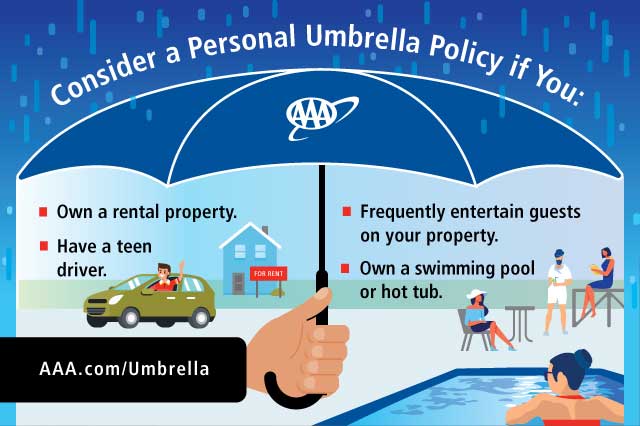
People that live with higher risks could also benefit from the extra cushion. You should consider the excess liability coverage from an umbrella policy if you:
Have a young driver on your auto policy. Teens are statistically the riskiest drivers on the road, with a crash rate three times that of drivers age 20 and older.
Frequently entertain or host guests on your property.
Understanding if Umbrella Insurance Is Worth It for You
Umbrella insurance is notably affordable. For about $150 to $300 per year, you can buy a $1 million personal umbrella liability policy.
As it is designed to supplement your existing coverage, the low cost is likely because you are usually required to have larger liability limits on your home and auto policies to qualify.
“Most insurance carriers give a discount on both your home and auto insurance if you have both written through them,” said Emily Buckley, insurance sales manager for AAA Northeast in Garden City, N.Y. With the amount you save from bundling, it could make sense to invest in an umbrella policy.
How to Get an Umbrella Insurance Policy
Keep in mind that not all umbrella policies are the same and there may be exclusions or limitations. Consult with your insurance agent for help with any specific concerns or needs you may have.
Now that you have a better understanding of umbrella insurance, do you think that it’s the right choice for you? Do you already have it? Tell us in the comments.
This article has been updated and republished from a previous version.
If a vacation learning about unique wildlife in one of the most exotic places on earth excites you more than lounging on a beach, HX Expeditions can take you on the voyage of a lifetime.
A leader in sustainable travel, HX Expeditions invites guests to responsibly explore remote destinations, including the Galápagos Islands.
Cruising With Purpose
When you book a cruise with HX Expeditions, you take on the role of Citizen Scientist. Through HX Expedition’s Science & Education program, guests collaborate with onboard scientists and subject matter experts in the ship’s science center, immersed in information about the wildlife, geography, climate and history of each destination.
Every explorer is tasked with engaging in active research projects, collecting data to enhance the overall knowledge of these regions, documenting biodiversity and monitoring the effects of climate change.
Local experts serve as the guides for the Galápagos cruises, providing information about the wildlife and islands on shore visits and valuable insight during onboard briefings before each daily expedition. All expeditions are included in the cost of the cruise.
Embark on the journey of a lifetime with a HX Expeditions cruise to the Galápagos Islands. Nestled in the Pacific Ocean near Ecuador, this chain of volcanic islands is home to a variety of plant and animal species found nowhere else on earth. While located in the tropics, depending on the island, some of the terrain is dry and some verdant.
Naturalist Charles Darwin brought the Galápagos to the world’s attention almost 200 years ago. While visiting in 1835, Darwin observed the differences among subspecies of animals on the islands, which prompted his theory of natural selection influencing evolution. Visit the Charles Darwin Research Center on Santa Cruz Island, where scientists are working to preserve the native wildlife.
While you can enjoy guided nature walks on trails frequented by lava lizards, land iguanas and other wildlife, HX Expeditions also provides small boats to explore the waters around the archipelago, which is the best way to observe its plants and unique animals. By boat, you can access 13 of the islands and view the dramatic differences in the terrain. Get up close with seals, sea lions and marine iguanas, not to mention the Galápagos penguin and 150 different species of birds.
The Galápagos are famous for the geriatric giant tortoises that inspired the theory of evolution and gave the islands their name. These creatures can live to more than 100 years old weigh up to 900 pounds! They squeeze in time to eat and sunbathe while resting 16 hours a day. Visitors can observe 12 difference species of giant tortoises in the wild or in a protected breeding center. Once near extinction, conservation efforts by the Charles Darwin Foundation and others have brought their numbers up.
The surrounding waters are just as magnificent. Explore by kayak or go snorkeling to spot a variety of marine life. Underwater, you can view turtles, the only marine iguanas in the world and vibrant fish. If you prefer to stay dry, you can still view the underwater wonders from a glass-bottomed boat available on the MS Santa Cruz II.
Exploring Sustainably
While striving to offer the most authentic experiences possible, HX Expeditions also prides itself on its long commitment to sustainability. Its two newest hybrid-powered expedition ships, feature battery packs, heat recovery systems and a revamped hull design. The the carbon emissions of these ships is estimated to be 20% lower than traditional cruise ships. The company stopped using heavy fuel 10 years ago and advocates for its ban worldwide.
Seven years ago, all unnecessary single-use plastics were banned throughout HX Expeditions. To introduce some guests to healthier ways of eating, the cruise line has an extensive vegan and vegetarian menu and has focused on reducing food waste. Two years ago, food waste per guest was cut by 22%.
Other planet-friendly commitments include supporting 41 environmental, cultural and social projects in 11 different countries and helping communities the ships visit.
Let AAA Travel make your dream vacation a reality. Connect with a travel advisor for free trip planning, custom itineraries, exclusive perks and expert guidance every step of the way.
Tapping Book now on your next adventure is always an exciting moment. But even the blissful rush of seeing a new place can be overshadowed by worrying about traveling with your medication.
Understanding the guidelines for flying with medication is a must to make sure your trip goes smoothly and, most importantly, you don’t go without the medication you need. Whether you’re flying within the U.S. or internationally, here’s what you should know before taking off.
How to Travel With Medication: Domestic
Prescription Medications
Although not required by the Transportation Security Administration (TSA), it’s best to keep your prescribed medications in their original pharmacy bottles or packaging. This helps to avoid confusion and provides clear proof of its legitimacy. The prescription label should have your name and the medication name.
Liquid medication “in excess of 3.4 ounces in reasonable quantities for the flight” is allowed in carry-on bags, according to TSA. It’s not necessary to have it in a clear zip-sealed bag, but you should tell your screening officer that medically necessary liquids are in your possession prior to being screened. TSA also allows you to bring an unlimited quantity of prescription medication in your carry-on bag but specifies that it must be for personal use.
When it comes to packing, old school is best, according to David Murcko, travel advisor with AAA Northeast.
“Liquids need to be in clear, zip-top bags anyway, so I just keep it simple,” he said. “I also write what it is on tape and stick the tape on the bag.”
Over-The-Counter Medications
For non-prescription medicine like vitamins, allergy pills or ibuprofen, it’s still best to keep them in their original packaging to prevent misunderstandings at security checkpoints.
Medical Devices
If you rely on medical devices like insulin pumps, nebulizers or a CPAP machine, make sure they are packed safely in your carry-on luggage. These types of devices are allowed through security but may require additional screening. As a precaution, it’s a good idea to carry any necessary documentation for these devices.
If a medical device is attached to your body, inform the TSA officer of its location prior to your screening. You will not be asked to remove devices attached to your body, but disconnected devices may be screened by X-ray.
How to Travel With Medication:International
International travel adds another layer of complexity when it comes to carrying medications as each country has its own rules and regulations. To avoid complications, be sure to research the country you are visiting for their requirements. Some medications that are commonly prescribed in the U.S. might be restricted or even illegal in another country.
When traveling with prescription medication internationally, it’s advisable that you carry a letter from your doctor that details your condition and the associated prescribed medications. You may also opt to carry copies of the prescriptions and their original packaging, showing that the medication is for personal use and is not a controlled substance.
If you are travelling with controlled substances, some countries require additional documentation or permits. Check with your airline and the destination’s consulate or embassy to confirm what documentation is needed.
“I always take doctors’ notes with me, copies of my passport and have Google Translate on my phone just in case there is an issue when traveling internationally,” said Murcko. To avoid confusion at customs, particularly if there is a language barrier, it’s helpful to have the names of your medications translated into the local language ahead of time.
Some medications like insulin or certain biologics require refrigeration, and long flights may pose a challenge in keeping them at the proper temperature. Be sure to contact your airline in advance to ask about options for storage.
Keep a backup supply. “Always have a backup for your backup for your backup,” said Murcko. “Make sure that you have enough medical supplies for the whole duration of your trip plus extra, because you never know when you might be delayed or stuck somewhere.”
If you’re traveling for an extended period of time, consider carrying extra medication in case of travel delays or lost luggage.
Know your rights. In many countries, travelers with medical conditions have the right to carry essential medications without facing discrimination or delays. If you experience difficulty, don’t hesitate to seek assistance from the appropriate authorities.
Stay organized. Use small containers to keep track of your medication and ensure you can quickly identify the right doses.
Have you ever had to travel with medication? Give your best piece of advice in the comments below.
Plan your next trip with a AAA travel advisor today. Travel advisor services are included with your membership at no extra charge.
A long road trip is much easier when you’re not the only one doing the driving. It’s safer too. If one of you starts to feel drowsy or cramp up, the other driver can take over and play navigator for a while.
While each company has its own rules, this general guide can help you understand more about adding drivers to your car rental reservation, taking some of the stress and guesswork out of the process.
Why would I want to add another driver?
It might be boring to be the only one with driving duty — but more importantly, it can be dangerous. Driving for hours on end can sometimes be exhausting, and falling asleep behind the wheel is a real risk on a long road trip. Even if you’re not planning on sharing the wheel, it’s smart to be prepared if your passenger needs to take your place.
Adding another driver can also greatly reduce the time you might need to spend on the road, since you and your co-pilot can trade places instead of pulling over to rest (or even pulling into a hotel at night). This is a great asset to have when you’re on a time crunch. Less time can be spent at rest areas and more time can be spent covering ground.
The people who are automatically covered in a rental car agreement are “Authorized Operators.” An Authorized Operator can be your employer, employee or coworker if you’re on a company business trip together (and have booked your rental car through your company). They can also be your spouse, if you’re renting in certain states like California, Iowa or New York.
Can I add anyone else?
A driver who is added to the rental paperwork is called an “Additional Authorized Operator.” Additional Authorized Operators must be present at the time of the rental and must sign on to the rental agreement themselves at the rental location. The additional driver must also present their driver’s license and a valid credit or debit card.
How much does it cost to add more drivers?
The main reason that most renters hesitate to add an Additional Authorized Operator is that they often come with extra fees. These fees vary across rental companies and state lines. Hertz, for example, charges an extra fee of $13.50 per day per additional driver. Additional Authorized Operators who are between 21 and 25 may be asked to pay an age differential fee as well, since many companies consider younger drivers an insurance risk.
In New York State, fees for Additional Authorized Operators of rented cars are capped at $3 a day. But remember: State laws apply to the state that you are renting the car in to begin with — not the state that you’re going to be driving to.
Do AAA Members get any discounts for Additional Authorized Operators?
Car rental companies like Hertz, Dollar and Thrifty waive the additional driver fee when both the renter and the additional driver are AAA members. Spouses and domestic partners of AAA members are not required to have a separate AAA membership to receive the same discount. If you want to access a AAA discount, your AAA Club Code must appear on the rental. You could also present a valid AAA membership card or a AAA credit card.
At Hertz, AAA members receive the best rate available at the time of reservation, so you can get additional savings on top of the waived fee for extra drivers. AAA members also receive free unlimited mileage on most Hertz rentals, which is perfect for the type of trip that necessitates more than one driver. You can enjoy the open road without worrying about an extra Additional Authorized Operator fee and without thinking about the miles you’re racking up.
Whether you’re headed out on a long adventure or just want a little company, adding another driver to your rental car is easier than ever. Driving just isn’t the same when you’re doing it alone.
Rent with Hertz and take advantage of exclusive AAA discounts today.
Think your teeth and eyes have nothing in common? They are more connected than you might expect!
From inflammation to vitamin deficiencies, researchers have found many links between oral health and vision. That is why it’s so important to schedule regular exams for both. If you are a AAA member living in Massachusetts, you can enjoy exclusive savings with Altus Dental™ and Altus Vision™ for individuals and families.
Here are some surprising ways oral health can influence vision.
Gum Disease: A Hidden Threat to Your Eyes
Anyone who has experienced an infection in a tooth or the gums knows that it can lead to swelling. That reaction doesn’t always stay confined to your mouth. Your body can respond to any infection with inflammation in other places, as well, which can lead to issues with your eyes.
Why is this? Optical blood vessels are small and particularly fragile, and they can be easily damaged by chronic or severe inflammation. For example, a study highlighted by the American Academy of Ophthalmology (AAO) found there may be a link between tooth loss and primary open-angle glaucoma, possibly because of inflammation.
People with diabetes more often experience higher blood sugar levels than the average population. Over time, high blood sugar levels can damage blood vessels and lead to inflammation, both of which are associated with oral and vision issues. As such, diabetes can lead to increased risk of both periodontitis and glaucoma, according to the American Dental Association (ADA) and the AAO.
Infections and Bacteria Can Spread
Severe infections in the mouth can spread through the sinuses to the eyes. For example, the AAO has reported that sinus infections from dental abscesses have been linked to an increased risk of orbital cellulitis, a serious eye infection. Oral bacteria also can spread elsewhere, as the bacteria can survive and travel in the bloodstream. If this bacteria settles in the eye region, it could lead to inflammation and, in rare instances, infection.
Good Nutrition Is Key
Research has shown that deficiencies in certain vitamins, like vitamin A and C, can have a negative impact on teeth and vision. The AAO has preached that a diet rich in vitamins and minerals can lower the risk of age-related macular degeneration. The ADA also emphasizes that a healthy diet is associated with better oral health. Eating good food can benefit the health of your mouth and your vision.
Of course, no amount of clean eating can completely prevent dental or vision problems. That’s why it’s important to schedule regular preventive checkups with both your dentist and your optometrist.
AAA Northeast members living in Massachusetts can utilize exclusive savings on dental and vision insurance with Altus Dental and Altus Vision™. Altus Dental provides easy access to in-network care with more than 10,000 locations locally and nearly 420,000 nationwide. In partnership with VSP® Vision Care, Altus Vision™ offers savings on exams, glasses, contacts and much more. You’ll also have access to the nation’s largest network of independent eye doctors and popular retailers.
Do your eyes feel dry? Are your gums irritated? The health of your mouth and eyes are more connected than you may realize. Luckily, small daily habits like staying hydrated and eating nutrient-rich foods can help you maintain both a bright smile and clear vision.
One of the best things ways maintain your oral health and vision is to schedule routine annual eye exams and bi-annual dental cleanings. With Delta Dental of Rhode Island and DeltaVision®, AAA Northeast members in Rhode Island have exclusive access to discounted dental and vision insurance plans.
Here are some other things you can do every day to keep your mouth and eyes healthy.
Don’t Slack on Routine Oral Maintenance
We all know that brushing and flossing daily can prevent gum disease, but it also can protect your eyes. Preventing gum disease can decrease the risk of inflammation and infection in your mouth from gum disease. Sometimes, inflammation or infection in the mouth can travel through the sinuses or the blood to do damage to the sensitive optical blood vessels that are key to keeping your eyes healthy, according to the American Optometric Association (AOA).
The buzz about superfoods is not just hype. Research has shown that a daily diet high in vitamins and minerals like vitamin A and C and omega-3 fatty acids is good for supporting healthy gums and good eye health. Carrots, sweet potatoes and spinach are excellent sources of Vitamin A. Oranges, strawberries and broccoli provide a healthy dose of Vitamin C. And for omega-3 fatty acids, consider adding salmon, seaweed and walnuts to your meals.
Cut Down on Sugar
Oral wellness and healthy vision are also impacted by the foods you eat sparingly. Everyone knows that limiting your sugar intake can reduce the risk of cavities and gum disease, but curbing your sweet tooth can help to keep your blood sugar levels in a healthy range. That’s important, as people with chronically high blood sugar levels, like those with diabetes, are more at risk of having eye issues. The AOA reports that chronically high blood sugar levels stress and damage the tiny optical blood vessels that are essential for your vision.
Just Add Water
Staying hydrated is very important to the health of both your mouth and your eyes as it helps to maintain healthy saliva production and tear film. Saliva prevents bacteria from gaining a foothold on your teeth, so much so that people with dry mouth often are prescribed a special toothpaste to help with saliva production. Tears protect the eyes by washing out irritants and keeping eyeballs hydrated.
Give Your Eyes a Break
Just like your teeth, your eyes need daily care. If you spend a lot of time looking at screens, follow the 20-20-20 rule. Every 20 minutes, look at something 20 feet away for at least 20 seconds. This reduces eye strain and can prevent headaches.
On our own, we all can only do so much to protect our oral health and vision. That’s why it’s important to schedule regular visits with your dentist or optometrist.
If you’re seeking adventure in the South, look no further than South Mississippi. Here, you’ll find natural beauty, historic landmarks, picturesque main streets and delectable surf and turf. Spend a few days cruising along the coastline before exploring the inland cities of Hattiesburg and Laurel on this road trip.
Cruise Along Coastal Mississippi
After your flight lands in Gulfport, climb behind the wheel of your rental and hit the streets of Coastal Mississippi, home to 12 cities along 62 miles of coastline. Set up your home base at one of the independent properties such as the White House Hotel in Biloxi or The Bay Town Inn in Bay St. Louis. Then, get ready for fun.
To dig into the history of the coast, stop by the Biloxi Lighthouse to learn more about the city’s history and heritage. For a lesson in the resilience and beauty of the human spirit in the aftermath of Hurricane Katrina, visit the Waveland Ground Zero Museum.
When you’re ready to eat, Coastal Mississippi satisfies every appetite. At The Chimneys in Gulfport, try the crab claws before moving on to the sauteed shrimp or trout. When you want a steak, there’s no better spot than Mary Mahoney’s Old French House in Biloxi; choice cuts include filet mignon, prime Angus ribeye and Wagyu sirloin. If you like alfresco dining, Shaggy’s Pass Harbor in Pass Christian is not to be missed, where the selection ranges from fish tacos to stacked burgers.
Head north on U.S. Highway 49 for a little more than an hour to Hattiesburg. Known as the Hub City, Hattiesburg welcomes you to enjoy its art, history, food and more, all within the downtown area. As you explore the area, keep your eyes open for some of the many murals that grace the building walls. For a whimsical excursion, head to the Hattiesburg Pocket Museum, which occupies an alley connecting Main and Forrest streets. Here you can grab a piece of art from the Pocket Gallery, view the mini installations or bust a move at the dance spot.
There’s plenty of shopping and dining around every corner, too. Grab vintage candy or handmade jewelry at The Lucky Rabbit, or pick up a paperback at The Author Shoppe. When you’re hungry, try the burgers and onion rings at The Porter Public House.
Don’t leave downtown without a visit to the African American Military History Museum. Housed in a historic USO building, it contains hundreds of artifacts, exhibits and photographs telling the story of service from the American Revolution through today.
For accommodations, skip the chain hotels in favor of a tiny home. Just 25 minutes from downtown, Longleaf Piney Resort features nine tiny homes and one lake house set among the trees just off the Longleaf Trace, a rails-to-trails pathway. Here, you can relax to the sounds of nature, enjoy a campfire or snooze in a hammock. The resort also offers e-bikes for rent, so you can bike your way down the Trace to downtown Hattiesburg.
Just 30 minutes north on Interstate 59, Laurel has become a popular destination as the location of HGTV’s “Home Town,” a show that features Ben and Erin Napier renovating houses around the area. Fans of the show flock to the Napier’s businesses hoping to catch a glimpse of the couple and to pick up some souvenirs. These include the Laurel Mercantile Co., Scotsman General Store & Woodshop and Scent Library.
But don’t stop there. Stroll the streets downtown and pop into some of the shops and restaurants along the way. One recommendation? Check out the wares at HAND+made Laurel, and grab a cup of HAND+made Lemonade to enjoy on your walk. If you’re looking for lunch, try Pearl’s Diner. Just don’t be late because the restaurant is open only from 11 a.m. to 2 p.m., Tuesday through Saturday.
Don’t leave town without visiting the Lauren Rogers Museum of Art, a free museum where you can view five primary collections: American art, European paintings, Native American baskets, Japanese Ukiyo-e prints and British Georgian silver. The museum also hosts temporary exhibits featuring Mississippi artists, as well as American and international artists. On your way out, step into the gift shop for a unique memento to take home.