Federal Student Loan Changes: What Families Need to Know Before July 

For students and families taking out new college loans or repaying existing federal loans, major changes are right around the corner. Starting July 1, new borrowing limits and repayment plans go into effect.  

Don Kerr, AAA Northeast’s director of student lending and college services, is guiding families through the changes and what they mean for covering the growing cost of higher education. 

Loan TypePrevious StructureNew Rules (Starting July 1)
Parent PLUS LoansNo formal annual cap$20,000 per year; $65,000 per student
Grad PLUS LoansAvailable for graduate studentsEliminated for new borrowers
Graduate Unsubsidized LoansHigher borrowing flexibility$20,500 annual / $100,000 aggregate (nonprofessional)
Repayment PlansMultiple income-driven optionsRepayment Assistance Plan (RAP) becomes primary option

What are the biggest changes? 

  • Parent PLUS loans have new limits. Starting July 1, new Parent PLUS loans will be capped at $20,000 per year and $65,000 per student. Parents who borrowed prior to July 1 are not subject to the new limits for up to three additional academic years. 
  • Grad PLUS loans are no more. New borrowers are now limited in the amount they can borrow for graduate school attendance. The new annual unsubsidized loan limit for “nonprofessional” graduate degrees is set at $20,500, with an aggregate limit of $100,000. Students borrowing to pursue “professional” graduate degrees have higher limits, $50,000 per year and $200,000 aggregate. Graduate students with existing loans are not subject to the new limits for up to three additional academic years. 
  • Repayment plans will be significantly different. Borrowing limits for undergraduate students are not changing, but students who take out their own federal loans to pay for college are going to have limited repayment options beginning July 1. The length of standard repayment plans will vary from 10 to 25 years based on how much the student owes, rather than the previous 10-year standard term. Those who needed repayment assistance previously had several options available, but starting next month, the only option will be the Repayment Assistance Plan (RAP), where monthly payments are based on adjusted gross income. Existing borrowers who have already graduated will maintain access to old repayment programs but must sign up for them prior to July 1.  

“These major changes to borrowing and repayment are right around the corner, and borrowers need to know that they must take action before the end of the month to access the plans changing or being eliminated starting in July,” said Kerr. 

What other financing options do students and their families have? 

With borrowing limits decreasing at a time when the cost of college is increasing, Kerr says students and families are searching for alternative resources, including scholarships, private student loans and, for parents fortunate to have equity in their homes, home equity loans. Parents and students considering private loans should prioritize their credit scores to secure the best possible rates.  

Kerr says the changes to federal loans are making scholarships even more competitive, but given that they do not require repayment, investing time and energy into identifying and applying for scholarships could be well worth it.  

Frequently Asked Questions About Federal Student Loan Changes

1. What federal student loan changes take effect on July 1?
Beginning July 1, new borrowing limits apply to Parent PLUS and graduate loans, and federal repayment options will be restructured for new borrowers.

2. How do the new Parent PLUS loan limits affect families?
New Parent PLUS loans will be capped at $20,000 per year and $65,000 per student, which may require families to seek additional financing sources.

3. Are existing borrowers affected by these changes?
Borrowers with loans issued before July 1 may retain access to prior borrowing limits and repayment programs for a limited transition period.

4. What happened to Grad PLUS loans?
Grad PLUS loans will no longer be available to new borrowers. Graduate students will instead rely on capped unsubsidized federal loans.

5. How are repayment plans changing for students?
New borrowers will have fewer repayment options, with the Repayment Assistance Plan (RAP) becoming the primary income-based alternative.

6. Do undergraduate borrowing limits change?
No. Federal borrowing limits for undergraduate students remain the same.

7. What alternatives can families consider if federal limits fall short?
AAA Northeast recommends exploring scholarships, private student loans, and home equity loans, while paying close attention to credit quality.

Subscribe to Your AAA Newsletter

Sign up and receive updates for all of the latest articles on automotive, travel, money, lifestyle and so much more!

Q&A With AAA’s Car Doctor: June 2026

Q. How much should we expect to pay at a Toyota dealer to address a knock sensor code? Either the sensor, the harness, or both?

A. The answer varies based on the model and year, as well as how accessible the sensor is. In many Toyota engines, the knock sensor is mounted under the intake manifold, which adds labor time. As a general example, on a RAV4 the knock sensor may cost around $190 and take about an hour to install. On a mid-size sedan such as a Camry, the part cost is similar — around $195 — but labor can stretch to more than two hours depending on engine layout. If the wiring harness is also damaged, that adds parts cost and additional labor. Keep in mind there will also be diagnostic time to confirm whether the issue is the sensor itself, the harness, or even a false code triggered by another problem such as engine noise or poor fuel quality.

Q. We own a 2016 Hyundai Sport with the 1.6L turbo and dual-clutch automatic transmission. It has just turned 100,000 miles and still has the original battery. It starts fine, even in sub-10-degree weather. Are we harming the car by keeping this battery?

A. That engine typically uses a 650 CCA AGM battery, which is more robust than a conventional flooded battery. Even so, at around 10 years old, you are likely on borrowed time. Batteries can lose a significant portion of their reserve capacity while still appearing to crank normally, especially in a small-displacement engine. Cold starts are demanding, but summer heat is actually harder on battery chemistry and accelerates internal breakdown. While you are not harming the car by continuing to use it, the risk is sudden failure with little warning. Replacing the battery proactively — particularly before a long trip — is a sensible approach to avoid inconvenience or a roadside breakdown.

Q. I drive a 2003 Pontiac Bonneville SSEi with just 49,000 miles. The headlight assemblies are cracked and need replacement. My mechanic wants $220 in labor, saying it will take two hours. Is this reasonable?

A. That estimate is reasonable. While the assemblies themselves may appear to be held in with only a few fasteners, proper replacement involves more than simple removal and installation. Typically, it will take about 1 to 1.2 hours to remove and reinstall both units, plus additional time — often 20 to 30 minutes — to correctly aim and align the headlights. Proper alignment is critical for both safety and legal compliance. As for parts, original equipment (OEM) units generally provide the best fit and clarity. If you choose aftermarket parts, look for CAPA-certified components, which have been tested for fit, performance and durability.

Q. I have a 1970 Chevy Impala and am thinking of switching all the exterior lights to LEDs. Since the car has no computer system, is this safe?

A. In an older vehicle without electronic control modules, converting to LED lighting is generally straightforward. However, it is not entirely without considerations. Some LED bulbs draw significantly less current, which can cause issues with older-style thermal turn-signal flashers, leading to rapid flashing or no flashing at all. This can usually be corrected by replacing the flasher with an electronic unit. Additionally, some LED conversions can generate heat in unintended areas, potentially damaging sockets or housings if the design is poor. Always verify the bulbs are approved for on-road use and designed for the specific application.

Q. I noticed white powder around the battery hold-down area in my 2015 Subaru, although the battery tests fine. What could be causing this?

A. The white, powdery residue is typically battery acid corrosion caused by electrolyte outgassing. This can occur when a battery is overcharging or simply aging. Some Subaru models have had charging system updates to address undercharging, but corrosion is more often associated with overcharging or normal battery wear. The best approach is to clean the affected area with a baking soda and water solution to neutralize the acid, rinse thoroughly, and dry the area. Inspect the hold-down hardware for rust and treat as needed. Continue to monitor the battery and charging system, especially if the corrosion returns.

Q. My wife broke the side mirror on her 2021 VW Atlas. The dealer quoted $1,000, but we found a used matching mirror online for $150 and installed it ourselves. Was this a good move?

A. Using a quality used OEM part is often an excellent way to save money without sacrificing durability. Modern mirrors can include features such as heating elements, blind-spot monitoring, and power folding, all of which add cost to new replacements. Salvage parts, when properly matched and in good condition, can offer the same functionality at a fraction of the price. Additionally, factory parts tend to be better engineered than some aftermarket alternatives. As long as the installation was done correctly and all features function properly, this was a smart and cost-effective repair.

Q. My wife’s 2011 VW Tiguan is consuming oil — about a quart every 2,000 miles. The dealer says this is normal. Does that sound right?

A. While it may not sound acceptable to most drivers, this level of oil consumption has been considered “within normal limits” by some manufacturers, including Volkswagen, particularly for certain turbocharged engines from that era. In some cases, manufacturers have even defined acceptable consumption as high as one quart per 1,000 miles. This makes it essential to check oil levels regularly—ideally every 1,000 miles or sooner. Extended oil-change intervals can make the situation worse, as it is possible to run the engine low on oil without realizing it. While it may not indicate imminent failure, it does require vigilance to avoid engine damage.

Q. We are considering replacing one of our two cars with an electric vehicle, such as a Tesla Model 3 or Hyundai Ioniq. What are your thoughts, particularly regarding charging?

A. A two-car household is often the ideal scenario for adding an electric vehicle. One vehicle can handle long trips — whether gasoline, hybrid or plug-in hybrid — while the EV is used for daily commuting and local driving. This setup minimizes range anxiety and maximizes convenience. Home charging is key to making EV ownership practical. A Level 2 charger using a 240-volt outlet allows for reasonably quick overnight charging. Public charging is improving, but it still requires planning for longer trips. Vehicles like the Hyundai Ioniq 5 and Ioniq 6 have been well received for their range, charging speed, and overall refinement. The Tesla Model 3 is also a strong contender, particularly due to Tesla’s charging network. Ultimately, the decision comes down to your driving habits and access to reliable charging at home.

Q. My 2021 Ram pickup had a dead battery after sitting for a week, and I found the rear seat area soaked. What could cause this?

A. This is a known issue in some trucks equipped with sliding rear windows. Over time, the window frame or seal can develop cracks or leaks, allowing water to enter the cabin. That moisture can reach wiring and electronic components, potentially leading to parasitic battery drain. The proper repair typically involves replacing the rear window assembly and ensuring all water-damaged materials — such as carpet padding or insulation — are thoroughly dried or replaced. Addressing both the leak and the electrical impact is essential to prevent ongoing problems.

Q. I store my 2016 Nissan Altima outside for part of the year and have problems with rodents nesting in the engine compartment. What can I do?

A. Rodent intrusion is a common issue for stored vehicles, especially in warm climates. Physical barriers are among the most effective solutions. A full vehicle enclosure that seals to the ground can prevent access, although it must be securely installed to withstand weather conditions. Chemical and scent-based repellents can help, but they require periodic reapplication. Another practical step is to remove the decorative plastic engine cover, as it can create a warm, sheltered space that attracts rodents. Keeping the engine bay as open and uninviting as possible, combined with deterrents, offers the best protection over extended storage periods.

Subscribe to Your AAA Newsletter

Sign up and receive updates for all of the latest articles on automotive, travel, money, lifestyle and so much more!

Gas Prices Continue Their Decline as Peace Talks Continue 

Crude oil and gasoline prices have steadily declined for about a month on building anticipation that the war with Iran might be nearing its end, and cargo flow through the Strait of Hormuz could resume. Last week’s announcement of a preliminary peace agreement helped nudge petroleum prices even lower. By the end of trading on Friday, crude prices were 6% lower week-over-week, settling between $75 and $80 a barrel — the lowest level since early March and more than $30 a barrel lower than their peak in April. 

But tightening inventories of oil and gasoline are keeping some pressure on pump prices: U.S. crude inventories fell by 17.2 million barrels last week, reaching the lowest level since March 1985, according to the Energy Information Administration (EIA). Inventories of gasoline also declined by 900,000 barrels and are now 6% below the five-year average, the EIA reported. The drawdown came even as gasoline production climbed 356,000 barrels a day to more than 10 million barrels a day — the highest rate in more than 10 months — as refiners ramp up output to meet summer demand. Total domestic demand last week reached 9.21 million barrels a day, the highest level in three weeks. Exports remain elevated as countries around the world turn to the U.S. to replace product previously delivered via the Strait of Hormuz. Over the past four weeks, gasoline exports have trended about 20% higher than last year. Oil exports have averaged 23% higher over the same period. 

“Recent declines in oil and gas prices have coaxed the national average below $4 a gallon for the first time since March — welcome relief at the pump,” said Jillian Young, director of public relations for AAA Northeast. “While prices have decreased significantly, markets remain uncertain about the timetable for Persian Gulf exports to return to prewar levels.” 

AAA’s June 22 survey of fuel prices found the national average was down 14 cents from the previous week ($4.06), averaging $3.92 per gallon. The June 22 national average price was 63 cents lower than a month ago ($4.55) and 71 cents higher than last year ($3.21)

As of June 22, Indiana and Oklahoma had the lowest prices in the nation at $3.32 and $3.41, respectively. California and Hawaii had the highest prices in the nation at $5.57 and $5.52, respectively.  

Region Current Price* One Week Ago One Month Ago One Year Ago 
Connecticut $4.06  $4.21  $4.64  $3.16 
Massachusetts $4.05  $4.17  $4.49  $3.08 
New Jersey $3.97 $4.10 $4.53 $3.14 
New York $4.23 $4.36 $4.60 $3.20 
Rhode Island $3.91  $4.05  $4.49 $3.06 

Gas Prices by State Over Time

$5.00
$4.50
$4.00
$3.50
$3.00
$3.16
$4.64
$4.21
$4.06
CT
$3.08
$4.49
$4.17
$4.05
MA
$3.14
$4.53
$4.10
$3.97
NJ
$3.20
$4.60
$4.36
$4.23
NY
$3.06
$4.49
$4.05
$3.91
RI
$3.21
$4.55
$4.06
$3.92
US
One Year Ago
One Month Ago
One Week Ago
Current


*Prices as of June 22, 2026 

The AAA Gas Prices website is your resource for up-to-date fuel price information. Search for average gas prices on national, state and metro levels by regular, plus, premium and diesel.  

Subscribe to Your AAA Newsletter

Sign up and receive updates for all of the latest articles on automotive, travel, money, lifestyle and so much more!

Why Life Insurance Through Work Isn’t Enough

It’s easy to believe that the group life insurance offered through your employer is sufficient coverage for you and your family. After all, what’s good for the goose is good for the gander, right? Well, not necessarily.

While group life insurance is generally affordable and convenient, it has its shortcomings. Relying solely on your life insurance through work could mean there isn’t enough to support your family’s needs.

Listen to Our Podcast

Have insurance questions? Listen to Episode 3 of our podcast, Merging Into Life: Insurance 101.

Tune In

How Group Life Insurance Limits Your Coverage

Employee-provided life insurance only offers a fixed amount of coverage for a specified period of time. The coverage amount is often a multiple of your salary, but doesn’t consider factors such as outstanding debts, mortgage obligations or a variety of future expenses.

Plus, group life coverage isn’t portable. When you leave your job — whether by choice or circumstances beyond your control — your life insurance coverage may end, leaving you and your family without protection during a period when financial stability is needed most. Starting a new policy at that point may come with higher premiums, as well, particularly if your health has changed since your initial enrollment in the employer plan.

Another significant drawback of life insurance through work is the lack of customization. These plans are designed to cater to a diverse group of employees, and as a result may not address everyone’s specific needs. Your financial situation, lifestyle, responsibilities and future plans are unique, and a one-size-fits-all approach to life insurance may not be sufficient. The great thing about individual policies is that some offer cash value, which is a great way to help plan for your retirement at the same time.

Get the Best of Both Worlds

Should you get life insurance through work? Sure, work life insurance is a valuable benefit, but it shouldn’t be considered a stand-alone solution for comprehensive coverage. Getting a personalized, individual life insurance plan ensures that your unique circumstances are accounted for in addition to being portable and offering the flexibility to adapt to life’s changing stages. You also get to choose whether you’d like a term or permanent policy.

Regular assessments of your coverage and consulting with a life insurance agent can help ensure that your life insurance strategy remains aligned with your evolving needs, providing you and your loved ones with the peace of mind they deserve.

Get a AAA Life Insurance Quote

Subscribe to Your AAA Newsletter

Sign up and receive updates for all of the latest articles on automotive, travel, money, lifestyle and so much more!

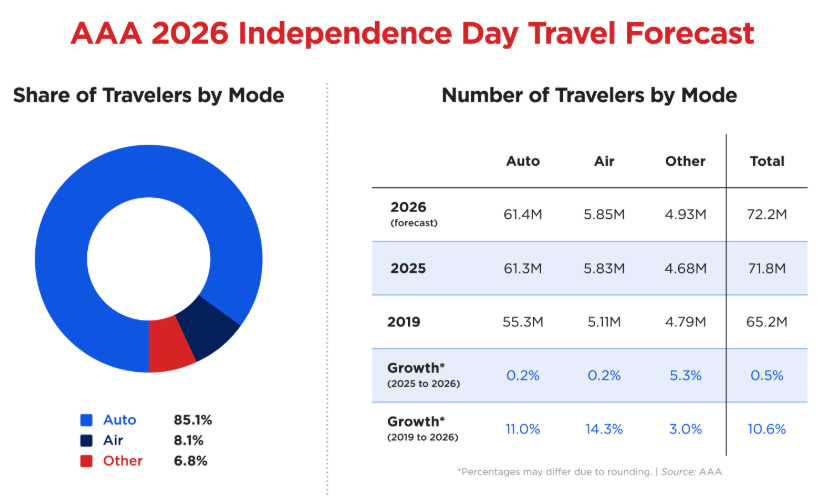
AAA: 72.2 Million Americans Expected to Travel Over July Fourth Week

AAA projects 72.2 million Americans will travel at least 50 miles from home for Fourth of July between Saturday, June 27, and Sunday, July 5. While domestic travel this year is forecast to surpass last year’s record of 71.8 million travelers, the increase is smaller than recent year-over-year gains. The number of travelers driving and flying to their destinations is relatively flat compared to last year, while travel by other modes, including cruises, is the category seeing the biggest increase.

“While the overall number of Independence Day travelers appears to be plateauing, traveling during the week of July Fourth remains a tradition for many,” said Jillian Young, director of public relations for AAA Northeast. “Whether they’re vacationing for the full week or just getting away for the long weekend, we still expect to see high volumes of travelers taking advantage of the holiday.” 

Independence Day Travelers by Mode of Transportation

By Car

AAA projects 85% of travelers — 61.4 million people — will drive to their destinations, nearly the same number as last year, when 61.3 million travelers took road trips. While gas prices have fallen over the past few weeks, the average price remains higher than last year. Despite higher prices at the pump, filling up the tank during a road trip is still cheaper than purchasing flights for many travelers. 

For travelers renting cars, AAA car rental partner Hertz expects Thursday, July 2, to be the busiest pickup day. 

AAA urges drivers to prioritize safety during their holiday festivities:

  • Drive sober: Nearly one in three summertime traffic deaths involves an impaired driver, according to a AAA crash data analysis. AAA, in partnership with Mothers Against Drunk Driving (MADD), reminds anyone who plans to drink or use impairing substances to arrange a sober ride before going out.
  • Slow Down, Move Over: Drivers play a huge role in preventing tragedies by reducing speed and changing lanes whenever they approach a vehicle on the side of the road. 
  • Don’t skip car maintenance: Last year during Independence Day week, AAA responded to more than 687,000 roadside assistance calls. Half of those required towing services, and nearly 30% of those calls were for battery replacement and flat tires. Stay on top of routine oil changes, plus check battery condition and tire pressure before hitting the road.
By Air

AAA projects 5.85 million travelers will take domestic flights over July Fourth week, a 0.2% increase over last year. Air travelers make up 8% of the share of holiday travelers. 

By Other Modes

Travel by other modes is seeing the biggest year-over-year growth compared to car and air travel. AAA projects 4.93 million Americans will take buses, trains and cruises over Independence Day week, a 5.3% increase from last year. Travelers are drawn to cruise vacations because they know how much the trip will cost upfront thanks to all-inclusive dining, various entertainment options and multiple destinations in one package.

AAA’s Top Independence Day Destinations

AAA members are heading to major U.S. cities and flying internationally to Canada and Europe during the holiday period. July Fourth fireworks and festivities in New York and Boston draw big crowds, and peak Alaskan cruise season brings travelers to Seattle, Anchorage, Fairbanks and Vancouver.

RankingDomesticInternational
 Seattle, WA Vancouver, Canada 
Orlando, FL Rome, Italy 
Anchorage, AK Dublin, Ireland 
Miami, FL Paris, France 
New York City London, England 
Chicago, IL Calgary, Canada 
Fort Lauderdale, FL Reykjavik, Iceland 
Fairbanks, AK Amsterdam, the Netherlands 
Denver, CO Athens, Greece 
10 Boston, MA Barcelona, Spain 

Best and Worst Times to Drive

The weekend of July Fourth will be the busiest on the roads, starting Thursday, July 2, according to transportation data and insights provider INRIX. Drivers looking to avoid the heaviest traffic should leave early in the day or consider traveling on Monday or Tuesday.

Best and Worst Times to Travel by Car
DateWorst Travel TimeBest Travel Time
Saturday, June 27 12 to 5 p.m. Before 10 a.m. 
Sunday, June 28 2 to 4 p.m. Before 11 a.m. 
Monday, June 29 2 to 6 p.m. Before 12 p.m. 
Tuesday, June 30 3 to 6 p.m. Before 2 p.m. 
Wednesday, July 1 12 to 9 p.m. Before 12 p.m. 
Thursday, July 2 2 to 6 p.m. Before 12 p.m. 
Friday, July 3 12 to 7 p.m. Before 11 a.m. 
Saturday, July 4 10 a.m. to 2 p.m. After 3 p.m. 
Sunday, July 5 12 p.m. to 6 p.m. Before 11 a.m. 

Subscribe to Your AAA Newsletter

Sign up and receive updates for all of the latest articles on automotive, travel, money, lifestyle and so much more!

What To Do if Your Data Has Been Breached

These days, it seems like everyone has experienced at least one data breach. You get a letter, email or text informing you that hackers broke into the records of an institution you use and your personal information may be at risk. What exactly was exposed and how much is often unclear.

More than 22,000 confirmed data breaches were analyzed in the 2026 Verizon Data Breach Investigations Report, representing the largest volume of incidents examined in the report’s 19-year history.

As data breaches become more common, consumers should know how to protect their information and act quickly when a breach threatens their privacy.

What Is a Data Breach?

Cybercriminals are constantly evolving their tactics to swipe personal information, but data breaches are large-scale attacks that can compromise thousands — or even millions — of records at once, often by targeting big organizations like banks, health care institutions and major retailers. Hackers are becoming increasingly sophisticated, studying organizations’ data systems and cybersecurity programs to find ways to break in.

Information leaked in a data breach can include Social Security numbers, bank account and credit card numbers, passwords, birth dates, addresses and passport numbers, according to Experian. Cyber thieves use the information to set up accounts and run up bills in your name without your knowledge — or sell it to other people who will do the same.

The top methods used to commit data breaches include stealing login credentials, exploiting software vulnerabilities and phishing. Unsurprisingly, a growing prevalence of artificial intelligence-enabled cyberattacks is also raising new alarms across the cybersecurity landscape.

Be proactive and protect your tech. AAA members can get exclusive discounts on device security and online protection with Norton 360. Norton 360 offers members antivirus, malware, ransomware and hacking protection, plus a password manager, parental controls, VPN private internet connection and more. Get offer.

Get 50% off every year

Keep your devices secure all summer long.

Save now

What To Do if Your Data Has Been Breached

If you receive a data breach notice, follow these steps recommended by Experian.

  • First, don’t ignore data breach notifications. Follow up as soon as possible.
  • If the organization that had the breach offers you free fraud and identity theft monitoring services, take them.
  • Run a privacy scan and a dark web search to see if your information is on any illicit or hidden websites.
  • Monitor your bank accounts, credit cards and Social Security account for any fraudulent activity.
  • Check your credit reports with all three credit bureaus — Experian, TransUnion and Equifax — to ensure there is no activity you don’t recognize.
  • Place a fraud alert or a credit freeze on your credit report. A fraud alert requires creditors to confirm your identity before approving an application, while a credit freeze blocks new credit accounts from being opened in your name.
  • If no one has opened an account in your name or made unauthorized purchases, you don’t need to report credit or identity theft. If they have, contact the organizations involved, as well as the Federal Trade Commission, the FBI’s Internet Crime Complaint Center and local law enforcement agencies.

Listen to Our Podcast

Get tips to outsmart scammers and protect your personal data. Listen to Episode 12 of our podcast, Merging Into Life: Identity Theft.

Tune In

How to Prevent Data Breaches

While protecting your personal and work data from large-scale breaches at corporations is difficult, you can safeguard your information as best as possible with these tips.

  • At work, always follow the company’s security protocols and make sure all virus protection programs are current, use passwords that are not easy to guess and promptly report any missing hardware.
  • Follow the same steps with your personal information, including purging old information from devices and shredding paper documents with sensitive information.
  • Open an E-Verify account to confirm your legal authorization to work in the U.S. and lock your Social Security number to prevent others from using it to get a job.
  • Subscribe to comprehensive cybersecurity protection through a service like Norton 360.
  • Sign up for ProtectMyID from AAA and Experian. ProtectMyID actively monitors your credit and identity around the clock, alerting you right away if it detects any suspicious activity involving your personal information. All AAA membership levels include Essential monitoring for free!
Have you experienced a data breach? How were you able prevent or minimize damage?

Subscribe to Your AAA Newsletter

Sign up and receive updates for all of the latest articles on automotive, travel, money, lifestyle and so much more!

8 Must-Haves for a Game Day Watch Party

This summer, soccer fans will gather in front of TVs around the world to watch their favorite teams play for the big prize. While the players are putting their best foot forward on the field, put your best foot forward as the watch party GOAT (greatest of all time).

Here are eight must-haves to make your game day watch party as good as winning gold.

1. Plenty of seating

Rule No. 1 for hosting a game day watch party? Every seat should be a good seat. Arrange couches, tables and chairs so that no matter where someone decides to settle in, they have easy access to the food and can see the score without getting up.

Be creative with it, and don’t be afraid of mismatching the types of seating. This is less about aesthetics and more about comfort. If you’re running low on seating options, you could even ask your guests to BYOC (bring your own chair). This is especially good for outdoor watch parties where guests may opt to sit in their own beach or camping chairs.

2. Snacks

Sometimes the best part of game day is good snacks. Impress your guests with lots of mouthwatering bites, like:

A focaccia slab sandwich big enough to share:

Cast iron skillet pizza:
Sweet chili wings:

If you love Buffalo wings, we have an entire post dedicated to those!

French onion mac and cheese:
Handheld strawberry cheesecake bars for dessert:

You can also try mixing things up with bites from around the world to honor each country’s team. Think sushi for Japan, pretzel bites and beer cheese for Germany, tacos for Mexico and so on.

If you’re bringing a dish to a game day watch party, make it easy on yourself with something that’s portable and won’t be a chore to pack up at the end of the night. When it comes to easy transport, dip is always a winner.

Try this easy pickle dip that uses its own pickle jar as a container (complete with a secure, screw-top lid!):

3. A drink everyone will love

A good hosting tip for a game day party (or any party, for that matter) is to make sure your guests have a drink in hand within five minutes of their arrival. Not only does this ensure they won’t have to go looking for one on their own, but it helps people feel more comfortable, too.

Keep lots of options available, especially beverages that are non-alcoholic. Water, soda and a yummy mocktail are all good choices and ensure everyone can enjoy the fun.

This “kickless” mojito brings together the bright, summery flavors of mango, lemon, lime and mint for a booze-less take on the classic cocktail.

Watch how to make it:

For one mocktail, you’ll need:

  • Juice of 1 lemon
  • Juice of 1 lime (plus a slice for garnish)
  • Fresh mint
  • 1/2 cup fresh mango, or frozen and thawed
  • Seltzer or sparkling water
  • Simple syrup to taste

Blend the mango until smooth. Muddle a few mint leaves with the lemon and lime juice to infuse the flavor. To a glass filled with ice, add the lemon/lime/mint mixture, simple syrup if you’d like it sweetened and then the mango puree. Top with seltzer or sparkling water and garnish with fresh mint and a slice of lime.

4. A good playlist

Before the game’s on and your guests are milling about, have a playlist running in the background that’ll get people pumped up for the match. If you’re stumped, ask each guest for their five favorites beforehand and shuffle the songs. This is a good way to get everyone’s tastes in the mix and also makes for lots of laughs when you try to guess who picked which song.

5. Conversation starters

In a group setting, it’s typical for not everyone to know each other. Get the conversations going with un-boring questions to kick things off, like:

  • What’s a fun fact you recently learned?
  • Do you have a hot take?
  • What subject are you an expert on?
  • Do you have a hidden talent?
  • Who can make you laugh the hardest?
  • What’s the best meal you’ve ever had?

6. Something for the non-fans

It’s true; not everyone comes to a game day watch party to watch the game —  some of us are there as begrudging plus-ones. Make sure you’re involving any non-fans as best you can with something interactive like bingo. Fill up the squares with fun instances they can keep track of, like when the home team scores its first goal, when someone commits a party foul like spilling a drink or when the most passionate guest inevitably cries over their team’s win or loss. Their prize for getting “Bingo!”? A free pass to never have to attend a sports-related party again.

7. A parting gift

No matter what the score ends up being, a party favor will make everyone happy. Go heavy on the theme here, incorporating elements like chocolate soccer balls or cupcakes with soccer ball-shaped frosting, mini toy versions of favorite players or official host city posters.

8. A game plan

Nobody likes to think about the worst possible scenarios — especially not on game day — but it’s always a good idea to be prepared for potential liabilities when hosting an event. These are a few things to keep in mind:

  • Have a fire extinguisher on hand in case of cooking mishaps. Check beforehand to know whether yours is expired.
  • Make sure any shared space is easily accessible for all guests and any spills are cleared quickly to avoid tripping hazards.
  • If you are serving alcohol, assign a designated driver so those who overindulge have a safe ride home.
What are you watch party tips? Share them in the comments!

Subscribe to Your AAA Newsletter

Sign up and receive updates for all of the latest articles on automotive, travel, money, lifestyle and so much more!

How To Party Like It’s 1776

It’s a milestone year for the United States of America — 250 years of independence! Here’s what might have been on the table in the late 18th century, and how it can inspire your own Fourth of July spread.

While pigeon pie and potted meat aren’t exactly crowd-pleasers, incorporating a few ingredients or traditions from the Revolutionary era can add a historical twist to your barbecue and make it a truly American celebration.

Seasonal Menus

Meals in colonial America varied by location, the seasons and income.

“Foods were changing all through the year,” said Frank Clark, master of historic foodways at Colonial Williamsburg in Virginia, where, according to the living-history museum’s website, “he researches, prepares and demonstrates18th-century cooking styles.”

Save on Colonial Williamsburg tickets with AAA!

Although, there were certain foods over most hearth fires, at the time of the American Revolution, about 80% of Virginians ate stew and bread or rice, according to Clark.

The stew would be cooked in one cast iron pot, sometimes transforming into soup or porridge. Depending on the time of year, it could have included salt pork, dried peas, squash, cabbages, beets, potatoes and carrots.

Families in rural areas survived on what they grew and caught. The earliest settlers brought carrots to Virginia, and since they were tasty and easy to grow, they appeared in a lot of dishes. Corn became a staple after Native Americans taught colonists how to grow it. Some raised cows and pigs.

People fished and hunted local game, such as deer, rabbits, ducks, turkeys and passenger pigeons, which were served in a variety of ways, including baked in pies. The popularity of pigeons as entrees, unfortunately, contributed to their extinction by 1914. Not surprisingly, many recipes had British roots, but local influences were taking hold.

Johnnycakes, thin, cornbread pancakes, were popular, tasty and portable, often carried by soldiers and travelers. Another dish passed on from Native Americans, its name derives from colonists mishearing Shawnee as Johnny, some have speculated.

Molasses, which was imported, was a common ingredient in baking and rum making and less expensive than sugar.

Fancier Options

Upper class families hosted more lavish, varied meals.

“The more meat, the better,” Clark said. “Often there were three meats at each of the two main courses.”

Meat dishes could include chicken cooked in wine, meat pie, roasted beef, duck, ham and venison. Breakfast foods, such as eggs, were served as side dishes. What guests didn’t eat for dinner was served for breakfast.

Desserts tended to be light, such as jam and candied fruit. One favorite dessert was syllabub, made with wine, brandy, lemon juice, sugar and heavy cream.

Cheers!

Colonists did enjoy boozy beverages. (In all fairness, the water often was not safe to drink.) They believed alcohol could cure various ailments and even considered it healthy, according to Clark.

In the early days of the colonies, most families brewed their own beer. They also drank tea and rum. Wealthier families often drank a punch concocted of sugar, citrus juices and spirits.

A traditional beverage in colonial pubs was a Flip, a beer cocktail. After strong ale was mixed with spices and a raw egg, the bartender plunged a hot rod from the fire into the mug, which was a dramatic way to cook the egg, heat, froth and finish the drink. The mixture was then poured several times between two mugs to thicken and mixed with rum.

Whether testing historic recipes or sipping more modern cocktails, always drink responsibly and plan for a sober ride.

american flags

Establishing New Traditions

As the Revolutionary War progressed and victory by the Continental Army seemed more likely, Colonial cuisine underwent a revolution of its own. People began moving away from their British roots, embracing regional foods and incorporating Native American and African ingredients, such as black-eyed peas and squash.

“In the last days of the war, colonists stopped drinking rum and moved on to bourbon (which was made in Kentucky), ate chocolate, turned away from tea and began drinking coffee,” said Clark. “Cider took over from beer and corn took over from wheat.”

It also wasn’t long before corn and pork were firmly established as staples of the new country’s diet. Think about that when your enjoying your corn on the cob and pulled-pork sandwiches.

“Food is a quick and easy way of showing patriotism,” Clark said.

Are you inspired to party like its 1776 this Fourth of July? Tell us in the comments.

Subscribe to Your AAA Newsletter

Sign up and receive updates for all of the latest articles on automotive, travel, money, lifestyle and so much more!

Northeast Gas Prices Continue to Decline as U.S. and Iran Reach Tentative Peace Deal 

After peaking in mid-April, oil and gas prices have been on a steady decline for the past three weeks in anticipation of a ceasefire and the resumption of oil tanker traffic through the strait. The strait has been effectively closed since the start of the war in late February, resulting in massive disruption to global oil markets. After the peace deal was announced on Sunday, crude prices immediately fell nearly 4% in overnight trading to about $80 a barrel — a level last seen in early March, immediately after the war began. Domestically produced West Texas Intermediate (WTI) is now down about $30 a barrel from recent highs but still elevated compared with prewar levels: WTI sat at $66 a barrel on Feb. 27, one day before the war. 

Strong U.S. refinery activity and continued high export demand continue to pressure crude supplies, which fell by 15.2 million barrels last week to reach their lowest level since October 2023, according to the Energy Information Administration (EIA). Domestic refiners operated at 95.3% of capacity — the highest weekly utilization rate since early January. They produced 9.72 million barrels of gasoline a day, an increase of 296,000 barrels a day from the prior week. The uptick in production helped boost gasoline supplies for a second straight week. They climbed by 200,000 barrels to 215.1 million barrels, according to the EIA. The build-in inventories came even as demand rose by an average of 137,000 barrels a day to 8.73 million barrels a day, and exports rose by 208,000 barrels a day to 1.14 million barrels a day. 

“Drivers across the Northeast have seen slow and steady relief at the pump since mid-May and the potential for peace could bring even lower prices in the coming weeks,” said Jillian Young, director of public relations for AAA Northeast. “Markets will likely remain impacted for some time as supply routes gradually resume, facilities are repaired and global emergency reserves are refilled after being depleted during the war.” 

AAA’s June 15 survey of fuel prices found the national average down 10 cents from the previous week ($4.16), averaging $4.06 per gallon. The June 15 national average price was 46 cents lower than the previous month ($4.52) and 93 cents higher than last year ($3.13). 

Region Current Price* One Week Ago One Month Ago One Year Ago 
Connecticut $4.21 $4.37 $4.64 $3.09 
Massachusetts $4.17 $4.29 $4.48 $2.99 
New Jersey $4.10 $4.24 $4.51 $3.05 
New York $4.36 $4.44 $4.60 $3.11 
Rhode Island $4.05 $4.18 $4.48 $2.97 

*Prices as of June 15, 2026 

As of June 15, Indiana and Texas had the lowest prices in the nation at $3.34 and $3.50, respectively. California and Hawaii had the highest prices in the nation at $5.74 and $5.56, respectively.  

The AAA Gas Prices website is your resource for up-to-date fuel price information. Search for average gas prices on national, state and metro levels by regular, plus, premium and diesel.  

Subscribe to Your AAA Newsletter

Sign up and receive updates for all of the latest articles on automotive, travel, money, lifestyle and so much more!

Where To Stay on Game Day

If you’ve finally secured tickets to a sporting event you’ve been looking forward to, you want everything to go smoothly. Before the big event, you might check out the view from your seats online, plan transportation and strategize where to eat.

One way to make the experience even easier is to stay close to the stadium or arena. When you book a room with Choice Hotels for the night before the game, you can avoid a lot of traffic and expensive parking fees. You can also relax if the game goes long, or you feel like celebrating a victory.

Here are six Choice Hotels stays near major venues in the biggest sports destinations in the eastern United States. 

New York City

Whether you’ve got tickets for Yankee Stadium, Citi Field, Madison Square Garden or MetLife Stadium over the river, there’s a Choice Hotel for you.

Blue Angel Hotel NYC copy
Blue Angel Hotel NYC

Blue Angel Hotel NYC, an Ascend Collection Hotel

This boutique hotel offers a comfortable stay near some of New York City’s most storied attractions, including Central Park, the Metropolitan Museum of Art and Radio City Music Hall. Closest to the Garden, it also offers good access to all the major stadiums and is a short walk to Rockefeller Center and MoMA. This cozy hotel also features a modern design and contemporary amenities.

Cambria Hotel New York - Chelsea Rooftop copy
Cambria Hotel New York — Chelsea

Cambria Hotel New York — Chelsea

This 18-story gem of a property includes unforgettable rooftop lounge views of The Big Apple’s skyline. Just a short walk to Madison Square Garden, it’s also close to the Empire State Building and Chelsea Market. The hotel is less than an hour by public transportation to MetLife and the city’s baseball stadiums. Cambria Hotel New York – Chelsea features a full-service restaurant and fitness center, and you can book meeting space here, as well.

comfort inn bronx
Comfort Inn & Suites near Stadium

Comfort Inn & Suites near Stadium

If you stay at this Bronx hotel, you only have a half-hour walk or a short subway ride north to Yankee Stadium, and it’s about the same distance to Central Park. Your stay is also less than an hour by public transportation to the Garden. You can start your day off right at the hotel’s fitness center, followed by a complimentary buffet breakfast.

Boston

Whether you want to take public transportation to Fenway or TD Garden or make Boston your home base for a match or game at Gilette Stadium, Choice Hotels has you covered. Here are two great options for a stay.

Cambria Hotel Boston Somerville copy
Cambria Hotel Boston — Somerville

Cambria Hotel Boston — Somerville

Across the famed Charles River from Boston, this hotel is just a short walk away from the Green Line of the Boston subway system, which can connect you directly to Fenway Park and TD Garden. Somerville and neighboring Cambridge are famous for their squares, and this hotel is located near several, including storied Harvard Square. During your stay, get a taste of Greater Boston’s Italian culinary scene at Josephine’s, a restaurant at the hotel, and enjoy 24-hour access to the hotel’s fitness center.

Cambria in Boston, Downtown copy
Cambria Hotel Boston Downtown — Seaport

Cambria Hotel Boston Downtown — Seaport

With great access to Boston’s T subway system, you can be deposited steps away from Fenway Park or TD Garden, and it’s a short ride to see colonial history at historic Boston Common and Faneuil Hall. Kids might love to play at the nearby children’s museum or spill the tea at the floating Boston Tea Party attraction. The hotel also offers shuttle service to Boston’s cruise terminal and the metro area’s casino. With a 24-hour fitness center, complimentary breakfast buffet and terrace views, it’s a great place to stay in the heart of the city.

Philadelphia

Philadelphia packs in a lot of sports venues within its borders, with Lincoln Financial Field, Xfinity Mobile Arena, and Citizens Bank Park all located in the South Philadelphia Sports District in the southern part of the city near the Delaware River. For history buffs, the City of Brotherly Love is a great city to linger, as well. 

Cambria Hotel Philadelphia Downtown copy
Cambria Hotel Philadelphia Downtown City Center

Cambria Hotel Philadelphia Downtown — City Center

It’s a short and straight drive or bus ride from this hotel to the sports district, and you can even walk from your stay to see historic Independence Hall, too. Sitting on the Avenue of the Arts, this 223-room hotel has its own ballroom and two restaurants, the Treble & Bass Bar & Restaurant and the Attico Rooftop Bar & Restaurant.

You’ve Read About It — Now Experience It

AAA travel advisors will turn your inspiration into a memorable vacation, providing trusted guidance and exclusive member benefits. Connect with us to learn more.
Call 888-780-5185 |  Find a AAA Branch  |  Contact Online

Subscribe to Your AAA Newsletter

Sign up and receive updates for all of the latest articles on automotive, travel, money, lifestyle and so much more!

Where To Travel Next — and What Currency You’ll Need

Looking for travel inspiration? These are some of the most popular destinations right now, based on AAA Travel booking trends. Discover what makes each one worth the trip and find out which currency you’ll need before you go.

AAA recommends bringing the equivalent of $50–$100 US dollars in local currency per person, per day for small expenses such as taxi fares, snacks, souvenirs and purchases at businesses that may not accept credit cards.

To avoid long lines, added fees and less favorable exchange rates abroad, arrive prepared by getting your foreign currency ahead of your trip. Stop by at any AAA Northeast branch and place your order at least three days before departure. Happy travels!

japan

Japan

Local Currency: Yen

Experience centuries of traditions and the latest technology while touring Japan. Explore Kyoto, the country’s imperial capital for more than 1,000 years, where historic temples, shrines and gardens offer a glimpse into the country’s rich heritage.

Tokyo is a must-see. Stroll through the Ginza shopping district, visit the Meiji Shrine, browse stores showcasing the latest in anime and experience teamLab Planets, an immersive digital art museum. And no trip to Japan is complete without setting aside time to see iconic Mt. Fuji.

Looking for souvenirs? Popular keepsakes include name stamps or hanko, shaped postcards, miniature figurines, chopstick rests and omamori — a blessing inside an envelope found at shrines. Don’t forget to keep some change handy for Japan’s famous gacha machines, which deliver random prizes for a few coins.

switzerland

Switzerland

Local Currency: Swiss Franc

Switzerland’s stunning landscapes seem almost too beautiful to be real, from its crystal-clear lakes and snow-capped peaks to its rolling green meadows. Much of Switzerland’s appeal lies outdoors, whether you’re hiking scenic trails or visiting its many lakes and waterfalls. It’s charming towns are just as captivating.

Visit Lucerne for waterfront streets, quaint shops and cafes, or take a gondola to Aletsch Glacier, the largest glacier in the Alps. You can also tour a castle, visit a watchmaker’s studio or explore the Open Art Museum, one of many.

If you’re looking to bring a piece of Switzerland home with you, Swiss chocolate tops most travelers’ lists. Watches and Swiss Army knives are also common choices.

peru

Peru

Local Currency: Sol

In Peru, Machu Picchu — the world’s most famous Incan monument — is a top attraction.

Another must-see destination is Arequipa, known as the White City for its buildings made of pale volcanic stone. Surrounded by three volcanoes, it is also home to one of Peru’s most beautiful town squares. In Lima, the nation’s capital, visitors can explore world-class museums and enjoy a renowned culinary scene.

Tourists like to shop for hats, scarves, sweaters and blankets made from alpaca wool, as well as vibrant handwoven placemats and wall hangings. Handwoven finger puppets and brightly colored ceramic bulls also are also often purchased as souvenirs, reflecting Peru’s rich artistic heritage.

south africa

South Africa

Local Currency: Rand

Wind through the jungle to spot the amazing native wildlife on safari in South Africa. Johannesburg, the country’s largest city, houses numerous museums as well as game farms and nature reserves.

Continue on to the Cape Peninsula, where you can visit Boulders Beach Penguin Colony to see thousands of African penguins, and explore the dramatic scenery of the Cape of Good Hope.

When shopping, look for locally made stone carvings, hand-painted ostrich eggs, carved wooden masks, beaded jewelry, and woven bowls and bags.

Croatia

Local Currency: Euro

A remarkable blend of exquisite scenery and centuries of history, Croatia has something for everyone. Many visitors enjoy the country’s beautiful beaches and eight national parks, some with multiple waterfalls.

“Game of Thrones” fans often head to the walled city of Dubrovnik, which served as a filming location for King’s Landing. In the capital city of Zagreb, travelers will find ancient ruins, museums and lively outdoor cafes.

When it’s time to hit the stores, look for lavender products. Croatia has grown lavender for centuries. Its olive oil is also considered among the best in the world. Other popular items include statues, bowls and jewelry made with white stone from the island of Brač.

Learn more about AAA foreign currency exchange.

You’ve Read About It — Now Experience It

AAA travel advisors will turn your inspiration into a memorable vacation, providing trusted guidance and exclusive member benefits. Connect with us to learn more.
Call 888-780-5185 |  Find a AAA Branch  |  Contact Online

Subscribe to Your AAA Newsletter

Sign up and receive updates for all of the latest articles on automotive, travel, money, lifestyle and so much more!

Merging Into Life: Identifying Burnout and How To Know if It’s Time for a Career Change

SEASON 3: EPISODE 1
Episode Feedback

Unpack the realities of job pivots, burnout and why today’s careers look more like mosaics than ladders.


EPISODE SUMMARY

Thinking about a career change can feel equal parts exciting and terrifying, but what if the hardest part is just giving yourself permission to do it?

In this episode of Merging Into Life, host Sabrina Pierotti opens up about her own journey leaving the fashion industry. She is joined by career coach and returning guest Sam DeMase. Together, they break down the myths that keep people stuck and discuss how to figure out if it’s time for a career change and how to pivot thoughtfully without feeling like you’re starting over.

From how to identify the real signs of burnout at work to escaping toxic culture and making low-risk career moves in a tough job market, this episode serves as your actionable checklist for knowing when to quit your job and making your next big move.


KEY TAKEAWAYS
  • Career changes are more common than you think. Traditional career ladders have given way to mosaic careers, where freelancing, job-hopping and portfolio-building are the new normal. Recognizing the signs of job burnout and choosing to pivot isn’t a failure; it’s a strategy.
  • Chronic workplace stress, value mismatches and unused skills are the biggest drivers behind career pivots. If you’ve been losing interest in your hobbies or feeling disconnected from your life for months on end, you are likely dealing with deep physical vs. emotional job exhaustion, which is a clear sign that it’s time for a change.
  • Making a career change at ages 30, 40 or beyond isn’t too late; it might actually be your advantage! Studies show an 82% success rate for midlife career shifters over 45, with higher job satisfaction and wage increases. Think of it as an encore career, not a second chance.
  • The easiest pivot is an “A to C” move, not “A to Z”. Rather than overhauling your entire professional identity, look for a parallel pivot that lets you lean into existing skills in a new context. You’re more qualified than you think; it’s just about how you tell your story.
  • In a tough job market, the specialist beats the generalist every time. Narrow your job search, niche down your resume, and apply only to roles that match your specific skill sets. A targeted approach gets more interviews than a scattered one, and anyone can learn to specialize.

TRANSCRIPT

[00:00:02] Sam DeMase: A lot of us have identities tied to our jobs, and that is a really difficult to lose. It feels very stressful. It feels like a loss of self. It’s very ingrained in our culture, unfortunately, for work to equal life. So, since many of us are still actively deconstructing that, this idea of a career change means changing everything, changing your entire identity, your entire life.

[00:00:25] Sabrina Pierotti: If you would have told me 10 years ago that I’d leave my career in fashion, become a voice actor, I’d have not believed you for a second. But the reality is I no longer glorified grinding it out, and I started to prioritize my mental health over everything else. I was having panic attacks, I was crying almost every day and woke up with a sense of dread and just no longer excited for my life. I felt deep in my bones that I would be living an unfulfilled life if I didn’t make that change. Hey, everyone, welcome back to the new season of Merging Into Life. I’m your host, Sabrina Pierotti. You know, when people talk about career changes, the advice can sound pretty simple: Update your resume, network more, take the leap. But for most people, it’s not that straightforward. There’s the anxiety of leaving something familiar, the pressure to make the right move and the very real question of how do I even do this? Well, today we’re talking about what career change actually looks like now. The myths that keep people stuck, the signs that maybe it’s time to move on and how to pivot thoughtfully without feeling like you’re starting from scratch. Our guest is career coach, Sam DeMase, who you probably remember from Season 2 where she shared her advice on building career confidence. I am so excited to have her on the show again. So, let’s dive in.

[00:01:55] Sabrina Pierotti: Hi, Sam, welcome back. We are so excited to have you. Your episode from Season 2 was such a hit, so thank you for agreeing to hop back on with me today.

[00:02:05] Sam DeMase: Thank you so much, Sabrina, for having me, I’m excited.

[00:02:07] Sabrina Pierotti: I’m really curious to get your opinion on something that we all inevitably go through at some point in our life, which is a career transition. So, before we dive in to all the nitty-gritty and the how-to, Sam, what is one main message you want our friend listening, who is currently in a transition, to take away from our conversation today?


RESOURCES

Merging Into Life

Join AAA

A Power Mood (Sam DeMase)

Merging Into Life S2E10: Building Career Confidence

What Causes Burnout and How to Prevent It

7 Side Hustles to Put Extra Money in Your Savings


You can be featured on our podcast!

Have a question for our experts? Leave us a voice message. Whether it’s about money, insurance, wellness or everyday life, ask away — and keep listening. Your call could be featured on Merging Into Life.


*The views and opinions expressed in this podcast are not necessarily the views of AAA Northeast, AAA and/or its affiliates.

Subscribe to Your AAA Newsletter

Sign up and receive updates for all of the latest articles on automotive, travel, money, lifestyle and so much more!

What to Know About the AAA Defensive Driving Course

For many motorists, their last driving class was back when they first got their license, and that was many moons ago. The fact is, no matter how skilled or experienced you think you are behind the wheel, a refresher couldn’t hurt.

That’s where the AAA Defensive Driving Course comes in. I’ve attended the course both in-class and online and have found it to be an easy way to be a better driver and save on auto insurance.

Learn more about AAA Defensive Driving Courses and to find out if there is an opportunity to lower your auto insurance rate in your state.

About the AAA Defensive Driving Course

The nationally-recognized AAA Defensive Driving Course is designed to provide the latest safety information and tips regarding traffic laws and basic rules of the road. The six-hour course can be taken in a classroom with a certified instructor or online. Depending on the state, completion of a program may count towards an insurance discount or violation point reduction.

I took the class in New York, where a AAA Defensive Driving Course certificate of completion can be presented to your insurance company for 10% off collision, liability and no-fault premiums every year for three years for the principal vehicle operator. Drivers can also receive a reduction of up to four points from their driving record acquired within 18 months prior to the class.


Attention New Yorkers! New York State has updated how points are assigned for certain serious traffic violations, with some offenses now carrying higher penalties. Points may also count against drivers for up to two years, which can increase the impact of multiple violations. The DMV-approved AAA Defensive Driving Course can help reduce points and reinforce safe driving habits. Register now.

For AAA Northeast members in other states, similar auto insurance benefits are also available in Rhode Island, Connecticut and New Jersey, but not in Massachusetts. Learn more about what is offered in the state that you are licensed in.

AAA driver improvement course

In the Classroom

For two consecutive Thursday nights after work, I went to a local hotel to take the course. I enrolled online and chose to take it over two, three-hour sessions instead of all at once. It was a full class and appeared to be a familiar practice for some, who return every three years to maintain their car insurance benefits.

My instructor was a retired police officer who said he has been teaching the AAA Driver Improvement Course for 14 years. He spoke frankly but friendly and was undeniably knowledgeable about safety and road laws. He began with the question, “What causes crashes?” And from there continued with an eight-chapter workbook and video to answer that question and offer recommendations for prevention.

Topics covered included tips and reminders on vehicle maintenance, what to do in an emergency, traffic signs and road markings, and other basic principles such as avoiding road rage, drowsy driving and impaired driving. After each chapter, there was a short quiz, which the class took and discussed together.

aaa driver improvement course

AAA Defensive Driving Course Online 

For those who would prefer to take the class on their own time, an online version is available. You can take up to 30 days to complete the course, which is interactive, user-friendly and includes all of the same up-to-date research and safety information provided by the AAA Foundation for Traffic Safety that you get in the classroom.

Set aside an hour or so for a few nights and you’ll be done before you know it. A certificate will be mailed quickly upon completion, so you can get your insurance discount or point reduction as soon as possible if applicable where you live.

AAA Defensive Driving Course

You could qualify for auto insurance savings!

Sign Up

What You’ll Learn

We all consider ourselves good drivers, but there is always something new to learn. Cars and traffic continue to evolve over the years, and so the AAA Defensive Driving Course is constantly changing too. Distracted driving and texting while driving are some of the top themes touched upon, as well as understanding new vehicle technologies such as blind spot sensors and backup cameras.

Some of the traditional road “rules” and old standbys most of us learned in driver’s ed class have also been rethought. Remember the old 10 and 2 mantra for where to put your hands on the steering wheel? 9 and 3 or 8 and 4 is now the recommended placement as it’s better suited for now-standard power steering.

Overall, the course stresses that being a good driver is not just about your own safety but the safety of others, and that awareness of your own actions is just as important as being alert to what is happening around you.

aaa driver improvement course

Sign Up

Whether you take it for the insurance benefit, point reduction or simply because you want to feel safer on the road, the principles taught in the AAA Defensive Driving Course are valuable for every driver. The course is especially encouraged for teen drivers and senior drivers, who are both more likely to be in a crash.

The course does not take much time, it’s not difficult and it’s useful. And the knowledge that you walk away with — both new and refreshed — will help to keep the roads a little bit safer for everyone.

In-class or online, the AAA Defensive Driving Course is open to everyone, although AAA members are charged a lower fee.

What area of driving do you think is the most important to brush up on? Tell us in the comments below!

Learn more about the courses and benefits in your state and register for a class.

If you’re interested in learning how to drive or want to brush up your skills, we have you covered. The AAA Adult Driver Training Program will turn you into a lifelong safe motorist.

Subscribe to Your AAA Newsletter

Sign up and receive updates for all of the latest articles on automotive, travel, money, lifestyle and so much more!

AAA Launches National Effort to Bring Millions of Meals to Local Communities  

AAA is launching the second year of its nationwide giving campaign in local communities across the country. The initiative aims to provide at least 5 million meals to “Fuel Hope, Fight Hunger” at a time when food insecurity is at its highest level in more than a decade.  

“This campaign is about more than just a meal. At AAA Northeast, we help and serve as a way of life, and bringing hope to people facing difficult circumstances perfectly aligns with our core values,” said John Galvin, President and CEO, AAA Northeast. “By joining forces with AAA clubs across the country once again to support food pantries, kitchens and those in need, we’re working to create the greatest possible impact to curb hunger in our communities.” 

For its second annual campaign, AAA is partnering with Feeding America, the nation’s largest hunger-relief organization. The organization supports tens of millions of people through a nationwide network of 250+ food banks, 20+ statewide food bank associations, 10+ regional co-ops and 60,000+ agency partners, including food pantries and meal programs. With its broad reach — including thousands of dedicated associates and millions of valued members — AAA aims to raise awareness, inspire donations and volunteerism, and engage local communities in building a hunger-free America. 

“We can end hunger when we work together,” said Elizabeth Pettengill, Interim Vice President for Corporate and Foundation Partnerships at Feeding America. “Through the Fuel Hope, Fight Hunger campaign, together we will help provide meals to help ensure more neighbors have access to the food and resources they need to thrive.” 

Food insecurity is present in every community in the U.S. and is not caused by a shortage of food, but by barriers that keep people from accessing enough food to live well. Anyone can experience food insecurity regardless of background, race or ZIP code. It can be the result of a short-term setback, such as a layoff, or long-term circumstances like managing a chronic health condition. In 2024, 47 million people — 1 in 7 people — experienced food insecurity in the U.S.   

AAA selected June 8-12 as a week of impact to focus on donations and volunteer efforts. Every donation strengthens the support kids and their families can count on, keeping them fed during the summer.  

Throughout June, food donation boxes will be available in all 65 branches and administrative offices across the AAA Northeast territory. Employees plan to volunteer with members at various events, including collecting donations curbside at grocery stores, preparing food for those in need and stocking shelves at pantries. Learn more about how you can join AAA in supporting our neighbors in need and helping end hunger: Help Fight Hunger With AAA.  

If you need food assistance or know someone who does, find your local food bank at https://www.feedingamerica.org/find-your-local-foodbank to get connected with resources.  

About Feeding America 

Rooted in the voices of neighbors facing hunger, Feeding America® unites the country ensuring everyone has access to food and a thriving future. We support tens of millions of people as part of a nationwide a network of 250+ food banks, 20+ statewide food bank associations, 10+ regional co-ops and 60,000+ agency partners, food pantries and meal programs, Powered by leaders and volunteers embedded in local communities, we are one of the nation’s most effective food distribution systems driving immediate impact today—and a catalyst for long-term change through advocating for legislation that improves food security and work to address its factors.  We partner with people experiencing food insecurity, policymakers, organizations and supporters united with the unwavering commitment to provide nourishing food and work to end hunger at its roots so everyone can live fuller, healthier lives. Visit FeedingAmerica.org to learn more.  

Subscribe to Your AAA Newsletter

Sign up and receive updates for all of the latest articles on automotive, travel, money, lifestyle and so much more!

Northeast Drivers Get Some Relief at the Pump as Prices Fall 

Across the country, pump prices have fallen daily by a penny or two for more than two weeks, sliding to levels last seen in late April when oil prices briefly eased. While both Brent crude and West Texas Intermediate ended last week slightly higher when trading stopped on Friday, each benchmark is down about 10% over the past two weeks.  

Even with the recent drop in prices, petroleum markets remain unsettled as negotiations to end the war continue. Concerns are increasing about tightening oil and gas supplies around the world as vessel traffic through the critical Strait of Hormuz remains severely constricted. Additionally, renewed attacks across the region over the weekend have added to the uncertainty. 

Domestically, crude oil inventories fell by a sizable 16 million barrels last week, according to the Energy Information Administration (EIA). U.S. crude inventories are now at the lowest levels since mid-February and about 3% below the five-year average. While refiners operate at high levels heading into the busy summer driving season, foreign demand for American crude continues to soar. Last week, oil exports surged by 1.4 million barrels a day to 5.87 million barrels a day, according to the EIA. That’s the highest level since late April and nearly 2 million barrels a day higher than the comparable week last year. 

Gasoline inventories, on the other hand, rose by 3.4 million barrels last week to snap a 15-week streak of declines, according to EIA data. While an increase in supply can help push prices lower, gasoline stockpiles are still considered tight for the season and sit 5% below the five-year average. The rise in inventories came as post-Memorial Day gasoline demand took a step back last week, falling by 662,000 barrels a day to average 8.59 million barrels a day. The figure marked the lowest weekly reading since early April.  

“Consumers have benefitted from falling pump prices over the past two weeks, but volatility and vulnerability remain at the forefront of oil and gas markets,” said Jillian Young, director of public relations for AAA Northeast. “Even with the recent drop in retail gas prices, Northeast drivers are still paying well over $1 more a gallon than they were a year ago.” 

AAA’s June 8 survey of fuel prices found the current national average down 16 cents from the previous week ($4.32), averaging $4.16 per gallon. The June 8 national average price was 38 cents lower than a month before ($4.54) and $1.04 higher than the previous year ($3.12). 

Region Current Price* One Week Ago One Month Ago One Year Ago 
Connecticut $4.37 $4.51 $4.62 $3.08 
Massachusetts $4.29 $4.39 $4.46 $2.99 
New Jersey $4.24 $4.38 $4.54 $2.98 
New York $4.44 $4.53 $4.58 $3.10 
Rhode Island $4.18 $4.30 $4.49 $2.97 

*Prices as of June 8, 2026 

As of June 8, Indiana and Texas had the lowest prices in the nation at $3.43 and $3.62, respectively. California and Washington had the highest prices in the nation at $5.89 and $5.62, respectively. 

The AAA Gas Prices website is your resource for up-to-date fuel price information. Search for average gas prices on national, state and metro levels by regular, plus, premium and diesel.  

Gas Prices: Weekly, Monthly & Yearly Comparison
$5.00
$4.50
$4.00
$3.50
$3.00
$3.08$4.62$4.51$4.37
CT
$2.99$4.46$4.39$4.29
MA
$2.98$4.54$4.38$4.24
NJ
$3.10$4.58$4.53$4.44
NY
$2.97$4.49$4.30$4.18
RI
$3.12$4.54$4.32$4.16
US
One Year Ago
One Month Ago
One Week Ago
Current

Subscribe to Your AAA Newsletter

Sign up and receive updates for all of the latest articles on automotive, travel, money, lifestyle and so much more!

Crossword: At The Beach

Let’s get ready for a day at the beach! Play our beachy crossword to celebrate everything you love about sun, surf and sand.

Here are some tips to help you get the most out of your puzzle playing experience. Good luck!

Since our members are the root of everything we do, your feedback is important to us. Let us know if you run into any issues while playing, or share your ideas for future puzzles by emailing us.

Subscribe to Your AAA Newsletter

Sign up and receive updates for all of the latest articles on automotive, travel, money, lifestyle and so much more!

Picture-Perfect Wedding Photo Locations in the Northeast

Your wedding day is one of the most important — and most photographed days — of your life.

Fortunately, the Northeast has countless postcard-worthy backdrops for unforgettable wedding photos. Whether you’re tying the knot at city hall or saying “I do” at a historic estate, these stunning spots will help you capture memories that last a lifetime.

Find Your Wedding Photo Location

Connecticut

For an elegant yet natural vibe, Harkness Memorial State Park on the Long Island Sound is a dream. The seaside estate features manicured gardens, a grand mansion and sweeping ocean views. Photography permits and reservations are required for wedding shoots, easily arranged through the parks department.

New Hampshire

For jaw-dropping scenery, head to Cathedral Ledge, perched high above the Saco River Valley. Though it feels remote, you can drive to the top, then take a short walk to the ledge for panoramic views of Echo Lake and beyond. It’s a photo moment you’ll never forget. No permit is necessary to snap your dream mountaintop shot.

New Jersey

With the Manhattan skyline and the Statue of Liberty in the background, it’s no wonder Liberty State Park is an epic place to take pictures. The park’s 2-mile waterfront promenade and the historic Central Railroad of New Jersey Terminal are both top picks for romantic shots. Bonus: Pets are welcome, and no permits are required for wedding photography.

Listen to Our Podcast

Tips for the bride and groom as you plan to head down the aisle. Listen to Episode 22 of our podcast, Merging Into Life: How to Plan for a Wedding.

Tune In
Maine

Located beside the vacation town of Bar Harbor, Acadia National Park offers rugged coastal beauty, lush forests and stunning mountain views. Two of the most photogenic spots? The summit of Cadillac Mountain offers panoramic ocean views, and Sand Beach is framed by towering peaks. Best of all, no photography permits are required.

Massachusetts

Looking for cobblestone charm? The Beacon Hill neighborhood in Boston is a picturesque setting of federal-style brick row houses and gaslit streetlamps. Acorn Street is a fan favorite, so consider an early morning shoot to beat the crowds. No permits are required here — just bring your best poses!

New York

Few places are as symbolic — or scenic — as Central Park in Manhattan. From the charming Bow Bridge or The Mall & Literary Walk, lined with elm trees, the park is full of storybook shots. Pro tip: Book a local photographer (such as those on GetYourGuide) to help you find hidden gems for one-of-a-kind shots. Permits are necessary and are managed by the Central Park Conservancy.

Pennsylvania

Romance is in full bloom at Longwood Gardens in Kennett Square. With regal fountains, whimsical greenhouses and 1,100 acres of landscaped beauty, it’s one of the most visited botanical gardens in the US. Indoor and outdoor spaces make it a perfect choice year-round. A photography permit is required at least four weeks before your scheduled shoot.

wedding photo locations
Rhode Island

Castle Hill Lighthouse, set on Narragansett Bay at the end of the Ocean Drive Historic District in Newport, is the epitome of coastal romance. With sweeping sea views and historic mansions nearby (Jackie Kennedy grew up in the area), it’s perfect for nautical-themed photos. The land is owned by the AAA Four Diamond designated Castle Hill Inn, which coordinates access for photography sessions at the lighthouse.

Vermont

Think a farm setting isn’t glamorous? One look at Shelburne Farms and you might change your mind. With scenic trails, gardens and Lake Champlain as a backdrop, it’s rustic romance at its finest. A permit is required for all photography sessions on the property.

Permits and Planning

Many of these wedding photo locations require permits. Fees, restrictions and processing times vary, so it’s best to contact the venue or the parks department a few months in advance. Some areas limit group sizes or restrict props or equipment like drones, so always do your homework to avoid day-of surprises.

Let's plan something wonderful

Book your next trip with AAA Travel now or call 888-780-5185 to speak with a travel advisor.

Book Now

Destination Wedding Planning

Feeling overwhelmed by all the planning? AAA offers destination wedding planning services to make your big day effortless. Whether you’re dreaming of a romantic beachside ceremony or a mountaintop wedding, our travel advisors can make it happen. As a member, you have free access to advisors who specialize in weddings and honeymoons — we call them our Agents of Honor. Find yours today!

Where did you have your wedding photos taken? Tell us in the comments.

Subscribe to Your AAA Newsletter

Sign up and receive updates for all of the latest articles on automotive, travel, money, lifestyle and so much more!

Is Your Car Hurricane Ready?

Atlantic hurricane season occurs from June 1 to November 30. For those living in coastal states, hurricane car preparation in the event of an evacuation is vital for your safety. Following these steps will ensure your car is ready to roll out before the storm rolls in — giving you one less category to worry about.

Here’s what you need to know about hurricane safety for vehicles.

Hurricane Car Preparation Tips Every Driver Should Know

Test Your Battery

Protecting your car from hurricane-related problems starts with the battery. Car batteries typically have a three to five-year lifespan. Call AAA for a battery inspection to ensure your car will start when you need it most. With AAA Car Battery Service, a battery service technician comes to your home or work so you can bypass the parts store and repair shop. They’ll test your car battery on-site and determine how much life it has left. If needed, your battery can be replaced on the spot.

Fill Your Tank

Gas becomes a hot commodity when a storm is approaching. During hurricane season, keep your tank topped off to avoid waiting in long lines or not finding gas at all.

Check Your Brakes

While there is never a good time for an accident, having one during a hurricane evacuation due to faulty brakes would be terrible. Have your brakes checked with a reputable technician to confirm they are in good working condition.

Hurricane Preparedness Guide

Learn how to keep your home and family safe before, during and after a major storm.

Read now

Inspect Your Tires

Having the right tire pressure and the proper amount of tread plays a critical role in your tire’s ability to grip the wet roads and stop quickly. The recommended tire pressure can be found on a sticker inside the driver’s door or in your owner’s manual. Test your tire tread by placing a quarter into your tread grooves; if you can see the top of Washington’s head, your tires need to be replaced.

Replace Your Windshield Wipers

Windshield wiper blades should be replaced every six months to make proper contact with the windshield. Wiper blades that squeak, skip, smear or streak reduce driving visibility.

hurricane warning

Assess Your Fluids

Evacuations typically cause congested roads and slow, stop-and-go traffic. Topping fluids off and having hoses in good condition will ensure your vehicle runs cool.

Time It Right

When a hurricane threatens to impact your area, consider evacuating early. Leaving in the morning helps you avoid being stuck in slow and sometimes standstill traffic, increasing your gas mileage. Also, driving early in the morning when temperatures are cooler reduces the risk of a breakdown caused by high heat strain on your engine.

Driving during a storm isn’t advisable as even a foot of standing water can do damage to your vehicle, but having a car emergency kit stocked with essentials like medicine, water, jumper cables, basic tools, flares and cell phone chargers is still recommended just in case.

Most importantly, stay calm, follow recommended evacuation routes and do not attempt to take shortcuts.

When Staying Put

If you’re sheltering in place during a hurricane, there are a few things you can do for flood damage prevention for your car. If possible and safe to do so, move your car to higher ground. Park either at the top of a hill or closest to the top of an above-ground parking garage. Be sure to close every door and window (including the sunroof!)

Get a AAA Auto Insurance Quote

Subscribe to Your AAA Newsletter

Sign up and receive updates for all of the latest articles on automotive, travel, money, lifestyle and so much more!

Jigsaw: Garden Bloom

Subscribe to Your AAA Newsletter

Sign up and receive updates for all of the latest articles on automotive, travel, money, lifestyle and so much more!

Historic LGBTQ Sites in the Northeast

If you’re in the Northeast, you don’t have to go far to bump into some of the most historic LGBTQ sites in the world. Walk in the footsteps of LGBTQ pioneers at these local, historic sites.

The Stonewall Inn

No list of LGBTQ landmarks is complete without the Stonewall Inn. The gay bar and tavern located in New York City’s Greenwich Village was the site of the 1969 Stonewall riots. When police raided Stonewall on June 28, 1969, a group of patrons and passersby retaliated and sparked the modern movement for LGBTQ liberation. On the anniversary of the riots, the first Pride parades took place in New York City, Los Angeles and Chicago. Pride Month is in June because it marks this pivotal moment in LGBTQ history. Today, Stonewall is a National Historic Landmark and even has its own National Monument across the street in Christopher Park.

Julius’ Bar

Julius’ Bar is one of the oldest continually-operating bars in New York City, and it’s also the oldest gay bar in New York City. This bar in Greenwich Village wasn’t always gay-friendly, though. In 1966, three members of the gay rights organization the Mattachine Society held a “sip-in” at Julius’ to protest laws that prohibited openly (or suspected) gay and lesbian people from being served at bars. The sip-in attracted attention from the New York Times and the Village Voice, leading the New York State Liquor Authority to roll back some of its policies against gay and lesbian patrons. It was an important stepping stone that would eventually lead to the events at Stonewall. Julius’ Bar is now on the National Register of Historic Places. Its interior is remarkably preserved and extremely similar to how it would have looked in 1966.

Provincetown Art Association and Museum

Originally, the beachside LGBTQ community of Provincetown was an artists’ colony. The Provincetown Art Association and Museum, established in 1914, documents the history of art and culture in P-town as it gradually grew into one of the top LGBTQ destinations in the country. The Provincetown Art Association and Museum offers a mix of contemporary and historical art, mostly by artists who have a connection to the area. At the museum, you can attend classes and lectures on everything from watercolors to LGBTQ symbolism in historic art. You can also see pieces by artists like Andy Warhol, John Singer Sargent, Blanche Lazzell and William Littlefield.

Carrington House

Carrington House was built at the turn of the 20th century, and it was one of the first structures in Fire Island’s Cherry Grove. Theater director Frank Carrington purchased the house in 1927, expanded it and used it to house visiting LGBTQ artists, actors and writers. Truman Capote famously developed the novel “Breakfast at Tiffany’s” while he was staying there. Though it has since fallen into disrepair, some in the community hope to transform it into a museum celebrating the history of Fire Island. Carrington House and the surrounding area is listed on the National Register of Historic Places.

Cherry Grove Community House and Theater

Also on Fire Island, you’ll find the Cherry Grove Community House and Theater, which was built in 1948. It’s the oldest continually operating LGBTQ theater in the country, and served as the cultural and civic center of Cherry Grove. The Cherry Grove Community House and Theater, which is on the National Register of Historic Places, continues to support the community today – in 2021 it was used to administer COVID-19 vaccines to residents.

Arlington Street Church

Arlington Street Church

Boston’s Arlington Street Church has a long history of supporting the LGBTQ community. Since the 1970s it’s served as a popular meeting spot for various LGBTQ groups, like the Boston Gay Men’s Chorus, BAGLY, the Daughters of Bilitis and the Homophile Union. The Unitarian Universalist church welcomed the gay Catholic group Dignity-Boston after they were banned from meeting on Roman Catholic church property. In 1981, the church held its first prom for LGBTQ youth. In 1983, members hosted their first AIDS benefit concert. In 2004, Arlington Street Church held America’s first state-sanctioned wedding for a same-sex couple. Then, just three days later, 55 LGBTQ couples were legally married there on the same day. In addition to its rich history, the Arlington Street Church is beautiful, with 16 stained-glass windows installed by Tiffany Studios, 16 hand-rung bells in its bell tower, Corinthian columns and a 62-foot-high arched ceiling.

Alice Austen House

Alice Austen was a trailblazing photographer whose uncompromising passion challenged the mores of 19th-century Staten Island. She took more than 8,000 pictures during her career. At the Alice Austen House, you’ll find her best shots, including her 1890 documentation of immigrant living conditions during quarantine. But it’s her private pictures that are among her most celebrated. Today, the house she shared with her partner, Gertrude Tate, features scores of photos that document queer relationships between Victorian-era women. Alice’s independent streak led to her being one of the first women in Staten Island to own a car. Years later, she achieved another first: the Alice Austen House was designated an LGBTQ landmark by the National Park Service in 2017, the first in the state devoted to a woman.

Did we forget any other landmarks important to LGBTQ history? Have you been to any of these places before? Let us know in the comments below.

If you plan on taking a road trip to one of these historic sites, learn about exclusive Hertz discounts for AAA members.

Subscribe to Your AAA Newsletter

Sign up and receive updates for all of the latest articles on automotive, travel, money, lifestyle and so much more!