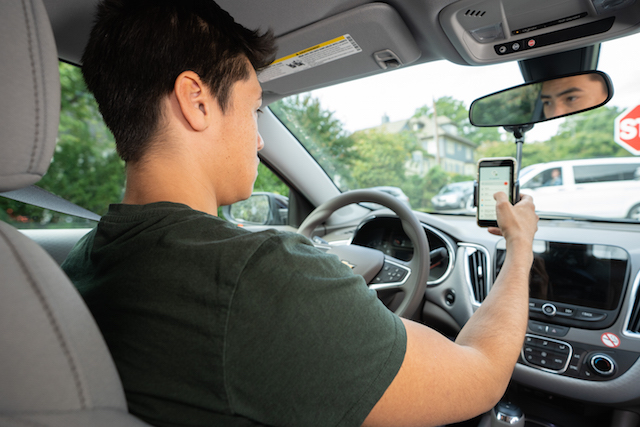
Whether it’s virtual meetings, virtual classes, online shopping or ordering takeout, it’s likely that at least some of your daily activities are taking place online.
We’ve all pivoted to this new virtual world, which is why AAA has created an easier and faster way for you to request roadside assistance. We know how important it is to get help as quickly as possible when you’re having an issue at the roadside, and our enhanced online system is the fastest way for you to request service.
To request roadside assistance with your laptop, tablet or smartphone:
Visit AAA.com and select “Roadside Assistance, Request Online”
Download our free mobile app to your phone or other device
When you need help, the online request system will pinpoint your precise location and guide you through a simple process to request assistance in less than two minutes. All you need is your membership number, and in a few easy steps you’ll be able to tell us the service you need – a dead battery, flat tire, locked out or out of gas, or even if you’re just stuck – confirm where you are, pick the car that needs help, and then we’ll take it from there. You’ll even be able to track your service provider’s progress, and you’ll be safely back on the road in no time.
Of course, you can still request assistance anytime by calling 800-222-4357. No matter which method you use, AAA Roadside Assistance is available 24 hours a day, seven days a week, 365 days a year.
No matter what happens, we’re always here for you.
In “This Is Spinal Tap,” a character brags that their amplifiers go to “11” instead of just 10. That same philosophy applies to cars when automakers take performance to the next level.
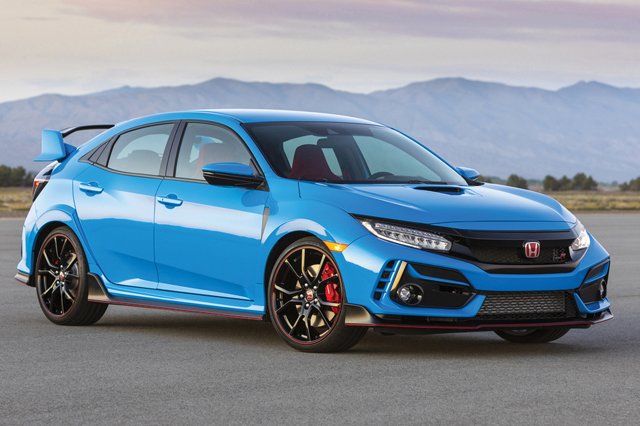
If you’re going to drive a small high-performance car, outlandish spoilers and bulbous bodywork just go with the territory. Such is the case with the Honda Civic Type R.
This top-of-the-line variant of the familiar Civic hatchback has what may be the biggest, most convoluted rear wing ever put on a production car. Which strikes me as somehow fitting, as with a 306-horsepower, 2.0-liter turbocharged four-cylinder motor under the hood, this baby can really fly.
Acceleration is abundant in any of the six-speed manual transmission’s gears (sorry, not sorry: no automatic is offered), and faster speeds arrive almost without effort. Steering is precise, and the powerful red Brembo disc brakes produce “right now” stopping power.
One other thing you may expect from a performance-oriented model is rough ride quality – and you’ll get it in Sport mode. Flip the console-mounted switch to Comfort, however, and the Type R becomes a livable daily driver. Handling is always above reproach.
In this life, things are not always what they seem. Sometimes, like in the case of the all-new Toyota GR Supra, that’s not necessarily a bad thing.
You see, this fifth-generation of Toyota’s super coupe is actually a Japanese re-engineered version of BMW’s latest Z4 convertible. That means lots of German hardware, including its gutsy 382-horsepower, turbocharged 3.0-liter engine (a new base model for 2021 comes with a 255-horsepower turbo 2.0-liter four cylinder).
One downside to this technology transfer is the slightly confounding iDrive infotainment system that uses a large console-mounted knob to control everything from navigation to the radio station.
This car is both uniquely handsome and deceptively quick. The top model’s adaptive suspension delivers a smooth ride that contributes to this effect, as does the spot-on steering.
Add a high-quality interior and the latest tech features and you have a very modern muscle car.
Looking for a new ride? Check out more car reviews at AAA.com/TestDrive.
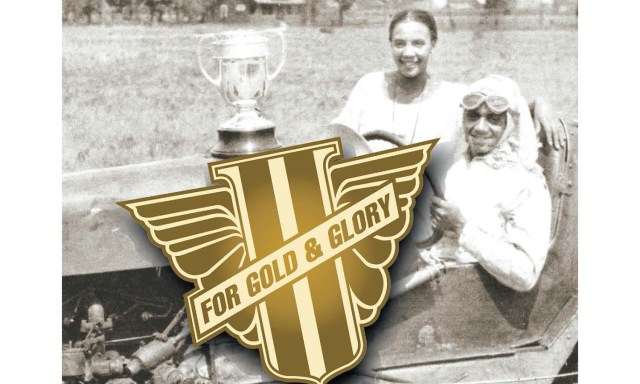
Charlie Wiggins and the Gold and Glory Sweepstakes
In honor of Black History Month, learn how Charlie Wiggins became one of the country's great racecar drivers despite being barred from racing's biggest event.
The Indianapolis Speedway is the mecca of professional race car driving. But when Charlie Wiggins and other African-American drivers were barred from competing at the vaunted raceway, they took matters into their own hands.
Wiggins was born in Evansville, Ind., in 1897. He spent much of his childhood shining shoes outside an automobile repair shop. He eventually convinced the owner to take him on as an apprentice. Wiggins quickly became an expert mechanic. In 1922, he moved to Indianapolis, opened his own shop and began building a race car out of junkyard parts. Dubbed “the Wiggins Special,” it was his dream to drive the car in racing’s greatest event: the Indianapolis 500. Yet Wiggins was denied entry based solely on the color of his skin.
Undeterred, Wiggins and several other African-American drivers formed their own racing league, the Colored Speedway Association, which held competitions across the Midwest. Wiggins was outstanding in the new league. His exceptional driving ability coupled with the engineering knowledge to build top-notch cars propelled him to many victories and earned him the nickname “the Negro Speed King.”
The highlight of the Colored Speedway Association circuit was the annual Gold and Glory Sweepstakes, a 100-mile race on a 1-mile dirt track at the Indiana State Fairgrounds. Wiggins didn’t compete in the first event in 1924, which, according to the Historic Vehicle Association, drew a crowd of 12,000 and was the largest sporting event held for African Americans up to that point. However, over the next decade, Wiggins would win three sweepstakes championships.
Wiggins gained prominence across the racing world – and across racial lines. In 1934, well-known Indycar pilot Bill Cummings hired Wiggins to tune his car for the race. According to Road & Truck, Wiggins posed as a janitor in order to surreptitiously bypass Jim Crow laws. It worked and thanks to Wiggins’ skills, Cummings won the Indianapolis 500 and set a track record.
Two years later, Wiggins suffered a horrific accident in the Gold and Glory Sweepstakes, losing his right leg in a 13-car wreck. Afterward, he made himself a wooden leg and spent the next four decades building and repairing cars, and training mechanics. One of his proteges, Sumner “Red” Oliver, became the first official African-American mechanic in Indy 500 history as a member of the 1973 Patrick Racing Team. Unfortunately, Wiggins passed away in 1979, 12 years before Willy T. Ribbs became the first black driver to qualify for the Indy 500.
For more information on the Colored Speedway Association, pick up “For Gold & Glory” by Todd Gould, the definitive book on the African-American racing car circuit.
The COVID-19 pandemic has caused a great deal of stress and anxiety in many people’s lives. But when we think about anxiety, it’s almost always in the context of how it affects the major aspects of an individual’s life – their mood, behavior, relationships, career. Very rarely do we consider how anxiety can disturb the routine elements of everyday life. Take, for example, driving.
It’s common for driving to cause anxiety even under the best of circumstances. COVID-19 has only made it more rampant, and in turn, made the roadways a little less safe.
According to Kristy Cuthbert, a Graduate Student Clinician with Boston University’s Center for Anxiety and Related Disorders, the effects of the pandemic manifest themselves in two major ways. Most notably, drivers may be mentally distracted by the stresses of the pandemic that they loose focus on the road, a condition known as rumination. “If you’re sitting in your car and you’re worried about how things are going to go when you get home, if your family is going to be okay, are you bringing COVID home to your family, you find yourself off on a train of thought and it’s easy to get distracted from the drive home,” Cuthbert says.
Second is the effect the pandemic has had on workers’ commutes. Many who normally take public transportation have chosen to drive, while people who had been forced to work from home likely haven’t been behind the wheel very much over the past 10 months. Those in either scenario are now driving everyday when they’re simply not accustomed to it. “When you’re first getting behind the wheel after a long time, there is a lot of anxiety involved with that.”
AAA Northeast’s Public Affairs Specialist, Joanna Frageorgia, hosts a discussion with Kristy Cuthbert, a Graduate Student Clinician with Boston University’s Center for Anxiety and Related Disorders. Cuthbert shares about how COVID-19 related anxiety can impact drivers.
Unfortunately, there is no quick fix for anxiety. But there are some tips and tricks to help alleviate your stress when driving Cuthbert recommends a practiceknown as “grounding.” This technique involves engaging your senses in order to distract you from unwanted thoughts. Since the main senses you use during driving are sight, hearing and touch, Cuthbert suggests making a mental note of things you can hear (the radio), see (the red of the stop sign), and touch (the warmth of the steering wheel). “This is a way of grounding you in the present by using your senses that brings you back to the task at hand.”
More than anything, if you’re experiencing anxiety in the car or out of it, it’s important to know that you’re not alone. “Everyone is experiencing increased stress and anxiety…Hopefully that gives a sense of community and maybe it allows a little bit of that self-judgment to fall away,” Cuthbert says. “You’re not alone in this. That’s really the key takeaway.”
To learn about Cuthbert’s work or to seek assistance go to bu.edu/card. You can discover more about AAA’s traffic safety programs and resources at AAA.com/Community.
Fashion trends come and go, but some will be remembered for years to come. See if your favorite styles made it into our new crossword.
Here are some tips to help you get the most out of your puzzle playing experience. Good luck!
Since our members are the root of everything we do, your feedback is important to us. Let us know if you run into any issues while playing, or share your ideas for future puzzles by emailing us.
It’s critical to know the rules of the road before you get behind the wheel of a car. But for most of us, it’s been a long time since we sat for our driver’s license exam. It’s likely we forget – or maybe never even learned – some of them. To see how well you know your driving laws, take our rules of the road quiz below and let us know how you do!
Unless otherwise stated, all questions refer to driving laws in the six states in AAA Northeast’s territory: Connecticut, Massachusetts, New Hampshire, New Jersey, New York and Rhode Island. Similarly, all mentions of the term “Northeast states” refer to the aforementioned six states.
*In New Jersey and Rhode Island, headlights are required to be on from sunset to sunrise. ^In New Hampshire, the age limit is 7 #New York has no such law while New Jersey’s ban only applies to those with a learner’s examination permit. All Northeast states ban handheld cell phones and texting while driving for ALL drivers. **In New Jersey, the property damage threshold is $500 ^^In New Jersey, the requirement is 20/50
Whether you’re just beginning your driving career or are a long-time driver looking to improve your skills, AAA has you covered. Learn more about our Driver Training program and Defensive Driving courses.
Lucky for us, there are many types of clam chowder to choose from here in the Northeast, from a rich, creamy bowl of New England clam chowder to a hearty, red-colored concoction often known as Manhattan clam chowder.
But just how many types of clam chowder are there, and how are they different? I went on a investigative journey, and what I found was that the answer is much, much more complicated than it seems.
Can’t get enough clams? We have all your favorite clam recipes here.
Types of Clam Chowder: The Great Debate
I started by consulting the world’s leading authority on words, Mr. Webster, who defines “chowder as a soup or stew of seafood (as clams or fish) usually made with milk or tomatoes, salt pork, onions and other vegetables (as potatoes).” This seemed broad, yet simple enough. But, how do clam chowder types gain local characteristics? Why is New England stereotypically creamy, while Rhode Island clear, and so on? What contributes to the creation of many types of clam chowder?
I found out that this discrepancy wasn’t a new thing. Chowder is a historically evolving dish, having been served in the Northeast recorded back into the 1700s. While the different types of clam chowder often blend, intersect and influence each other, each region often vehemently maintains that their version is the correct one and the most delicious. Whether or not the soup actually hails from that region is another story.
In fact, chef Louis P. De Gouy, author of the 1949 “The Soup Book,” noted, “Clam chowder is one of those subjects, like politics and religion, that can never be discussed lightly. Bring it up even incidentally, and all the innumerable factions of the clambake regions raise their heads and begin to yammer.”
But culinary political correctness aside, I think everyone can agree on one thing: they’re all delicious! Read on to find out about each area’s classic chowder and for some great recipes. Enjoy!
New England Clam Chowder
This clam chowder is markedly different from other types of clam chowder. It’s distinguished by the presence of a thick dairy base that gives the soup a creamy white color and a hearty texture. According to “The Yankee Cookbook,” the recipe calls for salt pork, onions, potatoes, milk and butter – and of course, clams. Although individual recipes vary, the distinguishing milk or cream element is omnipresent.
The soup generally doesn’t contain any vegetables other than onions and potatoes, also a differentiating characteristics from other types of clam chowder. It’s most commonly served in the northern New England states.
Rhode Island clam chowder is classically known for its absence of milk or cream. But, as it turns out, this individual characteristic setting it apart from other types of clam chowder isn’t as clear as it may seem.
Some Rhode Island chowders are made in the same style as New England chowder. They simply omit the dairy product, resulting in a clear soup. Others are red. This is due to the addition of stewed tomatoes, an element attributed to the abundance of Portuguese settlers. The Yankee Cookbook weighs in on just how intense – and confusing – the controversy can get:
“The raging clam chowder controversy that has continued almost uninterruptedly in New England for generations centers on the use of tomatoes as an ingredient in its preparation. Rhode Island and Connecticut housewives uphold the tomato. The rest of New England scorn it. A Maine politician claims the addition of the tomato to clam chowder is the ‘work of the reds’ who seek to undermine ‘our most hallowed tradition,’ and suggests that all housewives and chefs adding tomato be forced to ‘dig a barrel of clams at high tide’ as a penalty.”
Regardless, one important thing about Rhode Island chowder remains the same: the use of quahogs. What are quahogs, you ask? Why, they are none other than Rhode Island’s official state shell. As a Rhode Islander, I can tell you, they’re kind of a big deal around here. Plentiful in the Rhode Island and nearby Cape Cod areas, the clams are easily harvested at low tide. They are definitely the key ingredient in any delicious Rhode Island chowder.
It seems that south of New England, the hostility surrounding the clam chowder controversy eases up a little. Everyone seems to be OK with tomatoes in their chowder, as they serve as defining characteristics of the Manhattan variety. The tomatoes are used instead of milk or cream. And oftentimes more vegetables, such as peppers, celery and carrots, are added to the recipe without protest.
The result is a tasty, vegetable-style, hearty soup enjoyed by many, both in New York City and beyond. There is little evidence linking the recipe to Manhattan, though.
Like other types of clam chowder, however, the emergence of this variety didn’t go off without a hitch. It even downright angered many traditionalists, including Eleanor Early, a mid-1900s food writer, who passionately stated, “Some people make a vegetable soup with a [clam] drawn through it and have the audacity to call it clam chowder.” She adds, “Tomatoes and clams have no more affinity than ice cream and horseradish.”
As if things weren’t confusing enough, this type of clam chowder is emerging as a popular blend. It combines two types of clam chowder: New England and Manhattan.
The result is a creamy, tomato-based clam chowder that’s served all over the country. It’s also named for the obvious pun, Long Island being between New England and Manhattan. The half-and-half variety is catching on in restaurants, thanks to patron requests. Perhaps the best place to try the mixture is Popei’s Clam Bar on Long Island. After all, it claims to have invented the concoction.
So what is the real and the best of all the clam chowder types? Well, that all depends on what you’re looking for and if you’re willing to be flexible.
Jasper White, author of “50 Chowders,” encourages soup lovers to keep an open mind.
“By insisting that only a certain type of clam, fish, dairy product or vegetables makes the ‘true’ or ‘best’ chowder, the same people who carry on the legacy of chowder have also limited its scope. The reality is that cooks have improvised chowders continuously for about 300 years, and there was never one true chowder.
“All the rivalry, history and speculation are good fun,” he said, “but what really matters is what’s in the pot.”
Did you get a stimulus check last year? The stimulus payments, or Economic Impact Payments, affected millions of people who were determined eligible by the IRS in 2020. Though there’s still talk of a third stimulus check just around the corner, you only need to consider the first two stimulus payments when you’re doing your 2020 taxes. If you got a stimulus payment, is that money taxable? Do you have to record it when you file your taxes? And what about if you were eligible for a payment, yet somehow did not receive it? We’ll answer all those questions and more.
Who Qualifies for the Stimulus Payments?
The federal government sent out two different rounds of payments in 2020. The first was under the CARES Act, and the second was under the Coronavirus Response and Relief Supplemental Appropriation Act.
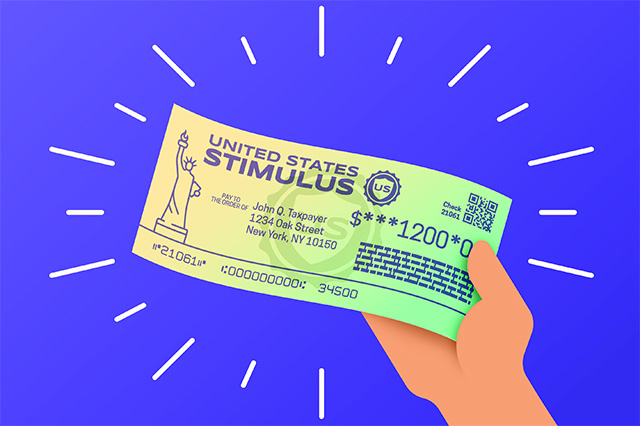
The first stimulus payment, which went out in April of 2020, was $1,200 per person and $500 per child. The second stimulus payment, which just went out in December of 2020, was $600 per person and $600 per child. But not everyone qualified for these payments. Those that qualified included individuals with an annual income of up to $75,000, married couples with a joint annual income of up to $150,000 and individual heads of household (read: single parents) with an annual income of up to $112,000.
Is the Money from My Stimulus Payments Taxable?
You do not have to pay taxes on your stimulus payments. The money from your stimulus payments is not considered income by the federal government, and so you do not owe any taxes on it. That money is yours.
Do I Have to State My Stimulus Payments When I File My Taxes?
Let’s say that you got all of the stimulus payments that you qualified for, and that your life circumstances haven’t changed since then. You haven’t gotten married, your income didn’t drastically decrease, you didn’t have a baby, and nothing else happened that could affect the amount of money you were owed. In that case, you don’t have to do anything! The IRS is aware of the money they paid you, and you can file your taxes as normal.
When you received your stimulus payments, you should have also received a document titled Notice 1444 for the first stimulus and Notice 1444-B for the second stimulus. These notices feature information about the amount of the payment, how the payment was made and how to report payments that weren’t received. Even if you are not planning on using these notices, file them in a safe place with the rest of your tax documents so that you can refer to them if you need to.
However, if you didn’t get the stimulus payments that you were owed, or if you didn’t receive them in full, there’s still something you can do about it.
What if I Didn’t Receive My Stimulus Payments?
This is where taxes really come in to the stimulus payment conversation. What if you never got that money? If you didn’t receive a stimulus payment but still qualified it, or if you didn’t get the full amount that you were owed, you can be eligible to claim a “recovery rebate credit” on your tax return. Even if you are not required to file a tax return for 2020, you do have to file one if you want your recovery rebate credit.
If you want to see if you’re eligible for the recovery rebate credit, you need to know the amount of any stimulus payments that were already issued to you in 2020, and have documentation for it. This is where Notice 1444 and Notice 1444-B come in handy. The recovery rebate credit will then be reduced by any previous stimulus payments. Then, you need to fill out the Recovery Rebate Credit Worksheet (Form 1040), which can help you calculate if you are eligible for the credit.
If, as mentioned above, your financial situation has changed during 2020, this is the time for you to state the changes and get the credit that you qualify for. According to the IRS, the economic impact payments were based on your 2018 or 2019 tax information, but the recovery rebate credit is based on the information you include on your 2020 tax return.
Can Anybody Help Me With This?
Taxes are already confusing enough without all of the extra complications of the economic impact payments. But fortunately, you don’t have to file your taxes all on your own. TurboTax is ready to help you with everything from stimulus payments to recovery rebate credits. With special COVID-19 questions, it makes the process of filing your 2020 taxes simple and easy. You don’t need tax knowledge or even an appointment to make sure that your taxes are done right and you get every benefit you’re eligible for. Plus, AAA members get up to $20 off online federal products.
With news that the single dose Johnson & Johnson vaccine has met U.S. Food and Drug Administration requirements, vaccination is once again front and center in many Americans’ minds.
The Centers for Disease Control and Prevention has released a vaccine finder tool to help you locate vaccine distribution sites. The tool populates the name, address and phone number of pharmacies and stores within a one to 50-mile radius of your zip code.
At this time, users can search for the Moderna, Pfizer-BioNTech and/or Johnson & Johnson’s Janssen COVID vaccines and see whether specific locations are in or out of stock.
Know Your Eligibility
COVID-19 vaccinations are still in limited supply in the U.S. Vaccine eligibility varies by state, but if you are ready – or considering getting ready – to receive a vaccine, the finder tool can help you plan.
“Initial supplies of COVID-19 vaccine [should] be allocated to healthcare personnel and long-term care facility residents,” according to the CDC.
The next groups the CDC recommends get vaccinated include anyone 75 years and older along with frontline essential workers. This means people working in food and agriculture, grocery stores, manufacturing, public transit and education (teachers, support staff, daycare workers, etc.) as well as corrections officers, fire fighters, police officers and U.S. Postal Service workers.
For more vaccine rollout recommendations from the CDC, see here. Contact your local health department for more specific information regarding your eligibility.
Plan Your Vaccination
Knowing where you’ll get your vaccine is only half the battle. To assure things go as smoothly as possible, plan for what comes next as well, including scheduling a second vaccination and easing possible side effects.
“If you received the Pfizer-BioNTech vaccine, you should get your second shot three weeks (or 21 days) after your first,” according to the CDC. “If you received the Moderna vaccine, you should get your second shot one month (or 28 days) after your first.”
You can expect some potential side effects from your vaccination, including injection site pain and swelling as well as the possibility of mild cold/flu-like symptoms.
Continue Taking Precautions
Vaccine rollout hasn’t been easy, but a new vaccine and the CDC’s vaccination finder increase hope for wider vaccine distribution. Vaccinations can help protect against COVID-19, but remember that vaccination does not mean immunity.
“It’s important for everyone to continue using all the tools available to help stop this pandemic as we learn more about how COVID-19 vaccines work in real-world conditions,” according to the CDC. “Cover your mouth and nose with a mask when around others, stay at least 6 feet away from others, avoid crowds, avoid poorly ventilated spaces and wash your hands often.”
For more information on COVID-19 vaccines, see here.
Always talk to your doctor before making health-related decisions.
The warmer months are finally here, which means there’s even more fun to be had in the Pocono Mountains. But spending time with family doesn’t have to mean spending lots of money. There is a ton of fun things to do in the Poconos that are free!
The Pocono Mountains has 2,400 square miles of beautiful greenery and massive lakes and rivers for endless outdoor adventures, not to mention a great selection of tours and events in town. Gather your friends and family and forget about the budget.
The farmers’ markets in the Poconos are a fun and free way for locals and visitors to get out and meet the local farmers and learn about the area. Explore the Main Street Farmers Market at The Cooperage Project and ask the farmers and purveyors questions about their produce and plants. They are so passionate and knowledgeable about their craft that you’ll quickly learn things like how to take care of your plants that aren’t doing well or how to cook a certain vegetable you’ve never heard of.
Calling all girls! Skirmish Paintball is offering free basic paintball field entry to women on select Ladies’ Days for ages 10 and up. Skirmish Paintball the world’s premier paintball facility played on a wooded site with trout streams, waterfalls, natural- and man-made obstacles. This deal includes all-day play, gun and gear rentals and parking. You don’t need any experience to play and the friendly staff can answer any of your questions beforehand. It’s great exercise and a fun way to spend the day, so grab your friends and get ready to smile.
It’s no secret that waterfalls are abundant in the Pocono Mountains; a magical cascade is always nearby, no matter which of the four counties you are located in. Hiking to a waterfall is a rewarding and free adventure; turn it into a full-day family picnic, or a romantic sunset walk with your significant other. While you’re out and about, bring your binoculars and do some bird watching. There are hundreds of native birds in the area to spot.
Keep your eyes open while enjoying the nature trails at the Pocono Environmental Education Center campus or the Dorflinger-Suydam Wildlife Sanctuary to spot all types of birds from colorful songbirds to raptors including owls and bald eagles. Both are open to the public daily, all-year-long from dawn until dusk. Spring and fall migrations are particularly spectacular. Bring your binoculars!
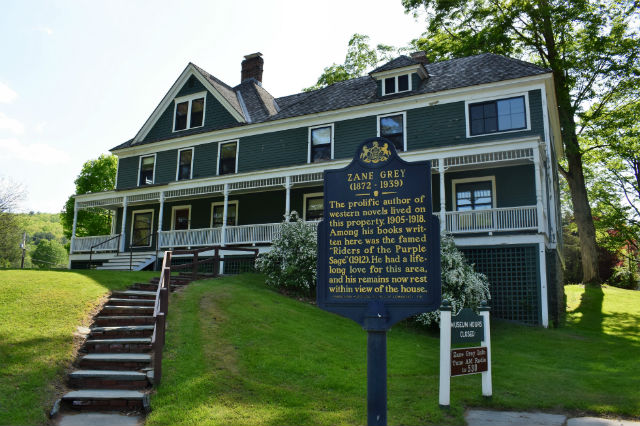
Plan a visit to one of the many free museums and historical sites throughout the region. Learn about American history at the Upper Mill, an operating, restored water-powered mill that was built in the early 1800’s. Or tour the Zane Grey Museum and learn about the famed western fiction writer’s miraculous life. Open from Memorial Day to October, National Park Service rangers and volunteers will be available to answer questions at both locations.
A bike ride is a wonderful way to explore. Ride through the town or chose one of the hundreds of trails in the area. Follow the route of the whitewater rafters or ride along the former railroad bed that parallels the Lehigh River. You’ll enjoy views of waterfalls throughout the trail and will surely encounter some beautiful wildlife. Grab a bottle of water and some comfy shoes and hit the trail!
What is your favorite free thing to do in the Poconos? Share it with us in the comments.
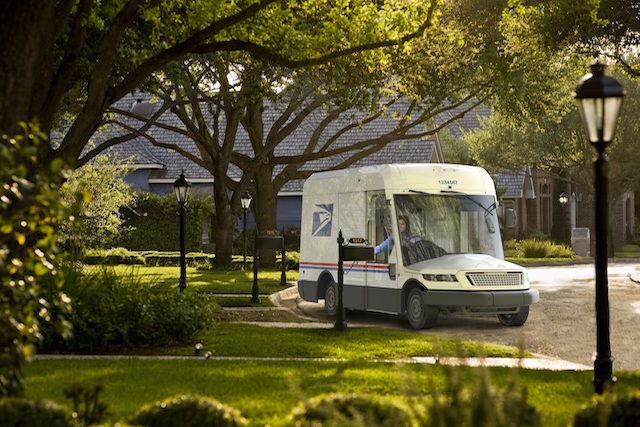
Last month, the United States Postal Service announced it awarded a contract to Oshkosh Defense to manufacture a new generation of postal delivery vehicles. It will be the first major upgrade to the USPS fleet in thirty years.
Oshkosh Defense, based in Oshkosh, W.I., will produce at least 50,000 to 165,000 trucks over 10 years. All the vehicles will be assembled in the United States. The Postal Service has a fleet of more than 230,000 vehicles, approximately 190,000 of which deliver mail six or seven days a week. The current mail-delivery trucks are Grumman LLVs manufactured between 1987 and 1994. They were only intended to have a have 24-year life span.
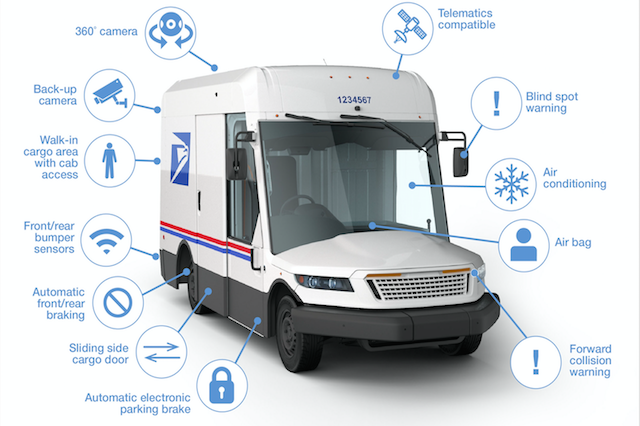
The exact design of the new vehicles has yet to be finalized, but it’s clear that these trucks will have a unique look. And while they may look funny, the vehicles were designed with safety in mind. The large windshield allows for increased visibility and eliminates the front blind spot. The low hood and bumper were designed to prevent pedestrian fatalities. Should one get hit by a truck, they are more likely to get stuck in the legs rather than the torso, a difference that could very likely safe their life. This comes at a time when pedestrian deaths are reaching record highs.
Other safety features found on the trucks include 360-degree cameras, advanced braking and traction control, air bags, a front- and rear-collision avoidance system that includes visual, audio warning and automatic braking.
The new fleet vehicles will also be environmentally friendly, equipped with either fuel-efficient internal combustion engines or battery electric powertrains. The trucks will also have increased cargo space allowing them to accommodate higher package volumes, thus reducing the number of trucks needed on the road.
This past fall, a road trip in Sicily fulfilled one AAA member's personal goal of driving abroad – and tested his driving moxie against their notorious drivers.
A road trip in Sicily fulfilled a personal goal of driving abroad – and tested my driving moxie against their notorious drivers.
My first impression of driving in Italy came from overhearing a colleague throwing out ideas at work: “Just like road signs in Italy, these are merely suggestions.”
Sixteen years later I could attest to that firsthand with my first Roman cab ride – the only recollection of which is my wife and I clutching each other in the back seat, equal parts fear and fondness. A few days later, we boarded a Trenitalia for a seven-hour train ride. The train itself boarded a ferry on the way to Messina, the first stop in Sicily, where we would visit family I’d never met before.
A few days into our stay, we were brought to Montalbano Elicona, the town where my father was born, 40 miles west of Messina. Cousin Carmelo did the driving as we sat in the back overlooking the steep hill we needed to ascend to reach the town. As Carmelo confidently sped around tight turns with not much more than a stone wall protecting us from potential doom, I assured myself, “They do this all the time.”
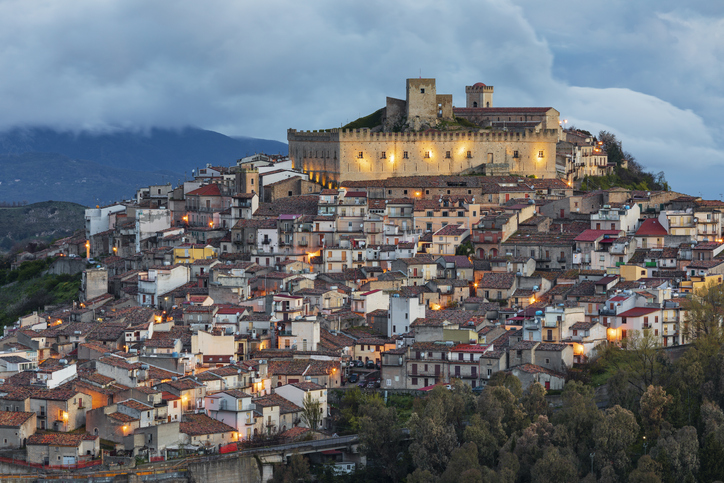
The skyline of Montalbano Elicona at dawn.
We departed three days later, with Carmelo driving us to the airport – and missing the airport exit. We expected him to take the next exit to turn back. Instead he turned back ‘Sicilian style’: put the car in reverse, back up for a few hundred feet and take the exit.
No shoulder? No worries.
Driving in Sicily
My turn to drive in Sicily would come six years later during a couples trip, circling the island at Italy’s boot tip. Our six-day journey planned for us to pick up our car in Palermo, drive south to Agrigento to visit the Greek ruins, cut east to Taormina, a quick stop north to see the family again in Messina, then back across to Palermo.
The beaten path rarely being the most interesting, en route to Agrigento we diverted to the Cattedrale di Monreale, the UNESCO World Heritage site located in the eponymously named town. The roads here were not designed with cars in mind. The first anxious moment was when a local tailgated us as we made the way up the winding one-lane road to the cathedral. My sense that we were holding up traffic was justified when I allowed a driver behind me to pass and received a less than welcoming wave from him in return.
We garaged the car and arrived at the cathedral with a few minutes to spare before the Italian afternoon riposo, just enough time to awe at the 12th century Norman architecture. The next stop brought us to Sciacca, and that stretch of SS624 didn’t disappoint, gifting us with a stunning hilly landscape. As we got closer, we caught our first view of the Mediterranean Sea.
Agrigento was among the largest cities of the ancient Greek empire. It sits on a plateau overlooking the Mediterranean; the Valley of the Temples, Agrigento’s main attraction, is also recognized as a World Heritage site.
Two days later, for the run from Agrigento to Taormina, I took a break from driving to enjoy the view from the backseat. The diversion on that leg of the trip was the town of Piazza Armerina and the third UNESCO site on our itinerary, the Villa Romana del Casale. The mosaics in the 4th century Roman resort made the stop worthwhile.
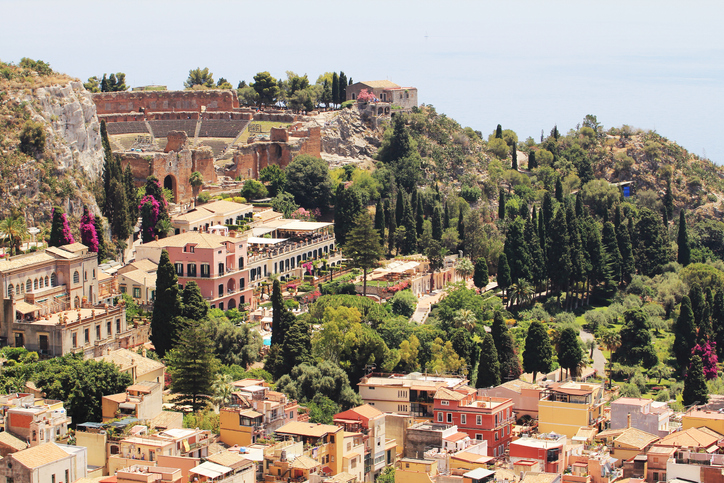
Taormina, Sicily.
Continuing from the villa, it was easier to see the sights unfold from the backseat as Sicily continued its run of hilly landscapes, fertile vineyards and a shepherd using much of the road to guide his sheep.
We hit the Autostrade for the first time as we reached Catania. From my phone I determined that the toll from Catania to Taormina would be €1.70 and payable by credit card or cash. I patted myself on the back and texted this intel to my wife who was riding in the ladies car.
Upon reaching the Taormina exit, we inserted the credit card into the toll machine – and saw it gobbled up. A few tense minutes passed with the credit card not forthcoming as we tried to converse with an agent over the intercom.
Eventually the machine gave up its catch, which we exchanged for dropping two euros in the basket and sped off. I subsequently learned that American credit cards aren’t suitable for the toll road and the wives had wisely paid cash.
The trip up the hill is a scenic single lane that brings you into the heart of Taormina. Miss a turn there and you’ll find yourself either circling the town again, facing the wrong end of a one-way, or in a local’s driveway (as my wife’s car did).
As we arrived at the hotel, we were happy to garage the cars and become pedestrians for the next three days, Taormina being very walkable.
It was easier to let Angelo, a local guide, drive us to Mount Etna on our third day there. On our way back to town, Angelo took us to the Madonna della Rocca, a 1640 church built in the rock which hangs high over the town. The road leaving the church cannot allow large tour buses and provided its own acrophobia-inspiring overlooks.
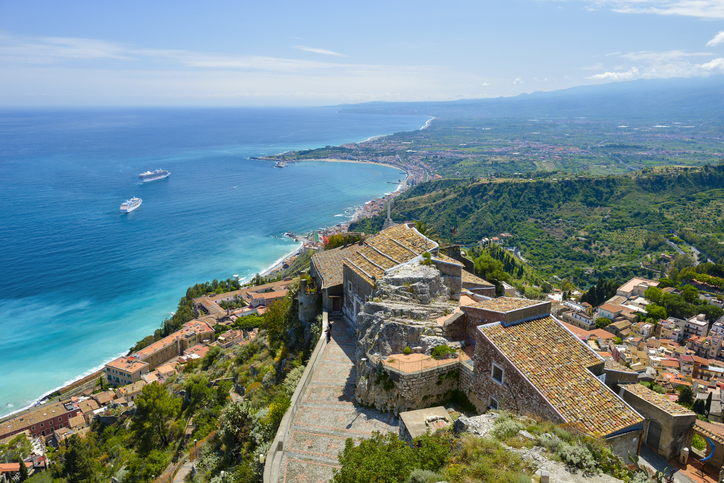
Santuario Madonna della Rocca, Taormina.
Family Reunion
Back on the road the following day, we headed north to Messina, enjoying the view of the blue Ionian Sea hugging A18/E45. At the Messina Centro exit (paid that toll in cash!), I was confident we would reach the family by 1 p.m. as promised. Guided by GPS, we took a turn that led up a somewhat familiar road. The roads were wide enough for no more than a parked car and one lane of traffic to accommodate both directions.
So, what to do when a car inevitably comes in the opposite direction? Always defer to the local, hit it in reverse and hopefully find a spot to back into. But how do you do that when another driver is on your tail? The spot we found was not easy to get back into and in that panic, I looked in my rearview hoping for some sympathy. Instead I saw frustration as my tailgater clasped his hands in a very animated way, wagging them, plainly praying to the driving gods that I would get out of his way.
It was now apparent we needed to turn around. As I looked for a place to reverse, our next obstacle came into view: A large tree branch extending three quarters across the road. The branch itself wouldn’t have been difficult to drive over, but that would have meant bowling over the bent-over woman picking whatever the branch was offering – berries, figs, pistachios or maybe olives.
She and our car had a standoff, which we lost; she continued to pick at the branch. We crept around the branch and advanced a few dozen meters to make our U-turn. The unforgiving road was not much wider than the length of our car, making the U-turn tight and treacherous. A fence bent over 45 degrees, overlooking a sharp hill drop, was evidence that other drivers had done this before. Fifteen to 20 delicate K-turns later, we were on our way back.
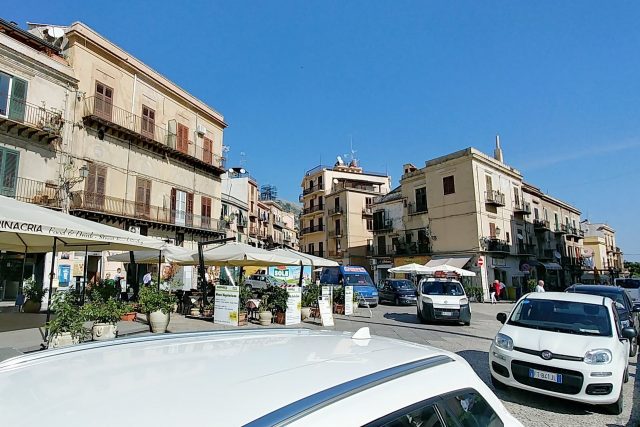
Traffic in Monreale, Sicily
The lost time made the visit with family too short. We considered staying overnight, as we indulged on pancetta-wrapped scallions and braciole paired with homemade creamy limoncello and red wine. But rather than risk missing our morning flight, it was best to move on.
Returning west, I drove A20 in awe of the tunnels built into the mountains to accommodate the Autostrade and gazed at the towns built into those mountains centuries earlier.
Three hours later, we found ourselves in Cinisi, just south of Palermo – a favorite overnight spot for early-morning fliers. The next morning, after one final missed turn, we reached the rental car return.
The rental agent thoroughly inspected the car and joked “You’re a killer.” In his thick accent he points out a small bird carcass wedged in the wheelhouse. Add that regret to the list of unexpected yet mostly endearing memories.
Nick Popolo is a longtime AAA member from Staten Island, NY. Connect with Nick on Twitter at @npopolo.
Far too often we believe trips require traveling countless miles to reach faraway lands. But that thinking can rob us of the amazing sights and sounds found much closer to home.
With the COVID-19 pandemic restricting our travel, now is the perfect time to rediscover your own backyard. Fortunately, several local state tourism boards have put together road trip suggestions. Whether you’re a foodie, history buff or just love hitting the open road, there’s something for everyone.
A more unique road trip through the state is following the Barns Trail. Consisting of seven different routes, this trail takes you past Connecticut’s barns that are open to the public, including working farms, farm stands, orchards and wineries.
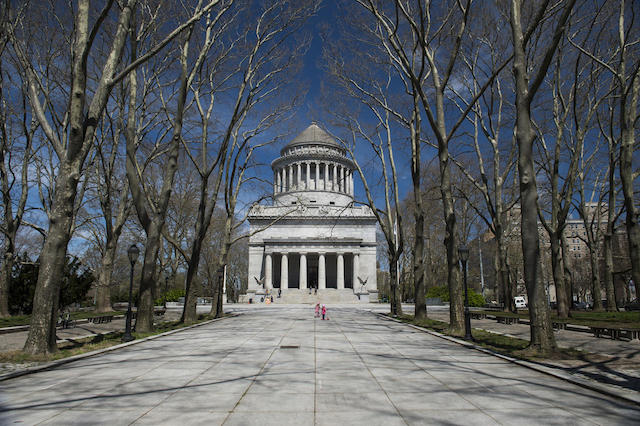
Grant’s Tomb in Manhattan (Photo: Courtesy of New York State)
New York
The New York State Division of Tourism has compiled a plethora of road trip destinations that allow travelers to discover the Empire State’s rich history. The stops are divided into themes, including Arts and Culture, Civil Rights, Immigration and Natural History.
New York’s Finger Lakes region provides the ideal backdrop for an educational road trip about the origins of the modern-day women’s rights movement. It all starts in Seneca Falls, where the first Women’s Rights Convention took place in 1848. Today, the city is home to the Women’s Rights National Historical Park and National Women’s Hall of Fame. Nearby, in the cities of Rochester and Auburn, travelers can visit museums dedicated to Susan B. Anthony and Harriet Tubman, respectively.
The Blackstone Valley Tourism Council teamed up with the Providence Warwick Convention and Visitors Bureau to create a series of themed road trips throughout Rhode Island.
“Are We There Yet?” is a family-oriented journey that takes travelers to Central Rock Climbing Gym in Warwick, BattleGroundz in Lincoln and the Providence Children’s Museum. When hunger strikes, families can chow down on burgers at Harry’s Bar & Burger then satisfy sweet tooth cravings with the latest offerings from PVDonuts.
Speaking of food, “Comfort Food Across Cultures” allows travelers to experience different societies by eating their way through various cuisines. Stops include the Bolivian and Peruvian restaurant Los Andes, Korean Fried Chicken spot Den Den and Krakow Deli & Smokehouse, which serves up Polish pierogis and golombki.
The “Take it Outside” road trip celebrates the Ocean State’s outdoor escapes, including Rocky Point Park, Goddard Memorial Park and Roger Williams Park, which also houses the Roger Williams Park Zoo and Museum of Natural History and Planetarium. When the weather warms, outdoor activities like kayaking, water sports, horseback riding and hiking can be done at the Landing at Lincoln Falls and Lincoln Woods State Park.
The site of Paul Revere’s capture (Photo: Courtesy of NPS)
Another Massachusetts road trip idea takes you along Cape Cod. Stretching from Orleans to Provincetown with stops at various beaches, trails and lighthouses, this is an ideal scenic drive.
New Jersey
New Jersey’s Department of Travel and Tourism recommends cruising along the state’s eight scenic byways, which “showcase the state’s cultural contributions, rich heritage and natural beauty.”
All of these drives offer travelers something different. The Millstone Valley Bypass is a 25-mile journey that will transport you back to Revolutionary War times as you pass by Rockingham, George Washington’s last wartime headquarters. More Washington history can be discovered along the Delaware River Bypass, which takes you to Washington Crossing State Park, the location where George Washington and the Continental Army landed after crossing the Delaware River.
In the northern part of the state, the Palisades Bypass offers unparalleled views of the Hudson River and the Manhattan skyline, with lookout points to stop and enjoy the sights. In southern New Jersey, you can travel along the Bayshore Heritage Scenic Byway. This 122-mile roadway allows you to view much of the state’s coastline as well as the East Point and Cape May Lighthouses.
Whether you rediscover your own backyard or take a longer drive to one of these states, enjoy the journey, travel safely, and don’t forget to review the COVID-19 guidelines if you are planning to travel outside of your own community.
And, if you need a little extra space while you’re on the road, or you just want to take the trip in a vehicle that’s “new to you,” visit your local neighborhood Hertz and don’t forget AAA members can save up to 20% on rentals.
The Northeast is home to some of the most talented celebrities in film, music, and television. Did your favorite star make it into our new crossword? Play to find out!
The Northeast is home to some of the most talented celebrities in film, music and television. Did your favorite star make it into our new crossword? Play to find out!
Here are some tips to help you get the most out of your puzzle playing experience. Good luck!
Since our members are the root of everything we do, your feedback is important to us. Let us know if you run into any issues while playing, or share your ideas for future puzzles by emailing us.
Here in the Northeast, we have some of the best food in the country. From New York and New Haven-style pizza and Long Island bagels to New England classics like clam chowder and lobster rolls, our culinary landscape is one worth bragging about. Of course, the home-cooked meals and family recipes coming out of our own kitchens are also photo-worthy sources of pride.
Food can be so much fun to take pictures of. It doesn’t move, you can pose it however you like and afterwards you can eat your creation.
Spice up your food photos with these five simple tips on how to photograph food.
Scroll down to see all of the delicious-looking food photos we received from this Photo Session.
Use Natural Light
Artificial light can create unnatural colors in your food images, so using natural light is best. If it’s warm enough outside, I recommend heading outdoors to set up your shot. Look for a shaded area – filtered or overcast light is best. You want to avoid direct sunlight, it can create harsh shadows. If you’re stuck inside for the shot, arrange your food display by a window that gets a lot of natural light.
(Photo: Beth Mancuso)
Vary Your Depth Of Field
If you want to focus on just one food item – or one part of a dish – use a shallow depth of field to draw the viewer’s eye in. Choose a large aperture anywhere between f/1.8 – f/2.8. If you’re using your phone to take the image, use portrait mode to achieve this look. Alternately, if you want to show a whole plate of food, use a smaller aperture anywhere between f/5.6-f/11. For my shot of the cookies my aperture was set to f/2.2. Learn more about camera settings with our cheat sheet.
Color can add wow factor to your photos. Try pairing your foods with complimentary colors. In this image I paired the red of the berries with a teal background to really make the red pop. You can add color to your photos by either introducing another colorful food into the image or by using a colored background. You can find a colored wall in your surroundings or use colored paper.
(Photo: Beth Mancuso)
Show the Process
Food preparation often has many steps involved. Take a few shots of the different steps, and create a collage with the images. I shot this triptych with my phone and made sure to use the same angle, background and lighting for all the shots so they would match.
(Photo: Beth Mancuso)
Tell a Story
Add a human element to your image to show the relationship between food and people. Food has many traditions and emotions tied to it. I love how excited my son was to eat this ice cream cone. I think it shows how we all feel when we get to eat such a treat!
My grandmother’s 80th birthday tea party during COVID. (Paige Parrella)
Fruit Bowl (Norman Shein)
These member photos look good enough to eat! Take a look at all of the food photo submissions we received from this Your AAA Photo Session in the slideshow and don’t forget to check our social media channels, where we will be featuring some of our favorites. Some photos may also be featured in an upcoming issue of Your AAA magazine.
Check out past AAA Photo Sessions and stay tuned for the next one, coming soon.
Beth Mancuso is a professional landscape and travel photographer.
The New York Hall of Science is the center of the universe when it comes to interactive science. Founded at the 1964-65 World’s Fair, NYSCI has grown into one of the area’s leading educational institutions. It welcomes droves of students, teachers and families each year.
Located in Queens, the museum uses the “Design-Make-Play” method to educate visitors in the STEM subjects of science, technology, engineering and math. It has 12 permanent exhibit areas as well as several temporary exhibits hosted throughout the year. NYSCI also has a 3D movie theater and hosts a litany of public programs and events.
NYSCI is always buzzing with activity. Here are a few of the museum’s main exhibits and attractions that are a must-see during any visit.
Note: Due to the ever-changing nature of the COVID-19 crisis, please check official website before visiting to check for restrictions or closures.
The Design Lab is a drop-in space where visitors can explore, build and create. It has various activity spaces, where guests are challenged to find solutions to real-world problems. Explainers are stationed throughout the Design Lab should guests need any help solving a challenge. Explainers are young men and women (ages 14 to 24) from the community who work on the museum floor, interacting with the public and helping visitors to understand the science behind the exhibits and demonstrations. Since 1986, NYSCI’s Science Career Ladder has enabled more than 4,000 students to serve as Explainers to gain work experience while being exposed to a wide array of STEM career and college pathways.
The activities at Design Lab are frequently changed based on experimentation, reflection, and feedback from guests. This makes each trip to the Design Lab – and to NYSCI – a unique one.
The fun is not just contained within the walls of the museum. Outside, guests will find several interactive exhibits including the Science Playground. Designed for children of all ages, it features elements such as Archimedes screw and water play area, windpipes, a climbing net, a giant lever, slides, sandboxes and metal drums.
Also located outdoors is Rocket Park Mini Golf. This nine-hole miniature golf course is designed to teach players the science of spaceflight. Key concepts such as propulsion, gravity, escape velocity, launch window and gravitational assist are explored along the way. There is an additional fee of $6 for adults and $5 for children and seniors to play.
Connected Worlds, held in the Great Hall, is an interactive animated world where visitors’ decisions and actions dictate how the natural world is kept in balance. The six different environments – jungle, desert, wetlands, mountain valley, reservoir and plains – are fed by a 38-foot-high projected “waterfall” that flows out across an 2,300-square-foot interactive floor.
Guests are challenged with keeping their environment flourishing by planting seeds, feeding animals and learning to share the water source among all the “worlds.” Guests learn about the concepts of sustainability science including feedback loops, equilibrium in a dynamic environment, and casual links and influences.
The museum has a state-of-the-art 3D movie theater, complete with a 22-foot wide screen. It plays a variety of educational videos as well as award-winning scientific movies throughout the year.
Have you visited the New York Hall of Science? Tell us about your experience in the comments.
The American Society of Civil Engineers (ASCE) gave America’s infrastructure a C- grade in its latest report card. While not an impressive mark, the C- grade is actually the highest score the country’s infrastructure has received in 20 years. Previously, it received a D+ in 2017.
The report grade, released every four years, rates every part of America’s infrastructure system including roads, bridges, energy, rail, transit and aviation. Overall, 11 of the 17 categories received a grade in the D range, including transit, which had the worst mark of D-. On the opposite end of the spectrum, rail received the highest grade with a B. Five category grades — aviation, drinking water, energy, inland waterways, and ports — went up, while just one category — bridges — went down. The grading includes several measurements in its methodology, including condition, capacity, safety, and innovation.
The ASCE estimates that the U.S. will need to invest nearly $2.6 trillion over the next decade to maintain a state of good repair and earn a grade of B. This echoes the sentiments expressed by Rhode Island Senator Jack Reed when he sat with AAA recently. “We do have to have a big infrastructure package,” Reed said. “We’ve been working at it slowly but we do need a bigger, more intense program.”
Failure to properly fund infrastructure improvements will cost the public down the road. According to the ASCE, “By 2039, America’s overdue infrastructure bill will cost the average American household $3,300 a year, or $63 a week.
The ASCE the country’s oldest national civil engineering organization, represents more than 150,000 civil engineers in private practice, government, industry, and academia.
What do you think of the infrastructure in your area? Let us know in the comments below.
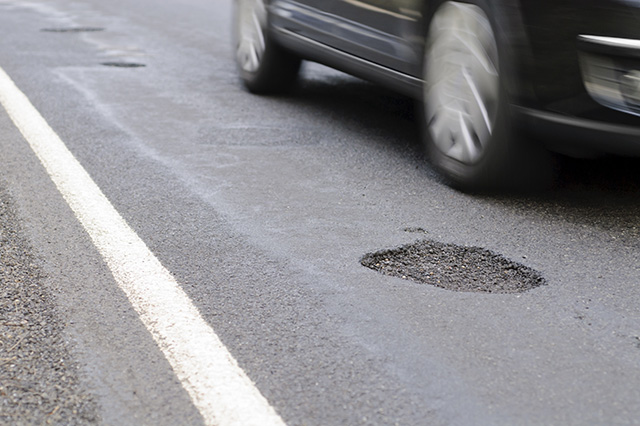
Driving over rough roads can take a toll on your wheels. Make sure you’re covered with AAA’s Tire & Wheel Protection Program.
It was cold. Luckily the water in my portable water filter hadn’t frozen overnight. I was laying in my tent, comfortable enough in my sleeping bag, wondering whether or not to let some air out of my sleeping pad.
It was a little light; probably around 6 or 6:30 in the morning. I was dreading what was awaiting me: an ice-cold stream crossing. Well, at least the sun was coming out. Time to get a move on.
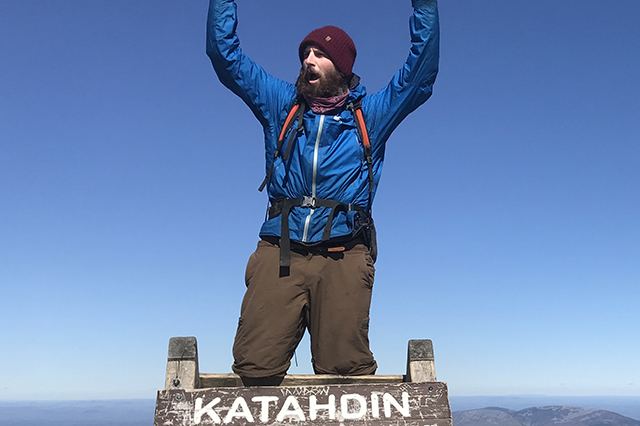
Just another day on the Appalachian Trail. On this specific day I was near the end of my journey in Maine’s Hundred Mile Wilderness, the last section of the trail. The Appalachian Trail is a 2,192-mile hiking route that winds from Springer Mountain in Georgia to Mount Katahdin in Maine. It’s one of the most popular trails for thru-hikers, folks who complete a long trail from beginning to end within a year. In 2018 alone, over 4,000 people tried to thru-hike the Appalachian Trail, with just over 800 achieving their goal.
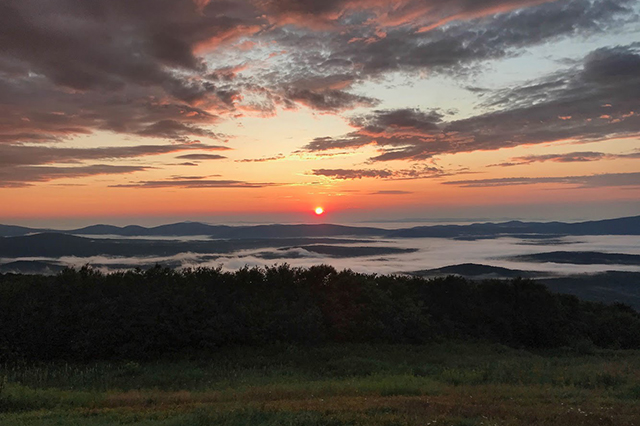
Sunrise at Bromley Mountain in Vermont.
Why the Appalachian Trail?
Why would someone want to become a thru-hiker? That’s a good question, and one that isn’t answered easily. For me, it was a collection of reasons. Primarily, I love backpacking, and I love to challenge myself. I have a great respect and enthusiasm for the outdoors, our public lands and their conservation and preservation. However, taking a selfie in the woods to post on your Instagram is not going to get you through the trail. There are many logistics to consider. It took me more than a year of planning to make the trip happen. Leaving my job, family and friends was a real jolt. Many times I wondered if I had made the right decision.
The first few days were tough. I wasn’t sure if I could complete the trail. To add insult to injury, I fell flat on my face on the first day. It takes a while for a hiker to gain hiker legs, but after a few weeks, I entered a new realm. A simpler – yet extremely demanding – one. I woke up, packed up my gear, ate, walked, drank water, walked, had a snack, walked. You get the picture.
Dinner is a hiker’s favorite time of day. Some days, it was all I thought about. My mind would play tricks on me – somedays I could smell a hot meal hours before I arrived at camp and started cooking. When I finally stopped for the day and completed most of my chores, I would cook and chow down. Sleep came shortly after: Most hikers are out cold when night comes.
A (Hot, Hungry, Cold, Buggy) Walk in the Woods
Walking in the woods is fun, but it can be monotonous and lonely at times. I was always facing down to watch my step. Uneven ground was twisted with roots and scattered with rocks. I spent all day walking up and down hills, sometimes with an occasional breathtaking vista as a reward. I listened to audiobooks, or albums I downloaded in town, and sometimes just mulled things over in my head. I took in the world around me: the trees, plants, birds and sounds of the woods.
Of course, there was also rain, and cold, and burning heat and incessant mosquitoes. I started to miss life’s simple pleasures and couldn’t wait to get into town for a shower, a bed and beer! Hostels line the Appalachian Trail, and I would see all my fellow vagabonds when I arrived at one. We ate lots of food. Calories are important when you exert as much energy as we did. I would eat my food, more food, and everyone else’s food if they didn’t finish their meals. Which is how I earned my trail name: Two Dinners.
Bedtime was always early, since I needed to hike 15 to 20 miles a day. I soon felt like a professional hiker. This was my job, my life.
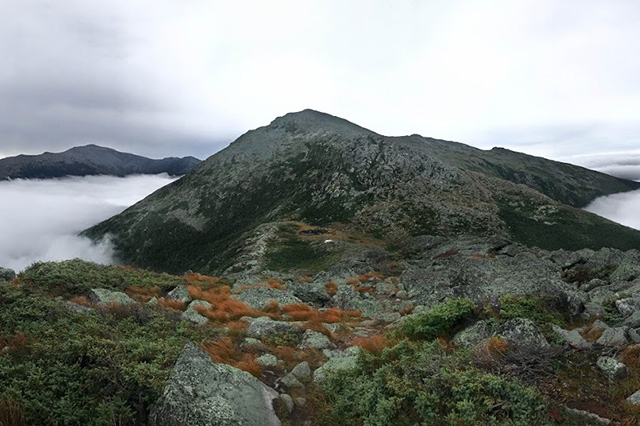
Clouds obscure nearby peaks on Mount Adams in New Hampshire’s Presidential Range.
The Social Network
The Appalachian Trail is a very social trail. Thru-hikers travel together daily for almost 2,200 miles. Trail families, or “tramilies,” form as certain groups of hikers become close to one another. Some grow so close that they’re inseparable. I considered myself a loner since I hiked alone most of the time. This allowed me to chat with different types of hikers. We’d meet at camp, exchange trail names, and exchange words about ourselves, our gear, and our hopes and dreams. Perhaps I’d see that cool hiker again the next night. Or maybe I’d see them hundreds of miles down the woodland corridor. The trail allows you to get to know people of all different origins, life experiences and world views, which was a great perk of my journey.
I started the trail full of expectation. The excitement and fear I felt standing on top of Springer Mountain followed me for a while. Eventually I got used to the daily grind, and then suddenly, the beginning felt so far away. The months passed by in Virginia and the Mid-Atlantic states. I briefly stopped in Vermont and visited home for a week. When I returned the end was in sight, and before I knew it, I was in Maine. One afternoon I could see Katahdin, the final mountain, looming in the distance.
There and Back Again
Now, my journey is over and I’m back in Rhode Island. I lost 40 pounds and am in the best shape of my life. The trail taught me that doing what you want matters, and that it’s important to take chances. We can get caught up in society’s expectations. We worry about what is expected of us, or about what we think is expected of us, and lose a bit of ourselves in the process.
It was important for me to experience a change. It was necessary to be the hero of my own journey and to face it and persevere. I now make decisions carefully and tailor what I want for my life. I recommend that everyone put themselves out there and take on the unknown, no matter how big or small the journey.
One way to do this is to get out there for a hike yourself. For the past six years I’ve been taking day hikes and weekend backpacking trips around New England. It’s not hard to get out there, even for just a few miles. Local trail organizations, books and trail-finding apps are full of resources.
Maybe one day, you’ll even take a chance and drive down to Georgia to start your own epic journey.
Jonathan Cipriano is a AAA Northeast member from R.I. He departed Georgia’s Springer Mountain on April 16, 2019, and reached Mount Katahdin in Maine on Oct. 5.
Many people are working from home these days, and it’s a new situation for a lot of folks. While you’re not adding the wear and tear of a daily commute or paying as much for gas, you can’t completely forget about your car while it sits in your driveway.
Depending on how long your car is idle, issues like dead batteries, stale fuel, rusty brakes or issues with rodents and other critters should be addressed. Here are a few tips to keep your car running properly during a hiatus from driving:
Fill your vehicle’s fuel tank and add a gasoline stabilizer. This will extend the life of fuel and prevent condensation from building up in the fuel tank.
Inflate the tires to the vehicle manufacturer’s recommendation; the correct pressure is usually found on a placard on the driver-side door jamb.
Drive your vehicle at least once a week for 30 minutes. Not only will it get you out of the house, it will exercise all the moving parts of the engine and help maintain the battery. Don’t just let the car sit idle; drive it around to get the maximum benefit for all the fluids and tires.
When you do drive the vehicle, don’t be surprised if you hear a slight grinding noise from the brakes. This is nothing more than a little surface rust wearing off the brake surfaces. Rust can accumulate from being parked for a period of time and isn’t something to be too concerned with.
Take a few minutes to lubricate door locks (if accessible), hinges, the hood release and even the gas door release. Use a light oil or silicone spray, not a penetrating oil. Penetrating oil is great for dealing with rusty nuts and bolts but tends to wash away lubricants.
Don’t ignore needed maintenance. Many service recommendations are based on time and not just mileage. For example: your car requires an oil change every six months, or 7,000 miles. You still need to have the oil replaced and the vital fluids checked, regardless of whether you drive 7,000 miles or not.
Depending where you park, there may be mice or other critters that want to call your vehicle home. These rodents can chew on wires and cause thousands of dollars of damage, make nests in your filters and cause other messes. I’ve even had one set up shop in my glove compartment! There are a variety of sprays and granules on the market to deter these animals. Some have the scent of a predator and others smell like mint — a scent rodents don’t like.
Keep your car clean. Wash your car weekly if it’s parked outside. Acid rain and bird droppings can damage the finish. And, an afternoon spent washing, vacuuming and waxing your vehicle will burn about 1,100 calories — it is also a great stress reliever!
AAA members can save on automotive replacement parts and accessories at NAPA.
Got a question about your car? Visit AAA.com or email jpaul@aaanortheast.com to get an answer from AAA’s Car Doctor John Paul.
One late evening nearly 25 years ago, Shane Snowden was driving home on a rural California highway she had traveled hundreds of times before. She wasn’t under the influence. She wasn’t speeding or on her phone. Snowden was just driving along as her regular self. Everything was fine, until it wasn’t. As she rounded a curve, Snowden heard a thud unlike any other she had heard in her life. Before she knew it, she saw a young man sprawled across the hood of her car before rolling over the windshield and over her car.
The teenage bicyclist died instantly. Snowden was found not at fault, but for more than two decades, the experience has remained engrained in her heart and mind. It’s why she has worked tirelessly to ensure her story does not become someone else’s. In recent years Snowden has begun speaking publicly about the experience. To help spread the word about the importance of safe driving, Snowden founded The Crash Project, an organization that aims to encourage mindful driving and support for safety initiatives.
“There are a lot of loved ones telling their stories and they do a lot of good,” Snowden says. “My thought was, what if people thought about car crashes not only around how it feels to have a loved one die? What if we talked about another piece of that – how it feels to kill somebody as the driver? That’s something a lot of people have not had the chance to think about. They haven’t heard from drivers who’ve killed. That’s why I try to tell my story and speak out about road safety.”
While traffic fatalities have dropped over the last few years, pedestrian deaths are on the rise. In 2019, more than 6,500 pedestrians were killed in the U.S., the most since 1988. The pandemic has only further emphasized the need for a change in driver behavior and attitude. The number of traffic fatalities in the U.S. increased last year despite a significant drop in number of miles driven by residents. The National Safety Council estimates that more than 42,000 people died in car crashes in 2020, an 8% increase over the previous year and the most since 2007.
Snowden is still hopeful that change on the roadways will come despite the sobering statistics. She points to the widespread acceptance of safety measures such as seat belts, child restraints and designated drivers, all of which were not commonly used just a few decades ago. “I do believe people can change. I believe drivers can change. One driver at a time, driving differently, day by day, drive by drive.”