
Related Articles




Trending Articles


NEWEST ARTICLES



In the ideal valet scenario, you pull up like one of the cool guys in the movies, toss your keys to the driver with a wink and ask him to “keep it close.”
What happens in reality? Not so smooth.
In what is often a confusing and sometimes hectic situation, many are left guessing when it comes to proper valet protocol. How much should you tip the valet? Do you tip at drop off or pick up? What we should do and what’s right to do is not always clear-cut.
We spoke to lifestyle and etiquette expert Elaine Swann, aka “The Etiquette Lady,” for her advice.
Although trusting a stranger with the keys of one of your most expensive possessions can be a bit unnerving, valet service is offered at high-end hotels and restaurants to elevate your overall experience at the establishment and can make it even more enjoyable.
Let’s be honest — it’s pretty nice to walk out of a restaurant completely full and not have to lift a finger to get your car. Even better when it’s pouring or freezing outside.
If you choose to take advantage of valet service (keyword: service), it is not a question of if you should tip, but how much to tip valet.
“It is always a good idea to tip the driver,” said Swann, who suggests leaving the gratuity when you return to pick up your car. Tips are commonly pooled so you don’t usually have to worry about tipping twice if the person who parked your car is different than the one who retrieved it.
Of course, if you want any extra attention, like if you want them to “keep it close,” a slightly larger gratuity beforehand is the norm. I’m pretty sure that’s how the cool guys in the movies make it look so easy. I don’t know about the wink though. Maybe you shouldn’t do that.
In general, how much to tip valet depends on the level of help and accommodation provided.
“The tip can be anywhere between three to five dollars depending on the service,” says Swann. Sometimes the valet will go above and beyond for you, carrying bags or gifts, going back to your car to get something you forgot, or even helping with directions and information about where you are going. “If they do anything for you other than just parking your car, then definitely give a larger tip.”
Also, consider the circumstances. A little extra during times of inclement weather or bitter cold is always nice.
Swann recommends checking in with the hotel or restaurant in advance to see if valet service is included or can be added to your credit card. For example, some hotels will allow you to add the valet tip to your room charge. But most of the time, tips are earned and collected by the valets themselves, so you want to make sure that you have enough cash on hand.
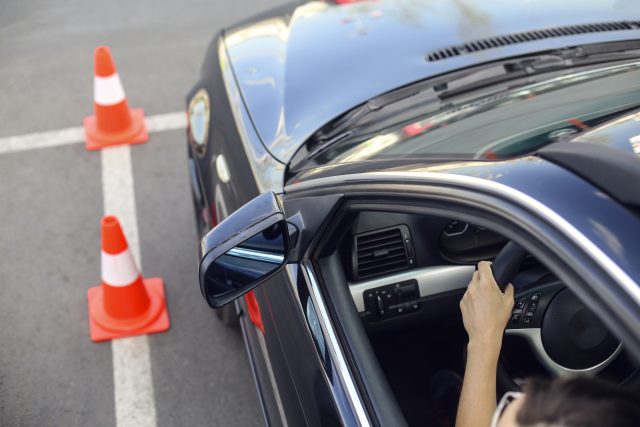
Naturally, common courtesy goes a long way in determining the level of service you will receive. Simply being polite helps the entire process go smoother for the valet and everyone in the lot.
Swann goes back to the basics, stressing the importance of saying “please” and “thank you” and establishing a friendly relationship with the valet. “If they’re wearing name tags use their first name so that way you have a connection with them. It will make them feel better about taking care of your car and taking care of you.”
To make parking as seamless possible, avoid distractions, stay alert and as Swann suggests, make eye contact with the valet as you are pulling in for direction. “If you’re looking around, getting distracted on your cellphone or talking to someone, you’re not paying attention. Making eye contact with that valet will help you in terms of getting instructions on where to stop your car.”
And finally, if you know you are going to valet park, turn down your radio, make sure the seat area is cleared of clutter, remove any valuables, and turn off the GPS and exit the navigation. Even if it’s just taking a minute to throw everything into the trunk, make sure your car is clean. “It makes it easier for the valet to get in and out without them having to worry about your phone charger hanging down … or having to fight with your GPS repeating and rerouting,” said Swann.
This article has been updated and republished from a previous version.



Terceira is nestled within the Azores, a Portuguese autonomous archipelago some 870 miles west of Europe. Steeped in culture and history, there’s much to explore on Terceira, including the fresh seafood and fine wine. Terceira’s cultural center is the southern port of Angra do Heroísmo, a UNESCO World Heritage city awash with colonial architecture and rich maritime history.
While the island can be explored on one’s own, a private guide may help you get the most from your trip. An experienced travel advisor can help you navigate the local terrain and the island’s several important festivals.
Terceira may feel luxuriously remote, but it’s more accessible than you might think. It’s just a five-hour direct flight from New York or Boston with SATA Azores Airlines.
Get the most out of your visit to Terceira Island with this sample seven-day itinerary, filled with opportunities to explore its rich history, culture, cuisine and stunning landscapes.
After an overnight flight, land at the Aerogare Civil das Lajes airport and travel a short distance with your private guide to Angra do Heroísmo. There, take advantage of an early check-in at a boutique hotel in the city center to freshen up.
Enjoy a quick cafe meal, then walk to enjoy a guided tour of Sé Cathedral, the biggest temple on the archipelago, and the Palácio dos Capitães-Generais museum, both built in the 16th century. Stop at some charming shops along the way. Afterward, enjoy a traditional dinner of Alcatra, a slow-cooked beef stew, at a local restaurant.

Terceira, like the other Azores Islands, was born from volcanic activity. Throughout the island, you can find many reminders of its turbulent geological history.
A private guide can take you a short drive inland to explore Algar do Carvão, a volcanic cave with a dramatic lava tube and underground lake. Next, take a walk in the Furnas do Enxofre, a national monument and nature preserve which features steaming geothermal vents and beautiful wetlands.
Have lunch at one of the many quintas, or farm-to-table countryside restaurants, before arriving in the vineyards on the northern part of the island to sample local wine. Return to Angra do Heroísmo for a seafood dinner.
Terceira sits along important migratory routes for many species of whales and dolphins. In the morning, when the seas are calmer, hop aboard a whale watching cruise leaving from Angra do Heroísmo. See how many magnificent creatures you can spot and learn about the island’s ocean ecosystem from a local biologist.
Deep sea trenches just offshore also shelter many other types of fish and ocean life, providing spectacular underwater views for snorkelers and divers.
Back onshore, enjoy a seaside lunch, and then travel to Serra do Cume, an observation point which offers sweeping panoramic views of the island. The evening is free to explore and enjoy local cuisine.

The island’s volcanic soil makes for lush pastureland, and Terceira Island enjoys a rich farming tradition.
Take a guided tour to one of the island’s many dairy farms and learn of Azorean cheesemaking. Then enjoy wine and cheese at a local countryside restaurant. You can also take part in a breadmaking workshop to learn how to make Massa Sovada, a traditional Azorean sweet bread.
For dinner, sample Alcatra de Peixe, Terceira’s traditional fish stew, back in Angra do Heroísmo.
Seafaring nations prized the Azores, and the Spanish and the Portuguese empires fought for control of the archipelago. Terceira contains several strategically important sea-facing lookouts where visitors can learn about the island’s history.
Monte Brasil, one such lookout, is a volcanic peninsula bordering Angra do Heroísmo. While there, you can take a guided tour to the Fortress of São João Baptista to discover sweeping views of both the ocean and the island.
Next, enjoy refreshments at a tea house in the city while learning about the history of tea plantations on nearby islands. A guide can lead you through the colorful Imperios chapels and discuss their importance to local religious traditions.

Return to the island’s northern coast to splash in the Biscoitos natural pools, which are small swimming holes naturally carved out of volcanic rock. Swim in shelter here while looking out at the Atlantic Ocean.
Afterward, enjoy a seafood lunch and, perhaps, more of Terceira’s local wine. Then, travel back to Angra do Heroísmo for a farewell dinner as you prepare for your trip home.
Take one last stroll through the city center before traveling to the airport for your departure.
Do you think you’d enjoy a trip like this? Start planning your vacation to the Azores and Terceira Island today.
Featured image: Angra do Heroísmo, Terceira Island. ©José Mendes ©Visit Azores


Big things come in small packages. Terceira, a tiny island off the coast of Portugal, is packed full of opportunities for new adventures.
Terceira and the eight other Azores Islands were born from volcanic activity, so its terrain features jutting rock formations, lava tubes and volcanic soil. It’s the perfect backdrop for outdoor fun, from horseback riding to kayaking around the rugged coast.
This island adventure is more accessible than you may think. SATA Airlines offers direct flights from New York City or Boston to Terceira in five hours or less. To get the most out of your getaway, consider working with a AAA travel advisor to book activities in advance.
Saddle up for a guided horseback ride in Serra do Cume, one of the highest inland points of eastern Teceira. Terceira Island ponies are renowned for being small, intelligent and easy to ride. A gentle morning or afternoon ride in the island’s center offers sweeping views of the island’s lush patchwork fields. These fields, fed by the rich volcanic soil, support the island’s dairy farmers.
Gruta do Natal was formed from a lava tube, and the walls and rock formations feature multiple colors, adding to the cave’s otherworldly mystique. This cave has relatively straight, long passages, making it easier than most to explore. Visitors can opt for a guided or self-directed tour, and the cave’s interpretation center provides a map and a hard hat to use.

Want to get away from the crowds and contemplate your island destination at sea? You can rent a kayak or stand-up paddleboard from one of several outfitters in the port city of Angra do Heroísmo and explore the coastline at your own pace. Local outfitters also offer two-to-three-hour tours for those who would rather have a guide on the saltwater. Kayakers sometimes can spy wildlife, like seabirds and dolphins, that might be harder to spot with the wave action of a larger whale-watching boat.
This hiking spot gets its name from the blackened soil and jagged volcanic rock that can be found here, evidence of the island’s last eruption some 260 years ago. The circular trail offers great views of the island’s endemic flora and terrain. The three-mile trail is strenuous but can be completed by athletic hikers in an afternoon with time to spare. The well-maintained trail includes many boardwalks and steps to help with footing.

These islets are part of a protected nature park just off Terceira’s southeastern coast. The twin rock formations, once part of the island’s coast, provide perfect nesting habitat for several species of terns and other seabirds. Take a small group tour on a large inflatable power boat to view these nesting grounds and learn about the volcanic rock structures that make up Terceira’s shoreline.
Terceira is well-known for its vibrant and intricate arts and crafts that are steeped in European culture and influenced by the sea. Stop by the Pottery of São Bento near Angra do Heroísmo for a guided tour of the island’s handiworks in clay, embroidery and ceramics. Then, take the opportunity to paint your own tile to take home.

At its widest point, Terceira is just 18 miles long, which means it is the perfect distance to explore the island by bike. Here, there are cycling opportunities for nearly all skill levels, from flat, picturesque roads to adventurous plunges. You can rent a bike in Angra do Heroísmo and sightsee at your own pace or hire a guide to accompany you on your journey. E-bikes are available for rent on the island.
Terceira is home to more cows than humans, and these bovine producers can roam and graze year-round. Take a tour of the Queijo Vaquinha cheese factory and learn the art of cheesemaking from one of the most beloved cheesemakers in the Azores Islands. Be sure to sample from one of Vaquinha’s distinctive cheese wheels after the tour.

On Terceira’s northern shore, volcanic activity carved out natural swimming pools overlooking the Atlantic Ocean. Bring your suit and your snorkel and you can see the rich diversity of life in this tidal zone while marveling at the power of the nearby ocean.
Bring an empty stomach as you embark on a three-hour walking tour of Angra do Heroísmo, a UNESCO World Heritage site, and sample from traditional pastries, seasonal fruits and savory snacks that represent the island’s many culinary traditions. Between bites, learn about the iconic buildings and fascinating history of this centuries-old city.
Start planning your vacation to the Azores and Terceira Island today.
Featured image: Horseback riding in Sete Cidades, Terceira Island. ©Visit Azores


The thaw of early March in the Northeast brings with it mud, black ice and potholes. On the brighter side, it also brings signs of spring. For example, the maple sap is running, and many of the region’s commercial maple farms open their doors during
The Maple Syrup Producers Association of Connecticut hosts its Maple Weekend, March 15-16 and lists about two dozen maple farms with open houses throughout the state. Great Mountain Forest nature preserve in Falls Village and Norfolk will be among those opening its sugar shack doors to the public.
The Massachusetts Maple Producers Association hosts its maple weekend, March 8-9 and lists 29 participating sugarhouses, including Rocky Brook Farm in Sterling. Visit this picturesque family farm as they make syrup, linger outside with the farm’s horses and learn about the farm’s barn restoration work.
New Hampshire maple weekends are among the most popular in the region. Dozens of sugarhouses are participating in the New Hampshire Maple Producers Association’s Maple Weekend on March 15 and 16. The Sugar House at Morningstar Farm in Plaistow offers a tour, pancake breakfast and some very creative maple products for sale, including maple-infused barbecue sauce, maple-garlic seasoning and maple Thai chili sauce.
New Jersey does not have many commercial maple producers, so there is no formal maple weekend in the Garden State. However, Tenafly Nature Center hosts a series of weekend maple sugaring events from late February to March 16. Visitors can practice identifying maple trees, learn about the history of maple syrup making and watch the syrup making magic happen.
New York maple weekends are pretty sweet, too! The New York State Maple Producers Association hosts two Maple Weekends, March 22-23 and March 29-30. The association’s interactive map lists dozens of producers hosting open houses, and even helpful shows which host pancake breakfasts. One of those is Shaw’s Maple Products in Clinton, which will serve up pancakes, sausage and farm-fresh eggs both weekends; diners can watch the syrup being made, too.
Rhode Island doesn’t have an organized maple weekend, and has only a handful of commercial maple syrup producers. However, a well-known sugar shack in the Ocean State is Uncle Buck’s Sugarhouse in Hopkington. The syrup producer will open its doors to the public weekends throughout March. There will be fresh maple products and tours and live syrup production demonstrations, weather depending.
Are maple weekends part of your early spring plans? Tell us in the comments.


Identity theft impacts millions of Americans every year, with financial losses reaching into the billions. Fortunately, there are tools available to help you catch identity theft in its tracks.
AAA members can get free ID theft protection from Experian. ProtectMyID Essential includes daily monitoring of your Experian credit report, email alerts, lost wallet protection and fraud resolution support. In addition, AAA Premier members receive $10,000 in identity theft insurance. Paid plans are also available, offering even more protection.
Regularly monitoring your credit report is a great first step toward safeguarding your identity.
You can also take these additional steps to protect yourself and your loved ones from identity theft.
Learn more about common scams.

Get tips to outsmart scammers and protect your personal data. Listen to Episode 12 of our podcast, Merging Into Life: Identity Theft.
Tune InAre you signed up for AAA’s ID theft protection services? Tell us in the comments.
This article has been updated and republished from a previous version.


As one of the most exciting places to visit in Great Britain, the city of Manchester is full of energy, character and diversity. Delve right in and feel the buzz of this vibrant city, with its revolutionary history, famous music scene, dynamic food and drink offerings, and of course, its iconic soccer teams. It is shaping up to be Manchester’s biggest year yet.
A global destination for art, music and culture, Manchester offers immersive experiences showcasing both world-renowned artists and local creatives. Manchester’s biggest music festival, Parklife returns in June, with global artists such as Charli XCX, 50 Cent and Peggy Gou taking the stage. More exciting artists will come together in July at the Manchester International Festival, featuring theatre, music, dance and more. In August, the city shines with Manchester Pride Festival, taking over the streets with a variety of events, including SCENE, Manchester’s LGBTQ+ Film and TV Festival which celebrates both new and classic queer cinema and television.
See Manchester in its starring roles with the film and TV map, taking you to various filming locations for Hollywood blockbusters like Captain America and Sherlock Holmes movies and much more. You can start your adventure in Manchester today with direct flights from New York with Aer Lingus.
Why not combine your visit to Manchester with a few nights in the North of England or North Wales, two regions that are rich with heritage, adventure and breathtaking scenery. Forage for botanicals to make your own gin at Goosnargh Gin, Preston, or discover Chatsworth House in Derbyshire, a place that inspired Jane Austen and has featured in numerous film and TV productions. Explore the quirky boutiques on The Shambles in York, believed to be one of the inspirations behind Harry Potter’s Diagon Alley, or take to the skies on the world’s fastest zip-wire, soaring at over 100mph across the breathtaking Snowdonia scenery. All this doesn’t even begin to scratch the surface of what’s on offer, so what are you waiting for?

From its industrial past to the vibrant, diverse destination it is today, come explore Manchester’s thriving art scene.
Discover hidden gems and modern art on the Skyliner Street Art Tour, wander around The Whitworth gallery to see historic exhibitions and contemporary commissions or check out Aviva Studios, a world-class arts and culture center.
As evening falls, immerse yourself in the vibrant nightlife and music scene, enriched by a legacy of influential bands and artists and a breeding ground for new talent.

Experience one of the most exciting places in the UK! Save on direct flights from New York.
Book NowManchester’s food and drink scene is booming, making it one of Great Britain’s most exciting foodie destinations.
Tantalize your taste buds on one of the city’s many food and drink experiences. Take in the sights while enjoying a classic afternoon tea from the comfort of a famous black cab, craft your own tailor-made gin to take home on the Spirit of Manchester Gin Distillery experience and discover Manchester’s rich history through edible insights on the immersive Scranchester Food Tour.
And this doesn’t even begin to cover the range of culinary delights Manchester has to offer. Anyone hungry?

Discover the boundless adventure that awaits you in Manchester, where the urban landscape seamlessly blends with natural beauty. Explore Manchester’s unique charm on foot, through its many engaging guided walking tours. Or enjoy Manchester’s sky park, Castlefield Viaduct, set in the heart of the city’s industrial and Roman heritage sites. Whether you’re an adrenaline junkie or a nature enthusiast, this vibrant region offers an array of outdoor experiences to captivate your spirit.

Manchester has become a favorite location for both blockbuster movies and hit TV shows. Its striking architecture, diverse neighborhoods and vibrant cultural scene make it a versatile backdrop, appearing as everything from 19th-century London to modern-day New York.
Immerse yourself in Manchester’s rich cinematic heritage as you follow in the footsteps of movie stars. Learn about the city’s starring role on screen on The Locationist guided walking tour, check out the different film festivals offered throughout the year and download the Manchester Film & TV Map, which takes you on a journey through Manchester’s Film and TV locations.

Discover the beautiful coastal towns, medieval castles and outdoor adventure of the magnificent mountainous landscapes of the North of England and North Wales. Get around with ease on Great Britain’s rail networks or on a small group tour from Manchester, combining the diverse mix of city with quaint villages and stunning countryside, makes for the perfect vacation.
Explore Great Britain’s best zoo (voted by TripAdvisor 2024) at Chester Zoo, home to 37,000 animals. Cruise across the stunning scenery surrounding England’s largest lake on a kayak tour in the beautiful Lake District. Follow in the footsteps of Harry Potter and Thor at the dramatic Durham Cathedral and Castle. Wander through the Leeds Victorian Arcades, marveling at one of the largest stained-glass roofs in Europe. Indulge in Lancashire’s finest delicacies at Holmes Mill, celebrating all things food, drink and entertainment.
Sports lovers will want to soak up the atmosphere of Anfield Stadium, home of Liverpool Football (soccer) Club, which transforms into a world-class concert venue during the summer.
With so much to explore just beyond Manchester, your adventure is only just beginning!
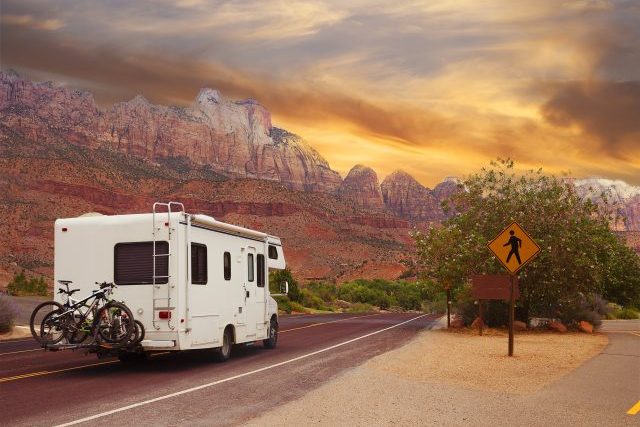
RVing isn’t just a way to travel — it’s a lifestyle.
More than simply a mode of transportation, an RV is an all-in-one vacation mobile. It’s your hotel, restaurant and roaming office. It’s your home on the road.
Whether you’re interested in renting or buying an RV for the first time, or you can’t wait to get on the road again, these RV safety and insurance tips will make sure your journey is a smooth one.
If you daydream about cross-country road trips, camping at national parks or waking up in a new place every day, read our article about why you should take an RV road trip. It includes what to think about when planning, types of RVs and more.
For those that own an RV, a specialty RV policy is recommended to properly cover your home on wheels. It also will provide you with a variety of options to customize to your needs.
Because an RV is like a car and a home, it includes some of the coverages of both auto and home insurance. Like car insurance, your RV insurance should have liability coverage for bodily injury and property damage. And like a home, you’ll want to discuss a total loss policy with your agent that covers replacement cost vs. actual cash value.
There are a few other factors to consider that could impact your RV coverage as well.
Learn how you can protect your RV with specialty insurance through AAA.
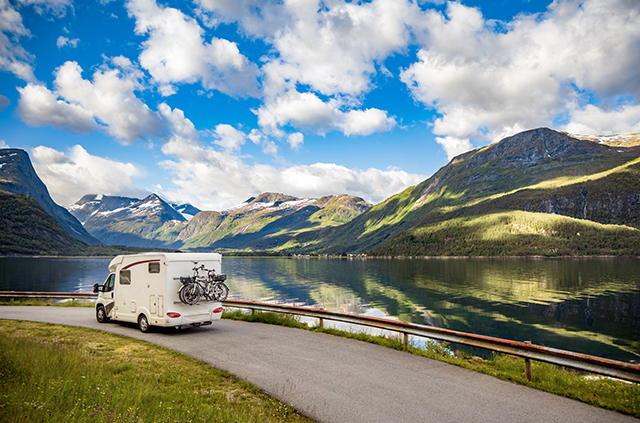
Once you’re fully insured and you’ve found and booked the perfect campsite, it’s time to hit the road. Keep these RV safety basics in mind for your travels ahead.
RVs are longer and heavier (some could be as big as buses) and have limited visibility. Some states require a special license to drive an RV, especially if it’s over a certain weight, but you don’t need one to drive most motorhomes, according to Outdoorsy.
If you’re new to RVing, you can benefit from taking a training course, like the one by the RV Safety & Education Foundation. Classes and workshops are often offered online and cover everything from RV weighing to tire safety.
For your first RV trip, try a destination that’s closer to home so you can get better acquainted with the vehicle. Practice makes perfect!
If you own an RV, you know they experience a good amount of wear and tear. After all, they drive for long distances and could stay parked for months at a time. Bring your RV to a trusted mechanic that specializes in RVs for regular checkups and stick to the maintenance schedule recommended by the manufacturer.
Tires are a big part of RV safety; a blowout could ruin your trip and spell disaster for both the vehicle and the precious cargo inside. You want to make sure the tires can handle the weight you are carrying and maintain and monitor the pressure. Consumer Reports also recommends replacing tires every 10 years from the date of manufacture, or sooner if noted in your owner’s manual.
Like any other road trip, you’ll want to make sure both you, your passengers and your vehicle are prepared. Give your RV a thorough safety check to get it ready for the road, map and price out your route for fuel and plan for emergencies. You’ll also want to secure down all the items in your RV before every trip to keep them from becoming hazardous projectiles while driving.
Many veteran RVers swear by this rule, which encourages drivers to stop driving once they’ve hit 330 miles or it’s 3:30 in the afternoon – whichever comes first. This ensures you’ll have enough time to explore your destination without being completely spent from too many hours behind the wheel, and that you’re totally alert while driving.
Other versions of this theory are known as the 3/3/3 rule (300 miles/stop every three hours/stay three nights) and 2/2/2 rule (200 miles/stop every two hours/stay two nights).
While most campsites and RV parks are safe, you may want to invest in a security system to keep an eye on your RV. Easy-to-install security camera systems, as well as window and door alarms may help to give you added peace of mind while you’re sleeping and out exploring.
If you do experience a break-in, your RV insurance can cover you for the replacement cost of your items – in other words, the full cost to replace the item with one of similar kind and quality.
If you plan on using public Wi-Fi during your trip, you may also consider downloading a virtual private network or VPN on your devices, to keep your personal information safe.
Schedule an appointment with an insurance agent to learn more about protecting your RV with specialty insurance through AAA.
Tell us your best RV tips in the comment below.
This article has been updated and republished from a previous version.

Americans grew slightly less wary of self-driving vehicles over the past year, but an overwhelming majority still don’t trust riding in one, according to the latest AAA survey on autonomous vehicles.
Just 13% of U.S. drivers indicated they’d feel safe riding in a self-driving or autonomous vehicle (AV). That’s up from last year, when 9% of drivers said they’d be comfortable. Despite the slight increase, 6 in 10 drivers still report being afraid to get into a vehicle that drives itself.
For drivers, enhancing vehicle safety systems remains the priority — 78% of survey respondents listed advancements in safety systems as a top vehicle technology initiative. In contrast, the development of self-driving vehicles is a low priority as only 13% of drivers expressed interest in AV technology.
“Most drivers are interested in advanced technology to enhance safety but still want to maintain a sense of control over their vehicles,” said Jillian Young, director of public relations for AAA Northeast. “When it comes to gaining consumer trust in self-driving vehicles, automakers face a long road ahead and as vehicle technology continues to evolve, educating consumers on safety standards is paramount.”
Robotaxis — self-driving vehicles used for taxi and ride-hail services — operate in several major cities. AAA’s survey found that 74% of drivers were aware of robotaxis, but more than half (53%) said they would choose not to ride in one.
Collectively, interest in advanced driver assistance features (ADAS) continues to remain high. The survey found that 64% of U.S. drivers would “definitely” or “probably” want Automatic Emergency Braking (AEB) on their next vehicle, 62% would want Reverse Automatic Emergency Braking, and 59% would want Lane Keeping Assistance. AAA advocates for standardized naming schemes for these systems to accurately describe their capabilities and limitations and reduce consumer confusion.
“Advanced driver assistance technologies should enhance driver safety rather than give the impression that the car is driving itself,” Young said. “As the software and sensors that power these systems continue to improve, drivers must be informed about their limitations as well.”
AAA has conducted various tests to determine if the technology performs as expected. Research released by AAA in October 2024 showed significant AEB advancements, particularly at speeds up to 35 mph.

Thanks to ample supplies, steady production, soft demand and growing concerns about a slowing economy, the price for a gallon of regular unleaded has barely moved week-over-week across the region and increasingly trails last year. In some states, more than 10 cents separate the prices seen this year and the comparable week of 2024.
Demand for gasoline fell to 8.23 million barrels a day last week, according to the Energy Information Administration (EIA). The drop of 338,000 barrels a day from the prior week was likely due to the return of severe cold to much of the U.S. Frigid temperatures typically hold back demand as people skip driving excursions and stay home.
In the Northeast, despite a drawdown of about 200,000 barrels last week, gasoline supplies are ahead of last year by 2 million barrels, the EIA reported. Coupled with the lackluster demand, prices remain suppressed at a time when they typically begin climbing in anticipation of the switch to summer blended fuel in April.
“Domestic refiners are beginning to face the potential for an oversupply of winter blended fuel, and that’s helping keep prices in check as we enter the waning weeks of winter,” said Jillian Young, director of public relations for AAA Northeast. “Eventually, prices will climb as the more expensive summer blend begins to appear on the market in the coming weeks.”
AAA Northeast’s Feb. 24 survey of fuel prices found the current national average down 2 cents from last week ($3.16), averaging $3.14 gallon. Today’s national average price is a penny higher than a month ago ($3.13) and 12 cents lower than this day last year ($3.26).
| Region | Current Price* | One Week Ago | One Month Ago | One Year Ago |
| Connecticut | $3.08 | $3.08 | $3.09 | $3.27 |
| New Jersey | $3 | $3.02 | $3.10 | $3.19 |
| New York | $3.17 | $3.17 | $3.17 | $3.30 |
| Massachusetts | $3.03 | $3.03 | $3.04 | $3.18 |
| Rhode Island | $3.02 | $3 | $3 | $3.14 |
*Prices as of Feb. 24, 2025
As of Feb. 24, Mississippi and Texas had the lowest prices in the nation at $2.66 and $2.73 respectively. California and Hawaii held the highest prices in the nation this week at $4.84 and $4.55, respectively.
The AAA Gas Prices website is your resource for up-to-date fuel-price information. Search for average gas prices on national, state and metro levels by regular, plus, premium and diesel.
Some things are just better in pairs. Chocolate and peanut butter, mornings and caffeine – even your homeowners and automobile insurance policies.
When it comes to managing your insurance needs, there are many reasons why bundling your insurance policies can be beneficial, from lower payments to a streamlined claims process. Here’s a look at all the ways a home and auto insurance bundle can make things a little simpler.
One of the most compelling reasons for bundling home and auto insurance is the potential for cost savings. Insurance companies often provide substantial discounts to folks who purchase multiple policies from them, and this discount can lead to significant savings over time.
Handling and keeping track of multiple insurance policies sometimes feels like a juggling act and can be rather time consuming. Bundling your auto and homeowners insurance simplifies the process by consolidating your coverage under a single provider. This can make it easier to keep track of payments, yearly renewals and policy updates. Instead of dealing with separate companies, you have a single point of contact for all your insurance needs, streamlining communication and any remaining administrative tasks on your end.
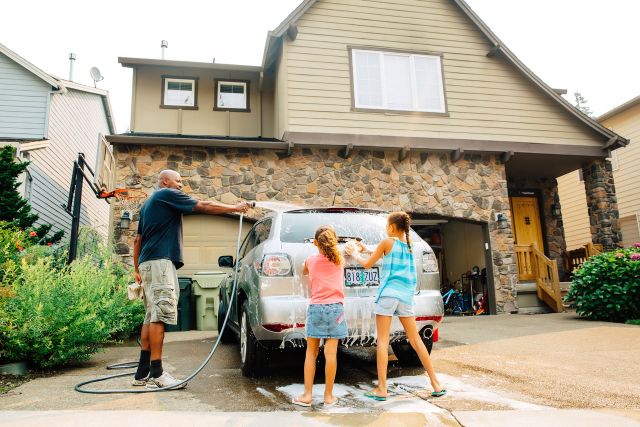
When you bundle your auto and home policies, you may gain access to enhanced coverage benefits that aren’t available with standalone policies. These additional perks may include higher liability limits, identity theft protection and increased coverage for certain types of claims. Bundling can also make you eligible for special programs or rewards offered by the insurer, like the ability to purchase an umbrella policy. This kind of policy provides coverage if the damages exceed the liability limits on your auto and homeowners policy.
In the event of a claim, having both auto and homeowners insurance with the same provider can lead to a more efficient process as coordination becomes more straightforward. This alone reduces the likelihood of disputes and delays that can occur when policies are with separate entities. If the claim involves both your vehicle and your home, like in the case of a natural disaster, such a direct line of communication is not only advantageous, but eases the burden on you to facilitate.
As always, it’s a good idea to compare offers from different insurers to allow for the best value and coverage for your specific needs.
Speak with a AAA insurance agent today about bundling your home and auto policies.


With winter showing no signs of slowing down, many Americans are dreaming of warmer weather. AAA bookings show that Florida, Georgia, Hawaii and California are among the top U.S. destinations this spring break season, which begins in March and ends mid-April.
“For many families who live in colder climates, spring break can’t come soon enough,” said Jillian Young, director of public relations for AAA Northeast. “Florida is always a favorite this time of year because of its beaches, theme parks and cruise ports. For vacationers from the Northeast, Aruba, Punta Cana and Turks and Caicos are all popular international spring break destinations for warmth, fun and relaxation.”
In addition to warmer climates, AAA bookings show several European cities, including Rome, London, Paris, Barcelona and Madrid, among the top spring break destinations this year. With travel to Asia booming over the past year, Tokyo also makes the top 10 list of international spring break destinations.
| AAA’s Top Spring Break Destinations | |
| Domestic | International |
| Orlando, Florida | Rome, Italy |
| Fort Lauderdale, Florida | London, England |
| Atlanta, Georgia | Paris, France |
| Miami, Florida | Amsterdam, Netherlands |
| New York, New York | Lisbon, Portugal |
| Honolulu, Hawaii | Dublin, Ireland |
| Los Angeles/Anaheim, California | Oranjestad, Aruba |
| Tampa, Florida | Barcelona, Spain |
| Chicago, Illinois | Tokyo, Japan |
| Charlotte, North Carolina | Madrid, Spain |
Flying to spring break destinations is more expensive this year compared to 2024. The average round-trip ticket is up 7% for domestic cities and up 2% for international cities, according to AAA booking data.
Hotel stays in the U.S. are 8% more expensive this spring break season, while international hotel stays are 4% cheaper.
The cost to rent a car domestically is about the same as last year, while international car rentals are 5% cheaper this spring break season.
The cost to cruise is up, too: Domestic cruises this spring break season are 27% more expensive compared to last year. International cruises are 3% more expensive. Still, AAA’s inaugural cruise forecast projects 19 million Americans will embark on ocean cruises this year, marking the third straight year of record cruise passenger volume.
For those looking to travel to the United Kingdom and Europe, you’ll need more than just your passport. Travelers must fill out an online application before entry under new travel requirements taking effect this year.
Travelers should also be aware that the REAL ID deadline is quickly approaching. As of May 7, 2025, adults traveling within the U.S. must have a REAL ID or other acceptable form of identification to board domestic flights and access certain federal facilities. To find out if your current identification is compliant, visit the federal government’s REAL ID website.

Book your next trip with AAA Travel now or call 866-423-5585 to speak with a travel advisor.
Book Now

A. Based on my most recent experience, this may be the best Explorer that Ford has built to date. The optional 400 horsepower turbo-charged V-6 engine is smooth and powerful, the newly redesigned 10-speed transmission shifts smoothly and is nicely matched to the engine. The model I evaluated was the “platinum” trim and it was very luxurious. As a three row SUV, Ford did a great job with this newest Explorer.
A. If you plan to keep the car for any length of time, it makes sense to repair it. I have found it is always better to go with original equipment when it comes to catalytic converters. Some aftermarket converters work fine (AP, WALKER, DORMAN are good ones) but many readers and shop owners have told me of problems with some bargain converters. I have seen replacements as low as $200. Also, there are two catalytic converters on this car. If your shop is confident with their diagnosis and comfortable with their aftermarket supplier and can save you $600 then it seems like an easy decision.
A. I remember having dinner with the president of Porsche when we hosted him at my press association. At the time they were introducing the Cayenne and telling us how Porsche is now not just a seasonal sports car company but a true all-weather car. You didn’t mention what model GTS, is the 911 GTS a family car, well not really since the rear seat is mostly unusable. In fact, the rear seat in a 2025 911 is a no-cost option. But the Cayenne and Panamera certainly could be family cars. It is also interesting to note that today, Porsche sells more SUVs than sports cars. Because they can be fun, fast and great handling family cars. Now the rust issue could be the pretreatment chemicals being used on the roads. Salt has been replaced by magnesium chloride in many states. It provides exceptional ice melting capabilities and in brine form lowers the freezing point of water. This chemical adds to road safety but is corrosive to both metal and concrete.
A. My first thought was also the sunroof drains. I would double check that the drains are truly draining outside of the car. Open the sunroof and pour water into the open sunroof tray, you should be able to see the drain holes. The issue may be the water may not be draining outside of the car. The other common area is the seal at the cowl is leaking. Also make sure the AC evaporator is draining. The cowl can leak into the evaporator and if the drain is clogged things get wet. Testing can be performed with low pressure water. When I looked for leaks, I used to use a garden hose hooked up to a shower head and would work my way up from bottom to top and look for the leak. What you can also try is turning the heater fan on full blast and with a spray bottle with soapy water, spray body seams and look for bubbles. The last thing is professional help. Some dealers use freelance wind and water leak techs. Some of these folks use ultrasonic tools to find leaks and even smoke machines to find leaks.
A. Preconditioning the cabin while the car is plugged in helps maintain battery range. I would avoid using regenerative braking in the snow. It is like applying the brakes and can cause a skid. Also, unless this Model 3 is all wheel drive, winter tires or all weather (not to be confused with all season) tires are needed. Even with the weight of BEVs, tires provide traction. Some single motor EVs are rear wheel drive and with the instant torque of an electric car can easily skid. Similar to a gas car, where we recommend for winter to top off your fuel tank, top off your car’s battery. Electric cars are great when stuck in traffic since they use very little electricity, but starting the day with a battery at 90 percent will help prevent running out of electricity. Also, if you rely only on public charging, these stations can get crowded (especially with ride hailing drivers) if there is a prediction of extremely cold /wintery weather.
A. I would start with cleaning the windshield. I have used Bon Ami powdered cleaner or Bar Keepers Friend to remove any waxy film and deposits. Then follow up with a good window cleaner. The Car Doctor’s wife is a fan of SprayWay. Once you have purchased quality wipers, the next step is making sure the wipers are perpendicular to the windshield. Over time the arms bend and no longer provide good contact to the windshield. Sometimes just tweaking the wiper arms using an adjustable wrench as a tool can quiet the noise and chatter. If all of this does not work you may need to replace the wiper arms, which may not be keeping enough tension against the windshield.

On the one hand, stubborn inflation, tariff fears and expectations for higher interest rates in the coming months are acting as headwinds for oil and gas markets, holding prices down on the assumption of weaker economic activity. On the other hand, markets reacted positively last week to stronger demand and headlines describing peace discussions in the Middle East and between Russia and Ukraine. Overall, crude oil prices ended marginally lower last week — the fourth straight week of declines — and the price for U.S.-produced oil is now 9.1% lower than in mid-January.
Meanwhile, gasoline demand rose last week to a healthy 8.57 million barrels a day, according to the Energy Information Administration. That’s an increase of 250,000 barrels a day week over week. That’s higher than the comparable weeks of 2023 and 2024, and demand so far in 2025 has outpaced last year by roughly 1%. Higher demand is music to the ears of domestic refiners, who have been increasingly concerned about the potential for an oversupply of winter-blended fuel before they officially switch to producing summer blend by April. National inventories of gasoline fell last week by 3 million barrels, which was the first drop in supplies in three months.
“Refiners are beginning the process of emptying their tanks of winter blend and transitioning to summer blend production,” said Jillian Young, director of public relations for AAA Northeast. “Historically, pump prices start climbing in the late weeks of winter, but this year, regional prices are staying put so far, thanks to cheaper oil and sizable gasoline inventories.”
AAA Northeast’s Feb. 17 survey of fuel prices found the current national average up 3 cents from last week ($3.13), averaging $3.16 gallon. Today’s national average price is 5 cents higher than a month ago ($3.11) and 12 cents lower than this day last year ($3.28).
| Region | Current Price* | One Week Ago | One Month Ago | One Year Ago |
| Connecticut | $3.08 | $3.08 | $3.06 | $3.27 |
| New Jersey | $3.02 | $3.04 | $3.04 | $3.23 |
| New York | $3.17 | $3.17 | $3.15 | $3.30 |
| Massachusetts | $3.03 | $3.03 | $3.02 | $3.19 |
| Rhode Island | $3 | $3 | $2.97 | $3.14 |
*Prices as of Feb. 17, 2025
As of Feb. 17, Mississippi and Oklahoma had the lowest prices in the nation at $2.67 and $2.71 respectively. California and Hawaii held the highest prices in the nation this week at $4.84 and $4.53, respectively.
The AAA Gas Prices website is your resource for up-to-date fuel price information. Search for average gas prices on national, state and metro levels by regular, plus, premium and diesel.


Quick Summary: To safely deal with a tailgater, the most effective strategy is to stay calm, maintain a steady speed, and move to another lane as soon as it is safe to let them pass. Avoid “brake checking” or escalating the situation with gestures, as aggressive driving contributes to over 56% of fatal crashes. If a collision occurs, ensure you are protected with comprehensive auto insurance and 24/7 roadside assistance. Last Updated: April 7, 2026.
It’s frustrating when a slower driver keeps you from getting where you need to go, and it might be tempting to tailgate, but that’s never a good idea. To avoid being a tailgater all you need is an attitude adjustment and a lighter foot on the gas.
The problem comes when someone is riding your bumper so close you cringe every time you brake. You can trust your AAA insurance policy to protect you if you are involved in a crash, but these tips from the AAA Foundation for Traffic Safety will help you avoid and safely deal with tailgaters before the situation escalates.
The most important rule when dealing with a tailgater is to stay calm. That’s likely not your first reaction, but it’s the best one.
Your initial response is probably some combination of anger at the driver who is way too close and anxiety over the possibility they’ll hit you. Let those emotions pass. If you react with anger or fear and start driving erratically, you’ll only make the situation worse. Continue driving the speed limit, stay cool and obey traffic signals.
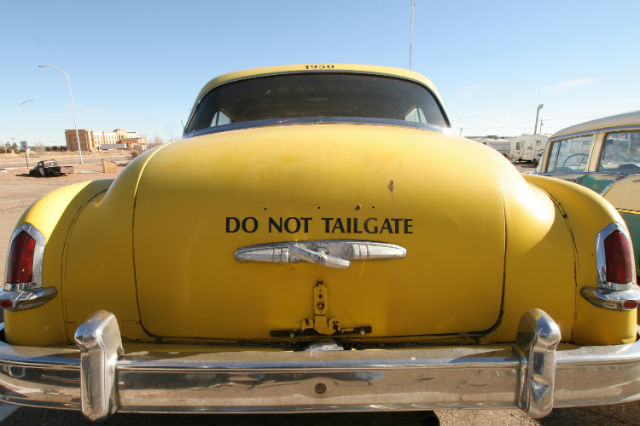
Tailgating is dangerous because it reduces the space between cars to an unsafe distance. If you suddenly hit the brakes, the tailgater may not have enough time to react and slow down before hitting your car.
If you’re being tailgated, be extra cautious when you brake. Don’t slam on the brakes for no reason – and certainly not to be spiteful. Unless it’s an emergency braking situation, brake gently. You want the tailgater to see you slowing down and have enough time to slow down as well.
If you do happen to get into a fender bender or worse, file an insurance claim if needed and remember AAA Roadside Assistance is available 24/7 if you need a tow.
| Scenario | Recommended Action |
|---|---|
| Multi-lane Highway | Signal and move to the right lane immediately. |
| Single-lane Road | Maintain speed; pull into a lot or turnout when safe. |
| Feeling Anxious/Angry | Avoid eye contact and hand gestures; stay focused on the road. |
| Need to Slow Down | Brake gently and early to give the driver time to react. |
If you’re on a multi-lane road and it’s safe to move to another lane, put on your turn signal and get out of the way. This is the easiest way to deal with a tailgater and end the situation. The driver behind you is being unsafe and if you can solve the problem simply by switching lanes, then do so as soon as possible. If there’s not another lane, consider turning into a parking lot.
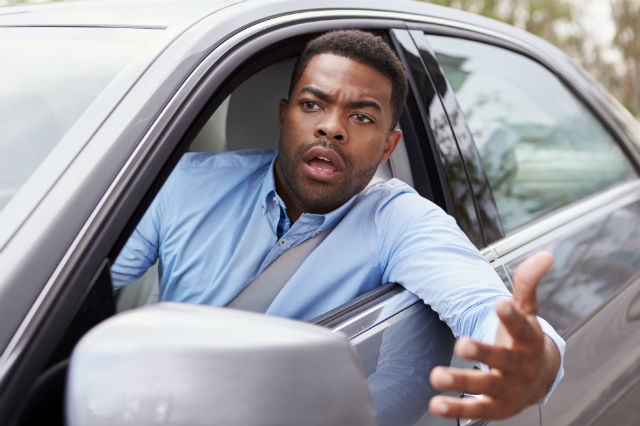
It might be tempting to get angry at the tailgater and not let them pass. Don’t let your emotions get the best of you. Tailgating is a dangerous and aggressive driving tactic.
Aggressive driving, defined by the National Highway Traffic Safety Association as a combination of moving traffic offenses that can endanger other people or property, is often the result of road rage and a major factor in fatal highway collisions each year.
A 2009 study by the AAA Foundation for Traffic Safety based on the NHTSA’s Fatal Accident Reporting System, found that aggressive driving played a role in 56% of fatal crashes from 2003 through 2007. And according to recent NHTSA data, “following improperly” is among the top aggressive driving behaviors associated with fatal crashes.
It’s far easier to change lanes and let a tailgater pass than become one of those statistics.
There’s the chance you’ll be tailgated on a road where there’s no safe way to let the tailgater pass. If you’re doing the speed limit, don’t speed up. No matter how impatient the driver behind you is, do not break the law and go faster than posted speed limits.
Driving at a speed where you’re confident and in control of your car is key. Do not be pressured into driving outside your comfort zone. That’s simply swapping one unsafe situation for another.
You’ve been glaring at the driver in your rearview mirror for 10 minutes when there’s finally room for him to pass. Fine. Let him pass, but don’t give him dirty looks or make rude hand gestures to let him know exactly how you feel about his tailgating as he speeds away. Responding to an aggressive driver with more aggression is not a responsible way of dealing with a tailgater.
Engaging an aggressive driver could escalate the situation into something even worse. The sooner the tailgater drives away, the better.
Aggressive driving tactics like tailgating are nerve-wracking. Keep calm, don’t overreact, and let the tailgater pass when possible so everyone safely arrives at their destinations.
What should I do if someone is tailgating me on a single-lane road?
If you cannot change lanes, maintain your speed and do not feel pressured to speed up. Look for a safe place to pull over, such as a parking lot or a designated turnout, to let the faster driver pass safely.
Is it legal to “brake check” a tailgater?
No. Intentionally slamming on your brakes (brake checking) is considered aggressive driving and can lead to a rear-end collision for which you may be held partially liable. Instead, tap your brakes lightly to flash your lights or gradually reduce your speed.
How does tailgating affect road safety statistics?
According to the AAA Foundation for Traffic Safety, aggressive driving behaviors—including tailgating—play a role in more than half of all fatal traffic accidents. Staying calm and allowing aggressive drivers to pass is the most effective way to stay safe.
Article Fact-Check: This safe driving guide was last updated on April 7, 2026, to reflect the latest safety data from the AAA Foundation for Traffic Safety.
Museums exist for almost every interest. While there’s the usual natural history and art museums, there are also many Northeast museums dedicated to eccentric subjects, from puppets to stamps to sharks.
For curious visitors and unique hobbyists, here are 12 off-the-beaten-path museums in the region. Most on this list can be perused in an hour, making them good pitstop attractions. Plan your visit ahead of time, though, as admission hours of these quirky museums vary widely.
Ballard Institute and Museum of Puppetry
This museum houses some 3,000 puppets from around the world and regularly hosts performances, workshops and forums. Connected with the University of Connecticut’s School of Fine Arts, the Ballard Museum seeks to educate visitors about the history and future of this revered theatrical artform. Admission to the museum is free.
Here you’ll find the largest collection in the world of locks, keys, handcuffs and ornate door hardware, with many pieces of the collection made in Connecticut. Housed in what was once the headquarters for an important lock-making company, the museum also periodically hosts escape room challenges. Admission: $3-$5.
Experience 500 years of printing history, from antique printing presses to word processors. The museum houses many exhibits, including what may be the world’s only collection of phototypesetting equipment. Admission: Free for students and Haverhill Library card holders; $10-$15 for others.
National Streetcar Museum at Lowell
This small museum is a hands-on exhibit dedicated to trolleys and other street cars. The museum is housed within the Lowell National Historical Park’s visitor center, and visitors can hop on the park service’s free trolley service at certain times of the year. If you like this museum, it is part of a larger network of streetcar museums, which includes exhibits throughout New England and New York. Admission: $2-$3, cash/check only if purchased at the museum.
Spellman Museum of Stamps and Postal History
This quirky museum at Regis College is born from the stamp-collecting passion of a globetrotting Catholic cardinal. It contains a large library of national and international stamps, as well as exhibits on the history of stamps and Massachusetts post offices. The gift shop will be an important stop for any stamp collector. Admission: $2-$8; $20 maximum for families.
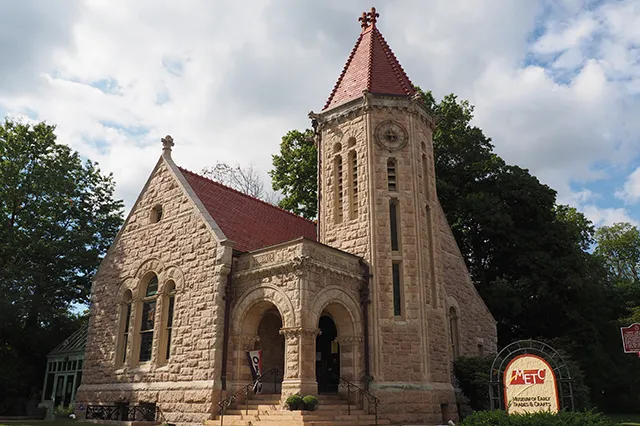
Museum of Early Trades & Crafts
This museum focuses on the work of past generations of New Jerseyans, from farmers to blacksmiths to millworkers. It also hosts many different hands-on learning opportunities for makers of all ages. Admission: $3-$6; $15 maximum for families.
Yogi Berra Museum & Learning Center
While this museum on the Montclair State University campus is dedicated to the great, oft-quotable legacy of one of baseball’s greatest catchers, it also offers many opportunities for hands-on learning opportunities on sports science and thoughtful discussions on baseball’s racially segregated past. Admission: $10-$15; free for members of the military and Montclair students.
Hosted by the American Kennel Club, this museum highlights artwork dedicated to our canine companions. Here you will find watercolors, bronze sculptures, textile art and interactive exhibits, all focused on the foibles and exploits of four-footed best friends. Admission: $5-$15.
H. P. Sears Oil Co., Inc. Service Station Museum
This roadside attraction is dedicated to a time when gas stations were full-service stops. In the mid-20th century, there were several dozen of these distinct red, white and blue art-deco service stations in the Northeast, but this is the only fully restored station left. Visitors can also explore a small showroom of antique gas station paraphernalia when it is open. Admission is free.
This museum is dedicated to the legacy of the Woodstock Music Festival of 1969, which took place on the same property when it was privately owned farmland. Exhibits include a lot of psychedelic artifacts, film clips of the festival and oral histories from those who were there. Bethel Woods also continues to host music festivals, of course. Admission for the museum is $5-$22.69.
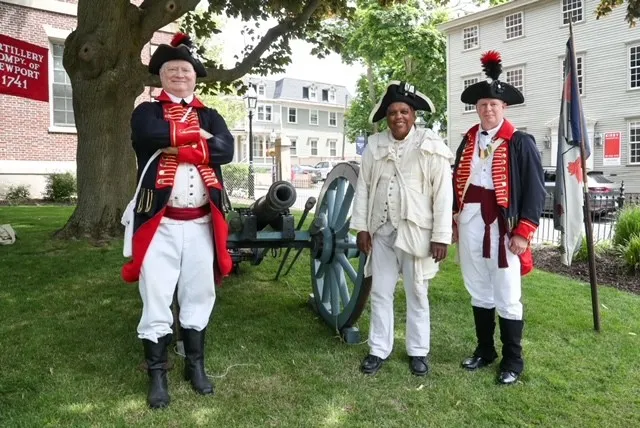
The Artillery Company of Newport Museum
This museum is housed in the headquarters of a now-ceremonial Rhode Island militia that dates back before the American Revolution. Here, you will find an eclectic mix of military artifacts, including a bronze cannon cast by Paul Revere and VIP military uniforms from dignitaries of England, Egypt and Jordan. Admission is free.
Dedicated to advancing shark preservation through education, this small museum stakes its claim as being the first shark museum in the United States. It features artifacts from around the world, including an exhibition on the movie “Jaws” in celebration of its 50th anniversary in 2025. Admission is free.
Save on museums and more with AAA Tickets.
Do you have a favorite quirky museum in the area? Tell us about it in the comments.
Featured photo: Courtesy of Bethel Woods Center for the Arts.

New research from the AAA Foundation for Traffic Safety reveals concerning trends in pedestrian fatalities in the U.S., which have soared by over 80% in the past 15 years. There have been 7,522 fatalities nationally in 2022, after reaching a historic low of 4,109 fatalities in 2009.
Almost the entire increase in pedestrian deaths has occurred on urban arterial roads, after dark. These busy roads are typically built to quickly move a lot of traffic in urban and suburban areas while still allowing access to local streets. This means pedestrians and vehicles often share congested roads that are not always well-lit or have appropriate sidewalks, crosswalks or traffic signals.
Researchers uncovered that a disproportionate number of these pedestrian deaths occurred in socially and economically disadvantaged neighborhoods. Many residents in these areas depend heavily on walking, especially to reach public transportation. Cities and suburbs continue to grapple with several challenges when it comes to implementing the necessary infrastructure upgrades needed to make roads safer in these communities. AAA urges planners, public health professionals, legislators and traffic safety practitioners to work together to reverse these deadly trends.
The study also identified several interconnected factors in these crashes, including a lack of safe crossing locations, high pedestrian crossing volumes and poorly lit roads without continuous sidewalks.
“Reducing the spike in pedestrian deaths requires data-driven investments made where they can have maximum impact,” said Jillian Young, director of public relations for AAA Northeast. “Drivers and pedestrians alike must behave appropriately on the road. But, to truly move the needle on safety, policymakers must invest in road improvements in communities where a disproportionate number of pedestrians are hit and killed.”
AAA recommends a Safe System approach, which considers the need to address both human and infrastructure factors, reducing crash severity through safer roads, vehicles, speeds and road users.
AAA reminds drivers to do their part as well:
Drivers are responsible for yielding to pedestrians, but those traveling on foot should also be vigilant. Pedestrians should use caution by staying on sidewalks and using crosswalks as often as possible. Always obey traffic signals, look both ways before crossing the street and do not walk and text.
“However, I believe it will do no harm to accept your invitation. It may prove an interesting experience.” —William McKinley
With those words the 25th president of the United States became the first to ride in an automobile while in office. It was the late 1800s and McKinley was accepting an invitation from O.F. Stanley, who had invented a “steam-propelled horseless carriage.”
History tells us McKinley did not enjoy his ride, which shouldn’t come as much of a surprise. After all, open-air vehicles driving on rough roads were not overly conducive to a luxurious experience. Fortunately for the commanders in chief to follow, the presidential driving experience has come a long way.
There are few, if any, vehicles that have earned as much reverence and intrigue as the presidential state car, and for good reason. Each one is both innately historic and one-of-a-kind. You do not need to be a historian or car aficionado to appreciate them.
These cars tell stories — about the presidents who rode in them and the country they oversaw.
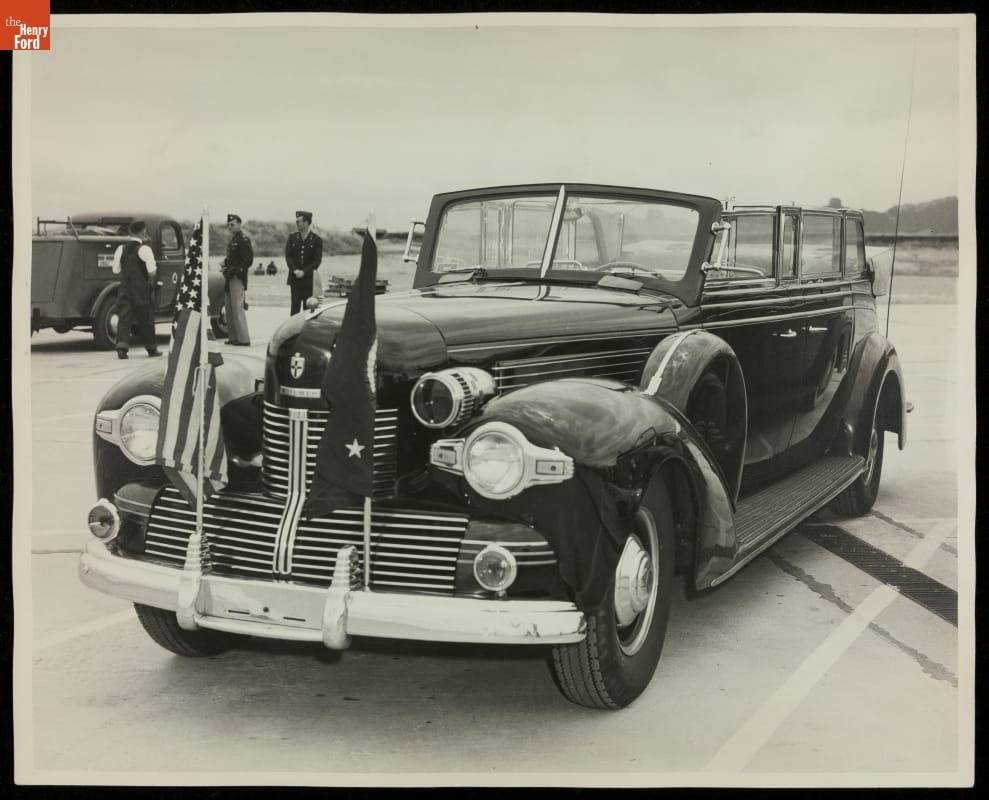
During the early 1900s, U.S. presidents were driven around in standard production cars available to the general public, or at least the segment of the population that could afford such a vehicle back then. It wasn’t until Franklin D. Roosevelt’s presidency that the Secret Service began using specially built official state cars.
FDR’s tenure as president initiated the thought of customizing presidential vehicles for improved security and convenience for two specific reasons. In 1933, Roosevelt survived an assassination attempt as he was giving a speech from the back seat of his open touring car. He also needed a vehicle his wheelchair could get in and out of easily. And so, in 1939, the Lincoln K state car was introduced. Dubbed the “Sunshine Special” due to the fact FDR loved to ride with the roof down, the car came outfitted with a two-way radio as well as handles and extra-wide running boards that Secret Service agents could use to ride outside the vehicle.
After the Japanese attacked Pearl Harbor in 1941, security concerns ramped up even more. As such, the Sunshine Special went back to the factory where armored doors and bullet-resistant tires and gas tank were added. While that was happening, FDR used an armored limo that, according to the Secret Service, originally belonged to Al Capone. The Department of the Treasury had seized the vehicle years prior on a tax evasion charge.
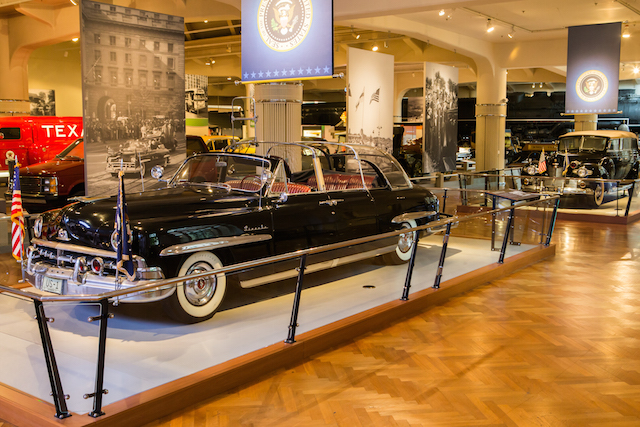
President Harry Truman inherited the Sunshine Special, but by 1950 he was allowed to choose his own car. Rumor has it that Truman held a grudge against General Motors after the manufacturer refused to give him access to their cars during the 1948 presidential campaign. Therefore, Truman stuck with Lincoln and opted for the marque’s Cosmopolitan model.
Truman used the car for the remaining two years of his presidency. However, the vehicle is more closely associated with his successor, Dwight Eisenhower. It was the 34th president that had the car outfitted with its famous bubble-top roof so that spectators could see him when the top was up.
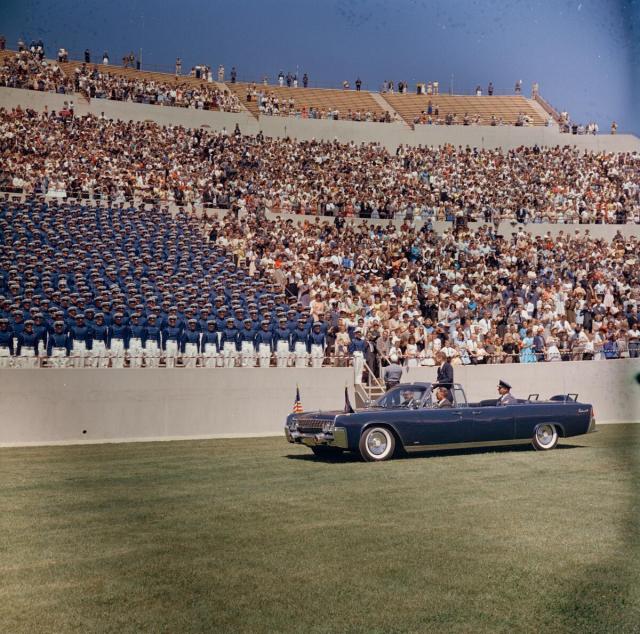
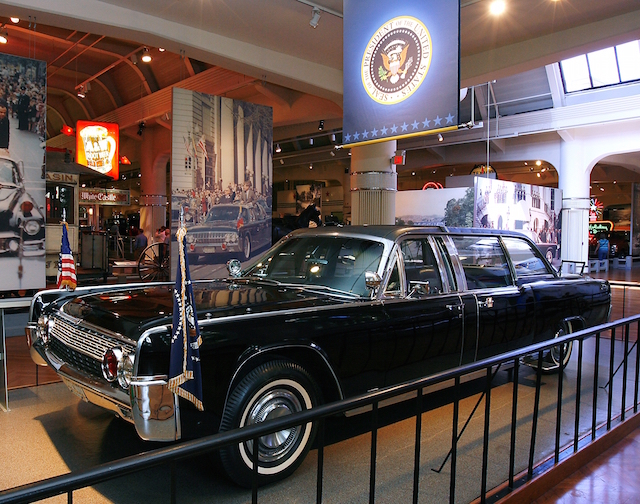
The most famous presidential state car played a role in one of the darkest moments in U.S. history — John F. Kennedy was riding in a 1961 Lincoln Continental when he was assassinated in 1963.
The car’s bold styling, featuring a low-slung body and suicide doors, personified the young, forward-thinking president. It was customized with a phone system and a mechanism that elevated the passenger seat to allow spectators a better view of the president.
But as aesthetically pleasing as the Lincoln was, it did not have any serious protective features. While the vehicle did come equipped with a clear plastic bubble-top, it was not bulletproof.
After President Kennedy’s assassination, it was clear the presidential limo needed a substantial update. The problem was, there was no time no wait for a new car. Lyndon B. Johnson needed a vehicle right away.
Instead, the ’61 Continental was stripped down and built back up stronger and more formidable than ever. Titanium was added to the vehicle’s body, the windows were bullet resistant and a permanent, bulletproof roof was installed. The car remained in use through LBJ’s presidency and into Richard Nixon’s term in office. It now resides in the Henry Ford Museum, along with several other presidential state cars. (Lincoln is a division of Ford Motor Company.)
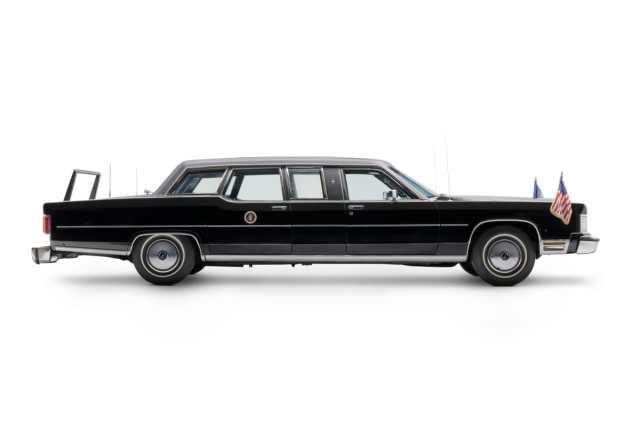
Presidents Nixon, Gerald Ford, Jimmy Carter and Ronald Reagan would all use variations of the Lincoln Continental. The presidential state car didn’t see a model change until Reagan switched to a Cadillac Fleetwood limousine in 1983. (Aside from George H.W. Bush’s Lincoln Town Car, Cadillacs have been used ever since.)
Modifications of the car included a raised roof that made it easier for the president to see the crowds. The new vehicle’s introduction also ushered in new safety protocols. Beginning with the Fleetwood, presidential cars were only used for official state business and, because of security concerns, this would be the last such vehicle to be preserved.
Security measures escalated at a considerable pace in the 1990s. President Bill Clinton’s Fleetwood did not have running boards or a sunroof for safety reasons. It did, however, have telephones, internet access and satellite communications, all of which were considered extremely high-tech to have in a car in 1993.
President George W. Bush’s Cadillac DeVille marked an important milestone in presidential car history: It was the first such vehicle not to be based on a commercial model. Instead, it was built to the specifications of the Secret Service. In fact, by 2001, Cadillac wasn’t even producing cars that could be converted into limousines. It’s speculated that the “DeVille” was actually built on the chassis of one of General Motors’ full-size SUVs. Either way, the car was equipped with an infrared night vision system, 5-inch-thick armored doors and a self-contained passenger compartment with its own secure air supply.
President Obama’s Cadillac lived up to its moniker of “The Beast,” weighing 15,000 pounds. The blast-resistant limo had Kevlar-reinforced tires and 8-inch-thick rear doors as heavy as the main-cabin doors of a Boeing 757. The vehicle also carried tanks of oxygen and bags of type AB negative blood (Obama’s blood type).
Get more automotive history.
Featured image: John F. Kennedy’s presidential limousine. (From the Collections of The Henry Ford)
This article has been updated and republished from a previous version.
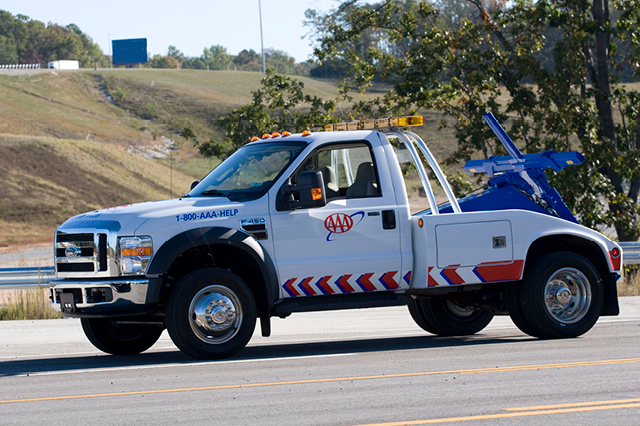
A tow truck is one thing we never think about until we need it. Knowing ahead of time how to find a tow truck can go a long way toward getting you and your car off the road in a safe and timely manner.
AAA provides 24/7 roadside assistance that covers the member rather than a specific vehicle, with service requests available via phone (800-222-8252), the AAA website or the AAA mobile app. Depending on the membership tier, members receive towing to a destination of their choice ranging from 3 miles up to 200 miles per call.
Here are the important things to know when you need to find a tow truck near you.
If you’re driving and your car suddenly fails, slow down and pull over to the shoulder of the road. Make sure you are out of the flow of traffic. When you are in a safe spot, request roadside assistance. Look for street signs or, if you’re on a highway, mile markers or landmarks. This will help the tow truck driver find you.
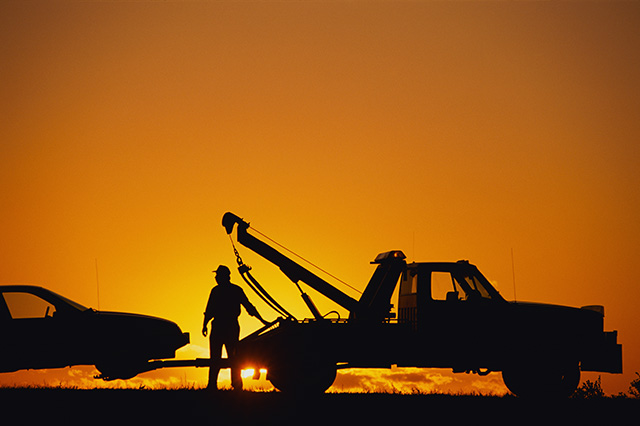
Yes, as part of AAA Roadside Assistance, members have access to 24-hour tow truck service.
You can use the AAA app to find a tow company near you and track the driver as they are on their way. Download the app now.
Those with a basic level membership receive up to 3 miles of towing per call per year included in their membership. Plus members receive 100 miles of towing for each roadside assistance call, while premier members get also 100 miles of towing per call with one tow up to 200 miles.

Wherever you are when when your car breaks down, AAA will come to you. There are two easy ways to request a tow truck. One is by simply calling the number on your AAA membership card. You can also request assistance online. AAA’s digital roadside assistance request system is fast and easy to use.
Tell the service provider the repair shop where you want your vehicle taken. If you don’t have one in mind, ask the operator if there is a nearby AAA Approved Auto Repair facility.
One member is allowed to ride to the repair shop with the tech. AAA can also help to arrange transportation to get you where you’re going safely.
Last updated: April 1, 2026
It seems like the kinks in last year’s Free Application for Federal Student Aid (FAFSA) have been ironed out.
When word got out in 2023 that the U.S. Department of Education planned to overhaul and simplify the FAFSA, parents and colleges anticipated an easier filing experience.
But it didn’t work out that way. The new form was plagued by problems. Usually released by Oct. 1, it was delayed until December 2024 and then final award decisions were late. With no word on financial assistance, students were forced to put off finalizing their choice of schools, and colleges had to push back deadlines for deposits, a stressing situation for schools and families.
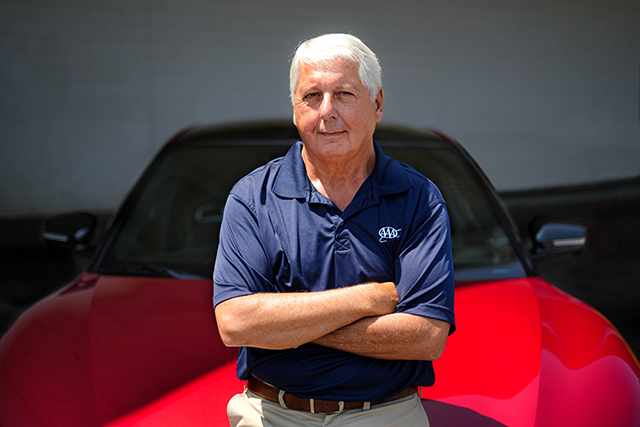
“Families need a good window to compare different offers,” noted Donald Kerr, director of student lending and college services for AAA Northeast.
Fortunately, year two is going better, said Kerr, whose department helps families complete the FAFSA form. While there was a slight delay in releasing the 2025-2026 form, some families were able to access it in November, he said. This means students will get their award letters in time to make informed decisions.

Give them a strong financial start with reliable student loan solutions.
Learn MoreStudents seeking federal grants and loans to pay for college must fill out the FAFSA form annually to determine whether they qualify for financial aid, based on their family’s income. Many colleges also use the form to decide how much aid they award students.
Last year, not only was the FAFSA’s release delayed, but many completed forms had to be reprocessed. The original FAFSA formulas did not account for increases in the cost of living and inflation, which meant that some families qualified for more aid, according to Kerr.
Among the goals of the revamp was to reduce the number of questions and make the form easier to complete, so more families would submit it and more would qualify for aid. Before the revisions, families spent as long as an hour completing the FAFSA; most people can do it now in 20 to 30 minutes, Kerr said. AAA staff can also help members complete the forms. Because the FAFSA form is available online, Kerr said he and his staff have been able to assist more people virtually.
AAA staff members strive to assist members throughout the college process, from applications to graduation, according to Kerr. AAA’s Pivotal College Years portal provides information about colleges, how to apply and careers.
“We help with the financial aid process, finances, and then, when students graduate, we provide advice about repaying student loans,” Kerr added.
The student lending and college services department may be small, but it has more than 50 years of experience in financial aid, Kerr pointed out. They also offer webinars on financial aid topics. “Besides our experience, we keep in touch with members, we prepare ahead of the season and get ready for different changes so we can give members the expertise and guidance they need,” according to Kerr. “If we don’t know something, we make sure members know where to get it. We have more ability to help more people.”
Have you recently filled out the FAFSA form? Tell us about your experience in the comments.