How to Vet a General Contractor

Thanks to TikTok and YouTube, it takes less than 10 minutes for a homeowner to learn how to replace a toilet, install a window or build a secret passageway behind the bookcase in the living room.

If only it were that easy to hire a general contractor.

It takes time to find the right fit for a major home renovation project. But hiring a contractor without thoroughly vetting them first is like giving a complete stranger a wad of $100 bills and hoping they come back with groceries.

You might think it would get awkward as you pepper a prospective builder with questions about his or her work history and safety practices, but there are answers you deserve to know before any money changes hands.

Hesitance or reluctance to answer your questions is also a sign that you might be dealing with an unscrupulous crew. Start with these questions as you embark on your quest to find the right contractor for your home renovation project.

What can you tell me about your company?

While internet reviews of a company can be helpful, they could also be written by employees or rival businesses. Give the company a fair shake by meeting with the owner or project manager. Ask for a few customer testimonials, preferably something recent and another from a few years back. Ask how long the company has been in business and find out if the company is a member of the area chamber of commerce.

Can I see your license?

Ask for proof that the contractor is licensed, bonded and insured. If a contractor is unable to produce these documents, do not hire them. That is not a risk you want to take.

The contractor should have both general liability insurance, for damage to your home, and workers compensation insurance, in case a worker gets hurt on your property. If the contractor does not have insurance, you could be held liable for damage to the house or an injury to a worker. Your homeowners insurance might pay the claim, but that could result in higher rates or make it difficult for you to get insurance in the future.

How much?

Obviously, price plays an important role in the contractor you choose, but don’t let it be the only factor. What you want is someone who can do quality work at a fair price. Seek at least three bids and ask each company to provide an itemized list of expenses so you can see exactly how your money will be spent. Confirm that the list accounts for every aspect of the project, including building permits and trash removal. Homeowners can also use resources like HomeAdvisor’s True Cost Guide to view the average price of what other homeowners have paid for similar projects in your area.

Can you give me a timeline?

Unexpected issues might come up, but an experienced contractor should be able to give you a timeline for the job. Ask for firm start and end dates and make sure they account for change orders and cleanup, too. If you decide to hire the company, verify that the dates are included in a formal legal document. You should also establish how the contractor would contact you — and vice versa — during the workday, after hours and when you need to make a decision.

What permits are required?

In most states, building permits are required for everything from demolishing a wall and changing a window to replacing a roof and installing a fence. A permit is essentially an agreement that the builder will adhere to construction codes. The contractor should offer to pull all the necessary permits for the job, which will save you time and the headache of answering complicated questions from the building inspector. If a contractor gives you a hard time about the permits, consider someone else.

Who will be in my home?

Big projects take time, and during those days or weeks, workers may be inside your home when you are not. If the contractor is not the foreman who will run the project, ask to meet that person and make sure it’s someone you trust in your home when you are not there. Ask what an average work day is like and if they will have other projects going on while working on yours. It is not unreasonable to ask for a set schedule of the hours they plan to work as well as regular progress reports as the project moves along.

Do you stand by your work?

Ask what kind of warranty the contractor provides for his or her work. Insist on a written warranty — rather than a verbal agreement — for parts and labor. An average warranty for labor is a minimum of one year, according to HomeAdvisor. Many contractors will visit your home six months after the project is complete to fix anything that has gone wrong. Some will visit again in a year.

What is your payment schedule?

This will likely depend on the size of your project. For smaller jobs, where the contractor and homeowner have agreed on an hourly charge or fixed fee, it is normal for the payments to be made upon completion. For larger projects, the contractor should provide a detailed payment plan (known as a draw schedule).  The draw schedule lists when payments will be due based on when certain phases of the project have been completed. Be leery of a contractor who asks for a huge advance to begin the project. For large jobs, contractors typically require a down payment of 10%, according to HomeAdvisor. Never pay more than 50%. Never pay with cash, either. A check or credit card is a much better option.

With these questions answered, you should be able to make an informed decision about the contractor you want to make your home renovation project a beautiful reality. Of course, before you sign anything, make sure everything you agreed upon is in writing in the contract.

Have a question about how a home renovation project could affect your insurance? Go to AAA.com/Insurance.

Subscribe to Your AAA Newsletter

Sign up and receive updates for all of the latest articles on automotive, travel, money, lifestyle and so much more!

Unconventional Coffee Drinks in the Northeast

A good cup of coffee is subjective. Some prefer it black, while others chant “extra, extra” like old-time paper boys when placing their orders. The fact is we might not all agree on how to take our coffee, but we certainly have no shortage of options to argue over in the Northeast. From exceptionally fresh coffee roasteries to nitro brew on tap, we have it all – but this one’s for the paper boys.

These coffee drinks go way beyond just cream and sugar. Some even push the boundary of what can still be considered coffee. And that’s just how we like it.

Banana Split Latte

Find it at: The Nook Coffeehouse

East Greenwich, R.I.

Don’t be fooled – this isn’t your average banana-flavored latte. Here, the banana split latte has the advantage of a multidimensional flavor profile thanks to black sesame tahini, which perfectly balances the would-be overpowering and sweet banana syrup. What’s left is a smokey, nutty and almost bananas foster-like taste that keeps you sipping until the last drop.

Beetlejuice Brew

Find it at: Mykonos Cafe & Bakery

Millbury, Mass.

Beetlejuice. Beetlejuice. Beetlejuice. That’s us ordering this drink over and over again. Made with rich mocha syrup, iced coffee and mint cold foam, it’s reminiscent of grasshopper ice cream, but better, because caffeine. Although it’s a limited-time special made for the new movie sequel, Mykonos Cafe has plenty of creative offerings to choose from like the Teddy Graham Cold Brew, Honey-Bee Latte and even Cadbury Cream Cold Brew. Pair your drink with a yummy treat out of the well-stocked dessert case, and you’ve got yourself a perfect morning.

Butterfly Pea Latte

Find it at: Remi43 Flower & Coffee

New York City

This beautifully blue latte is right at home among the floral dreamland that is Remi43, a cafe and flower shop in one. With its subtle earthy flavor, butterfly pea flower is more often used in tea brews but creates a well-rounded profile when used with espresso. Besides its striking color, butterfly pea flower is also known for being anti-inflammatory and rich in antioxidants.

Ice Spice Latte

Find it at: Presto Strange O

Warwick, R.I.

Like the rapper it’s named after, this latte is a fan favorite. It’s got a lot going on: Three base flavors – pumpkin, gingerbread and cookie butter – mixed and generously topped with whipped cream, cinnamon and caramel drizzle. But everything comes together harmoniously under its piled-high dome lid. The creativity doesn’t stop there: Presto Strange O also has themed lattes for each zodiac sign offered during their month, like the Age of Aquarius latte, comprised of pistachio and honey flavors with salted honey cold foam on top.

Find it at: Riposo Coffee Roasters

Rumson, N.J.

A tribute to the almond-flavored Italian dessert, the rainbow cookie latte from Riposo Coffee Roasters has the taste down to a science: Espresso shaken with chocolate and almond syrup blanketed with raspberry almond cold foam and topped with cocoa powder and an actual rainbow cookie. Perfection is hard to achieve, but this might be it.

Spumoni Latte

Find it at: Over Easy Kitchen & Espresso Bar

Marlboro, N.J.

Coffee and ice cream were just made for each other. Our evidence? Affogatos, actual coffee ice cream, and this spumoni latte. Offered seasonally, this latte is created with a blend of pistachio, strawberry and mocha flavored syrups and includes two shots of espresso and green and pink cold foam on top. For the fall, they’re whipping up a Pumpkin Pie Chai made with pumpkin syrup and chai tea topped with pumpkin spice cold foam and turbinado sugar.

Taro Latte

Find it at: RaonJena Coffee & Dessert

Glastonbury, Conn.

Taro, a root vegetable native to Southeast Asia, takes center stage in this latte from RaonJena Coffee & Dessert. Although seemingly unorthodox to pair coffee with something that closely resembles a potato, taro has a unique flavor that is often described as nutty and even vanilla-like. Naturally purple-hued, taro also makes the latte an eye-catching shade of lavender. Available hot or iced.

Which extra coffee drinks did we miss? Let us know in the comments!

Subscribe to Your AAA Newsletter

Sign up and receive updates for all of the latest articles on automotive, travel, money, lifestyle and so much more!

Cruising Solo? You’re Not Alone! 

It used to be one was the loneliest number at sea – and you paid a price for it! But today, solo cruising has never been more welcoming or affordable.

The solo cruising trend started making waves years ago, but post-pandemic it turned into a tsunami. Modern sensibilities coupled with an urge to see the world without delay, even if that means going it alone, have altered the horizon for travelers who rightly view cruising as an easy way to strike out on a solo trip. Embracing the trend, cruise lines have responded with new-builds and retrofitted ships to accommodate solo passengers.

Book a cruise with AAA Travel.

Listen to Our Podcast

Get tips for a smart, safe and fulfilling solo trip. Listen to Episode 13 of our podcast, Merging Into Life: Traveling Solo.

Tune In

Solo Cruising

Bear in mind, a solo cruise isn’t the same as a singles cruise. Those embarking all by their lonesome aren’t necessarily looking for love. In fact, many are married, so it’s a misconception to even assume solo cruisers are single. The trend also spans different age groups.

However, aside from wanderlust, you can count on one common denominator among travelers: Nobody likes the dreaded “single supplement” – cruise lingo for the surcharge an individual incurs when occupying ship cabins traditionally built for two paying passengers. This fee can be as much as 100% of the per-person fare, which basically amounts to solo cruisers footing the bill for phantom cabinmates. For some, it’s a gangway bridge too far.

solo cruising lounge
Solo Lounge on Norwegian Epic.

Norwegian Solo Cruises Set the Bar

Norwegian Cruise Line deserves kudos for recognizing the solo trend early and doubling down on it. All the line’s latest ships feature a complex of studio cabins purpose-built for solo cruisers, alleviating the need for single supplements. Equally noteworthy, the cabins are clustered around an exclusive, key-entry Studio Lounge that provides a social gathering place for solo cruisers and perks such as complimentary snacks, cocktail hours and a host to help organize activities.

Let's Plan Something Wonderful

Book your next trip with AAA Travel now or call 866-423-5585 to speak with a travel advisor.

Book Now

For solo cruisers concerned about feeling left out or lonely, the setup delivers a surefire safety net. Plus, the studios’ chic design (think mood lighting, integrated furnishings and smart storage) adds a certain cachet. These are thoughtful spaces, not throwaway areas with individual cabins squeezed in. Still, all studios are inside accommodations (some with corridor windows or virtual portholes that reveal exterior views via LED screens). And, they always sell out fast.

The popularity of its studios prompted Norwegian to up the ante this year with the introduction of solo staterooms, including ocean view and balcony categories, across its entire fleet. When announcing the new options, in addition to its own data, the cruise line cited mind-blowing stats, including a Radical Storage study reporting a 267% increase in online searches for “solo travel” between 2020 and 2022.

solo cruising - celebrity
Infinite veranda on Celebrity Beyond.

More Cruise Lines With Solo Cabins 

Norwegian isn’t the only line rolling out the welcome mat. Cunard used a multimillion-dollar refurbishment to add solo staterooms. Most adorn its flagship, Queen Mary 2, which sails regularly from a local homeport in New York.

Holland America prides itself on a hospitable record concerning solo cruisers, pointing to inclusive activities (even soirees with professional dance partners) and now purpose-built solo cabins on the newest pinnacle-class ships.

Celebrity boasts a perfect upward graph for increasing solo spaces, some sporting the line’s innovative “infinite veranda” (a retractable wall-to-wall window that transforms the entire living area into a veranda).

Elevating the luxe quotient, Oceania’s latest ships feature perk-laden, concierge-level solo veranda staterooms. Oceania also added solo staterooms to four older ships.

Even family-focused Royal Caribbean touts solo cabins. Some connect to standard staterooms, producing a perfect granny-suite. Princess jumped on the trend, too. Sun Princess, which launched this year, is the first in its fleet designed with solo cabins.

Riverboats rarely contain solo cabins, but American Queen Voyages does offer a few. On the other hand, riverboats, expedition vessels and luxury lines tend to be the best bet for reduced or even waived single supplement deals. Usually, these smaller ships also provide included shore excursions, always a great way for solo cruisers to safely explore destinations with others and bond over the shared experiences.

solo cruise - spa
The spa on the Norwegian Bliss.

The Perks of Going on a Cruise Alone

The crux of cruising’s appeal to solo travelers is that it delivers the best of both worlds. You can travel independently, but amid the security of a larger group. The cruise line handles logistics, so the ship becomes a familiar touchstone while discovering unfamiliar destinations. Once you pick an itinerary. They facilitate the big stuff, and you fine-tune the experience.

Since you’re traveling solo, that means consulting a party of exactly one … you! No negotiating different schedules and opinions when deciding what to do. Enjoy guilt-free freedom to pursue personal interests, try new things on a whim or just do nothing at all. The independence can be self-enlightening.

Onboard, dip in and out of activities. Looking for sublime me-time? Enrichment lectures, spa treatments and endless sea-gazing await. Want more interaction or maybe a thrill? Join classes on anything from mixology and music to yoga and scuba diving. Or, on the biggest boats, try skydiving, go-kart racing, ziplining and more. Along the way you’ll meet like-minded passengers if you’re interested in socializing.

Cruising even makes dining – a stressor for some solos – easy. While you can opt to eat alone, both traditional dining (at an assigned table with the same people at the same time every night) and anytime dining (at whenever, wherever, with whomever) allow you to sit with others. Simply ask to join a large table. Plus, some specialty restaurants promise a communal vibe. You’ll find chef’s tables, teppanyaki and meal experiences that unfold like shows. For example, Celebrity’s Le Petit Chef utilizes 3D table animation to take diners on a culinary romp. Many lines facilitate group tables for solo cruisers, too.

Usually there are solo meetups and some solo-specific programming, such as a group pub crawl. Technology has eased the way for solo cruisers as well, with online forums to connect passengers prior to departing.

A solo cruise can be deliciously self-indulgent and so rewarding. You’ll feel empowered, having conquered a bit of the world on your own. If you’re unsure at first, don’t fret. Cruises are friendly. You’re on a one-of-a-kind experience, but you’re all in the same boat.

Did you know your AAA membership grants you access to your own travel team? Plan your cruise with the help of a trusted AAA travel advisor. Call 866-423-5585 to start planning today!

Subscribe to Your AAA Newsletter

Sign up and receive updates for all of the latest articles on automotive, travel, money, lifestyle and so much more!

Basic Car Maintenance 101

Proper car care can improve your vehicle’s performance, keep you safe on the road and save you significant amounts of money.

We’ve rounded up our top car maintenance tips to help you get started.

Washing and Waxing

Keeping your car’s exterior in good condition isn’t just aesthetically pleasing. Regular washing can help maintain the vehicle and keep its value, thus saving you money now and earning you more money later should you try to resell it. Once your car is clean, you’ll want to keep it that way. Waxing forms a protective coat over the paint, which will help repel road grime, bird droppings and tree sap. 

Here are a few tips to properly wash and wax your car:

  • Move your car out of direct sunlight and make sure it is not hot to the touch.
  • Get the vehicle good and wet to wash off any accumulated dirt, grime and other debris.
  • Use a dedicated car wash soap, not hand or dish soap that can strip off the car’s protective wax.
  • Use the two-bucket method. One bucket will have the clean, soapy water, and the other is where you’ll drop the dirty water.
  • Dry your car with a microfiber cloth. Once dry, spread a small amount of wax onto your cloth or pad. Then apply it to the car using a circular motion and steady pressure. Work the wax into the paint until it’s completely absorbed.
  • To buff, use a clean towel or microfiber cloth, gently buff the paint until you get the shine you’re looking for. This step ensures that the wax fully bonds with the paint.
  • And though you’re focusing on the exterior, don’t forget to get around to cleaning the car’s interior as well.

Listen to Our Podcast

Learn the signs to spot car trouble early, avoid breakdowns and manage repairs with confidence. Listen to Season 2, Episode 7 of our podcast, Merging Into Life: Your Essential Car Maintenance Checklist

Tune In

Headlights

Unless the bulb burns out, headlights are probably the last thing you think about when it comes to car maintenance. But headlights can begin to deteriorate after as little as three years. AAA research found that deteriorated headlights produce only 22% of the light output (low beam) that new, original headlights provide.

AAA recommends routinely checking headlights for discoloration, such as a yellowed or cloudy appearance. If it’s difficult to see the bulb through the lens, have the headlights replaced or restored as soon as possible.

Battery Maintenance

Most of the roadside assistance calls AAA Northeast receives are for battery issues. But many of these issues can be avoided with proper car maintenance. These tips can help to keep your car battery in top shape and ensure you don’t get stuck in your tracks.

  • Drive your car for at least 30 minutes once per week to maintain a full state of charge. Shorter drives can discharge the vehicle battery over time.
  • Battery terminals require regular removal and cleaning in many environments. Periodically disconnecting the car battery to clean its terminals with water, baking soda and a specialized terminal cleaning brush can help extend its life.
  • If you accidentally drain the battery and need a jump-start, your battery needs to be recharged properly on a battery charger, likely for several hours or more. Years ago, we may have let a car run for an hour or so to recharge the battery, but this will not properly recharge batteries in today’s cars, and you will likely find yourself stuck again with a no-start after turning the car off.  There is no set amount of time that can be relied upon to recharge a battery by running its engine. Trust AAA Car Battery Service to test your battery and charging system, or anytime you need a jump.
  • All car batteries will eventually die. The average battery life in the Northeast is between three to five years. As they age, batteries should be checked yearly, ideally before cold temperatures hit.

Oil and Fuel

Your car needs several different fluids to run. Two of the most prominent are fuel and oil.

You may not give much thought to the gas you put in your car, but there are numerous types of fuel available. Choosing the right one can improve your vehicle performance and potentially help the environment. Opting for the wrong one can seriously damage your car.

In the past, it was recommended to change your car’s oil every 3,000 miles; however, today’s engines are built to go 5,000 miles or more between oil changes. To get the proper schedule for your car, refer to the manufacturer’s recommendation in the vehicle owner’s manual.

Regardless of how often you need to change your oil, you should still check the vehicle’s oil levels every month. Fortunately, checking your oil is one of the more basic car maintenance tasks.

Here’s how you do it:

  • Make sure the engine is cold or has been turned off for at least 10 minutes.
  • Locate the dipstick, which will have a hook or ring on it, and pull it out. Wipe off any oil with a clean, lint-free rag so you can see the markings.
  • Put the dipstick back in place and pull right back out again and look at the markings.
  • If the oil reaches the high line where it says full, then you’re all set. If it’s down at the bottom line, then you’re running low and need to add oil. Add oil until the level is up to the full or safe mark without overfilling.

Tires

Tires are the only parts of the car that touch the road, so their importance cannot be overstated. A tire that is worn down or not properly inflated could have disastrous effects on the roadways. Additionally, proper tires – in good condition – improve your car’s fuel efficiency, which will save you money.

A few things to consider when checking your tires:

  • Take a good look at each tire to see if there are any visible signs of damage. These include tears, bulges, bumps or wayward nails stuck into the tread.
  • Check tire pressure and use the manufacturer’s recommended tire pressure as your guideline.
  • Keep a close eye on tire pressure when the outside temperature shifts. As a rule of thumb, when the temperature drops 10 degrees your car’s tires can lose between one-half and one pound of air pressure. Add or reduce the air in your tires to stay at the manufacturer’s recommendation.
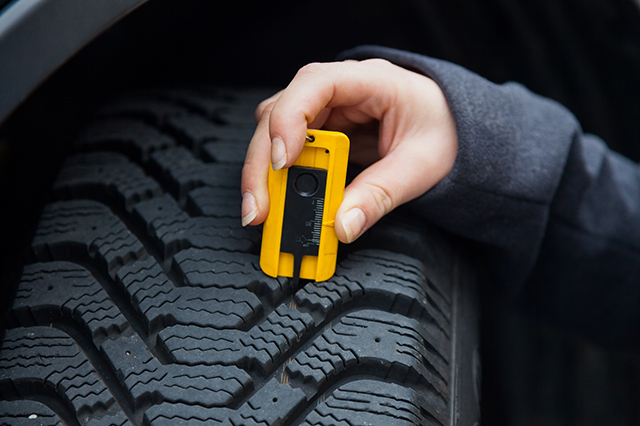
  • Check tire tread by using a quarter. If the tread does not touch the top of Washington’s head, then you have less than 4/32 inch of tread and your tire should be replaced.

Have an electric car? Get tips on how to keep it in top shape on AAA’s EV Platform.

If you have any other basic car maintenance questions, ask our Car Doctor John Paul. Or you can always head to a AAA Approved Auto Repair facility and leave your car needs to the pros.

AAA members can save on automotive replacement parts and accessories at NAPA.

Subscribe to Your AAA Newsletter

Sign up and receive updates for all of the latest articles on automotive, travel, money, lifestyle and so much more!

Crossword: Fall Desserts

Subscribe to Your AAA Newsletter

Sign up and receive updates for all of the latest articles on automotive, travel, money, lifestyle and so much more!

The Best Children’s Museums in the Northeast

The first children’s museum opened its doors in Brooklyn in 1899. Since then, children’s museums have steadily grown in sophistication. These museums help children engage in learning through play. They also offer ongoing classes and provide venues for family entertainment, making them important community centers.

We’ve rounded up 12 of the best children’s museums in the northeast, each with its own unique vibe and offerings. While we list admission price ranges, please note that these museums have membership programs which may prove more affordable than single tickets for repeat visits. Most of these museums also provide free or reduced-cost day passes through their local libraries. These passes often are booked well in advance, though, so plan ahead.

Need a ride? Rent a car.

best children's museums in the northeast

Children’s Museums in Connecticut

EverWonder

Newtown

Admission: $3-$10

This museum focuses on (science, technology, engineering, and mathematics (STEM) learning through play. The hands-on displays on wind, water, gravity and motion might appeal most to children 5 and under. Unlike many other children’s museums, the layout of EverWonder is divided into smaller rooms, which may be especially appealing to those prone to sensory overload.

Sacred Heart University’s Discovery Science Center and Planetarium

Bridgeport

Admission: $15-$18

This newly renovated and expanded museum offers a cutting-edge STEM play experience, with permanent exhibits dedicated to the exploration of space science and physics, as well as an awe-inspiring planetarium. For children not obsessed with outer space, there are more generalized play areas, including a hospital for teddy bears.

Stepping Stones Museum for Children

Norwalk

Admission: $16-$20

This hands-on science and natural history museum features exhibits geared toward older children who like to learn through play. Highlights include a multimedia television production experience that puts kids in front of and behind the camera, a paleontology dig site for dinosaurs and a lab to explore the energy-generating capacity of moving water.

best children's museums in the northeast
Photo credit: Lex Piccione. Courtesy of Boston Children’s Museum.

Children’s Museums in Massachusetts

Boston Children’s Museum

Boston

Admission: $22

The Boston Children’s Museum offers something for kids of all ages. Highlights of the three-floor landmark include a large room dedicated to water play, an enclosed climbing maze and animatronic dinosaur displays. In good weather, check out the nearby playgrounds by the Charles River.

EcoTarium

Worcester

Admission: $14-$19

Visiting EcoTarium is like being at several museums at once. The large children’s museum includes hands-on displays to learn about natural history and science, enclosures to observe otters, owls and a mountain lion and a preschool room – a “mini-Worcester” where little ones crawl, climb and play. In good weather, the museum also offers a large outdoor play area and an open-air train ride to survey the extensive grounds.

Wenham Museum

Wenham

Admission: $8-$10

This cozy play-based museum offers many opportunities for open-ended, tactile play and to learn about New England history. Highlights include a panoramic model-train landscape, as well as a preserved 17th century living room. This hands-on museum is best suited for energetic toddlers and young children.

Children’s Museums in New Jersey

Imagine That

Florham Park

Admission: $7-$22

This children’s museum provides plenty of opportunities for freeform, imaginative play. Highlights include a supermarket display, a climbable pirate ship and a full-size cab of a fire truck within a kid-sized firehouse. Little ones will find plenty of possibilities for play here.

Liberty Science Center

Jersey City

Admission: $26-$31

“Epic” may best describe this 300,000-square foot museum, which houses the Western Hemisphere’s biggest planetarium and a skeletal display of a blue whale. Other highlights include an 80-foot touch tunnel to navigate in pitch darkness, and a vast, suspended climbing place space. Liberty Science Center has exhibits catered to kids of all ages, from toddlers to teens.

Children’s Museums in New York

The Long Island Children’s Museum

Garden City

Admission: $16-$18

This intimate children’s museum is dedicated to play for younger children, with revolving and permanent exhibitions, live theater and art spaces. The museum’s exhibits are colorful and well-designed to invite sensory exploration, and there are opportunities for outdoor fun in good weather.

Mid-Hudson Discovery Museum

Poughkeepsie

Admission: $14.50

Located in a bright-yellow building overlooking the Hudson River, this cheery museum is structured to encourage open-ended exploration through play. The hands-on displays are designed to capture the imagination and spark the creativity of small children, although older children may begrudgingly have fun, too.

Westchester Children’s Museum

Rye

Admission: $12-$18

A perfect rainy-day activity located just steps from the beach, this museum provides opportunities to play and learn for younger children. Highlights include the 48-foot-long Pixel Wall, with pegs for making a constantly changing mural of colorful artwork and a larger-than-life Erector-like set, for older children who are into building and design.

Children’s Museum in Rhode Island

Providence Children’s Museum

Providence

Admission: $16

This smaller museum is perfect for entertaining little ones for a morning or afternoon, with indoor and outdoor play structures and opportunities for hands-on learning. Highlights include a water play room and a room for creating magnetic mazes and shaping tubed structures that utilize wind power.

Save on museums and more with AAA Tickets.

Featured image: Courtesy of Stepping Stones Museum for Children

Subscribe to Your AAA Newsletter

Sign up and receive updates for all of the latest articles on automotive, travel, money, lifestyle and so much more!

Merging Into Life: Budgeting 101

SEASON 1: EPISODE 10
Episode Feedback

How to create and stick to a budget that works.

listen on apple podcast badge button
listen on spotify badge
listen on amazon music badge
listen on pocket casts badge button

IN THIS EPISODE

Getting the garbage out on time for pickup, staying on top of the dishes, exercising regularly … these are all small but mighty everyday accomplishments. However, few small tasks are as satisfying or as impactful as creating a budget that actually works.

So, what is the easiest way to start a budget?

In this episode, Ashley Bove, workplace financial consultant with Fidelity Investments, shares simple and straightforward budgeting 101 pointers for beginners. Listen for tips on how to allocate for living expenses, save, build an emergency fund, repay debt and stop living paycheck to paycheck, while still having money leftover each month for yourself.


KEY TAKEAWAYS

[1:47] – Ashley Bove’s key to budgeting: the 50/15/5 rule
[10:32] – How to start the budgeting process
[11:44] – How to balance paying off debt while saving up


WATCH ON YOUTUBE


TRANSCRIPT

[00:00:00]
Amanda Greene: Hey, what should we have for dinner tonight?

[00:00:05]
Amanda’s Daughter: Hibachi.

[00:00:06]
Amanda Greene: Oh, that does sound really good. But I meant, what should we make for dinner tonight? We should probably eat at home.

[00:00:12]
Amanda’s Daughter: But it’s so good. And then you won’t have to cook.

[00:00:15]
Amanda Greene: Oh, that’s true. And today has been a really long day. Wait. No, we just went grocery shopping. We need to cook dinner at home tonight. Should we do tacos or pasta?


RESOURCES

AAA Financial Products

Fidelity Investments

Financial Planning in Your 20s and 30s

10 Money Saving Habits to Start Right Now

Smart Personal Savings and Budgeting Apps

Building Your Budgeting Toolbox

Start These Savings Challenges


Want to Learn More? Drop Us a Note

"*" indicates required fields

This field is for validation purposes and should be left unchanged.
Subject
Name*

*The views and opinions expressed in this podcast are not necessarily the views of AAA Northeast, AAA and/or its affiliates.

Subscribe to Your AAA Newsletter

Sign up and receive updates for all of the latest articles on automotive, travel, money, lifestyle and so much more!

Plan Your Fall Getaway to the Adirondacks

Autumn in New York’s Hamilton County is special. The winding roads, foliage-covered mountainsides and lively small towns with cozy lodgings offer a fall full of big experiences and endlessly vibrant scenery.

Take a road trip to see the region’s brilliant autumn colors, discover miles of hiking trails and savor seasonal flavors. For breathtaking views from above, you can climb one of the area’s seven historic fire towers.

Leaves and So Much More

Visitors often come to Hamilton Country to ogle the foliage and then discover so much more.

To fully immerse yourself in the natural beauty all around, consider camping. From state-owned parks to the backwoods, there are lots of choices, whether you are pitching a tent or parking an RV. Lake Eaton in Long Lake, for example, provides showers, bathhouses, canoe and boat rentals and easy lake access, as does state park Lake Durant Campground, also with showers and toilets as well as close proximity to the Northville-Placid Trail and smaller trails nearby.

The Adirondack Experience fall foliage report is updated regularly throughout the season, so don’t forget to check before you visit!

Fall in Hamilton County Awaits

Foliage, camping, arts and culture – experience fall with small towns and big outdoors!

Visit Today

Paddling and Small-Town Life

With warm days and cool nights, swimming season may be over, but the weather still is perfect for viewing the scenery from a glimmering lake. Canoes, kayaks and other boats are available for rent or purchase at many of the lakeside marinas.

Take time to hike through the woods to discover waterfalls. For a challenge, try hiking up Blue Mountain. You might also want to take part in the Fire Tower Challenge and earn a badge for climbing all seven of Hamilton County’s fire towers. Originally used as lookouts for forest fires, the towers offer unparalleled views of the landscape.

Spend time exploring the small towns in the area, many of them perched along lakes, and enjoy their parks, shops and restaurants. Stroll through downtowns and check out locally owned stores. Blue Mountain Lake is home to Adirondack Experience, a museum filled with stories and exhibits about life in the Adirondacks in 20 historical and contemporary buildings spread over 121 acres.

Inlet offers a charming downtown, public beach and draws waves of snowmobilers in the winter. The town of Raquette Lake, is located on its namesake, the largest natural lake in the Adirondacks.

hamilton county


The Great Camps

Raquette Lake is home to Great Camp Sagamore, the former wilderness refuge of the Vanderbilt family from 1901-1954. Many of America’s wealthiest families built rustic estates, complete with the comforts of their urban mansions, in the Adirondacks to escape the heat of city summers. Great Camp Sagamore is open for tours and overnight stays.

Not far away is Great Camp Santanoni in the town of Newcomb, which opened in 1893. Home to Albany banker Robert Pruyn and his family, the camp is located on the Santanoni Preserve, which comprises almost 13,000 acres of the state’s Adirondack Forest Preserve and boasts 5,000-plus square feet of porches facing Newcomb Lake. Unlike the other Great Camps, Santanoni was a working farm for years.

Festivals, Exhibitions and More

Fall also is a time for festivals and exhibitions, live music and enjoying nature’s bounty. Farmers markets are scheduled throughout the season.

Mark your calendars for the ADK Lakes Theatre Festival, which runs through September 29 and dust off your antlers for the Great Adirondack Moose Festival September 27-29, where you can participate in a moose-calling contest and celebrate the return of the mighty moose to the Adirondacks.

Book a Columbus Day cruise on Raquette Lake Oct. 14 aboard the W.W. Durant, a steamboat-style ship. Later in the season, you can get into the holiday spirit at the Annual Country Christmas Tour, Nov. 22-23, featuring hand-crafted items from the Adirondacks.

Don’t wait until the leaves fall, book your Hamilton County vacation today.

This image has an empty alt attribute; its file name is ilny.png

®I LOVE NEW YORK is a registered trademark and service mark of the New York State Department of Economic Development; used with permission.


Subscribe to Your AAA Newsletter

Sign up and receive updates for all of the latest articles on automotive, travel, money, lifestyle and so much more!

How to Deal With Trees in a Storm

If you’ve ever watched trees in a storm, you know that it can be scary.

A sunny day can turn into a violent and windy thunderstorm in a matter of minutes. Menacing black clouds creep in quickly, bringing strong winds that push the trees around, swaying them back and forth and carrying away leaves and small branches with ease. Hurricanes, though more predictable, can come on just as fast and with even more force.

Trees are used as a gauge for defining how powerful a storm is, not only to the average person, but in meteorological storm categories and wind measurement. The intensity of a storm can be determined by observing the wind in the trees, how it moves the branches and if it is strong enough to uproot even the grandest of oaks.

It’s a helpless feeling when uncontrollable forces of nature are at work and all you can do is cross your fingers that a heavy branch or tree won’t fall on your home or car. Of course, if you ever do experience tree storm damage, your insurance can help.

Prevention

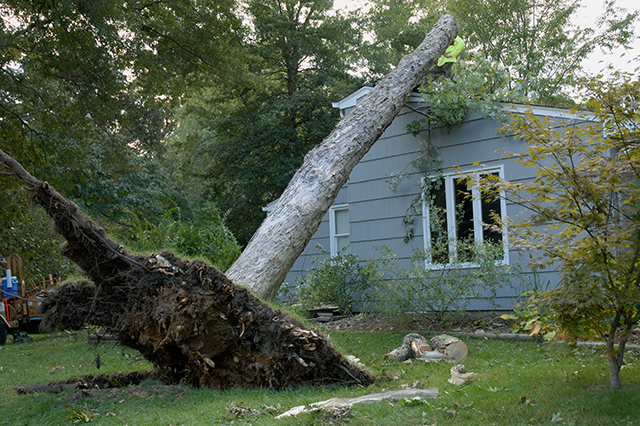
Structural damage caused by branches and trees falling in a storm is one of the most common homeowners insurance claims during hurricane season, as well as in the winter due to blizzards and heavy snow.

As a homeowner, it is your responsibility to perform regular maintenance to your home and property to avoid potentially dangerous situations. This includes pruning and trimming tree branches that are weak or hanging over your house and removing dead or dying trees. Hire a professional to take care of the big jobs ahead of hurricane season as part of your seasonal home maintenance in the spring.

Insurance Coverage for Tree Storm Damage

First and foremost, if a tree falls on your home, evacuate immediately, make sure everyone is safe and call 911. If you can do so safely, cover up any openings caused by the fallen tree with a tarp or something similar.

“If a tree hits your home or other insured structure, such as a detached garage, your standard homeowners insurance policy covers the damage to the structure, as well as any damage to the contents,” according to the Insurance Information Institute.

Keep in mind that poor maintenance is taken into consideration when reviewing claims. If your insurance company determines that storm damage could have been avoided by proper upkeep, such as failure to remove a dead tree, it may not be covered.

Living Arrangements

In some cases, the destruction may be so bad that your home could be deemed unsafe to live in and you may need to make other living arrangements. “Your home insurance may also help you cover additional living expenses if you need to reside elsewhere while repairs are being made,” said Jodi DeSantis, vice president of insurance for AAA Northeast.

trees in a storm

Car Coverage   

If a tree falls and causes damage to your vehicle, it will be covered if you carry comprehensive – sometimes called “other-than-collision” coverage, on your policy. Policy deductibles (the out-of-pocket limit that you are responsible for paying) will apply.

Power Loss

Imagine stocking up on bread, eggs and milk before a storm, just for it all to go to waste because of a power outage. Falling trees and branches often cause prolonged power losses, but many people don’t realize that they may be able to get reimbursed for the cost of lost groceries.

Check with your insurance agent to see if you have food spoilage coverage on your homeowners policy. If not, it is relatively inexpensive to add. “It is well worth the dollars. And most insurance carriers will waive your deductible when this coverage is utilized,” said DeSantis.

If you do experience a power outage, maintain the temperature of your refrigerator or freezer by keeping the door closed as much as possible. Once power is restored, check all your refrigerated foods for freshness; if there is any doubt, throw it out!

Get more tips on how to handle a power outage.

Neighbors’ Trees

What if a neighbor’s tree falls and damages your property? Because a healthy fallen tree is considered an act of God, the person who sustains the damage is the one who will file the insurance claim and be covered by their insurance. However, your neighbor may be held liable if the tree was knowingly in poor condition or deteriorating. Just another reason why it’s important to stay on top of tree maintenance.

Storm Damage Tree Removal

If a tree falls on your property and causes structural damage, repairs as well as tree removal may be covered by your insurance. If the fallen tree does not hit a structure, there may not be coverage for debris removal, except in certain situations like if the tree is blocking a driveway or handicapped ramp.

Have you ever experienced storm damage from trees? Tell us about in the comments.

Discuss homeowners insurance with a AAA Insurance agent today.

This article has been updated and republished from a previous version.

Subscribe to Your AAA Newsletter

Sign up and receive updates for all of the latest articles on automotive, travel, money, lifestyle and so much more!

Learn Your Way Around Different Types of EVs

People tend to lump all electric vehicles into one pile, but consumers may not realize different types of EVs have varying degrees of electrical dependence, including models that could appeal to those who are reluctant to go all-electric.

Despite efforts by state and federal governments to promote electric vehicle sales, many buyers remain hesitant to transition from traditional gas cars. According to AAA’s latest EV survey of drivers in the Northeast, range and charging infrastructure remain primary concerns.

AAA research has found that consumer interest in EVs lacks enthusiasm nationwide, however, 1 in 3 drivers would consider purchasing a hybrid.

Understanding EVs

Part of what keeps drivers from committing to an EV is simply not knowing their options, even when it comes to the basics. For example, it’s common for people to miscalculate how an EV will fit in with their personal driving habits.

“Most people drive fewer than 100 miles a day and almost every EV on the market today can cover their daily needs without stopping to charge,” said March Schieldrop, senior public affairs spokesperson for AAA Northeast. “When someone buys an EV, one of the big realizations is that they almost never rely on public charging and nearly all their charging occurs overnight at home.”

Range anxiety, or the fear of running out of battery charge, might be more of a concern for long trips, but even then, planning ahead can help.

Many are also unaware of the different types of EVs and how they operate. What is the difference between a battery electric vehicle and a hybrid? Or a hybrid versus a plug-in hybrid? And what do charging terms like Level 1, Level 2, Level 3 and supercharging mean?

Electric cars require a bit of homework, so we’ve compiled this explainer to help. You may still be on the fence now, but an EV could be in your future.

President Joe Biden signed an executive order in December 2021 for the U.S. government to end the purchases of gas-powered vehicles by 2035, but “mass adoption will take time,” said Schieldrop. “The average car on American roads is now more than 12 1/2 years old. Even if gas-powered cars are no longer sold in this country in 10 years, it will take decades for every car on the road to be an EV.”

Power/Current

Lithium-Ion Battery

The type of battery used in most EVs due to its high energy density and ability to be continually recharged.

Alternating Current (AC)

An electric current that continually changes direction. It is the standard electrical current in homes.

Direct Current (DC)

An electrical current that flows in one direction. It is the type of current that comes from a battery. When being charged by AC, EVs convert the power to DC to replenish their batteries.

Regenerative Braking

A system found in most EVs that captures the energy created by braking and transfers it to the car’s battery. 

Different Types of EVs

Hybrid Electric Vehicle (HEV)

A type of car that uses both an internal combustion engine and an electric motor for improved fuel economy. Hybrids do not require an external charging source to charge. The gas engine generates enough electricity to charge the battery while driving and also gets a boost from regenerative braking.

Plug-In Hybrid Electric Vehicle (PHEV)

A hybrid that can also be charged externally. Plug-in hybrids get some of their charge from regenerative braking, but as the name suggests, can also be plugged into a power source. They can travel as far as 40 miles on electricity alone.  

Battery Electric Vehicle (BEV)

A vehicle powered entirely by an externally charged electric battery.

Fuel Cell Electric Vehicles

Powered by hydrogen, these environmentally friendly cars produce no harmful emissions, just water vapor. They’re available in limited markets due to lack of infrastructure.

Zero Emissions Vehicle (ZEV)

A vehicle that emits no exhaust gas or other pollutants while in use, which inclues all of the above.

Electric Car Charging Stations

Charging

Level 1

The slowest form of charging, Level 1 is usually done at home using a standard 120-volt household outlet. Level 1 charging takes several hours to fully replenish an EV battery. Never use a Level 1 charger with an extension cord.

Level 2

Level 2 charging is significantly faster than Level 1, adding roughly 20 to 50 miles of range per hour. Level 2 chargers must be professionally installed for residential use. Most public charging stations are Level 2.

Level 3

Also known as DC fast charging, Level 3 is capable of high-power energy transfer that can replenish an EV battery to 80% in a half-hour.

Supercharger

Tesla’s proprietary EV charger can add up to 200 miles of range in as little as 15 minutes, according to the automaker. This fast-charging standard is called the North American Charging Standard (NACS). Tesla owns and operates a network of more than 35,000 superchargers across North America.

Bidirectional Charger

A converter that changes the car’s DC energy back into AC electricity so it can power something else, like appliances, another EV or even a house. This also requires a device to disconnect the house from the electrical grid so it can be connected to the vehicle.

Connectors

SAE J1772

Also known as a J plug or Type 1 plug, this five-pin connector is widely used in North America and supports both Level 1 and Level 2 AC charging.

CCS1

The CCS1, which stands for Combined Charging System Type 1, features a seven-pin configuration, integrating the SAE J1772 connector with two additional pins, allowing it to support both AC and DC charging. 

CHAdeMO

This connector, which is used for DC fast charging, is found on models from Asian manufacturers.

NACS Adapters

Select EVs other than Teslas can connect to Superchargers using an NACS adapter. However, many major automakers, including Ford, General Motors, Nissan and Mercedes-Benz have recently adapted the fast-charging standard and will be transitioning all new EVS to come with built-in NACS charge ports.

To learn more, visit AAA’s EV website.

Subscribe to Your AAA Newsletter

Sign up and receive updates for all of the latest articles on automotive, travel, money, lifestyle and so much more!

How to Be the Best Mortgage Loan Candidate

Applying for a mortgage loan can be a dream come true or a real wake-up call. The difference is how well you prepare.

Getting your ducks in a row before applying for the biggest loan of your life is important if you want homebuying to be the wonderful experience it should be. It’s not something you can do overnight, either.

Becoming a quality mortgage candidate is something that can take years. Here are some of the steps you should take.

Have a Good Track Record

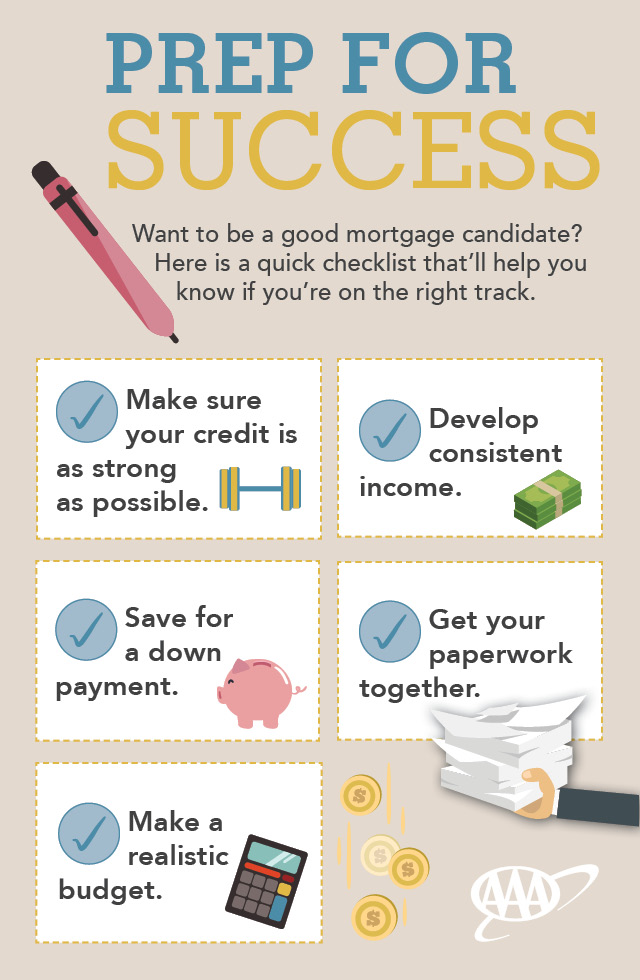
One of the best ways to show you’re prepared for a mortgage loan is through strong credit. The basic principles of building good credit are: always pay your bills on time, be careful about opening and closing new lines of credit and don’t use a high percentage of your available credit.

A good way to know how you’re doing is to review your credit report. Every consumer is entitled to a free copy of his or her credit report once a year from each of the nation’s three leading credit repositories. Click here for details on getting your report.

Listen to Our Podcast

For expert advice on the homebuying process, listen to Episode 7 of our podcast, Merging Into Life: Buying Your First Home.

Tune In

Scores Aren’t Everything

Credit scores are numbers that help tell lenders how likely borrowers are to consistently make loan payments. There are some credit card companies that offer customers free access to their scores. It’s important when reviewing these scores to remember that there is no single credit score.

FICO is one of the most popular credit scores, but it might not be the figure a lender is using to determine your credit worthiness. Lenders use a variety of algorithms to determine applicants’ credit scores, and they can vary depending on the type of credit you’re applying for.

Think of your credit score as more of a ballpark estimation of your credit worthiness versus a cold, hard figure.

Having a low credit score can have varying degrees of consequences. If your credit is too low, your mortgage application may be denied. If your credit is good, you may be approved but at a higher interest rate than someone with excellent credit. Some credit scores may also limit your eligibility for loan programs. Mortgages through the Federal Housing Authority, for example, tend to have lower credit thresholds than traditional mortgages.

mortgage loan

Work It

A steady income goes a long way toward proving you’ll be able to make payments on your mortgage loan. Applicants with consistent work histories often fare better than those who have recent gaps in their work histories.

Be Realistic

Don’t overextend yourself. Lenders typically will allow your monthly debt to go up to 43% of your gross monthly income. But consider your lifestyle. If you have upcoming expenses like college for a child or possibly a new car purchase, you may want to dedicate less toward a mortgage payment..

Save, Save, Save

Borrowers who make large down payments are often seen as lower risks than borrowers who make small down payments. In fact, homebuyers who aren’t prepared to put 20% down should be prepared to pay for mortgage insurance. It’s a fee often added to your monthly mortgage payment like homeowners insurance, and it protects a lender in the event a borrower defaults. If you don’t think you can put aside even a small down payment, like 3.5%, you may be eligible for a government-insured mortgage program that permits relatives to gift you money for a down payment.

Get Organized

You’re going to need quite a few documents to close on your mortgage. Getting all your paperwork together as early as possible can help. Have at least have two or three recent paystubs, tax returns from the last two years and bank and debt statements.

For faster, more personalized service to secure your mortgage, consider using a mortgage broker with AAA.

Learn more about AAA mortgage loans and other home loan services. 

Subscribe to Your AAA Newsletter

Sign up and receive updates for all of the latest articles on automotive, travel, money, lifestyle and so much more!

Top Hotels by Wyndham for New England Leaf Peeping

Visiting the Northeast in autumn is the best time to enjoy the cool, crisp air, fall-themed foods and the most vibrant changing foliage.

When planning a trip around leaf peeping in New England, where you stay matters. With excellent locations, amenities and price point options, a hotel by Wyndham has everything you need. With a collection of 25 trusted brands, Wyndham Hotels & Resorts welcomes travelers for all types of trips, from airport layovers to beachfront getaways and everything in between.

If you’re looking for a place to stay in and around New England this fall, here are our top Wyndham properties to book.

Save at Wyndham Hotels & Resorts

AAA members get up to 15% on fall getaways.

Book Now

Hawthorn Extended Stay by Wyndham Ellsworth

Bar Harbor, Maine

Maine is one of the first states where the leaves begin their fantastic color transformation. The Hawthorn Extended Stay is situated perfectly near gorgeous Acadia National Park and charming downtown Bar Harbor – both must-see locations. Guests enjoy free breakfast during their stay, a heated indoor pool, free Wi-Fi and convenient distance to both local airports, so getting there is a breeze. This contemporary hotel is also dog-friendly*, so bringing your furry friend along to enjoy the foliage is no problem at all.

wyndham

Wyndham Boston Beacon Hill

Boston

Not only is Boston’s central location ideal for a range of leaf-peeping destinations within the region, but it’s also one of the most picturesque cities to see in the fall. Make Wyndham Boston Beacon Hill your home base, situated in the heart of the city with proximity to some of Boston’s top attractions like award-winning restaurants and TD Garden. Valet parking**, pet-friendly rooms* and a rooftop pool only scratch the surface for the thoughtful amenities you’ll enjoy during your stay.

wyndham

Wyndham Newport

Newport, R.I.

While enjoying your leaf-peeping adventure in Rhode Island, the breathtaking scenery is just the start. Book an idyllic New England escape at the Wyndham Newport, where hospitality takes center stage. Enjoy inspired local fare at the onsite restaurant, take a dip in the heated saltwater pool, relax beside the outdoor firepits or sunset patio in the evenings and get to where you need to be downtown by shuttle – for free.

wyndham

La Quinta Inn & Suites by Wyndham Lake George

Lake George, N.Y.

Although not technically part of New England, New York is on many leaf peepers’ lists. As you explore the region, head to Lake George to catch waterside views of the leaves. A comfortable stay at La Quinta Inn & Suites provides free parking, free breakfast, a fully equipped gym, basketball court, hot tub, game room and more. Newly opened in 2023, this modern hotel allows you to make the most of your stay in Lake George as it’s merely minutes away from popular restaurants and activities like wineries, horse racing and plenty of family fun.

Going somewhere else this fall? Explore Wyndham Hotels & Resort’s locations worldwide. AAA members save 10% or more on hotel stays.*** Book now by calling 800-789-4103 and mention you are a AAA member or visit WyndhamHotels.com/AAA.

*Additional pet fee may be charged

**Additional valet fee may be charged

***Restrictions apply.

Subscribe to Your AAA Newsletter

Sign up and receive updates for all of the latest articles on automotive, travel, money, lifestyle and so much more!

A Costa Rica Vacation Has Something for Everyone

Vacations can sometimes seem like a tug-of-war between those who want to get out and explore, and those who just want to chill out. In Costa Rica, there’s no need for competition, because everyone wins.

“Wherever you are in Costa Rica you can have a different experience,” said Jodi Abata, a AAA travel advisor based in Wayne, N.J. “It’s not just a beach destination. There are rainforests, an active volcano and exotic plants and animals. It’s an amazing place for families with ziplines, horseback riding, thermal baths and more.”

Costa Rica’s location explains its best-of-all-worlds reputation: This Central American nation has Pacific and Caribbean coastlines separated by a mountainous interior. The latter is covered in dense jungle and rainforests alive with four species of monkeys, tree sloths, toucans and more.

The phrase “pura vida” can be seen and heard throughout Costa Rica. Though it directly translates to “pure life,” its meaning goes much deeper. Used as both a greeting and a farewell, it encompasses the positive spirit of Costa Rican culture. It represents enjoying the simply things, connecting with and respecting nature and being grateful for every day. Come experience it!

Your Costa Rica vacation is just a click away. Book now.

costa rica - monkey

Where to Stay in Costa Rica

Both coasts of Costa Rica have beautiful beaches but offer distinctive experiences.

While all-inclusive resorts are strongly associated with the Caribbean, in Costa Rica, the big resorts are located on the Pacific Coast in Guanacaste and Puntarenas provinces.

Costa Rica’s shorter Caribbean shoreline, entirely contained within Limon province, is far less developed and home mostly to villas and boutique hotels.

In Guanacaste, for example, you can vacation at the family-friendly, AAA Four Diamond designated Planet Hollywood Costa Rica, an all-inclusive Marriott Autograph Collection property. Or splurge on a couples escape to the Four Seasons Resort Papagayo, the adults-only, all-inclusive Secrets Papagayo or the Andaz Costa Rica Resort at Peninsula Papagayo.

Let's Plan Something Wonderful

Book your next trip with AAA Travel now or call 866-423-5585 to speak with a travel advisor.

Book Now

Things to Do in Costa Rica

Costa Rica’s excellent road system allows visitors to move freely around the country, and many travelers choose to mix a relaxing beach stay with adventurous explorations in the country’s interior, said Abata.

Arenal Volcano National Park and the spectacular La Fortuna Waterfall, two of Costa Rica’s most popular backcountry destinations, are under three hours’ drive from Limon and under four hours by road from Guanacaste.

The park and surrounding Arenal Conservation Area are home to their namesake active stratovolcano – lava has been flowing here regularly since the 1960s! Hiking trails trace the path of the major eruption of Arenal volcano in 1968 as well as crossing a series of hanging bridges suspended in the rainforest canopy. Here, the dormant Chato volcano is also protected, with its crater lagoon, Lake Arenal.

Nearby lodging like the Springs Resort and Spa and Nayara Springs let you immerse in volcano-heated hot springs after a day of hiking and exploring.

costa rica vacation

More Costa Rica Activities and National Parks

While Costa Rica’s Caribbean coast is best known for low-key relaxation, there’s no shortage of activities when you want to get off the beach. Tortuguero National Park, named for the leatherback sea turtles that nest there, is full of rivers, canals and lagoons; it’s about two hours north of Limon by road.

Cahuita National Park is about half the distance away from Limon and preserves many of Costa Rica’s diverse charms in one place: Pristine beaches, coral reefs teeming with fish and rainforests where hikers may encounter tree sloths and raccoon-like coatis. To immerse yourself in local culture, head to the town of Puerto Limon, known for its rich Afro-Caribbean heritage.

Corcovado National Park, one of the most biodiverse places on the planet, is located on the isolated Osa Peninsula on Costa Rica’s southwest Pacific coast. Six native wild cats including oncillas, margays, pumas, jaguars, jaguarundis and ocelots mostly inhabit this remote area. It’s a long drive from anywhere, but a flight from the capital of San Jose to Drake Bay, about an hour from the park, takes 40-50 minutes.

costa rica vacation

Hiking is required to see some of Costa Rica’s most singular sites, but it’s not all hard work. The country abounds in ziplines and canopy tours. Zoom over tropical dry forests toward the Guanacaste coast on Diamante Eco Park’s Superman Canopy Zipline or hang like a spider monkey over a Pacific coast jungle with the Rainforest Adventures Aerial Tram in Jaco. The Arenal reserve offers thrilling ziplines and easygoing canopy tours, as well.

Exploring on horseback is another less strenuous way to enjoy Costa Rica’s natural beauty, with guided rides available along the beaches and into the rainforest.

Environmentally conscious and unspoiled, Costa Rica is a welcoming destination for Americans where English is widely spoken and the U.S. dollar is always accepted.

“It’s a beautiful country, with very nice people and a very safe place,” Abata said. “Costa Rica is its own little world.”

Did you know your AAA membership grants you access to your own travel team? Plan your Costa Rica vacation with the help of a trusted AAA travel advisor and customize your trip from start to finish. Call 866-423-5585 to speak with an advisor today!

Have you been to Costa Rica? Tell us what you love about it in the comments below.

Subscribe to Your AAA Newsletter

Sign up and receive updates for all of the latest articles on automotive, travel, money, lifestyle and so much more!

Be on the Lookout for Flood-Damaged Cars

If you’re shopping around for a used vehicle, there’s a good chance you are going to come across a flood-damaged car, whether you realize it or not.

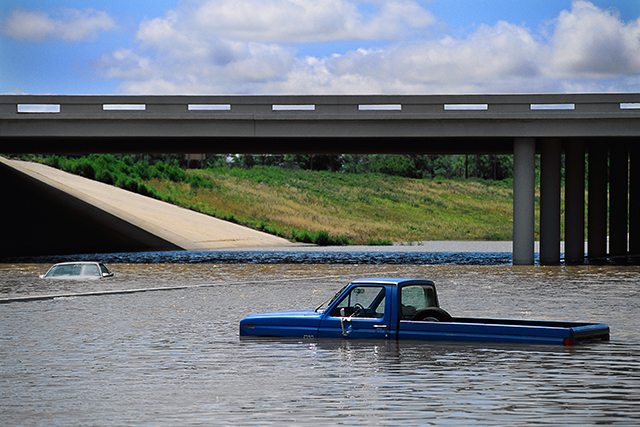
Insurance companies often declare flood-damaged vehicles as total losses, and those cars are then sold to salvage companies. However, rather than being dismantled for parts, some of these vehicles are purchased by individuals who restore them to some degree of working order. AAA warns car buyers that water-damaged vehicles can be transported anywhere for resale.

Thousands of flooded cars make their way back to the used car market each year and that number often increases following hurricane season and major floods.

AAA Approved Auto Repair

We take the guesswork out of finding a trusted technician for your vehicle.

Learn More

Signs of a Flood-Damaged Car

So, how do you know if you’re on the verge of buying a flood car? Start with the vehicle’s description. It may be referred to as “storm-damage” and could have a new title indicating it was an insurance total. Car history reports can help, but only if the car was put through a claim process.

Here are some other ways to check for water damage:

  • Inspect the car thoroughly for rust stains inside the car, especially around seat brackets.
  • Use all your senses. Does the car smell like mold/mildew? Conversely, does it smell like someone is trying to cover something up?
  • Check for carpet or upholstery that has been replaced or recently shampooed. Pull back the carpet at different areas and look for mud, dirt, rust or water stains.
  • Look in the trunk and under the spare tire. On a SUV, lower the spare tire and look for mud and debris. If the spare tire looks like it was just steam-cleaned, be suspicious. A spare tire that has been under a vehicle for a few years should be dusty, not caked with mud or spotlessly clean.
  • Is there mud and dirt on the underside of the dashboard? This area is hard to clean.
  • Look for water in the headlights and taillights.
  • Rust on the underside of the vehicle. Corrosion is uncommon in newer vehicles and those that are owned and operated in warmer climates.
  • Open the hood and look for water stains, mud and dirt in nooks and crannies (the alternator, cooling fan and other surfaces).
  • Check the fuse boxes for signs of corrosion.
  • Are the electrical components, such as lighting, heating/AC fan and window motors, not functioning properly?
  • Look for rust, mud, dirt or discoloration in body seams and small out-of-the-way crevices on the doors, under the hood and inside the trunk. Rust on unpainted screws indicates moisture.
  • Check all the fluids. If they are a milky color this could indicate water contamination.
  • If all of the windows have condensation on a warm day, it could indicate the interior was flooded.
  • A technician or even a do-it-your-selfer can check for engine fault codes. If the fault codes were recently cleared, this could indicate someone trying to hide something.
  • Some states do a better job of identifying cars with reconstructed titles. If you are looking at a local car and it has a recent out-of-state title, be wary and ask lots of questions.
  • Finally, if the price looks too good to be true, it probably is.
flood

What Happens if Your Car Was Caught in a Flood?

If you are caught in a few inches of water, your car will most likely be fine. If the water leaked into the vehicle’s interior, however, there may be real trouble.

Here are some tips and steps to take if your car becomes flooded.

  • Call your insurance company to check on coverage.
  • Take plenty of photos to document the damage.
  • Don’t start the car. Have it towed home or to a repair shop to be evaluated.
  • If the water was fresh (not brackish or salty) and the engine was off, you may be OK.
  • Driving into deep water could cause the engine to hydro-lock and cause extensive damage. When the engine sucks in water, that water can’t be compressed and will damage internal engine components.
  • Don’t start the car until it has fully dried out. Even though cars today have lots of computers, allowing the car to fully dry out may save all the expensive electronics. Think of a wet cellphone – sometimes if it is allowed to dry out, it will be OK – and so may your car.
  • The interior should be thoroughly cleaned and the carpets removed to fully dry out. This will help eliminate any mold or mildew.
  • Change all the vital fluids. They may be contaminated by water.
  • When in doubt have the vehicle evaluated by a reputable repair shop.

Have a question about flood-damaged cars? Leave them in the comments below.

Get a pre-purchase inspection by a trusted mechanic. Locate a AAA Approved Auto Repair facility near you.

Subscribe to Your AAA Newsletter

Sign up and receive updates for all of the latest articles on automotive, travel, money, lifestyle and so much more!

Merging Into Life: Moving Out for the First Time

SEASON 1: EPISODE 9
Episode Feedback

Packing, unpacking and settling into your new place.

listen on apple podcast badge button
listen on spotify badge
listen on amazon music badge
listen on pocket casts badge button

IN THIS EPISODE

This episode is your ultimate guide to moving out for the first time. Whether you’re renting or buying, it’s all yours to do as you please.

You get to decide how to decorate, when you’ll do the dishes and if you’ll eat on the couch or at the dining room table. But, with great power comes great responsibility, so you might have to move your own stuff as well. No need to stress, we’ve got everything you need, from a moving out checklist to additional tips to ensure a smooth transition.

Our guests Rob Shetler, Vice President at Shetler Moving & Storage, and Jami Supsic, Home and Style Director at HGTV Magazine, join us to share their professional insights. They cover how to make the most of your new space, whether the couch will fit through the door, and the essential things to buy for your first home.


KEY TAKEAWAYS

[5:38] – How to make sure your furniture fits your new space
[7:19] – Key things to consider when using a moving company
[13:21] – How to make the most of a small space
[16:38] – How to find affordable furniture


TRANSCRIPT

[00:00:02]
Amanda Greene: Hey, how are you? What are you doing?

[00:00:04]
Friend: Good. Not much. What are you doing?

[00:00:05]
Amanda Greene: I just sent my niece some money. She’s moving out for the first time. Can you even believe that?

[00:00:10]
Friend: Oh my gosh. Wow. I can’t believe she’s old enough to be out on her own.


RESOURCES

AAA Renters Insurance

AAA Home and Condo Insurance

First-Time Homebuyers Guide

Your Guide to Renters Insurance Coverage

Top Tips for a Stress-Free Move

How to Pack a Moving Truck

Shetler Moving & Storage

HGTV Magazine

Federal Motor Carrier Safety Administration


Want to Learn More? Drop Us a Note

"*" indicates required fields

This field is for validation purposes and should be left unchanged.
Subject
Name*

*The views and opinions expressed in this podcast are not necessarily the views of AAA Northeast, AAA and/or its affiliates.

Subscribe to Your AAA Newsletter

Sign up and receive updates for all of the latest articles on automotive, travel, money, lifestyle and so much more!

The Safest Cars for Teens and New Drivers

Safety is always a consideration when buying a new car, but it’s especially important when it comes to teens and new drivers. For drivers without much experience behind the wheel, safety features are key to helping prevent and protect against crashes.

When picking the safest cars for teens, the Insurance Institute for Highway Safety and Consumer Reports consider a number of important factors before making their recommendations. For starters, only vehicles with a curb weight greater than 2,750 pounds are listed. Every car must pass extensive safety tests and evaluations with flying colors, and receive strong marks from Consumer Reports for braking, handling and reliability. Additionally, vehicles must have a minimum rating of four or five stars from the National Highway Traffic Safety Administration. Best Choice vehicles are also equipped with standard automatic emergency braking systems.

We chose our safest cars for teens and new drivers from among the top picks. There are no subcompact vehicles, as larger, heavier cars provide a greater level of protection during a crash. No sports cars or high-horsepower vehicles are included either; such cars may encourage young drivers to speed, which contributes to roughly one-third of all traffic fatalities.

Safest Cars for Teens and New Drivers: Used

toyota corolla
2017-2019 Toyota Corolla

Starting in 2017, the Corolla’s front-end structure was tweaked and the frame around the driver door was strengthened to improve protection in small overlap frontal crashes. Both the sedan and hatchback received high safety ratings based on advanced safety features. The 2017 Corolla received an overall safety rating of five out of five stars from the NHTSA, earning a five-star rating in the side crash test and four stars in the frontal crash and rollover tests. Starts at about $10,600.

toyota camry
2018 or newer Toyota Camry

The midsize four-door sedan was a top safety pick in 2018. The model features a larger cabin and improved steering and handling than earlier versions. The car comes with an assortment of safety features, including the Toyota Safety Sense, so all 2018 Camry models have traffic-adapting cruise control, automatic emergency braking to prevent a potential forward collision, lane departure warning and mitigation and auto-dimming LED headlights. Starts at about $9,600.

toyota avalon
2017 Toyota Avalon

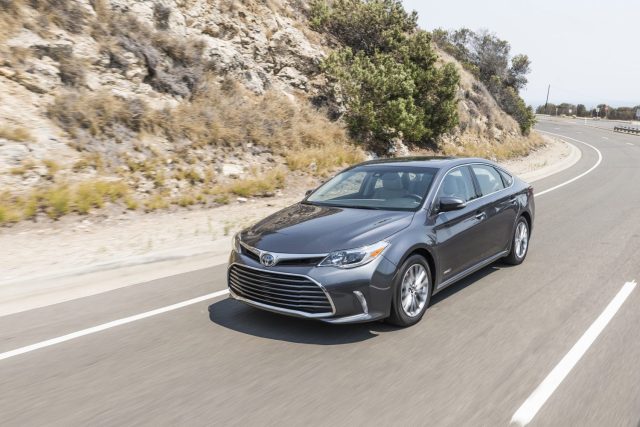
A large four-door sedan, the 2017 Avalon model with updated headlights was a top safety pick for 2017. This roomy, comfortable car includes Toyota’s Safety Sense package with adaptive cruise control, a lane departure warning and intervention system, forward collision warning, automatic pre-collision braking and automatic high-beam headlight control. Starts at about $14,400.

Safest Cars for Teens and New Drivers: New

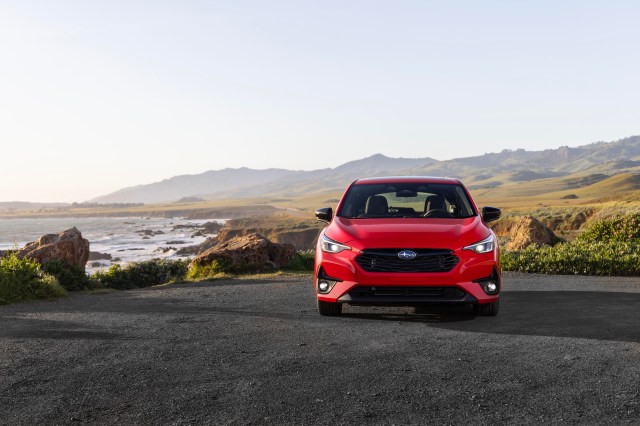
subaru impreza
2024 Subaru Impreza

A charming small four-door hatchback, like all Subarus, the Impreza comes with all-wheel drive, a big plus in winter weather. The cabin is roomy and comfortable, and the cargo area spacious. Safety features include standard lane departure warning, front crash prevention and pedestrian warnings, as well as a rearview camera and dusk-sensing headlamps. Prices start at $23,400.

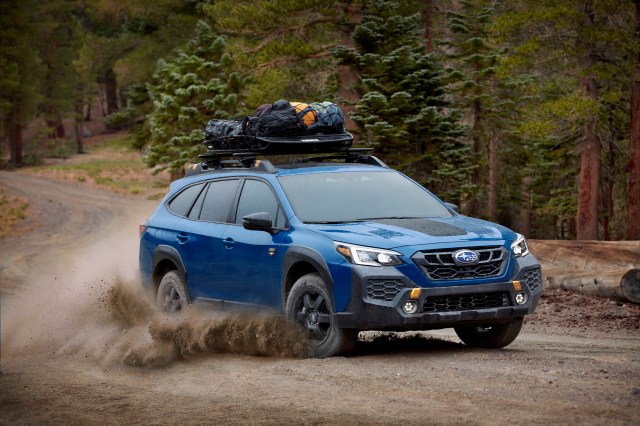
subaru
2024 Subaru Outback

A mid-size, four-door wagon, the Outback combines “a station wagon’s practicality, comfort, easy-driving character and fantastic outward visibility with the ground clearance, ride compliance and all-weather sure-footedness of an SUV,” according to Edmunds. The Outback, of course, comes with all-wheel-drive and standard lane departure warning, front crash prevention and pedestrian warnings, among other features. Prices start at $28,895.

mazda cx30
2024 Mazda CX-30

Another all-wheel-drive vehicle, this small four-door SUV comes with a six-speed automatic transmission and is a pleasure to drive. The Mazda CX-30’s well-appointed interior and leather upholstery give it a touch of luxury. Among the safety features are lane-keeping assistance with warnings for lane departures, adaptive cruise control and self-operating emergency braking. Prices start at $24,995.

Need a new car for your teen driver? Let AAA help finance the purchase with a low-interest auto loan.

AAA Northeast is not affiliated with or sponsored by the car manufacturers discussed in this article. The article reflects our own independent analysis.

Subscribe to Your AAA Newsletter

Sign up and receive updates for all of the latest articles on automotive, travel, money, lifestyle and so much more!

Find Your Caribbean With Sandals & Beaches Resorts

Dreaming of a vacation that allows you to truly relax? Sandals® all-inclusive Caribbean resorts offer the ultimate in comfort and convenience in the most gorgeous tropical places.

From Sandals’ adults-only properties to its family-friendly Beaches resorts, you can find the stay that’s right for you, set along pristine beaches in Antigua, Barbados, the Bahamas, Curacao, Grenada, Jamaica, Saint Lucia, Turks and Caicos and Saint Vincent.

Just when you thought the Caribbean couldn’t get any more carefree, you can enjoy drinks, dining, entertainment, water activities, Wi-Fi, fitness centers, free roundtrip airport transfers and more – all without having to reach for your wallet. Even gratuities are included.

You don’t even have to worry about planning; a AAA travel advisor will take care of everything.

Discover Your All-Inclusive Caribbean Playground

Leave your wallet and your cares behind, because all-inclusive means just that. 

Start Exploring

For Adults

Sandals’ has 17 adults-only resorts on some of the Caribbean’s best beaches. Each destination is designed with couples in mind, outfitted with romantic suites and restaurants, quiet pathways, hidden grotto pools, firepits under the stars and included land and water activities for you and your partner.

There are seven Sandals resorts in Jamaica to choose from, including the original in Montego Bay, tucked along one of the longest and most secluded white sand beaches on the island. Sandals South Coast also stands out for the two miles of coast on which it rests.

sandals grenada

Sandals Royal Bahamian in Nassau, Bahamas, is especially luxurious. With seven pools, a spa, the all-new Coconut Grove lounge area and unlimited dining at your choice of 10 exquisite restaurants (plus two new food trucks!), you may not want to leave.

For a different view, Sandals Regency La Toc in Saint Lucia makes its home in a 220-acre tropical estate, overlooking a sloping hillside that ends at a gorgeous golden beach. Sandals Royal Curacao sits on 3,000 acres on the Spanish Water Bay and Caribbean Sea, surrounded by mountains.

Sandals Saint Vincent is the newest resort. Home to a private cove, it gives guests the chance to explore a quieter island.

beaches resort

For the Family

For families, there’s Sandals’ sister resorts, Beaches. With two properties in Jamaica – Beaches Negril and Beaches Ocho Rios – and one in Turks & Caicos, Caribbean adventures await for everyone in your crew.

In addition to the anytime gourmet dining options and endless activity inclusions that Sandal’s is known for, Beaches resorts also has on-site water parks and kids’ programs.

Each resort has six children’s programs broken down by ages and staffed by trained nannies, allowing parents to have a dinner date or just some alone time. Featuring age-appropriate activities in separate groups for newborns up to age 17, some of the nannies have completed specialized training to care for children with autism and other special needs.

Resorts also include Caribbean Adventures with Sesame Street, giving little ones a chance to hang out with their favorite characters.

sandals montego bay

Included Activities

If you love the water, gear up for endless fun. Resorts offer snorkeling, scuba diving (for certified divers), aqua trikes, paddle boarding, wind surfing, kayaking and catamaran sailing. Some locations also have motorized activities such as water skiing, wake boarding and banana boat rides. Guests ages eight and older at Beaches Turks & Caicos resort can take an eight-hour course to learn to sail.

When you’ve had your fill of the beach, Beaches guests can wash off the sand at the resorts’ water parks, with towering waterslides as well as lazy rivers, wave pools and other attractions, or just plunge into one of the swimming pools.

Equally numerous and varied are the choices of on-land games and activities, including golf (complimentary roundtrip transfers to nearby Sandals golf resorts and green fees are waived in Jamaica and Saint Lucia), basketball, beach volleyball, soccer, tennis, pickleball, shuffleboard, bocce, horseshoes and table games. Or stop in the fitness center for a more structured workout.

Guests can also sign up for excursions and spa treatments, which cost extra.

Exquisite Dining

All that activity requires fuel, and there is no shortage of restaurants to fill up the tanks. Resorts have multiple restaurants, featuring cuisine from around the world. Sandals also tries to highlight locally grown and native foods on its menus. Each resort has at least five bars that serve premium liquor and there are stocked bars in every room. Unlimited snacking between meals is also available, for those anytime cravings, and can be delivered to your room.

Contact your AAA travel agent and plan your next getaway today! 

Subscribe to Your AAA Newsletter

Sign up and receive updates for all of the latest articles on automotive, travel, money, lifestyle and so much more!

The Coolest Cave Tours in the Northeast

Delve into a world of natural wonders that can only be seen when you go underground. Cave tours make for an especially cool day trip. (So cool, in fact, you might want to bring a jacket – underground temperatures can dip into the low 50s!). A visit to these awesome geological formations makes for a fun and educational adventure for all ages.

If you’re ready to head underground, here are our favorite cave tours in the Northeast.

Need a ride? Rent a car.

The Coolest Caves in New England

Lost River Gorge & Boulder Caves

North Woodstock, N.H.

Lost River stuns with enchanting natural beauty both above and below ground. Follow the scenic one-mile wooden boardwalk trail and wind past tumbling waterfalls and nearly a dozen glacial boulder caves with whimsical names like Lemon Squeezer and Bear Crawl. Two-hour guided lantern tours at dusk offer unique perspectives on the hidden depths of the caves. As a bonus, tours end with s’mores and a cozy campfire. The littlest explorers can even participate in a fun scavenger hunt as part of a Junior Gorge Guide program.

Polar Caves

Rumney, N.H.

At Polar Caves Park, you can explore nine granite caves from the last ice age. Why the name Polar Caves? They say it’s because even on the hottest days, you can feel the chill of the caves’ icy cold “breath.” This is a self-guided adventure, so plan to wander in and out of caves at your own pace. Above ground, children will delight in the small animal park with European fallow deer and ducks. You can purchase animal feed, as well as souvenirs and snacks at the park’s main lodge.

New York Cave Tours

Howe Caverns

Howes Cave, N.Y.

At Howe Caverns, you’ll be amazed by cave formations, underground streams and expansive chambers. A 90-minute guided tour traces the cave’s exhilarating discovery story. Wander through enormous rooms and under super-sized boulders on a 1.25-mile walk and 0.25-mile boat ride, all while 150 feet below the Earth’s surface. Specialty tours, including a two-hour lantern tour and a two-hour family flashlight tour, help bring to life the thrill of Lester Howe’s discovery of the caves in 1842. Uniquely, Howe Caverns hosts yoga and Zumba classes during summer months.

Secret Caverns

Howes Cave, N.Y.

Just two miles from Howe Caverns is the quirky yet captivating Secret Caverns, a roadside attraction that proudly claims to be the “Speleological Center of the Universe.” Speleology, of course, being the scientific study of caves. Bundle up since the caves maintain a refreshing 50 degrees year-round. Sign up for a guided 45- to 60-minute tour to get up close and personal with stalagmites, stalactites and flowstone. You’ll also spy a breathtaking 100-foot-tall underground waterfall. Make note, only cash is accepted here.

Pennsylvania Cave Adventures

Crystal Cave

Kutztown, Pa.

Crystal Cave offers a fascinating underground adventure. With a constant 54-degree temperature inside the cave, you’ll want a jacket or light sweater for the one-hour guided tour. Prepare to be awed by stunning stalactites, stalagmites and intricate formations with names like Totem Pole, Ear of Corn and Bacon. The tour starts with a short film on cave geology. Once back in the sunshine, pan for gems, get in a round of mini golf or treat yourself to a scoop at the on-site ice cream parlor.

Indian Echo Caverns

Hummelstown, Pa.

At Indian Echo Caverns, explorers go underground for a 45-minute adventure through awe-inspiring caverns that first opened to the public in 1929. Knowledgeable guides educate on the spectacular limestone formations, crystal-clear pools and mysterious passages within the 52-degree caverns. Above ground, the fun continues thanks to picnic areas, a playground, gem mining and a small petting zoo with goats, alpacas and chickens.

cave tour - lauuren caverns
Laurel Caverns. Photo by Alex Byers.

Laurel Caverns

Farmington, Pa.

Laurel Caverns boasts the largest cave system in Pennsylvania, featuring more than four miles of curious and narrow passages. Marvel at the expansive chambers and striking formations on a 30-minute guided or self-guided tour through illuminated sections of the caves. For the truly adventurous, weekend caving programs allow you to navigate tight, unlit spaces with hard hats and lights. Kids ages 4 to 9 will love The Grottos, a simulated cave experience that’s a fun and safe learning activity.

Penn’s Cave & Wildlife Park

Centre Hall, Pa.

Embark on a 45-minute guided tour aboard a flat-bottom motorboat through an underground waterway called Lake Nitanee at Penn’s Cave & Wildlife Park. This unique cave exploration wows with stunning views of limestone formations and chambers with names like The Statue of Liberty and Garden of the Gods. Afterward, explore the wildlife park on a 90-minute guided bus tour across 1,600 acres. Keep your eyes open for free-roaming bison, elk, bighorn sheep and red foxes.

Have you been on any of these cave tours? Tell us in the comments.

Featured image: Courtesy of Penn’s Cave & Wildlife Park

Subscribe to Your AAA Newsletter

Sign up and receive updates for all of the latest articles on automotive, travel, money, lifestyle and so much more!

Term vs. Whole Life Insurance: What Is the Difference?

When getting your first life insurance policy or renewing your plan, you are faced with a choice: term vs. whole life insurance. Each has its own benefits, but which plan is right for you? It depends on a variety of factors, from your current stage in life, to your age and finances.

We know that thinking about life insurance and how to keep your family protected when you are gone can feel like a heavy decision, but it’s an important one. Life insurance can help your loved ones take care of outstanding debt or continue to pay everyday expenses. It can also be used to pay off a mortgage, cover final expenses and pay for costs towards child care formerly provided by a stay-at-home parent. And since policy rates increase as you get older, the sooner you can get one in place the better.

Let’s delve deeper into the difference between term vs. whole life insurance and which one best fits your needs.

If you’d like to learn more about your life insurance options, schedule an appointment with a AAA insurance agent. 

Listen to Our Podcast

Have insurance questions? Listen to Episode 3 of our podcast, Merging Into Life: Insurance 101.

Tune In

The Basics of Term vs. Whole Life Insurance

Term

As the name implies, this type of plan is temporary, offering a fixed premium that provides coverage for a predetermined period of time. Typically, the longest a term plan will extend is 30 years from the issued date, and if the insured dies before the policy expires, the designated beneficiaries will receive the death benefit. Because it offers a more limited scope of protection, term life insurance policies are often more affordable than whole plans.

Whole

Whole plans tend to cost more than term plans and unlike term plans, a whole life insurance policy is a lifelong commitment. Coverage remains active for the policyholder from purchase until death, and accordingly, the benefits are available at anytime. In addition, whole plans have an intrinsic cash value, and policyholders can often borrow money against them.

term vs. whole life insurance

What to Consider

Deciding between a term vs. whole life insurance policy depends on your situation.

A term life policy may be the best option in cases where the loss of a loved one could have a profound financial impact on family members. It basically serves as income replacement designed to protect your dependents and help them to maintain their lifestyle if you die during the policy period. Also, because term policies are more affordable, they are a good short-term fix until you are ready to upgrade to a whole plan and are easily the best option for those just starting out with life insurance.

Whole life insurance is preferable for planning your inheritance and your estate’s future. When the time comes, this type of plan will be far better suited to cover estate taxes. In addition, if you have a lifelong dependent relying on your income – a child with special needs, for example – a whole policy should be in place to provide financial support, especially if you don’t want to rely on retirement savings or other assets. If you can afford it, the more comprehensive protection offered by a whole plan is the better option to plan for your long-term finances.

Decisions, Decisions

Whether you go with a term or a whole policy, all plans take into account your age, health and financial standing (i.e., debts, expenses and assets). You should also anticipate any expenses that may arise for your beneficiaries in the coming years, such as education and housing. These are all major factors in making any policy decisions, and in the end, the most accurate way to determine which plan fits your budget and your expected needs is to compare the long-term costs of all your options.

To get the best of both worlds, you may want to consider a return of premium policy. This is a term life insurance plan – sold as a 10-, 15-, 20- 25- or 30-year policy, which offers customers the option to get their money back if they outlive the term, or keep the money in an account and have it paid into a whole life insurance policy that you never have to contribute to again as long as you live. So, you get a money-back guarantee along with the protection and advantages of a term policy such as death benefit, lower price and underwriting.

Truth be told, life insurance offers such much flexibility that you have seemingly endless ways to fit a policy into your lifestyle. Oftentimes the best approach for consumers is to start out with term and convert it to a whole policy when the time is right. But before you commit to any plan, consider reaching out to a qualified professional for assistance in assessing your options.

Did this help you to learn more about the difference between term vs. whole life insurance? Tell us in the comments. 

Get a personalized life insurance policy through AAA

Subscribe to Your AAA Newsletter

Sign up and receive updates for all of the latest articles on automotive, travel, money, lifestyle and so much more!

What to Do When Your Car Breaks Down

Even the most responsible drivers run into car trouble now and then. It’s up to you to know what to do during a car breakdown, and how to keep yourself and others safe if it happens.

Here’s some car breakdown advice from AAA experts.

Listen to Our Podcast

Learn the signs to spot car trouble early, avoid breakdowns and manage repairs with confidence. Listen to Season 2, Episode 7 of our podcast, Merging Into Life: Your Essential Car Maintenance Checklist

Tune In

Why do cars break down?

A car breakdown happens when little problems are ignored long enough to turn into big problems.

There are many reasons for a car breakdown, but some of the most common reasons are an overheated engine, battery failure or a tire blowout.

A car might not start because of a bad starter or loose battery connection, but we’re going to focus on what to do when your car breaks down while you’re driving.

When a car breakdown starts to happen, you might feel the engine stumble or hear it misfire. The vehicle might jerk suddenly, or you could see steam billowing out of the front end.

As a general rule, red warning lights on the instrument cluster indicate serious issues. Think of them like red lights on a traffic signal. If you see one come on, pull over immediately to prevent what could be catastrophic damage, according to AAA’s Car Doctor John Paul.

These are considered the top three warning lights.

  • Engine oil pressure: Commonly called the teakettle, this light indicates the engine has lost its supply of oil and harmful metal-on-metal contact is about to occur, followed by major engine damage within seconds.
  • Coolant temperature: Often signaled by a thermometer symbol riding waves (accompanied by a temperature gauge in the red), this light indicates a coolant leak or failure of a coolant system part such as the thermostat.
  • Charging system failure: This one is the battery light with the plus and minus symbols inside. It illuminates when the alternator stops supplying power to the electrical system. It likely won’t damage anything else, but your car could lose power completely in fewer than 15 minutes.
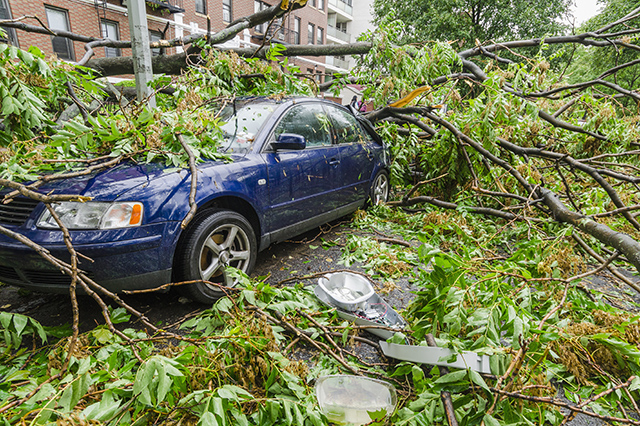
Another red light to keep an eye on is the one that indicates an issue with the hydraulic brake system. In some cars it appears as “BRAKE,” but check your owner’s manual to make sure of what it looks like in your vehicle. This light could mean your car is low on brake fluid or that you left the parking brake engaged, or it could warn of a serious brake problem that craves the help of a certified automotive technician. Yellow or amber warning lights typically indicate less serious issues, but drivers should still exercise caution and address the problem as soon as possible.

When does a car breakdown typically happen?

It depends. Paul has seen a Chevrolet Malibu running well with 425,000 miles on it. Then again, he’s seen vehicles that get the daylights driven out of them, such as police cars, or ones that have skipped important maintenance services, wear out at 50,000 to 70,000 miles. It comes down to how well the vehicle is maintained, and whether or not important parts are replaced.

  • Top off car fluids or change them if they are dirty or contaminated.
  • Inflate tires to the manufacturer’s recommended tire pressure.
  • Inspect your tires for any visible signs of damage and that the tread is not too worn-down. Try using a quarter to check.
  • Test your car battery. (Most of the roadside assistance calls AAA Northeast receives are for battery problems.) AAA Battery Service will come to you to complete this task and, if necessary, replace your battery.
  • It’s never a bad idea to have your vehicle undergo a thorough inspection before traveling. An auto repair shop can spot and fix potential problems before they put a detour on your road trip plans. Find a trusted auto shop near you.
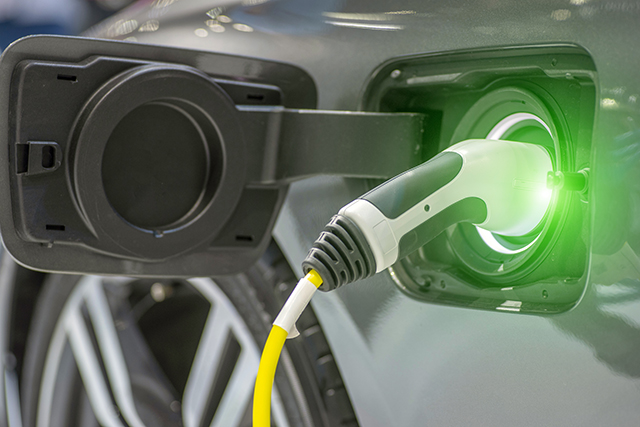

What should you do when a car breakdown happens?

If a red light comes on, or you can feel your car failing, pull over as soon as it’s safe to do so. Seconds matter in these situations. (Especially if you see smoke, which can indicate a fire. If your car is on fire, get away from it and call 911 immediately.)

It doesn’t take long for a blown head gasket to cause a blown out water pump, radiator or heating core, says Peyton Knight, owner of the AAA Approved Auto Repair station Knight’s Automotive in Ledgewood, New Jersey.

“The most important thing you can do is watch the gauges and warning lights,” Knight said. “They usually come on early enough that you won’t do major damage if you pull over and shut off the car right away.

“Yes, the car might still go, and you might be tempted to try to make it home, but you’re going to do more damage than it’s worth,” he added.

In the event that a tire blows out, slow down by lifting your foot off the accelerator (do not slam on the brakes). Signal and pull over to the shoulder on the right side of the road, completely out of the flow of traffic and on level ground if you can. Try – keyword “try” – not to freak out, avoid sudden maneuvers and don’t forget to look for other drivers if you must change lanes. When you get to safety, call AAA Roadside Assistance for help. Look for landmarks, street signs or anything else that can help AAA get to your location.

If your engine stops, or you run out of gas, you’re going to need to use your vehicle’s momentum to get out of the road. Again, coast on over to the right shoulder and do not hit the brakes until it’s necessary to stop.

If your vehicle’s engine has overheated, pull over ASAP but do not open the radiator cap (it even warns you not to do this on the cap, so no excuses!). Twisting the cap open on a hot radiator is incredibly dangerous and will only net you a face full of hot steam.

While many of these scenarios require you to pull over as soon as possible, never jeopardize your safety to make it happen. If you find yourself in an inoperable car in the middle of traffic, stay in your car, turn your emergency flashers on and call AAA for help.

car breakdown

What if a car breakdown happens on the highway?

At highway speeds, fast decision-making is even more important.

If your car fails or a tire blows out, decelerate by lifting your foot off the gas and signal your intent to pull over. If you can make it to a rest stop or off the nearest exit, do so. Otherwise, pull off to the left or right shoulder, park and call for help. Do not get out of your vehicle and stay buckled. Other drivers may not see your vehicle, or you if you’re standing in front of it, especially at night or in inclement weather.

If you think your vehicle might get hit, or if you feel unsafe where it broke down, get to a safer location and tell the roadside assistance dispatcher your intentions. Make note of any nearby mile markers or exit signs. This will help your roadside assistance technician find you.

Some people use flares or orange warning triangles to mark their location after a car breakdown. Only do so if you can exit your vehicle on the side opposite the traffic and do not light flares if you smell gasoline leaking from your car. A good way to set up the triangles is to place them 100 feet, 200 feet and 300 feet from the car, Paul said.

How can you prevent a car breakdown?

Here are some steps you can take to reduce the likelihood of a car breakdown.

  • Follow the manufacturer’s recommended car care schedule. Parts have a lifespan, and the manufacturer knows better than anyone what that lifespan is.
  • Bring the vehicle to a reputable repair shop. AAA Approved Auto Repair facilities conduct a safety inspection during every service, even something routine like an oil change. Thinking ahead helps catch potential problems before they result in a breakdown.
  • Conduct regular car maintenance. It’s your responsibility to catch fluid leaks, battery issues and tire problems in between trips to the shop. Once per month, pop the hood and make sure there’s no corrosion on the battery terminals; look for leaks (underneath the car, too) and check the tread depth and air pressure in all tires (including the spare).

How can AAA help with a car breakdown?

AAA Roadside Assistance is available 24/7. Our technicians can help you fix a flat tire, give you a battery jump or tow you to a repair shop for a more serious repair. They know exactly what to do when your car breaks down.

Members can request roadside assistance in several different ways, including by phone (1-800-222-4357), online (AAA.com/GetMoving) or using the AAA Mobile App.

Did we answer your questions about what to do when your car breaks down? Do you have any others? Leave your comments below. 

This article has been updated and republished from a previous version.

Subscribe to Your AAA Newsletter

Sign up and receive updates for all of the latest articles on automotive, travel, money, lifestyle and so much more!