Few vehicles are as iconic as the Ford Mustang. The OG pony car is known for its good looks, long hood and impeccable performance – and it’s been a standard of excellence for more than 50 years. Out of sheer respect for this highly customizable two-door American idol, here’s a look at how the original – dubbed 1964 1/2 by enthusiasts – and the Mustang of today stack up.
Do you remember when the first Ford Mustang was released? Are you a Ford Mustang owner today? Share your thoughts on the original pony car in the comments section below.
U.S. national parks showcase the country’s beautiful, yet diverse natural wonders. Where some people adore a wide open plain, others revel in the tranquility of high mountain peaks. Yet still others find beauty in Earth’s geothermal power. Here are seven of the U.S. national parks’ most scenic spots, with sites to suit any taste.
This secluded valley holds a bounty of historic sites and verdant scenery. The 11-mile road loops through the area, past several restored buildings, including churches, log homes, barns, and a still-functioning mill – memories of the residents who settled here after the War of 1812. Plenty of parking can be found for exploring these sites as well as the trails in the area. This valley is home to a wide variety of wildlife, from deer, foxes, and elk to the occasional black bear, so keep your eyes open, particularly at dawn and dusk.
Though it lacks the lush vegetation found in some other parks, Death Valley, which straddles eastern California and Nevada, highlights nature’s stark beauty. A particularly scenic spot is along the nine-mile-long Artist’s Drive. Here the monochromatic landscape gives way to the remnants of a violent geologic past. Oxidized iron, mica and manganese have painted the sides of this alluvial fan in stripes red, pink, yellow, green and purple, which greet visitors as they follow the one-way twisty road along the face of the Black Mountains. As the road dips and curves, views of the vast desert valley are juxtaposed against the array of color on the rock walls. The Artist’s Palette, located about halfway along the drive, is the prime spot for viewing this display. Though the view from the road is impressive, many guests stop to take a short hike to see the rocks’ hues up close.
Unlike its tony namesake in New York City, Utah’s Park Avenue Trail, in Arches National Park, won’t empty your wallet…and the views are way more spectacular. This two-mile out-and-back trail among nature’s skyscrapers takes visitors up close to some of the park’s most well-known and frequently photographed sites, such as Courthouse Towers, Queen Nefertiti, the Three Gossips, the Organ, and the Tower of Babel. The hike itself is easy and relatively flat. Though these geologic features are visible from the road, experiencing them on foot provides the best sense of their immensity.
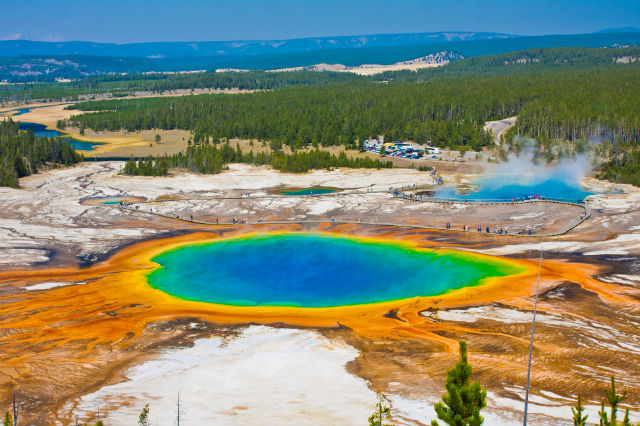
Grand Prismatic Spring, Yellowstone National Park.
Of course, Yellowstone National Park must be included in a list of the most scenic places in U.S. National Parks. The only question: Which spot in this well-loved park is the most beautiful? Based on its sheer burst of glorious color, a display of nature’s finest palette, the Grand Prismatic Spring is clearly the winner. This 370-foot-diameter hot spring in the Midway Geyser Basin is the largest of its kind in the country and the third largest in the world. But its size isn’t its main draw; the colors are the main attraction here. The bright blue center of the spring is ringed by bands of vivid reds, yellows and oranges. These rainbow rings are created by colorful thermophilic bacteria that dine on the minerals found in the water, thanks to the area’s high geothermal activity. Of course, because of its beauty, the spring is one of the most visited sites in the park, so arrive early to avoid the larger afternoon crowds. The best views can be found from the nearby Fairy Falls overlook.
Sunrise atop Cadillac Mountain in Acadia National Park is a view to remember. As the first rays of light break over the eastern horizon of the Atlantic, the numerous islands off the coast of Mount Desert make their first appearance. Between early October and early March, visitors to this 1,533-foot vantage point – the highest point on the North Atlantic seaboard – are the first to experience sunrise in the United States. During the day, a panorama of Frenchman Bay, the Atlantic Ocean and the rocky Maine coast is easily accessible from the paved park road that leads to the mountain summit, but more adventurous travelers can hike the North or South Ridge Trails to the top of Cadillac Mountain.
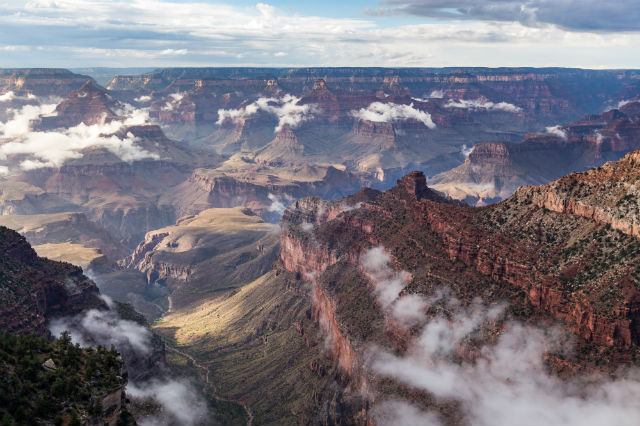
The sweeping views of the Grand Canyon are memorable and spectacular from pretty much anywhere in the park. However, Grandview Point, which sits on the southernmost part of the canyon’s south rim, definitely offers a must-see vantage point. From 7,400 feet, it provides a sweeping overlook of several buttes, including Rama, Krishna and Vishnu Shrines, as well as the Colorado River far below. The Grandview Trail, which is found at the point, is one of the park’s easier descents, though it does not descend all the way to the river. This region receives more rain than other parts of the canyon, so it supports thicker forests of pine and oak. Access to the viewpoint can be found at the end of a one-mile side lane off the Desert View Scenic Road, about 12 miles east of the Grand Canyon Village.
Though the mention of a scenic view usually brings to mind a vast, open landscape, the Big Room at Carlsbad National Park is an exception. This enormous 8.2-acre chamber is located a mile and a quarter down the cave system’s Natural Entrance Trail. Several features, such as the cave-popcorn-covered Lion’s Tail and the dangling Sword of Damocles – two well-known stalactites – as well as numerous fossils, side caverns and soaring stalagmites lend this underground treasure an otherworldly feel. Like many aboveground geologic features, this cave was transformed and created over millions of years. The dripping water carries minerals, which form the hanging stalactites and rising stalagmites, some of which eventually meet to form solid columns, such as the massive Temple of the Sun.
Have you been to any of these places? Tell us in the comments!
Some of the most awe-inspiring scenery can be found in the Canadian Rockies and Pacific Northwest. From snowy mountain peaks to pristine coastlines, the area is an ideal destination for nature lovers, adventurers and anyone looking to experience the vast beauty of North America.
Of all the ways to explore, rail travel provides unique access to breathtaking spots that can’t be reached other ways, and Rocky Mountaineer offers even more. Passengers journey by day and enjoy the comfort of a hotel bed at night. With luxury seating, gourmet dining and adventure opportunities, rail service has never been so enticing.
Unforgettable scenic routes with open-air viewing spots
When you think of the northwest Pacific coastline and the long stretch of mountains that form the Canadian Rockies, it can be overwhelming to decide how to see everything in one vacation. Beyond the cosmopolitan cities that dot the area, the stunning scenery has so many highlights that it can become challenging to plan the right road trips and excursions that will encompass them all.
Fortunately, the travel experts at Rocky Mountaineer have mapped out four customizable routes that allow you to explore Western Canada and give you a good dose of Americana. As you pass through the unforgettable sights on each of the routes, the glass-domed coach offers a variety of angles on the canyons and mountains. Remember to enjoy the open-air viewing spots as well.
If you’re interested in an ocean view route, consider the Coastal Passage, which begins in Seattle, travels along the sparkling Pacific, and tours you through the wild landscape of the Rockies. Depending on how many days you have to explore the region, your itinerary will include different excursions and free days on which you can venture off and explore attractions such as the Vancouver Aquarium, museums, and even resort towns such as Whistler.
For a journey steeped in history, many travelers opt for First Passage to the West, which is Rocky Mountaineer’s most popular offering. In fact, this is the only passenger rail service on the historic route through the Spiral Tunnels that connect eastern and western Canada. On-board hosts offer stories and commentary on all of the routes, but history buffs might enjoy the facts they pick up on this one the most, particularly when they see where the last spike on the Canadian Pacific Railway was driven.
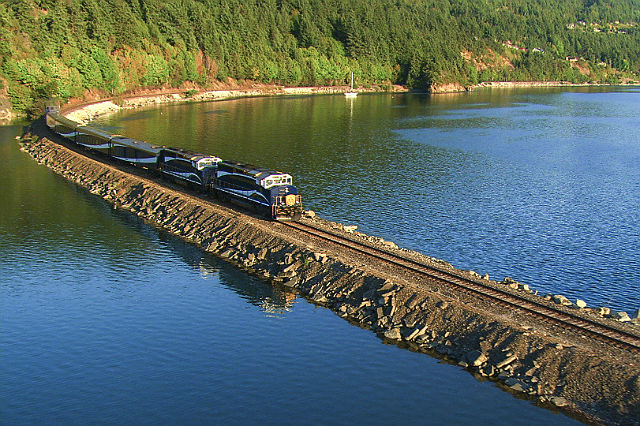
Rocky Mountaineer on the Coastal Passage route. (Photo: Rocky Mountaineer)
The Rainforest to Gold Rush route also offers a good dose of history as it tours the remote Cariboo gold rush region, but maybe even more captivating is the chance to see some of Canada’s extreme terrain. On one journey you will travel from lush rainforest to the desert of Kamloops deep in British Columbia. In many ways each of the routes contains a study in opposites, dramatic yet differing vistas that are enthralling each in their own way.
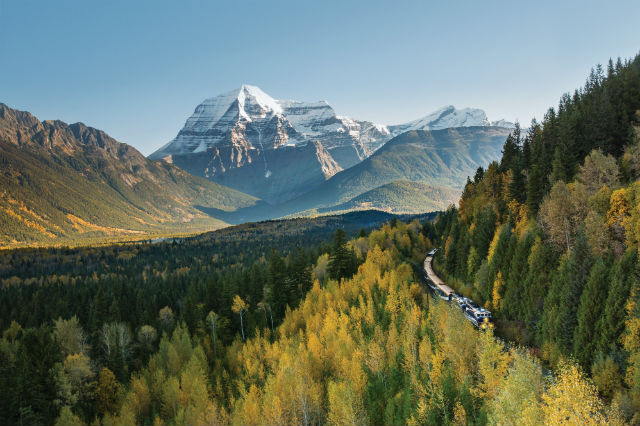
Nature lovers climb higher and higher on Journey through the Clouds, the aptly named route that takes travelers through remote areas of the Canadian wilderness to the highest peak of the Canadian Rockies. If the spectacular vistas of Mount Robson aren’t enough, you certainly will get to take part in some bear sightings, which are much less nail-biting from the comfort of your plush seat.
Since each trip length is designed to hit the major highlights, the pressure of keeping on schedule is virtually eliminated, making it easier to relax and recharge. After all, exploring this part of the North American landscape is not just a travel milestone. A change of scenery this dramatic is downright unforgettable.
Customizable packages and sightseeing options
Beyond choosing their route, travelers can opt for a number of add-on adventures such as whale watching and sightseeing excursions, some self-guided and others as part of a larger tour group. At glacier-fed Lake Louise, take the opportunity to test your paddling skills or learn some new ones in a rented canoe. If you’re not interested in setting out on the blue-green water, take a light hike or just spend some time enjoying the alpine meadows and the picturesque views, which include the iconic Fairmont Chateau resort.
With its Swiss style architecture, Banff National Park is another key destination along the Rocky Mountaineer routes that offers attractions for adventurers and serenity seekers alike. Treat tight muscles to a massage at Banff Caribou Lodge and Spa or take a dip in the steamy mineral water of the naturally occurring hot springs, surrounded by crisp mountain air. After a relaxing soak replenishes you, embark on a culinary adventure including stops at the Banff Avenue shops known for their delicious confections.
For an even more adventuresome trip, begin your journey or cap it off with an Alaska cruise. Departing from Seattle or Vancouver, a luxury vessel will let you see glaciers, whales, and stunning landscape from a whole new perspective. If that’s out of the budget, there are plenty of ways to augment the rail experience including a panoramic helicopter ride between Banff and Calgary or a tour of Athabasca Glacier in a giant six-wheel Ice Explorer vehicle.
Seamless transition from stunning views to hotel accommodations
One of the most striking aspects of rail travel is the coordination of so many elements you normally have to navigate on your own. With a warm arrival, guests are welcomed by teams prepared to handle everything from luggage handling to exceptional culinary experiences. After a day of soaking in the scenery and taking part in off-board experiences, the transition to evening hotel accommodations is seamless.
From granite cliffs to emerald lakes to rainforests, the stream of sights offered by rail service are rejuvenating for both adventurers and those seeking relaxation. With customizable options like those offered by Rocky Mountaineer, you can create your own ideal vacation topped off with hotel accommodations each night. Add an Alaskan cruise, a panoramic helicopter ride, or just take advantage of the carefully selected destination stops. Either way you may never see North America the same way again.
Have you ever traveled by rail? Tell us about your experience in the comments!
Get in touch with a AAA travel counselor to help you plan your railway adventure.
Central air not cooling? Central air is one of the most comfortable facets of modern life. But how do you know when your central air system needs to be replaced? Sure, it might have some problems now and then, but it can be difficult to determine whether it just needs a tune-up or needs to be gutted entirely.
If your central air isn’t cooling your home the way it should, you might want to figure out whether you should get it repaired or replace it entirely. You want your air conditioning system to be efficient (both for the environment and for your wallet) while also keeping you comfortable and cool as a cucumber. And you don’t want costs from constant repairs to keep piling up.
Most central air conditioning systems actually aren’t built to last more than twenty years. Once it gets up into that age range and your central air isn’t cooling, you have to start thinking about whether you want to repair or replace.
Think about how much longer you’re going to be living in your home, how often you use your AC, and how many more repairs you might need. If your AC system is more than 10 years old, it might actually be more cost-effective to replace it rather than repair it.
Old AC systems might even be dated. Many older systems use R-22, a refrigerant that’s being phased out to meet environmental regulations. It’s much more difficult to get your hands on R-22 than it used to be. If your system needs to be topped off with more refrigerant, it probably means that there’s a coolant leak. And if your old AC system is still using R-22, you’ll have to pay a pretty penny to get it repaired and refilled. It’s just supply and demand.
Is your utility spending increasing?
Heating and cooling accounts for about 44% of the average American’s utility costs, so the efficiency of your AC system can have a sizeable impact on your wallet. An unpleasant surprise in your utility spending is reason to believe that something is wrong with your AC system.
If you haven’t changed the way you’re using your air conditioning, yet your utility bills keep increasing anyway, it might be time to get a new central air system.
Is your house filled with dust?
Excessive dust and noise can also clue you in to any problems that might be going on in your AC system. Leaks in the ductwork can fill your house up with dust and dirt, no matter how much you clean your air conditioner’s filter. Perforations in the ductwork will also increase your AC system’s operating costs, since it has to work twice as hard to compensate for the leakage.
New AC systems will have the added benefit of improving your home’s air quality, by reducing indoor air pollution. A properly-functioning AC system will circulate the air in the interior of your home, and filter out pet dander, dust, pollen and other irritants.
Always consult with a professional first to determine if a dust issue can be resolved by simply cleaning the ducts or if it is more serious.
Does your AC system sound haunted?
Whenever you turn your air conditioning on, does it sound like you’re waking the dead? This clicking, grinding, rattling and hissing is not the work of a ghost—it’s your central air.
If your central air conditioning makes a lot of noise whenever it’s in operation, that might mean that your duct system is too small for the square footage of the house that it’s tasked with cooling down. It could also mean that your system is leaking refrigerant, which is a serious problem that requires the attention of a professional HVAC technician. A new system with properly sized and sealed ductworks will minimize the noise to a low purr.
Is your central air not cooling consistently?
Did you know that your central air system also removes humidity from the air? An effective heating and cooling system can often be key to quality of life, especially during the more intense parts of the year. You shouldn’t settle for a hot and humid house when you have central air.
Your AC system is supposed to maintain consistent temperatures and humidity levels throughout the house. If you notice that your living room always feels like a tropical rainforest compared to the other rooms in your house, your faulty central air system could be the culprit.
A new central air system is an investment in your home, with some hefty upfront costs. It’s normal to feel a little skittish about making the change, but it will save you money in the long run. A new AC system will eliminate the cost of constant repairs, and it will also lower your utility bills. An up-to-date system will also increase your home’s resale value.
If you’re having trouble choosing a new system that’s right for you, look to the professionals. Petro’s team of professional HVAC technicians are trained, experienced and highly qualified. They can help you choose the latest and most energy efficient AC system for your home.
In fact, AAA members can get $200 off any new heating or AC system from Petro. Just mention the code “AAA” to save on cooling your home.
How did you know it was time to upgrade your air conditioning? Let us know in the comments below!
With 44 lakes and 74,832 acres of wild forest, Fulton County has a lot to offer. From history to hiking trails, to fishing and boating, there’s something for everyone in every season at this nearby getaway destination.
Lakeside sites and attractions
With so many lakes in Fulton County, there are many opportunities for fishing, boating and all sorts of aquatic activities.
Fulton County, where the Adirondack Park meets the Mohawk Valley, offers an active vacation or an ideal locale for relaxing. We’re a short drive from Albany, and conveniently located between New York City and Montreal. Escape to a four-season vacation destination and find out why we say 44 lakes…44choices.
The biggest and arguably the most famous lake is the Great Sacandaga Lake. At 29 miles long and 6 miles wide, it offers marinas, beaches, fishing and more. (Keep in mind that you will need a fishing license.) If you have a boat, there are plenty of boat launches from which to set sail.
At the Northampton Beach State Campground on the northwest corner of the Great Sacandaga Lake, amenities include a boat launch and rentals, 223 campsites, hiking trails, a beach and swimming. The Junior Naturalist program is a great way to encourage children to explore the surrounding environment. Check the DEC website for opening and closing days and camping fees.
In the center of Fulton County, Pecks Lake Resort contains a rustic, sprawling complex of 15 cottages and lakeside campgrounds. Owned and operated by the Peck family for more than a century, the campgrounds are available for long- and short-term rentals. On the water itself, there’s fishing, waterskiing and a boat launch. Open May through October.
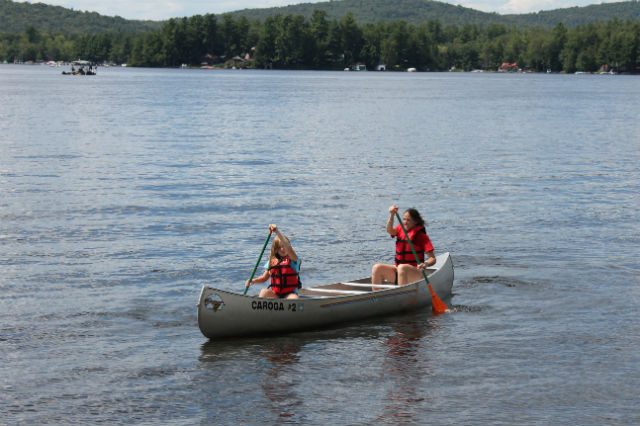
At the Caroga Lake State Campground & Day Use Area, visitors can enjoy boating, fishing and hiking. Rowboat, canoe and kayak rentals are available at the campgrounds, as well as an exercise course with 18 stations, a trailer dump station and a recycling center. Click here for opening and closing days and camping fees.
(Photo: Fulton County Tourism)
Fulton County history
Do you like history? Museums? Fulton County has plenty of both to document its rich history, including early colonial settlements, women’s suffrage and the longstanding local leather and tanning industries.
The pioneering women’s rights activist and abolitionist Elizabeth Cady Stanton was born and raised in Johnstown. She was the first to call for the woman’s right to vote in the United States and helped organize the Seneca Falls Convention.
The Elizabeth Cady Stanton Hometown Association offers a cell phone tour around Johnstown tracing the important sites in Stanton’s early life that shaped her activism, including her 1815 birthplace, school and other historical markers around the city.
Want to learn about the foundation of Johnstown? Start with Johnson Hall State Historic Site. This estate, built in 1763, was the home of Irish immigrant Sir William Johnson, Mohawk Indian Molly Brant, and their eight children. Johnson was the largest single landowner and most influential individual in the settlement and development of the Mohawk Valley, and he served as the Superintendent of Indian Affairs for the British government. Guided tours are $4 for adults, $3 for senior citizens and students, and free for kids 12 and under. Open May through October.
From 1890 to 1950, 90 percent of all gloves sold in the United States were made in the aptly named Gloversville, which is why the Fulton County Historical Society and Museum features a leather and tanning exhibit with a representation of a glove shop. The museum is also home to the Fulton County Baseball & Sports Hall of Fame, along with exhibits that pay tribute to the military, Native American history, and the local railroad. Open from 12 p.m. to 4 p.m. on Thursday to Sunday from Memorial Day Labor Day, and on weekends until Columbus Day. Admission is free.
Although only open July through August, the Caroga Museum in Caroga Lake is a fun summer day trip. Explore their 1905 farmhouse, 1870 cobbler shop and old-fashioned games from the Sherman’s Park Arcade, or check out one of their public barbeques or classes.
(Photo: Fulton County Tourism)
Seasonal activities in Fulton County
While the summer months have camping, boating and swimming, the winter snowfall provides opportunities for snowmobiling, skiing and more.
There are 200 miles of trails for snowmobiling maintained by local clubs, as seen on this map, and many areas for skiing within Fulton County. Royal Mountain, for one, has 40 skiable acres on 12 alpine trails. And at Lapland Lake Nordic Vacation Center, they have a cross-country skiing trail designed by former U.S. Olympic skier Olavi Hirvonen, an ice skating pond, sledding and snow tubing.
For those into ice fishing, there’s the annual Walleye Challenge on the Great Sacandaga Lake. Now held the on the third Saturday in February, the most recent edition welcomed 1,750 fishing enthusiasts to catch fish and compete for prizes.
Even more in Fulton County
Why not catch a ballgame at Parkhurst Field, one of the oldest baseball grounds in America? MLB legends Cy Young and Honus Wagner have played here. Now it hosts travel teams and the Gloversville Little League. A museum is open on game days.
And if you plan on visiting in the fall, you should know that Fulton County is a prime location for fall foliage viewing. See the changing leaves on one of the many hiking trails, which range from brief excursions to the beginning of the 135-mile Northville Lake Placid Trail.
Want to hear about even more places to visit Fulton County? Visit 44lakes.com to learn more about the activities, events and attractions.
AAA is pretty much synonymous with American roads. No surprise, then, that AAA was a driving force behind the America’s Byways program. As a pioneer of scenic routes, AAA introduced maps that highlighted these roads in 1983. It was also at the forefront of the movement to address America’s crumbling roadway system, and save the...
AAA is pretty much synonymous with American roads.
No surprise, then, that AAA was a driving force behind the America’s Byways program.
As a pioneer of scenic routes, AAA introduced maps that highlighted these roads in 1983. It was also at the forefront of the movement to address America’s crumbling roadway system, and save the historic roads it knew so well.
The Federal Highway Administration took up a study of the idea in 1988. AAA, with its long history of mapping, writing travel guides and reviewing tourist facilities along just about every inch of U.S. roadway, provided technical support and expertise that led to the eventual creation of the America’s Byways program.
Helping teens learn to drive safely is one of the most important missions we have at AAA. Why? Because motor vehicle crashes are the leading cause of death for teens in the U.S. At AAA, our commitment to helping teens drive safely dates to the 1940s. That was the start of our successful driver training...
Helping teens learn to drive safely is one of the most important missions we have at AAA. Why? Because motor vehicle crashes are the leading cause of death for teens in the U.S.
John Galvin
At AAA, our commitment to helping teens drive safely dates to the 1940s. That was the start of our successful driver training program, which continues today. Through research and education, we’ve developed classroom curriculum and in-car techniques to help prepare teens for a lifetime of safe driving.
In 2016, there were 3,500 fatalities in crashes involving young drivers. There were more than 200 just in the six states served by AAA Northeast. Crash statistics report the numbers, but they don’t tell the heartbreaking stories of the individuals or their families. Sadly, too many of us have faced the horror of losing a loved one in a traffic accident.
Many accidents involving teens can be directly linked to distraction. In fact, we know that distraction plays a role in nearly 6 out of 10 teen crashes. The primary distractions include teen drivers talking to other passengers in the vehicle or interacting with their smartphones. Teens are also not buckling up enough: In 2015, 60 percent of teen drivers killed in crashes were not wearing a seat belt. And speed is a factor in nearly 30 percent of fatal crashes involving a teen driver.
Parents can play a powerful role by modeling good driving behaviors. It’s also important for parents to help teach teens to drive. And all through their driving years, parents can be effective in-car coaches, set positive examples and manage their teen’s driving privileges.
AAA has been a leader in advocating for increased parental involvement in the teen driving process. Because of our efforts, Connecticut, Massachusetts and Rhode Island have laws requiring parents to take driving classes before their teens receive a permit. Through the work of our AAA Foundation for Traffic Safety, we help parents understand the risk factors for teen drivers. We continue to work every day, in each of our states, to eliminate fatalities.
We can make a difference together. To learn how to prepare teens for the road ahead, visit our teen driving website, TeenDriving.AAA.com.
March is National Colorectal Cancer Awareness Month. For colon health, Dr. Isabelle von Althen-Dagum, a gastroenterologist at St. Catherine of Siena Medical Center in Smithtown, N.Y., recommends a diet high in fish, vegetables and fruits. To foster a colon-healthy diet at home, try these simple meal ideas from von Althen-Dagum. Keep the health kick going...
March is National Colorectal Cancer Awareness Month.
For colon health, Dr. Isabelle von Althen-Dagum, a gastroenterologist at St. Catherine of Siena Medical Center in Smithtown, N.Y., recommends a diet high in fish, vegetables and fruits.
To foster a colon-healthy diet at home, try these simple meal ideas from von Althen-Dagum.
Put 1 cup of almonds, ½ cup of sugar and 2 teaspoons of water into a saucepan. Cook on medium heat, stirring frequently, until the sugar is caramelized and coats the almonds.
Place the almonds on aluminum foil to cool.
Once cooled, sprinkle the almonds over your salad and drizzle with a raspberry vinaigrette dressing.
Credit: bhofack2 / iStock / Thinkstock Dress roasted butternut squash up with chopped cilantro and low-fat cheddar cheese.
Butternut Squash
For a side dish to pair with chicken or fish, try this simple recipe for roasted butternut squash.
Peel and cut the squash into bite-size pieces, then season with olive oil, salt and pepper.
Place the squash onto a baking sheet and roast in the oven for about 30 minutes at 350 degrees.
Once the squash is done (it’s ready if you can pierce it easily with a fork), top it with fresh, chopped cilantro and ½ cup of low-fat, shredded cheddar cheese.
Credit: AnnaPustynnikova / iStock / Thinkstock Put a vegetarian twist on fajitas by using black beans, red beans and chickpeas.
Vegetarian Fajitas
Put a vegetarian twist on a Mexican delight by using canned black beans, red beans and chickpeas as the focus of your fajita.
Rinse the beans and put them in a saucepan with a little bit of water. Warm on the stove until heated through.
Move them to a bowl and toss them with your favorite brand of salsa.
Once mixed, place the beans in the center of a flour tortilla and top with sour cream, guacamole or more salsa.
Lastly, garnish with Dr. von Althen-Dagum’s favorite: cilantro.
Have you tried any of these meals yourself? In what ways do you maintain a colon healthy diet? Tell us in the comments below!
Check out more recipes in our Food for All department.
Picture it: You come home to find Dad watching TV in the living room, flipping between “MASH” and the latest Watergate report on the evening news. You hear the soulful sound of Marvin Gaye on the radio and follow it to find Mom making Jiffy Pop in her avocado-green kitchen, counters and appliances alike splashed...
Picture it: You come home to find Dad watching TV in the living room, flipping between “MASH” and the latest Watergate report on the evening news. You hear the soulful sound of Marvin Gaye on the radio and follow it to find Mom making Jiffy Pop in her avocado-green kitchen, counters and appliances alike splashed with the color.
Yellow-green, olive, avocado. No matter what you called it, or what other earthy tones it was paired with, the 1970s interior design trend was pervasive and, by today’s standards, downright ugly.
But fear not, fans of green, because 2018 has brought the color back in a new way.
According to the “Pinterest 100: The Top Trends to Try in 2018” list, sage is the new neutral in interior design. Sage, a blend of olive and slate, is more muted than its ’70s counterpart, and more often used as an accent color than a theme.
Even avocado green has been given a second chance. Rather than pairing it with orange or gold, the bold choices of the ’70s, the color is paired with neutrals like white, cream, brown or gray.
The common denominator is subtlety. Gone are the days of asparagus-green kitchens and bathrooms and green shag carpets. Rather, think sage accent walls and avocado green pillows.
What do you remember about the 1970s? Are you excited to see the green trend revived? Tell us in the comments below!
You might cover hundreds of miles on your next vacation or business trip, but that doesn’t mean it will be easy to reach the 10,000 steps a day that experts recommend for good health. There are ways, however, to tuck them in. “Every minute counts. Every step counts,” says Heidi Simon of America Walks, a...
You might cover hundreds of miles on your next vacation or business trip, but that doesn’t mean it will be easy to reach the 10,000 steps a day that experts recommend for good health. There are ways, however, to tuck them in. “Every minute counts. Every step counts,” says Heidi Simon of America Walks, a coalition of advocacy organizations dedicated to getting Americans on their feet.
Here are Simon’s tips for your next trip.
Plan Ahead
Check out your destination and your hotel. “A lot of cities have walking tours as ways to get out and explore wherever you might be visiting,” Simon said. When booking a hotel, try to find one in a walkable area so you can take a morning or evening stroll if you’ll be in a seat for most of the day.
Walk in Transit
“If you’re waiting at an airport, you could be walking around the terminal and getting your steps in that way,” Simon said. Some airports – including those in Atlanta, Minneapolis-St. Paul and Portland, Ore. – offer walking paths or walking tours. When traveling by car, Simon recommends taking a 15-minute walk beforehand, and as many short walking stops as you can fit in.
Walk and Play
On vacation, make sure you include one or two activities a day that involve walking. When visiting museums and attractions, get a map from the information desk and plan to explore far-flung corners to help you get some steps in. Or take a walk around the grounds before your visit.
Walk and Work
“We are big supporters of walking meetings,” Simon said. “If you know you’re going to be meeting with someone and it’s a nice day out, maybe suggest that you guys have a conversation as you walk around outside.” Take advantage of physical activity breaks now offered at many conferences, or get in touch with other participants and get a walking group together. “That’s another way to network and make connections,” Simon said.
Improvise
Unexpected downtime is one more chance to get moving. “Sometimes you might just have an extra 15 minutes in your day and see a park down the road that you want to walk to,” said Simon, “and that’s just as healthy as if it was something that was penciled into your schedule.”
How do you get your steps in while you’re on the road? Let us know in the comments!
Need to get away? Visit AAA.com/Travel for ideas and inspiration for your next trip.
The AAA Foundation for Traffic Safety will soon release new information on the driving habits of older drivers. The research is the second phase of the foundation’s groundbreaking senior driver study, the Longitudinal Research on Aging Drivers project, or LongROAD for short. The multiyear project, which began in 2015, has resulted in the largest and...
The AAA Foundation for Traffic Safety will soon release new information on the driving habits of older drivers. The research is the second phase of the foundation’s groundbreaking senior driver study, the Longitudinal Research on Aging Drivers project, or LongROAD for short.
The multiyear project, which began in 2015, has resulted in the largest and most comprehensive senior driver database in existence. AAA will use its findings to better understand the risks senior drivers face and how to counteract them.
In December, the foundation released the first results from the LongROAD study. Researchers found that 90 percent of older drivers do not use accessories, like pedal extensions and seat cushions, that can keep them safer behind the wheel. Those who do use them often do not consult professionals to learn how to install them, something AAA recommends.
The foundation also is expected to release reports on the following subjects this year.
New car reliability
When the rubber hits the road, what new cars can you count on? This report helps prospective buyers choose a reliable set of wheels and examines what causes new cars to break down.
Ride-sharing costs
Many people today would rather summon an Uber or Lyft than own a car in a big city. This study will look at what it costs someone to use a ride-sharing service as their primary mode of transportation.
Apple CarPlay vs. Android Auto
A follow-up to research that found drivers who use voice-based and touch-screen vehicle features while driving were visually and mentally distracted for more than 40 seconds. This project will examine the safety and functionality of these two burgeoning apps.
Since 1947, the not-for-profit AAA Foundation for Traffic Safety has performed research to make roads safer and prevent traffic crashes. Read about recent findings and upcoming projects.
It can be hard to keep up a regular exercise schedule on top of the mountain of spring cleaning chores facing you. But there’s some consolation: Doing housework counts as a form of exercise.
This spring, take advantage of the time you’ll already be spending outside and burn more calories by turning your outdoor chores into workouts.
We’ve paired the following chores with exercises recommended by WebMD, so that you can finish your spring tasks without sacrificing fitness.
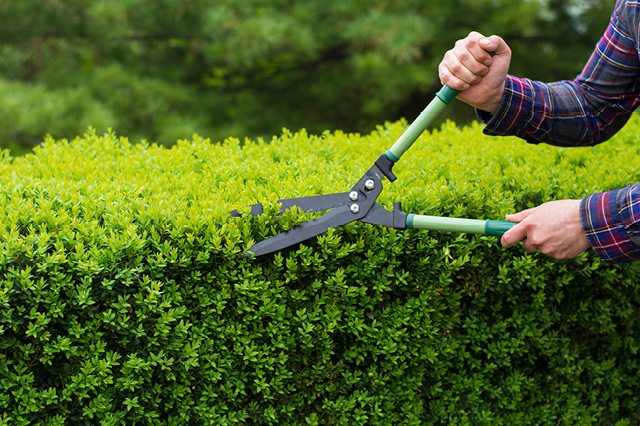
Since you’ll already be reaching up to trim your trees and taller shrubs, why not add calf raises to the task?
Hold on to something, like a stepladder, for balance and stand with your feet hip-width apart. Raise your heels so that you’re standing on your toes, hold, and then lower your heels back down.
Become an Extreme Gardener
While we’re still waiting for “extreme gardening” to be a real thing, you can add exercises like lunges to bump things up a bit.
When pulling weeds, step forward with one leg, keeping your upper body straight and abs tight. Lower your hips until both knees are at a 90-degree angle, and push back up to the starting position to complete the lunge. Then you can pull those pesky weeds out of your garden.
When doing other garden work, be sure to switch the arm you’re working with periodically to equally distribute the muscle work.
Tips
Don’t be afraid to make extra trips. Leave your tools in the garage so that you have to walk back and forth to retrieve them.
Keep your core engaged.
Always use your legs instead of your back when lifting something heavy, like a bag of fertilizer or mulch.
Always consult your doctor before trying any new exercises.
How do you make the most out of your outdoor chores? Tell us in the comments below!
Working out covers one area of fitness. Let AAA Prescription Savings help you ward off springtime ailments by covering medication for your whole family – including your pets!
If you’re moving or planning some cleaning or remodeling this spring, you’ll probably be packing a lot of boxes. Keep in mind these tips from moving experts.
The Best Containers
Boxes and cartons designed specifically for moving can help prevent damage to your items and make packing easier.
Wardrobe boxes are large cardboard containers with a bar across the top for hanging clothing. Move clothes from the closet to the box while still on the hanger and put them back just as easily.
Mirror boxes are slim and rectangular – specifically sized to cushion glass and paintings.
Small, sturdy boxes that are easy to lift and carry are designed for holding heavy items like books and dishes.
The Best Process
Secure fragile items using unprinted paper. Before placing wrapped items in a box, pad the bottom with a stack of wadded paper. Fill gaps with towels, clothing or bubble wrap.
First, pack by room (all the kitchen items together) then, by items (dishes in one box, etc.). Place the heaviest things at the bottom.
Uh-oh. You’re all packed, but now you need something. Label each box by room and what’s inside.
What are your tips for mastering the art of packing boxes? Let us know in the comments below!
AAA members save up to 20 percent on Penske one-way truck rentals when booked online, plus discounts on packing supplies. Learn more.
You’re going to be stuck in the car with your beloved family or friends for an inordinate amount of time. Maybe it will be for the trip you always wanted to take to Walt Disney World Resort (hello, 20-hour drive!) or a shorter jaunt to Amish Country or Niagara Falls.
Whatever the trip, you’re going to need something that can keep everyone happy (and occupied) for an hour. Or two. Or – shudder – 20.
To help you out, we’ve rounded up some family-friendly and general-interest podcasts that should help smooth out any long ride, no matter who calls shotgun, hogs the snacks or takes up way too much room in the back seat.
This science podcast is for both kids and curious adults. Each episode answers a question or looks at a particular topic through a child’s eyes. Molly Bloom hosts, with a different kid each episode co-hosting and various experts chiming in.
Check out “Narwhals: Unicorns of the Sea?” for a good introduction. During it, you’ll learn that only males have the trademark “horn” – it’s really a tusk! – and that they grow in size over time.
The shows have delved into topics like roller coaster designs, the science behind Mary Shelley’s “Frankenstein,” how electricity reaches your outlets, and mystery sounds galore. Everyone – not just the kiddos – will have fun deciphering the various sounds. Hint: They’re never what you think they are!
Episodes are just short enough to keep kids’ attention – podcasts range from 4 to 60 minutes.
Chances are you’ve heard a TED Talk or two. During these short talks – usually less than 18 minutes long – you can learn about everything from AI to the power of introverts to zoology from leading experts in the field.
TED Talks Daily podcasts take these informative video talks and distills them into an audio format. You can find a talk on almost every conceivable subject, from the morals of driverless cars to digital photo archeology to what it’s like to see the Earth from space.
Third-grader Eva Karpman hosts this short podcast aimed at inspiring kids – and their adults – to pursue their passions. Sometimes her mom Olga joins in, too. Each episode is between 20 to 30 minutes long, just perfect for keeping a young one’s attention.
Recent episodes have found Eva talking to Melissa Hartwig, a sports nutritionist behind the Whole 30 food craze; one-handed concert pianist Nicholas McCarthy; and Joe De Sena, who founded the Spartan Race.
Anyone who’s heard “This American Life” knows it’s a special brand of radio show – and luckily for us – podcast. The first episode I ever heard was “House on Loon Lake.” I was in my car running errands, when suddenly I found myself in the middle of the podcast and absolutely unwilling to leave the radio, straining to learn more about the abandoned house and the gang of kids who discovered it. I sat in driveway and listened to the rest of the show for 20 minutes.
The show is that good. Host Ira Glass and his cohorts examine a different theme each week. It’s essential, gripping storytelling that’s extremely hard to explain. But it’s intoxicating and addictive. Most are suitable for all audiences, but you may want to listen to one you’re interested in beforehand to make sure it’s OK for younger listeners. (The website has episodes divided into topics like “Stories Kids Seem to Like,” “Funny Stories” and “Award Winners” to help you choose.)
But be warned: This show has been on the air since 1995, and has hundreds of episodes in its archives. Happy listening!
Anyone who thinks kids (and adults!) spend way too much time on their screens today will appreciate this biweekly podcast where host Kitty Felde chats about middle-grade books, or books that are aimed at readers ages 8-12.
Each episode is 20-minutes long, and discusses all genres, including the classics, not just the teenage vampire pulp that seems to invade the publishing world every few years or so. And the kids are the stars here – discussing what they like and don’t like about books, and asking questions of various authors.
Recent episodes have found children excitedly chatting about Roald Dahl’s “James and the Giant Peach,” Dave Barry’s “The Worst Class Trip Ever” and Kwame Alexander’s “The Crossover.”
If you love silly science, you’ll love this podcast from hosts Guy Raz and Mindy Thomas. I mean, really, how can you not like any podcast where the host imagines pouring pancake batter into a 3-D printer for some quick and easy flapjacks?
Equally silly episodes explore the science of doggo sniffers, the organizational habits of squirrels and the brain-boosting effects of recess.
Most episodes hit the 20-minute mark, just perfect for playing a bunch during a really, really long car ride.
Getting the recommended eight hours of sleep is one way to accomplish a happier, healthier lifestyle. With a good night’s sleep, individuals can experience benefits such as boosted immune systems, improved moods and better brain function. If you’re not getting the best sleep possible, it’s time to go ahead and find yourself a new bed mate – we’re talking about mattresses here – and pave your path to some uninterrupted Zs. So, which is the best type of mattress for you?
There are a lot of things to consider when buying a new mattress. When it comes down to the actual bed, you’ll need to think about firmness, size, and materials. But there are also individual preferences to consider, like your favorite sleeping position or how much you weigh. Some people might even want to factor in old injuries or problem areas. With all of these things to think about, finding the best type of mattress could feel impossible. We break it down and cover the basics.
Which is the Best Type of Mattress For… Side Sleepers
Side sleepers have some pretty unique needs. And since their resting positions often change throughout the night, it’s important to find a mattress that offers all-around support. A side sleeper’s bed should relieve pressure on the hips and shoulders, as well as keep the spine, neck and back aligned. That means you’ll want to look for something between soft and medium on the firmness scale. Foam mattresses, which contour and support the shape of your body without too much pressure, are great options. Side sleepers should look for mattresses with materials like memory foam, latex foam, gel polymer, poly foam, or coils with a pillow top design.
Tip: Proper spine alignment is particularly important when it comes to side sleepers. Place an old pillow between your knees while you sleep. This can help make sure your upper leg is properly supported.
Stomach sleepers should look for mattresses that fall somewhere between medium and firm.
Which is the Best Type of Mattress For… Stomach Sleepers
While side sleepers should focus on beds that contour the body, stomach sleepers should do the exact opposite. Instead, opt for beds that fall somewhere between medium and slightly firmer. This will allow stomach sleepers to remain flat (or as flat as possible) while resting and prevent backs from overarching, which can cause stiffness and prolonged back pain. However, even though stomach sleepers should invest in firmness and support, most still want a bed the feels soft and comfortable. If you find yourself in this category, look for options with highly advanced foam materials ora firm mattress with a thin, but soft foam or pillow-top layer. This should help give you that perfect balance between rigid and soft.
Tip: Stomach sleepers should try to keep their bodies as flat as possible when resting. You’ll want to find a pillow that supports this position. According to Sleepopolis, an overstuffed pillow will elevate the head too much and may lead to extra pressure or spinal misalignment in your neck.
Which is the Best Type of Mattress For… Back Sleepers
Like stomach sleepers, most back sleepers need a mattress that is firm. According to Sleepopolis, the medium to slightly firm range generally provides necessary back support, while remaining soft enough to remove pressure points. However, back sleepers can choose from a wide range when it comes to firmness levels, it all depends on preference. Those with a lower overall weight might find that mattresses that are too firm may cause a “floating” feeling that exacerbates lower back pain. Adjustable foundation mattresses can be a great investment.
Tip: Sleeping on your back can feel a little awkward. If you have some extra pillows lying around, use them to better position your body. According to The Sleep Jungle, placing one pillow under each arm is a great position for back sleepers.
While the information above can help consumers make more informed choices, budget will ultimately decide what type of mattress a person springs for. Before heading out on your next shopping adventure, do some research and consider factors like mattress size and brand, since these will both affect pricing.
How do you decide which is the best type of mattress for you? Let us know in the comments below.
Trying to get more veggies into your diet? March is all about the green – what with St. Patrick’s Day and the start of spring and all – so there’s no better time to try some easy vegetable recipes.
The five dishes below taste great and will help boost your veggie intake this spring.
Food blogger Angela Liddon touts this dish, which is packed with quinoa, spinach, avocado, zucchini, snap peas, carrots and pepitas. Not only does it look gorgeous, it’s also filled with tons of vitamins, fiber and fresh-from-the-garden goodness. It’s a bowlful of sunshine, so welcome after the dreary winter months.
Tender spring asparagus takes center stage in this penne dish with asparagus and cherry tomatoes from Italian food maven Giada De Laurentiis. This quick and easy dish takes just 15 minutes to get from stovetop from tabletop, making it perfect for a weeknight dinner.
Using chocolate as a base is a sneaky yet delicious way to get vegetables into, say, a finicky toddler or reluctant teen. With the addition of avocado, this chocolate avocado pudding from allrecipes.com gets an influx of vitamins and nutrients. According to the U.S. Department of Agriculture, avocados are full of vitamins B, C and E, as well as potassium. Yum!
Tacos are one of my favorite go-to meals. Sometimes I fill them with fake meat crumbles, and sometimes I use fish or black beans instead. But I never through about making them with shrimp until I saw this recipe from garlicmysoul.com. It’s so fresh and easy: Saute up some shrimp, toss with whatever roasted veggies you have, add some salsa and voila. Dinner! (Bonus: My 13-year-old daughter loved this dish. Mom for the win!)
Don’t have time to eat your greens? Drink them instead! With just four ingredients – kale, coconut water, banana and pineapple – this smoothie recipe from realsimple.com will make you feel like you’re vacationing in the tropics, tasty mocktail in hand.
Have a few favorite healthy dinner ideas that you would like to share? Tell us in the comments.
Parking in NYC can be a daunting task. There are lots of signs and rules and parking tickets. And when it comes to expensive parking garages, it’s hard to know where to go to get the best deal for your dollar – or at least feel the least ripped off.
Whether parking on the street, in a lot or at the airport, we’ve gathered hints and tips that will help to get you into a decent NYC parking spot. If you can park here, you can park anywhere!
Alternate Side Parking in NYC
You hear it every morning on the traffic report, “Alternate Side Parking is in effect” or “Alternate Side Parking rules are suspended,” but unless you deal with it every day you’re probably not quite sure what that means. Alternate Side Parking rules are enforced to make room for street sweepers in the morning. Most streets are cleaned twice weekly, once in each direction, and when the rules are in effect you can’t park on the side of the street that is being cleaned.
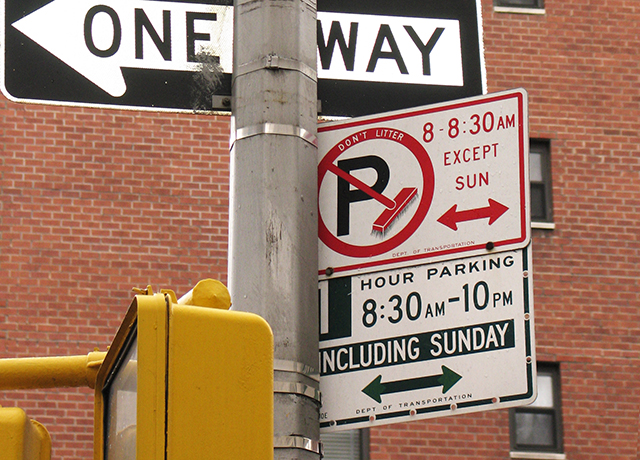
Alternate Side Parking signs can be recognized by a large red “P” crossed out with a broom, citing specific days and hours. For example, a sign may say “11:00 a.m. -12:30 p.m., Monday and Thursday,” which means you would have to move your car no later than 11:00 a.m. on those two days.
The city suspends Alternate Side Parking for holidays and as needed for severe weather or other emergencies. When the rules are suspended, you may park your car in “No Stopping,” “No Standing” and “No Parking” zones, unless the rules are enforced seven days a week (i.e. “No Standing Anytime”). For the calendar of scheduled suspensions and to find out exactly what these very similar but different signs mean, click here.
Parking Garage Tips and Airport Parking
Finding NYC parking on the street is no easy task, but parking garages can get expensive. Once again, it pays to plan ahead and do a little research before you pull into the first and closest lot you see. Thankfully, there are many websites and apps to compare rates, get discounts, and even find and reserve your parking space in advance.
One of the most convenient and economical ways to get to the airport is to drop your car off at a lot that has free and continuous shuttle service. Perhaps you’ve seen the yellow and black spotted Swiss cheese-looking shuttles driving along the Belt Parkway – that’s The Parking Spot, an affordable, 24/7 airport parking service. The Parking Spot provides full-service, nearby parking to 21 major airports in the U.S. including LaGuardia and Newark. It offers free valet service, luggage assistance and free shuttle service that operates every five to seven minutes.For flyers headed to JFK, you can click here for ways to save on long-term parking.
Street Parking in NYC
To avoid getting stuck with a parking ticket (about $70 on average) pay attention to the meter and/or time restrictions and keep an eye out for Alternate Side Parking rules and suspensions. Read the signs carefully; metered parking limits range from 1-12 hours and vary from block to block, sometimes even on different sides of the same street.
Parking rules are strictly enforced and you will get a ticket – or get towed. All of New York is a designated Tow-Away Zone. For anything from an illegally parked car to an expired registration, you may be headed to the tow yard.
Gone are the days of digging through your pockets and searching under the car mats for change. NYC Parking Cardscan be purchased online from the Department of Transportation and can be used for street parking and in municipal lots. Load it up in prepaid denominations of $20, $50 or $100, then just swipe and go. Except of course on Sundays, when metered parking in NYC is free throughout the five boroughs.
Whenever venturing into the city, always think ahead. Consider how potential obstacles such as traffic, construction and holidays, may affect your travel time and parking options. Plan your route accordingly.
Do you have any tips for parking in NYC that you would like to add? Let us know in the comments.
Taking a cruise is a fantastic way to see amazing sights while vacationing with ease. But if all your cruising daydreams take you only to palm trees and tropical beaches, then you’re missing out.
If you love nature and the great outdoors – or have ever dreamed of visiting the 49th state – a cruise is one of the best ways you can experience Alaska’s breathtaking natural beauty.
Intrigued? Read on to learn more about the unique experiences an Alaskan cruise has to offer.
Natural beauty
The Last Frontier is home to spectacular natural phenomena, much of which is best enjoyed from the water. From the comfort of your cruise ship you’ll witness amazing wildlife and stunning views. Here are just a few of the incredible sights on your Alaskan cruise for which you’ll have a front row seat.
The Inside Passage: Weaving between islands and fjords, mountains and glaciers, few routes in the world can rival this waterway’s scenic views. It’s also home to a thriving ecosystem of marine life. Typical sights include whales, bald eagles, sea lions, porpoises and sea otters.
Tracy Arm: Located near Juneau, this narrow fjord is home to some of Alaska’s largest glaciers and is surrounded by forested mountains, waterfalls and vibrant wildlife on sea and land. Watch and hear the thunderous sound of “calving” – icebergs breaking off from the glaciers and falling into the sea!
Hubbard Glacier: Known as “the galloping glacier,” this 600 foot tall glacier races toward the sea at an impressive 80 feet per year. With its stunning blue color and constant calving activity, Hubbard Glacier is spectacular to behold.
Hubbard Glacier.
Fun excursions
While there’s so much to see from the grand vantage of your cruise ship, you will be equally amazed at the host of fun land excursions to pick from.
Ketchikan Zipline: Ready for adventure? The Ketchikan Zipline is an exhilarating ride through the canopy of the lush Tongass National Forest. Enjoy a stunning bird’s eye view of the rainforest and see how many bald eagles you can spot!
White Pass & Yukon Route Railroad: Hop aboard a vintage train car and follow in the literal tracks of the Klondike gold prospectors. This narrow-gauge railway ascends nearly 3000 feet in elevation in only 20 miles, providing nonstop panoramic scenes and an impressive view from the summit.
Misty Fjords: Travel via floatplane to this vast wilderness stretching along the Inside Passage, and admire the pristine lakes, waterfalls and jaw-dropping granite cliff faces.
Denali National Park: Visit the interior of Denali National Park on a cruisetour. With six million acres of breathtaking wilderness and the highest peak in North America, this park is chock full of things to do and ways to explore! From hiking and snowshoeing, to white water rafting and helicopter tours, to zooming through in a jeep or ATV. Learn to drive a dog sled, or grab some down time by playing with the puppies at the Husky Homestead.
Fascinating destinations
From bustling cities to charming mountain towns, Alaska’s settlements are home to rich history, breathtaking views and a thriving lifestyle.
Skagway: Step back in time and explore Alaskan history through this picturesque mining town. Take a walking tour through the historic district and be transported back to the 1898 gold rush. Have a pint of spruce tip ale at the Skagway Brewing Company. Take a (shockingly) refreshing dip in the glacial waters of Lower Dewey Lake. Or explore what nature has to offer in the stunning alpine environment.
Juneau: This city has the distinction of being the second largest in the US (by area), and is the only state capital that cannot be reached by road. Explore the easily accessible Mendenhall Glacier. Take a thrilling tramway ride up 1,800 feet to the summit of Mt. Roberts. Watch for whales, bears, eagles and more on a wildlife tour. Or set out on Juneau’s impressive 250+ miles of hiking trails with panoramic views of lakes, glaciers, mountains, and the city itself.
Ketchikan: There are so many opportunities to play and learn in this quaint mountain town. Watch the incredible journey of King Salmon swimming up Ketchikan creek. Learn about the history and arts of native peoples and view the world’s largest collection of totem poles. And don’t forget to save some time for flightseeing, snorkeling, and a spin on the famous zip lines.
Luxurious onboard experiences
Just because you’re touring wild, rugged Alaska, doesn’t mean your Alaskan cruise will lack luxury. When you’re not out adventuring, there are plenty of amenities to enjoy from the comfort of your ship.
Food: Sip cocktails and enjoy fine dining, or relax in a casual atmosphere. Your ship offers a variety of specialty restaurants, bars, and lounges to choose from. Traveling by cruise allows you to enjoy the culinary expertise of world class chefs – even in the world’s most remote areas.
Spa & fitness: There’s no need to neglect your wellness during your trip! Take advantage of the luxurious spa and fitness facilities onboard. Relax in the sauna, keep up with your normal workout routine, or pop in for a yoga or spin class.
Events, parties and entertainment: It wouldn’t be a cruise without incredible entertainment. Enjoy live music and exciting performances, then dance the night away when the DJ takes the stage.
Activities for kids and teens: The cruise experience can be magical for the whole family! Engage in fun, family-centered activities that are great for all ages. Let your teens do their thing in a (supervised) teen hangout space. Keep learning at the center with an exciting summer camp program. Drop your little ones off at a kid-focused event or employ a babysitter so you can squeeze in a few hours of adult time.
What about you? Are you ready for your own Alaskan cruise adventure? Happy adventuring!
Your phone is, in essence, you. Photos and experiences from your travels, messages to your friends and loved ones, banking information, passwords, your calendar – all this information, and more, may be found on your smartphone. And with all this data, it’s easy to see how losing your phone can be scary. But what about the less obvious threats, like automatic location sharing?
As we continue to get connected and share our lives through social media, it’s important to keep ourselves and our information secure. Check out our top 3 cyber security tips on how to keep enjoying the conveniences of your smartphone without oversharing.
Use a passcode
Your smartphone’s lock screen is the first line of defense against people who might want to sift through your personal data. You’ll want to make a strong passcode. Devices have options for traditional PINs, unique passwords, fingerprint IDs and even facial recognition. While the best security measure is to utilize at least two of these options, not everyone is comfortable with fancy biometrics. And that’s okay – just be sure to use some form of security.
PINs are easy to remember, but hacking them is also as easy as a quick glance over the shoulder. Instead use a unique passcode that mixes letters, numbers and symbols – one that you haven’t used before. And for even greater precautions, use these passcode cyber security tips:
Set the lock screen to reappear after a short window of no activity. It’s best to keep it between 30 seconds to 1 minute, but never go above the 5-minute mark. Otherwise, even with a passcode, there will be a large window for others to get a hold of your info.
Have your device automatically wipe its data after a certain number of failed login attempts. If your phone is lost or stolen, this will ensure that other people can’t access your information.
Change your passcode from time to time. It will help keep would-be intruders guessing.
Be wary of public Wi-Fi
Free Wi-Fi has become a standard in restaurants, coffee houses, hotels, airports and other communal spaces around the world. Convenient, yes, but public Wi-Fi should probably come with a warning: Log in at your own risk. Susceptible to cyber-attacks, your personal and financial data are vulnerable on public Wi-Fi. How do you keep your information protected?
Avoiding public Wi-Fi altogether is the most effective way to stay safe. And that leaves smartphone users with unlimited data plans at an advantage. Travelers can simply turn on their phone’s personal hotspot to connect a laptop, iPad or another Wi-Fi enabled gadget to their secure network. But if you’re traveling with a large group, you’ll need a device with a little more oomph. Portable Wi-Fi Gadgets, although palm-sized, can usually connect up to 10 devices without sacrificing internet speed and will work anywhere there’s network coverage.
Still, things happen, and sometimes using public Wi-Fi is unavoidable. So, if you find yourself connected to Starbuck’s free Wi-Fi on your next coffee run, here are some of the most important cyber security tips to remember:
Accidentally connecting to a “fake” hotspot is easier than you think. So, make sure to turn off your phone’s “automatically connect to Wi-Fi whenever it’s available” feature. And always ask an owner or employee at the location you’re visiting for the Wi-Fi details, including the network name.
When using public Wi-Fi, don’t pay bills, do online banking or access other sensitive data. Yes, that includes e-mail and social media, like Facebook, which can sometimes share sensitive info. Only use public Wi-Fi to surf the web.
Use a VPN, or Virtual Private Network, to connect to public Wi-Fi whenever possible.
Share your location sparingly
Whether you’re headed out of town for a business trip or a vacation, it’s best to keep that information to yourself. Seriously. Uploading a post that tells all of your Facebook friends and their friends that you’ll be gone for a week, puts your home and your valuables at risk.
Even if you don’t post your location and vacay plans on social media, chances are you’re still sharing plenty. Most smartphones and apps automatically share your location. And as automatic geotagging features and geolocation apps grow in popularity, consumers might want to think twice about who their sharing this information with and how often.
When you take a photo, most smartphones will capture your geographical location as well. And while that might seem harmless, and maybe even cool, this geotagging feature can be risky. Geotags, which don’t appear on actual images the way time stamps do, are stored in the photo’s metadata. And that tag can include your exact GPS location.
That picture you just posted of your awesome, new flat screen TV? Criminals can easily retrieve its location (your address!) using EXIF (Exchangeable Image File) viewer apps. And to make matters worse, if you like geotagging your Facebook posts and tweets, those same criminals will know when you aren’t home, making your valuables easy pickings.
How do you protect your information and prevent oversharing? Here are some cyber security tips that will help:
Turn off location services. While some apps like “Find my iPhone” and maps require location sharing to work properly, it’s unnecessary for others. From data-sensitive apps like your mobile wallet, to game apps, your location may be shared. Head to your smartphone’s privacy settings and look for location services. You’ll want to individually turn off location sharing for any app you think might put you and your information at risk.
Remove image geotags using EXIF viewer apps and editors, such as deGeo(iOS) or other.
While these top 3 cyber security tips are essential, it’s important to remember that they aren’t the only ones to worry about. From making sure you don’t automatically save usernames and passwords in your apps to updating software regularly, there are plenty of things to consider when it comes to the safety of your personal information.
What cyber security tips do you exercise in your day to day phone use? Let us know in the comments below.
Some of our fondest memories are from life’s special occasions – a family vacation, your child’s graduation, or perhaps a milestone wedding anniversary.
But these special moments often come with a high price tag, and stressing over how to afford the bill can greatly detract from your experience of the event.
It’s important to build savings and be financially ready when these important moments occur, so you can enjoy them to the fullest and not be saddled with inconvenient expenses or credit card debt.
We know saving can feel tough, so we’ve put together some simple tips for how you can save in advance for the moments that matter most to you. Follow these 5 tips to ensure you’re prepared for all the momentous occasions in your life.
Plan Ahead
Map out the big events or trips you have coming up in the next one to two years (or further out if needed). Knowing a special occasion is on the horizon allows you to start setting aside the funds you’ll need to enjoy it the right way.
Do some research to estimate what the final price tag will look like. If you’re planning a trip, find out the approximate cost for travel, lodging and activities. If you’re planning a celebration, consider whether you’ll need to rent a venue or pay for catering. Don’t let unexpected expenses take away from your experience!
Once you know the total amount you’d like to save for your special occasion, plus how much time you have to reach your goal, you can calculate the exact amount you’ll need to save each month.
You’ll find it’s much easier to save when you have a clear, measurable goal that you’re working toward!
Automate Your Savings
A great way to make sure you actually save your desired amount each month is to open a savings account specifically for the event, and to have your savings amount automatically withdrawn from your paycheck.
So if you plan to spend $2000 on your child’s graduation party, and you have 6 months to build your savings, you would transfer $333 ($2000 ÷ 6) to your new account each month or $166 per paycheck if you’re paid twice a month.
With your savings on autopilot you won’t have to worry about forgetting to save, or risk the temptation of spending those funds on something else. Plus, with a separate savings account you can easily watch your progress as you work toward your goal.
If your saving plan is short term, such as a year or less, you can maximize your savings by opening a savings account that accrues interest. For long term saving, consider putting your money in an investment account to get an even higher return.
Cut Unnecessary Spending
What if the amount you want to save from your paycheck cuts into your budget for everyday expenses? You may want to examine your budget and see if there’s any unnecessary spending you can cut out so that more of your income can go toward savings.
Adjusting your budget could mean some simple changes, like reducing how frequently you eat out, brewing coffee at home instead of paying Starbucks, or drinking less alcohol. If you’re ready to make a bigger change, consider canceling or negotiating your cable service or switching your cell phone carrier.
Remember, you’re cutting out non-essential expenses now so that you can spend later on the moments that matter. So be sure to have a clear goal of what you’re working toward and an easy way to measure your progress. If you’re foregoing fun now but don’t have a clear picture of the wonderful payoff, it will be much harder to stick to your new budget.
Save Points
Many credit cards offer rewards in the form of points that can be redeemed for expenses like airfare, rental cars, lodging, and dining. Going into debt for your vacation or honeymoon is not a good plan, but having a credit card that accrues points you can spend on travel is a great way to make your dollars go further.
Instead of using your credit card for purchases you can’t afford, use it to pay for items that were already in your budget like gas, groceries and utility bills. Then pay off your balance in full.
You’ll earn points that you can use toward special occasions, and with your balance paid off you won’t be charged interest. Some credit cards will even reward you with cash back or extra points for making certain purchases.
When you pay for portions of your trip with points, this allows you to have a smaller savings goal – or to put those extra savings toward upgrading your trip.
Increase Your Income
If you have big goals for saving and would rather not cut back on your current lifestyle (or are unable to), you may want to think about ways you can increase your income.
You don’t need a salary increase to make extra money (though asking for a raise could be a quick way to reach your goals). These days there are many opportunities to earn extra cash.
Use your professional skills to pick up some freelance work, like filing taxes, doing bookkeeping, or helping small businesses with their marketing. Get some quick cash through pet sitting or providing childcare. Have a garage sale to sell older housewares, or head to the internet to sell nicer items like collectibles and designer clothing.
Are you a whiz at math? Writing? Speaking Spanish? Become a tutor! Students from elementary age through college need tutoring.
Have an empty room now that your child’s moved out? Rent it out to travelers on AirBnB. Or drive for a rideshare service like Uber or Lyft. These services are always recruiting and typically offer generous signup bonuses for new drivers.
Whatever hustle you choose, be sure you’re using your earnings to build savings and get closer to your goals!
What about you? What are the best tactics you’ve used to build savings for life’s special occasions?