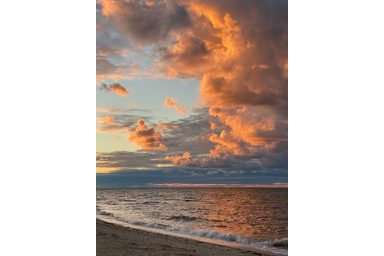
Santa Cruz: The Best-Kept Secret in California?

Santa Cruz County is nestled in the geographic shadow of San Francisco and San Jose.

And that’s kind of fitting because it’s often overshadowed, at least in popular culture, by those two wildly different siblings: one an artistic free-spirit and the other, Silicon Valley, a highly caffeinated entrepreneur.

But Santa Cruz presents a different vision of California. Here, you can surf and go mountain hiking in the same day, or explore ancient redwoods before riding a heritage railroad car to an iconic amusement park on the beach.

Santa Cruz is characterized by an unhurried pace, the epitome of Northern California cool, in contrast to San Jose’s hustle. It’s both agricultural and coastal, historic and progressive at the same time. Its city is quaint, unlike San Francisco, and the county’s expansive footprint and Mediterranean climate offer a dynamic range of outdoor activities.

Even wildlife knows it’s a special place: Butterflies and humpback whales stop there on annual migrations down the coast. And that’s where the tale of Santa Cruz starts, along the coast, where the city’s brand was seared into popular culture.

The OG Surf City

In July 1885, three Hawaiian princes – Prince David Kawānanakoa, Prince Edward Abnel Keliʻiahonui and Prince Jonah Kalanianaʻole – hopped on some locally milled redwood planks and surfed in Santa Cruz. It was the first recorded description of surfing in California.

Ever since, Santa Cruz and surfing have become synonymous, have grown up together. The local newspaper coined the term Surf City in 1927 (a name that Huntington Beach unfairly co-opted decades later). And naturally, the city’s home to the world’s first surfing museum.

Calling Santa Cruz a “best-kept secret” is ridiculous to any surfer. Santa Cruz has 11 world-class breaks, meaning it has some of the best waves on the planet. It hosts surfing competitions such as the International Longboard Association Contest and the O’Neill Cold Water Classic – the latter a reminder that wetsuits were invented here. O’Neill Wetsuits was founded after local surfer Jack O’Neill experimented with material so he could stay in the water longer when it grew cold.

But surfing is just one facet of Santa Cruz aquatic life.

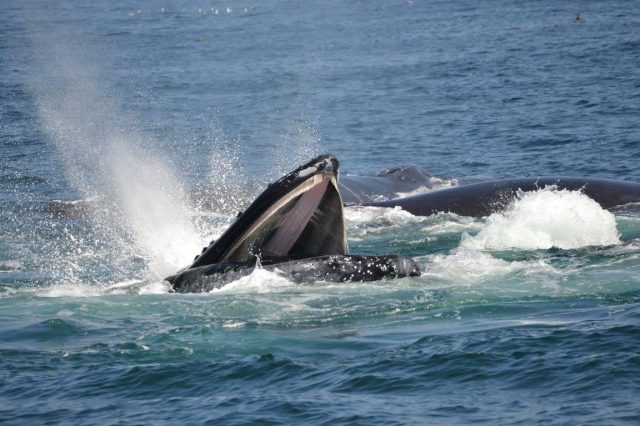
You can go whale watching pretty much any time of year. The humpback whale is an annual Monterey Bay visitor from spring to fall. And about 20,000 gray whales swim through these waters twice a year, from December to April.

Dolphins, sea otters and sea lions are also local denizens of the deep. And is there anything cuter than watching a sea otter go about its day?

As the presence of so much sea life would suggest, the fishing is pretty good, too. You can do the deep-sea thing, or head up to the mountains for freshwater fish or just cast a line off of the wharf.
santa cruz boardwalk

An Iconic Coastline

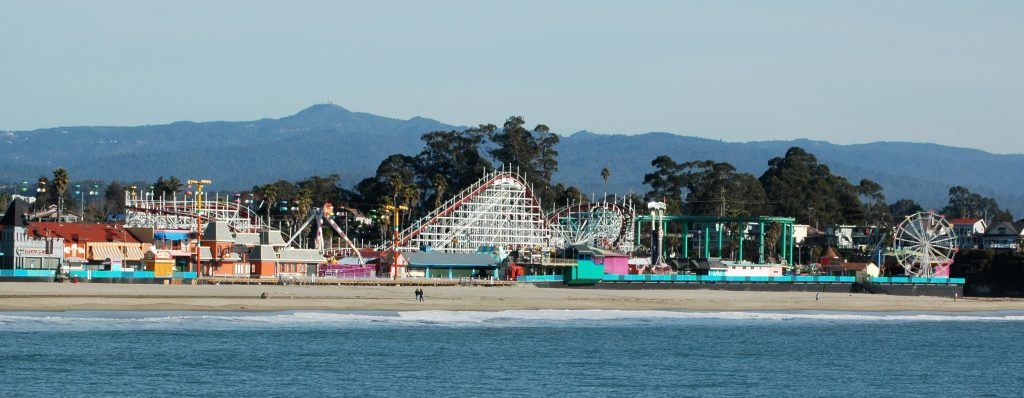
Anyone who’s seen “The Lost Boys” or “Us” will instantly recognize the iconic Santa Cruz Beach Boardwalk, California’s oldest amusement park.

The park, built along the northern shores of Monterey Bay, has been in operation since 1907. Two of its rides are registered National Historic Landmarks.

The Looff Carousel, operating since 1911, is one of only six carousels in the country with its original brass ring dispenser. The ride’s 324-pipe organ, separately constructed in the 1890s, is still intact.

Then there’s the Giant Dipper. Built in 1924, it’s one of the 10 oldest operating wooden roller coasters in the world. And it’s still thrilling visitors nearly a century later. Even by modern standards, it’s a great ride. The coaster peaks out at 70 feet and reaches 55 mph, and there are a few moments where your stomach will drop and drop again.

Taken together, the boardwalk is an experience all its own. While its architecture harkens back to a golden age, the park is no dusty museum. It’s still vibrant and a heck of a lot of fun for kids of all ages.
santa cruz forest

Naturally Speaking  

If amusement parks aren’t your thing, there’s plenty more to see. Santa Cruz is replete with natural splendor.

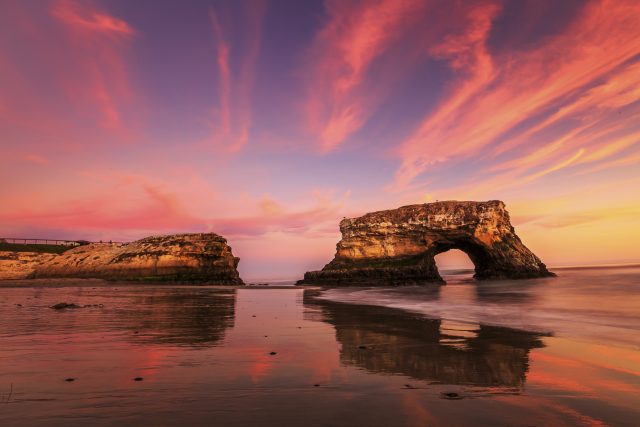
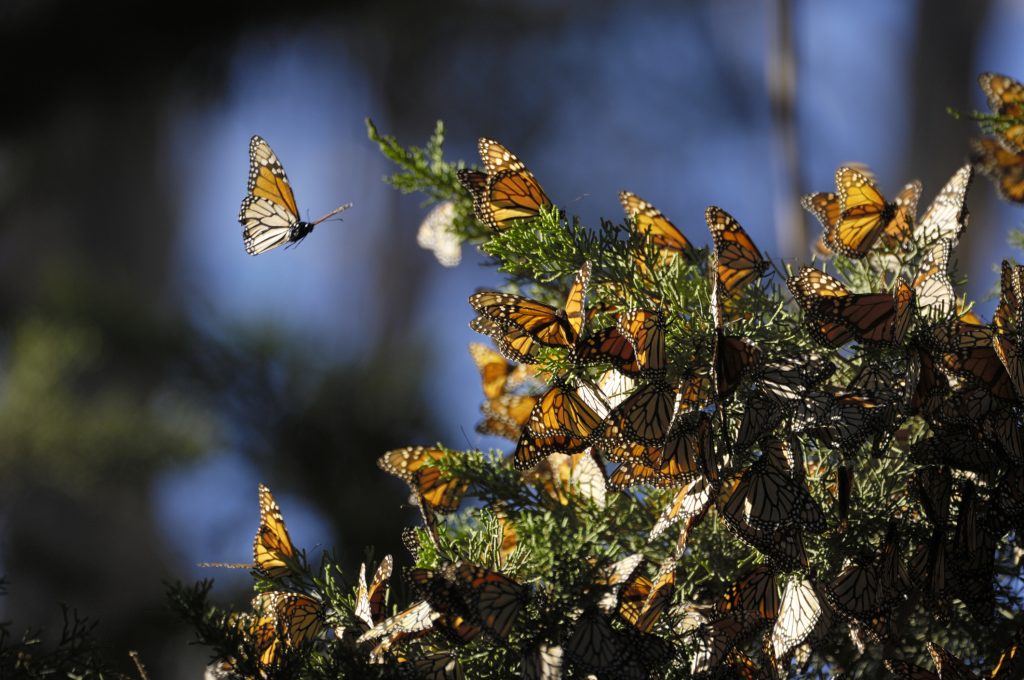
Natural Bridges State Park (named after the once-intact rock formations pictured at the top of this article) features more than just a gorgeous spot on the coast. The park’s Monarch Grove is home to migrating masses of butterflies from October through February.

There are so many butterflies at times that they form a sort of “living tree.” When you first lay eyes on them all huddled together on a branch, it looks like a mass of leaves – until each leaf flies away. The scent of eucalyptus trees permeates the grove and of course, the ubiquitous towering redwoods abound.

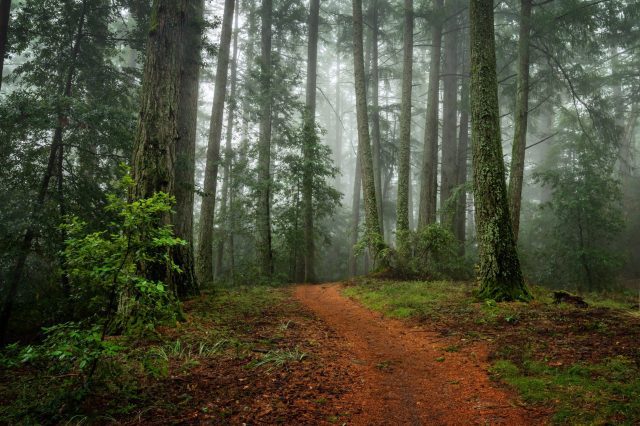
The redwoods and geography of Henry Cowell State Park are so stunning, they inspired President Theodore Roosevelt to hasten federal parkland initiatives. Old-growth redwood trees (some as old as 1,500 years) inhabit 40 of the park’s 4,650 acres, which also encompass grasslands, sand hills, and the San Lorenzo River. You may also bump into deer, bobcats, coyotes and of course banana slugs (which are, no joke, the official mascot of the University of California, Santa Cruz).

Hiking and mountain biking are also popular here given the miles of trails, and Henry Cowell is just one of many campsite opportunities. There are 14 state parks and beaches in Santa Cruz County.
santa cruz

Wait, There’s More

Santa Cruz offers much more than sand, surf and redwoods. Its mountains are home to more than 30 wineries including popular Ridge Vineyards and Rhys Vineyards. And the city’s downtown is packed with public art, live music venues, bars, restaurants, small shops and occasional street performers.

There’s history to explore, too. The oldest human settlement, in nearby Scotts Valley, dates back 12,000 years. The Ohlones tribe settled along the coast about 8,000 years ago. And the city’s Chinatown as well as its nearby mission, offers some more recent history lessons.

Santa Cruz should be on any tourist’s California radar, even if just for a day trip. And getting there can be half the fun. From San Jose, you’ll drive through scenic mountains toward the coast.

And Santa Cruz is just a 90-minute drive south along the stunning Pacific Coast Highway from San Francisco. If you keep driving, Big Sur isn’t far behind.

Take the hassle out of travel and book an adventure today with AAA Travel!

What’s your favorite “best-kept secret” spot? Let us know in the comments below.

Subscribe to Your AAA Newsletter

Sign up and receive updates for all of the latest articles on automotive, travel, money, lifestyle and so much more!

Podcast Pulse: The Spookiest Halloween Podcasts

Halloween Month (or October, as some call it) is upon us, and with it comes all the joys of autumn, like pumpkin pie, costumes and ghouls. Lots of ghouls. To hype yourself up for the best October yet, here are some spooky, scary podcasts for Halloween.

Spooked

“Spooked” started out as a recurring special episode on storytelling podcast “Snap Judgement.” It was so popular that “Snap Judgement’s” host, Glynn Washington, spun “Spooked” off into its very own show. Guests tell stories about their experiences with the paranormal and their encounters with the unexplainable. They’re ostensibly true, but they sound like campfire stories come to life – the perfect Halloween podcasts.

Recommended episodes: The Night Whistler, Hush, The Wraith, A Friend in the Forest

Criminal

“Criminal” is unlike other true crime podcasts, because it’s not really interested in gore. Still, that doesn’t mean it’s not terrifying at times. Nothing is more bone-chilling than listening to host Phoebe Judge calmly tell you a story about a stranger living in a woman’s attic. “Criminal” is one of the best podcasts out there, with magnificent audio production and reporting. Judge also has the perfect voice for a podcast like this – cool and collected, but also occasionally spine-tingling.

Recommended episodes: Baby Snatcher, The Job, The “It” Girl, Unexpected Guests, Secrets and Séances, A Bump in the Night

Radio Rental

“Radio Rental” is a podcast about real-life horror stories, told by those who lived them, produced by Atlanta Monster’s Payne Lindsey. Although the stories are real, the podcast is hosted by a video store clerk named Terry Carnation, played by Rainn Wilson. This framing device provides some much-needed levity when the stories get a little too close to home. “Radio Rental” is all about close calls, mysterious strangers, weird memories and last-minute twists. I inhaled the entire show in about two days, since I just couldn’t stop listening.

Recommended episodes: Episode 04, Episode 13

Lore

Host Aaron Mahnke explores the historic origins of humanity’s creepiest folktales and ghost stories. It’s a history podcast and a horror podcast all in one – and Mahnke’s calm, dulcet tones make it seem almost like a campfire story. Tune in for stories of people burying themselves alive, staging pictures with ghosts, accusing one another of being vampires and so much more.

Recommended episodes: Perspective, Under Siege, Teacher’s Pet, Broken Fingernails, The Castle

My Favorite Murder

Karen Kilgariff and Georgia Hardstark love murder – but not in that way. “My Favorite Murder” is a true crime podcast about the joy of telling horror stories to your friends. Every week, Kilgariff and Hardstark trade (lightly-researched) stories about murderers. Nothing captures the spirit of Halloween quite like joking about serial killers and real-life monsters.

Recommended episodes: 186 – Sprankers!, MFM Minisode 134 – The Ghosts, 170 – Habeas Delicious, 167 – Bomb Grade, 136 – The Uninhibited, 118 – Golden State Killer Caught!, 92 – The Halloween Special

RedHanded

In some ways, “RedHanded” can be similar to “My Favorite Murder.” Friends Suruthi Bala and Hannah Maguire get together to tell a true crime story together, but since they’re telling the same story, they can often do more research and go deeper into detail. Although they’re not afraid of making jokes sometimes, “RedHanded” can get pretty serious and gruesome. A lot of the episodes have a charming DIY feel, with Bala and Maguire making references to being “under the blanket,” AKA sitting under their duvet covers to record. Even though  the show has gotten more successful over the years, it’s still obvious that Bala and Maguire are doing this because they love to do it. Be warned: “RedHanded” gets dark.

Recommended episodes: Episode 109 – Andrea Yates & The Devil, Episode 100 – Gilberto Valle: Cannibal Cop, Episode 88 – The Mysterious Death of Elisa Lam, Episode 52 – Cruise Crime: The Disappearance of Amy Bradley

Dr. Death: Dr. Duntsch

“Dr. Death” is the terrifying true story of Dr. Christopher Duntsch, a Dallas neurosurgeon. Bad back? Chronic pain? Don’t go under this doctor’s knife. Dr. Duntsch had a nasty habit of turning spine surgeries into grisly hack jobs (that only some of his patients survived). “Dr. Death” is the story of a dangerous doctor – and the whistleblowers who took him down.

Listen from beginning to end.

Sawbones

Podcaster Justin McElroy and Dr. Sydnee McElroy take listeners on a tour of the messed-up things people have been doing to their bodies for centuries. “Sawbones” is a podcast about medical history – particularly about the strangest parts of medical history. Due to its proximity to sheer body horror, some of the episodes get especially ghoulish – though the McElroys endeavor to make it as light-hearted as possible.

Recommended episodes: Bleach, Possession, Asbestos, Medical Astrology, The (Maybe) Real Dr. Frankenstein, The Dancing Plague, Sleepwalking

Stuff You Missed in History Class

“Stuff You Missed in History Class” is a venerable old podcast with a huge back catalog of episodes for new listeners to trawl through. For most of the year, “Stuff You Missed in History Class” is a calm, well-researched podcast about the forgotten corners of history. But every October, they deliver a series of new Halloween podcasts. Hosts Tracy V. Wilson and Holly Frey tell spooky stories about historical ghosts, haunted houses, colonial vampires and the history of Halloween pop culture.

Recommended episodes: The Allegedly Haunted Island of Poveglia, New England Vampire Panic, Edward Gorey, Building Disneyland’s Haunted Mansion, A Cruise Through History’s Ghost Ships, Ghosts of History: Versailles (This episode is over ten years old!)

Spooky Audio Dramas

Sometimes there’s nothing better than a good old-fashioned ghost story. The following fiction podcasts are sure to deliver spooks and scares (or at least some creepy-crawlies). They’re a great addition to your list of Halloween podcasts.

Recommended audio dramas: Welcome to Night Vale, The Magnus Archives, Alice Isn’t Dead, Limetown

Looking for some more podcasts? Check out Podcast Pulse articles about shows for new listeners, the best comedy podcasts and ways to find the perfect show for you.

Do you have any spooky stories that have happened to you? Let us know in the comments below!

Subscribe to Your AAA Newsletter

Sign up and receive updates for all of the latest articles on automotive, travel, money, lifestyle and so much more!

Unwrap an Adventure This Holiday Season 

With shortages and shipping delays predicted for this holiday season, experts are warning consumers to start shopping early.  

This year, why not accumulate memories instead of more “things”? Join AAA Northeast for its incredible Vacation Sale Nov. 6, from 9 a.m.-3 p.m. You’ll find no lines, no delays and no hassle – just plenty of travel-planning anticipation and some of the year’s best prices. 

“It’s the perfect time to give the gift of travel,” said Chelsea San Martino, director of travel marketing at AAA Northeast. “There’s no stress and no shortages when you’re planning a getaway with family or friends.”  

Pre-Black Friday Vacation Sale

One day only, 11/6. No lines. No shipping. Unwrap an adventure.

Register Here

The online event will feature pre-Black Friday deals like discounts on international getaways, reduced cruise fares, onboard credits and more. Attendees could save $1,400 on worldwide vacations, up to $3,100 on river cruises and $1,300 on cruises, and get up to 50% off on Caribbean getaways. 

Those who book at the show will be eligible for up to $400 cash back at time of departure or up to $800 in future travel credits. AAA Travel advisors will be available during the event for help with questions and options. 

For more information and to register for the free event, visit AAAVacationSale.com.

Subscribe to Your AAA Newsletter

Sign up and receive updates for all of the latest articles on automotive, travel, money, lifestyle and so much more!

What Does and Doesn’t Affect Your Credit Score

Your credit score provides potential lenders with an easy way to evaluate your creditworthiness. A high credit score can open a lot of doors, such as buying a car or house. A low score, on the other hand, can make your goals harder to reach.

Not knowing what affects your credit score is akin to trying to ace an exam for a class you never took. With that in mind, let’s take a refresher course on what does and doesn’t affect this all-important number.

What Does Affect Your Credit Score

Payment History

Five main factors affect your credit score, but none hold more weight than your payment history. This category shows lenders whether or not you’ve paid past credit balances on time, including those for credit cards, mortgages, and student and car loans. It also takes into consideration factors such as how overdue late payments were, the amount of money still owed and how much time has passed since any delinquencies.

Credit Utilization

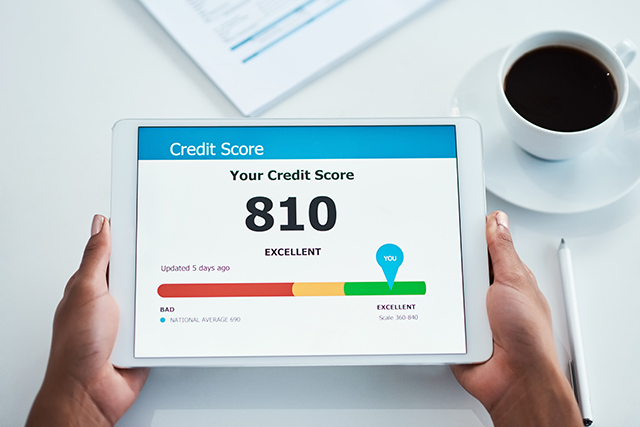
Credit utilization refers to the percentage of available credit you’re using. For example, if you have a $10,000 monthly credit card limit but only put $1,000 worth of charges on the card that month, you would have a credit utilization rate of 10%. (Remember, having credit and using credit are two different things.) It’s recommended to keep your rate below 30%, but the lower the better.

Credit History Length

Generally, the longer your credit history, the better. This is especially true if you have a strong payment history. It proves to lenders that you’re likely to continue such behavior in the future. Credit history length includes items such as the age of your oldest and newest accounts, and the average age of all your accounts.

Hard Credit Inquiries

Whenever you apply for a new line of credit, the lender will request to see your credit report in order to determine your eligibility. This is what’s known as a “hard inquiry.” Each hard inquiry will cause a temporary drop in your credit score that usually only lasts for a few months.

Credit Mix

It’s good to have a mix of revolving credit, such as credit cards, and installment credit, such as mortgages, car loans and student loans. Credit mix doesn’t have a huge impact on your credit score, however, so you can still have a high score without having both credit types on your report.

how to build your credit score

What Doesn’t Affect Your Credit Score

Shopping for Low Interest Rates

As mentioned above, applying for a loan, mortgage or credit card will trigger a hard inquiry by the lender, negatively impacting your credit score. Shopping around for lowest interest rates will require multiple inquiries over a short period of time. Fortunately, credit bureaus will recognize you’re simply applying with multiple lenders in order to compare rates and treat it as a single inquiry.

Checking Your Credit Score

Requesting your own credit report results in what’s known as a soft inquiry, which has no impact on your credit score. You’re entitled to one free annual credit report from each of the credit bureaus – Equifax, Experian and TransUnion. During the COVID-19 pandemic, these companies are offering free weekly online credit reports. 

Getting Married

Your credit score is yours and yours alone, even after you get married. If your spouse has bad credit prior to your marriage, it won’t impact your score after you tie the knot. That said, it will affect your ability to open any type of joint account, and if said account becomes delinquent, it will appear on your credit report.

Your Income or Bank Balance

How much money you have and are bringing in play important roles in your financial life, but are not reflected in your credit score. Meaning, you won’t have a high credit score simply because you have a high-paying job or hefty savings account, and vice versa. And in turn, any changes to these numbers decreasing won’t affect your credit score.

Note that although you won’t find income or bank balance information on your credit report, lenders will often take these into consideration when deciding if and how much credit to award you.

Using a Debit Card

Debit cards are linked to your own personal bank accounts, so when you use them to pay for something, you’re using money you already own. Since no lender is extending you credit, debit card use has no effect on your credit score. Debit cards can help prevent you from spiraling into debt the way credit cards can. However, since they are not reported to credit agencies, they also can’t help you build credit.

Being Denied Credit

If you are denied a line of credit, it likely means your credit score is less than ideal. However, the actual act of being turned down doesn’t lower your score. There will be a slight dip when the lender requests a hard inquiry into your score, but that’s all.

Learn about all the ways AAA and Discover can help you handle your financial needs.

Subscribe to Your AAA Newsletter

Sign up and receive updates for all of the latest articles on automotive, travel, money, lifestyle and so much more!

Keeping Your Home Heating System Maintained

As temperatures dip and the weather outside gets a little more frightful, your home should be toasty and warm. But ensuring the comfort of a well-heated home on the most bitterly cold winter days starts with keeping your heating equipment properly maintained. Snuggle more and shiver less this winter with these tips.

Staying on Top of Maintenance

Don’t wait until something breaks and your home heating system requires emergency repairs. When the weather is cold, you won’t want to go a single day without heat. By regularly maintaining your system, you can save money on costly repairs and prolong the life of your home heating system. Annual maintenance, even when you don’t think anything is wrong, will ensure that you don’t have any surprise problems when you need your heating system most.

Petro Home Services can provide comprehensive, full-service annual inspections from highly-trained heating specialists that can save you money, give you peace of mind and keep your home comfortable.

Central Heating System Maintenance

A central heating system is a fine-tuned machine, and all of the components need to work together to make sure that your heating is safe, warm and cost-effecient. When a home heating technician comes to inspect your heating system, they will calibrate it to make sure you get proper delivery of heat to every part of your home. Here are some of the components that they should be inspecting.

Switch and Save!

New customers get $150 in FREE heating oil.

Get Offer

Filter Inspection and Replacement

In central heating systems, warm air moves through filters to keep the air clean. If these filters get clogged, dust, dirt and other contaminants can make their way into the air that circulates through your home – the air that you and your family breathe all day. The warm, dirty air will move through the ductwork, room by room. This contaminated air can be hazardous to your health and should be dealt with immediately. Clogged filters also cause your heating system to work harder and can lead to it breaking down.

When a home heating technician inspects your system, they will inspect the air filters to make sure that they are clean and safe. If they’re clogged or dirty, they will often simply be replaced – a cheap, easy fix that will help you breathe easy and keep your system running efficiently.

Thermostat Inspection and Repair

The thermostat – that thing your kids are always messing with! The thermostat is one of the most important parts of a home heating system, and the part that you interact with the most. A properly-functioning thermostat will signal your home heating system to produce the desired temperature, and it also measures the current temperature in your home. If your thermostat is malfunctioning, it can report the wrong temperature to your home heating system, or signal it to produce the wrong temperature in your home. It can be frustrating to users who simply want to set the thermostat to their desired temperature.

Many times you can fix the problem on your own, if you have a programmable thermostat, by simply changing the battery. Other times you will need to call in a trained professional to take a look. A trained home heating specialist can diagnose if there are any problems with your thermostat, and either repair or replace it.

home heating maintenance

Boiler and Furnace Inspection and Repair

What’s the difference between boiler heating and furnace heating?

A boiler uses hot water or steam to heat your home. The heated water is pumped through the house to heat radiant flooring systems or radiators. Boiler systems can run on natural gas, propane, electricity, oil or even wood pellets.

A furnace uses air rather than water. It can run on natural gas, propane, oil or electricity to heat air and push it through your home’s ductwork. Furnace heating can sometimes produce more dryness than boiler heating, due to the blowing air. Boiler heating is a more radiant heat, so there’s no hot air blowing on you.

These two types of systems require two different types of maintenance. Furnaces require an annual inspection, and your air filters will also need to be changed out on a regular basis. If you live with pets or in an area with a lot of dust in the air, you should change them more often to maintain their cleanliness. Boilers require an annual inspection and tune-up by a professional home heating technician. Remember to keep the area around your furnace or boiler clear and clean.

When your boiler or furnace is inspected, a home heating technician can repair any issues or replace it if necessary.

Ventilation and Radiation

If you have a furnace, you have a heating ventilation system. If you have a boiler, you have a heating radiation system. When these systems are functioning properly, they will deliver consistent warmth throughout your home.

Over time, air trapped in your boiler, pipes or radiator can block the flow of heated water – it’s also susceptible to rust from dirt and debris in the system. When this happens, the system draws more fuel to compensate and reach the correct temperature and it can get expensive.

If you have a furnace, clogged ventilation systems can cause a similar problem. Warm air gets trapped in the heating system, and more fuel has to be used to overcompensate. A home heating specialist will inspect the points at which air or heat flows or radiates into your home.

Duct Inspection and Replacement

In furnace-based central heating systems, air ducts deliver warm air throughout the house. If the insulation in your duct systems breaks down or tears, it can cause heat to release in places where it’s not supposed to be. Since the air isn’t heating your home like it should be, the system will again draw extra fuel to hit your desired temperature. It’s like money leaking out of your wallet and into your walls. A heating system technician will inspect your ductwork and insulation to ensure that all the warm air goes where it needs to be going.

Fuel Line and Fuel Tank

Fuel lines, which transport fuel to the burner, must be tightly-sealed to be safe and operate efficiently. A home heating specialist should inspect the fuel line for rust, leaks and consistent assembly. They will also inspect the fuel tank. If there are any issues with your fuel line, a total replacement of the piping is the safest option.

AAA members who sign up as a new customer with Petro Home Services can receive special offers including $200 off any new heating or AC system. Learn more

How often does your home heating system receive maintenance? Let us know in the comments below!

Subscribe to Your AAA Newsletter

Sign up and receive updates for all of the latest articles on automotive, travel, money, lifestyle and so much more!

What to Do When a Loved One Dies

Losing a loved one is one of life’s most difficult and painful experiences. But along with the emotional toll, there’s also the very practical matter of settling the person’s affairs. The truth is, there are quite a number of steps you must take to fully close out a person’s life after they pass. This process shouldn’t be taken on alone. You’ll need the help of friends, family members and professionals.

It’s hard to have to think about what to do when a loved one dies. Take it step by step with the help of this guide.

Get a Legal Pronouncement of Death

The first step to take when a loved one dies is to get a legal pronouncement of death. This should as soon as possible, according to the National Institute on Aging. The document is filled out by a medical professional, officially declaring the person has passed away. (It is not the same as a death certificate.) Without this document, you will not be able to plan funeral arrangements or handle the deceased’s legal affairs.

If your loved one dies at a hospital, nursing home or under hospice care, the staff will take care of this step. If they pass away at home, however, you’ll need to call 911. Paramedics will transfer them to the emergency room, where they will be legally pronounced dead.

Notify Others

Your first instinct in the immediate aftermath of a loved one’s death will be to inform others. But consider limiting this to close friends and family. Then ask those people to help spread the news. This will take one task off your plate.

While it doesn’t need to be an immediate phone call, Consumer Reports recommends contacting your loved one’s employer if they were still working at the time of their death.

Secure and Maintain the Property

If no one is residing at the deceased’s home, make sure the property is secured and maintained by a relative, friend or neighbor. This includes locking all doors and windows on the house and cars, collecting mail, throwing out food, watering plants and keeping on a minimal amount of heating to prevent frozen pipes, if needed. If your loved one had pets, arrange for someone to care for them for the short-term future.

what to do when a loved one dies
If your loved one was a veteran, you may be able to get financial help for burial and funeral costs from the Department of Veterans Affairs, as well as military funeral honors for the deceased.

Make Funeral Arrangements

Your loved one may have had a prepaid burial plan. If so, most of the arrangements will already be set. If there’s no plan in place, contact the funeral home of your choice. They can help walk you through the process. One important decision the family will have to make is whether to cremate or bury the body.

If the deceased was a member of the military, contact the Department of Veterans Affairs to see if you are eligible to receive burial benefits. According to the VA, it pays survivors up to $2,000 to cover funeral costs. Your loved one may also be eligible for a military funeral service.

Ask friends and family members if they would like to participate in the funeral services as a pallbearer or to eulogize your loved one. You may also want to write an obituary.

Obtain the Death Certificate

The funeral home you are working with will usually provide a death certificate. It’s important to get multiple copies. Most experts say you should obtain up to 10 copies. You’ll need to provide one to financial institutions, insurance companies and government agencies in order to settle your loved one’s affairs.

Settle the Estate

If your loved one had a will, the executor named in the document will be in charge of settling the estate. If there is no will, a probate court judge will name an administrator in lieu of an executor. Either way, it’s likely you’ll need assistance as distributing assets can be a complicated task. An estate attorney can help you navigate the process.

Contact the Appropriate Agencies

Over the preceding few weeks, it’s important you contact the appropriate government agencies, financial institutions and service providers. This may include:

Social Security Administration: In most cases, the funeral home will report the death to the Social Security Administration. If your loved one was receiving benefits, however, you should contact SSA as soon as possible to stop payments. Any monthly payments received after their death will have to be returned. Certain family members, such as widows or widowers, may be eligible to receive the benefits going forward.

Life insurance companies: You’ll need to contact your loved one’s life insurance company to file a claim on any policies they had. Make sure to have the policy numbers and a copy of the death certificate on hand.

Credit agencies: The Social Security Administration will notify the three major crediting agencies of your loved one’s death but it’s a good idea for you to do so as soon as possible. This will get the account flagged., helping prevent identity theft. You’ll also then receive a copy of the deceased’s credit report, which will give you a clear understanding of their credit accounts and any outstanding debt.

Worried about having your identity stolen? AAA offers members free identity protection.

Banks and financial institutions: Contact banks to see what accounts and safe deposit boxes your loved one had. You will need a copy of the death certificate to close or change any accounts.

Department of Motor Vehicles: Cancel your loved one’s driver’s license to prevent identity theft. The process varies by state, but you’ll likely need a copy of the death certificate.

Social media: You can submit a request to have your loved one’s social media accounts removed following their death. Certain platforms, such as Facebook and Instagram, offer the option of having the account memorialized. ConsumerResources.org’s guide walks you through the process on each platform.

Utility companies, the U.S. Postal Service, subscription services: Notify these providers to change or stop services.

Head to AAA.com for more on navigating all of life’s stages.

Subscribe to Your AAA Newsletter

Sign up and receive updates for all of the latest articles on automotive, travel, money, lifestyle and so much more!

The Top Roadside Attractions in the Northeast

Between big cities, national parks, historical sites, scenic locations and entertainment spots, the Northeast has an overabundance of worthy road trip destinations. But keep your eyes peeled along the way, because there are also plenty of noteworthy sights to be found alongside the region’s highways and byways.

Roadside attractions usually range from fun and quirky to downright bizarre, but they’re always worth pulling over to see firsthand. With that in mind, here are some of the can’t-miss roadside attractions in the Northeast.

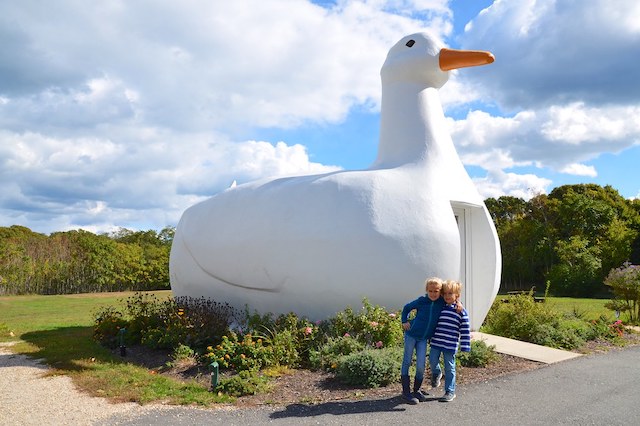
“The Kids At The Big Duck” by Joe Shlabotnik is licensed under CC BY-NC-SA 2.0

The Big Duck

Flanders, N.Y.

If you happen to be driving through the eastern Long Island town of Flanders, it will be hard to miss the giant duck on the side of the road. The Big Duck, as it’s known, is a 20-foot-tall, 30-foot-long building in the shape of a Pekin duck. It was the brainchild of duck farmer Martin Maurer, who commissioned the structure back in 1931 as a marketing ploy for his business. The building served both as a store to sell ducks and duck eggs, as well as a promotional tool highlighting the region’s growing duck farm industry. According to the Southampton Press, Long Island was once home to approximately 90 duck farms.

Although nearly a century has passed, the Big Duck remains one of Long Island’s premier tourist attractions. It’s even listed on the National Register of Historic Places. While you can’t purchase eggs there anymore, visitors can pick up duck-themed memorabilia, learn about Long Island duck farming history, and get travel and tourism information.

Lucy the Elephant

Margate, N.J.

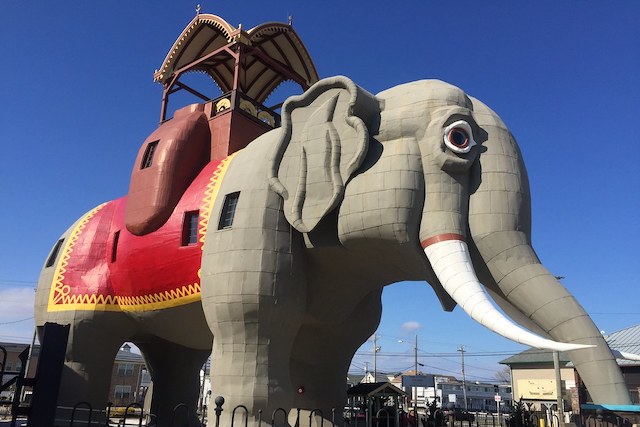
The Big Duck isn’t the region’s only giant animal structure built as a marketing ploy. Just outside Atlantic City you’ll find Lucy the Elephant. This six-story structure was originally constructed by real estate developer James Lafferty in 1891 to help draw potential customers to his land. Not long after, a hotel was built around Lucy, drawing guests from near and far.

Lucy, however, fell abandoned in the 1960s and there were plans to demolish the structure. Fortunately, a group of local residents raised enough money to save and restore the building. In 1976, Lucy the Elephant was designated a National Historic Landmark. According to the Casino Reinvestment Development Authority, Lucy is both America’s oldest example of zoomorphic architecture and oldest roadside attraction.

Lucy the Elephant is still open for business. Guests can visit, tour and even spend the night.

Car Rental Savings

Get up to 20% off the base rate of your next car rental.*

*Terms apply.

Book Today

Ponyhenge

Lincoln, Mass.

On the outskirts of Boston, in a town called Lincoln, you’ll find one of the most peculiar roadside attractions in the country. There, in an open pasture on Old Sudbury Road, sits Ponyhenge, an artfully arranged collection of plastic and metal toy horses.

Ponyhenge’s origins can be traced back to 2010, when a single hobby horse was placed in the open field. No one is quite sure how and why it got there. Nevertheless, more and more rocking horses, toy horses and horse figurines kept showing up, much to the delight of the people who own the land. “There was something lovely about it being anonymous, and now every time we go away, another one appears,” the owner told the Boston Globe.

The horses are periodically rearranged, so you never know how they’ll look when you visit.

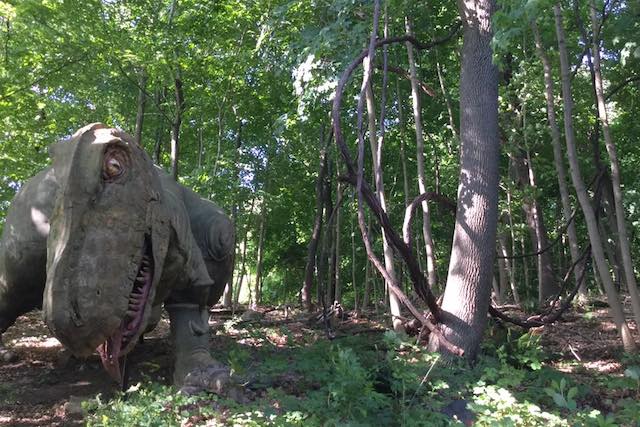
(Courtesy of Wells Dinosaur Haven)

Wells Dinosaur Haven

Uncasville, Conn.

Take a giant step back in time and mingle with some prehistoric creatures at Uncasville’s Wells Dinosaur Haven. In the backyard of artist Jeff “Fish” Wells’ home, you’ll find a collection of giant dinosaur statues roaming the grounds. Wells has been working on this project for 40 years and continues to add to it today.

Although Dinosaur Haven in situated on Wells’ private property, the artist is happy to share his work with the public. Visitors are always welcome to come explore the grounds free of charge.

The Big Blue Bug

Providence, R.I.

Apparently, the Northeast has a fondness for giant animal structures. Joining the Big Duck and Lucy the Elephant as popular roadside attractions is Rhode Island’s Big Blue Bug. Sitting atop the building along I-95 that houses Big Blue Bug Solutions is a 58-foot-long, 9-foot-tall, 4,000-pound giant bug statue. According to the company, it is an exact replica of an Eastern Subterranean Termite. (We’ll take their word for it.)

Originally constructed in 1980, the bug has made quite a name for itself, appearing in the movie “Dumb and Dumber” as well as television shows like “The Daily Show” and “The Oprah Winfrey Show.” In 1990, a naming contest was held. The winning submission was Nibbles Woodaway. Get it? Because termites eat wood. Anyway, at least you can now be on a first name basis as you pass the bug on the I-95.

Need a ride to get to these Northeast attractions? AAA members can save up to 20% on Hertz rentals.

What are your favorite roadside attractions in the Northeast? Tell us in the comments. 

Subscribe to Your AAA Newsletter

Sign up and receive updates for all of the latest articles on automotive, travel, money, lifestyle and so much more!

AAA Photo Session: Motion

Capturing movement on camera can be tricky but there are so many ways you can get creative with it. Once you’ve mastered some basic techniques, motion photography can be used to either freeze or convey a fast-moving moment.

Thank You for Participating!

Browse through all of the photos we received in this motion-themed Photo Session, and don’t forget to check our social media channels, where we will be sharing some of our favorites. Select photos may also be featured in an upcoming issue of Your AAA magazine.

motion photography
(Photo: Beth Mancuso)

Capturing Movement in Photography

If you’ve ever wondered how to capture a busy city street, your kid jumping into a pool mid-cannonball or the constant rush of a waterfall, these tips can help.

What gear do I need?

To effectively capture movement you just need a camera! However, to explore all types of movement you will want to invest in a tripod and some neutral density filters.

Which camera mode should I use?

If you are a seasoned pro, I would use manual mode. If you are just learning you could put your camera into “shutter priority” mode, usually the S or TV mode on your dial.
What subjects should I shoot?

Water is my favorite moving subject but there are all kinds of subjects that show great movement – people, sports, animals, birds and transportation, to name a few.

Types of Motion Photography

motion photgraphy
(Photo: Beth Mancuso)

Freeze Motion

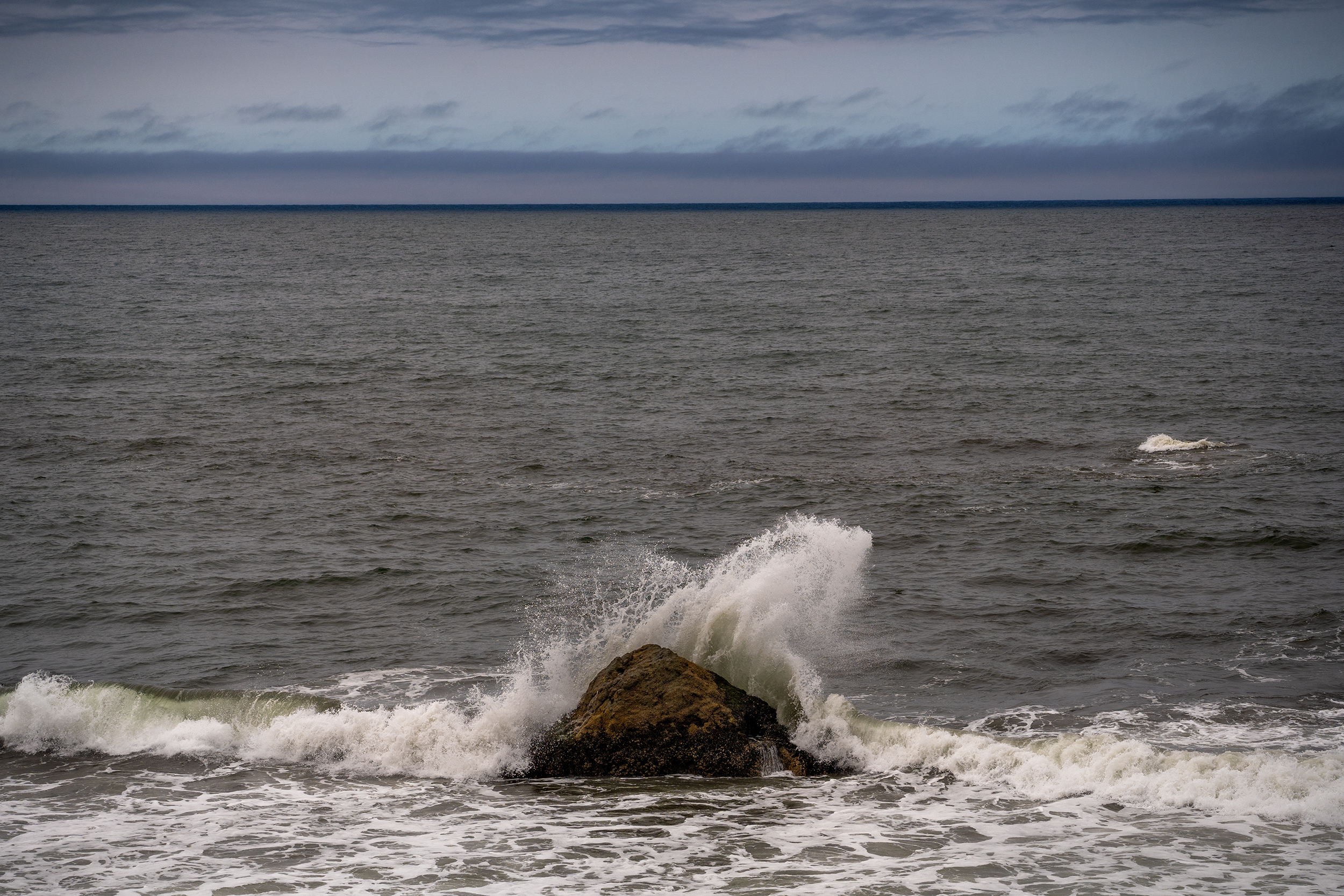
With this method you can produce a still, crisp photo from a moving subject. Take a look at the photo above. The ocean wave looks frozen in time. You can see the tiny water droplets suspended in mid-air. To freeze motion you will need a fast shutter speed. I recommend being above 1/200th of a second and above. For very fast moving subjects like cars or running animals, you will need to be above 1/1000th of a second.

motion photography
(Photo: Beth Mancuso)

Show Motion

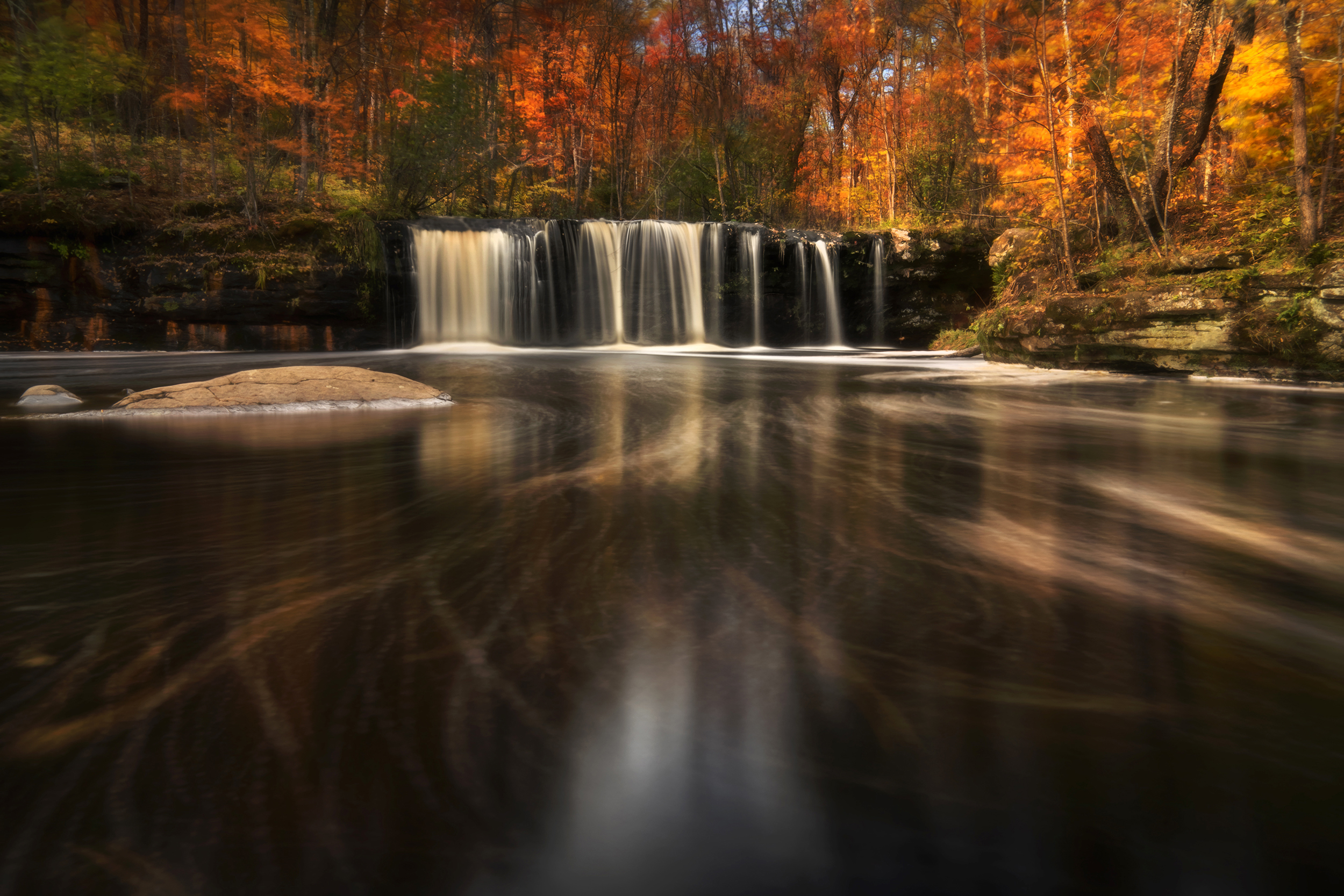
To show motion you need a tripod. If it’s a bright day you will also need a neutral density filter. Neutral density filters block light, allowing your camera to achieve slower shutter speeds. In the image above, I used a tripod and a 10 stop neutral density filter to slow down my shutter speed, which was set to 6 seconds.

Please note: To correctly use neutral density filters you will need your camera to be in manual mode.

motion photography
(Photo: Beth Mancuso)

Intentional Camera Movement

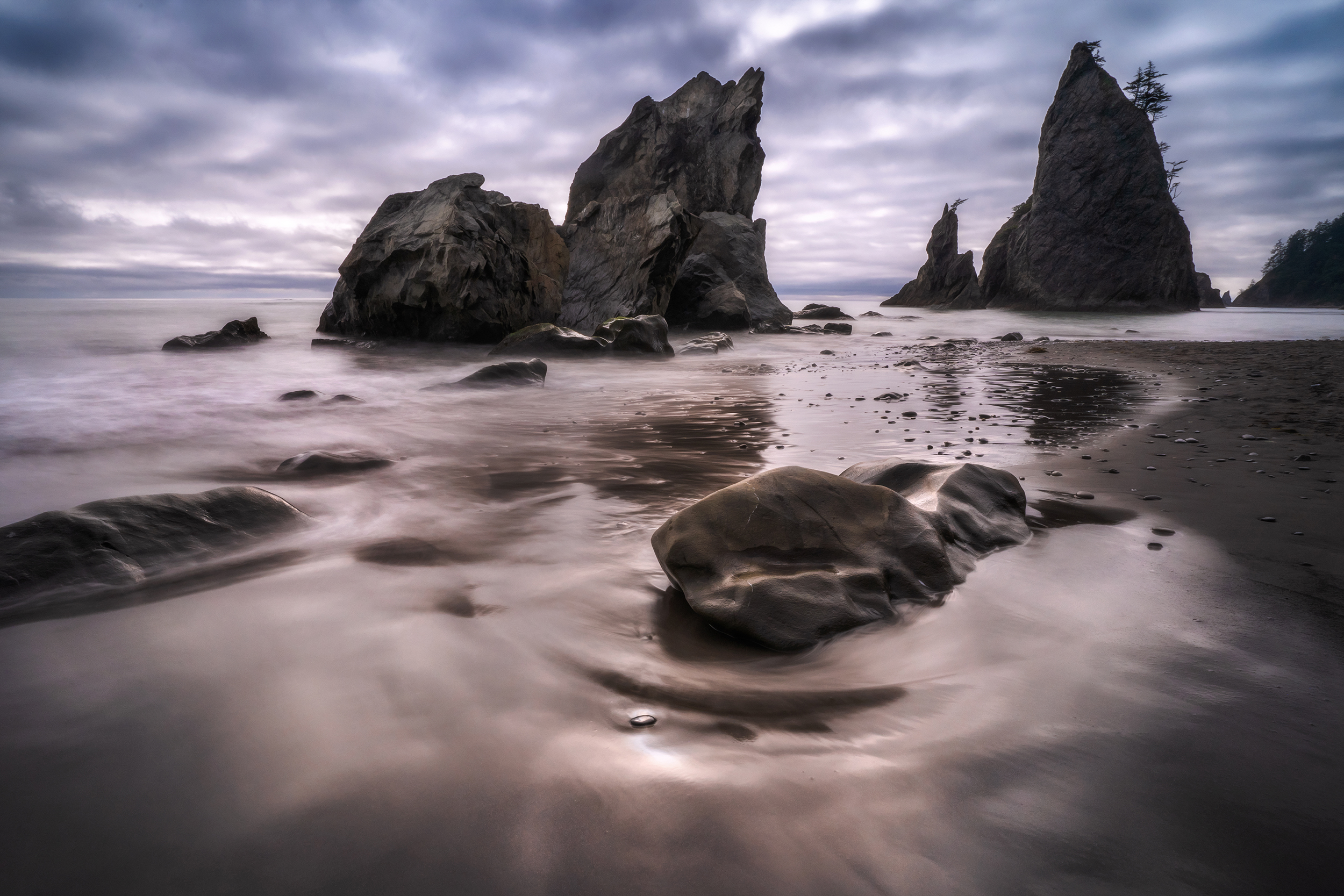
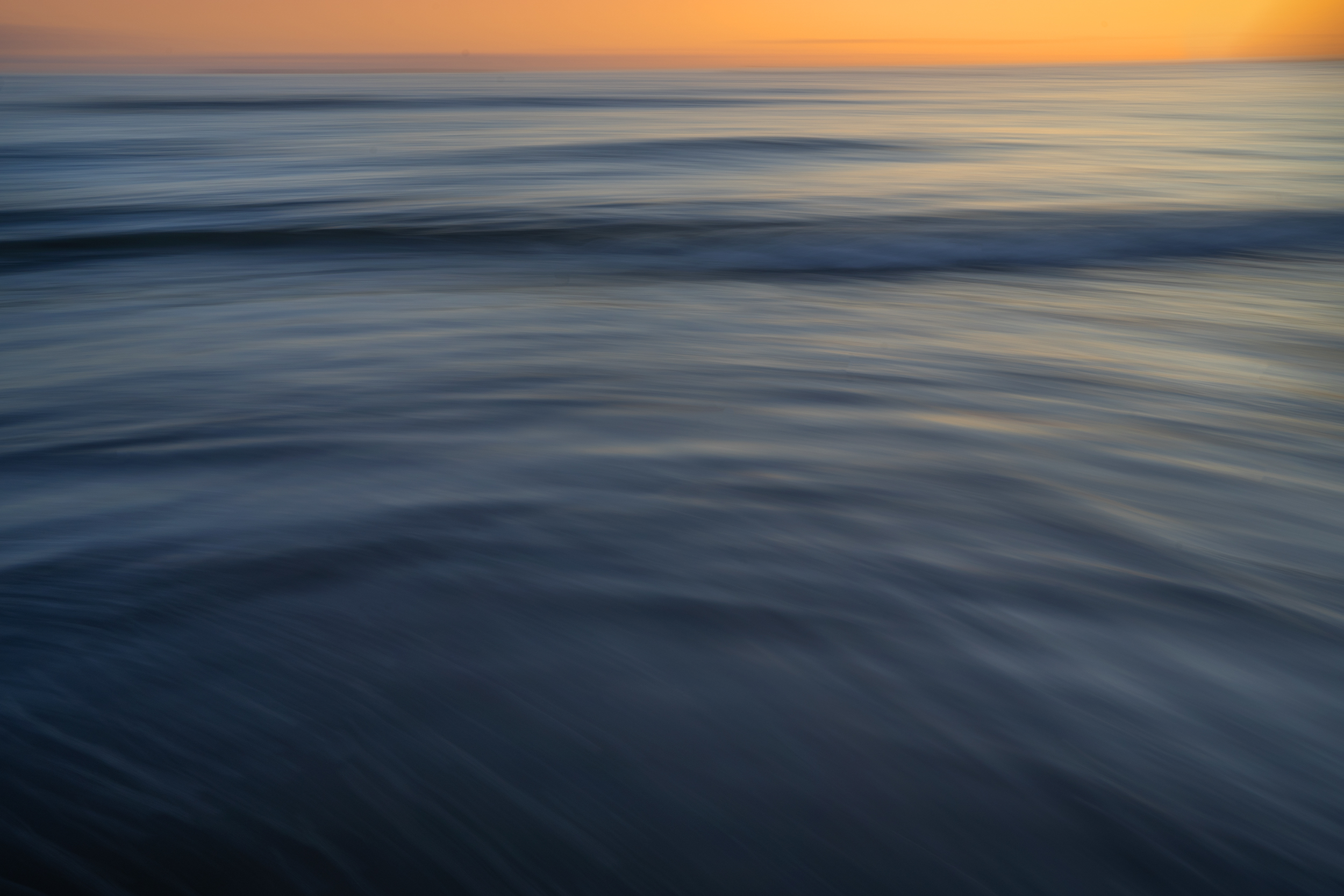
Otherwise known as ICM, this is when you intentionally move your camera when you are taking an image. The image above is an example of that. With my shutter speed set to .8 of a second  I intentionally panned my camera quickly to the right. The outcome is a painterly or abstract look. Waves, leaves and rocks are all fun subjects to practice intentional camera movement on.

Check out past AAA Photo Sessions and stay tuned for the next one, coming soon.

Beth Mancuso is a professional landscape and travel photographer.

Subscribe to Your AAA Newsletter

Sign up and receive updates for all of the latest articles on automotive, travel, money, lifestyle and so much more!

Get New Glasses This Holiday Season

If you’re searching for a new pair of glasses (or a hint to send to the person buying your gifts), then look no further. This guide will help you learn more about the latest trends in eyewear, so you can make your list and check it twice – with perfect vision and great style!

For more inspiration, be sure to take a look at the Holiday Gift Guide from LensCrafters. Their classic chic, everyday glamour and bold luxury collections offer a variety of styles for every taste.

Why Gift Glasses?

The holiday season is here again, meaning it’s the time of year you’ll likely be seeing family and friends – whether virtually or in-person – who you maybe haven’t seen in a while. Dress to impress with a new pair of glasses.

And don’t forget to keep those eyes protected from the bright, winter sun. Sunglasses are a smart and stylish gift that can be enjoyed for many seasons to come.

LensCrafters has a wide variety of glasses and sunglasses to choose from, with new collections from some of the best designer brands available now.

Share The Love this Holiday Season

Shop the newest eyewear collections and save 50% on lenses with a complete pair and 30% on sunglasses.

Save Now

New Collections

See what’s new in the world of eyewear with the latest designer styles from collections by Michael Kors, Prada, Ray-Ban, Versace, Vogue and more. From timeless and everyday looks to more bold and luxurious options, there is something for everyone.

No matter who’s on your holiday list this year, each trend features products for men, women and kids, making it easy to gift a pair of eyeglasses to yourself and the people you love.

Classic Chic

Certain looks are timeless, and elegant, designer frames from Coach, Michael Kors, Ray-Ban and Tory Burch definitely fit the bill. Whether you are looking for a pair of daily prescription glasses or sunglasses, a classic design guarantees style longevity, all while revamping your look.

Choose a pair of slick, round frames or always-stylish rectangular frames in a variety of colors and designs. These looks are best paired with anti-reflective lenses, which help reduce the effects of nighttime glare to prevent eye strain and improve vision. Learn more about different types of eyeglass lenses and treatments.

new glasses holiday

Everyday Glamour

Make every day feel like a special occasion with a pair of glasses that keep it simple while still being stylish. There are plenty of new arrivals meeting this description from LensCrafters, Ralph and Vogue. The best part? They are all under $200!

With interesting frame shapes like butterfly and cat eye to the more traditional rectangle, everyday glamour is all about fun colors, patterns and materials.

Look at styles of sunglasses that also follow this trend. Go for warm brown or cool gray lenses in interesting or understated frames and feel glamorous any day.

Bold Luxury

With looks ranging in inspiration from vintage to contemporary, you can easily up your eyeglasses game with a set of bold, sophisticated frames. Peruse new, eye-catching eyewear from Bulgari, Burberry, Dolce & Gabbana, Prada and Tiffany.

Frame shapes in this category include cat eye, irregular, rectangle and round and feature metallic accents, geometric shapes and other cool design elements. These looks are best paired with superior extra-thin lenses, which are lightweight and less visible at the edges for a stylish, comfortable look.

Go bold in sunglasses from Tiffany, Valentino or Versace with stylish aviator or square frames.

Whether you prefer a classic, glamourous or bold look, make sure you’re seeing clearly this holiday season and year round with a new set of eyeglasses. Stay on top of your eye health and make sure you are getting the right prescription with an annual eye exam.

Protect your eyes in every season while also rocking your personal style. If you’re looking for new glasses, remember that AAA members can save at LensCrafters

Subscribe to Your AAA Newsletter

Sign up and receive updates for all of the latest articles on automotive, travel, money, lifestyle and so much more!

Traveling With Pets: The Tips and Tricks You Need to Know

No matter how excited you may be for a vacation, having to say goodbye to your pet is always the hardest part. But what if you don’t have to? If they don’t mind the trip, pets can provide lots of added fun and happiness to your adventure.

If you are hesitant to travel with your pet because you are concerned about finding accommodations, there’s no need to worry. There are thousands of places that welcome four-legged companions. AAA makes it easy to search for pet-friendly hotels, restaurants, attractions and campgrounds across the country, along with travel tips and other resources.

Here’s a list of important things to consider if you plan on traveling with pets.

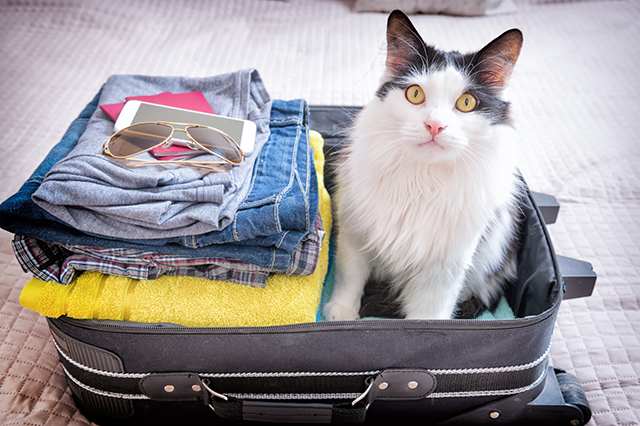
  • Should your pet travel? Consider your pet’s age, wellness and temperament before hitting the road with them in tow. Traveling with a pet that is very young, very old, sick or pregnant is not advised. Dogs prone to biting, excessive barking or that have failed obedience school, also should not travel.
  • Is the trip suitable for pets? Don’t bring your pet if you are just going to end up leaving them in the hotel room or locked in a kennel for the day. The family dog will likely enjoy a hiking and camping trip much more than a theme park vacation. The family cat, however, may love Space Mountain. (Just kidding – non-service animals aren’t allowed in Disney theme parks, but they do have their own resort.)

Animal League America: Rescue. Nurture. Adopt.

Saving the lives of defenseless dogs, cats, puppies and kittens – over 1,100,000 to date.

Adopt Today!

Do Your Research

  • Where to stay and eat? Find out in advance which hotels, restaurants and campgrounds accommodate pets. Also check to see if the parks and beaches you will be visiting permit pets.
  • Pet policies. Before making any reservations, inquire about pet policies at the hotel and be prepared to pay an additional charge. Are there rooms designated for those traveling with pets? Are there breed or size-specific restrictions? Certain states also have pet policies, such as Hawaii, which imposes a 120-day quarantine for all visiting carnivores to prevent the importation of rabies.
  • Be specific. When booking your trip, you must specify the kind of animal you are bringing. Just because the hotel listing says “pets accepted,” does not mean they accept all pets. If the hotel staff is expecting a little dog, you do not want to surprise them with a Great Dane.

Getting Your Pets Ready and Packing Tips 

  • Go to the vet. Make sure your pet has a clean bill of health before traveling. You will also need to update all vaccinations and obtain a certificate showing proof of up-to-date immunizations, especially rabies. Documentation is necessary when crossing country and state lines. Ask the vet if there are any safety or health risks where you are going.
  •  Get your pet used to travel. Do a few test runs in the car before you set out on a long trip, even if you are flying to your destination. Although some pets love the car, others get anxious or bored. Begin by allowing your pet to explore the car/carrier without going anywhere, and then take a ride to somewhere fun like the park to help them see that driving and travel are not so scary. Make sure they are safely  restrained in the car and bring plenty of treats for good behavior. A trip to the dog park may also help your dog get adjusted to being around other dogs and people.
  • Pack as carefully for your pet as you do for yourself. Make sure your pup or kitty has a collar outfitted with all of the necessary identification, such as license and ID tags with contact information. Other important items to pack include a leash, plenty of food, food and water dishes, treats, blankets and bedding, favorite toys, grooming supplies and first aid.
  • Prepping the carrier/crate. An excellent (and airline-approved, when flying) carrier is essential, not only for keeping your pet safe and contained during transit, but to provide a familiar place to stay when confinement is necessary at your destination. Get your pet used to the carrier the same way as the car, leaving it open with a familiar object inside to show that it’s a safe, cozy space. When flying, the crate must be labeled “Live Animals.” It should also have your name, address and phone number clearly printed on it.

Traveling With Pets by Car 

  • Keep pets in the backseat. Restraining your pet in the backseat is suggested to prevent distractions and to keep everyone safe in the event of a collision. A front airbag can be deadly to a pet, even when restrained.
  • Prevent car sickness. Feed your pet a light meal four to six hours before departing.
  • Take breaks. AAA recommends that drivers stop every two hours to take a break during a long trip, and your pet will appreciate it too. Make sure they are leashed before opening the door, especially if they are not used to traveling as they may become disoriented and want to dart.
  • Never leave a pet in a parked car, even with the windows open.
traveling with pets

Traveling With Pets by Air (and Traveling Abroad)

  • Find out if your pet is fit to fly. Cats and certain breeds of dogs including snub-nosed dogs such as pugs are prone to severe respiratory difficulties in an airplanes cargo hold and should only travel in the passenger cabin with their owner. Check with the airline to see what is recommended and/or allowed.
  • Research and reserve. Compare the animal-welfare guidelines of several airlines beforehand to see which is best for you and reserve your pet’s spot on the plane well in advance.
  • Where will your pet fly? Most animals fly in the cargo hold as checked baggage and are considered as such by the airline. Ask that your pet be hand-carried on and off the plane. Small, well-behaved pets may be taken into the passenger cabin with you as carry-on luggage on most airlines.
  • Prepare for the flight. Do not feed your pet less than four hours before departure but provide water until boarding. Exercise your pet before the flight and have them “take care of business” before you enter the terminal. Attach food and water bowls to the carrier along with enough sustenance for the flight. Attach a feeding schedule and instructions, if desired.
  • If your pet is in the cargo hold, alert the flight crew and captain; the pilot must activate the heater. Include an ice pack wrapped in a towel for extra comfort on a hot day, and a hot water bottle on a cold day. If there are layovers or delays, ask if you may check your pet in person.
  • International travel. Prepare for a long flight and at least a short quarantine period. Contact the embassy or consulate at your destination for information about documentation, quarantine requirements and animal welfare regulations.

Car and air are generally the only ways to travel with animals. Amtrak and major bus lines such as Greyhound do not accept pets.

Safety Precautions

  • In case of emergency, familiarize yourself with the nearest animal hospital at your destination. Also consider getting pet insurance. If something happens on the road requiring immediate care, you will be relieved to have it.

Practice Proper “Petiquette”

  • Always keep your pets clean and under control as a courtesy to other travelers.
  • At hotels, keep your pet leashed and only in designated areas. Leave no trace of your pet in the room before checking out.
  • If you are visiting relatives, be sure that your pet will be a welcomed guest.
  • For health reasons, pets are not allowed inside of dining establishments, but many restaurants will allow dogs to sit quietly with their owners at outdoor tables.

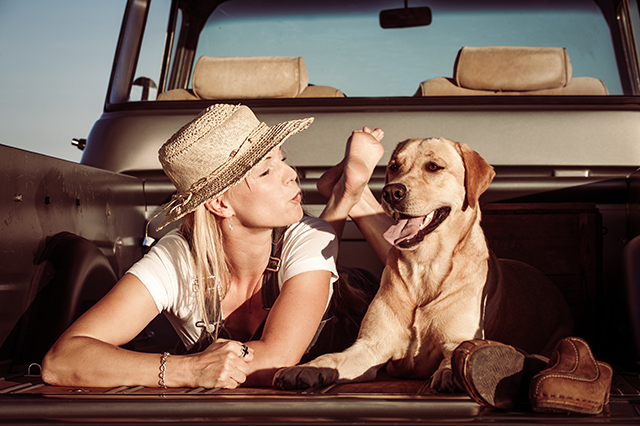
Instead of waving goodbye to Sparky and his sad puppy eyes at the door, bring him along for the trip and have him take his rightful place in your vacation memories smiling beside you in the family photos.

Plan your next getaway (with or without pets) with AAA.

Subscribe to Your AAA Newsletter

Sign up and receive updates for all of the latest articles on automotive, travel, money, lifestyle and so much more!

Quiz: Christmas Trivia

Subscribe to Your AAA Newsletter

Sign up and receive updates for all of the latest articles on automotive, travel, money, lifestyle and so much more!

Now Anyone Can Be Kevin McCallister for a Day

Growing up watching the “Home Alone” movies during the holidays, I always wondered what it would be like to have all the cheese pizza I wanted and to order a sundae the size of my head at the Plaza Hotel in New York City a la Kevin McCallister. 

(For those not in the know, in the classic ’90s movie “Home Alone 2,” Kevin McCallister boards the wrong flight and ends up staying at the Plaza Hotel in NYC for the holidays. Limo rides, copious amounts of cheese pizza, nefarious bandits and heartwarming Christmas high jinks ensue.) 

If you’ve ever wanted to recreate Kevin’s experience, now’s your chance. The Plaza Hotel’s “Home Alone 2: Fun in New York” package lets you take in the magic of the holiday season in the Big Apple, just like Kevin did. 

Round out your stay with a stop at some of the city’s best pizza joints and Christmas sights, and you’ll end up with a full belly and a joyful heart. Ah, to feel like a kid again!  

Let’s go! 


View this post on Instagram


A post shared by The Plaza Hotel (@theplazahotel)

The Plaza 

The AAA Four Diamond Plaza Hotel has been a New York City icon since opening in 1907. Countless movies have been filmed there and legends of film and Broadway have passed through the doors. Although Christmas is a popular time for the “Home Alone” package, guests can book the experience year-round.  

“Many come dressed in their best Kevin McCallister garb,” said Crystal Laurence, director of sales at the Plaza. “It’s always a diverse group, from couples, adult siblings or families. We recently had a family ask us to give their kids the full experience by allowing them to check in at the desk with their dad’s credit card.” 

Being a guest at the famed Plaza Hotel was a humbling, incredible experience. The team made me feel like royalty from the moment I walked into the lobby. Then I checked into the room and noticed the massive, luxurious soaking tub, rain shower and giant king bed. Amazing!   

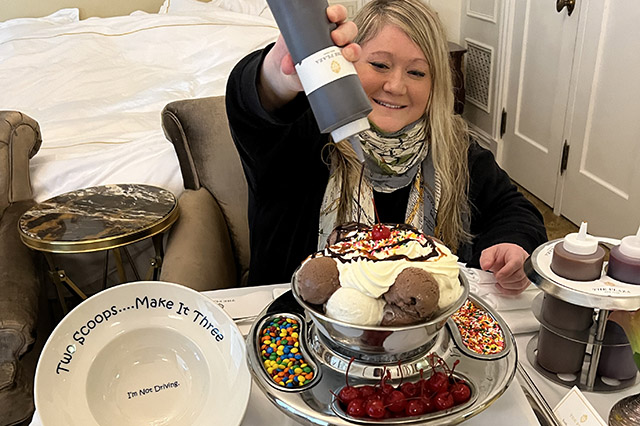
After settling in, I was treated to an over-the-top, 16-scoop sundae with a variety of toppings inside a bowl emblazoned with a line from the movie: “Two scoops … make it three, I’m not driving.” I felt like a kid again, digging the massive spoon into the tower of ice cream scoops with all the toppings, whipped cream and sauces I could ask for. 

The package also includes a four-hour sightseeing limo tour, driving past famous sites like Rockefeller Center, Radio City Music Hall, Carnegie Hall and more. And, of course, guests can enjoy a steaming hot cheese pizza in the back, just like Kevin did.   

See the Plaza Hotel and other famous TV and film spots on a On Location movie tour! AAA members save 15% on tours in New York City and Boston when booking in advance online.

The Pizazz  

There’s something truly magical about New York City during the holidays. It transforms into a winter wonderland with twinkling trees, ice skating rinks, oversize decorations, light shows and holiday markets.  

Whether it’s your first time in the city or the 50th, there are certain things you should see during the holidays. Head to the Union Square and the Bryant Park holiday markets, which feature local vendors offering everything from food and drinks to crafts and jewelry. 

Be sure to check out Bryant Park’s stunning Christmas tree before heading over to see perhaps the world’s most famous Christmas tree at Rockefeller Center. Yes, you’ll have to deal with some pretty intense crowds, but it’s worth it. For more holiday sparkle, head around the corner to Saks Fifth Avenue. Continue your Christmas sightseeing at the Macy’s flagship store to see the decorated windows before heading over to Hudson Yards for more twinkling lights. 

If all that walking made you hungry, check out the Grand Central Market, a European-style food shop inside Grand Central Station that stocks fresh caviar, meat, cheese, produce, bakery items and more. 

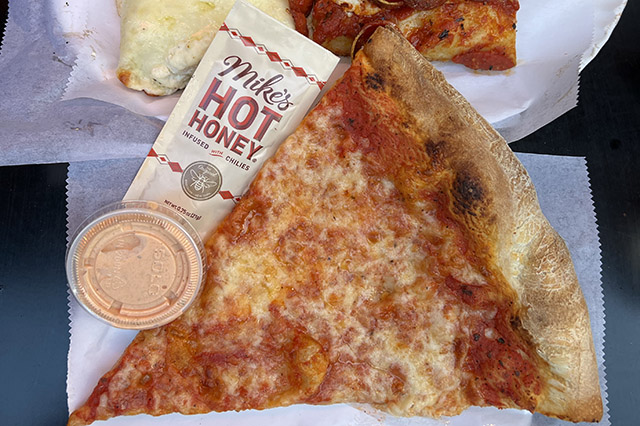
A classic cheese slice at Village Square Pizza.

The Pizza 

If you’re staying in the city for a few days, why not craft your own pizza tour a la Kevin McCallister? I’d suggest starting at Village Square Pizza in the West Village. There you’ll find amazing white pizza squares, classic cheese slices and pepperoni squares piled high with cup and char pepperoni for a little kick and a lot of protein. For sweet heat, add Mike’s Hot Honey to anything or order the famous homemade vodka sauce for dunking.  

Along Bleecker Street, both Bleecker Street Pizza and John’s of Bleecker Street (coal-fired whole pies only) are great choices. The classic cheese slices at Scarr’s Pizza are slightly browned for a crispy effect, while Vinnie’s Pizzeria in Brooklyn features delicious cheese, eggplant parm and sausage and ’roni slices.

It’s amazing what a Kevin McCallister-approved sundae, a piping hot cheese slice, and a good holiday market can do for the soul during the holiday season. 

Feel like exploring all the sights and sounds of the Big Apple? Let a AAA Travel advisor help you put together the perfect NYC package.

What do you think about the Plaza Hotel’s “Home Alone” experience? Is it something you would do? Tell us in the comments. 

Subscribe to Your AAA Newsletter

Sign up and receive updates for all of the latest articles on automotive, travel, money, lifestyle and so much more!

7 Adventures Waiting for You in Florida

Are you hoping for more adventures in the sun this year? So much more than theme parks and relaxing beaches, Florida is brimming with opportunities for active fun.

Here are seven reasons to plan your next adventure in the Sunshine State.

Zip Lining

Above an abandoned limestone quarry in Ocala sits The Canyons Zip Lines & Adventure Park. There, you can soar above a glittering spring-led lake with the wind and sun on your face. Glide through the air at up to 45 miles per hour along your choice of nine zip lines. Leave enough time to venture across one of the park’s rope bridges or participate in a historical wine and chocolate tasting tour.

Exactly Where You Need To Be

Find the adventure you’ve been craving on a Florida vacation.

Be Here

Hiking

Yes, Florida is relatively flat, but it doesn’t lack interesting landscapes for exploring on foot.

In the panhandle, you can enjoy underground hikes at Florida Caverns State Park or trudge along the river at Blackwater River State Forest. Or if you prefer trekking south, check out the backwoods trails at Big Cypress Reserve or the lushly lined tracts at Dagny Johnson Key Largo Hammocks Botanical State Park. Don’t forget your mosquito repellant, sunscreen and binoculars for Florida’s famous birdwatching.

horseback

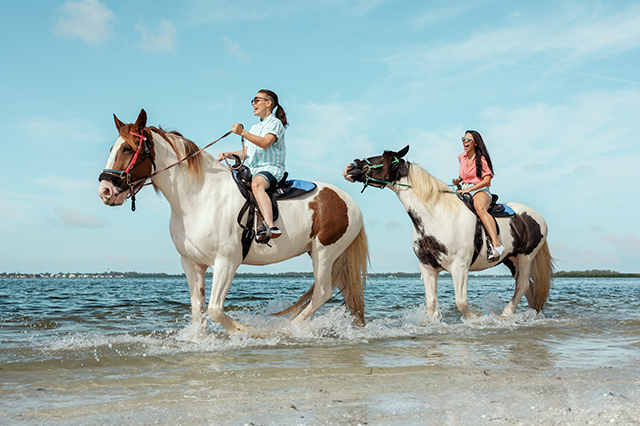
Horseback Riding

For the ultimate family-friendly adventure, head to Amelia Island. This quiet slice of Florida land has a wide, sandy shoreline and epic Atlantic surf. While there’s plenty to do on the island, from tucking into plates of local shrimp in Fernandina Beach to bicycling along miles of lush greenway, horseback riding beckons to many adventure seekers. It’s the perfect, peaceful way to take in the scenery.

Kiteboarding

If you’re a fan of windsurfing, get ready to amp up your game with Florida kiteboarding. Considered an extreme sport by many, kiteboarding is a great heart-pumping activity to offset your days spent lounging on one of Florida’s long, powdery beaches.

Here are several Florida spots that are perfect for your next kiteboarding trip:

kyak
(Photo: Scott Sporleder)

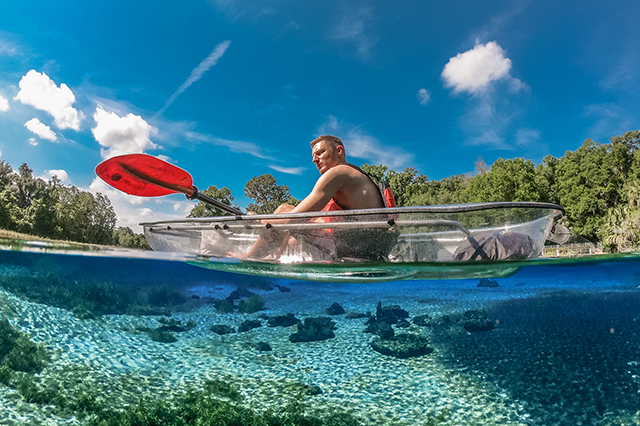
Kayaking

If you’re a fan of water sports, chances are high that you’ll love a relaxing kayaking trip. Florida practically brims with kayaking destinations. For a true adventure, check out one of the bioluminescent tours for night kayaking along Florida’s Space Coast.

Snorkeling

Whether you prefer Florida’s Atlantic or Gulf coast, good snorkeling is never far away. From long, sleek trumpetfish to spectacular angelfish, there’s so much to see under the sea. Popular snorkeling destinations include Dry Tortugas National Park, Key Largo, Ginnie Springs, Devil’s Den (north of Ocala) and Destin.

Paddleboarding

Florida has long been known as a paddleboarder’s paradise, and for good reason. It’s a year-round sport that’s accessible for families, couples and solo water lovers. While the Florida coastline can get rough depending on the day’s surf, the inland lakes are placid — perfect for gliding and paddling — almost any day of the week. For beginner-friendly stand-up paddleboarding (SUP), check out South Walton, Destin and St. Augustine.

Start planning your Florida vacation today. 

Subscribe to Your AAA Newsletter

Sign up and receive updates for all of the latest articles on automotive, travel, money, lifestyle and so much more!

16 Winter Day Trips From NYC

Don’t let the cold temperatures and slushy roads prevent you from going on one of these winter day trips from NYC. There are so many ways to stay busy this season.

Our list includes excursions that require you to embrace the cold and others that are warm and relaxing respites from the frosty weather. And while most of them make for a great day out, a few are out-of-state or offer lodging to justify an extended weekend visit.

Note: Due to the ever-changing nature of the COVID-19 pandemic, please check official websites before visiting to check for restrictions or closures.

Relaxing Winter Day Trips From NYC: Resorts and Spas 

Spa Castle
College Point, N.Y.

During the winter months, this Queens sauna and spa is a hot spot for those seeking a warm and relaxing respite from the cold. The site features spa pools, saunas, a fitness center, sleeping room and a meditation room. There’s also a beauty spa and hydrotherapy pools as well as a juice bar and light dining options.

Mohonk Mountain House
New Paltz, N.Y.

Located in a Victorian castle along Lake Mohonk, highlights at this resort include trails, a spa, outdoor and indoor pools, an ice rink and views for days. There are a variety of dining options, and afternoon tea and cookies in the  fireside lounge. Day access to the Mountain House and property is available to those with advance dining or spa reservations. A winter sports day pass can also be purchased, which includes equipment rental fees for ice skates, snowshoes and other activities.

Whiteface Lodge
Lake Placid, N.Y.

Located in Adirondack Park, this resort features 6 million acres of recreation area and has a movie theater, bowling alley, ice skating, full-service spa, fitness center, wellness classes, saunas, steam rooms, hot tubs and restaurants. Its buildings, accented with wood-beamed exteriors and cast iron fireplaces, reflect 19th century architecture. Visitors can try out the slopes on Whiteface Mountain or drop by the Olympic Museum.

Gurney’s Montauk Resort and Seawater Spa
Montauk, N.Y.

Only 4 miles from the Montauk train station, this oceanfront resort showcases the best of the beach in the off-season, making it one of the best winter day trips from NYC. It features a full-service spa with heated indoor saltwater pool and gym, as well as a cocktail lounge and several restaurants. While you are in town, discover more ways you can enjoy your day in Montauk in the winter.

Fun For the Kids 

Bounce! Trampoline Sports
Locations throughout N.Y.

Filled with wall-to-wall trampoline courts, this 50,000-square foot-emporium in Long Island features trampolines that reach to the ceiling, a bungee ride and a dodgeball court. Kids can jump into foam blocks or play on inflatable obstacle courses in the safe space. But perhaps the most fun is in trying to slam-dunk basketballs.

WonderWorks
Syracuse, N.Y.

Described as an “amusement park for the mind,” this site features more than 100 hands-on science exhibits and attractions, laser tag, a ropes course and a 4D motion ride. Other activities include virtual sports, creating three-dimensional images and Xtreme 360 Bikes.

Legoland Discovery Center Westchester
Yonkers, N.Y.

Among millions of Lego bricks, there’s tons of fun stuff to do at Legoland Discovery Center at the Ridge Hill shopping center in Yonkers. With a 4D cinema, indoor Lego playground and a mini New York City replica, this interactive indoor attraction is another one of the best winter day trips from NYC, especially for children ages 3-10. Save up to 30% at Legoland Discover Center with your AAA discount.

CoCo Key Water Resort
Mt. Laurel, N.J.

Who says the pool is closed for the winter? This indoor water park features an aquatic jungle gym, wading pool, large water slides, a lazy river, mini pool with a basketball court, adults-only whirlpool, an indoor-outdoor spa and eateries. Overnight packages are available for onsite lodging.

winter day trips from nyc

Winter Sports

Windham Mountain
Windham, N.Y.

Windham Mountain Ski Resort offers 54 trails for skiers, six terrain parks, snow tubing slope, ice skating, 3 miles of trails for cross-country skiing and snowshoeing, a mini snowmobile park and more.

Ice Climbing With Alpine Endeavors
New Paltz, N.Y.

Allow expert guides to show you the top spots for ice climbing in the region from November through mid-April. All equipment is provided and instructions are customized to the experience level of your group. If you prefer your feet on the ground, Alpine Endeavors also leads winter hikes and snowshoe treks.

Fahnestock Winter Park
Carmel, N.Y.

Featuring nearly 10 miles of machine-groomed trails through a 16,000-acre preserve, Clarence Fahnestrock Winter Park is a great spot for cross-country skiing and snowshoeing. The winter sports zone includes a base lodge that offers hourly rentals of skis, show shoes, sleds and inner tubes, as well as hot chocolate and other snacks that can be enjoyed in front of the fireplace.

Greek Peak Mountain Resort
Cortland, N.Y.

Ski resort Greek Peak has activities for those planning to spend time outdoors and those who seek an escape from the freezing temperatures. You can ski on the mountain’s 32 trails from December through mid-March. There’s also snow tubing and an indoor water park with a whitewater wave pool, rapids, slides and a hot spring.

Find more family-friendly ski resorts in the Northeast.

Nature-Filled Winter Day Trips From New York 

Stamford Museum and Nature Center
Stamford, Conn.

Originally a private estate, the 118-acre museum now houses a 10-acre working farm and Tudor-style museum. There is also a gallery featuring exhibitions, an interactive nature center, outdoor trails, a large planetarium, four-story observatory with a research telescope, playground and an otter pond. The center also offers seasonal exhibits, festivals, children’s programming and camps.

Lakota Wolf Preserve
Columbia, N.J.

Being surrounded by a pack of wolves in the woods might not sound like the most appealing winter activity, but it is if you’re visiting New Jersey’s Lakota Wolf Preserve, which cares for wolfs, foxes and bobcats born in captivity. Visitors can meet some of the wolves in a fenced-in area and tour the site as well, making this one of the best winter day trips from NYC for animal lovers.

Long Island Seal Watching Cruise
Freeport, N.Y.

Midwinter is a great time for spotting harbor and gray seals on Long Island. The two-hour cruise is led by onboard naturalists who tells visitors about the biology and behavior of seals and other sea creatures that might be spotted during the cruise. Reservations are required.

Minnewaska State Park Preserve
Kerhonkson, N.Y.

Known for its lakes and waterfalls that become dramatic icescapes during the winter, Minnewaska State Park has 23,000 acres that include 25 miles of footpaths and 35 miles of carriage roads. You can also take a 3-mile hike led by the site’s environmental educator that stops at Awosting Falls. Snowshoes can be rented per day, and the site has a $10 vehicle entry fee.

Which one of these winter day trips tickles your fancy? Let us know in the comment section. 

Plan and book your next winter trip with AAA.

Subscribe to Your AAA Newsletter

Sign up and receive updates for all of the latest articles on automotive, travel, money, lifestyle and so much more!

Must-Visit Connecticut Winter Getaways

While falling temperatures lure many people into dreaming of a tropical beach vacation, traditional warm-weather getaways still have a lot to offer visitors in the off-season. During this time of year, you can find reduced rates at premier hotels and less crowds at tourist sites.

There may be no better off-season destination in the Northeast than the Connecticut coast, which combines history, picture-perfect scenery and top attractions. Here are three of the top Connecticut towns to explore this winter.

Old Saybrook

Located where the Connecticut River meets the Long Island Sound, Old Saybrook is one of the state’s oldest towns, having been incorporated in 1854. That history is on full display with numerous museums and parks celebrating the town’s past.

Fort Saybrook Monument Park is a 17-acre park complete with storyboards that detail the history of the Saybrook Colony, which was founded in 1635. Visitors can also enjoy the park’s panoramic views of the Connecticut River.

The General William Hart House, built in 1767, was once the home of the Revolution-era political and military figure. The property is now listed on the National Register of Historical Places. Visitors can tour the property, including its award-winning historical garden.

Aside from its historical sites, Old Saybrook also has a thriving cultural scene. One notable former resident is actress Katharine Hepburn, who moved to the town as a child. Old Saybrook has honored the Academy Award winner by renaming its cultural arts center after her. Known as The Kate, the center is located in a historic theater that was also formerly the town hall. It presents a full repertoire of cultural and performing arts programming for all ages.

When you get hungry, visit one of Old Saybrook’s delectable seafood restaurants like Fresh Salt and afterward head to the 30 Mile Brewing Company. The brewery is all about variety, serving everything from stouts and double IPAs, to saisons and sours, meaning it has something for everyone.

connecticut in winter

Mystic

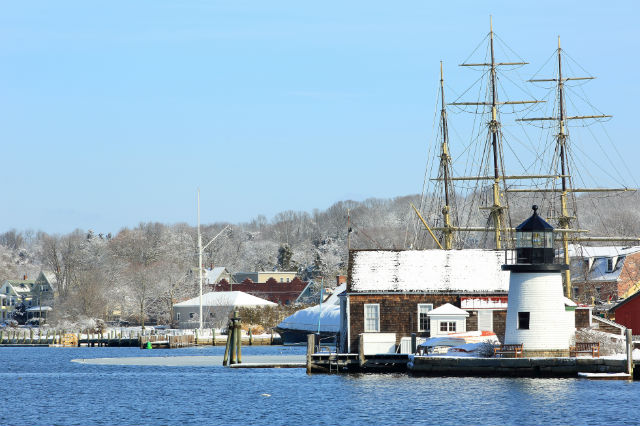
No Connecticut winter getaway is complete without a visit to the quintessential New England town of Mystic. Nestled along both sides of the Mystic River, the town is one of Connecticut’s premier vacation destinations. It is best known as home of two of the area’s most-visited attractions: the Mystic Seaport and the Mystic Aquarium.

Founded in 1929, the Mystic Seaport Museum is the country’s leading maritime museum. It is the home of four National Historic Landmark vessels, including the Charles W. Morgan, which holds the distinction of being the last wooden whaleship in the world.

The museum’s maritime gallery is the nation’s foremost art gallery specializing in contemporary marine art and ship models. The Mystic Seaport Museum also holds special events, workshops and classes suitable for people of all ages throughout the year.

Mystic Aquarium’s indoor and outdoor exhibits allow visitors to get up close and personal with thousands of creatures including African penguins, rescued seals and New England’s only beluga whales. Make sure to catch the complimentary sea lion show to see these fascinating animals in action. The aquarium has numerous exhibits and events going on year-round.

But Mystic is much more than just these two unique locations. Need some retail therapy after all that exploring? Olde Mistick Village is home to more than 30 unique shops selling everything from Christmas ornaments to Tibet Himalayan handmade crafts to fudge, candy and specialty foods.

Olde Mistick is also the perfect place to grab a meal as it’s home to some of Mystic’s finest restaurants including Jealous Monk and Pink Basil. Afterward, head to the Village’s multi-theatre arts and movie cinema to complete your night out on the town.

East Lyme

Nestled along the center of Connecticut’s coastline is the town of East Lyme. It is a popular summer destination with its long stretch of public beaches, but is just as enticing during a Connecticut winter.

Much like other towns in the area, East Lyme boasts an impressive history, no better exemplified than by the Thomas Lee House and Little Boston School. Constructed circa 1660, the Thomas Lee House is Connecticut’s oldest wood-frame house. In 1914 the house was sold to the East Lyme Historical Society, which continues to offer tours of the estate.

The Little Boston School House was built on the Lee family property in 1805 after then-owner Elisha Lee deeded land to have the building erected. The school was restored to its early-20th-century appearance and opened to the public in 1973.

More history is on display at the Samuel Smith Farmstead. Built in 1685, the building represents a perfect example of a Colonial-era, gambrel-roof house. Free tours are available of the property, which also includes a barn and farm.

Speaking of barns, no visit to East Lyme is complete without a stop at the Book Barn. This hidden gem has a collection of more than 500,000 books spread out between four locations, all within one mile of each other.

FIND & BOOK A HOTEL WITH AAA IN CONNECTICUT

What’s your favorite Connecticut winter destination? Tell us in the comments. 

Subscribe to Your AAA Newsletter

Sign up and receive updates for all of the latest articles on automotive, travel, money, lifestyle and so much more!

Unique Museums of the Northeast

The Northeast is home to some of the finest, most well-regarded museums in the country. Places like the Metropolitan Museum of Art, American Museum of Natural History and Museum of Fine Arts immediately come to mind. But these cultural monuments are by no means the only Northeast locales where history, art and other interesting collections are on full display.

The region is, in fact, blanketed with a countless number of smaller, often more unique museums. They’re found both in big cities and tucked-away towns, on the coast and off the beaten path. Each one is dedicated to something you won’t likely see at any another museum. Here are just a few unique museums in the Northeast.

International Cryptozoology Museum

Portland, Maine

We know you probably already know this, but for the uninformed, cryptozoology is the study of animals whose very existence is unsubstantiated (think the Loch Ness Monster). If this subject sounds intriguing, you’ll want to head to Portland, Maine, home of the International Cryptozoology Museum. Here, you’ll find countless artifacts of undiscovered creatures, including what the museum claims are actual hair samples of Abominable Snowmen and Bigfoot. Other exhibits focus on local folklore beasts such as the Jersey Devil and Montauk Monster.

American Classic Arcade Museum

Weirs Beach, N.H. 

If you’ve got an itch for a bit of childhood nostalgia, a trip to the American Classic Arcade Museum should soothe your symptoms. Occupying the entire second floor of the Funspot arcade, the museum is the largest shrine dedicated to arcade games in the world. In total, it houses roughly 200 pinball and arcade games, most originating from the 1970s and ’80s. In fact, you won’t find any made after 1987. What you will find are all the classics, including Tetris, Space Invaders and, of course, Pac-Man.

unique museums

Eric Carle Museum of Picture Book Art

Amherst, Mass. 

Dr. Seuss (who himself has a fascinating Massachusetts museum to his name) is not the Northeast’s only famed children’s book author and illustrator. Eric Carle, of “The Very Hungry Caterpillar” fame as well as some 70 other books, was born and raised in Syracuse, New York, before settling in western Massachusetts as an adult. It’s the latter region, specifically Amherst, where he and his wife established the Eric Carle Museum of Picture Book Art in 2002. The museum, which is the only one in America dedicated exclusively to book picture art, includes rotating galleries of work by famed illustrators such as Maurice Sendak and the aforementioned Theodor Seuss Geisel.

Celebrate the New Year. Let’s Go!

Save up to 40% off the base rate.

Book Today

Nantucket Shipwreck & Lifesaving Museum

Nantucket, Mass. 

You can’t talk about New England’s past without delving into the region’s storied maritime history. While there are a plethora of well-known museums dedicated to the topic, one off-the-beaten-path-site is sure to peak any visitor’s interest. The Nantucket Shipwreck & Lifesaving Museum features more than 5,000 artifacts related to the region’s famous shipwrecks and rescues dating back to the 19th century. As an added bonus, the museum’s location at the edge of Folger’s Marsh provides photo-worthy views of Nantucket island.

PEZ Visitor Center

Orange, Conn. 

Did you know the iconic PEZ candy’s U.S. base is right in our own backyard? In 1973, the Austria-based PEZ company built its American production facility in Orange, Connecticut, just outside of New Haven. The site remains fully operational to this day and, fortunately for us, has since added a visitor center.

The tourist attraction, which just celebrated its 10th anniversary, contains the largest public collection of PEZ memorabilia in the world. You’ll also find viewing windows to get a firsthand look at how these sweet, collectible treats are made.

The Audrain Automobile Museum

Newport, R.I. 

In 2014, Newport’s century-old Audrain Building was renovated into an exhibition space to house the Audrain Automobile Museum, one of the most unique collections of cars on the East Coast. Within its walls, visitors will find more than 150 of the rarest automobiles and motorcycles in history, ranging from the early 1900s through present day. The museum puts on three to four new exhibits each year covering a wide array of themes, from the history of electric cars to modern day supercars. It also serves as host to a variety of events, including the Audrain Newport Concours & Motor Week.

unique museums

The National Museum of Mathematics

New York, N.Y.

If you’re anything like us, you believe it’s mathematically impossible for math to be fun. Well, one trip to the National Museum of Mathematics will dispel that notion for good. The two-story site in the heart of Manhattan is part science fair and part playground. It’s all designed to illuminate the role mathematics plays in nearly every aspect of life, from sports and art to nature and architecture. And yes, every exhibit is interactive so be sure to bring your kids – or your inner child!

It’s a Wonderful Life Museum

Seneca Falls, N.Y.

Tucked away in picturesque Seneca Falls is a unique museum honoring one of the greatest films ever made. Opened in 2010, the It’s a Wonderful Life Museum is filled with memorabilia from the 1946 classic. These include items from the personal collections of director Frank Capra as well as several of the film’s cast members.

You may be asking yourself what Seneca Falls has to do with “It’s a Wonderful Life.” Although the movie was shot in California and takes place in the fictional town of Bedford Falls, New York, many believe the Finger Lakes city was the inspiration for the film’s setting. Capra notably visited the Seneca Falls while he was writing the screenplay.

The Paranormal Museum

Asbury, N.J.

Asbury Park may be best known for its famous boardwalk or as Bruce Springsteen’s stomping grounds. But the seaside town is also home to a place with a little less cheery disposition. The Paranormal Museum, a part of the Paranormal Books & Curiosities, is a space dedicated to, for lack of a better word, oddities. You’ll find relics, haunted objects, even a wall of Ouija boards. The museum also offers ghost tours through Asbury Park’s haunted grounds.

Need a ride to get to these Northeast museums? AAA members can save up to 20% on Hertz rentals.

What are your favorite museums in the Northeast? Tell us in the comments. 

Subscribe to Your AAA Newsletter

Sign up and receive updates for all of the latest articles on automotive, travel, money, lifestyle and so much more!

AAA Photo Session: Clouds

When it comes to taking photos, it’s good to have your head in the clouds. Whether puffy and white, wispy and weird or all dressed up in the colors of a sunrise or sunset, clouds captivate and often entice us to pick up our cameras.

Thank You for Participating!

Browse through all of the photos we received during January’s cloud-themed Photo Session in the slideshow below, and don’t forget to check our social media channels, where we will be sharing some of our favorites. Some photos may also appear in an upcoming issue of Your AAA magazine.

Tips on Photographing Clouds

Clouds can either make or break a photo. When there are no clouds in the sky it produces a somewhat boring image, but the right amount of clouds can make for a stellar shot. Here are tips for capturing happy little clouds.

cloud photo
(Photo: Beth Mancuso)

Underexpose

Most of the time the sky is going to be brighter than the rest of your image. If you are relying on auto mode, you are probably going to end up with skies that are blown. This means that you lose the detail in the sky and part of your image will appear white. To combat this from happening, you will want to shoot in manual or aperture priority mode and underexpose.

Underexposing your shot by one stop will give you a better chance of retaining the details of the sky. Once you blow the highlights you can’t get them back, but if your image is underexposed you can lift the shadows and exposure when editing to bring out the fine points.

Bracket

Another option is to bracket your image. This means taking at least three different shots at varying exposures and then merging them together later when you are editing. So, you would take one shot underexposed to capture the sky and the highlights, another shot that is exposed at zero to capture the midtones and finally an overexposed shot to capture the details in the shadows.

Most cameras have bracketing built into it, you just have to turn it on. Also note that a tripod is recommended for bracketing. It makes it easier to merge the images together when all your shots line up.

Filters

You can try a graduated neutral density filter. These filters will be darker on the top half of the filter to help you get a more even exposure throughout your image. The caveat with these is that it will darken everything including any buildings, trees or people that may be in front of your sky. They work best when you have a clean horizon line.

Shutter Speed

cloud photo
(Photo: Beth Mancuso)

If you want your clouds to be crisp in detail and look exactly as your eyes see them, you will want to choose a shutter speed that is fast enough to not catch any movement in the clouds. I recommend anything above 1/100th of a second.

cloud photo
(Photo: Beth Mancuso)

If you want to show motion in your clouds you will need a tripod, neutral density filter and a long shutter speed. I often use a 10 stop neutral density filter and 30-second exposure. You can go even longer than 30 seconds if you have a remote to fire your camera. The result is clouds streaking across your sky in a very painterly way.

Check out past AAA Photo Sessions and stay tuned for the next one.

Beth Mancuso is a professional landscape and travel photographer.

Subscribe to Your AAA Newsletter

Sign up and receive updates for all of the latest articles on automotive, travel, money, lifestyle and so much more!

Office Sweet Office


Creativity, collaboration, celebration.

It’s difficult to define those “three Cs” of human resources – impossible to measure and put a concrete value on – but you can feel it when they’re gone.

And as work-from-home became the norm over the past two years, many organizations found those intangibles tough to replicate in a virtual setting.

Businesses across the world are grappling with when to bring their employees back to the office. But equally important is ‘how’ to do it. Because leaders are going to have to work that much harder to give employees a good reason to return.

Morale can be easy to ignore in the best of times, yet it comes into stark contrast in the worst. And if your organization did ignore those issues at the peak, your valley is that much deeper and your climb back up will be that much harder.

How will your organization create an environment that convinces people it’s better to be at the office than at home?

Is it the physical space itself? Should you remodel your offices to make it more of a destination, the kind of place people will want to be?

Or will the pull of camaraderie, of human connection, do the job? Research shows that those with a good friend at work are much less likely to quit.

In a way, working remotely means having a more rigidly structured schedule. It’s not meetings that cause teams to bond, if you think about it. It’s what happens before and after a meeting when you really get to know each other, joke around, talk about your weekend, whatever.

Other types of professional growth take a big hit with a distributed workforce as well. Think about mentoring, how is that getting done? Is it even happening at an informal level anymore?

We all know the time to bring everybody back isn’t far off. Omicron appears faster and not as virulent as its predecessor. So, what will get people excited to return? What are you doing to say, ‘Now’s the time and this is the place!’

Your organization’s success post-pandemic may just depend on the answer.

Ron Arigo is senior vice president and head of human resources at AAA Northeast.

Subscribe to Your AAA Newsletter

Sign up and receive updates for all of the latest articles on automotive, travel, money, lifestyle and so much more!

On the Road Across the Canadian Border

I woke up in Bangor, Maine, on Sept. 20, 2021 with excitement for an adventure ahead, an open road to someplace new and an opportunity to use my passport for the first time in two years.

Canada had just opened to American tourists in August, and I was on my way from my Massachusetts home to see two provinces on a four-day trip.

The requirements for entering Canada were: 1. Download the Arrive Can app and upload pictures of your vaccination card; 2. Get a COVID test within 72 hours of your visit; and 3. Be willing to accept a random COVID test at the border and a rapid COVID test at the Prince Edward Island border.

It was with confidence and a backup plan that I got tested the previous morning and headed to Bangor for the night to wait for my results, which I received the next morning. I tested negative, and after a front desk clerk printed the results out for me, I was off to New Brunswick, Canada.

When Canada first reopened, the lines at the border were miles long. On this day in late September, I drove right up, showed my documentation, submitted to a random COVID test and was on my way. I was happy to get tested, I feel grateful that the Canadian government has a plan and protocol for letting us visit.

Inside Canada

My first stop was for coffee and a walk around St. Andrew’s by-the-Sea. Just over the border from Maine, St. Andrews, is a cute little village known for being Canada’s first seaside resort. Next stop was the largest city in the province, St. John. I had lunch and visited the three sites I had planned, the Reversing Falls, the city market, and Irving Nature Park. The stops were nice, but didn’t take me long, so I headed up the coast to Fundy National Park. In the little town of Alma, I got to see large fishing boats sitting on crates to keep them out of the mud at low tide. The tides here are so huge that the top of these boats was below the pier, amazing. The boats plan their daily fishing schedule based on the tides.

The next day I stopped at Hopewell Rocks, an iconic Bay of Fundy tide location. The tide is 46 feet here. I got lucky. Low tide was at 8 a.m. and I arrived in time for the 9 a.m. opening of the park.

long bridge
A scenic view of the Prince Edward Island bridge in Canada.

Prince Edward Island

My travel style is get to where I’m going, see it, get back on the road. Just after 10 I was headed to Prince Edward Island. To get to PEI, I crossed an 8-mile bridge. It’s really something to see, it helped that the weather was perfect that day. Once across, I had to stop for a COVID rapid test. The island has kept COVID at bay with its ability to control who comes in. I did hear at dinner that there was a recent uptick in COVID, traced to a school, so they had put back in place mask mandates. Since I didn’t get a call about my rapid test, and my border test results came back negative (that’s three tests in three days for me), I was free to explore PEI.

My wife has a friend who has spent a lot of time in PEI. Her husband emailed me a detailed list describing a three-hour drive I could take and get a good feel for the island. I followed the itinerary, starting with a restaurant in Charlottetown, where I probably had the best fish and chips ever. PEI is just amazingly beautiful, and it helps that the weather was perfect and there are not a whole lot of tourists around.

One of the things I couldn’t do last year on my “48 states in 48 days” trip is hang out and talk to people. That night I picked up some good information at a restaurant while having dinner. The first was from a guy who grew up on Prince Edward Island. When I told him I was thinking of driving to Cape Breton Island the following day, he said he had been there once in his life, during high school. His team had a sporting event, and they drove there overnight – it was five or six hours away. The second piece of information was that New Brunswick had instituted a new travel policy that day to cut down on COVID. Everyone had to apply to travel through the province.

I confirmed the distance to Cape Breton, and quickly ruled out trying to make it there and back to New Brunswick in one day. So, it’s now a destination for a future trip. On the second piece of information, I was able to download the form I needed, attach my vaccination record, and submit it to the province for approval to travel.

Now that I had extra time in Prince Edward Island, I went back over my list of things to see in and decided to backtrack on some of the places I missed. I don’t think I have ever been to a more picturesque place. Everything is just stunning from the color of the houses to the boats, to the landscape and the ocean. I was so glad that I slowed down to appreciate what was in front of me, rather than rush off to the next destination.

Back in New Brunswick

In Fredericton, New Brunswick, I had to show my vaccination card at the hotel and at every restaurant I went into. It is the capital of the province and a nice little city on the river. I walked along the river and crossed over on a bike bath converted from a rail line.

Do you think Canadian’s are nice? Yesterday before dinner, a guy walking down the street saw me about to put money in a meter, and he said “don’t waste your money. They don’t collect after 5.” I replied that the meter said to pay until 6 p.m. (It was 5:30.) He told me “don’t worry about it, they are all union and don’t work after 5.” The next day, as I was paying at another meter, a women walked by, pointed to a nearby parking lot and said: “It’s a lot cheaper, over there.”

My final day was the drive from Fredericton back to my home just outside of Boston, an easy six-hour drive. The roads in Canada are good and uncrowded at that time of year. I noticed they are not big on rest areas, but it was no problem finding gas stations and anything else I needed right off the highway.

If you are looking to use your passport, want to get the feeling of excitement for new places, and want to visit a nice area, I recommend New Brunswick and Prince Edward Island.

Subscribe to Your AAA Newsletter

Sign up and receive updates for all of the latest articles on automotive, travel, money, lifestyle and so much more!

Hidden Effects Winter Weather Can Have on Your Car

You may already know about, or have experienced firsthand, car batteries‘ propensity to die in the winter or how regular tires don’t grip snow-covered roads particularly well. Unfortunately, these issues are just the tip of the iceberg when it comes to the long list of harmful effects winter weather has on your car.

Some of these lesser-known problems are simple inconveniences while others can result in serious damage to your vehicle. But don’t panic just yet. Where there’s a will there’s a way, and there are indeed tips and tricks you can utilize to block the blow winter wants to deliver your car.

Lower Fuel Economy

If it feels like you’re making more trips to the gas station during the winter, you’re probably right. Fuel economy in a conventional gasoline vehicle decreases between 10% and 33% when the temperature drops, according to the U.S. Department of Energy. The reasons for the lackluster performance are plentiful:

  • Idling while your car warms up gets 0 miles per gallon, lowering your vehicle’s mpg.
  • Winter gasoline grades yield slightly less energy per gallon.
  • Driving slower (due to snow- and ice-covered roads) reduces fuel economy.
  • Four-wheel drive requires more fuel.
  • Colder air is denser, creating greater resistance against a moving car.

Solution: You won’t be able to completely ward off winter’s effect on your fuel tank but there are a few easy steps that can help. If possible, keep your car in a garage to prevent the engine and cabin from getting too cold. It takes less energy to keep your car warm than to get it warm, so this will go a long way in easing the burden on your engine. It will also eliminate the need for idling as you wait for car to warm up. Other helpful tips include removing any accessories that could increase wind resistance and combining trips so you spend less time driving with a cold engine.

Driving Range Reduction

It’s not just gas-powered cars that don’t move as well in the winter – electric vehicles can’t conquer the same distances in cold weather that they can in warmer months. One AAA study found the average driving range of an electric car decreased by about 40% when the temperature drops to 20 degrees. All this is the result of a lithium-ion battery that gets overly taxed in frigid temps.

Solution: Just as with gas-powered cars, you’ll be better off if you can keep your electric vehicle in a garage. This will save the battery from exerting a significant amount of power heating the car. Charging your battery more often, warming up the vehicle while it’s plugged in and utilizing eco-mode features are a few other ways to increase your electric vehicle’s driving range in the winter.

Learn more about how electric vehicles perform in the winter

winter car damage

Sluggish LCD Screens

Many of today’s cars come equipped with liquid crystal display screens, better known as LCD. Just like other fluids, the molecules in these liquid crystals don’t move quite as fast when subjected to cold temperatures. Therefore, you’ll find your vehicle’s touchscreen to be sluggish and less responsive during the winter.

Solution: There’s little you can do to prevent this problem except wait for your car to warm up. The good news is that once the temperature rises, your screen will be humming along just like before.

Frozen Fuel Lines

Unless you live in the Arctic Circle, you likely will never need to worry about your gasoline freezing. However, any water moisture in the fuel lines can freeze, inhibiting fuel intake and preventing gasoline from reaching the engine.

Water can get into the lines if water vapor enters the fuel take. As the tank warms, the vapor undergoes condensation, creating water droplets that mix with the fuel and travel to the car’s engine.

Solution: Keep your gas tank as full as possible during the winter. There will be no room for air, or water vapor, if the tank is full of gasoline. Use a gas line antifreeze if you suspect there is water in the fuel tank.

winter car damage

Decreased Tire Pressure

A common theme among cold-weather automotive problems is the issue of molecules contracting. As we’ve seen, this commonly occurs to a vehicle’s fluids, but it’s also true about air, as in the air in your tires. When the temperature drops, the air contracts and tire pressure decreases. Tires can lose between one-half and one pound of air pressure with every 10-degree dip in temperature. An under-inflated tire will wear down faster, negatively impact your car’s handling and fuel economy, and is more prone to a blowout.

Solution: While you can’t prevent your tire’s air pressure from dropping, you can prevent it from becoming a problem. It simply requires checking your air pressure more often and inflating your tires as needed.

Yes, you can wash your car during the winter. Here’s how

Damaged Undercarriage

It’s no secret that the weather can wreak havoc on a vehicle’s exterior. But what’s out of sight is often out of mind, meaning your vehicle’s undercarriage can easily be forgotten about. This is particularly troublesome during the winter when snow, ice and salt can rust and corrode the metal components under your vehicle’s floor.

Solution: Make sure to clean the undercarriage when washing your car (which you should do at least monthly). Check out these tips on how to wash your car in winter.

Thick Motor Oil

Motor oil becomes thicker when the temperature drops and doesn’t circulate as easily. This makes the starter motor use more energy and the car’s oil pump work harder.

Solution: Your best bet is to switch to a low-viscosity synthetic oil. Consult your owner’s manual as the manufacturer may recommend a cold-weather oil.

Save your car from winter’s wrath with AAA Battery Service. Book your appointment today to have a AAA battery technician come to you, test your car battery and, if needed, install a new one.

Get more automotive maintenance tips or leave your questions in the comments below. 

Subscribe to Your AAA Newsletter

Sign up and receive updates for all of the latest articles on automotive, travel, money, lifestyle and so much more!