Northern Lights: 10 Shining Examples of the Best Viewing

Northern Lights: 10 Shining Examples of the Best Viewing

Against the night sky, the shifting curtains of light known as the aurora borealis – the northern lights – appear in vivid shades of green, violet and even red or blue during the darkest times of the year.

It takes a bit of travel, a bit of luck and warm clothes to spot them, but these 10 places offer the best odds.

1. Kilpisjarvi, Finland

This small Sami village on the shores of Lake Kilpisjarvi, near the borders with Sweden and Norway, is a prime spot for experiencing both the culture of Lapland and the northern lights. The town’s position at the 69th parallel north puts it in the middle of the aurora band, meaning your chances of seeing the lights are quite good.

2. Tromsø, Norway

In this stunning city in northern Norway, you’ll have your choice of staying in a regular hotel or an ice hotel while you watch the lights overhead. When you’ve had your fill of the skylit specta-cle, head into town and experience a little of the city’s nightlife, including the world’s north-ernmost brewery.

3. Reykjanes Peninsula, Iceland

Western Iceland, in particular the town of Reykjanesær, experiences clear weather ideal for aurora hunting. Near Reykjanesær you’ll find brightly painted houses and churches, and a light-house standing alone at the end of the peninsula makes for quite a picturesque photo of the lights.

Shimmering green hues illuminate the sky over the Reykjanes Peninsula in Iceland.

4. Yellowknife, Canada

Pack an extra down jacket or two, because Yellowknife can get cold (like 40 below cold), and you’ll want another layer while you’re watching the light show. Viewing is excellent around the city, and in places like Aurora Village, you’ll find heated benches from which you can comforta-bly watch the lights.

5. Fairbanks, Alaska

In Fairbanks, the Geophysical Institute and the University of Alaska issue aurora viewing fore-casts, which means you can stay indoors until you rush out to see the lights. Or you can head out of the city to the village of Manley Hot Springs where, if you’re lucky, you can watch the lights from your very own hot tub.

Fairbanks, Alaska, provides some of the best views of the aurora borealis.

6. Churchill, Canada

There are dark skies and aurora activity more than 300 nights a year in the skies over Churchill, which makes this tiny town in northeastern Manitoba on the shores of the Hudson Bay an ideal spot for aurora viewing. Expect greens and blues, and occasional pink flashes, as the lights play in the sky and reflect on the bay below.

7. Kangerlussuaq, Greenland

This town is home to the country’s only international airport and some 300 clear-sky days every year, making it a destination for aurora seekers. You can see the lights in the city, but the show is even better if you head into the dark countryside. Join up with a tour group or, better yet, take a dog sled expedition to find lights near the city.

8. Moray Coast, Scotland

With its reputation for foggy, rainy weather, Scotland isn’t on the radar of many aurora hunt-ers, but it should be. Along the Moray Coast, in northeast Scotland near Aberdeen and Cairn-gorms National Park, you can spot the northern lights in coastal towns or from high spots in the park. Both locations offer exceptionally dark skies and vivid displays.

Scotland is a surprising place to catch the show.

9. Kola Peninsula, Russia

Located almost entirely within the Arctic Circle, Kola Peninsula is a land laced with rivers and crystalline lakes, tundra and taiga. In winter, the northern lights add another element. Head to Murmansk, the largest city in the region, for nightly treks away from the city lights, or try a snowmobile, ski or dog sled adventure.

10. Faroe Islands, Denmark

At this rugged archipelago between Norway, Iceland and Scotland, the northern lights shine in their typical green ribbons and arcs, but frequently flash violet, adding to their mystery. You can see the lights from September to April, but thanks to the Gulf Stream, the islands only occa-sionally dip below freezing (a bonus for any winter expedition).


Denmark’s Faroe Islands are a prime spot for seeing the northern lights.

Subscribe to Your AAA Newsletter

Sign up and receive updates for all of the latest articles on automotive, travel, money, lifestyle and so much more!

Top 10 Things to Do in Australia

A trip Down Under holds a place on just about everyone’s bucket list. From pristine beaches to the unusual wildlife to the iconic sights, both natural and manmade, Australia is a country bound to delight all visitors.

Whether you’re visiting the metropolitan side of Oz in Sydney, Melbourne, Brisbane or Perth, or you’re seeking to get in touch with antipodean Mother Nature, check out these ideas for what to do in Australia.

Dunk Under the Water

Australia is home to one of the world’s most famous diving and snorkeling spots: The Great Barrier Reef. This natural structure parallels the Queensland shoreline for nearly 1,600 miles, offering visitors numerous sites to explore. Some of the more popular areas for spotting sea life and shipwrecks are Cairns, the Whitsunday Islands and Townsville in the north, and the Brisbane area near the southern part of the reef. Surrounding Moreton Island, about an hour from Brisbane, are the Tangalooma Wrecks – fifteen decommissioned boats that were purposely sunk in 1963 to create an artificial harbor. Marine life has taken over these rotting crafts, making this dive site a living aquarium.

Or Ride on Top

Just as the underwater world in Australia is world-renowned, so is the action on top of the waves. Surfing is synonymous with Australian culture, and surf sites such as Bondi Beach in New South Wales are known the world over. Though you can find prime conditions at many other beaches in New South Wales, the country’s other territories also offer curling waves and rolling swells, including Noosa, at Point Break in Queensland, and Bells Beach in Victoria.

Explore Australia With AAA & TravelBound

Book with your AAA Travel Agent and mention TravelBound to create the perfect itinerary to Australia.

Learn More

Take in a Show at the Sydney Opera House

Perhaps one of the best-known sites in Australia, the Sydney Opera House, with its overlapping shell-like structure, opened in October 1973. The facility actually contains several performance centers, with shows playing nearly every day. Even if spending a few hours attending a performance isn’t in your plans, tours of the building and backstage areas are offered several times a day.

Meet Some of the Natives

Australia’s wildlife is unusual, to say the least. Mammals that lay eggs. Birds with plumage of seemingly every color known to man. Hopping herds of kangaroos. Though you will likely encounter these creatures while exploring the natural side of Oz, you can ensure a 100 percent sighting – and even throw in the chance to touch some animals – at one of the countries many sanctuaries. Unlike zoos, these resident animals were either orphaned in the wild or injured to the point that they could no longer fend for themselves. So go ahead, pat a wombat, get up close with a koala, take a safari through a kangaroo sanctuary or tickle a platypus.

things to do in australia
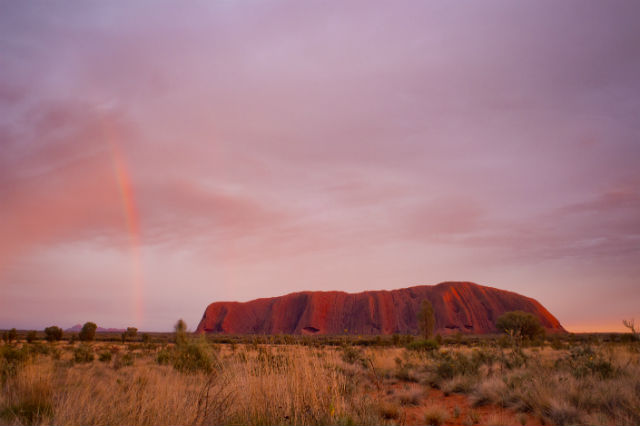
Uluru. (Photo: Editorial RF / iStock Editorial / Getty Images Plus)

A Spiritual Journey at Uluru

The sandstone formation Uluru, also known as Ayer’s Rock, rises nearly 1,142 feet (348 meters) above the Northern Territory’s arid “Red Centre.” It’s no wonder that this site has been a major spiritual destination for the Pitjantjatjara Aborigines, and ownership of Uluru was rightfully returned to them in 1985. Various tour operators offer activities from camel rides to helicopter rides to ensure that visitors can view the mountain from any angle.

Australia’s Aborigines

While visiting Australia, take the time to learn about the original inhabitants, the Aborigines. Though museums and cultural centers can be found throughout the country, Arnhem Land, in the Northern Territory, contains the most concentrated population of indigenous people. This region is wild, with dramatic landscapes and endless outdoor activities. Aboriginal celebrations, such as the four-day Garma Festival in August, give visitors a chance to learn about the culture and traditions of this region. The Buku-Larrnggay Mulka Center, in Yirrkala, showcases displays of Aboriginal art – bark paintings, carvings, and other pieces – as well as the history of the Yolngu people’s participation in World War II.

Take a Walking Tour

A walkabout is a traditional rite of passage for Aboriginal boys, a passage to manhood. Though this ritual was for spiritual purposes, one of the best ways for any visitor to Australia to truly get a sense of the vast landscape is on foot. Guided walking tours are available that lead groups through landscape.

Hop on a Wine Train

Wine has surpassed the ubiquitous Foster’s oilcan as the representative beverage from Australia. The country is the eighth-largest producer in the world, with the bulk of the vineyards found in the southern part of the country where the climate is more favorable for grape growing. Vintages from the Barossa Valley are likened to those from Bordeaux, Napa and Tuscany, whereas the Clare Valley, near Adelaide, is known for its crisp Rieslings. Take a wine tour for a full day of sipping pleasure.

Take in Geographic Wonder

In addition to the Great Barrier Reef, beaches and iconic Uluru, Australia boasts numerous other natural geographic wonders. Visit the Pinnacles Dessert, where limestone spires up to 4 meters tall jut out of the sand, to feel like you are walking on another planet. The Twelve Apostles sea stacks (though now only eight) off the coast of the Great Ocean Road and the Three Sisters found in the Blue Mountains west of Sydney, are similar formations that showcase Australia’s vast and varied landscape.

Have a BBQ on the Beach

Admit it – you’ve been dying to “put a shrimp on the barbie!” Barbecuing is popular in Australia and many public beaches provide free picnic areas, some with grills, so you can partake in this seafood pleasure. When you’re shopping for ingredients, however, just remember that in Australia, shrimp are called “prawns.”

Start planning your Australian trip of a lifetime with AAA and TravelBound

Subscribe to Your AAA Newsletter

Sign up and receive updates for all of the latest articles on automotive, travel, money, lifestyle and so much more!

Entertainment Budget Basics

When you’re a young professional, the financial obligations of life might be a constant irritation, but they really become a challenge when you have kids. Although health care and housing predictably take up the bulk of the spending in American households, the cost of entertainment is one area that many families neglect to take into account when laying out their budget.

The fun things you do with your family provide bonding opportunities as well as a respite from the day-to-day stresses that life sends your way. So, since research indicates a year-over-year increase in entertainment-related expenses, we’re offering a rundown of some tips you can use to offset those costs and keep enjoying what you love.

Movies and music

For many American families, watching movies and listening to music are among the most popular forms of entertainment. But even these expenses can be reduced with a bit of strategy involved.

For instance, before you head to your local theater, check for any student and/or senior discounts that might apply to your family. Most chains also offer regular deals on tickets and concession items as well as rewards programs. AAA even offers discounted tickets at some of your favorite movie theaters.

As far as how to satisfy your music needs, the solution is simple. Rather than buying music online, sign up for a free, ad-based music service. Some premium services may cost as little as 99 cents for the first three months.

Books and magazines

It might seem like obvious advice, but for families who are avid readers, look no further than your local library. In addition to physical copies of both new and classic books, libraries often have an impressive selection of periodicals, making it easy to catch up on your favorite magazine or newspaper without spending a dime.

Many major markets also offer electronic libraries through which you can borrow eBooks, audiobooks and even videos. The New York Public Library, for example, uses a system called Overdrive that uses your library credentials to set up an account. Other than libraries, you could simply opt for eBooks in general — since they’re often much cheaper (and more convenient) than hardcovers — or pay a visit to a used bookstore, where you’ll be able to find a surprisingly wide variety of titles for incredibly low prices.

Cable television

You might not be able to imagine a world without cable television. Chances are, however, that you’ll soon be joining the 13.5 million households that no longer pay for a traditional cable package. And why should they? Even for the most dedicated couch potatoes, it’s a brave new world filled with streaming services, network-specific apps and on-demand cable alternatives.

Many major networks offer free full episodes of current shows within days of the initial airing and sports deals to ensure that you never miss a game. It’s easier than ever to select the shows you want a la carte. So consider cutting the cord and embrace a more streamlined approach to the television you pay for.

entertainment budget

Sports and other events

Whether you’re interested in attending a local sports game or some other event, you’ll likely find easy ways to save money if you know what to look for. Much like the discounts we mentioned earlier at movie theaters, many organizations offer lower prices for students, seniors and members of the military, and even if they don’t, they may feature special deals on designated dates.

Do your research before you buy tickets for anything. But if you’re really wanting to have fun on the cheap, look into what is going on in your community. From sports to the arts, many cities host events for little to no charge to boost attendance, build word of mouth or simply as a fundraising effort. Lastly, you might opt to volunteer at a nearby theater or sports venue, since you’ll be able to get involved in something you love and perhaps score some discounts or free tickets in the process.

Dining out

Going out to eat isn’t exactly an entertainment cost, but considering its prevalence as a family activity, it’s still worth mentioning here. The average American family spends a bit over $3,000 every year at restaurants, a statistic that likely also factors into the national obesity rate.

Our best advice for how to curtail your dining budget? Rather than going out to eat, try designing a weekly menu and cooking at home more often. This will ensure that you don’t buy more groceries than you need and prevent food from spoiling. You could even involve the whole family and make preparing meals a group activity. If you make extra food, you might have enough for lunch the next day, thereby preventing the temptation to buy more food during the work day. It might take a bit of planning, but making your own meals isn’t only more cost-effective but healthier too.

Every little bit helps

Now that you have some new ideas for how your family can trim entertainment costs, you might be able to direct your newfound extra funds toward building your savings. AAA can help you get there. With four high-yield savings products to choose from, you can maximize your savings account and accelerate its growth at the same time, allowing a much faster development than you’ll find elsewhere.

Subscribe to Your AAA Newsletter

Sign up and receive updates for all of the latest articles on automotive, travel, money, lifestyle and so much more!

Your AAA Network Reaches Readership Milestone

Earlier this year, we launched the Your AAA Network with the goal of providing you, the reader, with interesting and useful daily content in the travel, money and lifestyle space.

More than 5 million page views later, we want to say THANK YOU.

This endeavor is off to a promising start. Your comments motivate us to work harder, your social shares are genuinely appreciated, and nothing excites us more than hearing your editorial pitches.

I would also like to congratulate our amazing editorial team on recently winning the Best Product Launch/Relaunch Success award from the Specialized Information Publishers Association. Other national SIPA winners included CNBC, PRNews, HR Magazine, OPIS and more.
Your AAA Award

I am proud to work alongside such an amazing group of content creators.

If you aren’t signed up to receive emails from Your AAA, click here. And again, a sincere thank you for reading!

Subscribe to Your AAA Newsletter

Sign up and receive updates for all of the latest articles on automotive, travel, money, lifestyle and so much more!

5 Great Family Trip Ideas

Some of the most treasured vacation moments happen spontaneously, like when you unexpectedly come across a beautiful sight or you look around and everyone is enjoying the day’s activities completely in sync.

Plan a Family Vacation With Trafalgar

Forget the fuss of planning a family holiday. From transportation and included meals to hand-picked accommodations and expert Travel Directors leading the way, Trafalgar's trips are designed to ensure the whole family enjoys the adventure. It’s the real thing, without worrying about a thing. Book with AAA and receive exclusive benefits!

Learn More

Behind the scenes, a well-orchestrated trip lays the groundwork for these moments. From picking the best destination to organizing a themed vacation, here are the family trip ideas that will keep your vacation moving along smoothly.

Weigh Domestic Versus International Destinations

With travel inspiration and trip ideas for families everywhere you turn, it can be difficult to narrow down the destination options. However, no matter where you decide to go, you must make sure the location is safe, fun for all ages and within your budget. Now, the decision is to choose whether to travel domestic or international as they both have their advantages and challenges.

Through an international trip, children have the opportunity to gain a more expansive view of the world, which often jump-starts a lifelong love of travel and adventure. For parents who have never traveled to a location before, the chance to share this first-time experience with their children is a major draw. The most challenging part is coordinating the logistics, particularly when you decide to embark on an extensive trip such as a multi-city tour of Europe.

It may seem overwhelming to plan a trip that takes your family to London, Amsterdam, Venice and Paris, but these are just some of the stops included in an escorted vacation package like the Trafalgar European Whirl. By placing your vacation in the hands of travel experts, you can avoid the stress of organizing transportation connections and selecting the best hotel accommodations in each city, allowing you more freedom to enjoy every leg of your European trip with your family. Parents also find it easier to relax when they have a guide who can answer questions about the local area and provide recommendations about restaurants and interesting excursions along the way.

If you’re sorting through domestic trip ideas for your family, rest assured that your children will still gain a new cultural perspective, but this time in their own country. As they see extraordinary sights within the U.S., they will learn about history, nature and the local art, opening their eyes to the varied landscapes and local cultures they encounter. The most challenging aspect of a domestic vacation is planning an itinerary that will keep everyone entertained, particularly when children of multiple ages are involved.

Organize Your Trip Around a Theme

While transportation and hotel accommodations may be less challenging to coordinate on a domestic trip, families often find it difficult to fill the days with the right activities. By organizing a trip around a theme and including multiple destinations, family members of all ages are more likely to stay engaged, and teenagers are less likely to complain of boredom.

Among the popular trips for families are those that delve into the story of American independence, including visits to historic cities like Boston, Philadelphia, Gettysburg and Washington, D.C. If American history is your primary focus, consider the Pilgrims and Patriots package offered by Trafalgar.

family trip ideas

Teach Children About the Value and Cost of Travel

In the same way that individual travelers may have a travel bucket list of destinations they would like to visit, many have a list of places they would like to visit with their families. Topping the list of international family destinations are the Caribbean, Canada and Europe, while Florida, California and New York remain popular for domestic trips.

It’s always important to stay within the bounds of what is affordable for your family, but you might consider saving for a future trip now and letting children know what’s in the works. Once you’ve set your sights on a future destination, let everyone know so that they can become engaged in the trip from the outset. When children understand that travel is valuable to the quality of life but should also be financially within means, they learn important lessons about budgeting.

Pack the Right Gear for Every Family Member

A forgotten toy can wreak havoc on the beginning of a trip, so make sure to have comprehensive lists of what every family member will need and check them multiple times before embarking on your journey. Those lists should include everything from clothing and toiletries to your child’s chosen stuffed animal. If your trip will include water or sports activities, make sure to pack the proper outfits, gear, and sun and bug protection. When you’re on a tour like the Trafalgar Greek Island Hopper package, you’ll certainly want bathing suits for everyone to wear on the golden beaches of Mykonos. While it may be possible to purchase a forgotten item at your destination, you can’t guarantee that you’ll find just what you need.

Amid planning lists for other members of your family, make sure to prioritize your essentials as well. When the adults on the trip have everything they need, they’re more relaxed and able to enjoy the travel experience. Taking care of everyone’s needs includes anticipating your own.

Plan Entertainment for the Journey

Even if your trip moves along exactly as planned, vacations involve a lot of transportation between destinations. Sometimes they even involve flight delays, traffic and other unavoidable circumstances. Whether you plan car games or bring movies that children can watch on the plane, bring the necessary technology and activities to keep everyone occupied. While young ones watch a movie or teenagers listen to their favorite music, adults enjoy the quiet time that comes from remembering to bring enough sets of headphones.

Spending vacation time together extends the love of travel throughout the family. As you weigh the options, these tips can help you orchestrate a remarkable vacation full of priceless, cherished memories.

Inspired to book a family vacation? Plan a dream trip with Trafalgar and get exclusive benefits as a AAA member! 

Subscribe to Your AAA Newsletter

Sign up and receive updates for all of the latest articles on automotive, travel, money, lifestyle and so much more!

Fun and Educational Apps for Kids

They can be fun, they can be educational, but can apps be fun and educational? Absolutely! This summer, don’t let your kids’ quest for knowledge stop once they leave school. In fact, all they need is their smartphones or tablet and excitement to learn.

Here are some apps that prove that learning can be as fun as swimming in a pool on a hot summer day or swinging on swings.

Fun and Educational Apps for Kids 5 – 7+

Fruity Fractions for iOS ($2.99)

Fractions can be tricky, but, with this app, they don’t have to be. Kids follow along with the main character Quip, who just wants his share of fruit, and to learn basic fractions concepts along the way. The game provides instructional support for learners so that they can learn concepts easily.

With fifty expert-designed problems and a storyline that progresses with each problem solved, kids can see that learning fractions can be enjoyable. Just make sure they don’t play this game on an empty stomach!

Drawing Pad for iOS ($1.99) and Android ($1.99)

Are your kids into art? Consider having them download Drawing Pad.

This app works much like a real-life art studio, down to the appearance of the tools that they can use. From crayons and colored pencils to markers and paintbrushes, budding artists can express themselves creatively and learn how each tool works. The pieces can be saved to a drawing pad album so that they can be worked on later.

This app does include a feature that allows kids to share their pieces on social media, so be sure to exercise caution.

Thinkrolls for iOS ($3.99) and Android ($2.99) 

With Thinkrolls, children learn about physics and build their logic and problem-solving skills. They will use advantage force, acceleration, buoyancy, heat, elasticity and gravity in order to reach the end of the maze. The puzzles strengthen observation, creative thinking, logic, problem solving, spatial cognition and memory.

Two key elements of the game is that there are unlimited tries and zero penalties, so they can learn through trial and error what works and doesn’t work. Your children can use this app without worrying about losing in-game lives or anything like that.

Learning physics with this app is as much fun as eating ice cream on a hot summer’s day and not having the ice cream drop on the sidewalk.

fun and educational apps

Fun and Educational Apps for Kids 8 – 9+

Dragon Box Elements for iOS ($4.99) and Android ($4.99) 

This game will teach your kids middle school- and high school-level geometry and the logic behind it. And, within a matter of hours, they’ll absorb concepts without realizing that they’re actually learning. Bright characters and mesmerizing puzzles will encourage them to keep playing.

There are 100+ puzzles that kids – and adults too – can complete to gain a deeper understanding of the logic behind geometry. But, the geometry is hidden to the point where kids can progress in the game with no trouble. This game offers the opportunity for everyone to learn as a family, with four individual game saves maximum.

Marble Math for iOS ($3.99) and Android ($2.99) 

This fun and educational app based on the Common Core Curriculum is a great way for your elementary school children to practice solving math problems in their head. They’ll need to be incredibly focused, however, to avoid obstacles in order to maintain a high score.

But, if they get a wrong answer, that’s not an issue: Marble Math gives the option to replay the problem or show the correct answer before moving on to the next problem.

They can also add as many customized profiles as desired, as individual game settings and progress are saved in each profile. In addition, parents and teachers can adapt the game to tailor to the students’ learning pace. While smartphones may come in with a built-in calculator, knowing how to solve math-related equations mentally can take a child a long way.

Stack the States for iOS ($2.99) and Android ($2.99) 

Learning geography can be fun. With Stack the States, your child can have a great time learning about the U.S.

This app will help your kids learn the states and capitals as well as other trivia like nicknames, flags, abbreviations and more. In addition, this app has five additional games – Map It, Pile Up, Puzzler and Capital Drop – featuring the states as player characters. This way, kids become more familiar with the states.

Other prominent features include high resolution pictures of famous U.S. landmarks and upbeat sound effects and music.

Fun an Educational Apps for Kids 10 – 12+

Cargo-Bot for iOS (free) 

Have a child who wants to become a programmer? Is he or she interested in programming concepts? Encourage them to download Cargo-Bot.

This puzzle game features a robot, and the player has to teach it how to move crates using specific codes. It also challenges the brain and helps the player learn all about programming.

This fun and educational app is the first to be created entirely on iPad using Codea.

Monster Physics for iOS ($1.99) 

Is your child curious about how things are built and how they work? Monster Physics is the app for them.

This fun and educational app lets your child explore the concepts of physics and take advantage of the “build” feature. The feature lets them make gadgets using metal, wood and plastic parts.

The app also contains 50 missions for the child to solve. The difficulty increases with each mission. By using critical thinking and problem-solving skills, your child will feel not just motivated to learn more about how physics impacts their daily lives. They will also feel empowered in their newfound knowledge and understanding.

Swift Playgrounds for iOS (free) 

This fun and educational app is perfect for kids, as well as for anyone else interested in coding. It requires no prior knowledge of coding. The user also experiments with Swift, a code used for the development of many popular mobile apps today.

This app is the first of its kind to take full advantage of the iPad and the iOS SDK, or the iOS Software Development Kit. In a world that’s becoming more and more digitized, a child can benefit from learning how to code, so downloading this app can be one of the best decisions they can make.

Have any fun and educational app suggestions? Let us know in the comments!

Subscribe to Your AAA Newsletter

Sign up and receive updates for all of the latest articles on automotive, travel, money, lifestyle and so much more!

Choosing the Best Hotel for Your Travel Style

Searching for a hotel can be an overwhelming process. After sifting through pages and pages of deals and promotions, we’re often left more confused than when we started. We all want to stay at the very best place but depending on how you like to travel – and whom you like to travel with – “best” means different things to different people.

GO. GET. DOUBLE REWARDS.

2X Points on Every Stay! Register now! AAA PreferredSM Best Western Rewards® members will earn double rewards points on every stay between September 17, 2018 and November 18, 2018.

Learn More

Are you looking for a hotel for family vacations? Solo business trips? College reunions? To find the most ideal lodging, you need to define your priorities. Are you looking for a party atmosphere or is a kid-friendly environment more important to you? Is affordability your main incentive or are you willing to splurge on something luxe?

When booking a hotel, consider these four points first.

Price

Lodging tends to take up the largest chunk of a travel budget. If price is your priority, there are many ways to save. Most hotel websites have a special offers section. If you are a AAA member you can also check to see if there are any exclusive benefits available. AAA members can save on a number of hotels, including Best Western.

Some hotels also have a flexible date option when searching, which will show you all the prices for that month. Prices can fluctuate according to month or day of the week so if you don’t have a strict time restraint, play around with this feature.

Experts recommend booking your hotel at least two to three weeks prior, but generally, rates drop the closer you get to the check-in date. If you’re an opportunist who can handle open-ended plans, sometimes it pays to wait; however, there are some risks involved. When you wait for prices to drop, you don’t always get the cream of the crop. If you’re just looking for a place to lay your head for the night this is a great way to cut costs, but it’s recommended for groups to book in advance. You don’t want your family of five to get stuck in a room with a single bed!

If you’re in town to see an attraction or attend a conference located in a city center, look for hotels on the outskirts of town. Hotels tend to get cheaper the further they are from major areas of activity. Compare prices of hotels near your area of interest with places 15-20 minutes away but remember to factor in the cost of transportation and make sure the overall price is still worth it.

Location

Cash may be king, but travel is usually all about the location. What do you want to see while you’re traveling? You want your hotel to be in relation to those destinations. And if they’re not in walking distance, where’s the nearest public transport?

Always take the hotel’s location description with a grain of salt. Sometimes “can easily get to Empire State Building” means walking to a bus that takes you to a train which takes you to another bus. To be safe, check out potential hotels on a map and familiarize yourself with the area around your intended location. Looking at a map will also show you what other points of interest are nearby, such as dining or shopping. How far do you need to walk to get a late-night bite? This leads to other questions like is the area safe enough to walk at night? What type of neighborhood is it? Some quick background research can provide you with these crucial details.

finding the best hotel best western

Amenities

Even if price and location are the only things that matter to you, you should know what to expect in terms of basic amenities and, more importantly, what to watch out for. The four basic amenities are air- conditioning, parking, breakfast and Wi-Fi. These may seem like features that every hotel should offer in 2018, but they’re not. When booking your hotel, pay attention to what they say about these amenities –  especially if they don’t say anything at all.

AC is usually a given in the United States, but not in other countries. As for parking, sometimes hotels will list it as an amenity even when referring to a third-party garage off site that charges extra. Whenever a hotel lists a service like parking or Wi-Fi without a price, don’t automatically assume it’s free. The same goes for breakfast. Often one rate will include breakfast and one won’t, so choose carefully! When in doubt about any of these basic features, contact the hotel just to make sure.

If you’re going to spend most of your time at the hotel, amenities are paramount. Are you looking to lounge by the pool with drink in hand? Consider an all-inclusive resort. Want a room with a view? Check out photos of the rooms posted on the hotel’s site but, be sure to compare them with photos from guest reviewers! Pictures can be deceiving. Looking for some deep R&R? Many resorts have signature spas and offer discount packages for guests. Are you looking to get some work done while on the road? Maybe you need a hotel with room service that delivers to your door, so you can stay focused on the task at hand.

Atmosphere

What kind of ambience are you looking for? It’s best to know the personality of a place before you book, even if you won’t be spending most of your time there. Would you be comfortable on a small, intimate property where the staff knows your name? Are you with a group of friends looking to hang out with a younger crowd? Are you bringing kids along for the trip? These are all very different vibes and you should consider what kind of experience you want. You can find this information by looking at guest reviews beforehand or checking the inspector notes if the hotel is AAA Diamond Rated.

Finding a hotel is about picking your priorities and knowing what to look for. If you understand what you want in terms of price, location, amenities and atmosphere, you’re already halfway there. Self-awareness is the difference between picking the “best” hotel, and the best hotel for you.

AAA members save 5% to 15% and earn bonus Best Western Rewards points when booking AAA rates! Click here to learn more about all AAA hotel deals.

Subscribe to Your AAA Newsletter

Sign up and receive updates for all of the latest articles on automotive, travel, money, lifestyle and so much more!

Finding Treasures Along Portugal’s River of Gold

Portugal is having a moment.

The westernmost country on the European continent, home to explorers who led the Age of Discovery, has been luring world travelers to its own shores of late.

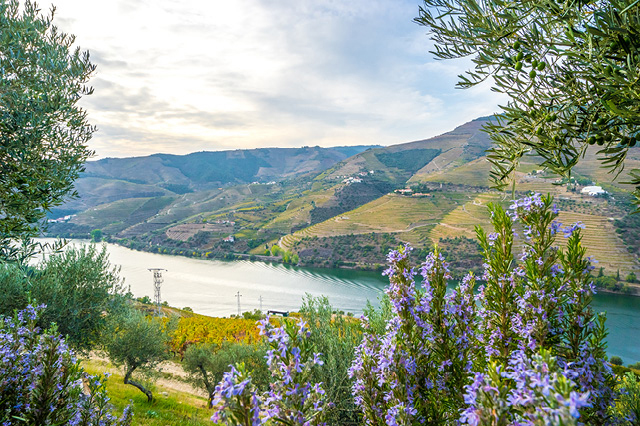
I savored that thought as I took a final sip of sweet port wine on the bow of the Viking Torgil as it bobbed on the Douro River in Porto, the city named for the libation. After a week sailing through Portugal’s Douro Valley, the Torgil was providing passengers a memorable last look at the river.

Our sleek riverboat shared the waterway with rabelo boats, wooden workhorses once used to transport wine casks. Colorful quayside houses and worn cobblestone lanes rose up from one riverbank, while signature wine cellars adorned the other. Bell towers clanked. And, as the sun set, the lacy metal arch of the Dom Luis 1 Bridge filtered light on the scene, turning the Douro gold.

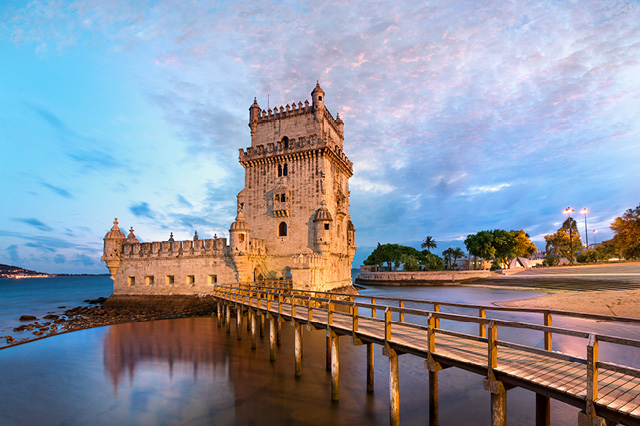
The Belem Tower in Lisbon, Portugal.

Cultural Riches

In Portuguese, Rio Douro means “river of gold,” but whether that references loot or looks remains unresolved. Why choose when both apply? Aside from striking riches with its historic wine trade, Portugal has yielded treasure with the recent popularity of riverboats. Viking has three boats plying the Douro, with plans to add a fourth.

Many companies, including Uniworld, charter boats to sail the region, which requires petite vessels capable of navigating narrow passageways with dramatic curves and snug locks.

The cruises deliver a unique itinerary and complimentary tours. I spent two nights in Lisbon before boarding the boat, enough time to experience a sensory showcase. I eyed Manueline landmarks such as the ornate Jeronimos Monastery (Vasco da Gama’s resting place) and Belem Tower. I marveled at soul-wrenching fado music and tasted pastel de nata, the country’s famous custard tart. The aromas of baking bread surrounded me as I fingered accessories made from local cork.

Find and book a hotel in Lisbon.

We also visited Coimbra, Portugal’s medieval capital, en route to the boat. Even Spain came into view via a tour to Salamanca, one of Europe’s oldest university towns and home to glowing sandstone architecture.

Mateus Palace
Mateus Palace, built in 1743, is in the heart of Portugal’s winemaking country.

Port of Call

Still, the heart of this journey celebrated the artistry of Portugal’s port winemaking region, its hypnotic landscape and the product produced nowhere else in the world. With vineyard strolls and wine tastings, my appreciation for port grew. Landmarks emerged, from the baroque Mateus Palace (depicted on Mateus Rose labels, popular in the ’70s) to a bakery in Favaios with a traditional stove fueled by grapevines.

The boat’s window-lined public areas highlighted the stunning scenery of the Douro Valley, a rural masterpiece of steeply carved valleys lined with terraced vineyards and dotted with ancient country estates. All 53 cabins, many with balconies, faced outside, and a top deck with a pool and shady pavilion was perfect for taking in the atmosphere.

I loved spying Portugal’s blue-and-white azulejo tiles. Panels at railway stations in Porto and Pinhao depicted Douro Valley scenes. Thankfully, I found more tiles to admire in Lamego, while descending the 686 steps at the Shrine of Our Lady of Remedies. (Pilgrims ascend on their knees.)

That’s beyond my capabilities, but I wouldn’t hesitate to pray for another trip to Portugal.

Find and book a hotel near the Douro River.

Have you been to Portugal? Tell us about your trip in the comments section below.

Speak with a knowledgeable AAA travel agent about member perks on trips to Portugal, river cruise vacations and other destinations.

Subscribe to Your AAA Newsletter

Sign up and receive updates for all of the latest articles on automotive, travel, money, lifestyle and so much more!

Five Northeast Road Trips for a Fantastic Fourth of July

From backyard barbecues and patriotic parades to fireworks that shoot across the sky, the Fourth of July is a birthday bash for America that everyone’s invited to attend. Communities throughout the country celebrate Independence Day, but some go all-in with blowouts in the name of freedom.

Everybody knows pomp reigns in Washington, D.C., with its parade down Constitution Avenue and fireworks that explode above the Capitol dome as the National Symphony Orchestra plays. In New York, the Macy’s 4th of July Fireworks illuminate the Manhattan skyline. Several barges on the East River send sparks soaring, with new colors and effects added every year. Spectators view the show from multiple points in the city and even some places in New Jersey. Plus, the New York and D.C. celebrations are broadcast nationally. Both are bucket-list destinations for a fantastic Fourth of July, but they’re not the only ones. Check out five more within road-trip range.

Find and book a hotel in Washington or New York.

New York celebrates the Fourth of July with the Macy’s fireworks display.

1. Bar Harbor, Maine

Fun on the Fourth begins early in Bar Harbor, with an outdoor blueberry pancake breakfast. A lunchtime a seafood festival highlights another local treat – lobster plucked right offshore. In between are relay races around scenic Mount Desert Island, craft fairs and a traditional Independence Day parade. Expect lobster races, too. Music fills the quaint village green throughout the day, and at night, fireworks burst over Frenchman Bay. Besides going red, white and blue, Bar Harbor also goes green by using disposable utensils made from cornstarch at its seafood festival.

Find and book a hotel in Bar Harbor.

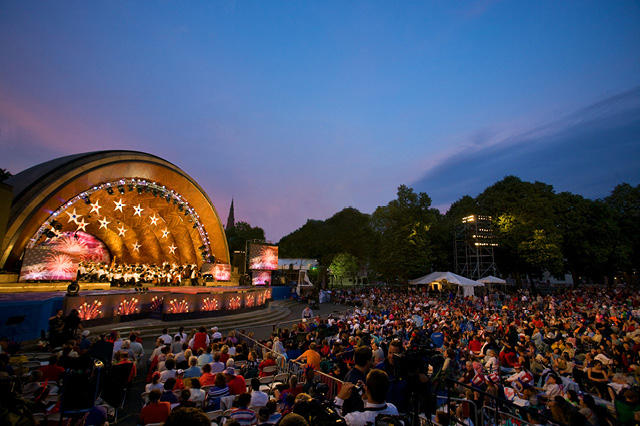
The Boston Pops perform at the Hatch Shell on the esplanade as part of the annual spectacular.

2. Boston

Revolutionary War history fuels a weeklong Harborfest celebration culminating on the Fourth of July with a reading of the Declaration of Independence from the balcony of the Old State House, a flag-raising ceremony, a parade and the Boston Pops Fireworks Spectacular (complete with real cannon fire). Fireworks illuminate the esplanade along the Charles River, and afterward, church bells ring citywide. Activities before Independence Day include a Chowderfest, historical re-enactments, a screening of “Yankee Doodle Dandy” in Christopher Columbus Park and special programming along the Freedom Trail. 

Related reading: 10 Signature Boston Foods and Eateries.

Find and book a hotel in Boston.

3. Bristol, R.I.

This town bolsters its reputation as America’s most patriotic town with a claim to the oldest continuously held Fourth of July celebration in the nation, an event that’s been evolving since 1785. Festivities begin on Flag Day, June 14, by proclamation of the town crier and conclude on Independence Day with a parade that travels down Hope Street, the center of which is painted in red, white and blue stripes. A visiting naval ship, nightly concerts at Independence Park, patriotic speakers, a Fourth of July Ball and a prestigious drum and bugle corps competition round out the celebration, along with brilliant fireworks over Bristol Harbor on July 3. 

Related reading: Charming Bristol, R.I., Leaves a Lasting Impression.

Find and book a hotel in Bristol.

4. Ocean City, N.J.

Fireworks give the sand and surf at Ocean City a warm glow on Independence Day. Launched from a barge just beyond the Ocean City Music Pier, which was dedicated on July 4, 1929, it’s a true beach and boardwalk bash. The day starts with a bicycle parade that honors the most patriotically adorned ride. Pie-eating, kite-flying and even hula-hooping contests follow. Plus, bands play under the covered loggia of the pier before and after the fireworks, creating a casual old-time dance party atmosphere.

Find and book a hotel in Ocean City.

The Philadelphia Museum of Art and Benjamin Franklin Parkway are alight with fireworks on the Fourth of July.

5. Philadelphia

America’s birthplace celebrates the Fourth with countless free events, from open museums and movie screenings to fireworks displays, during the Wawa Welcome America Festival. A free Hoagie Day honoring our troops kicks off the celebratory week, which climaxes on the Fourth with Declaration of Independence recitations, a parade with historical characters, a Liberty Bell tapping and a fete hosted by Betsy Ross, who shares a huge flag crafted from cupcakes. Plus, a block party sprawls down Benjamin Franklin Parkway to the Museum of Art’s “Rocky” steps, where an outdoor concert (Pitbull this year) precedes a fireworks finale. 

Related reading: The Top 10 Things to Do in Philadelphia, Pa.

Find and book a hotel in Philly.

How will you celebrate the Fourth of July this year? Tell us in the comments.

Talk to an expert. A AAA travel agent will help you make the most of your road trip.

Subscribe to Your AAA Newsletter

Sign up and receive updates for all of the latest articles on automotive, travel, money, lifestyle and so much more!

Beware of Foodborne Illness

Whether it’s a picnic in a park, backyard barbecue or camping cookout, nothing spoils the ambiance of alfresco dining faster than food poisoning.

The Centers for Disease Control estimates that 48 million Americans suffer from foodborne illnesses each year, a problem that can rise with the temperature in summer months.

“It gets warmer. There’s higher humidity. People are preparing food outside,” said Ernest Julian, chief of the R.I. Department of Health’s Center for Food Protection. “They tend to leave food out in 90-degree temperatures, where bacteria can double every 20 minutes.”

Don’t let salmonella, Campylobacter, E. coli or any other contaminant spoil your food – or your summer. Food-handling basics that work indoors also work outdoors. Sanitizing surfaces and proper hand hygiene – washing at least 20 seconds with warm soapy water before and after food preparation – are essential.

These precautions will also help you ward off foodborne illnesses.

Picnics and Cookouts

  • Don’t leave food sitting for more than two hours – one hour maximum when temperatures spike to 90 degrees or higher.
  • Keep cold foods in a cooler, and serve small portions, replenishing when needed.
  • Dairy products, sliced fruits and vegetables and raw meats should be put on ice. Keep perishable food cold until ready to be cooked.
  • Packed coolers keep cold longer than partially filled ones.
  • Position an insulated cooler in shade or a shelter, away from direct sun. Fill with ice, frozen gel packs or frozen food, which can serve double duty as cold packs.
  • Avoid opening the cooler too often.
  • Consider keeping meats in their own cooler.

Grilling

  • Avoid cross-contamination. Use separate cutting boards and utensils for raw meat and ready-to-eat items like vegetables or bread.
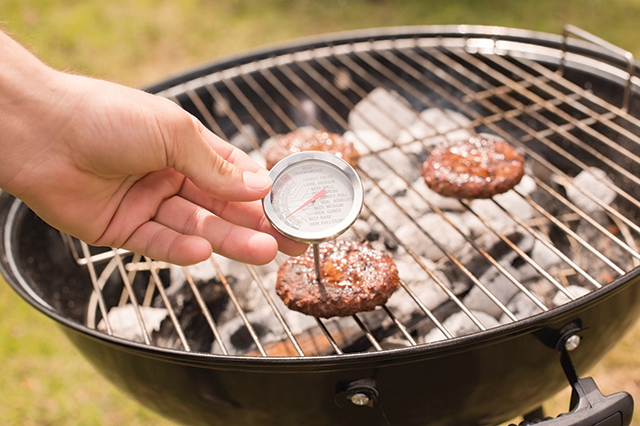
  • Cook to proper temperatures. Food thermometers can ensure meat and poultry are cooked thoroughly, to safe minimum internal temperatures.
  • Keep meat and poultry 140 degrees or warmer until served. You can avoid overcooking by moving cooked food to the side of the grill rack.
  • Always use clean plates and tongs for serving cooked food. Never reuse items that touched raw meat or poultry.

Read also: Summer Health Head to Toe

What are some of your favorite summer cookout foods? Tell us in the comments section.

Subscribe to Your AAA Newsletter

Sign up and receive updates for all of the latest articles on automotive, travel, money, lifestyle and so much more!

The Importance of Staying Hydrated During Exercise

There’s something about summer that sensitizes even Olaf, the snowman from “Frozen,” and sends him singing.

But when the heat rolls in, it’s the beginning of our battle to balance exercise and play beneath the blazing sun. If we’re not careful, we could overheat as quickly as the engine of a car stuck in bumper-to-bumper beach traffic.

“Emergency rooms and physicians’ offices fill up every year with people who weren’t exercising safely in the heat and then end up with dehydration, heat exhaustion or heatstroke,” said Dr. Deborah Ann Mulligan, an American Academy of Pediatrics spokesperson and AAA member.

Older adults and children are among those most susceptible to heat-related illnesses. But young and healthy adults who participate in strenuous physical activities during hot weather can also be affected.

Here are just a few prevention strategies.

But if there is a single best preventive measure, it is drinking water.

“Our bodies crave water,” Mulligan said. “This becomes especially true during periods of high-intensity activity or extended heat exposure.”

The American College of Sports Medicine recommends drinking six to eight 8-ounce glasses of water daily and increasing the amount before, during and after exercise – especially when in outdoor heat.

Water should be readily accessible, and consumed regularly during athletic activities.

The need for water is especially important as we get older.

“It is critically important for older adults to hydrate,” said Barbara Resnick, a geriatrics nurse practitioner and past president of the American Geriatrics Society. “It’s No. 1. Their thirst drive is not the same as a younger person’s – their bodies don’t tell them they’re thirsty.”

Also read: Good Workout Plans for Warm Weather.

What types of physical activity do you enjoy in the summer? Share ideas with our readers in the comments section.

AAA members save on deliveries from ReadyRefresh by Nestle. Visit our discounts site for more information.

Subscribe to Your AAA Newsletter

Sign up and receive updates for all of the latest articles on automotive, travel, money, lifestyle and so much more!

Mind the Heat While You DIY

Rising temperatures and longer days have people bounding toward summer – springing from simple spruce-ups around the house to major projects.

“The days are longer, and you can fit more in – you want to be outside,” said Becky Turpin, director of home and community safety for the National Safety Council.

But there are dangers to working under the merciless summer sun. Since June is National Safety Month, and the beginning of summer, the council is urging do-it-yourselfers and professionals alike to protect themselves against heat-related illnesses.

Here is some advice from the safety council and the Centers for Disease Control and Prevention that can help you stay cool and safe.

Drink plenty of fluids – early and often: Avoid sugary, caffeinated or alcoholic liquids, which can be dehydrating, or super-cold beverages that can cause stomach cramps.

Cover up: Use broad-spectrum sunscreen with a minimum SPF of 15. Wear lightweight, light-colored, loose-fitting clothing, sunglasses and wide-brimmed hats.

Mind the hour: Work during the coolest hours of the day – in the morning and evening. Take it easy between 11 a.m. and 3 p.m., which can be the hottest time of the day.

Take a siesta: Rest often in shady or air-conditioned areas. Napping during peak sun hours can allow your body to recover.

Wet down: Apply cool, damp washcloths or towels to your wrists, ankles, armpits and neck during breaks. Take tepid showers, baths or sponge baths when you feel warm, during lunch and dinner breaks, and before bed.

Pace yourself: Start slowly then gradually increase the pace, especially if unaccustomed to working in hot environments.

Eat light: Avoid hot and heavy meals.

Use a buddy system: Work together and keep tabs on each other. Heat-induced illness can cause confusion or unconsciousness.

Be alert: Stay informed of extreme heat alerts and plan accordingly. Check on people ages 65 or older who are more susceptible to high-heat conditions.

Read the signs: Practice safety precautions, and know the symptoms of and treatments for heat-related illnesses.

Read also: Summer Health Head to Toe and When to Replace Your Central AC System.

What are your DIY plans this summer? Tell us about them in the comments section.

Subscribe to Your AAA Newsletter

Sign up and receive updates for all of the latest articles on automotive, travel, money, lifestyle and so much more!

Exploring Madagascar’s Quirky Beauty

After panting up another slope, enveloped by a quilt of green rice paddies and agricultural fields, I encountered a sight that sent my heart soaring. I pedaled into a village of thatch-roofed houses where residents spontaneously gathered, lining the road. Three dozen grinning children waved and jumped with glee, while older men wearing straw hats shouted “Salama,” the local greeting, and women, swaddling their infants against their chests, perched on a stone wall yelling “Bonjour” and “Bon voyage.” This joyous welcome by the citizenry, unaccustomed to tourists, continued until I was long out of sight, and recurred in each and every village I visited.

During my week cycling and hiking through Madagascar, the world’s fourth largest island off the east coast of Africa, I experienced the country’s disparate beauty. It’s rough and tumble, with pothole-pocked roads filled with motorbikes, minivans, bicycles, wooden carts pulled by zebu (ancient humped, prized cattle) and locals walking to market with goods balanced on their heads. And yet it’s magical, populated by unique creatures and flora found nowhere else in the world, and precious ecosystems like dense rainforests and expansive savannahs that sprawl to the foot of majestic peaks.

Luckily for curious travelers, many tour operators now offer hiking, biking and other itineraries that are opening an intimate connection with this country’s often curious features.

Unexpected Geological Finds

An area of geysers near the Itasy region of Madagascar.

In the Itasy region, near the town of Analavory, I pedaled through a stunning landscape flecked with rounded mounds – old volcanic cones – and veered down a side road toward a series of geysers that bubbled and spewed carbonic acid-laden water. It formed peculiar structures resembling wax-encrusted candles streaked rusty orange. I strolled around ochre-colored rocks to a large pool of turquoise water where I detected the faint odor of sulfur swirling about.

A Grand Rainforest

Rolling into 100,000 acres of Ranomafana National Park, I cruised down switchbacks, enjoying the sun-dappled light and dramatically cooler temperatures. Water dripped from thick foliage all around me, and waters gushed into the Namorona River. The next day, I hiked steep trails hemmed in by bamboo, fig, strawberry guava and immense fern trees with Rajeriarison Emile, the park’s first guide who’s been there since 1985. He pointed out adorable golden bamboo and red-fronted brown lemurs – two of the park’s dozen lemur species – as they sprang from one branch to the next. Endangered lemurs are unique to Madagascar and tiny nearby islands. Even the ladybugs are different: They’re tinged with blue.

Striking Towers

Isalo National Park, Madagascar
Isalo National Park is a ruggedly handsome sandstone landscape.

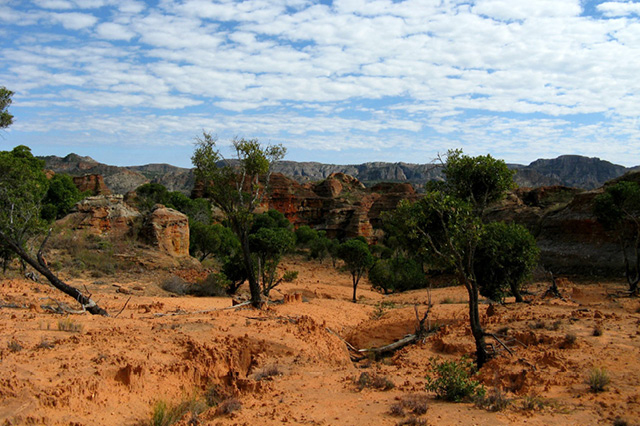
After cycling south through a vast savannah with impressive granite outcrops and herds of zebu, I traded my bike for hiking boots the next day. I wandered with my guide, Jules, through Isalo National Park, a colorful sandstone realm of water-battered and wind-polished gorges and rock towers. We ambled through the Canyon des Makis where the rugged cliffs are honeycombed with caves that the Bara people use as temporary burial chambers. I felt the isolation as we stood beside wondrous massifs splashed with green, white, black and crimson and listened to the sound of the wind.

Eccentric Trees

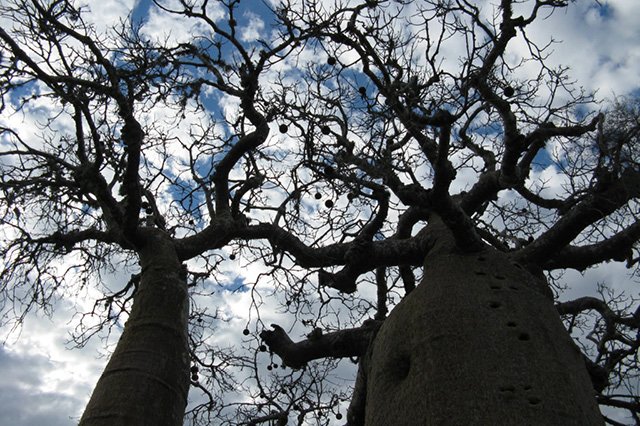
Oddly shaped baobab trees in Parc Mosa-Spiny Forest.

Once I reached Ifaty on the southwest coast, I settled into Hotel de la Plage. The resort fronts a white sand beach beside Madagascar’s largest lagoon, where simple sailboats called laka ply the teal waters. Fascinated with the oddly shaped baobab, Madagascar’s national tree, I reserved a van to the nearby Parc Mosa-Spiny Forest. As we meandered through the private park, my guide, Clovis, explained how these trees with their canopies of finger-like branches that reach for the sun are unusual in so many ways. For one, they’re bulging with water. Stopping at the park’s 1,400-year-old specimen, I tried wrapping my arms around its 40-foot trunk, and marveled at Madagascar’s precious inhabitants.

Talk to a AAA travel agent about a trip to Madagascar or other out-of-the-way places.

Subscribe to Your AAA Newsletter

Sign up and receive updates for all of the latest articles on automotive, travel, money, lifestyle and so much more!

Where to Stay in Atlantic City

Atlantic City has long been a hot destination for gambling and partying. This south Jersey city is home to world-class restaurants, a famous boardwalk and beach, an amusement park and great concerts and entertainment. Whether you’re a high roller or are traveling on a smaller budget, here’s where to stay in Atlantic City, including AAA Diamond Rated hotels.

Where to stay in Atlantic City: Budget

Sheraton Atlantic City

The Sheraton  is the perfect option for those looking to hit Atlantic City on a budget, but it is also great for families. The hotel is located a short distance from the main strip of hotels and resorts, so it’s a bit quieter. The lack of a casino at this hotel is also a plus for families, as there is no all-night action on the premises. The rooms are all non-smoking, and have a warm feel with gold, burgundy and plum accents throughout. And if you love to shop, you can spend all day next door at the Atlantic City Tanger Outlets.

Courtyard by Marriott Atlantic City

Just one block from the beach and boardwalk, the Courtyard by Marriott Atlantic City gets you close to the action at an affordable price. The lobby and well-appointed roomed are sleek, stylish and modern to make your stay comfortable and enjoyable. There’s also an on-site fitness room and a bistro, so you don’t have to go too far to start your day off with a good breakfast.

Where to stay in Atlantic City: Mid-range

The Chelsea

The Chelsea Hotel is a hip but affordable option for your stay. The hotel is very popular among younger guests, with a retro feel and a happening social scene. Fireplace lounges, private poolside cabanas and intimate nightclubs give the hotel more of a sophisticated vibe than what many of the Atlantic City hotels offer. The property also features two pools (one on the rooftop), two restaurants, a spa and resort-style beach service. The Chelsea doesn’t have its own casino, but is just a short walk down the boardwalk to gamble.

Tropicana Casino and Resort

If you’re looking for the full Atlantic City experience at a reasonable price, the Tropicana Casino and Resort is an excellent option. This massive waterfront property, which has over 2,000 rooms split between three towers, includes free Wi-Fi, contemporary décor and even video game consoles. Tropicana is home to eight full-service restaurants including the Atlantic City locations of famous eateries like The Palm Restaurant and Carmine’s, as well as numerous casual eateries and sports bars that offer everything from Tacos to seafood.

The Tropicana also has its own three-floor casino that consists of over 3,000 slot machines and over 100 table games. Or if you would rather spend your money on more tangible things than gambling (or if you win big), the hotel has its own mall called The Quarter. For relaxing and entertainment, the resort contains both an indoor and outdoor pool (complete with a swim-up bar), a full-service spa, beach service that includes cabanas for rent right on the sand and an IMAX movie theater. Catch a live show at their 2,000-seat theater, which regularly hosts headlining acts.

Where to stay in Atlantic City: Luxury

Caesars Atlantic City

The Caesars Atlantic City location keeps with the ancient Roman theme of its Las Vegas counterpart and offers a wide array of attractions. The 1,100 room resort is located right on the beach and boardwalk and is home to its own casino with over 3,400 slot machines and 135 table games. All of the rooms at Caesar’s have floor-to-ceiling windows that offer incredible views. And you don’t want to miss out on the opportunity to relax by the rooftop pool.

Caesars’ many dining options range from places to grab a quick bite to upscale steakhouses, including a pub and grill by world-famous chef Gordon Ramsey, while nightlife at the hotel features the 8,500 square foot DUSK nightclub and two full-service bars. For fun, day or night, there’s also The Playground, a nightlife, entertainment and shopping complex located on a pier adjacent to the resort, connected by a skyway, which offers a unique indoor row of shops, pubs, bars and live music venues inspired by Nashville’s Broadway and Memphis’ Beale Street.

Borgata Hotel Casino & Spa

The Borgata is one of the newer complexes in Atlantic City, having opened in 2003, but it has cemented itself as one of the town’s best hotels in its relatively young life. The hotel’s casino is one of the largest in Atlantic City with almost 3,500 slots and 200 table games occupying its 161,000 square feet. And when it comes to dining, Borgata is second to none. Among its many dining options, it has five fine-dining restaurants with establishments by world-renowned chefs like Bobby Flay and Wolfgang Puck. The Borgata’s outdoor pool, surrounded by lush gardens and palm trees, is one of the top in the city.

Nightlife is also a huge draw at the Borgata. The complex is home to two concert venues as well as a comedy club, numerous bars and lounges and nightclubs that regularly feature celebrity DJs. The hotel is located about two and a half miles from the Atlantic City beach and boardwalk, but it runs shuttles to neighboring beaches on Saturdays and Sundays during the summer months.

The Water Club at Borgata is also a AAA Four Diamond property and includes its own spa, pools and shopping.

where to stay atlantic city
Some cozy fires at the Golden Nugget Atlantic City. (Photo: AAA Hotels)

Golden Nugget Atlantic City 

The Golden Nugget Atlantic City is not only one of the top Atlantic City hotels, but one of the top New Jersey hotels. This resort and casino complex shies away from the gimmicky themes that many places in Atlantic City offer and focuses on giving it’s guests a more luxurious stay. Smaller than the city’s mega-resorts with only 727 rooms, the hotel boasts are more intimate feel throughout, while also offering an outdoor pool with a poolside lounge and fire pits, a 500-seat theater, a full-service spa and a varied selection of restaurants.

Nightlife at the Golden Nugget includes Haven Nightclub, which plays a blend of EDM and hip-hop music. But for those looking for something a bit more relaxing Rush Lounge, Bar 46, and the H20 poolside bar and grill are all great places to sit and have some drinks with friends. Be sure to also check out The Deck, an outdoor restaurant that has been voted as having the best deck by the Atlantic City Press.

Where are your favorite places to stay in Atlantic City? Share them with us in the comments!

Plan and book your next getaway with AAA.

Subscribe to Your AAA Newsletter

Sign up and receive updates for all of the latest articles on automotive, travel, money, lifestyle and so much more!

Experience the Magic of the 1960s and Woodstock at Bethel Woods

In August 1969, over 400,000 people descended on an alfalfa field on Max Yasgur’s farm in Bethel, N.Y., for what was advertised as “An Aquarian Exposition: 3 Days of Peace & Music.” Nearly a half-century later, the vibe from this generation-defining event, better known as Woodstock, still resonates in this Catskills town.

Visit the Museum at Bethel Woods

Relive the sights, sounds, and spirit of the 1969 Woodstock festival and the transformative decade of the ‘60s. Tour the grounds, now a National Historic Register site in Bethel, N.Y. On view thru December 31: Peter Max: Early Paintings featuring pieces from the Casterline and Fireman family collections.

Learn More

Bethel Woods Center for the Arts, located on the land where the festival took place, continues the magic of Woodstock with live performances, a museum showcasing the 1960s, and other cultural and educational events.

At the National Register Historic Site, visitors can stand in the footprint of the stage or relax in the festival field, where you can almost hear Jimi Hendrick’s version of “The Star-Spangled Banner” reverberating through time. Later this summer, the first trail of the restored Bindy Bazaar area that served as the marketplace at Woodstock will open to the public.

For those who were there to experience Woodstock and want to relive the memories or folks who simply would like to get a sense of where it all happened, Bethel Woods is a cultural destination like no other.

Preserving History Through Music  

This unique place and its legacy is protected by staying true to its roots in music. No matter what kind of tunes you’re into – rock, country, pop, jazz, classical or folk – Bethel Woods is a memorable place to see live performances.

The Pavilion amphitheater at Bethel Woods Center for the Arts opened in 2006 and has since hosted numerous well-known performers, including Bob Dylan, Elton John, the New York Philharmonic, The Eagles and The Zac Brown Band.

Click here for a full list of performers and events.

Experience the ’60s

Visitors to Bethel Woods can immerse themselves in the social, political and cultural vibe of the 1960s at The Museum at Bethel Woods. For those old enough to remember the era, the videos, personal stories and artifacts bring back the feelings from the Summer of Love. For younger generations, the museum both entertains and educates about the significance of the Woodstock festival taking place at the end of a decade filled with cultural change.

The permanent collection takes visitors on a journey through time, back through the struggles and idealism of the 1960s. Informative, interactive displays explain the changes that occurred throughout the decade, from the initial middle-class prosperity of the 1950s to the Cold War and the assassinations of President John F. Kennedy and Martin Luther King Jr. Video footage and photographs tell the story of the civil rights movement and the U.S. involvement in Vietnam, two of the defining pressures that led to the call for peace, brotherhood and love that culminated in the Woodstock festival.

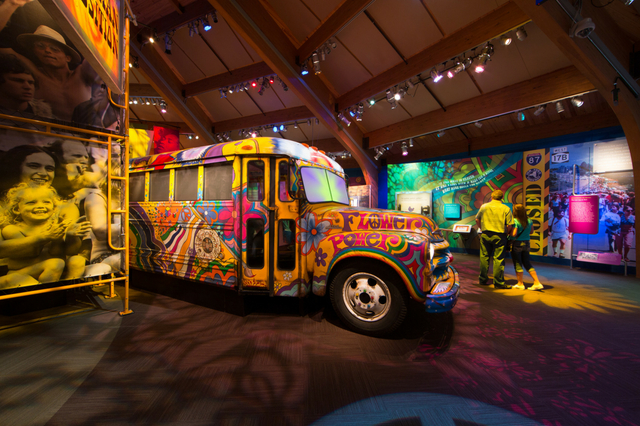
Images of the crowds filling Yasgur’s hallowed field, just down the hill from the Museum, cover the multihued walls. One can even take a seat on the psychedelic bus, decorated with whorls of bright colors and beaded curtains over the windows, and pretend it’s August 1969 again.

Complementing its extensive and growing permanent collection, the Museum also hosts special exhibits each year. These temporary shows range from artists such as Peter Max, who influenced social change in the ’60s, to a photography exposition of civil rights leaders from the era, to sculpture spread across the historic grounds. Two fast-approaching milestone anniversaries will be commemorated with special shows: the 1968 U.S. elections and, of course, the 50th anniversary of Woodstock in 2019.

bethel woods
Bethel Woods Center for the Arts

Educational Immersion

Bethel Woods has continued to develop educational initiatives and events to further its mission to be the premier ’60s cultural and educational center. A major goal is to educate the public about the lessons the 1960s imparted and how society can maintain its engagement with peaceful change. To meet this goal, the center offers a multidisciplinary arts program, through which the spirit of the Woodstock era is shared with upcoming generations.

The weekly Saturdays at the Woods program encourages parents and children to work together to develop artistic and self-expression skills. A more structured program, Explore the ’60s, teaches schoolchildren about the importance and lasting effects of the decade through a reading, writing and speaking curriculum that meets several Common Core state standards objectives. A program designed specifically for high school students, Project: Identity, combines art instruction with the development of imagination and innovation skills to help teens transition and help them realize the importance of the arts to a well-rounded life.

Festivals

Bethel Woods hosts several festivals throughout the year, providing an opportunity for visitors to gather and celebrate the bounty of the Catskills region. The Harvest Festival, which has been held for two decades, occurs every Sunday in September. This family-friendly event features farmers markets, artisans and crafters, live performances, a sit-down farm-to-table brunch and kids’ activities.

The Bethel Woods Wine Festival and CRAFT: Beer, Spirits, and Food Festival, both held in October during the peak foliage splendor, showcase the best of the region’s vintners, brewers, distillers, and food producers. Rounding out the year, the Holiday Market brings together local artisans offering a wide variety of gifts from New York state.

Baron Wolman, a photographer best known for his candid portraits of musicians for “Rolling Stone,” described the importance of the 1969 festival: “Woodstock showed the world how things could have been, and for this reason it’s important that we never forget this experience, this place, this time, this dream that came true … if only for three days.”

Today, nearly 50 years later, this seminal moment in U.S. history is preserved for generations to come, and the ideas and lessons from that time, nearly 50 years ago, will not be forgotten.

Learn more about Bethel Woods Center for the Arts and start planning your visit today.

Subscribe to Your AAA Newsletter

Sign up and receive updates for all of the latest articles on automotive, travel, money, lifestyle and so much more!

Protect Yourself From Heat Exhaustion

This summer, as the temperatures rise, be sure to pay attention to what your body is telling you. Heat exhaustion is a result of your body overheating. Though not as serious as heatstroke, which can be fatal, heat exhaustion can be scary. It could also lead to heatstroke if untreated.

The Causes of Heat Exhaustion

According to the Mayo Clinic, the most common causes of heat exhaustion are exposure to hot weather – particularly when combined with high humidity – and strenuous physical activity. Dehydration, which reduces your body’s ability to sweat, is another cause.

All three disrupt your body’s ability to cool itself efficiently, causing symptoms such as dizziness, fatigue, nausea, heavy sweating, fainting and more.

Athletes who train outdoors during the summer are prone to heat exhaustion, as are people under 4 years old and over 65 because they are less tolerant of heat.

How to Prevent Heat Exhaustion

To protect yourself and your family from heat exhaustion, follow these prevention tips from the Mayo Clinic.

  • Wear loose, lightweight clothing.
  • Avoid sunburn by wearing sunglasses with UV protection and wide-brimmed hats, as well as applying broad-spectrum sunscreen with an SPF of at least 15.
  • Stay hydrated by drinking plenty of fluids.
  • Avoid strenuous physical activity in hot weather. Do it indoors if you can or schedule it for the cooler times of the day (usually morning or evening).
  • Be mindful of medications that may increase your risk of having heat-related problems.
  • Don’t leave anyone – pet or person – in a parked car for even the smallest amount of time. The temperature in a parked car can rise about 20 degrees in 10 minutes. Cracking the windows or parking in a shady area won’t keep the temperature down. Even a seemingly harmless, 70-degree day could quickly become dangerous.

If you or a loved one are experiencing symptoms of heat exhaustion, stop all activity, move to a cooler place and drink cool water or sports drinks with electrolytes. Contact your doctor if symptoms worsen or don’t improve within one hour.

Have any tips for staying cool during summer activities? Tell us in the comments below.

AAA members save on ReadyRefresh by Nestle.

Subscribe to Your AAA Newsletter

Sign up and receive updates for all of the latest articles on automotive, travel, money, lifestyle and so much more!

Fresh Ideas for Preparing Your Garden-Grown Tomatoes

This summer, take hold of your health by exercising your green thumb. In addition to improving your mood, getting your body moving and exposing you to more vitamin D, gardening ensures you’ll have a store of healthy cooking ingredients. Whether from your garden or the local farm stand, fresh fruits and vegetables add nutritional value and delicious flavor to your meals.

Take a summer garden staple like tomatoes – they can be used in so many ways other than just tossed in a salad. We reached out to AAA Diamond Rated restaurants for ideas. Which will inspire you to get creative in the kitchen with garden-fresh vegetables?

Pump up the Jam

Get a party going in your mouth with a spiced tomato jam from chef Matthew Varga of AAA Four Diamond Rated Gracie’s in Providence, R.I.

Ingredients

3 pounds ripe, cherry tomatoes
1½ cups sugar
¼ cup freshly squeezed lemon juice
3 tablespoons fresh grated ginger
1 tablespoon ground cumin
½ teaspoon ground cinnamon
¼ teaspoon ground cloves
1 teaspoon salt
½ teaspoon cayenne

Peel the tomatoes by blanching them for a moment, then plunging them in an ice bath. The peels will slip off easily.

Combine all ingredients in a heavy-bottomed, large saucepan. Bring the mixture to a boil over medium high heat, stirring the pot often.

Once it boils, reduce the heat and simmer, stirring occasionally. In about an hour, the mixture should cook down to a thick jam. Taste and adjust seasoning.

tomato sauce
Give more flavor to grilled chicken or fish.

Dress up a Summer Classic

Executive chef Chris Eddy, from the AAA Five Diamond Rated Restaurant at Winvian Farm in Morris, Conn., makes a tomato sauce with a kick. He likes to use green zebra tomatoes in this recipe.

Ingredients

1 medium tomato, chopped
1 cup low-fat mayonnaise
Fresh basil
Virgin olive oil
Salt and pepper

Combine chopped tomato, mayonnaise, a few leaves of basil and a drizzle of olive oil in a blender. Blend until smooth. You could also drain the mixture through a fine mess strainer.

Add salt and pepper to taste.

How do you get creative with tomatoes? Share your ideas in the comments below.

Get a head start on growing your own tomatoes and other produce with our list of gardening resources and tips.

Subscribe to Your AAA Newsletter

Sign up and receive updates for all of the latest articles on automotive, travel, money, lifestyle and so much more!

Headlight Restoration Tips From Sylvania Automotive Lighting

Headlight restoration not only makes your car look better, but it can have a major impact on driver safety. In fact, a AAA study found that cleaning your headlights doubles the maximum light intensity of your lamps and reduces glare-producing light scatter by up to 60 percent – both very good things if you want to see where you’re going on a dark night or rainy day.

But the problem is, only about 20 percent of drivers have attempted to clean their car’s headlights, according to AAA. Considering that headlights start to deteriorate after five years, and the average age of cars on the road is more than 11 years, chances are you know someone who could benefit from a headlight cleaning and new bulbs.

Take some time to check the condition of your headlights, and keep reading for headlight care tips from Brian Noble of Sylvania Automotive Lighting.

Q. Do drivers really need to clean their headlights and if so, why?

Absolutely. Headlights are a critical, active safety item within a vehicle, as they serve as the first line of defense when driving at night or in dark conditions. Being able to see an object in the road or on the side of the road is an important step to being able to react appropriately. If a driver detects an object or animal in the road sooner, they will make a better, faster decision to avoid an accident. 

Q. What are some best practices for headlight maintenance?

First, you want to make sure you are replacing the headlights before they burn out. All too often, vehicles with a burned-out headlight or obviously dim headlights can be found traveling on dark roads, posing a risk to both the driver and others on the road. With one headlight out, drivers are essentially seeing half as well as they potentially could. If a vehicle owner cannot remember the last time headlights were changed, it may be time for replacements. Headlights dim over time and both bulbs are on the same amount of time. If one bulb burns out, you can assume the other bulb isn’t too far behind since they were made to the same specifications.

That brings us to my next point: Always replace in pairs. It’s very important to replace headlights in sets of two. Since headlights dim over their lifetime, a new bulb paired with an old bulb will create an uneven field of vision, which can be a major distraction on the road for both drivers and oncoming traffic.

Remember to clean your vehicle’s headlights and brake lights regularly, such as when filling up at the gas station, and, during the winter, be sure to clean off any snow on your front headlights and brake lights.

Q. Should drivers consider buying a headlight restoration kit?

The average age of vehicles on the road today is more than 11 years old. Millions of these vehicles have faded, cloudy plastic headlight lenses. This cloudiness, caused by degradation from the sun’s bright rays, reduces and diffuses the light going through the lenses, making it difficult to see when driving in the dark. Consider DIY clean headlight restoration kits that restore clarity and remove the hazy yellow appearance on headlight lenses. As a differentiator, Sylvania’s kits provide a UV Block Clear Coat, which protects headlights from future UV ray damage, the No. 1 reason headlights become cloudy. A good headlight restoration kit can restore a headlight to almost new condition, getting back the two-thirds of the light that is lost when a head light is cloudy.

Q. Do you have any tips to make bulb installation easier? 

Installation varies by vehicle. Sylvania Automotive Lighting and the CarCareKiosk have created step-by-step tutorial videos for various car makes and models on the road today, so leverage online videos when installing headlights yourself.

Remember to replace both high and low headlight beams at the same time. All headlights dim over time, so be sure to replace in pairs to avoid uneven lighting, which is a major distraction to other drivers on the road.

And, of course, stay safe. Wear safety glasses and gloves during installation. Be sure to handle the headlight properly – never touch the bulb itself; always handle the lighting by the base.

Learn more about AAA’s automotive services

Subscribe to Your AAA Newsletter

Sign up and receive updates for all of the latest articles on automotive, travel, money, lifestyle and so much more!

The Skinny on Sunscreen

Choosing sunscreen can be confusing, but all travelers should pack some.

Fortunately, as you ponder sprays, sticks, lotions and gels with various UV levels and ingredients, there is actually very little you need to know.

“Sunscreens fail for two reasons,” said Dr. Neal Schultz, a New York dermatologist in practice for 30 years. “Either you don’t put on enough or you don’t reapply.”

Because of this, Schultz says that liking the way your sunscreen feels and smells could be more important than the kind you use, as long as your choice has broad-spectrum UV protection with an SPF of at least 30.

If it follows the above guidelines and is sold in the U.S., Schultz says you don’t even need to worry about your sunscreen’s ingredients. “That’s all been done by the government and by the manufacturer,” he said.

Schultz says sunscreen lotions are easiest to apply and you should use about an ounce. Spray-on sunscreens are fine, except that people often miss spots. Put on your sunscreen before you put on your clothes or bathing suit for best coverage. Pay particular attention to the tops of the ears, tops of the feet and back of the neck. Men with thinning hair also need to cover those patches.

For the face, Schultz recommends using sunscreen pads, which contain light formulas that won’t run into your eyes if you sweat. Products that claim to be for sun protection, moisturizer and anti-aging generally include just trace amounts of the active ingredients, so he advises against them.

Your skin constantly perspires. “That’s why you need to reapply every two to three hours, even if you’re sitting under a tree reading and you haven’t moved a muscle,” said Schultz.

So, in the sunscreen aisle, look for products that smell good, feel good on your skin – and even have packaging you like. “A cardinal rule of skin care is you’ve gotta love your skin care product or you’re not going to use it,” Schultz said.

Need to brush up on your sunscreen basics? Check out our guide to understanding SPF.

What do you like most about your sunscreen? Share your recommendations with other readers in the comments section.

Subscribe to Your AAA Newsletter

Sign up and receive updates for all of the latest articles on automotive, travel, money, lifestyle and so much more!

American Landmarks You Can’t Miss

America is a land of stories. From coast to coast, it’s not hard to find them if you know where to look. There are hundreds of landmarks across the country that give voice to its history, whether from the vantage point of western settlers, Native Americans, immigrants or Mother Nature.

Discover America's Greatest Treasures

Tour America's greatest natural treasures with AAA Member Choice Vacations. AAA members receive savings of $50 per person and $50 for an excursion!

Learn More

Natural Landmarks That Will Leave You in Awe

While man-made monuments are great, there’s something truly powerful about feeling so small as you witness the sheer size of a redwood tree, a massive waterfall, an ancient mammoth or an expansive canyon – all created by nature’s tireless persistence. All four of these wonders can be experienced in both famous (and lesser known) landmarks across America.

Redwood Park, California

Ever wanted to know what it’s like to stand beside a redwood tree? The amazing breadth and height of this iconic species will take your breath away. Go for a short walk, a hike or a full-on camping trip under the shadow of these majestic trees that can live up to 3,000 years. Check out Roosevelt elk at Elk Meadow, watch the flight of a western red bat or spot a Steller sea lion on the park’s rocky coast.

Niagara Falls, New York

You will hear the falls before you see them. Actually, you may feel them before you see them, if the wind blows the mist the right way. Prepare to get a little wet – or perhaps very wet, if you plan to ride the Maid of the Mist. On this boat tour that sails at the base of the falls, the crew will give you a poncho, but be prepared to get soaked regardless.

In fact, if you like the idea of taking a shower as part of your tourist experience, visit the Cave of the Winds, where you will walk 175 feet down wooden walkways till you reach the “Hurricane Deck” at the base of the Niagara Gorge.

Click here for more fantastic things to do in Niagara Falls.

Waco Mammoth National Monument, Texas

Forty years ago, two archaeologists were digging through an area near the Bosque River hoping to come across old arrowheads. Instead, they found mammoth bones belonging to not just one mammoth, but an entire herd. The bones are 67,000 years old, and you can still see them where they lay in what’s known as the bone bed, beneath a shelter that was constructed to protect the bones.

Grand Canyon, Arizona

Have you ever imagined yodeling into the Grand Canyon? Come try it out while hiking or riding a horse or mule across this stunning landscape. Stay overnight at the Phantom Ranch at the base of the canyon and enjoy the rustic atmosphere. Raft down the Colorado River for just a day or make it a longer trip. Gaze down 3,000 feet from the Toroweap Overlook – if you don’t get too dizzy. There is much to see at this sprawling national park, and it will make memories that last a lifetime.

Check out this guide to Grand Canyon National Park.

american landmarks
Ellis Island

Landmarks That Shine a Light on Immigrants and Pioneers

Ellis Island and the Statue of Liberty, New York and New Jersey

It’s a surreal experience to stand where your ancestors once stood, viewing almost the same images they would’ve viewed. If any of your relatives passed through Ellis Island from another land into this country, you may find their names in the database at the National Immigration Museum that stands on this famed island.

Walk up the stairs and through the halls of the building they would’ve walked through and imagine the hustle and bustle of the crowds of immigrants, carrying their luggage and new dreams. Then, one boat ride away, visit Lady Liberty herself, take a walk inside, and read the text of the New Colossus by Emma Lazarus on the statue’s pedestal.

Angel Island, California

Alternatively, your ancestors may have arrived in this country via Angel Island. Sadly, the original immigration station on the island burned down in 1940, but the barracks in which new arrivals stayed still stands. You can still view Cantonese poetry carved into the wooden walls by those waiting for news about their immigration status.

Oregon National Historic Trail: Idaho, Kansas, Montana, Nebraska, Oregon, Washington and Wyoming

This trail, the largest landmark on our list, snakes through seven states, and tells the story, not exactly of immigrants, but of emigrants, as those from the east who moved westward. If you’ve ever played the popular game Oregon Trail, you’ll know how difficult the journey was. Come view the landscapes these pioneers would’ve seen and walk the remnants of the trail just as they did.

Landmarks That Tell the Stories of Native Americans

Hopewell Culture National Historical Park, Ohio

Near the city of Chillicothe, Ohio, is a large, grassy park with dozens of rolling hills. Those hills weren’t carved out by the hand of Mother Nature – these massive, graceful mounds were created by the Hopewellian Native Americans two millennia ago.

The word “Hopewell” refers not to one tribe, but to an entire network of tribes that stretched all the way from the east coast to the Rocky Mountains and comes from the last name of the landowners on whose property the mounds were first discovered. Come explore the six different mound sites at this park, all connected by a series of trails, and learn about the history of this unique landmark.

Salinas Pueblo Missions National Monument, New Mexico

At this little-known national monument stand three sites – Abo, Quarai, and Gran Quivara – that give us a glimpse into a time and place when Pueblo Indians met Spanish settlers. All three sites contain fascinating architecture dating back to the early 1600s and even earlier, from Spanish missions and defense towers (“torreones”), to adobe pueblos, and more.

Of course, these are just a few of the amazing national landmarks this country has to offer. If you have any recommendations for other exciting American monuments, don’t hesitate to share in the comments!

Visit one of these amazing landmarks when you book a trip with AAA Member Choice Vacations. AAA members get exclusive benefits.

Subscribe to Your AAA Newsletter

Sign up and receive updates for all of the latest articles on automotive, travel, money, lifestyle and so much more!