Between big cities, national parks, historical sites, scenic locations and entertainment spots, the Northeast has an overabundance of worthy road trip destinations. But keep your eyes peeled along the way, because there are also plenty of noteworthy sights to be found alongside the region’s highways and byways.
Roadside attractions usually range from fun and quirky to downright bizarre, but they’re always worth pulling over to see firsthand. With that in mind, here are some of the can’t-miss roadside attractions in the Northeast.
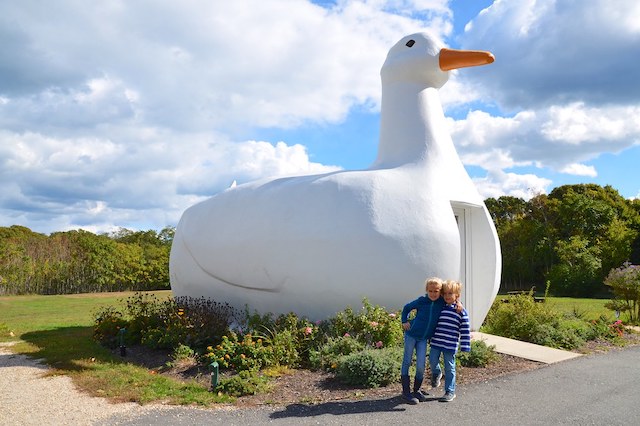
“The Kids At The Big Duck” by Joe Shlabotnik is licensed under CC BY-NC-SA 2.0
The Big Duck
Flanders, N.Y.
If you happen to be driving through the eastern Long Island town of Flanders, it will be hard to miss the giant duck on the side of the road. The Big Duck, as it’s known, is a 20-foot-tall, 30-foot-long building in the shape of a Pekin duck. It was the brainchild of duck farmer Martin Maurer, who commissioned the structure back in 1931 as a marketing ploy for his business. The building served both as a store to sell ducks and duck eggs, as well as a promotional tool highlighting the region’s growing duck farm industry. According to the Southampton Press, Long Island was once home to approximately 90 duck farms.
Although nearly a century has passed, the Big Duck remains one of Long Island’s premier tourist attractions. It’s even listed on the National Register of Historic Places. While you can’t purchase eggs there anymore, visitors can pick up duck-themed memorabilia, learn about Long Island duck farming history, and get travel and tourism information.
Lucy the Elephant
Margate, N.J.
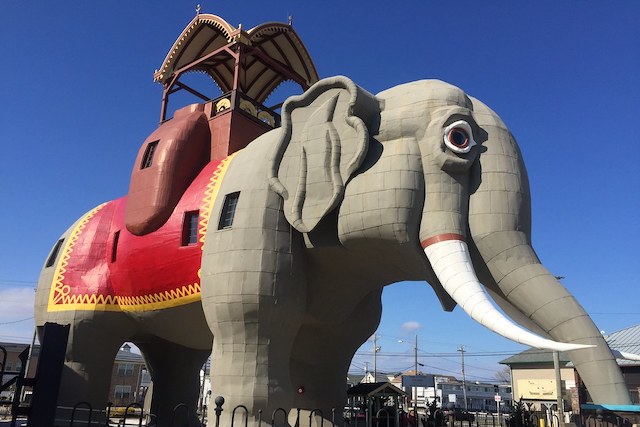
The Big Duck isn’t the region’s only giant animal structure built as a marketing ploy. Just outside Atlantic City you’ll find Lucy the Elephant. This six-story structure was originally constructed by real estate developer James Lafferty in 1891 to help draw potential customers to his land. Not long after, a hotel was built around Lucy, drawing guests from near and far.
Lucy, however, fell abandoned in the 1960s and there were plans to demolish the structure. Fortunately, a group of local residents raised enough money to save and restore the building. In 1976, Lucy the Elephant was designated a National Historic Landmark. According to the Casino Reinvestment Development Authority, Lucy is both America’s oldest example of zoomorphic architecture and oldest roadside attraction.
Lucy the Elephant is still open for business. Guests can visit, tour and even spend the night.
On the outskirts of Boston, in a town called Lincoln, you’ll find one of the most peculiar roadside attractions in the country. There, in an open pasture on Old Sudbury Road, sits Ponyhenge, an artfully arranged collection of plastic and metal toy horses.
Ponyhenge’s origins can be traced back to 2010, when a single hobby horse was placed in the open field. No one is quite sure how and why it got there. Nevertheless, more and more rocking horses, toy horses and horse figurines kept showing up, much to the delight of the people who own the land. “There was something lovely about it being anonymous, and now every time we go away, another one appears,” the owner told the Boston Globe.
The horses are periodically rearranged, so you never know how they’ll look when you visit.
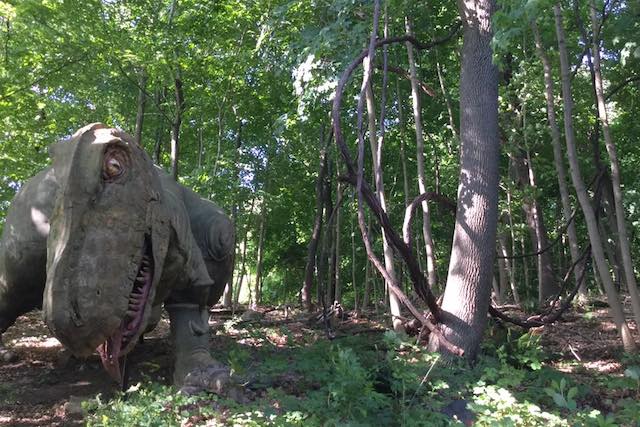
(Courtesy of Wells Dinosaur Haven)
Wells Dinosaur Haven
Uncasville, Conn.
Take a giant step back in time and mingle with some prehistoric creatures at Uncasville’s Wells Dinosaur Haven. In the backyard of artist Jeff “Fish” Wells’ home, you’ll find a collection of giant dinosaur statues roaming the grounds. Wells has been working on this project for 40 years and continues to add to it today.
Although Dinosaur Haven in situated on Wells’ private property, the artist is happy to share his work with the public. Visitors are always welcome to come explore the grounds free of charge.
The Big Blue Bug
Providence, R.I.
Apparently, the Northeast has a fondness for giant animal structures. Joining the Big Duck and Lucy the Elephant as popular roadside attractions is Rhode Island’s Big Blue Bug. Sitting atop the building along I-95 that houses Big Blue Bug Solutions is a 58-foot-long, 9-foot-tall, 4,000-pound giant bug statue. According to the company, it is an exact replica of an Eastern Subterranean Termite. (We’ll take their word for it.)
Originally constructed in 1980, the bug has made quite a name for itself, appearing in the movie “Dumb and Dumber” as well as television shows like “The Daily Show” and “The Oprah Winfrey Show.” In 1990, a naming contest was held. The winning submission was Nibbles Woodaway. Get it? Because termites eat wood. Anyway, at least you can now be on a first name basis as you pass the bug on the I-95.
Need a ride to get to these Northeast attractions? AAA members can save up to 20% on Hertz rentals.
What are your favorite roadside attractions in the Northeast? Tell us in the comments.
If you’ve been in the market for a new car, driven around a public parking lot or just turned on the news lately, you’ve come across electric vehicles left and right. EV sales have grown steadily in the United States over the past decade, yet they still comprise a minuscule percentage of the total automotive market share. But that may begin to change in a big way in 2022.
There are a number of reasons EV ownership could become more mainstream next year, but the most notable one may be the emergence of electrified trucks. The three most popular vehicles in America are pickup trucks. In 2022, we’ll see several EV pickups enter the market. There will also be more SUV and crossover EV options, in line with America’s growing preference for larger vehicles.
With that said, let’s get to the fun stuff. Here are just a few of the 2022 electric vehicles to get excited about.
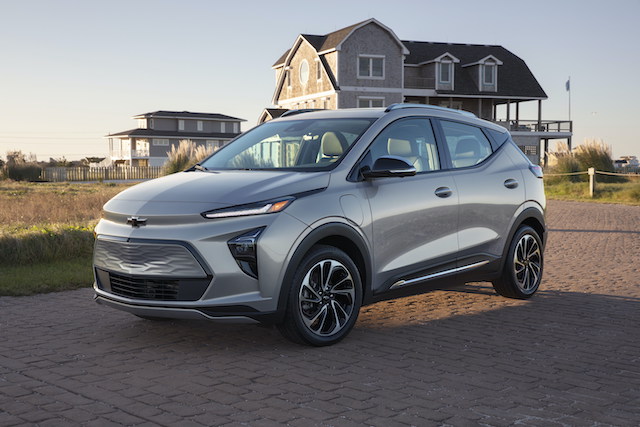
Chevrolet Bolt
The Chevrolet Bolt has long been one of the most popular EVs in the country. Expect that trend to continue as the hatchback has been newly redesigned for 2022. More notably, it’s being joined by the brand-new Bolt EUV, a compact SUV. Mechanically similar, the Bolt EUV offers the creature comforts of a larger model, including more cabin space and higher ground clearance. The crossover is also the first Chevrolet model to come with Super Cruise, parent company General Motor’s partially automated driving system.
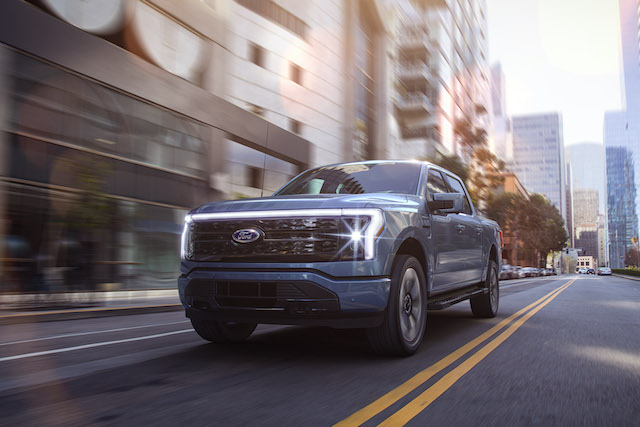
Ford F-150 Lightning
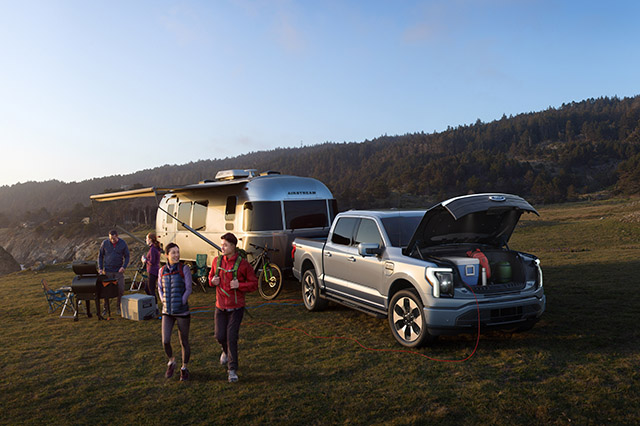
The gas-powered Ford F-150 has been the best-selling vehicle in America for more than 40 years. As such, electrifying the truck could have a profound effect on the American driving public and has led many to refer to the Lightning as the most important EV ever.
Those concerned the electric F-150 sacrifices power for clean driving need not worry. The Lighting boasts 563 horsepower and 775 pound-feet of torque. All this with a 230-300 mile range and a starting price below $40,000.
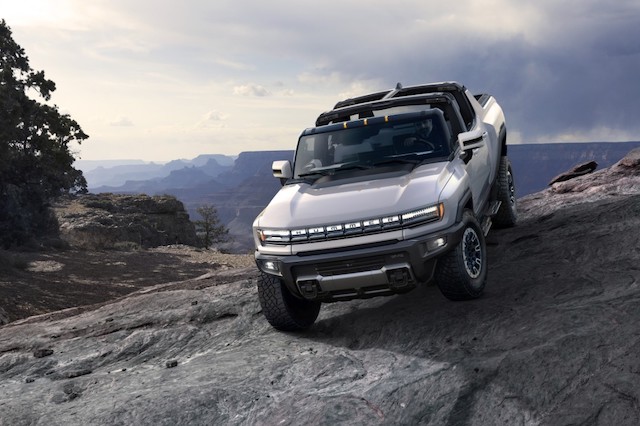
GMC Hummer EV Pickup
It’s hard to imagine the once gas-guzzling Hummer being on a list of eco-friendly vehicles. But times, they are a-changin’. And indeed, the Hummer as we used to know it has changed quite a bit. Formerly its own brand, the Hummer EV is now a GM model. Although it has none of the gas-powered engines, it has all of the horsepower. Three electric motors combine to deliver 1,000 hp. That’s enough to get you from 0 to 60 mph in three seconds. And let’s talk about the crab walk. This unique feature uses four-wheel steering to allow the vehicle to move diagonally. And did we mention the roof comes off?
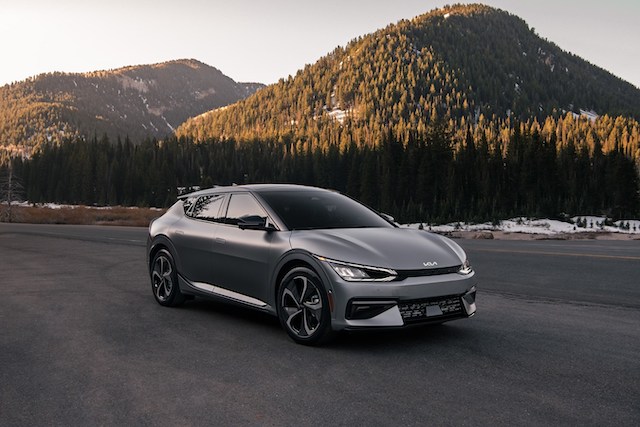
Kia EV6
With wheels pushed to the farthest edges of the car, the Kia EV6 is a stylish looking vehicle that’s part hatchback, part station wagon, part SUV. Along with those good looks comes a 300-mile range, 167-320 hp and a full suite of standard safety and driver-assistance technologies.
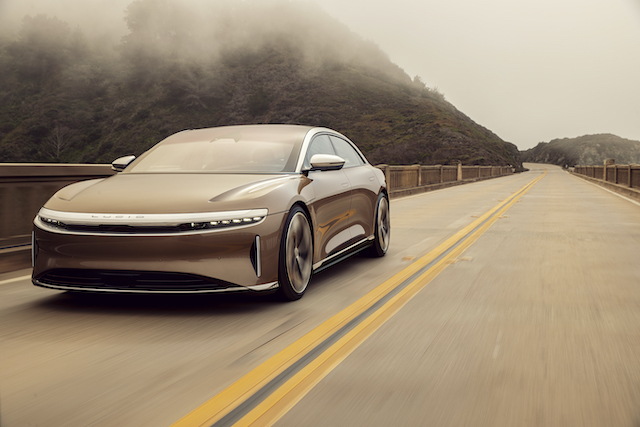
Lucid Air
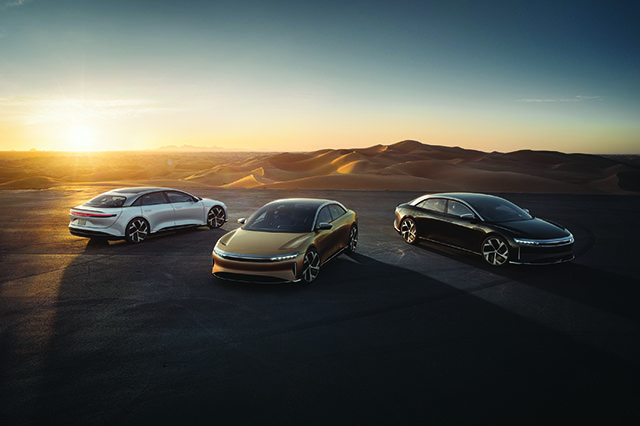
Few cars of any type have garnered as much buzz as the Lucid Air. Why the hype? In September, the electric vehicle’s range was certified by the EPA as a record-breaking 520 miles. Range anxiety has long been one of the most significant hurdles in widespread EV adoption. The Lucid Air, and the technology behind it, could mark a significant milestone in emission-free driving. Add in its 0 to 60 mph in 2.5 seconds capability, 1,100 hp and uber-luxurious interior and you have one remarkable car.
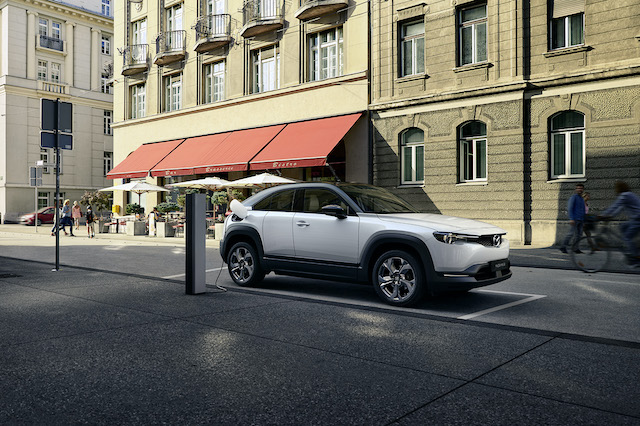
Mazda MX-30
Those shopping for an EV on a budget should take a hard look at the MX-30, which has a starting price below $35,000. If you’ve ever owned a Mazda before, you’re well aware of the carmaker’s ability to deliver more than the price tag suggests.
The MX-30 does have its downsides: At just 100 miles it has one of the shortest ranges in the EV market. To help offset this, Mazda offers customer 10 days of loaner Mazda vehicles each year to use for longer trips. MX-30 owners also receive a $500 EV charging credit to be used for public charging or the purchase of a ChargePoint home charger.
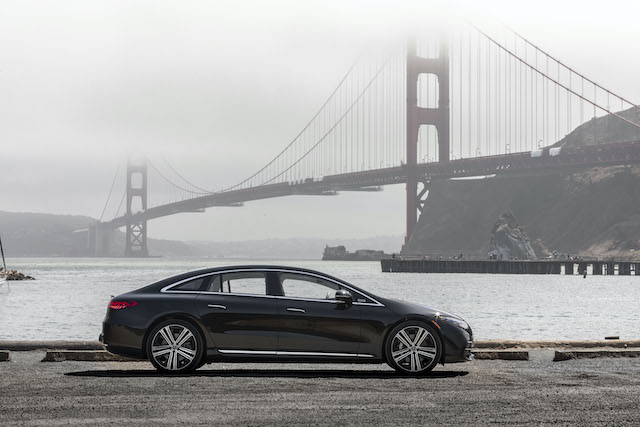
Mercedes-Benz EQS
The EQS will be the flagship electric sedan for the German automaker. The car’s aerodynamic design with sleek lines and rounded edges optimizes efficiency and helps deliver an estimated 470-mile range. Mercedes hopes the EQS can chip away at the large electric luxury sedan segment the Tesla Model S has dominated for so long.
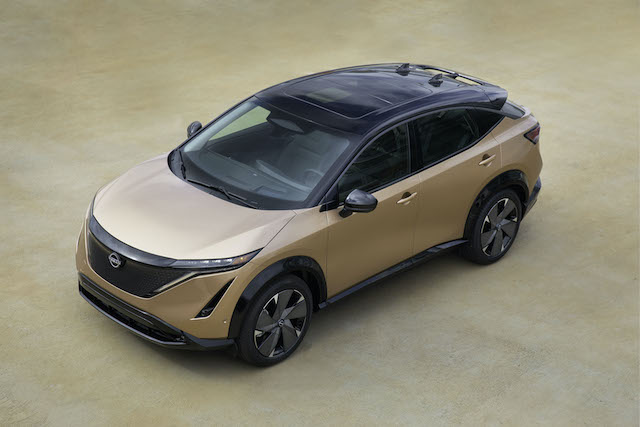
Nissan Ariya
Nissan, makers of the popular Leaf EV sedan, is adding a crossover to its electric vehicle lineup with the introduction of the Ariya. Available with front- and all-wheel drive, as well as standard and long ranges, drivers can customize their vehicle based on preferences and budget. Let’s not forget the Ariya’s state-of-the-art features, including a head-up display, built-in Amazon Echo and NASA-inspired Zero Gravity seats.
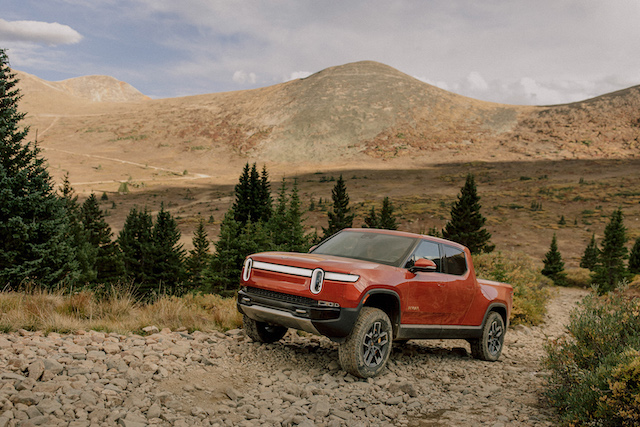
Rivian R1T & R1S
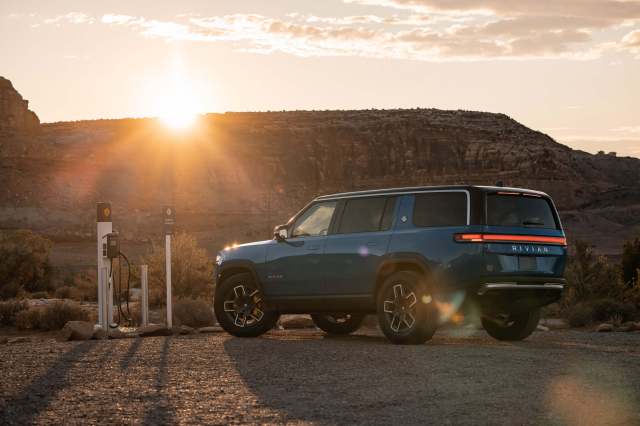
When the Rivian R1T rolled off the assembly line this fall, it became the first all-electric pickup truck available in North America. Not a bad first foray into the EV world for the upstart American company. Rivian plans to make the R1T the EV of choice for off-roaders. It boasts a towing capacity of up to 11,000 pounds, 14.9 inches of ground clearance, ability to drive through 3 feet of water and rock crawl at a 100% grade.
The R1T’s sister model, R1S, is an equally impressive electric SUV. It has many of the same stats as the Rivian pickup but with a larger, seven-seat cabin complete with an all-glass panoramic roof.
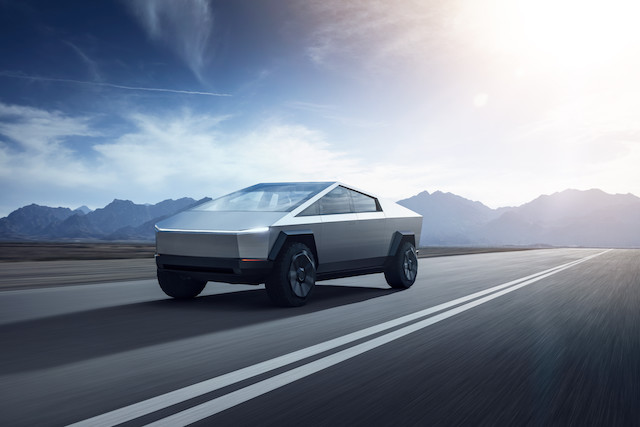
Tesla Cybertruck
To say the Cybertruck has been a polarizing figure in the automotive world would be an understatement – its futuristic appearance has garnered more than a few opinions. Still, if the vehicle delivers on its promise, it has a chance to revolutionize the EV market. According to the company, Tesla’s first truck will have the power of a pickup and the performance of a sports car.
Speaking of delivering on promises, the Cybertruck was originally slated to be on the road in 2021, so knowing the factory that will be used to manufacture the vehicle hasn’t even been completed puts some doubt into a 2022 debut. But, as of now, that’s the plan and you can already make your preorder.
Interested in purchasing one of these EVs? Or any other type of car? Let AAA help you finance your new or used vehicle purchase with a low-interest car loan.
Winter is coming, and with it, cold weather, snow and ice can wreak havoc on your house and property. Therefore, preparing your house for winter isn’t just a luxury but a necessity. Fortunately, there are a number of simple steps you can take to winterize your home that can help you remain safe and prevent costly repairs.
First, review your home insurance policy and speak to an agent to make sure that you are sufficiently protected from any concerning winter weather-related risks.
Check Your Insulation
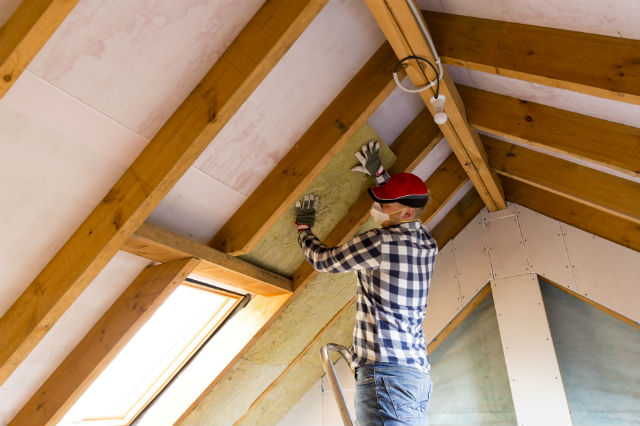
The most critical component of winterizing your home is ensuring that the heat stays in and the cold stays out. Adding an extra layer of insulation to your walls, as well as attic floor and basement ceiling, can go a long way toward keeping your abode warm. You may also want to insulate your pipes and water heater to prevent freezing and improve energy efficiency.
But cold air can seep in — and warm air out — of even the smallest crevice, so pay particular attention to exterior doors and windows. Install door sweeps that attach to the bottom of the door to seal the gap between the door and the threshold. You can use caulk or weather strips around windows, chimneys or any place where two different materials meet.
For an added layer of cold-weather protection, storm windows not only improve insulation, newer models even reflect back some of the room’s heat. According to the U.S. Department of Energy, storm windows can reduce heat loss by approximately 10%-20%.
Heating Tips and Safety
All heating equipment, including stationary space heaters, water heaters and central heating equipment, should be installed by a qualified professional according to local codes and manufacturer’s instructions. Make sure fuel-burning equipment is vented to the outside to prevent carbon monoxide poisoning. If you smell gas, leave your house immediately and call the fire department or gas company.
Your fireplace should have a sturdy screen to prevent ashes from flying into the room. Once the fire is out, wait until the ashes are cool before putting them in a covered metal container (never use plastic).
Keep anything flammable at least three feet away from a heat source. Always turn off portable heaters when leaving the room or going to sleep. Test your smoke and carbon monoxide detectors monthly and have your fireplace and heating equipment cleaned and inspected every year.
Heating Oil and Propane Delivery
Winter is no time to be left without heating oil or propane, yet weather conditions often make delivery difficult. Some simple steps can make the process easier and safer. Make sure to clear all the snow and ice leading to and around your fuel pipe. This will not only help delivery of heating fuel or propane but also allow access should there be an emergency.
Snow must also be removed from around all exhaust vents as well as above your tanks. Accumulating snow can easily block vents and force carbon monoxide into the house or cause heating system malfunctions. Snow and ice above your tank could fall and damage equipment or cause spills.
Exterior Attention
The exterior of your house, as well as the rest of your property, also requires winterizing.
Before winter, gutters must be cleaned out to prevent ice damming and water buildup, both of which can lead to internal leaks.
All yard furniture and loose items should also be removed and stored away, as items like these can easily be dislodged and cause damage to your home or property during a storm. If you have the time and resources, creating a windbreak, such as a row of trees, fence or wall, can help block cold winter winds from reaching your house.
Be prepared for the first snowstorm of the year by ensuring your snowblower is working properly and snow shovels are available, as well as stocking up on snowmelt.
To prevent tree branches from snapping and falling under the weight of heavy snow – and potentially causing damage to your home or nearby property – use a mop or boom to knock off some of the accumulating snowfall.
Winterizing a Vacant Home
Many people travel or relocate in the winter, or conversely have a summer home they don’t use during the cold months. But even an empty house needs to be winterized in order to be properly prepared for the season.
Cold weather can easily freeze and damage your home’s pipes. Therefore, even if the house will be empty for an extended period of time, do not turn your thermostat off. The thermostat should be kept at the lowest temperature that will prevent your pipes from freezing, generally about 50 to 55 degrees.
When you winterize a vacant house, shut off the water at the main valve. Additionally, you should open all the faucets to allow water already in the pipes to drain out. You may need to call a professional plumber to assist in this. In addition to water, you’ll also want to shut down the gas line to prevent fires or explosions.
Other good safety tips include unplugging your home’s electronics and appliances to eliminate the chance of a fire (and lower your electric bill) and asking your neighbors to keep an eye on your home and inform you if anything seems awry.
Sometimes, despite the greatest of efforts to winterize your home, the weather is unpredictable and property damage happens. Think about if your home insurance is ready for the cold weather months ahead.
Losing a loved one is one of life's most difficult and painful experiences. Along with the emotional toll, you must also settle their affairs. Here are the steps to take.
Losing a loved one is one of life’s most difficult and painful experiences. But along with the emotional toll, there’s also the very practical matter of settling the person’s affairs. The truth is, there are quite a number of steps you must take to fully close out a person’s life after they pass. This process shouldn’t be taken on alone. You’ll need the help of friends, family members and professionals.
It’s hard to have to think about what to do when a loved one dies. Take it step by step with the help of this guide.
Get a Legal Pronouncement of Death
The first step to take when a loved one dies is to get a legal pronouncement of death. This should as soon as possible, according to the National Institute on Aging. The document is filled out by a medical professional, officially declaring the person has passed away. (It is not the same as a death certificate.) Without this document, you will not be able to plan funeral arrangements or handle the deceased’s legal affairs.
If your loved one dies at a hospital, nursing home or under hospice care, the staff will take care of this step. If they pass away at home, however, you’ll need to call 911. Paramedics will transfer them to the emergency room, where they will be legally pronounced dead.
Notify Others
Your first instinct in the immediate aftermath of a loved one’s death will be to inform others. But consider limiting this to close friends and family. Then ask those people to help spread the news. This will take one task off your plate.
While it doesn’t need to be an immediate phone call, Consumer Reports recommends contacting your loved one’s employer if they were still working at the time of their death.
Secure and Maintain the Property
If no one is residing at the deceased’s home, make sure the property is secured and maintained by a relative, friend or neighbor. This includes locking all doors and windows on the house and cars, collecting mail, throwing out food, watering plants and keeping on a minimal amount of heating to prevent frozen pipes, if needed. If your loved one had pets, arrange for someone to care for them for the short-term future.
If your loved one was a veteran, you may be able to get financial help for burial and funeral costs from the Department of Veterans Affairs, as well as military funeral honors for the deceased.
Make Funeral Arrangements
Your loved one may have had a prepaid burial plan. If so, most of the arrangements will already be set. If there’s no plan in place, contact the funeral home of your choice. They can help walk you through the process. One important decision the family will have to make is whether to cremate or bury the body.
If the deceased was a member of the military, contact the Department of Veterans Affairs to see if you are eligible to receive burial benefits. According to the VA, it pays survivors up to $2,000 to cover funeral costs. Your loved one may also be eligible for a military funeral service.
Ask friends and family members if they would like to participate in the funeral services as a pallbearer or to eulogize your loved one. You may also want to write an obituary.
Obtain the Death Certificate
The funeral home you are working with will usually provide a death certificate. It’s important to get multiple copies. Most experts say you should obtain up to 10 copies. You’ll need to provide one to financial institutions, insurance companies and government agencies in order to settle your loved one’s affairs.
Settle the Estate
If your loved one had a will, the executor named in the document will be in charge of settling the estate. If there is no will, a probate court judge will name an administrator in lieu of an executor. Either way, it’s likely you’ll need assistance as distributing assets can be a complicated task. An estate attorney can help you navigate the process.
Contact the Appropriate Agencies
Over the preceding few weeks, it’s important you contact the appropriate government agencies, financial institutions and service providers. This may include:
Social Security Administration: In most cases, the funeral home will report the death to the Social Security Administration. If your loved one was receiving benefits, however, you should contact SSA as soon as possible to stop payments. Any monthly payments received after their death will have to be returned. Certain family members, such as widows or widowers, may be eligible to receive the benefits going forward.
Life insurance companies: You’ll need to contact your loved one’s life insurance company to file a claim on any policies they had. Make sure to have the policy numbers and a copy of the death certificate on hand.
Credit agencies: The Social Security Administration will notify the three major crediting agencies of your loved one’s death but it’s a good idea for you to do so as soon as possible. This will get the account flagged., helping prevent identity theft. You’ll also then receive a copy of the deceased’s credit report, which will give you a clear understanding of their credit accounts and any outstanding debt.
Banks and financial institutions: Contact banks to see what accounts and safe deposit boxes your loved one had. You will need a copy of the death certificate to close or change any accounts.
Department of Motor Vehicles: Cancel your loved one’s driver’s license to prevent identity theft. The process varies by state, but you’ll likely need a copy of the death certificate.
Social media: You can submit a request to have your loved one’s social media accounts removed following their death. Certain platforms, such as Facebook and Instagram, offer the option of having the account memorialized. ConsumerResources.org’s guide walks you through the process on each platform.
Utility companies, the U.S. Postal Service, subscription services: Notify these providers to change or stop services.
Head to AAA.com for more on navigating all of life’s stages.
Thanksgiving is all about family, feasting, and football. Celebrate the traditions that make Thanksgiving special in our crossword.
Here are some tips to help you get the most out of your puzzle playing experience. Good luck!
Since our members are the root of everything we do, your feedback is important to us. Let us know if you run into any issues while playing, or share your ideas for future puzzles by emailing us.
The turkey may be the star of the traditional Thanksgiving feast, but the sides are arguably the best part. Where would tom turkey (or tofurkey) be without his stellar supporting cast of buttery mashed potatoes, fragrant sage-infused stuffing and tangy cranberry sauce, after all?
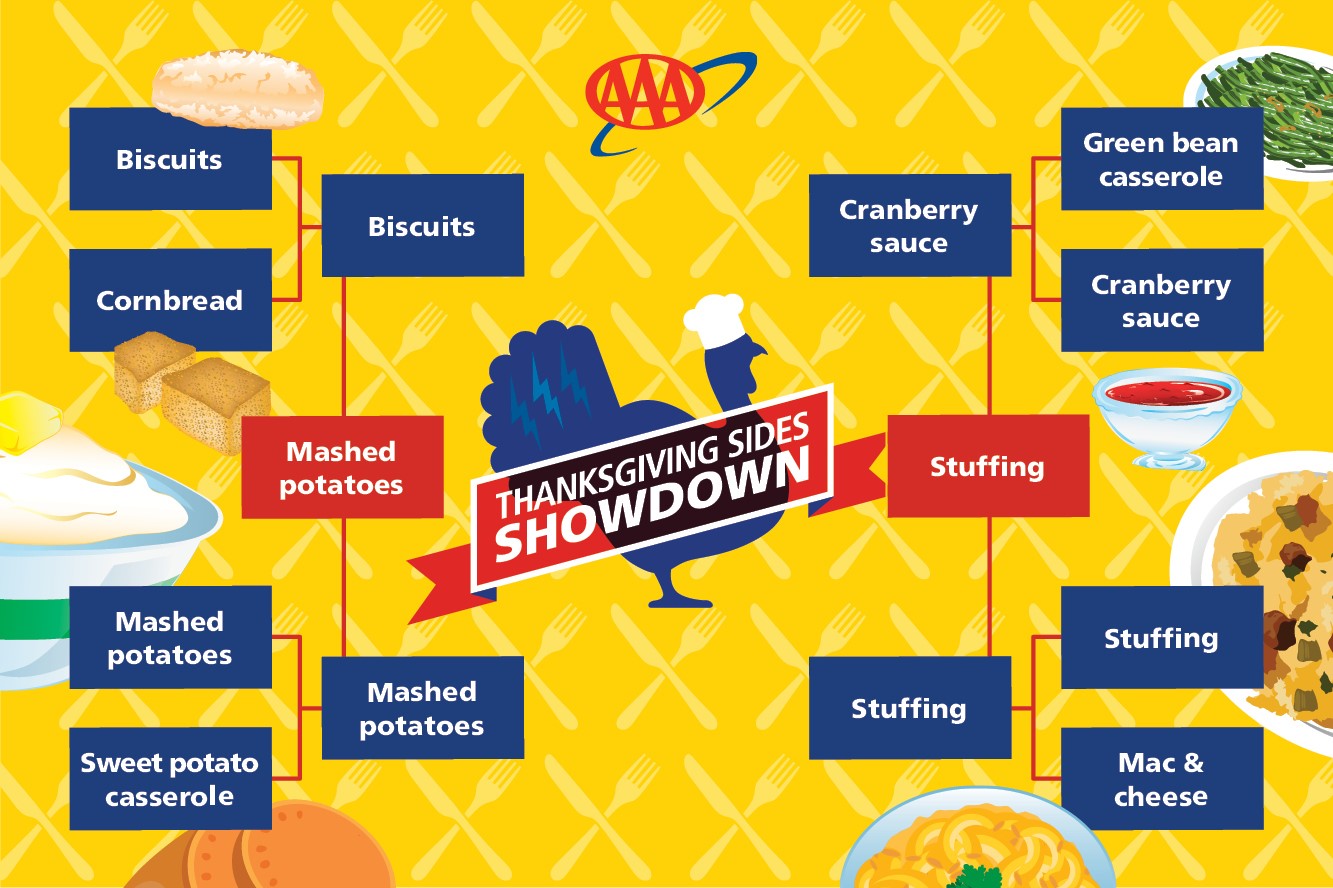
We settled the debate on the most-beloved Northeast food, now we know where you stand on Thanksgiving side dishes. Eight essential turkey companions duked it out for our Thanksgiving Sides Showdown, but in the end stuffing won over mashed potatoes 61% to 39%.
ROUND 3
616 total votes
Stuffing – 61% (winner)
Mashed Potatoes – 39%
ROUND 2
1,483 total votes
Stuffing vs. Cranberry Sauce
Stuffing – 85% (winner)
Cranberry Sauce – 15%
Biscuits vs. Mashed Potatoes
Mashed Potatoes – 86% (winner)
Biscuits – 14%
ROUND 1
7,283 total votes
Biscuits vs. Cornbread
Biscuits – 54% (winner)
Cornbread – 46%
Mashed Potatoes vs. Sweet Potato Casserole
Mashed Potatoes – 69% (winner)
Sweet Potato Casserole – 31%
Green Bean Casserole vs. Cranberry Sauce
Cranberry Sauce – 73% (winner)
Green Bean Casserole – 27%
Stuffing vs. Mac & Cheese
Stuffing – 93% (winner)
Mac & Cheese – 7%
Must-Have Thanksgiving Sides
Now that you are good and hungry, we’ve rounded up some of our favorite recipes from the web to help you with this year’s Thanksgiving or Friendsgiving meal.
Biscuits
If you want to soak up every last tasty drop of your Thanksgiving dinner, you are going to need a good biscuit.
There are two types of biscuits: rolled and drop. Rolled biscuits require rolling out the dough and cutting them into shape. These will rise more while baking and will typically yield a flakier result. Chef Jumoké Jackson aka @mrfoodtastic, has the method mastered. Follow him on Instagram and you’ll see why his buttermilk biscuit recipe is so sought-after. He even offers regular virtual biscuit-making classes for those looking to learn his secrets.
Drop biscuits like these from Serious Eats are not as pretty – think Red Lobster Cheddar Bay, but they can be all the fluffy, buttery things you love about biscuits with half the work. The dough can be made completely in a bowl or a food processor and is simply plopped down in spoonfuls into a tray to bake.
No matter how you make them, the key to light, flaky biscuits is to keep your butter as cold as possible and not overwork the dough.
Cornbread
There is very little documentation of what was actually eaten at the first Thanksgiving, but one food mentioned in the records is cornbread made with corn harvested by the Native Americans. Cornbread of the modern Thanksgiving table – a quick bread often baked in a cast iron skillet made especially delicious when slathered with honey butter – is likely much different than what was served at Plymouth, but it can be thought of as a nod to the holiday’s true history.
Sweet Potato Casserole
Marshmallows or no marshmallows? That is the question.
For some, the classic sweet potato casserole with its caramelized topping of chopped pecans or walnuts, brown sugar and toasty marshmallows delivers an over-the-top sweetness that should be reserved for dessert; for others, it’s exactly what Thanksgiving side dish dreams are made of. If you crave the classic in all its gooey goodness, this sweet potato casserole with marshmallows, pecans and cornflakes from Southern Living is the recipe you are looking for.
For a healthier version that cuts the butter and sugar and highlights the immune system-, gut- and overall health-boosting benefits of sweet potatoes, try Cooking Light’s sweet potato casserole with crunchy oat topping.
Mashed Potatoes
Mashed potatoes are a go-to side for a Thanksgiving meal. Buttery and smooth (perhaps with the addition of sour cream like Ina Garten does) or rustic and garlicky, it’s a dish that can stand on its own but is also a supreme vessel for gravy.
Green Bean Casserole
An American classic made with five ingredients, including a can of cream of condensed mushroom soup and crispy french fried onions, some version of this green bean casserole has likely graced your Thanksgiving table.
If you’re more of a from-scratch type of person, try Bon Appetit’s, made with cremini mushrooms and garlic parmesan béchamel sauce. If you’re completely over the casserole but still want to serve green beans, you might like Williams Sonoma’s green bean bundles with bacon and brown sugar instead.
Cranberry Sauce
Bright cranberry sauce breaks up the monotony of savory flavors on your dish and pairs perfectly with turkey. Make this homemade version from Simply Recipes with fresh or frozen cranberries and add orange zest, cinnamon, pecans and other fruits or spices to incorporate more of the holiday flavors that everyone craves this time of year.
If you prefer slices of gelatinized cranberry sauce that jiggles its way out of a can, that’s OK too. The holidays are all about tradition and nostalgia, and if that’s your tradition, bring on the can opener!
Stuffing
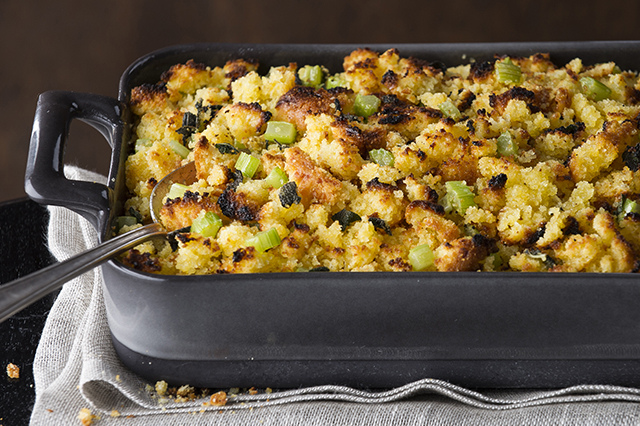
Stuffing and turkey go hand-in-hand – or hand in, never mind. Like other must-have Thanksgiving sides like mashed potatoes and cranberry sauce, the ideal holiday plate just wouldn’t be complete without it.
Technically, if it’s outside the bird it’s called “dressing,” but it’s the same ingredients and baked outside of the bird is generally safer. We like this traditional sage stuffing from Food52 and this gluten-free cornbread stuffing from Ambitious Kitchen.
Macaroni and Cheese
It may be rich, and you may not have enough room on your plate or in your stomach for it, but macaroni and cheese is the kind of Thanksgiving side that separates a holiday meal from every other. Alton Brown’s recipe comes highly rated with thousands of reviews. If someone in your family is dairy-free or vegan, try the “mind-blowing” vegan mac and cheese from Sarah Crawford @bromabakery.
And if you love the turkey more than the sides, here are a few tips – including advice from a Butterball Turkey Talk-Line expert, on how to choose, cook and season your bird for the tastiest results.
Do you agree that stuffing is the best Thanksgiving side dish? Tell us your favorite in the comments below.
Disney has unveiled Disney Genie, a park planning app that allows guests to coordinate their entire vacation. The free app features ride wait times, park maps, and the ability to make dining reservations and place mobile food orders. Guests can pay a fee to upgrade to Disney Genie+, which comes with photo perks, audio tours and Lightning Lane access (Disney Genie+ replaces Walt Disney World’s FastPass+ and Disneyland’s MaxPass virtual queue systems).
Ocean State of Mind
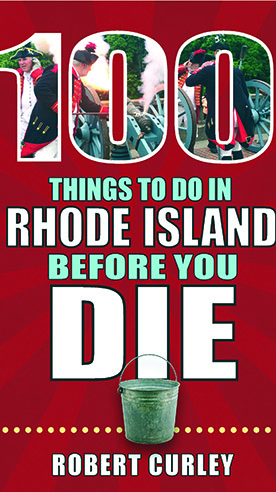
Hot wieners? Check. H.P. Lovecraft’s grave? Check. Gilded Age mansions, scenic apple orchards and the birthplace of the Industrial Revolution? Check, check and check.
You’ll find these notable Ocean State sites – plus 95 more – in “100 Things to Do in Rhode Island Before You Die” by local author Robert Curley.
From family-style chicken feasts at Wright’s Farm in Burrillville to Westerly’s Shakespeare in the Park, the book captures what makes Little Rhody such a quirky place.
From the art deco automobiles of the Roaring ’20s to the efficiency-minded vehicles born from the ’73 oil crisis, cars have always embodied the world in which they were made.
Even as we navigate through unprecedented times, automobiles have kept pace, becoming greener, more connected and easier to purchase.
So what does the road ahead have in store for automobiles?
Car-Buying Trends
If you’ve been in the market for a new car, you’re likely well aware of the skyrocketing prices. The average price of a new car surpassed $42,000 this summer, an all-time high, according to Kelley Blue Book.
The price hike is largely the result of a dwindling supply caused by a global microchip shortage. Inventory at the start of August was roughly 1.2 million, 68% below what it was at the same time in 2019, according to a Cox Automotive analysis.
“New-vehicle inventory continues to slowly drop, which is impacting current new and wholesale vehicle prices and sales incentives,” said Kayla Reynolds, a Cox Automotive industry analyst. “We expect the auto market for both new and used vehicles will continue to feel the impact of the new vehicle inventory shortage – in the form of elevated prices and limited choice – well into 2022 and possibly into 2023 as well.”
With prices soaring, car companies are trying to make the buying process easier by shifting much of it to the digital realm. In fact, purchasing a vehicle online has never been more popular.
For years, car buyers have been doing research on the internet, but the actual transaction has almost always taken place at the dealership. That is changing at a rapid pace. In 2018, only 1% of U.S. consumers purchased their vehicles online, according to Google. By March of 2020, that number jumped to 10%.
Automakers are responding. Nissan, for example, recently unveiled its “Nissan@Home” program that allows customers to schedule a test drive, manage the purchase process, take delivery and handle service needs all from
the comfort of their home.
The future of car buying will likely consist of a blended retail model with brick-and-mortar dealerships complementing a growing number of online services.
Electric Vehicles
The promise of electric vehicles has remained on the horizon for so long that it’s easy to believe these green vehicles will just remain a niche category. But while EVs still represent a small percentage of the market – just 2% of the new cars purchased in the U.S. in 2020 – the tide may begin to shift in 2022.
EV ownership was already on the rise in 2021, but what makes today’s forecast so promising is the unprecedented commitment and support from automakers. Hardly a month went by this year without another major automaker announcing plans to transition to a predominantly emission-free lineup of cars. In August, President Joe Biden announced a goal for electric vehicles to make up half of all new U.S. vehicle sales by 2030, and his $1 trillion infrastructure bill allocates $7.5 billion to improving EV infrastructure.
With improvements in technology and efficacy, the gap in price between EVs and similar gas-powered cars is rapidly closing. The average transaction price for all new vehicles in June was $42,282, according to Kelley Blue Book, compared to $49,766 for all electric vehicles.
Another concern – the lack of public charging stations – shows signs of abating. The infrastructure bill should help kick-start a build-out from the public sector, and a rise in ownership may incentivize private companies to invest in charging stations.
Technology
In January, a record 175 transportation and vehicle technology companies will present at the 2022 CES, the world’s most influential technology event. It’s more proof the automobile as we know it is undergoing a technological transformation.
Here are some of the technology features that could be in your next car.
Health and Wellness Features
Massage Functionalities:Massaging seats have typically only been available in higher-end cars. Expect to see them more widely available, as they have proven to be more than just a luxury feature.
Biosensors: Biosensors can notice changes like spikes in heart rate or respiration. Vehicles could then take this information and respond by playing calming music or turning on the air conditioning.
Air Purifiers: To combat air pollution, automakers are incorporating advanced purifiers into their vehicles. Volvo, for example, introduced its Advanced Air Cleaner technology into its 2021 models. It claims to remove 95% of harmful airborne matter.
Increased Connectivity
Cars have quickly become an extension of our connected life. Future vehicles will be able to connect not just with our other devices, but with other cars, networks and even infrastructure.
The technology could communicate with stop signs to see which vehicle has the right of way; navigate away from congested areas; and receive software updates and diagnostic data.
The most notable connected technology, however, is vehicle-to-vehicle communication, which allows cars to wirelessly exchange information like speed, location and direction. This feature could help reduce traffic jams and prevent crashes.
The Lucid Air luxury sedan has an Environmental Protection Agency-estimated range of 517 miles.
The New Cars of 2022
Everyone loves a shiny new object, and 2022 brings with it a group of highly impressive ones. Here are some of the new vehicles to keep an eye on.
Ford F-150 Lightning
While green technology has long been relegated to smaller, commuter sedans, it now finds a home in the most utilitarian vehicle: the pickup truck. But not just any pickup truck. The Ford F-150 has been the best-selling vehicle in the U.S. for more than four decades. The all-electric Lightning model’s arrival could mark a transformative shift in the EV market.
Lucid Air
In 2022, EV startup Lucid Motors is slated to release its first car, the Lucid Air. The luxury sedan is most notable for its Environmental Protection Agency-estimated range of 517 miles. Even though several EV models have 200-plus mile ranges, research shows one of the most common concerns with EVs is range anxiety, or the fear the car will run out of power before reaching its destination. The Lucid Air, and the technology behind it, should help make range anxiety a thing of the past.
Grand Wagoneer
What’s in a name? Jeep is certainly trying to find out. The marque is resurrecting the moniker after nearly 30 years for the brand-new Grand Wagoneer. The SUV is being positioned as a more luxurious option than the other new model, the Wagoneer. The Grand Wagoneer is the epitome of the modern SUV, combining luxury and power. Equipped with every imaginable tech and creature comfort feature, it also boasts a towing capacity of 10,000 pounds and a V-8 engine delivering 471 horsepower.
Minor car damage may seem like an easy fix, but that's not always the case. Small issues could lead to bigger problems if ignored or not properly taken care of.
How often do we put off chores or tasks, always thinking that tomorrow would be the ideal day to get them done? In most cases, the problems will simply remain but not get worse, and certainly not become dangerous. But when it comes to minor car damage repair, it’s a different story.
Minor car damage isn’t uncommon and usually it can be repaired quickly and at a low cost. However, in many cases those seemingly benign issues can either be a symptom of a much larger problem or can grow into a significant repair if left unfixed.
We asked AAA Car Doctor John Paul about common minor car damage issues that can wind up costing you major. Here’s what to watch for.
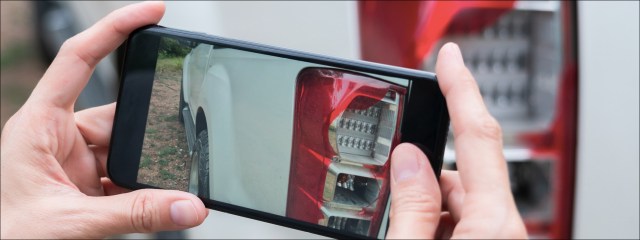
Broken Head and Taillights
Driving without properly functioning lights can be extremely dangerous, which is why nearly every state has laws requiring their use. Many states also specify that you must have two working head and taillights each. So if one breaks, you must get it repaired immediately.
If you break just the lens on the light and not the bulb itself, you may be tempted to simply try to piece it back together yourself. This isn’t going to work. “You cannot legally repair a lens with tape. It must be replaced,” Paul says. “Some headlight assemblies can cost well over $1,500 to replace some taillight lenses can also be quite expensive.”
Misaligned Wheels
Wheels can become misaligned if the vehicle is suddenly jarred, such as by driving over a pothole, or if parts of the suspension system wear over time and begin to shift.
You may not even realize that your wheels are not properly aligned and therefore, it might not seem like a major problem. The most common symptom of a misalignment is if your car pulls to one side or if the steering wheel is no longer centered. If you notice that the car pulls or the steering wheel is no longer centered, you need to get it fixed. This misalignment will rapidly wear down your tires. A new set of tires could easily run you several hundred dollars.
Lost Keys
Once upon a time, you could make a quick trip to the local hardware store to duplicate your car keys for just a couple of dollars. But with the introduction of key fobs, that option disappeared and made losing your car keys a significantly more expensive mishap. A key fob can cost anywhere from $50 to $1,500 depending on the vehicle.
Worn Down Brakes and Shocks
Brake grinding occurs when there is extreme wear to the brake pads or rotors, causing the metallic part of the brake pad or brake shoe to come in contact with the brake rotor or drum. The result is a loud grinding sound coming from your wheel whenever you press down on the brake pedal.
If you wait too long to have your brakes serviced, it could result in a significant repair. “Letting your vehicle brakes grind will generally lead to a replacement of the brake rotors or brake drums.” Paul says. “This can easily add hundreds of dollars to the cost of a brake repair.”
Engine Troubles
Maybe more than anywhere else in the vehicle, an engine’s minor troubles can lead to serious, catastrophic problems, Paul says. “A worn engine drive belt (fan belt) if allowed to fail can cause a discharged battery or the engine to overheat and possible catastrophic failure. In addition, not replacing an engine timing belt can lead to complete engine failure.”
Also be on the lookout for any leaks or drips, no matter how small. “A small drip of engine coolant can be caused by a leaking water pump. Over time, a leaking water pump can cause engine overheating and possibly engine failure. A small oil leak, if ignored, could also result in complete catastrophic engine failure.” These small problems will only get worse over time and certainly not get better by themselves.
Ignoring Warning Lights
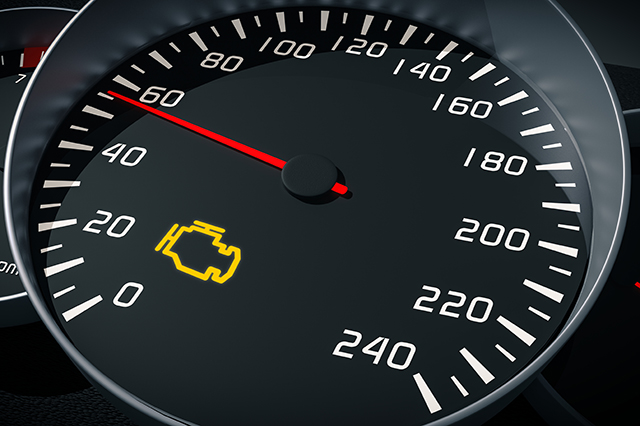
Warning lights and gauges are there to protect you and your vehicle. Ignoring them can cause serious problems and put you at risk. These warning lights can tell you about the condition of your engine including if it is low on oil, has low oil pressure, low on coolant or is overheating.
Of particular note, Paul reminds us, is a flashing check engine light. “This flashing light is caused by an engine misfire. This misfire can be the result of something as simple as a faulty spark plug. However, if left untreated, it can lead to a failure of the catalytic convertor and a much more significant repair.”
Warning lights can also alert you to a host of other problems like low tire pressure, airbag and antilock brake issues and hydraulic brake failure. If you address any of these in a timely fashion, it may be an easy fix. However, letting them get worse could result in a serious and costly repair.
Protecting Your Vehicle
No matter how well you maintain your car, minor car damage repairs are going to be needed. And if that happens after your warranty expires, you’ll be on the hook for the cost.
AAA offers an extended auto warranty that can cover you in times like these. These warranties cover nearly all mechanical and electrical components of the vehicle. For example, in February of this year alone, AAA covered repairs to, amongst others, air conditioners, navigation system and engine actuators. These ranged in price from $420 to $2,940.
The extended warranty is also transferrable. If you’re looking to resell, the new owner will be able to own the coverage until the agreement expires. This adds value to your car and helps you get a better price.
When the pandemic halted travel in 2020, almost everyone’s travel itineraries were delayed or canceled. And many airlines, cruise lines, tour companies and hotels issuing refunds or travel credits for travelers to redeem for future trips.
But with 2021 coming to a close, many of those credits are set to expire.
“We’re seeing a lot of people with future travel credits,” said Anne Lischwe, travel sales manager at AAA Northeast. “Use that credit – don’t lose it!”
Even if you’re not planning on traveling soon, you should research the particulars of your credits, she said. The two most important deadlines are the “book by” and “travel by” dates. Rules and restrictions vary by supplier, so make sure to read the fine print: You don’t want to dream about a sunny sojourn to Santorini only to discover your airline credit can only be used for domestic travel.
“Know as much detail about your travel credits as you can,” Lischwe said. “Make sure you know where and how you can use them.”
Seize the Day
In the past few weeks, Lischwe has seen an uptick in the number of people redeeming their travel credits. Members are booking now for 2022 trips to Europe, Alaska and the Caribbean. More people are open to European travel, especially since the U.S. opened to most vaccinated European travelers earlier this month.
She’s also seeing a rise in booking to places like Asia, the South Pacific and Australia, which are just starting to reopen to tourists.
Her No. 1 piece of advice to those who want to travel in 2022? Book now.
“Don’t wait,” Lische said. “There’s going to be a huge uptick in travel in 2022 – things are already selling out. Even if you’re not ready to travel, start to make a plan. You don’t want to try to redeem your credit the week before it expires.”
River cruises, especially, are seeing voyages sell out, since the smaller ships hold fewer passengers than larger ocean liners.
You may even get a surprise when looking into your travel credits. Many travelers, especially those who booked cruises, received bonus future travel credits when their plans were delayed.
“Some people have gotten to upgrade their cabin, extend their trip, or even book another trip,” Lischwe said. “People are really seeing the added value inherent in these bonus credits.”
A travel advisor can help make sense of any questions you may have about unused travel credits. They’re up to date on the latest restrictions and can help you plan your (long-delayed!) dream vacation.
Have a future travel credit you need to use? Make an appointment with a trusted AAA Northeast travel advisor, who can give you helpful advice on how to use your airline/hotel/cruise/tour credit. (Even if you didn’t book through AAA Northeast!)
Where will you go with your future travel credits? Let us know in the comments below!
Pop quiz: What do Buick, Chevrolet, Chrysler, Dodge, Ford and Honda have in common? Each of these car companies is named after their founders.
While they are undoubtedly apt titles, such a straightforward naming process doesn’t provide for a great story. But for every Ford, there’s a Toyota, also named for its founder but with a unique, cultural spin. Or Jeep, a name whose origins can’t seem to be pinpointed.
Let’s take a look at how some of the world’s most notable car companies got their names.
Acura
Acura, Honda’s luxury division, derives its name from the Latin word “acu,” which means “done with precision” or “mechanically precise.” To further emphasize the luxury car’s craftsmanship, Acura’s logo of a stylized “A” is meant to represent the shape of a caliper, a measuring tool used in science and engineering.
Alfa Romeo
In 1910, Cavalier Ugo Stella acquired the Italian manufacturing plant of a French automaker. The factory was located on the outskirts of Milan in the northern Italian territory of Lombardy. As such, it was given the name “Lombard Automobile Factory Company,” or in Italian, “Anonima Lombarda Fabbrica Automobili” – A.L.F.A.
Things were going well for the company until World War I changed everything. Alfa simply didn’t have the funds to transition manufacturing from automobiles to wartime vehicles. That’s when successful engineer Nicola Romeo stepped in to buy the company, which then altered its title by combining the ALFA acronym and the new owner’s surname to create Alfa Romeo.
Aston Martin
Aston Martin was founded by Lionel Martin and Robert Bamford, two auto racing aficionados. Unfortunately for the latter, only the former’s surname made it on the company title. The duo began building their own vehicles and entering them in races. Once such race occurred in Buckinghamshire, England. Martin got behind the wheel in one of their creations – and won. The name of that course was the Aston Clinton Hill Climb.
Audi
August Horch, a pioneer in automobile engineering, founded his first manufacturing company in Cologne, Germany, in 1899. He named it A. Horch & Cie. Only a few years later, Horch had a falling out with the board and left the company to start a new one. When it came time to name this new enterprise, he ran into a problem. His surname was trademarked by the original company.
Horch was discussing the issue with a business partner, a conversation overheard by the colleague’s son. The boy happened to be fluent in Latin and suggested the name Audi. Why? Because the German word “horch” and Latin word “audi” have the same meaning: “listen.”
BMW
The acronym BMW is as straightforward as it gets. The company’s engines were first built in the southern German state of Bavaria. As such, it was given the name Bayerische Motoren Werke. In English, this translates to Bavarian Motor Works – BMW.
Cadillac
The company that became Cadillac was the second failed business of Henry Ford. (His third attempt would prove much more successful.) On the brink of dissolution, shareholders called Detroit machinist Henry Leland to assess the value of company’s assets. Instead, Leland convinced them to stay in business with the idea of combining the Ford chassis with an Oldsmobile engine to make a new vehicle. The reformed company’s name is a nod to Leland’s home city of Detroit, which was founded by French explorer Antoine Laumet de La Mothe Cadillac in 1701.
FIAT
The car company known FIAT was founded in Italy in the 1800s, with its factory located in Turin. Thus, it was named the Italian Car Factory of Turin. In the native language, this translates to Fabrica Italiana Automobili Torino, which was later shortened to the anagram FIAT.
Interestingly, fiat is a real English word, meaning an authoritative decree or order.
Hyundai
The Hyundai Engineering and Construction Company was established in 1947. The name Hyundai means “modern times,” deriving from the Korean word “Hyun,” meaning “modern” or “present” and “Dai,” which refers to “era” or “generation.” Twenty years later, the company started producing cars. The new business line kept the Hyundai name, which was an perfect description for the burgeoning enterprise.
Jeep
There is likely no car company name origin more debated than that of Jeep. Several theories exist, but no one seems to know which one is true. What we do know is where the vehicle originated. In 1940, the U.S. government opened a bidding process for a new small, four-wheel-drive military vehicle. Eventually, Willys-Overland was contracted to manufacturer the new vehicle, known as the Model MB. But with entrance into World War II imminent, the Army needed more vehicles than the company could produce. Ford Motor Company was enlisted to help in production, and it began manufacturing its version of the vehicle, known as the Model GP, short for General Purpose. This is where the naming controversy begins.
Many people believe “Jeep” came about from slurring the letters “GP.” But the word predates the vehicle. It was used as early as World War I to describe an unproven recruit or vehicle. The confusion might help explain why Willys filed for the Jeep trademark in 1943 yet wasn’t granted it until 1950.
But the most animated theory behind the Jeep revolves around, of all things, Popeye. The popular comic strip featured a character named Eugene the Jeep, a mysterious animal with magical powers. The creature could disappear and walk through walls, the perfect namesake for a vehicle famous for its impressive feats on the battleground.
Kia
The name Kia is a compound word comprised of two Korean characters: “Ki” and “A.” The former means to “to rise from,” while the latter refers to East Asia. Put together, you get “to rise from East Asia,” an apt name for Korea’s oldest car manufacturing company.
Lincoln
Henry Leland, he of Cadillac fame, founded the Lincoln Motor Company with his son in 1917. He named the company after his personal hero, Abraham Lincoln. The 16th president of the United States was the first president Leland voted for. Unfortunately, the company fell on hard times and was later bought by the Ford Motor Company.
Lexus
In the 1980s, Toyota commissioned a branding agency to devise a name for its new line of luxury vehicles. The marketing firm came up with a list of more than 200 names. The frontrunner was “Alexis,” which evolved into Lexus. There are competing theories as to why Toyota settled on the name. Some say it’s an acronym for “luxury exports to the U.S.” or a combination of “luxury” and “elegance.” The company, meanwhile, states the name was chosen to represent luxury and high-end technology.
Mazda
In 1931, Japan’s Toyo Kogyo Company introduced its first vehicle, the three-wheeled truck “Mazda-go.” Toyo Kogyo was founded by a man named Jujiro Matsuda. Although his surname is spelled and pronounced very similarly to the word Mazda, he is not who the vehicle was named after. Instead, the title is a reference to Ahura Mazda, the god of harmony, intelligence and wisdom in Zoroastrianism, one of the world’s oldest religions. Toyo Kogyo executives believed the god symbolized both the beginning of Eastern and Western civilization, and of automotive culture. The fact that Mazda also sounds just like the founder’s name made it the perfect company title.
Mercedes-Benz
In the late 1800s, Austrian entrepreneur Emil Jellinek began commissioning Daimler cars to use in auto races, which were gaining popularity in Europe. He named his racing team after his daughter Mercedes. After some success, Jellinek agreed to purchase 36 new cars on the condition they be called Mercedes. When Daimler merged with the Benz company in 1926, the Mercedes-Benz brand was born.
Mitsubishi
Generally, a company’s name comes first, then its logo. Not in the case of Mitsubishi. Founder Yataro Iwasaki designed the company’s three-diamond logo as an homage to his family as well as that of his first employer, the Tosa Clan. The Iwasaki family crest consists of three stacked rhombuses and Tosa’s is of three leaves. As for the name, mitsu means “three” in Japanese, and hishi translates to “water chestnut,” (but the Japanese have long used it to describe a diamond shape.) When you add up these design and linguistic components you get Mitsubishi and its three-diamond logo.
Nissan
In 1928, Japanese businessman Yoshisuke Aikawa founded a company called Nihon Sangyo, which loosely translates to Japan Industries. When it debuted on the Tokyo Stock Exchange, Nihon Sangyo was listed by its abbreviated ticker name: Nissan.
Subaru
The manufacturer of the Forester and Outback looked to the sky when naming its company. Subaru is the Japanese word for Pleiades, a cluster of stars within the Taurus constellation. The car company’s logo contains six stars. Five represent the five companies that merged to form what would become Subaru, the sixth star.
Tesla
As you probably assumed, the electric car company is named after Serbian-American inventor Nikola Tesla, who specialized in electrical engineering. Tesla died penniless in 1943. The company bearing his name is worth $1 trillion.
Toyota
Toyota is another car company named after its founder, but with a slight twist. The company was created by the Toyoda family. In Japanese, the spelling of the family name requires 10 brush strokes; however, Toyota requires eight, a lucky number in Japanese culture.
Volkswagen
The name Volkswagen was originally bestowed on the German car company’s first vehicle. Translating to “the people’s car,” the moniker was the brainchild of the car’s designer, Ferdinand Porsche. Eventually, the manufacturer took on the name Volkswagen, while the vehicle became known as the Beetle.
Volvo
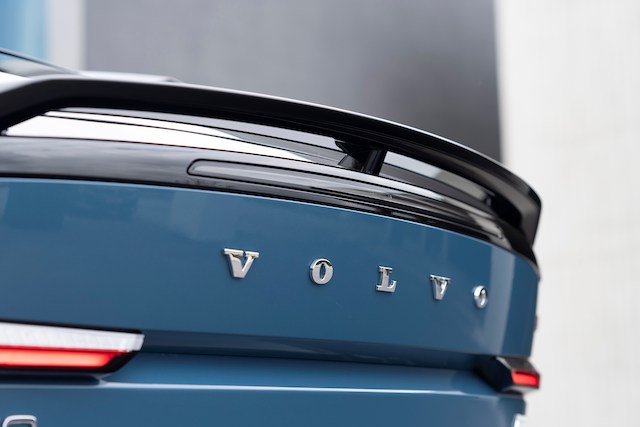
Volvo began as a subsidiary of the Swedish ball bearing manufacturer SKF. When devising a name for its products, SKF landed on “volvo,” which is Latin for “I roll.” The company trademarked the name in 1915 with plans to use it on just about everything it made. That never materialized. Instead, “Volvo” stuck with the car-manufacturing business when it was spun off in the 1920s.
Want more automotive history? From seatbelts to stop signs, our auto history page has you covered.
The Rhode Island State Police are stocking up on child passenger safety seats and are now certified to install them, thanks to a partnership with AAA.
AAA Northeast recently donated $5,000 to the state police Community, Equity and Inclusion Unit to purchase the seats and perform traffic safety outreach in underserved communities.
The police intend to give out the car seats at events throughout the state, such as those the Public Affairs team has scheduled at Head Start programs.
“Both organizations agree about meeting parents where they are, and that is often when they are picking up their children from preschool,” said Diana Gugliotta, senior manager of traffic safety at AAA Northeast. “Families in need can have their car seats checked by child passenger safety certified troopers and AAA representatives, receive instruction and a new seat if needed.”
The police will also make them available to people in need who they meet during regular patrol duties.
“When we encounter motorists without seats, it’s usually because they are financially insecure. They want their children to be safe, but they have to decide whether to use what little money they have either to eat or to buy a car seat,” state police Capt. Kenneth Jones said. “This is our way of helping community members who sometimes need us beyond enforcing the law. We are human beings under these uniforms. We want people to see the human side of us.”
The club and state police are also working together to deliver AAA’s Shifting Gears program to high school students. Police drug recognition experts speak to young people about the dangers they see on the roadways when people drive under the influence of marijuana. The program aligns with the police initiative called STARS, which stands for State Troopers Are Reaching Students.
The state police partnership is a good fit for AAA, Diana said. “We have mutual goals. We share the same values.”
From left, Public Affairs Specialists Adelle Zocher and Fran Mayko, Chair of the National Transportation Safety Board Jennifer Homendy and Director of Public-Government Affairs Alec Slatky.
Connecticut Celebrates New Seat Belt Law
Representatives of AAA Northeast along with national and state legislators and government leaders came together last month to promote Connecticut’s new seat belt law.
As of Oct. 1, all passengers riding in the back seat of vehicles must be buckled up. Previously, this law applied only to children under age 16.
Connecticut was one of the first states to enact a seat belt law for front-seat passengers in 1985, but it took more than 25 years to expand the law to every person in the vehicle.
AAA Northeast Public Affairs representatives played a key role in bringing about the new law.
Between the hilarious high jinks, open roads, car breakdowns and scene-stealing scenery, there are few film genres more beloved and universal than the road trip movie. And while these films never get old, there is one thing that may be even more enjoyable than watching them. That is – of course – living them.
What if you took the same trek as the characters in your favorite road trip films and experienced firsthand the route’s trials and tribulations? You may also get to see some of the famous locations appearing in the films. Truth be told, many of these fictional characters chose some incredible regions to travel through.
Here are the iconic journeys taken in five memorable road trip movies. Which one will you take?
“National Lampoon’s Vacation”
Illinois to California
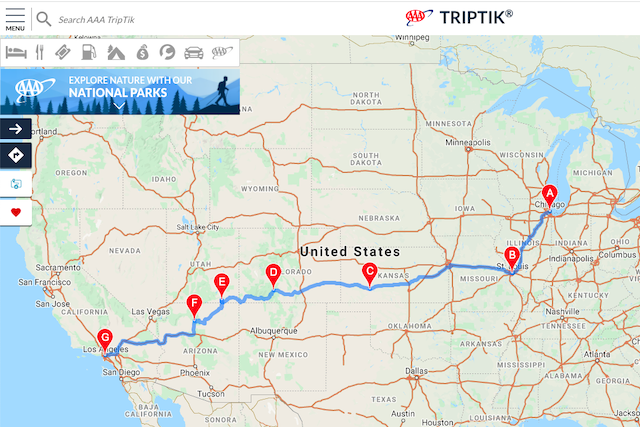
The Griswold clan is renowned for their travels through the U.S. and Europe, but no trek is more famous than their original journey to Walley World. In 1983’s “National Lampoon’s Vacation,” the family of four packed into a wood-paneled station wagon and drove from their suburban Chicago home to the fictitious theme park in southern California.
You’ll need a few days to recreate this epic 37-hour, 2,200-mile cross-country drive, but it will be well worth it. Starting in northern Illinois, you’ll head south to Missouri, where the Griswolds visit the Gateway Arch in St. Louis. Then drive west to Dodge City, Kan., and South Fork, Colo. The road trip takes on a decidedly scenic flavor from here on out. You’ll travel through Utah’s picturesque Monument Valley before hitting the Grand Canyon National Park. A few more hours to the west and you’ll reach your destination.
Feel free to copy the Griswolds and fly back home. Wanna plan your own route to Walley World? Head to the AAA TripTik travel planner to find the easiest way to your destination.
“Thelma & Louise”
Arkansas to Arizona
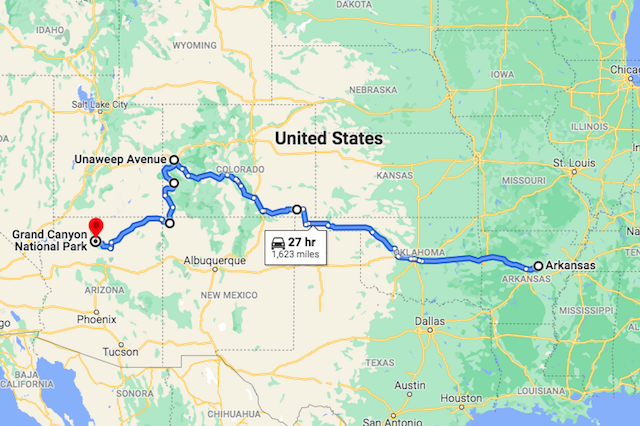
While we would never condone their criminal behavior, Thelma and Louise did take an epic road trip in the eponymous 1991 film. The duo originally set out for a simple getaway in the Arkansas mountains. Things quickly take a turn for the worse, however, and the friends decide to flee to Mexico in their 1966 Ford Thunderbird convertible.
Instead of driving straight to the border, Thelma and Louise famously avoid the state of Texas. After traveling through Oklahoma, they make a pit stop in Colorado’s Unaweep Canyon. They then traverse their way through deserts of New Mexico and Arizona before their journey comes to a soaring end at the Grand Canyon. Note that most of these latter scenes were actually filmed in Utah. The purported New Mexico backdrop was really the La Sal Mountains as well as Arches and Canyonlands national parks. And the movie poster? That’s a photo of Utah’s Monument Valley.
All told, this iconic road trip will take you more than 25 hours and put about 1,600 miles on your odometer.
“Dumb & Dumber”
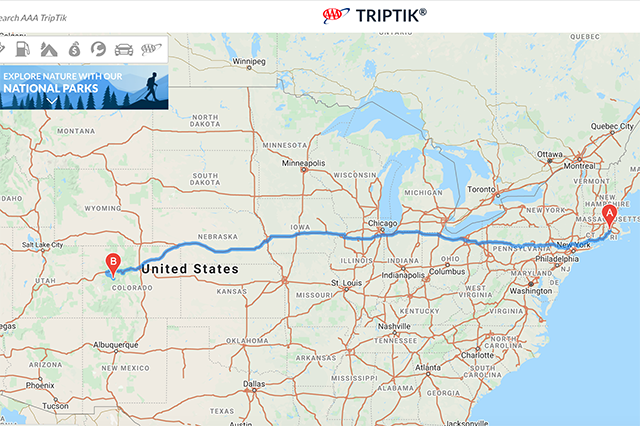
Rhode Island to Colorado
Don’t be fooled by the film’s title – there’s nothing foolish about retracing Harry and Lloyd’s road trip, which took them from the Northeast all the way to the Rocky Mountains. The friends start off in their home city of Providence. (The Farrelly brothers, who wrote and directed the film, are Rhode Island natives and set many of their movies in the Ocean State.) From there, it’s pretty much a straight shot due west, across 11 states and 2,100 miles.
Fans of the movie will remember the duo missed the turn for Aspen, driving back through the plains of Nebraska. Whether you want to add several hundred miles to your road trip is entirely up to you. Either way, when you get to the snow-covered mountains of Colorado, we recommend a vehicle with a little more horsepower than a pull-start minibike.
“Planes, Trains and Automobiles”
New York to Illinois
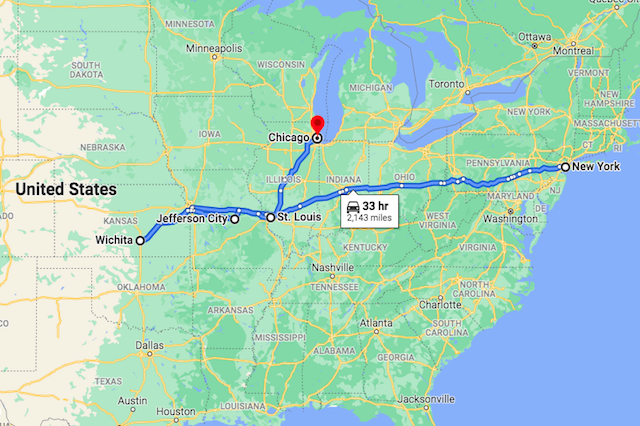
Granted, only the latter half of this famous excursion occurs on four wheels, but we’re including the entire New York to Chicago route and keeping our fingers crossed you don’t have the logistical nightmares of Neal Page and Del Griffith. The movie’s main characters attempt to get back to the Windy City in time for Thanksgiving, first by taking a flight out of LaGuardia airport. When the plane is diverted to Wichita, they hop on a train, which promptly breaks down in Jefferson City. From there, it’s a mix of buses, rental cars and refrigeration trucks to Chicago.
All told, this haphazard route totals more than 2,100 miles. It winds back and forth through eight states, plus four state capitals: Harrisburg, Pa.; Columbus, Ohio; Indianapolis, Ind.; and Jefferson City, Mo.
“Easy Rider”
California to Louisiana
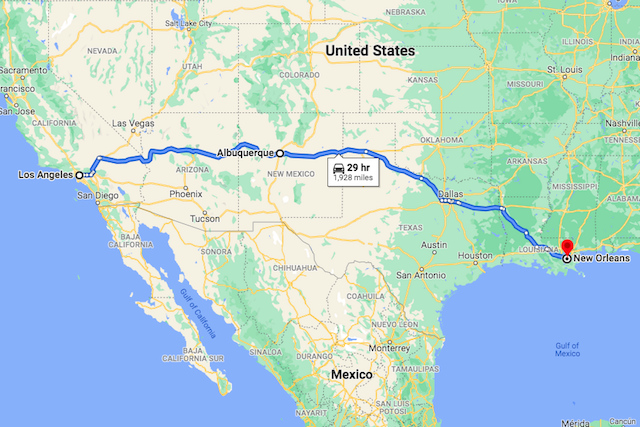
Those looking to travel in a different direction may enjoy retracing the route of Wyatt and Billy from Los Angeles to New Orleans. Beginning in the City of Angels, head northeast to the town of Barstow, where you’ll hop on the I-40. The western portion of the interstate overlays or parallels historic Route 66, creating a drive that is equal parts consequential and visually stunning.
I-40 will get you into Texas before you break off and head south across the state and into Louisiana. Hopefully you get to New Orleans in time for Mardi Gras!
Need more travel plans? From literature to haunted houses, AAA has every type of road trip theme covered. And make sure to check out our digital TourBook guides, which are packed with info on where to eat, stay and play during your journey.
If you’re worried about what to cook for your vegetarian guests this Thanksgiving, fret no more. The following vegetarian Thanksgiving recipes will have vegetarians, vegans and omnivores alike giving thanks to the chef.
Start With a Mediterranean Treat
Change up your traditional Thanksgiving menu with this classic Greek dish from Food Network: spanakopita triangles. Yummy phyllo dough is stuffed with fresh spinach, creamy feta cheese and roasted pine nuts. Yum!
Sayonara, Stuffing of the Past!
Replace traditional stuffing with this roasted parsnip bread pudding from Martha Stewart. Parsnips, leeks, heavy cream, eggs, butter, Parmesan cheese and brioche cubes combine for a stuffing stand-in that will satisfy all of your guests.
It Casseroles Right Off the Tongue
This savory sweet potato casserole from BonAppetit.com bursts with flavor thanks to rosemary, sage, brown butter and homemade breadcrumbs. Make the casserole a day ahead and refrigerate to save time on the big day.
A Deep-Dish Delight
Apple pie is a Thanksgiving tradition. This vegan version from Food Network mixes Granny Smith, Golden Delicious and McIntosh apples for a variety of flavors. Swap coconut oil for butter and almond or soy milk for dairy milk.
For more Thanksgiving recipes, including vegetarian, dairy-free and gluten-free options, see our Thanksgiving Sides Showdown.
What’s your favorite vegetarian holiday recipe? Tell us in the comments.
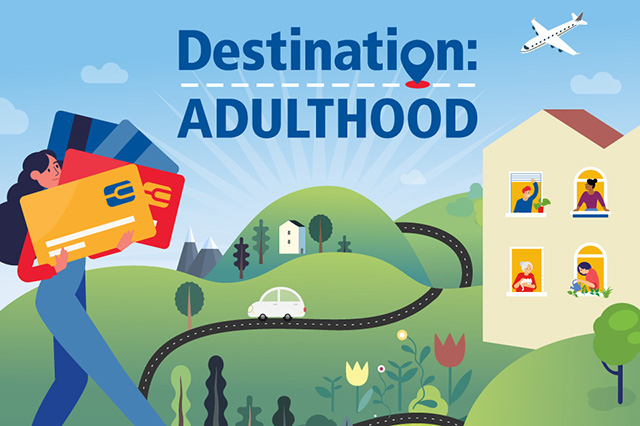
A road map to adulting, to help you navigate the twists and turns you may encounter along the way.
There are a lot of perks that come with being an adult: traveling on your own, buying your first car, becoming a homeowner. But all these exciting milestones are balanced out by admittedly not-so-exciting obligations: insurance, loans, mortgages. All of that adulting can be intimidating, especially when facing it for the first time.
What is adulting? Used as a verb, it means “To behave like an adult. To attend to the ordinary tasks required of a responsible adult,” according to Merriam-Webster. It’s laundry, it’s taxes, it’s bills. It’s all the necessary, often mundane things that you didn’t think of as a child when you said you couldn’t wait to grow up.
Over the past 120 years, we’ve learned a thing or two about growing up at AAA.
Although everyone’s journey is different, we like to think of the way to adulthood as a road (of course!). There’s no GPS to guide you toward the fastest route, no linear way from point A to point B. You have to find your own way, but it never hurts to stop and ask for directions. And that’s where we come in.
With this interactive map, our experts can help you navigate the various triumphs and challenges you are likely to encounter between your late teens and early 30s as you learn how to become a responsible adult. Think of it as a friendly guide to your adult years that you can refer to whenever you need it.
If you’re already well-versed on how to adult, please share with someone in your life who may find it useful.
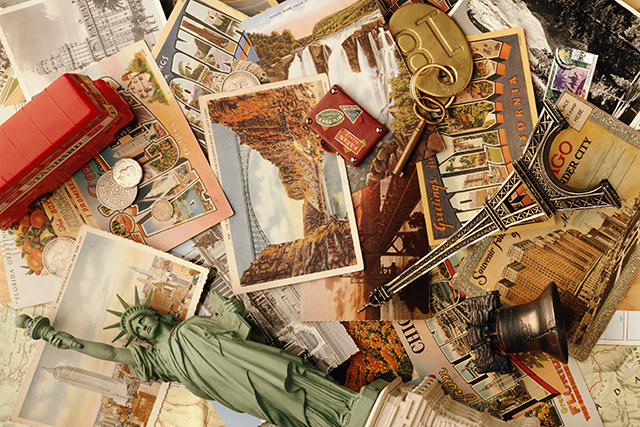
We recently asked about your favorite travel souvenirs, and you responded with sweet, sentimental and fun stories of your most-cherished travel treasures.
When traveling, there’s an undeniable impulse to want to take a piece of our destination home with us. That’s what makes travel souvenirs so special: They’re tangible, smile-inducing reminders of the places we’ve been, the things we’ve seen and the memories we’ve made.
There are trips where you wish you could stuff an entire city into your suitcase. And while you can never do that, a simple magnet that reminds you of your adventure every time you open the fridge can do practically the same thing.
We recently asked you to tell us about your favorite travel souvenirs, and you responded with sweet, sentimental and fun stories of your most-cherished travel treasures. Whether a collection of trinkets and tchotchkes amassed from a life of globetrotting or local art picked up during a once-in-a-lifetime vacation, the best travel souvenirs are often not expensive or extravagant but modest, creative and personal.
Read about some of our members’ favorite travel souvenirs below.
(Some entries have been edited for clarity.)
Your Favorite Travel Souvenirs
“Our go-to souvenir is refrigerator magnets. They come in all shapes and sizes but are mostly affordable and small enough to not be a problem to pack. When we get back home and the grandkids are here we have the “Ceremony of the Placing of the Refrigerator Magnet.” The kids chose the location and there the magnet stays. Just visiting the refrigerator brings back fond memories of our adventures in life.” – Rodney Howarth, Warton, N.J.
“In June 2021, I spent a week in the Italian Tyrol. Beautiful beyond words! Coming home I had a five-hour layover in London and went by high-speed tube to the Southwark Bridge for a tour of the then recently rebuilt Globe Theatre. I bought a candle holder made from oak used in the rebuilding. It has a quote from ‘The Merchant of Venice’ carved on it: ‘That light we see is burning in my hall. How far that little candle throws his beams! So shines a good deed in a naughty world.’ I love it! I had to race back to Heathrow after that to be on time for my flight home.” – Franny McGarry, New Bedford, Mass.
(Michelle Nason)
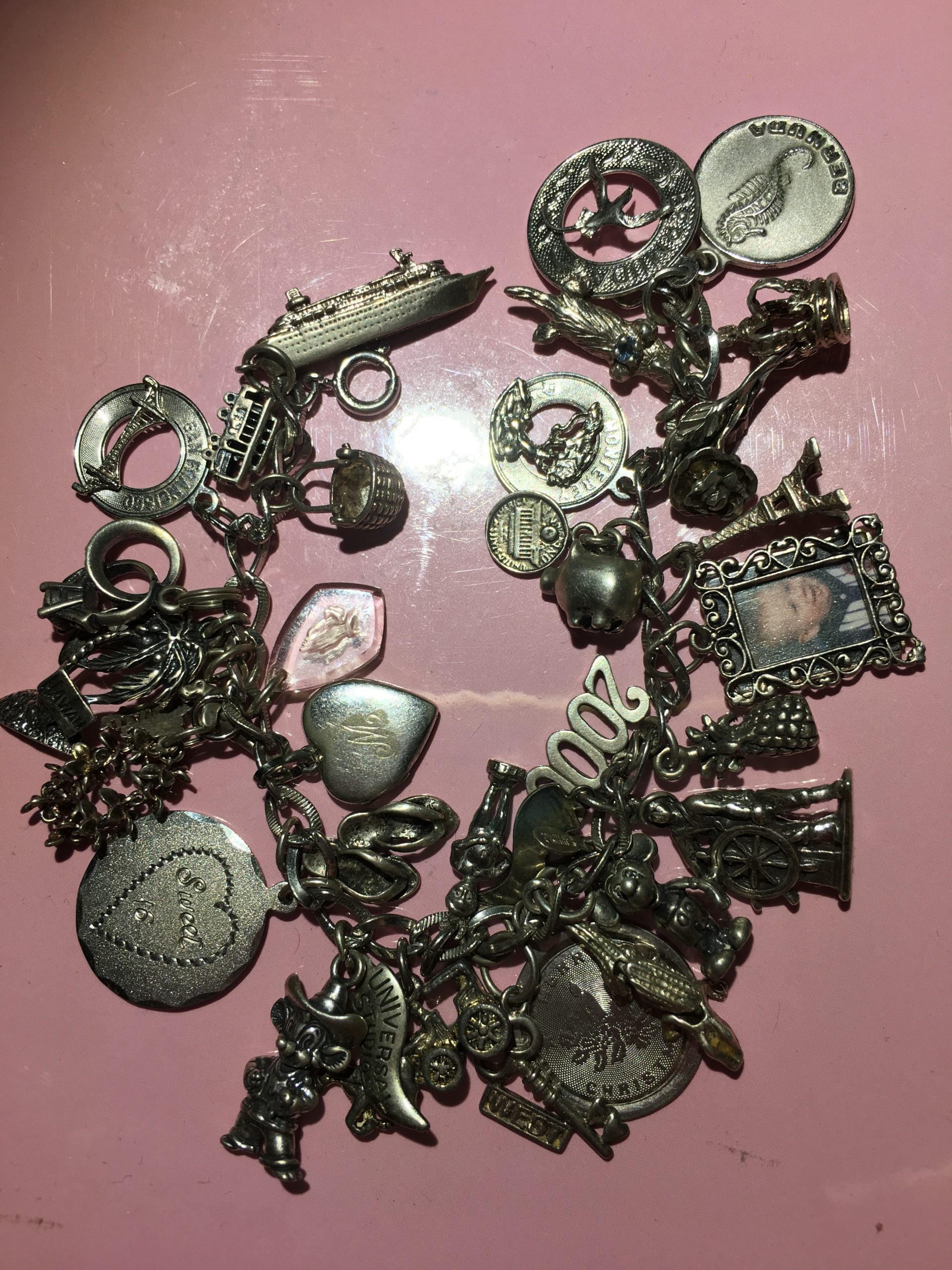
“My favorite trinket that I collect from every destination I visit is a silver charm for my charm bracelet! On Christmas Day, 1978, my parents gave me this charm bracelet with its first charm. I was 12 years old, and this was my first piece of ‘real’ jewelry.
Through the years, at each destination I went to I bought a charm for my bracelet. I have a charm of the RCCL Majesty of the Seas, a trolley car that celebrates my trip to San Francisco and a sea otter from Monterey refreshes my memories of my West Coast trip. A Nantucket lightship basket reminds me of my trip to Nantucket. The charms can be very intricate. I have a lei from Hawaii that is several flowers linked together that moves like the real ones! A horse and buggy charm reminds me of my trip to Amish country. And a Bermuda longtail bird charm reminds me of my trip to – you guessed it! – Bermuda.
Bringing back fond memories of my first trip to Europe is a copy of the Imperial State Crown from England, along with an Eiffel Tower charm from Paris and the Manneken Pis (aka Petite Julien) from Brussels. A key charm for Key West, an articulated alligator from Florida, a Gloucester fisherman, Mickey Mouse and many more dangle from my wrist. These charms represent memories of the destinations I’ve visited and the major events in my life. I hope to add more in the future!” – Michelle Nason, Coventry, R.I.
“I have a large collection of Christmas ornaments from all the places that I have visited. One of my first was of the Chateau Frontenac. Every December my family and I decorate our tree and as we unwrap the ornaments we reminisce about our adventures!” – Joanie Mazzella, Glen Head, N.Y.
“When my kids were very young, we discovered souvenir penny machines at the Chesapeake Bay Bridge and Tunnel gift shop on the way to the Outer Banks. It sparked a years-long quest for ‘squished’ pennies for all our travels. Now as young adults, they have filled penny passport books with imprinted coins from the top of Mount Washington to Disney’s Space Mountain, and many in between. For 52 cents, what a great way to preserve precious memories!” – Laura Follo, Brandord, Conn.
“Like most people, we take photos when we travel. It is so much easier now with phone cameras, but we often bring a real camera along. After each trip we choose our favorite and have it printed and framed. There is often a good story to go with each of our favorite photos.” – Louis Roth-John, Needham, Mass.
“My husband and I always collect pins from each destination, but our favorite memento we collect is dirt and sand! We have dirt from wild mustang trails from Theodore Roosevelt National Park and sand from any beach we’ve been to. We have each in beautiful glass bottles and they always invoke special memories from every place we’ve been.” – Karen Mastandrea, Fort Lee, N.J.
“I have a bottle of Sicilian wine that is completely covered in Mt. Etna’s lava stones.” – Anthony Lawrence, submitted via Facebook
(Kim Pereira)
“In 2019, my husband, our two adult kids and I finally went to Portugal (where my husband was born). My daughter had the fabulous idea for us all to get tattoos to commemorate our trip. We found a reputable tattoo parlor before going and planned a visit toward the end of our stay. Now we each have a beautiful reminder of our amazing and unforgettable vacation and no trinkets to lose!” – Kim Pereira, South Hadley, Mass.
“I collect the flat pennies you can make in those machines at tourist sites. It is a small remembrance of where we have been and have pictures of things we did or saw there. They sell books to display them so it’s nice to flip through and recall fun times as a family. Sometimes we get Christmas ornaments, too, so putting up the tree has extra meaning.” – Laura Ulrich, Massapequa Park, N.Y.
“I have collected heart-shaped rocks for my wife on every hike, from here in the USA to Iceland, Peru and 35 states. We have two huge heart-shaped bowls filled with rocks from those areas.” – Christopher Chanowitz, Milton, N.Y.
“My travel diaries. I’m not big on souvenirs but have a tradition of finding the strangest thing in the souvenir stores (and buy things I need in these stores to help their economy instead). So far, my favorite was a 6-foot-tall fly swatter in the Dallas Airport. (And too many to mention from Wall, South Dakota. A fun place to stop.)” – Rosemary Ross, submitted via Facebook
“After my sister passed away unexpectedly eight years ago, I began the quest of visiting all 50 states with my three children by my 50th birthday, all on a limited budget. Challenging to say the least. This was a way for me to deal with the deep grief I was experiencing, to research and plan how we were going to road trip these and afford it.
(Linda Zanetti)
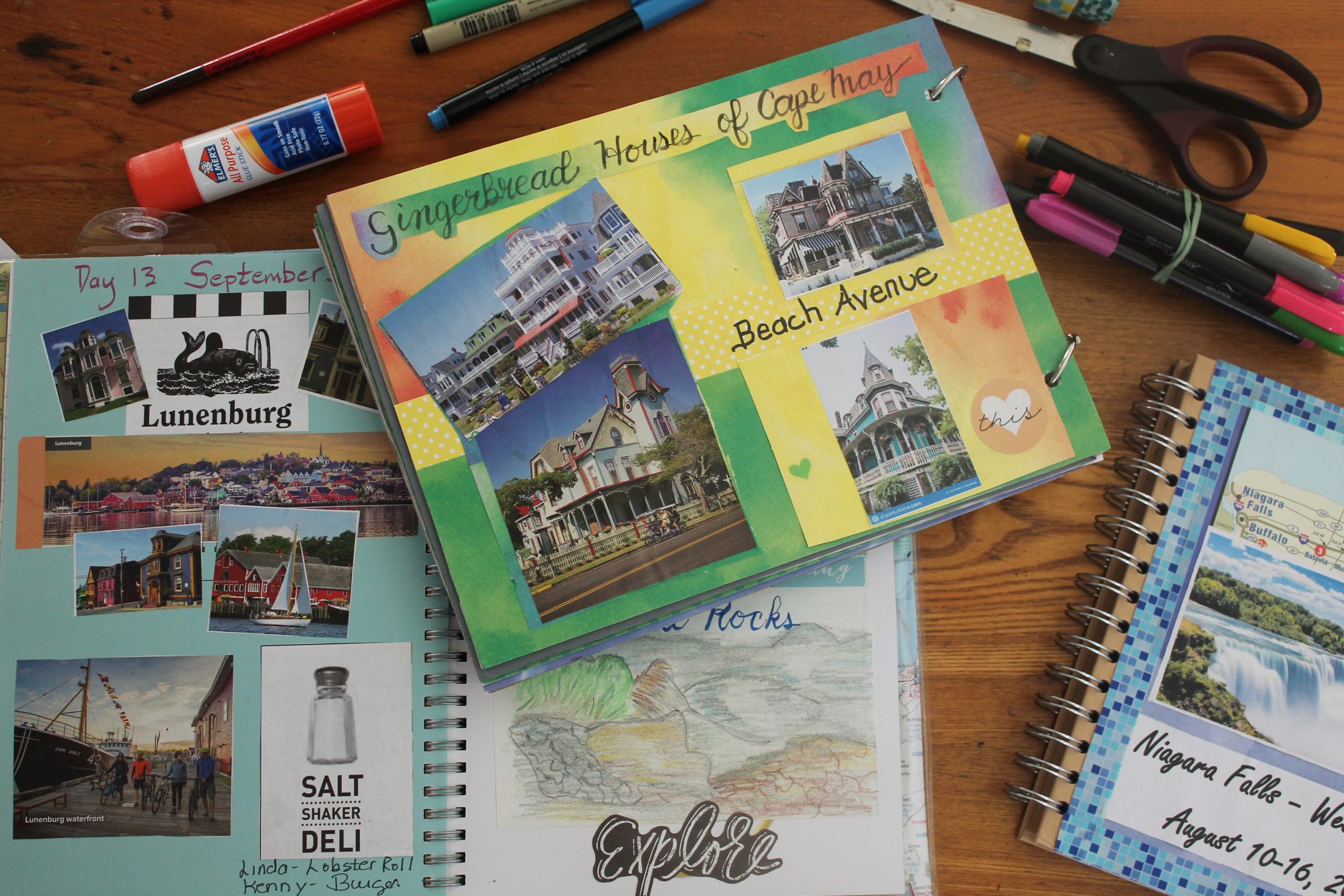
Travel journals…my favorite way to revisit my trips. – Linda Zanetti, Duxbury, Mass.
Outside of photos, I wanted something to remember from each state we visited. I chose to collect Christmas ornaments as I way to honor my sister. We loved Christmas growing up and she kept the spirit of Christmas alive all year. I would scour gift shops for the perfect ornament that would symbolize what that particular trip meant.
Each year my three children still decorate with me and it’s truly like opening a time capsule each time we place these on our tree. The stories, memories, tears, laughter and conversations are so symbolic of the travels we have had and the love we share. Although I am turning 52 and still have not yet traveled Hawaii, I look forward to the day I can place my 50th ornament on my tree.” – Tara Bozek, Ayer, Mass.
“Small amount of sand or shells from beaches.” – Jodi Zammit, Huntington Station, N.Y.
“My first and only trip to Ireland, I found a four-leaf clover on my first day in Adare. I pressed it in a book and laminated it when I returned home.” – Jennifer Nolan, Farmingville, N.Y.
“My favorite travel souvenirs are the small rocks I pick up from each state I visit. Just a small one, no bigger than an inch in size. I have them in a bowl on my kitchen windowsill. I take them from someplace where I know I am getting the natural stone found in the state.” – Catherine McMahon, Rhinebeck, N.Y.
(Nancy D’Anna)
“I have collected sand from every beach I visit. It’s amazing how varied the colors and textures are from different beaches. And looking at them reminds me of all the beautiful places I have been.” – Nancy D’Anna, Revere, Mass.
“My favorite travel memento was a miniature perfume bottle a stewardess gave me as a 7-year-old child en route to London. She escorted me to meet the pilot who gifted me a small gold pin and she made me a junior Boeing club member. It was a huge thrill, and I finally procured a second bottle from eBay as a backup this past year. I open and smell it sometimes but just seeing it makes me smile. Naturally, it’s aged, but then again, so have I!
I have loved flying and cosmetics ever since I got to wave to Her Majesty the Queen as her shiny, black Rolls-Royce – probably the Phantom IV State Landaulet – rolled out of the Buckingham Palace gates. It was quite a moment, seeing for myself that women really can and do rule the world.” – Peggy K. Schunk, Hawthorne, N.J.
“Whenever we go on vacation, I try to find a Christmas ornament, preferably a handmade ornament from that place. It takes hours to decorate our 6-foot tree. Looking at the tree brings back memories from the 60 years of travels.” – Carol Zordan, Litchfield, Conn.
“I would have to say pictures. Otherwise, antiques, like making a road trip out of finding an inexpensive fixer-upper Hoosier cabinet. Great memories going away with my husband for a few days to get it.” – Michelle St Clair, submitted via Facebook
“I used to go to Cabo San Lucas and San Jose Del Cabo for fishing, scuba diving, exploring, music and food with friends. One day with the scuba guides, I decided to go deep down to about 170 feet. On the way up you are to stop and let your body adjust, so I stopped and put my right hand on small rock ledges. On the last ledge I felt something. I picked it up … it was a coin. When I got to the surface it turned out to be an old British coin. Wow! What are the odds?” – George Stevenson, Portland, Ore.
“I collect a Christmas tree ornament from each new place that I travel to. When decorating my tree, I can then relive each experience/place. It’s also a great conversation starter when friends come over and look at the ornaments.” – Barbara Damico, Mays Landing, N.J.
(Gail Brodie)
“My favorite vacation souvenir is a beat up, spiral notebook titled “CAL REC”. It’s the record of our family’s 1971 cross-country trip (ending in California) when my brother and I were teenagers. I recorded all of the restaurants and motels we went to, listed all the tchotchkes that I bought, notated the sights we saw, the weather and illustrated each day with postcards from the motels. Forty years later, I created a digital version for my brother with then-current restaurant/motel status updates. And this year, my brother sent me an email each day, 50 years later to the day, with additional restaurant/motel updates, scans of my father’s old slides and the sharing of memories. It’s amazing how we share this experience still thanks to that old notebook.” – Gail Brodie, Shrewsbury, Mass.
“I went to Atlantic Beach in North Carolina in 1980 when I was 18. I went with a family on their vacation to help with their four children. We went shopping for souvenirs at a little store filled with pretty ceramic things. I bought myself a spoon rest with a little cat and one for my mother with a sand dollar. We both still use them. Every time I use it, I think of all the happy memories from that vacation!” – Susan Gura, Naugatuck, Conn.
“Once my son began traveling for work and bringing home souvenirs, I decided Christmas ornaments would be best. This is wonderful for our family to take the ornaments out, have a chat and hang them on our tree rather than just having a souvenir that sits on a shelf waiting to be occasionally dusted. Each year we are able to relive our travel memories. Now it’s so many they are the only thing on the tree and they are beautiful” – Marie Tremblay, Billerica, Mass.
“When I travel, I try to find a small music box to add to my collection. My music box from Paris plays Offenbach’s ‘Orpheus in the Underworld,’ better known as the ‘Can-Can’ song. From Barcelona, the music is ‘Habanera’ from Bizet’s opera ‘Carmen’ (yes, it takes place in Seville, but …). From Ireland, it’s ‘When Irish Eyes Are Smiling.’” – Sandra Steiner, Jamaica Estates, N.Y.
(Susan Ruttenber)
“My most memorable souvenir is this simple bamboo stick. Why? Well, a good 30 years ago, my then-boyfriend and I went on a trek in the Annapurna Sanctuary in Nepal. I had come down with what all the hikers jokingly called the Himalayan flu and had taken a very strong decongestant. The weather was very sunny and warm. As a result, I became very dehydrated and could hardly walk. So, for the final leg that day between Hinko Cave and the Machapuchare base camp, the sirdar (probably young enough to be my son) cut this stick for me to support myself. He and my boyfriend carried all of my gear. Hot tea with sugar helped revive me at the camp.
Several days later, my boyfriend suffered an ankle sprain and – after a day’s rest – used this stick for the remainder of the trek. There was no way I was going to lose this stick. As you can imagine, it was a bit of a problem going through several security checks at all of the airports on the way home. But here it is, still in the same corner of my home.” – Susan Ruttenber, Westwood, N.J.
“I like to pick up a pair of earrings when I travel. I have several turquoise ones from the Southwest. When I wear them, it brings me right back to when and where I bought them.” – Christina Green, Westerly, R.I.
“As a world traveler who has spent extended periods of time living out of a carry-on suitcase my favorite mementos are the hotel soaps. Using them at home for daily showers brings back the fabulous memories of far-flung destinations and the specific adventures we so enjoyed from those special parts of the world. Every shower is a trip down memory lane.” – Janet Marks, New York, N.Y.
“I collected shot glasses from all over the world. Everywhere we went, I bought one or more. Some were from the city itself, some were for a sports team from that city and some were just novelty-type for the fun of it. I had collected over 300 and had them displayed in my basement family room in shadow boxes that had up to 36 little cubbies that the shot glasses fit into perfectly. I received so much joy looking at them when I was down in that room. I sometimes would sit and think of the places we had travelled to and the memories would flood in. We are downsizing now, so about a year ago I sold my collection to a young man who seemed so happy to get them.” – Margaret Smith, Budd Lake, N.J.
“I was a flight attendant later than most, my children were up [in age] and some were married. I bought my husband a baseball cap from most every city I had a layover. He ended up with more than anyone would need. Not all the states, but pretty close.” – Mary Carey, Salem, Mass.
“Since I could never remember what size my growing children were when I went to various conferences, I always bought souvenir keychains. Even though they are now adults, we still make a point of bringing each other key rings. We try to avoid the cheap plastic squares, choosing instead to get the metal or pewter ones.” – Erma & Bob Bressler, Anramdale, N.Y.
(Beth Mancuso)
Photos As Souvenirs
One of the most popular travel souvenirs are photos. Learn how to preserve and showcase your vacation snaps with these tips from our Photo Session pro photographer, Beth Mancuso.
Cull Them
Step one after downloading your images is to go through and cull them. This means sorting through all of them and only keeping the winners. I use an asset managing program called Adobe Bridge to download and rate my images. After I have rated them, I go through and delete all the ones that didn’t make the cut.
Back Them Up
Technology can fail us! It is so important to back up your images. In addition to having the images saved on your computer, I also recommend backing the files up on both an external hard drive and a cloud service. I use a 1TB external hard drive as well as Google Drive. It’s better to be safe than sorry. There is nothing worse than losing all those precious memories.
Print Them
Perhaps my favorite way to preserve images is to print them. There are so many wonderful options out there and printed items can also make great gifts. My favorite high-quality consumer level print lab is Mpix, which offers all of the products mentioned below.
Make a Collage
You can get 4-by-6-inch prints made for as cheap as 27 cents. After you have printed out your favorite travel photos consider making a collage out of them. I have a bulletin board hanging in my office that I add to over the years. The nice part about a bulletin board is that you can change out the pictures whenever you feel like it.
Make a Calendar
Calendars make the best gifts! I like to try to match the month to a picture I took at that time. Most printing companies even allow you to customize the dates on your calendar.
Make a Book
My kids love flipping through the pages of the photo books I have created over the years. I love the books because they are durable and something that I can pass down to them when they are adults.
Wall Art
If you are looking for something bigger, I recommend having a canvas or metal wall art made to hang on your walls. My favorite is the metal wall art because it is so luxurious looking.
Looking to plan your next trip and add to your travel souvenir collection? Our Travel Advisors are always here to help.
Driving in inclement weather can be a challenge for even the most experienced drivers, but it can be especially daunting for new drivers. If your teen recently received a permit or driver’s license and has yet to experience driving in wintry conditions, these AAA driving instructor tips can help.
By preparing young drivers for winter conditions you’ll be making the roads safer for everyone.
Prepare the Vehicle
Young drivers should practice winter driving in a car that’s suitable for the weather. To have a properly winterized vehicle, consider switching to winter tires and winter windshield wiper blades. No matter which type of tire you opt for, be sure they are properly inflated and have plenty of tread.
Make sure your car is in peak operating condition and that you have it serviced before chilly weather returns. Check to make sure there’s plenty of antifreeze and windshield wiper fluid, and always keep at least half a tank of fuel in your vehicle during the winter.
Ensure young drivers have essential winter tools in the car, especially a shovel, ice scraper and an emergency kit. Additional supplies may include a blanket, spare winter clothes (gloves, hat, scarf, socks, etc.), a flashlight, bottled water and a first-aid kit.
Have your teen practice in the vehicle they are planning to drive, whether it’s a sedan, crossover, SUV or truck, because they all handle differently in slippery conditions. While anti-lock brakes and stability control are required by law, new drivers should also get familiar with any additional advanced safety features in the car. Features that rely on sensors, such as blind-spot and and lane-departure warnings, could be affected by winter weather conditions, so it’s important for them to practice with and without the technology. Remember, advanced driver-assistance systems are designed to work in conjunction with an engaged driver, not replace one.
Check out our story on the five best cars for winter driving, all of which boast important safety features that make driving during the winter a little easier.
Prepare the Driver
Teach young drivers how to properly brake while driving during the winter.
“When there is a light coating of snow or ice on roadways, drive into a large cul-de-sac or spacious parking lot with no obstructions in your path,” said Richard Field, a AAA Northeast Driving School instructor. “At low speeds have them apply the brakes firmly to gain experience on stopping distance, slippage and sliding as well as effect of the anti-lock braking system. Experiment by varying light to hard pressure on the brake pedal. Repeat while turning the steering wheel to understand understeer on slick roads.”
Drivers must start braking earlier during slippery conditions. Emphasize doing everything slowly and carefully. Never use cruise control or slam on the brake. Instead, tell them to take their foot off the gas, let the car slow and apply the brake gradually.
Another lesson for winter driving is to increase following distance between yourself and other drivers on the road, generally providing about four to 10 seconds of distance in between cars. This gives drivers extra time to react in case of ice or other slippery conditions.
“Regardless of whether the vehicle has front-, rear- or four-wheel drive, the best way to regain control in a skid is to take your foot off the accelerator and avoid slamming on the brakes, while continuing to look and steer in the direction you want to go,” said AAA’s Car Doctor John Paul. “Wait for the front wheels to grip the road again. As soon as traction returns, the vehicle will start to steer; you can then gently apply the accelerator. While all-wheel drive vehicles get you moving better in snow than front- or rear-wheel drive vehicles, they all stop the same way. Don’t become overconfident and drive faster than the road conditions safely allow.”
An additional option is enrolling your young driver in a AAA Driving School course. Our programs create lifelong safe drivers by presenting students with real-world, hands-on training. Program offerings vary by state, but courses are available in Massachusetts and Rhode Island. All programs are licensed by each state’s departments of motor vehicles.
Teach Caution
The most essential driver instructor tip for winter driving? Practice, practice, practice.
“New drivers simply may have no experience in winter driving, and rather than learning via trial and error, will benefit greatly from supervised driving practice,” Field said.
Start with being a good example. Keep an eye on the weather report: Everyone should avoid unnecessary driving during certain winter conditions – new and more experienced drivers alike. Be safe and stay home during severe winter storms.
One intimidating factor of winter driving is the possibility of running into black ice. Familiarize your young driver with how to navigate this challenging condition, starting with these tips.
Instilling your children with responsible money habits and leading by example can help them work toward a stable financial future.
From setting up a savings account and figuring out an allowance to explaining how budgeting and credit scores work, different financial discussions are appropriate for different age groups.
When you decide it’s the right time to start teaching your kids good money habits, keep these tips in mind.
Start Talking About Money
When it comes to discussing money and financial topics with their kids, 25% of parents were somewhat reluctant, 14% were very reluctant and 11% were extremely reluctant, according to a Parents, Kids & Money survey from 2019.
However, 53% of the children surveyed – ages 8 to 14 – said they wished their parents taught them more about money. Before your child reaches the age of seven, start talking to them about money, the importance of saving and how much different goods and services cost.
Open a Savings Account
It’s never too early to open a savings account in your child’s name. This is where you can deposit any funds they receive on birthdays and holidays, before they’re old enough to make their own financial decisions.
This money can start gaining interest, and your child will have some funds to start learning with when the time comes. What’s more, the age of bank accounts can help them with applying for credit later.
Giving Allowance
Allowance is a great way for young kids to start earning money. According to a survey from T. Rowe Price, 51% of parents said they give allowance, but their kids have to earn it. This is opposed to 17% who give allowance without any requirements and 32% who don’t give allowance at all. What’s more, 52% of parents surveyed said they give $10 or less per week.
How you decide to grant allowance depends on your parenting style. Some parents give allowance for daily chores, like making the bed, feeding a pet, putting away dishes. Others only give allowance when their kid(s) go beyond regular/expected responsibilities.
When it comes to the amount of money you should give your child as an allowance, experts tend to say that, on a weekly basis, 50 cents to a dollar for every year of age is appropriate.
Emphasize Saving
When teaching your kid about saving, use a clear container – like a mason jar or plastic tub – to allow them to watch the progress of their savings. You can even have more than one, labeling each for different things, such as saving, spending and giving.
Many children take well to visual learning. Seeing the dollars and change stack up over time makes tracking goals clearer and can lead to a bigger sense of accomplishment.
Explain Budgeting
If there’s something your child wants, teach them how to purchase it through budgeting.
Show them how to set a financial goal, including the price of the item they want, plus a little extra so they’ll still have some money left afterwards. If they don’t have any savings remaining from birthdays and holidays, they may be able to save faster by doing extra chores, or they’ll simply have to be patient and save up to meet their goal gradually.
Introduce a Debit/ATM Card
If your child/teen gets a part-time job, they should have a more secure place to save their money. When your child becomes an adolescent, it’s time to consider whether they’re ready for a debit/ATM card.
A debit card allows them to pull funds from a checking and/or savings account and make purchases. Show them how to track their spending, maintain minimum account balances and remember to replenish their savings after a larger purchase.
Today, a lot of banking is done online, and many banks have apps that allow for easier money management. Help your child stay on top of their finances by setting up low-balance alerts, charge notifications and more.
Start Building Credit
Once your teen is a bit older and starting to think about college, trade school and/or making a significant purchase like a car, it’s time to teach them about credit.
Have them use their credit card only for charges they have the money to cover. Then, have them pay off balances right away. Also, emphasize the importance of checking their purchase history to find and report fraudulent charges. And make sure they know what to do if their credit card number is ever stolen.
Finally, let them know they are entitled to one free annual credit report each year from the three credit bureaus – Equifax, Experian and TransUnion. This will allow your teen to track the progression of their credit score as they try to get at close to 850 as they can.
Be a Good Example
It’s true that you will likely need to be a co-signer for certain accounts for your kids when they are young, and you’ll be acting as their financial advisor for many years. However, one of the most important things you can do to teach your kid(s) good money habits is to lead by example.
Show your child how you budget, save and spend responsibly by being a strong saver and savvy spender. Sharing your tried-and-true financial habits, as well as money mistakes you’ve made in the past, can all become valuable lessons to the young people in your life.
How do/did you teach your kid(s) good money habits? Tell us in the comments below.
As temperatures dip and the weather outside gets a little more frightful, your home should be toasty and warm. But ensuring the comfort of a well-heated home on the most bitterly cold winter days starts with keeping your heating equipment properly maintained. Snuggle more and shiver less this winter with these tips.
Staying on Top of Maintenance
Don’t wait until something breaks and your home heating system requires emergency repairs. When the weather is cold, you won’t want to go a single day without heat. By regularly maintaining your system, you can save money on costly repairs and prolong the life of your home heating system. Annual maintenance, even when you don’t think anything is wrong, will ensure that you don’t have any surprise problems when you need your heating system most.
Petro Home Services can provide comprehensive, full-service annual inspections from highly-trained heating specialists that can save you money, give you peace of mind and keep your home comfortable.
Central Heating System Maintenance
A central heating system is a fine-tuned machine, and all of the components need to work together to make sure that your heating is safe, warm and cost-effecient. When a home heating technician comes to inspect your heating system, they will calibrate it to make sure you get proper delivery of heat to every part of your home. Here are some of the components that they should be inspecting.
In central heating systems, warm air moves through filters to keep the air clean. If these filters get clogged, dust, dirt and other contaminants can make their way into the air that circulates through your home – the air that you and your family breathe all day. The warm, dirty air will move through the ductwork, room by room. This contaminated air can be hazardous to your health and should be dealt with immediately. Clogged filters also cause your heating system to work harder and can lead to it breaking down.
When a home heating technician inspects your system, they will inspect the air filters to make sure that they are clean and safe. If they’re clogged or dirty, they will often simply be replaced – a cheap, easy fix that will help you breathe easy and keep your system running efficiently.
Thermostat Inspection and Repair
The thermostat – that thing your kids are always messing with! The thermostat is one of the most important parts of a home heating system, and the part that you interact with the most. A properly-functioning thermostat will signal your home heating system to produce the desired temperature, and it also measures the current temperature in your home. If your thermostat is malfunctioning, it can report the wrong temperature to your home heating system, or signal it to produce the wrong temperature in your home. It can be frustrating to users who simply want to set the thermostat to their desired temperature.
Many times you can fix the problem on your own, if you have a programmable thermostat, by simply changing the battery. Other times you will need to call in a trained professional to take a look. A trained home heating specialist can diagnose if there are any problems with your thermostat, and either repair or replace it.
Boiler and Furnace Inspection and Repair
What’s the difference between boiler heating and furnace heating?
A boiler uses hot water or steam to heat your home. The heated water is pumped through the house to heat radiant flooring systems or radiators. Boiler systems can run on natural gas, propane, electricity, oil or even wood pellets.
A furnace uses air rather than water. It can run on natural gas, propane, oil or electricity to heat air and push it through your home’s ductwork. Furnace heating can sometimes produce more dryness than boiler heating, due to the blowing air. Boiler heating is a more radiant heat, so there’s no hot air blowing on you.
These two types of systems require two different types of maintenance. Furnaces require an annual inspection, and your air filters will also need to be changed out on a regular basis. If you live with pets or in an area with a lot of dust in the air, you should change them more often to maintain their cleanliness. Boilers require an annual inspection and tune-up by a professional home heating technician. Remember to keep the area around your furnace or boiler clear and clean.
When your boiler or furnace is inspected, a home heating technician can repair any issues or replace it if necessary.
Ventilation and Radiation
If you have a furnace, you have a heating ventilation system. If you have a boiler, you have a heating radiation system. When these systems are functioning properly, they will deliver consistent warmth throughout your home.
Over time, air trapped in your boiler, pipes or radiator can block the flow of heated water – it’s also susceptible to rust from dirt and debris in the system. When this happens, the system draws more fuel to compensate and reach the correct temperature and it can get expensive.
If you have a furnace, clogged ventilation systems can cause a similar problem. Warm air gets trapped in the heating system, and more fuel has to be used to overcompensate. A home heating specialist will inspect the points at which air or heat flows or radiates into your home.
Duct Inspection and Replacement
In furnace-based central heating systems, air ducts deliver warm air throughout the house. If the insulation in your duct systems breaks down or tears, it can cause heat to release in places where it’s not supposed to be. Since the air isn’t heating your home like it should be, the system will again draw extra fuel to hit your desired temperature. It’s like money leaking out of your wallet and into your walls. A heating system technician will inspect your ductwork and insulation to ensure that all the warm air goes where it needs to be going.
Fuel Line and Fuel Tank
Fuel lines, which transport fuel to the burner, must be tightly-sealed to be safe and operate efficiently. A home heating specialist should inspect the fuel line for rust, leaks and consistent assembly. They will also inspect the fuel tank. If there are any issues with your fuel line, a total replacement of the piping is the safest option.
AAA members who sign up as a new customer with Petro Home Services can receive special offers including $200 off any new heating or AC system. Learn more.
How often does your home heating system receive maintenance? Let us know in the comments below!
Your credit score provides potential lenders with an easy way to evaluate your creditworthiness. A high credit score can open a lot of doors, such as buying a car or house. A low score, on the other hand, can make your goals harder to reach.
Not knowing what affects your credit score is akin to trying to ace an exam for a class you never took. With that in mind, let’s take a refresher course on what does and doesn’t affect this all-important number.
What Does Affect Your Credit Score
Payment History
Five main factors affect your credit score, but none hold more weight than your payment history. This category shows lenders whether or not you’ve paid past credit balances on time, including those for credit cards, mortgages, and student and car loans. It also takes into consideration factors such as how overdue late payments were, the amount of money still owed and how much time has passed since any delinquencies.
Credit Utilization
Credit utilization refers to the percentage of available credit you’re using. For example, if you have a $10,000 monthly credit card limit but only put $1,000 worth of charges on the card that month, you would have a credit utilization rate of 10%. (Remember, having credit and using credit are two different things.) It’s recommended to keep your rate below 30%, but the lower the better.
Credit History Length
Generally, the longer your credit history, the better. This is especially true if you have a strong payment history. It proves to lenders that you’re likely to continue such behavior in the future. Credit history length includes items such as the age of your oldest and newest accounts, and the average age of all your accounts.
Hard Credit Inquiries
Whenever you apply for a new line of credit, the lender will request to see your credit report in order to determine your eligibility. This is what’s known as a “hard inquiry.” Each hard inquiry will cause a temporary drop in your credit score that usually only lasts for a few months.
Credit Mix
It’s good to have a mix of revolving credit, such as credit cards, and installment credit, such as mortgages, car loans and student loans. Credit mix doesn’t have a huge impact on your credit score, however, so you can still have a high score without having both credit types on your report.
What Doesn’t Affect Your Credit Score
Shopping for Low Interest Rates
As mentioned above, applying for a loan, mortgage or credit card will trigger a hard inquiry by the lender, negatively impacting your credit score. Shopping around for lowest interest rates will require multiple inquiries over a short period of time. Fortunately, credit bureaus will recognize you’re simply applying with multiple lenders in order to compare rates and treat it as a single inquiry.
Checking Your Credit Score
Requesting your own credit report results in what’s known as a soft inquiry, which has no impact on your credit score. You’re entitled to one free annual credit report from each of the credit bureaus – Equifax, Experian and TransUnion. During the COVID-19 pandemic, these companies are offering free weekly online credit reports.
Getting Married
Your credit score is yours and yours alone, even after you get married. If your spouse has bad credit prior to your marriage, it won’t impact your score after you tie the knot. That said, it will affect your ability to open any type of joint account, and if said account becomes delinquent, it will appear on your credit report.
Your Income or Bank Balance
How much money you have and are bringing in play important roles in your financial life, but are not reflected in your credit score. Meaning, you won’t have a high credit score simply because you have a high-paying job or hefty savings account, and vice versa. And in turn, any changes to these numbers decreasing won’t affect your credit score.
Note that although you won’t find income or bank balance information on your credit report, lenders will often take these into consideration when deciding if and how much credit to award you.
Using a Debit Card
Debit cards are linked to your own personal bank accounts, so when you use them to pay for something, you’re using money you already own. Since no lender is extending you credit, debit card use has no effect on your credit score. Debit cards can help prevent you from spiraling into debt the way credit cards can. However, since they are not reported to credit agencies, they also can’t help you build credit.
Being Denied Credit
If you are denied a line of credit, it likely means your credit score is less than ideal. However, the actual act of being turned down doesn’t lower your score. There will be a slight dip when the lender requests a hard inquiry into your score, but that’s all.
Learn about all the ways AAA and Discover can help you handle your financial needs.