Launched by Mattel in 1968, Hot Wheels revolutionized the toy industry with “The Sweet 16,” a line of fast, custom-designed die-cast cars featuring low-friction “Redline” wheels and vibrant Spectraflame paint. Over five decades later, the brand has produced over 6 billion cars, becoming a global automotive and pop culture icon for both children and adult collectors.
An Instant Sensation
Before we dive into Hot Wheels history and the backstory of these beloved toy cars, let us set the scene:
Prior to the 1968 New York Toy Fair, the Mattel company invited a Kmart executive to its Los Angeles headquarters for a preview of its newest product. The toy maker was hoping to get a head start on its goal of securing 5 million orders from retailers. After watching a 1/64-scale muscle car replica shoot down a track and across the floor, the executive ordered 50 million cars on the spot.
By perfectly merging technical excellence and cultural significance, these toys became an immediate hit. And though Hot Wheels history began more than a half-century ago, those attributes have made the miniature toys as popular today as they have ever been.
“The car has always been more than just a mode of transportation,” says Bruce Pascal, owner of the world’s largest Hot Wheels collection. “It’s a thing of beauty. It’s a thing of awe. The automobile is something that’s so relevant and many times it’s one of the first things children do — learn the names of the car and identify cars as they drive by. And many times, they get that education through Hot Wheels.”
Hot Wheels History Begins
Toy cars were anything but a novel idea in the 1960s. Tens of millions, including Matchbox, Husky and Budgie models, were already being produced each year. The market was so saturated, in fact, that when Mattel co-founder Elliot Handler suggested the toy maker manufacture its own line of cars, he was met with healthy doses of apprehension and opposition from his colleagues. Even his wife and Mattel’s second-in-command, Ruth, had her doubts.
But Handler saw something the others didn’t. Or, more precisely, he saw what wasn’t there. Toy cars of the day were more miniature automobile replicas appealing to collectors than exciting toys for kids to play with and enjoy. Elliott knew there wasn’t room for another toy car similar to those already on the shelves – so he set out to create a better one. His dream was to manufacture a radical, yet realistic-looking toy car that could move on its own.
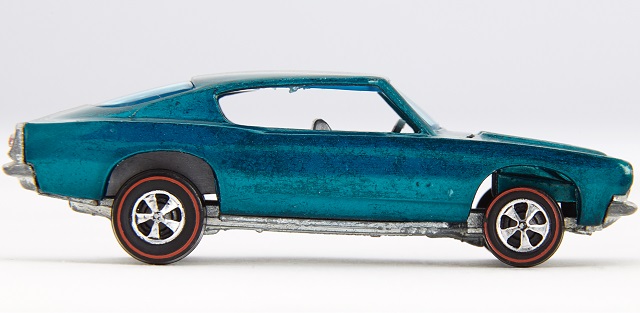
A Car That Shines …
Knowing the success of these new cars depended on their design and functionality, Elliot recruited talent from outside the toy world to help in development. This included Harry Bentley Bradley, a car designer from General Motors, and Jack Ryan, a Yale-educated missile systems engineer. They became two members of Mattel’s uniquely diverse employee pool. The company was known for hiring the best and brightest, regardless of sex, race, religion or background. In this sense, it was an outlier in the mid-1900s. But a diverse workforce brought new ideas and fresh perspectives, which is precisely what would be needed if the toy maker wanted to create a product the world had never seen.
Elliot encouraged his employees to take their own approach to solving problems. This philosophy gave the Hot Wheels team the creative freedom to take inspiration from popular culture. Fast, funs cars were all the rage in the 1960s. The Ford Mustang and Chevy Camaro were born. Steve McQueen was racing through the streets of San Francisco in “Bullitt.” The Beach Boys were owning the airwaves with odes to their coupes, T-birds and 409 engines. Amid this cultural backdrop, designers homed in on the evolving Southern California hot rod world. Not only did these race cars have the eye-catching aesthetic Mattel was looking for, they were custom-built for the same thing the toy maker aspired for its cars: speed.
… And Moves
To outpace past the competition, Mattel wanted its cars to not only be able to move on their own, but move with speed.
Engineers went to work building a miniature car that could accelerate like a life-sized one. This was accomplished with a series of design tweaks, including wide tires, mag racing wheels and a torsion-bar suspension that provided shock absorbency and wheel bounce. Designers also developed a low-friction wheel/axle assembly, which required a bit of ingenuity. In order to get the wheels to spin freely, the axle was made from a mandolin string, which had a small rolling surface to create less friction against the wheel. It was coupled with bushings constructed from Delrin, a low-friction plastic material developed by DuPont just a few years prior.
The end result was a toy car that could reach a scale of 200 mph. When Elliot first saw a demo of one of these cars zooming across the floor, he had a simple yet ultimately enduring response: “Those are some hot wheels!” The name stuck.
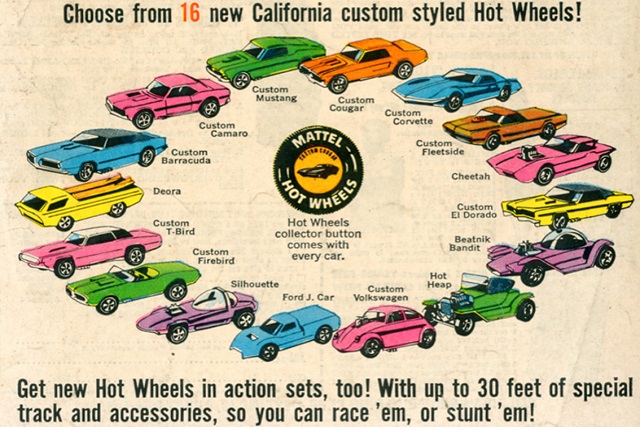
Hot Wheels Make Their Debut
The Hot Wheels Custom Camaro hit shelves in May of 1968. It was quickly followed by 15 other models: Beatnik Bandit, Custom Barracuda, Custom Corvette, Custom Cougar, Custom Eldorado, Custom Firebird, Custom Fleetside, Custom Mustang, Custom T-Bird, Custom Volkswagen, Deora, Ford J-Car, Hot Heap, Python and the Silhouette. These first edition cars became known as the “Sweet 16.” They consisted of revamped versions of the day’s notable muscle cars, as well as custom designs inspired by real-life hot rods. Each was adorned with Mattel’s Spectraflame metallic paint and red-lined wheels, the latter of which would become a trademark feature.
Flexible, plastic racing tracks complete with the now iconic loop were sold alongside Hot Wheels cars. Together they made for a toy that, just as Elliot predicted, became overwhelmingly popular. More than 16 million were purchased in the first year. Sales only increased as the calendars turned. Mattel manufactured its 1 billionth Hot Wheels in 1991. Today, it reigns as one of the best-selling toys of all-time and is as popular as ever.
Are Hot Wheels Worth Collecting?
You betcha. It’s not uncommon for individual Hot Wheels to fetch hundreds and even thousands of dollars. And there’s a vast market of collectors vying for the opportunity to get their hands on these valuable miniature cars. The most prominent — and expensive — known collection belongs to Pascal. All total, his 5,000 cars and 3,000 pieces of Hot Wheels memorabilia are valued at approximately $2 million.
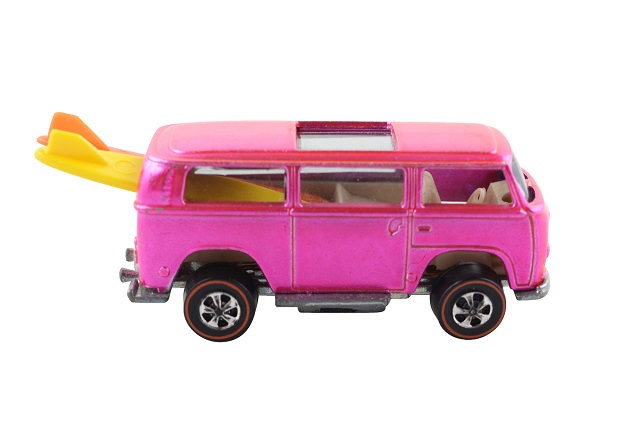
The crown jewel of Pascal’s collection, and the most expensive model in Hot Wheels history, is the rear-loading Pink Beach Bomb. The value of this Volkswagen-inspired bus with two surfboards sticking out the back stems from its scarcity. In development, Mattel discovered that placing the surfboards in the back threw off the car’s balance and prevented it from properly functioning on the Hot Wheels track. The toy manufacturer went back to the drawing board, redesigning the van with surfboards on the side. As a result, only two rear-loading versions were ever produced. Pascal’s, which is said to be in the best condition, is valued in the neighborhood of $175,000 today. For context, that same sum could fetch you five Volkswagen Jetta’s, with money left over.
How to Tell Which Hot Wheels Are Valuable
With billions of Hot Wheels roaming the Earth, discerning which miniature cars are valuable can be difficult without any Hot Wheels history insight. “If you don’t know anything about baseball cards and I put a Mickey Mantle card in front of you, how are you going to know it’s valuable?” Pascal says.
With that in mind, the renowned collector does offer up some guidance. “In the same way diamonds have the three C’s — cut, clarity, and carat –—[Hot Wheels] have condition, casting and year,” he says. “If the condition is mint, and it’s the right year and the right model and the right color and the right interior, then you have a bingo.” In regards to year, generally the older the better. Of particular value are “Redline” Hot Wheels. These cars were manufactured during the first decade of production, when nearly all Hot Wheels cars featured a red stripe on the tires, similar to those found on muscle cars of the day.
Even something as objective as age, however, can be hard to discern, Pascal warns. The year printed on the bottom of each Hot Wheel isn’t always indicative of when the car was manufactured. That number corresponds to the year Mattel first made that casting. But the toy maker famously reuses the same castings for many years.
If you have a potentially valuable Hot Wheels, you’re best bet is utilize what Pascal says is the best free guide available: eBay. To get an idea of how much your model may be worth, put on your detective hat to match the wheels, patterns, color and other features to those up for sale.
There’s also money to be had in Hot Wheels found on the toy shelves today. Such models fall into two categories. First are known as treasure hunts or super treasure hunts. These are limited-quantity cars randomly inserted into distribution boxes that catch fetch a quick profit. Costing just a few dollars, they typically can be resold for at least $20. Treasure Hunt Hot Wheels are distinguished by a circle flame logo located somewhere on the car. Super Treasure Hunt cars have a “TH” logo.
The second, and harder to find variety, are error cars. Like any other manufacturer, Mattel makes mistakes. Snag a Hot Wheels in the wrong direction, in the wrong package, missing paint, etc. and you’ve got a worthwhile commodity. Those errors can add up to hundreds of dollars of value.
Whatever you’re plan of attack — happy collecting!
Has Hot Wheels history got you hooked? Visit our Auto History page for backstories on everything from glove compartments to ice cream trucks.
Last updated: April 15, 2026

Related Articles


Trending Articles




NEWEST ARTICLES