Discover Fall in Lake Placid

The small Adirondack village of Lake Placid is well-known for its scenic beauty, winter sports and Olympic history. Although many people associate it with winter, Lake Placid is most picturesque and enchanting in fall.

Leaf Peeping

Autumn views are endless in Lake Placid. So, grab your sweater and a camera and take in the scenery on a foliage tour (available on land and water) or on the Skyride Experience gondola ride.

The region has its own foliage report that can help you plan your trip around peak autumn sightseeing.

Celebrate Lake Placid’s Fall Perfection!

We do fall perfectly. Enjoy lush, fiery colors, lively town atmosphere and cool autumn golfing.

Learn More

Outdoor Adventures

Every year, Lake Placid draws in thousands of tourists to enjoy a myriad of outdoor activities.

The tree-lined fairways and epic mountain landscapes at the Whiteface Club make for an especially memorable fall golfing experience.

And from mountains and lakes to valleys, rivers and thousands of miles of trails, Lake Placid is a hiker’s utopia. The Adirondack High Peaks are the biggest summits, drawing in crowds of explorers. But as you plan your adventure you will find there are many other treks with great views and fewer people, like the Mt. Van Hoevenberg East Trail, one of the newest trails in the six million acres of Adirondack Park.

Hit the Town

Post-adventure, there is plenty to do and see outside of the magical terrain.

Head to town and explore the many award-winning restaurants or visit the Lake Placid Center for the Arts, which offers programs in music, theater, dance, art and film, in addition to galleries, exhibitions and workshops to enjoy. At the local shops, you can discover fresh farmers markets finds, fine art and everything in between.

After a busy day, you may also want to wind down with some self-care at a full-service spa, known for custom treatments and local ingredients. Maybe a deep tissue massage after hiking the High Peaks?

Start planning your Lake Placid vacation today.

Subscribe to Your AAA Newsletter

Sign up and receive updates for all of the latest articles on automotive, travel, money, lifestyle and so much more!

Understanding Electric Vehicle Purchase Options

So, you’re ready to make the switch to an electric vehicle. You’ve done your homework, formulated a price range, even homed in on a few possible models. All that’s left are some test drives and signing on the dotted line, right? Let’s pump the brakes a bit.

EVs may not have internal combustion engines but they do come with the two age-old, car-buying questions: New or used? Buy or lease? Many of the factors that go into these decisions are the same for EVs as they are for their gas-powered counterparts. However, there are some important distinctions that should be taken into consideration.

New vs. Used

Ideally, we’d always like to get behind the wheel of a sparkling new car every time we’re in the market for a different set of wheels. Particularly in the rapidly developing world of EVs, buying a new vehicle ensures you’re driving the best-performing, most technologically advanced model available. But for practical reasons, purchasing a new car isn’t always an option. This is where the used car market comes into play.

The primary benefit of opting for a used EV is the upfront savings. This is no small point, as EVs are known to have high upfront costs. EVs also have fewer moving parts and require less maintenance, so older models will typically be in better shape than used gas-powered cars. Depending on the age of the used car, you could still be covered by the warranties, including the all-important battery warranty. (Not all car companies transfer this warranty to second-hand owners. If looking for a used EV, make sure to ask about this and factor it into your car-buying decision.)

There are some risks that come with owning a used EV. Regardless of the status of the warranty, you will be getting a poorer-performing battery. These lithium-ion batteries begin to degrade on day one and lose approximately 1-2% of their capacity each year. As battery capacity drops, so does driving range and overall performance. Since EVs are still a fairly new technology, there’s not a substantial amount of data on how long a typical battery will last.

Buying vs. Leasing

EVs are at the cutting edge of technology with better-performing cars being introduced each year. Batteries, in particular, are rapidly becoming more and more efficient. You may not want to be locked into a vehicle today when they can get a much-improved model a year or two later. A lease allows you to upgrade every two or three years, promising you’ll always be at the technological forefront. The rapid improvement in EVs also means they undergo steep depreciation. This loss of value won’t be your concern if you don’t own the car.

Leasing allows guarantees that you’ll be covered by the car’s warranties, which will likely outlast the terms of your lease agreement. For EVs, this includes a battery warranty good for a minimum of 8 years/100,000 miles. After the expiration of said warranty, the owner is responsible for any battery repairs or replacements, which can be expensive. By leasing, you’ll get a fresh battery long before your current one degrades any noticeable amount.

Buying an EV has its share of benefits, as well. Long-term, it’s generally a more sound financial decision to purchase a car instead of borrow. At some point, your monthly payments will end and the vehicle will be an asset you own. Lease payments will continue as long as you are in possession of the vehicle.

When it comes to EVs specifically, buying is the only way to ensure you will be eligible for the full federal tax credit, as well as any local financial incentives. Dealerships may pass along some of these savings if you are leasing, but there’s no guarantee.

And just because you purchased the vehicle, doesn’t mean you can’t upgrade. In fact, it may be easier to do so than when leasing an EV. You can always sell the vehicle any time you like. Getting out of a lease agreement early, however, may cost you in the form of termination fees and penalties.

Financing

For all intents and purposes, financing an EV is the same as financing a gas-powered car. When formulating the terms of your auto loan, lenders are going to look at factors such as credit score, down payment and income, not how the vehicle is powered.

On the personal financial side, coming up with a price range for an EV purchase can be a little trickier. EVs are typically more expensive than gas-powered gas in the same class. However, numerous federal and local tax credit and rebate programs can help offset that cost. Owners will also recoup money over the lifetime of vehicle ownership, as EVs are generally less expensive to operate thanks to fewer maintenance demands and zero fuel costs.

Visit AAA’s Electric Vehicle platform for more information on these cars of the future.

Subscribe to Your AAA Newsletter

Sign up and receive updates for all of the latest articles on automotive, travel, money, lifestyle and so much more!

New Electric Vehicle Brands to Keep an Eye On

The electric vehicle movement isn’t just revolutionizing automobiles, it’s shaking up the business world, as well. For decades, mass car manufacturing has been designated almost exclusively to the major companies. The changing mobility landscape, however, has given upstart companies an opportunity to enter the picture. Several up-and-coming EV manufacturers have done just that and made quite the name for themselves in the process.

But there’s more to the EV industry than just the cars themselves. The country is in desperate demand for substantial charging infrastructure improvements. Private companies have spotted this need in the market and are continuing to build out their own network of publicly available charging locations.

Here are some of the new EV brands you’ll be hearing more of in the future.

EV Manufacturers

Rivian

Even casual EV connoisseurs have likely heard the name Rivian by now. The startup was founded in 2009 and has since picked up a number of big-name investors, including Amazon and Ford.

Rivian made history in 2021 by producing the first commercially available electric pickup truck, beating industry stalwarts such as Tesla and GM. All-in-all, the R1T truck has been well received by critics. According to Rivian, it boasts a driving range of 260-400 miles, 11,000-pound towing capacity and a 0-60 time of as little as 3 seconds. In addition to the pickup truck, the Southern California-based company is producing an electric SUV that should be available later this year, and manufacturing fully electric delivery vans for Amazon.

Lucid

Like Rivian, Lucid made headlines last fall. This time, it wasn’t for production but for performance. In September, the California-based startup announced its debut sedan, the Lucid Air, achieved an EPA-certified range of up to 520 miles. That number is by far the highest of any EV on the market, besting runner-up Tesla Model S by more than 100 miles. (Lucid and Tesla are inextricably linked, as the former is being run by many past executives of the latter.)

Lucid currently offers three trim levels of the Air: the Grand Touring, Touring and Pure. All can travel at least 400 miles on a single charge, but you’ll have to pay a hefty price for that superior performance. The models come with starting price tags ranging from $87,400 to $154,000.

Fisker

Auto designer Henrik Fisker, who styled cars for BMW and Aston Martin, founded his eponymous EV company in 2016. Not long after, the car manufacturer announced it was developing a fully electric, $40,000 luxury SUV. The finish line of that pursuit is finally within sight, with the Fisker Ocean expected to arrive later this year. Touted as the most sustainable SUV on Earth, the vehicle’s most notable feature is a solar roof that, according to Fisker, can produce up to 1,500 miles worth of energy per year.

The upstart EV maker, which has already announced plans for a second, smaller SUV dubbed the Pear, has received more than 40,000 reservations for the Ocean. The base trim has a starting price point below $38,000.

NIO

NIO is a China-based EV manufacturer founded in 2014. It is already one of the leaders in electric car sales in its home country, along with companies like XPeng and Li Auto, and has big plans for expanding into other regions around the world. Late last year, NIO announced intentions of selling its vehicles in 25 new countries and regions, including the United States, by 2025.

NIO offers a full lineup of EVs, including both sedans and SUVs, with more models expected in the future. The ET7 and ES8 are its flagship sedan and SUV, respectively.

VinFast

VinFast, established in 2017, is the first Vietnamese carmaker to sell its vehicles globally. The EV manufacturer has eyes on entering the American market later this year. It will do so with two models, a mid-size and full-size SUV, dubbed the VF8 and VF9, respectively.

What’s most notable with VinFast isn’t its vehicles, however, it’s how the company is selling them: Drivers buy the car but lease the battery. The monthly payments are commensurate to the mileage plan chosen. Furthermore, VinFast offers consumers the option of a home charger or access to nationwide public charging.

Apple

It only makes sense that the largest tech company in the world would try its hand at manufacturing the increasingly popular, boundary-pushing technology that is an EV. To be clear, there are currently no known plans of an Apple-branded car coming to fruition anytime soon. But the tech giant’s intention of developing such a vehicle goes back nearly a decade, and just last year rumors circulated that Apple was partnering with Hyundai to produce an EV. While that deal ultimately fell through, don’t be surprised to hear about an Apple car in the very near future.

EV Infrastructure Providers

EVgo

EVgo is the nation’s largest public fast charging network, one that includes over 850 locations across more than 30 states and 60 metropolitan areas. The company claims 130 million Americans live within 10 miles of an EVgo fast charger. Furthermore, it has announced plans to triple its network’s size within the next five years.

Fast chargers can recharge an EV battery in minutes rather than hours. EVgo further distinguishes itself by powering all its locations through renewable energy. To use a charger, drivers can pay as they go or sign up for a membership. EVgo recently partnered with General Motors in a deal that will allow GM customers to receive discounts on charging and exclusive reservations at EVgo locations.

ChargePoint

While EVgo has the largest number of fast-charging stations, its footprint pales in comparison to that of ChargePoint in terms of total locations. The country’s leader in EV charging stations, ChargePoint has roughly 15,000 outposts across the U.S., accounting for some 50,000 charging ports. The vast majority of these, however, provide Level 2 charging, which takes longer to recharge an EV battery than fast charging.

ChargePoint chargers are sometimes free to use if they’re owned by a retail business, such as a shopping mall or hotel. Otherwise, EV owners can pay via smartphone or ChargePoint card.

Blink is another of the largest owners and operators of public EV charging locations. Since 2009, it has constructed more than 23,000 such locations. Utilizing Level 2 charging, Blink chargers are capable of adding up to 65 miles of range in an hour.

Blink also sells residential chargers to use at home. These Level 2 chargers connect to your home’s Wi-Fi and can be controlled through a smartphone and devices like the Amazon Echo and Google Home.

Visit AAA’s Electric Vehicle platform for more information on these cars of the future.

Subscribe to Your AAA Newsletter

Sign up and receive updates for all of the latest articles on automotive, travel, money, lifestyle and so much more!

Understanding Electric Vehicle Battery Life

The fundamental difference between electric vehicles and gas-powered cars is, of course, the source of energy. For the most part, the battery found in an EV provides greater peace of mind than an engine. No more frequent visits to the gas station, far less maintenance, the complete absence of harmful emissions, etc.

But this doesn’t mean batteries come with no considerations. There are several important aspects about these power sources that EV owners need to know about.

EV Battery Degradation

The vast majority of EVs utilize a lithium-ion battery, which provides greater energy density and a longer-lasting charge than other rechargeable batteries. Lithium-ion batteries are also found in your cellphone and laptop. You’ve probably noticed that as years go on, these devices don’t hold a charge as well as they originally did, causing their batteries to deplete much faster.

The same holds true for the lithium-ion batteries in EVs, which have a limited number of charging cycles. EV batteries will slowly lose capacity over time, a process known as battery degradation. Studies have shown that EV batteries typically lose about 5-10% capacity over the first five years on the road.

Healthy EV Battery Practices

While battery degradation is inevitable, there are several steps you can take to ensure your battery lasts as long as possible.

  • Don’t Overcharge: EV charging is non-linear, meaning it takes more time and energy to charge the battery’s last 20% capacity. This is extra work is taxing on the battery. Therefore, it’s recommended to charge your EV battery only up to 80%. Many fast-charging public stations will cut off charging or switch to slow charging once a battery reaches that level.
  • Avoid Low Charge Levels: On the other end of the spectrum, you’ll also want to keep your battery above 20%. Repeatedly charging from extreme low levels to a full charge can reduce the overall battery life.
  • Minimize Fast Charging: Level 3 charging, also known as DC Fast Charging, provides the unique benefit of being able to add 60-80% of a battery’s charge in as little as 30 minutes. However, pressing so much current into a battery in such a short time can strain the battery. You should only use fast charging when necessary. Level 3 is ideal for a quick recharge on a road trip, but Level 2 is kinder to your car’s battery.
  • Stay Within a Comfortable Temperature Range: EV batteries do not like the extreme ends of the thermostat. Prolonged exposure to intense heat or cold will not only impact the battery’s efficiency, it could also speed up degradation.

Measuring a Battery’s State of Health

It’s important for EV owners, and especially used-EV shoppers, to know the exact state of a vehicle’s battery. Fortunately, there are several ways to find this information out. Current owners can simply see what the estimated range is after they fully charge their car, then compare that to the range when they first purchased the vehicle. If your EV originally boasted a 200-mile range, for example, but now a fully charged battery only provides 180 miles, the battery’s capacity has dropped 10%.

For a more precise status update, head back to the dealership, where the service department can provide a detailed report on your vehicle’s battery health. Used car shoppers can also get a copy of such a report and will want to examine this document carefully.

Finally, EV owners can look to third parties for status updates. Companies like Recurrent offer automated battery health reports. Shoppers can also utilize this tool to check on the battery condition of a particular EV they have their eye on, simply by plugging in the car’s VIN.

EV Battery Warranties

The good news in regard to EV batteries and their potential decline is that these power sources are covered by a warranty that could very well last the length of the ownership. Federal regulations require automakers to provide an EV battery warranty of at least eight years or 100,000 miles. Some car companies go even further. Hyundai, for example, offers a 10-year/100,00- mile warranty on all its EV batteries, while the Tesla Models S and X come with eight-year/150,000-mile protections.

While the length of EV battery warranties may be similar, they are not all created equal. Some cover the replacement of a battery once its capacity drops below a certain percentage (usually around 60-70%), while others will only protect against a completely failed battery.

Many battery warranties are transferable, allowing used EV buyers to inherit whatever time and mileage remains on the original warranties. However, this practice is not universal. If you’re in the market for a second-hand EV, make sure to learn if the warranty will rollover.

Battery Replacement Costs

If your EV battery has finally reached the end of the road and your warranty has already expired, you’ll need to replace it. The battery is one of the most expensive components of an EV, so a new one won’t be cheap. The exact cost of this repair varies significantly based on car model, but you should expect to pay several thousand dollars. More-powerful batteries, however, could run well into the five-figure range.

Visit AAA’s Electric Vehicle platform for more information on these cars of the future.

Subscribe to Your AAA Newsletter

Sign up and receive updates for all of the latest articles on automotive, travel, money, lifestyle and so much more!

Cruises Are Inflation-Proof Vacations

As we all know by now, it’s an expensive world out there. This may lead you to believe that any vacation exploring that world is going to come with a sky-high price tag. Au contraire. One type of getaway has, by and large, avoided skyrocketing costs and could be the perfect budget-friendly vacation for you and your traveling party: cruises.

Not only have cruise prices remained stable during these inflationary times, that stable price is incredibly low. “[The prices] are some of the lowest that we’ve seen in a very long time,” Chris Gray Faust, managing editor of The Cruise Critic, recently told “Good Morning America.” “Not only are the fares low, but a lot of the cruise lines are putting in a lot of extra value type of things–like, they’re throwing in free gratuities, free Wi-Fi, free drink packages, things like that.” 

All-Inclusive Cost

What makes a cruise so budget-friendly is that the price to book your spot onboard includes travel to your destination, lodging, meals and entertainment. If these were purchased individually, they would cost significantly more than the price of a cruise ticket.

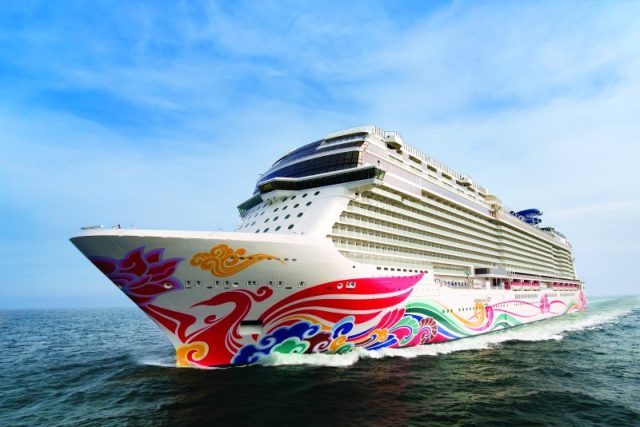
Let’s take a look at an example. Norwegian Cruise Line’s seven-night cruise from New York to Bermuda starts at less than $800 per person. Factor in a round-trip flight and add in a week-long stay at a nice hotel and you’re already well past the cost of a cruise.

And this is without taking into consideration the food and entertainment. Norwegian offers several complimentary dining options onboard, meaning you won’t need to pay for a single meal all week. (You can, of course, pay for a meal at one of the many specialty dining restaurants if and when you choose.) And entertainment? The ships put on several Broadway- and Las Vegas-caliber performances throughout the week. If you were to purchase tickets to such a show on land, it would likely set you back at least $100 per person.

Budgeting Made Easy

Cruises also make it easier to budget accordingly by allowing you to prepay for any add-ons you may want. Drink packages and shore excursions, for example, can be purchased beforehand so you know exactly what you’re paying for each and are not surprised at the end of your trip with massive bill.

Walking onto the ship with all aspects of your trip already paid for ensures that you won’t exceed your budget and provides a peace of mind that will suit you well as you set sail.

Book your Norwegian Cruise today!

Subscribe to Your AAA Newsletter

Sign up and receive updates for all of the latest articles on automotive, travel, money, lifestyle and so much more!

Weekend in Pittsburgh

Although its moniker and football team are named for its rich history in steel production, Pittsburgh’s industrial past has made way for a modern renaissance. Come expecting urban beauty, a celebration of diversity and a small-town feel that retains the traditions of the past while looking toward the future.

Point State Park

The perfect introduction to the city, Point State Park is located at the confluence of the Allegheny, Monongahela and Ohio rivers, known as the Golden Triangle. The scenic green space is a National Historic Landmark, remembered for its significance in the French and Indian War and other milestone struggles throughout the mid to late 18th century. It’s also known for having the nation’s tallest water fountain, spouting water up to 150-feet high!

On the Town

Head to the Strip District for a mile of mom-and-pop grocers, bakeries, restaurants and sidewalk vendors, ride the funiculars up the famous Pittsburgh inclines (the Monongahela Incline is the steepest in the country) and immerse yourself in pop art at the Andy Warhol Museum.

And don’t miss your chance to see inside the University of Pittsburgh’s 42-story Gothic Skyscraper, the Cathedral of Learning. Here you can take a self-guided tour of the Nationality Rooms, 31 classrooms designed by artists and architects that reflect different cultural periods, including Byzantine, Romanesque, Renaissance, Tudor and folk.

Make More Memories With Wyndham Hotels & Resorts

With 6,500 hotels in North America, Wyndham Hotels & Resorts has a wide range of hotels and resort options to accommodate your travel needs.

Save 10% or More

Game Time

Pittsburgh is a sports town. Depending on when you visit, you can see the Steelers at Acrisure Stadium (football), the Pirates at PNC Park (baseball) or the Penguins at PPG Paints Arena (hockey). College teams are also popular, especially the University of Pittsburgh’s Panthers.

If you enjoy adventure travel, recreational spaces abound. Walk, jog or cycle the trails along the Three Rivers Heritage Trail or go hiking in Riverview Park on the city’s North Side.

Where to Stay

Whether you’re in search of the value and convenience of Super 8 or the style and energy of the Wyndham Grand Pittsburgh Downtown, Wyndham Hotels and Resorts has options throughout the city.

Perhaps you’d like to wind town at the TRYP by Wyndham in the heart of Pittsburgh’s historic Lawrenceville neighborhood. If you’re headed somewhere else after your stay, Microtel Inn & Suites and Wyndham Garden are both located by the airport.

AAA members can save 10% or more at all Wyndham properties. Book your Wyndham hotel today.

Subscribe to Your AAA Newsletter

Sign up and receive updates for all of the latest articles on automotive, travel, money, lifestyle and so much more!

Road Trip Food Stops

There’s nothing quite like a road trip for getting out and seeing – and tasting – what a region has to offer. It’s not just about the destination but the stops along the way that make the ride special, and that’s especially true of where you choose to eat.

Whether it’s a meal or a quick stop for something sweet, instead of dining at familiar places and chain restaurants, seek out local spots. It’s fun to find the best food in town! Here are a few of our favorite places to stop and eat while road tripping through the Northeast.

Becky’s Diner

Portland, Maine

It’s not technically a law that you must have a lobster roll when you’re in Maine, but it’s definitely an unofficial rule. Located right on the waterfront, Becky’s has all manner of seafood to choose from, including a fantastic lobster roll. Too early for lunch? Don’t worry, you can still get your fix with their lobster omelet.

Bob’s Clam Hut

Kittery, Maine

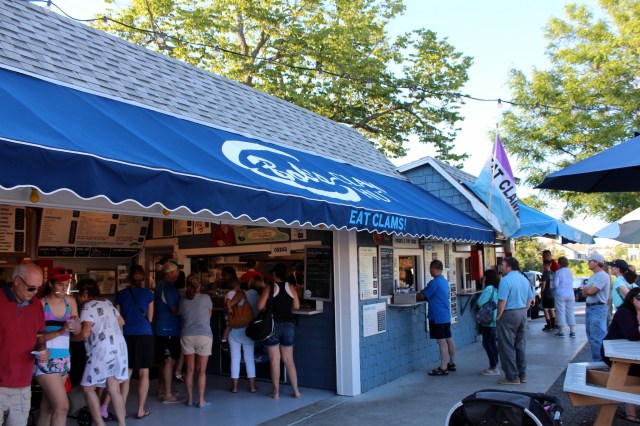
This isn’t a seafood restaurant. It’s a seafood joint. Although there’s nothing fancy about Bob’s, you’ll find some of the best clams and fried fish in the state at this unassuming building on the side of the road in Kittery. In fact, it made our list of the top 8 clam shacks in the region. The parking lot is tiny, so you may need to find a spot next door, but it’s worth the walk to get a heaping helping of fresh New England seafood. On a sunny day, walk right through the building to the yard out back and enjoy your meal on a picnic table in the sun.

Listen to Our Podcast

For more road trip tips and tricks, listen to Episode 5 of our podcast, Merging Into Life: Road Trip Starter Pack.

Tune In

Polly’s Pancake Parlor

Sugar Hill, N.H.

Don’t miss Polly’s if you’re making your way through the White Mountains of New Hampshire. Open for breakfast and lunch, this sweet stop is all about pancakes with plenty of maple syrup. You can create your own with a choice of seven batters and four fillings, including blueberries, chocolate chips and daily specials. Make sure you get some of the locally smoked bacon as a side and check out the country store where you can get many of their mixes to-go.

Car Rental Savings

Get up to 20% off the base rate of your next car rental.*

*Terms apply.

Book Today

Red Arrow Diner

Manchester, N.H.

There are several Red Arrow Diner locations in New Hampshire, but our favorite is the original in Manchester. It’s open 24 hours a day so you can get your pancakes, eggs, burgers and pie any time, day or night. Even if you’ve never visited you may recognize the Red Arrow Diner for being a famous stop along the campaign trail for presidents looking to make a big impression for the first national primary. You can see their photos shaking hands with the locals all along the wall behind the counter.

King Arthur Baking Company

Norwich, Vt.

You can find King Arthur Baking products in your local grocery store, or you can go to the flagship location up in the Green Mountains of Vermont. This stop is part shopping experience and part food break. The huge store sells everything a home baker could possibly need for their kitchen, but there’s also freshly baked breads, rolls, sweets, sandwiches and pizza. On sunny days, eat in the beautiful outdoor courtyard and enjoy the fresh mountain air.

Kane’s Donuts

Saugus, Mass.

No matter which donut flavor you try at Kane’s you won’t be disappointed (we highly suggest the creme brulee). There are several locations including one in downtown Boston and on the famous Route 1 that runs all the way from Maine to Florida. Not only are donuts tasty, but a box in the backseat makes for perfect nibbling as you make your way to your next destination.

Frank Pepe’s Pizzeria

New Haven, Conn.

Are you even on a road trip if you don’t stop for pizza and eat the leftovers in the car? Known for their thin-crusted, coal-fired Neapolitan-style pizza, Franke Pepe’s opened its New Haven location back in 1925 now has restaurants throughout the Northeast. A large is enough to feed a family and then some, so order accordingly.

Rein’s Deli

Vernon, Conn.

There’s a little bit of everything at this diner-style restaurant, from must-try pastrami and Reuben sandwiches, to salmon and lox and sweet cheese blintzes. You can even get a little something to-go at the deli counter. And did we mention there’s pie? Good luck picking just one flavor from the case up front. We recommend taking a slice or two for the road.

Becky’s BBQ

Middletown, R.I.

You might not think of Rhode Island as a place for great barbeque, but Becky’s may change your mind. It has all your hickory-smoked favorites from pulled pork to brisket to ribs, along with a list of tempting sides. Finish your meal with a slice of key lime or pecan pie.

Café Ommegang

Cooperstown, N.Y.

Brewery Ommegang is well-known for its wide selection of beers, but did you know it also has a fantastic cafe? This brewery in the woods is an idyllic location for a break from the road while touring upstate New York. Try the chicken and waffles with maple bacon bechamel and raspberry coulis or the poutine with local cheese curds and rich demiglace.

Need a ride? AAA members can save up to 20% on Hertz rentals.

Featured image: “Maine – Kittery: Bob’s Clam Hut” by Wally Gobetz / CC BY-NC-ND 2.0

Subscribe to Your AAA Newsletter

Sign up and receive updates for all of the latest articles on automotive, travel, money, lifestyle and so much more!

What Was the Bestselling Car the Year You Started Driving?

Whether is was fresh off the lot or, more likely, a hand-me-down on its last legs, we all remember our first car. But were we so focused on the freedom of the open road that we failed to notice what other people were driving? What the “it” car ​​​of the time was?

Automobiles have always been a sign of their times, so even if we weren’t behind the wheel of any of these bestselling cars, their popularity says a lot about what the roadways were like when we first started to drive.

Let’s see what the bestselling car in America was the year you started driving with a trip down memory lane.

Note: The following does not include SUVs or pickup trucks, for that would be a decidedly shorter list: the Ford F-series truck has been the bestselling vehicle in the U.S. the past 40 years.

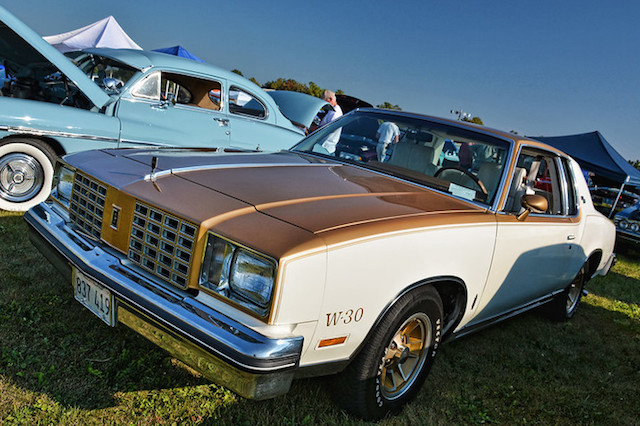
oldsmobile cutlass
“1979 Oldsmobile Cutlass W30” by Chad Horwedel is licensed under CC BY-NC-ND 2.0

1978-1981, 1983: Oldsmobile Cutlass

General Motors scored a major win in 1978 when it released the fifth generation Cutlass Supreme. This compact model featured a smaller body than previous iterations, which proved to be a hit with consumers. The Cutlass would remain America’s bestselling car into the 1980s. In 1983, the premium Cutlass Supreme model took the top spot. 

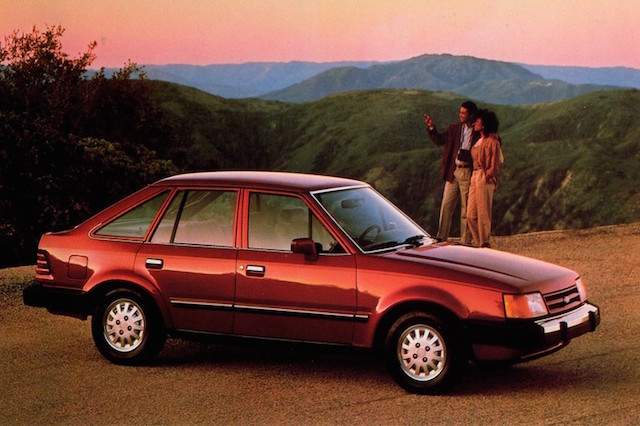
ford escort
“1987 Ford Escort GL 4-Door” by aldenjewell is licensed under CC BY 2.0

1982, 1987-88: Ford Escort

The Ford Escort briefly interrupted the Oldsmobile Cutlass’ reign atop the sales chart in 1982. First released the year prior, the Escort experienced a quick rise to the top thanks to a fuel-efficient engine, a variety of trim packages and a reasonable price. Its success had to be a welcome surprise for Ford  – and a sigh of relief  – as the car was replacing the universally panned Pinto in the automaker’s lineup. The Escort regained the sales crown later in the decade thanks to updated styling and a more powerful engine.

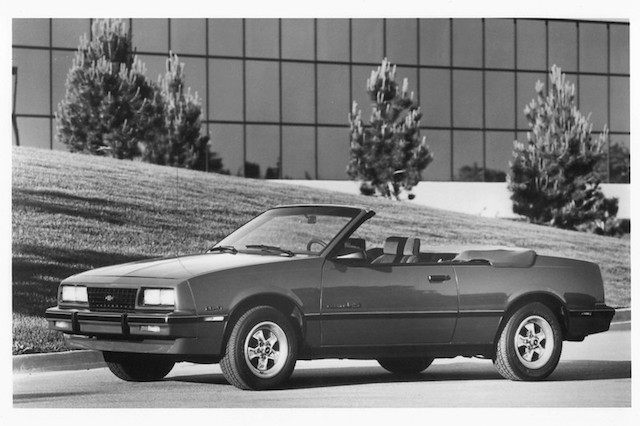
Chevrolet Cavalier
“Chevrolet Cavalier” by Hugo-90 is licensed under CC BY 2.0

1984-85: Chevrolet Cavalier

The Chevrolet Cavalier appealed to so many people thanks to its versatility. The car was available in five body types: coupe, sedan, hatchback, wagon and convertible, making it practical for lone drivers and families alike. Add in an efficient engine and fair sticker price, and the Cavalier became the car of choice in the mid-1980s.

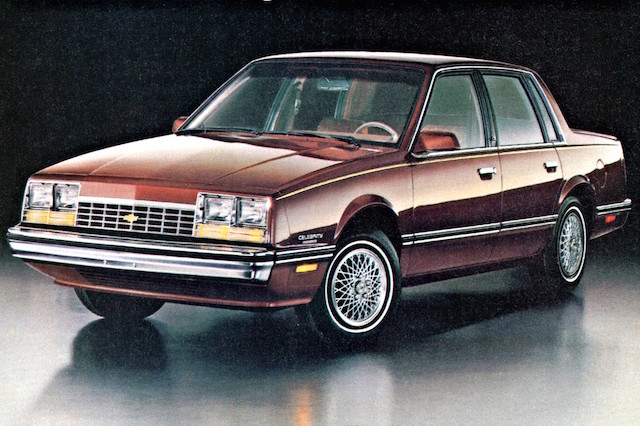
Chevrolet Celebrity
“1982 Chevrolet Celebrity Sedan” by aldenjewell is licensed under CC BY 2.0

1986: Chevrolet Celebrity

In somewhat of a surprise, the Cavalier was usurped from its throne in 1986 by its sister model. The Celebrity also came in various body styles, most of which offered ample cabin space for a mid-sized vehicle.

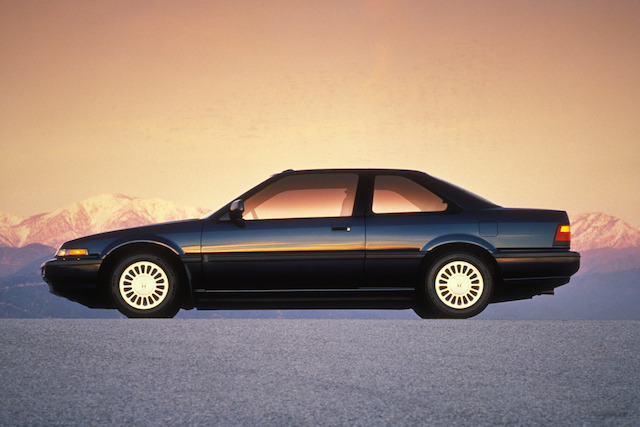
honda accord

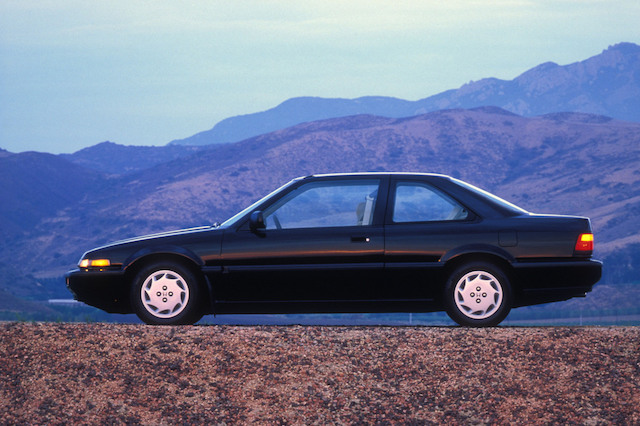
1989-1991, 2001: Honda Accord

The Honda Accord’s ascent to the top of the sales chart at the close of the 1980s was largely symbolic of the decade’s automotive market, which saw Japanese imports carve out a significant stake. Honda’s breakthrough vehicle was popular for good reason. The Accord came with a list of available features other competitors couldn’t rival, including air conditioning, power windows and locks, alloy wheels and a sunroof.

In 1990, Honda introduced its fourth-generation Accord, turning the compact car into a mid-sized sedan. The revamp proved wise as roughly 50,000 more units were sold than in the year prior. The Accord remained incredibly popular throughout the 1990s. It further proved its staying power by regaining its status as the bestselling car of 2001.

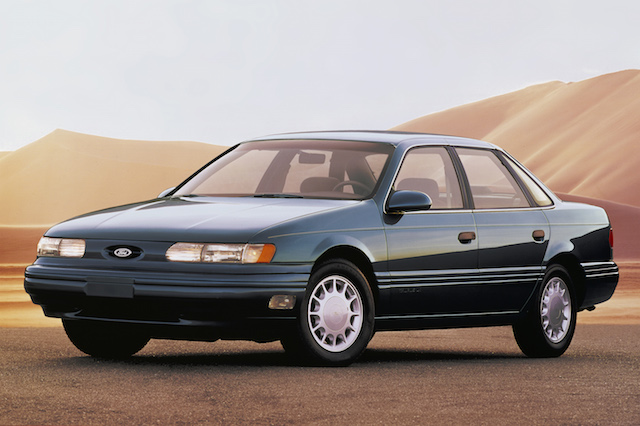
Ford Taurus

1992-96: Ford Taurus

The Ford Taurus began an impressive five-year stretch as the most popular car in America in 1992. The right combination of comfort, safety and value provided mass appeal to the American public. Helping boost sales was a wagon model suitable for families. The car remained a bestseller even in 1996, when a highly criticized styling redesign was unveiled to the market.

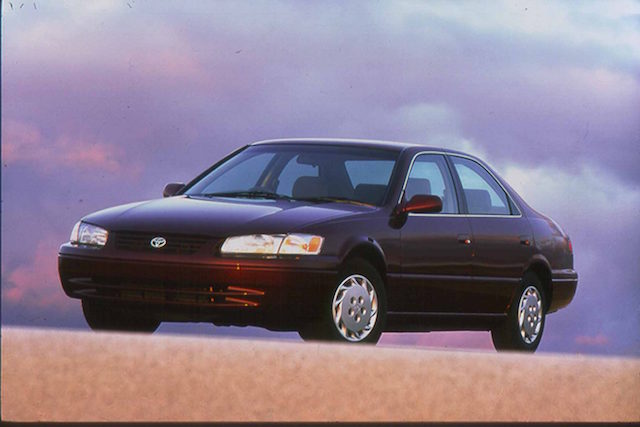
toyota camry

1997-2020: Toyota Camry

The Toyota Camry bumped the Ford Taurus to second place in 1997, the year that marked the beginning of the end for any competitors with eyes on the pinnacle spot. With one exception (when the Accord topped the charts in 2001), the Camry has been the bestselling car in America every year since. Much like other models in Toyota’s lineup, the Camry performs above average in just about every category, including performance, safety and, most notably, reliability. 

The car’s popularity continued to grow through the late ’90s and 2000s, peaking in 2007. While sales have decreased in recent years as SUVs and crossovers have taken over, the Camry still beats out all other competitors in its market.

Did you drive any of the cars on this list? Were they worthy of being the most popular in the country? Let us know in the comments below!

Subscribe to Your AAA Newsletter

Sign up and receive updates for all of the latest articles on automotive, travel, money, lifestyle and so much more!

AAA Photo Session: In Your Yard

Our yards come alive in summer.

Nature puts on a show as birds and other wildlife go about their business and gardens reach their peak. By the grill, on the patio, poolside or simply in your favorite lawn chair, it’s a place to relax, gather with friends and soak in all the sun and good vibes the season has to offer.

Although every season has its perks, seeing the yard reach its full potential in summer is what gloomy winter daydreams are made of. In this Photo Session, you showed us the highlights of what’s happening in your yards this year.

Thank You For Participating! (Session Closed)

Browse through all of the photos we received during July’s yard-themed Photo Session in the slideshow below, and don’t forget to check our social media channels, where we will be sharing some of our favorites. Select photos may also appear in an upcoming issue of Your AAA magazine.

Check out past AAA Photo Sessions and stay tuned for the next one.

Subscribe to Your AAA Newsletter

Sign up and receive updates for all of the latest articles on automotive, travel, money, lifestyle and so much more!

Travel Tips for Young Adults

So, you’re ready to take your first trip on your own. Where do you start? Pick a destination and then plan, plan, plan! Here are some travel tips for young adults to help make the process of traveling easier.

If you’d rather not do it all yourself, you can plan and book your next trip with AAA Travel. Our expert travel advisors will be happy to assist you each step of the way.

Saving for Vacation

There are plenty of saving tips and hacks out there, but you have to be realistic about what will work for you personally. If you have a hard time saving money, try using a budgeting app or putting your money into a savings account like a CD that you can only draw from at certain times. Make an appointment at your bank and discuss your finance goals with a bank manager.

Shop deals and sales pre-trip. A lot of essentials like flip-flops and Band-Aids that you can find at a dollar store are double the price (or more!) in tourist destinations, so plan wisely to avoid overspending at the gift shop on items you forgot.

Consider where you’ll be visiting and make a list of all the possible travel necessities you may need to pack for your specific trip. Heading to a theme park? You’re going to need sunscreen and comfortable walking shoes. If you’re visiting a national park and plan to do a lot of hiking, you may want to spare yourself the blisters and invest in a good pair of hiking boots.

A great travel tip for young adults looking to save money is to take inventory and use what you already have. Especially if you plan to carry-on, pouring shampoos, conditioners and other toiletries you have at home into the containers of a TSA-approved travel kit, could be more economical than spending on a bunch of travel-sized items.

Get more packing tips.

AAA Northeast Travel Advisor Emily Sgorbati has another savings tip for young travelers: “Instead of grabbing takeout or eating at a restaurant, put aside the money you would have spent and think about all the new foods you’d like to try in your travel destination. Dinner with a view of the Colosseum? Coming right up!”

This strategy can also be applied to other incidentals that you may spend on frequently. Do you take Ubers often? Consider riding your bike instead. Do you have online subscriptions you don’t use regularly? Consider if they’re worth it and if you can live without them, keeping  your eye on the travel prize ahead.

Get more ideas on how to save for vacation.

adulting traveling and studying abroad
(Illustration: Sarah Hopkins)

Studying Abroad

If you plan on studying abroad with your university, there are many aspects to consider. First and most exciting is where in the world will you study? Are you looking to explore your roots or learn a new language? Most universities have study-abroad programs that limit the countries you can visit, but here’s a helpful list that can provide you with some inspiration.

“Try to room share with local students or other international students while abroad, instead of with classmates from your university,” Sgorbati said. “You’ll get the chance to pick up new languages, try new food and have friends to visit all over the world when you’re done.” Imagine having a built-in Parisian buddy to visit for life!

Before you decide on your travel destination, be sure to do your due diligence and research the city’s travel guidelines and current travel restrictions.

Warren Jaferian, dean of the Office of International Education at Endicott College, has some expert tips for young travelers. “From a travel standpoint, when considering a place to study abroad, students must research and monitor the travel restrictions in place due to COVID-19, and whether American college students are able to travel,” he said. “Second, students should consult the Department of State website and review the travel warnings for the country, especially regarding personal safety and security concerns for Americans.”

Be careful and research all aspects of the city you finally decide on for your study-abroad program, including the safest areas to live in and any vaccines you may need for that area.

travel tips for young adults

Travel Insurance

Travel insurance may seem like an unnecessary added expense if you’re a young adult, but it can save you in the end. Travel insurance covers many of the unexpected circumstances that can interrupt or cancel your trip, including missed flights, lost baggage, unplanned illness and weather-related emergencies.

“Insurance is for travelers of all ages, gives you emergency medical coverage while traveling and you can receive exclusive AAA benefits like reimbursement for missed ports of call while cruising,” Sgorbati said.

Learn more about protecting your trip with travel insurance through AAA.

Renting a Car Abroad

Renting a car abroad can be a bit intimidating. Every country has their own set of driving rules and restrictions you should know about, which sometimes means having to drive on the opposite side of the road.

Some countries will require you to get an international driving permit or IDP to rent a car and drive legally in their country. An IDP is a valid form of identification that translates your information into 10 languages.

Rent a car with AAA.

If you would like to rent a car while studying abroad, check with your university about any restrictions first. “Our institution, like many others in the U.S., has a policy against study abroad students renting cars when overseas,” said Jaferian. “For those students not subject to such policies, they should consult with their insurance provider in the U.S. to see what coverage may be extended from their local policy and be informed about age limits and restrictions for foreign nationals in the host country (often 25+).”

Consider renting a car with a friend to share the expense. And if you are still uncomfortable with driving in a different country, most cities also have public transportation that you can familiarize yourself with.

Check out this guide to renting a car abroad for more tips.

How to Keep Your Money Safe Abroad

Try not to carry cash when traveling abroad. If cash gets lost or stolen it’s usually gone for good, while a credit card can easily be canceled and replaced. If you need cash, only carry small amounts with you at any given time. Don’t carry all your credit cards at once either; that way, if something happens to one, you always have a backup somewhere else.

Pickpockets that target tourists are infamous around the world, and even if you’re aware of this, you can still be a victim of their brazen tactics. Protect your valuables by wearing a secure bag like a fanny pack. Backpacks can be easily broken into and purses with no zippers are also an easy target.

An important travel tip for all young travelers is to always be aware of your surroundings and stay safe on your adventures.

What travel destination do you have your eyes set on? Start planning your trip today.

Do you have any other travel tips for young adults heading out to explore the world? Share them in the comments. 

Subscribe to Your AAA Newsletter

Sign up and receive updates for all of the latest articles on automotive, travel, money, lifestyle and so much more!

Vehicular Heatstroke Deaths up in Summer

Although the continual evolution of safety features has made vehicles significantly safer, one car-related fatality statistic remains: heatstroke deaths for children and pets.

On average, 38 children die in hot cars each year. On a typical 80-degree summer day, the interior temperature of a vehicle increases by 20 degrees in only 10 minutes and reaches a deadly 109 degrees in 20 minutes. On hotter days, it is common for temperatures in a parked car to reach 120-140 degrees, and cracking the windows has little to no effect.

Heatstroke is the result of the internal body temperature reaching 104 degrees. Children and pets are much more susceptible due to their thermoregulatory systems; the body temperature of children rises at a rate 3 to 5 times faster than adults.

Heatstroke Causes

Heatstroke deaths primarily occur due to one of three scenarios:

  • 20% of deaths result when a caregiver knowingly leaves a child in the car (typically to run a quick errand or finish a nap). The majority of the temperature rise occurs within the first 15 to 30 minutes, and caregivers assume that cracking the windows is enough to cool and ventilate the vehicle. Never leave a child or pet alone in a parked car for any amount of time.
  • 53% of deaths are caused by a caregiver forgetting the child in the vehicle. It should be noted that 46% of the deaths related to children forgotten in vehicles involved a change in the family’s routine where a different caregiver was responsible for dropping off the child at daycare. These tragedies most often occur on weekdays. AAA recommends drivers safely store their cell phone, work bag, or purse in the back seat when child passengers are present as another reminder to check the backseat.
  • 26% of cases are related to the child gaining access to the vehicle without adult supervision. An innocent game of “hide and seek” can lead to such tragedies. Often the child enters the vehicle and closes the door or trunk and cannot get out. It is important for drivers to lock their vehicles in driveways and garages to prevent these occurrences.

Signs of Heat Stroke

When a child’s core temperature rises, they will begin to experience a number of symptoms. These can include dizziness, disorientation, agitation, confusion, sluggishness and even hallucinations. Other signs of heat stroke include hot dry skin that is flushed but not sweaty, rapid heart beat and loss of consciousness.

If the child is in pain or not responsive, get the child out of the car and call 911 immediately. If you’re able to, spray the child with cool water. Stay with them until help arrives.

Heatstroke Prevention

The Alliance of Automobile Manufacturers and Association of Global Automakers have voluntarily agreed to integrate “rear seat reminder” warning systems in vehicles to alert caregivers to check the back seat for child passengers in every car sold in the U.S. by the 2025 model year. The agreement includes many large automakers, including domestic manufacturers General Motors, Fiat Chrysler Automobiles and Ford, and foreign-based companies such as Honda, Nissan and Toyota. Several manufacturers have already included the technology.

Just 10 minutes can be the difference between life and death, or a healthy child and one who has suffered brain damage. Any parent or caregiver, even a very loving and attentive one, can forget a child is in the back seat. The National Traffic Safety Administration urges caregivers to “look before you lock” and ask themselves “where’s baby?”.

AAA urges anyone who finds a child or pet alone in a locked car to call 911 immediately and take action to remove the passenger.

Subscribe to Your AAA Newsletter

Sign up and receive updates for all of the latest articles on automotive, travel, money, lifestyle and so much more!

How to Safeguard Your Life Insurance Against Inflation

Considering the fickle nature of the economy, perhaps one of the biggest long-term threats to your life insurance is inflation.

As of the most recent update of this post, the United States inflation rate is at a 41-year high, and has already beaten its record within the year.

While this often unpredictable economic change can wreak havoc on many of your assets, it can have particularly adverse effects on life insurance holdings. After all, the entire premise of the industry is predicated on planning out how much financial protection you’ll need, often many years in advance, taking into account the changing economic climate. So, if inflation takes an unexpected turn, your loved ones could possibly be left with less than expected.

When Inflation Strikes

To put it into perspective, the inflation rate in the U.S. is typically around 3% every year. While this doesn’t seem like much at first, even a subtle deviation in this increase can have far-reaching effects over the course of a decade or two. Think about it: With every year, the money in your pocket is worth 3% less.

And in June of 2022, the consumer price index – one of the primary measures of inflation – accelerated to 9.1%.

How, then, can you expect to anticipate whether the investment you’re making into your life insurance policy will be significant enough to provide your family with the safeguard they need?

The tricky part is that you can’t. Sure, you can do the calculations upfront and determine what your policy’s ultimate total should be down the line, accounting for perhaps slightly higher than the expected 3% inflation rate. However, there’s no way for this approach to eliminate any potential damage done to the planned benefit of your policy. Thankfully, there are other options for how you can protect your life insurance from the unfortunate reality of inflation.

What You Can Do

Inflation is inevitable, but here are a few strategies you can put into practice to help prevent it from dismantling the long-term vision of your life insurance policy:

  • Indexation: Some life insurance companies will allow you to exercise this option, which links your premiums with any number of figures intrinsically tied to inflation, such as the consumer price index and the average earnings index. As a result, your policy stays on par with the economy as inflation naturally occurs, retaining its long-term cash value over the course of many years. The catch is that indexation usually needs to be activated at the very beginning of your policy. After your plan begins, you may no longer have access to this option. So consider carefully if you want to add it to your plan before signing on the dotted line.
  • Policy riders: A policy rider is a clause built into your policy that provides extra protection or includes some other customized benefit that does not factor into a standard plan. In this case, some life insurance companies will offer one at an additional cost that protects against inflation, often by providing a monthly benefit that increases each year to offset the economic conditions. Ask your provider if such an option exists on your policy. As always, it’s much easier to make these decisions when starting a new plan.
  • Periodic coverage boosts: Less elegant than the above two solutions, this one merely entails injecting additional coverage into your policy on a regular basis to keep up with inflationary needs. The exact details of how you decide to do that are naturally completely up to you. Perhaps you may opt to devote additional funds to an existing plan or maybe even purchase an entirely new term policy to extend your coverage further into the future. The choice is yours, but this may be a more reliable option than factoring the inflation rate into your long-term life insurance needs in one fell swoop, as it at least gives you the option of course-correcting along the way.

An Uncertain Road

Although it may seem futile at times, estimating the impact that inflation will cumulatively have on your life insurance plan is a critical part of planning your financial future. Your policy is designed to be a safety net to protect your family in your absence, and without doing your absolute best to assess possible threats, it’s impossible to fortify the structure of your policy to provide the best possible security available to you. Inflation protection is an essential part of your plan’s long-term success, so don’t delay in taking the necessary precautions.

Do you still have concerns about how inflation may affect your life insurance policy? Let us know in the comment section so that we can help!

Discuss your options with a AAA insurance agent today.

Subscribe to Your AAA Newsletter

Sign up and receive updates for all of the latest articles on automotive, travel, money, lifestyle and so much more!

Summer on a Bun: Lobster Roll Recipes and More

How do you like your lobster roll? Cold and dressed in mayo or warm and drenched in melted butter? Maybe you don’t have a preference, as long as it comes with a waterside view. No matter which lobster roll recipe you enjoy, you have a New England summertime tradition right in the palm of your hand.

Know Your Roll: Types of Lobster Rolls

There are two primary types of lobster roll recipes: Maine- and Connecticut-style. While some variations exist in between, most eaters are loyal to one or the other.

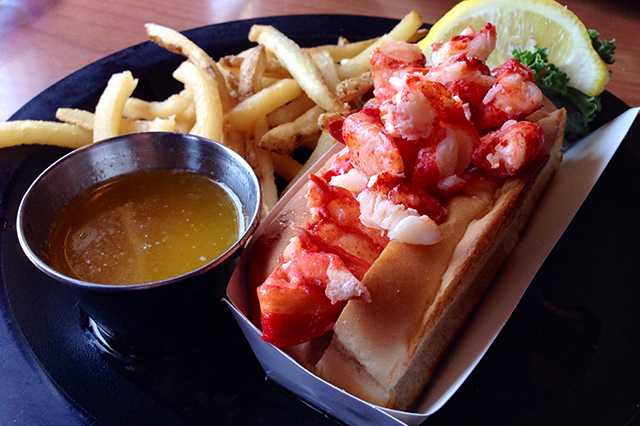
Based on the results of our Northeast Food Fight, the cold, Maine-style lobster salad roll is a resounding favorite. Some will add celery, lettuce and other seasonings to the mix, but purists believe that nothing should come between fresh lobster meat and mayo.

If you are driving through Connecticut and stop at one of the many lobster huts along the shoreline, you are more likely to find a hot buttery Connecticut lobster roll.

If you’re lucky, you may find a spot that serves both and you can decide which option you like better – if your mind isn’t made up already.

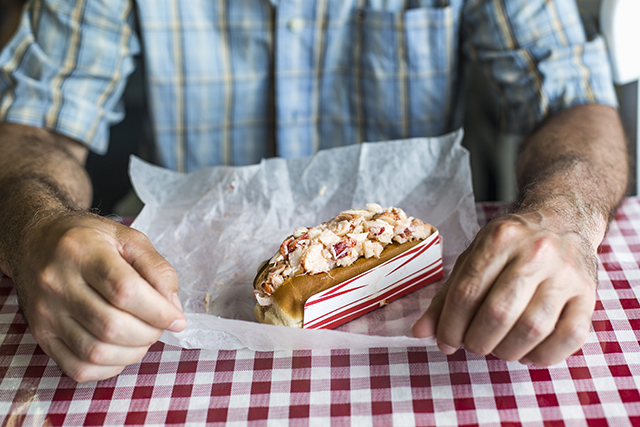
One thing remains consistent among all bona fide lobster rolls – the roll needs to be a split-top, New England hot dog bun.

Find a Lobster Roll Near You

McLoons Lobster Shack
South Thomaston, Maine

If you want to try both types of lobster rolls, take a drive up Interstate 95 to the small coastal town of South Thomaston. Head out to Spruce Head Island and you will find McLoons Lobster Shack, where you can get half mayo and half butter on one roll. This family-owned lobster shack is set near one of the area’s oldest wharfs, where you can sit out and watch the lobster fishermen pull in their catch of the day.

Arnold’s Lobster and Clam Bar
Eastham, Mass.

It wouldn’t be a proper Cape Cod road trip without a lobster roll. Named one of the best lobster rolls in Cape Cod, Arnold’s Lobster and Clam Bar offers both cold and warm lobster rolls in regular or jumbo size. Both are served with a side of famous Cape Cod potato chips made just down the street in Hyannis. After having a bite to eat, you can grab a famous Arnold’s ice cream and play a round at Arnold’s Mini Golf.

new england food

Easton’s Beach Snack Bar
Newport, R.I.

Easton’s serves all of the beach snack favorites, from burgers to fried seafood, but it’s known for its twin lobster salad rolls and buttered lobster rolls made with claw and tail meat. Take your meal out to the patio, which overlooks the beach, the Cliff Walk and the Newport mansions.

Captain Scott’s Lobster Dock
New London, Conn.

This quintessential lobster hut on a quiet marina gives you the chance to try both lobster roll styles while watching fishing boats coming in and out of the harbor. While you’re comparing rolls from different areas of the Northeast, why not try the New England and Rhode Island clam chowders, too, and have a full taste test.

Seven Seas Restaurant
Milford, Conn.

Seven Seas is known locally as one of the first places to serve a hot lobster roll. The hot buttered roll originated in Milford in 1929 at a restaurant called Perry’s that no longer exists, according to the Encyclopedia of American Food and Drink.

instagrammable foods
The Shelly at New York City’s North River Lobster Company.

North River Lobster Company
New York City

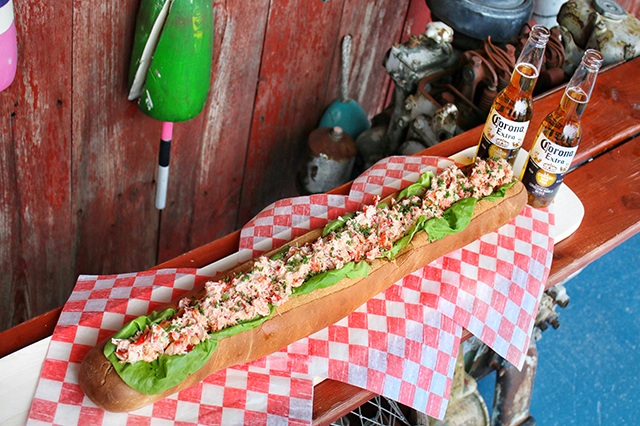
Is there a better place to eat a lobster roll than on a boat? Located on the Hudson River and 41st Street at Pier 81, you can hop aboard and sail up the Hudson while enjoying North River’s 28-inch classic lobster roll, The Shelly. At 28 inches (!), it’s oh-so  sharable and very Instagrammable. The restaurant serves other varieties of the classic roll, including one with bacon, one tossed with truffle mayo, and one sprinkled with “everything” seasoning.

Lobster Roll Recipes

Want to host a lobster roll tasting party at home? All you need is enough split-top hot dog buns for everyone and a few lobsters. If you want to make it Maine-style, try this recipe from AAA Five Diamond Designated topper’s at The Wauwinet in Massachusetts.

If Connecticut-style is more up your alley, saute salted butter and lobster in a pan until it is cooked through. Toast your roll and you’re ready for a feast.

What is your go-to lobster roll spot? Tell us in the comments.

Subscribe to Your AAA Newsletter

Sign up and receive updates for all of the latest articles on automotive, travel, money, lifestyle and so much more!

Thinking of Buying a Tesla? Here’s What You Should Know

Electric vehicles are getting more popular by the day. BY some estimates, roughly half of all new cars sales by 2035 could be electric vehicles. And, by a wide margin, no other manufacturer has sold more EVs than Tesla.

While that alone might be enough to convince some buyers, there are some particularities about the cars that prospective owners should be aware of.

Here is everything you should know before buying a Tesla.

Tesla Models

There are currently four Tesla models available for purchase today: S, 3, X and Y. The former two are sedans while the latter pair are SUVs. All models come in a Performance trim level and a less-expensive Long Range model.

Tesla Model S

The Model S was introduced in 2012 and has been a market leader ever since. As of 2019, it has an EPA range of 375 miles, one of the longest of any electric vehicle. It features all-wheel drive and the ability to reach 0-60 mph in just 3.1 seconds. Tesla claims it is the quickest four-door sedan ever built.

Inside has seating for five adults and 28 cubic feet of storage. (Remember: without an engine, the front trunk becomes a cargo space). The interior also features a 17-inch center touchscreen that integrates media, navigation, communications, cabin control and vehicle data. Many functions are voice-activated to focus the driver’s attention on the road.

Tesla Model 3

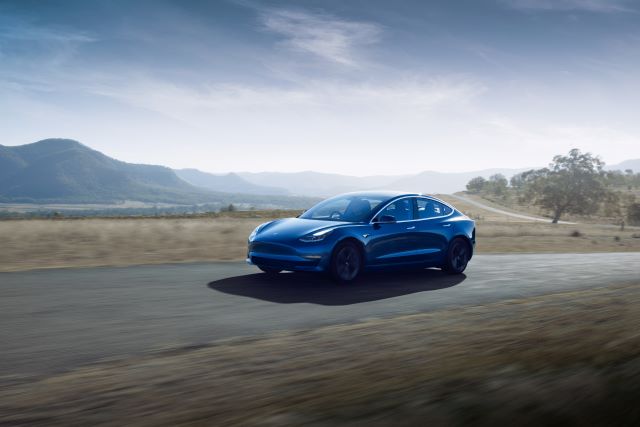
Tesla began producing this car in 2017. The sedan is similar to the Model S, except slightly smaller. It also has a shorter range (a maximum of 334 miles), smaller touchscreen and less of the Model S’s bells and whistles.

The most notable difference for potential consumers however, will be the price tag. At a starting retail price below $40,000, it is Tesla’s most affordable vehicle in its lineup. (The S can easily cost more than double). Due in part to its price, the Model 3 has been one of the top-selling electric vehicles in recent years.

Tesla Model X

The first SUV in Tesla’s lineup has some distinguishing features other than its larger size. Most notable are the rear Falcon Wing doors. These doors are hinged at the roof instead of the side. This allows for much easier entry and exit to the second — and third — row of seats inside the vehicle. It also has a windshield that stretches up and over the two front seats, providing riders a panoramic view of their surroundings.

The SUV has a top range of 330-mile range and 5,000-pound towing capacity. But with a starting price in the six-figures, it is Tesla’s most expensive vehicle.

Tesla Model Y

To give its customers a more reasonably priced SUV option, Tesla unveiled the Model X in 2020. With a starting price of $69,990, it’s roughly half the cost of the Model Y, while still boasting an impressive 318-mile range.

The Model Y comes equipped with 76 cubic feet of storage room and an optional third row of seats, creating room for up to seven passengers. Inside, there’s a 15-inch touchscreen and expansive all-glass roof.

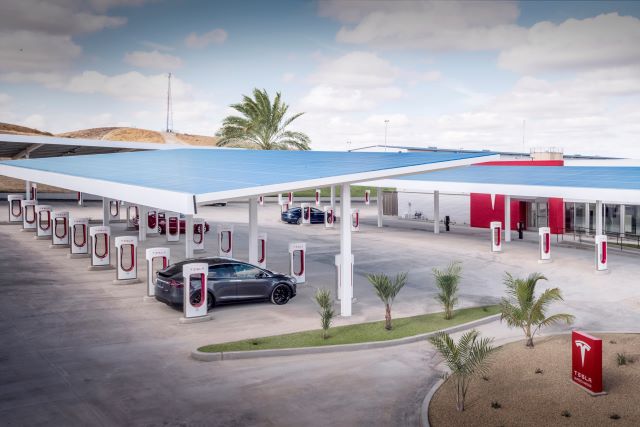
tesla charging station

Charging a Tesla

A Tesla vehicle can be charged anywhere there is an outlet. The cars come standard with a mobile connector (with adapters available for purchase) in order to use any electrical sources available.

Owners can use the mobile connector at home. However, this method is rather slow. Using a traditional household outlet, only two or three miles of range will be added per hour. Tesla recommends installing a wall connector for at-home use. These devices can deliver up to 44 miles of range per hour. An electrician or Tesla installation service is needed to install the wall connector. If traveling, drivers can charge the car’s battery at one of hundreds of private locations, such as hotels and restaurants, that have Tesla charging stations available.

The final charging option is unique to Tesla: Supercharging. Designed and built by Tesla, Superchargers are substantially more powerful than any other charging method. They are capable of replenishing half of a battery’s charge in roughly 30 minutes. There are more than 35,000 stations around the world, strategically placed along well-traveled routes.

Regardless of your charging method, the Tesla App allows you to monitor your charging status and receive charging-complete notifications.

Safety

All three Tesla models have received five-star safety ratings from the National Highway Traffic Safety Administration. New vehicles come standard with active safety features. These include automatic emergency braking, collision warning, side collision warning, blind spot monitoring and lane departure avoidance.

Additionally, as with all electric vehicles, Teslas have their batteries located on the floor of the vehicle. This creates a low center of gravity that improves stability and reduces the chance of a rollover.

Autopilot

Some safety concerns have come up regarding Tesla’s Autopilot system. This automated technology uses cameras and radar to create a suite of features to help in driving, such as cruise control and automatic steering. It is classified as a Level 2 automated system, according to the U.S. Department of Transportation. Vehicles reach this level, also known as partial automation, when they have combined automated functions, such as steering and acceleration.

When used properly, this technology can add an additional layer of safety. However, like all autonomous vehicle technology, Autopilot is not a self-driving system. A driver still must always be behind the wheel, remain engaged and be prepared to take over at any time.

Convinced on buying a Tesla? Make sure to finance your new car purchase with AAA.

Visit AAA’s Electric Vehicle platform for more information on these cars of the future.

Subscribe to Your AAA Newsletter

Sign up and receive updates for all of the latest articles on automotive, travel, money, lifestyle and so much more!

What Is the Difference Between a Crossover and a SUV?

While the sight and name of crossovers may be ubiquitous, their defining characteristics may be a little more difficult to ascertain.

Crossover, Crossover SUV, CUV, Compact SUV. Whatever you want to call it, this class of vehicles is taking over U.S. roadways. Some studies show crossovers account for nearly 40% of the cars on the road. Furthermore, nearly half of all new cars produced by major manufactures fall into the crossover designation.

In the spectrum between sedans and SUVs, crossovers appear to be closer to the latter, larger in size and boasting a higher ground clearance. But at what point does a crossover become a SUV? Car manufacturers have further muddled the distinction between the two vehicle classes by using these terms liberally.

So, what is the difference between a crossover and a SUV?

Construction

The most definable difference between a crossover and a SUV is in their bones. Crossovers are based on a car’s platform and boast a unibody construction. This means the body and frame are one structure. This type of construction is more cost-efficient and produces a lighter and more spacious vehicle. Unibody cars also tend to be safer due to their built-in crumple zones.

SUVs are based on a truck’s platform and built through body-on-frame construction. This method is how all cars were built back in the day. It involves mounting a separate bodywork unit to a vehicle’s frame. Body-on-frame construction produces qualities useful in heavy-duty and off-road vehicles, including greater torsional flexing and a more rigid platform that allows for increased hauling and towing.

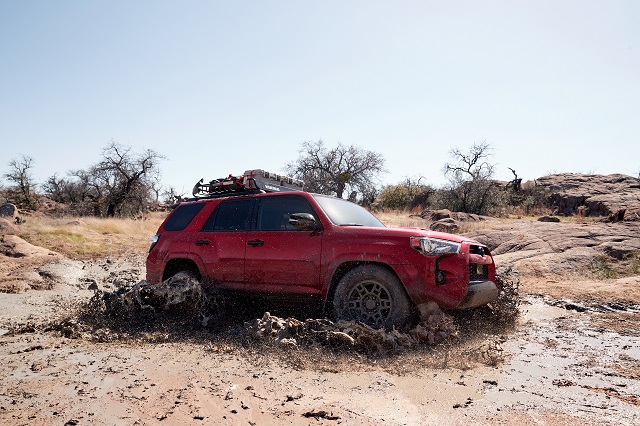
Thanks to its part-time four-wheel drive system, the Toyota 4Runner SUV can get out of some sticky situations.

Drivetrain

Almost all SUVs can be equipped with full and/or part-time four-wheel drive, as opposed to the two-wheel drive found in crossovers. In a four-wheel drive system, the front and rear driveshafts are locked together, causing them to spin at the same speed. This creates more traction, allowing SUVs to overcome challenging terrain and difficult conditions.

Four-wheel drive systems commonly have low and high ranges that can be selected by the driver. The former provides more traction on off-road conditions like mud, sand and steep hills, while the latter helps traverse slippery road conditions like ice and snow.

Engine

Another definable difference between a crossover and a SUV can be found under the hood. The former will have a four-cylinder engine. Most SUVs, however, come with a V6 (or six-cylinder) engine. Some may even have a V8. These larger engines provide the power SUVs need.

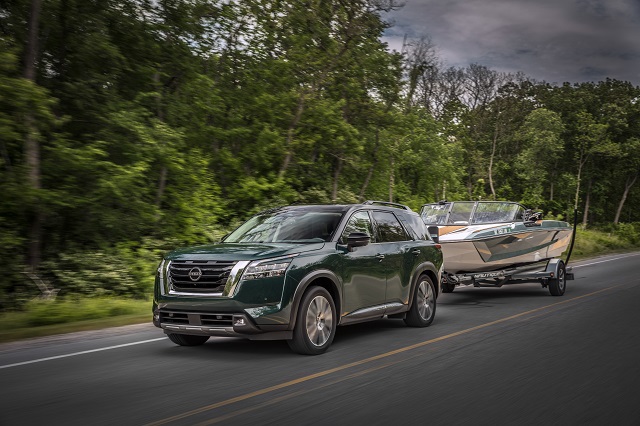
With engines producing more power and torque, SUVs like the Nissan Pathfinder are capable of towing heavier loads.

Towing and Hauling

SUVs generally have a higher towing capacity than crossovers. Some can even tow similar weights to that of pickup trucks. The increased superior capability is the product of engines that produce more torque, which is needed to get the car in motion.

Greater torque also means SUVs are able to haul more weight. This is also aided by the vehicles’ larger size and stronger body.

Fuel Efficiency

The larger engine found in an SUV provides more power, but generating that power requires more energy. As such, SUV use more fuel and are less fuel efficient than crossovers. Crossovers are also smaller and lighter, which helps improve their fuel efficiency.

Visit AAA.com to learn more about all things cars and trucks.

In the market for a new vehicle? Start by downloading our free Car Buying Guide, which includes tips on navigating every step of the process.

Subscribe to Your AAA Newsletter

Sign up and receive updates for all of the latest articles on automotive, travel, money, lifestyle and so much more!

Embrace the Music of the Mountains

There’s a place where music moves mountains.

Within the towns that line the mountains and foothills of North Carolina, visitors are invited to hear the traditional sounds of music handed down from families and communities, as well as new musicians that have flocked to the region. This is the land of the Blue Ridge Music Trails of North Carolina.

Here they’ve made it easy to find the music, curating events and day trips that will encourage you to dance, listen, watch and most certainly join in. These are just some of the highlights you can expect to find along the way.

Black Mountain

Nicknamed “The Little Town that Rocks,” charming Black Mountain is 15 minutes east of Asheville and surrounded by its namesake mountain range. It boasts unique shops and art galleries and a creative vibe.

A can’t miss stop on the Blue Ridge Music Trails, the White Horse Black Mountain is a renovated 1940s car dealership that is now an arts venue serving beer, wine and snacks. All types of artists can be heard here beyond the local flavor, even traditional Irish musicians. Tuesdays are especially fun as it is open mic night.

Live music and local, hand-crafted, certified organic beer can be enjoyed at Pisgah Brewing Company. Its free Sunday Jam Hosted by Spiro and Friends welcomes all ages for an outdoor evening of music in which bringing your own instrument is encouraged.

blue ridge music trails
Asheville Jazz Orchestra at White Horse Black Mountain. (Credit: Emma Anixter)

Other free and ticketed events offer a range of musical styles. If you’re visiting in the summer, Park Rhythms at Veterans Park is a free live concert series with a variety of musical genres that takes place Thursday evenings, June through August.

In May and October, the weekend-long LEAF Festival (formerly the Lake Eden Arts Festival) celebrates art, music and culture at the site of historic Black Mountain College. This year on October 20-23, the LEAF Festival is celebrating its 50th anniversary with multiple performance stages and artists, a family adventure village, art and culinary vendors and more.

Book a hotel in Black Mountain.

blue ridge music trails
Traditional musicians play outside Sparta’s quaint shops along Main Street. (Credit: Dave Russo)

Sparta


Just south of the Blue Ridge Parkway, Sparta is another small town worthy of a road trip for music lovers.

The Allegany Jubilee, set in a former historic movie theater, invites you to “clog, square dance or just tap your foot to old time mountain music” on its dance floor on Tuesday nights for a Hillbilly Hoedown with the Rise and Shine Band, and on Saturday nights with bands that change weekly.

Look for live music events on Main Street through the Alleghany Arts Council. May through December, Saturdays in ‘SpARTa’ offers music, art and more. Other spots to listen to live music include Muddy Creek Café & Music Hall and Laconia Ale Works.

As you explore the Blue Ridge Music trails, combine your visit to Sparta with a stop at the Blue Ridge Music Center, 30 minutes along the Blue Ridge Parkway near the North Carolina/Virginia state line. Open May through October, it offers daily free “Midday Mountain Music” from noon to 4 p.m. featuring local and regional musicians, as well as ticketed Saturday night concerts. The music continues year-round regionally with the Center’s “On the Road” series.

Discover more about the region’s musical heritage and get a chance to mix your own mountain music on-site at the Blue Ridge Music Center’s Roots of American Music Museum exhibition. The Center’s two hiking trails (one easy, one moderate) can get you singing on your own while discovering the area’s natural beauty.

Book a hotel in Sparta.

Waynesville

For more musical adventures, drive about 40 minutes west of Asheville to Waynesville, one of the largest towns in Western North Carolina.

First, explore the shops, restaurants and art galleries of downtown and Main Street. Schedule your visit to be a part of a mountain hoedown tradition that has been going strong for almost a century during the Waynesville Street Dance. Main Street transforms for this event, which takes place four times from June through August and features bluegrass musicians, bands and clogging teams. The most fun of the event is when you join in to dance with the locals.

For live music from spring to fall, Frog Level Brewing in downtown offers an outdoor beer garden and music venue set on a scenic creek.

The 16th Annual Music at the Mill is slated for Sept. 10, 2022, at the Francis Grist Mill, which dates to 1887 and is on the National Register of Historic Places. The annual event celebrates Western North Carolina bluegrass and barbecue. Bring a lawn chair to relax and enjoy the regional sounds. There will also be crafts and a milling demonstration.

Not too far from Waynesville, the Stompin’ Ground in Maggie Valley is one big dance party on Saturday nights from May through October. Participate or simply watch the high-energy line dancing, square dancing, clogging and two-step dancers and listen to the lively mountain and country music.

Book a hotel in Waynesville.

Does a trip to the Blue Ridge Music Trails of North Carolina sound like your kind of road trip? Tell us in the comments.

Plan your next vacation with AAA Travel.

Featured image: Aerial view of the town of Black Mountain. (Credit: Visit NC)

Subscribe to Your AAA Newsletter

Sign up and receive updates for all of the latest articles on automotive, travel, money, lifestyle and so much more!

5 Ways to Soak Up Burlington’s Good Vibes

Long known as a bastion of revolutionaries and free-thinkers, Burlington, Vt., proudly flaunts its independent bearings and live-and-let-live attitude. Visitors will find plenty of cultural attractions and outdoor fun in the state’s most populous city that also serves as a hip, laid-back college town ringed by Lake Champlain and mountains.

Eat

Shake off the sleepies with a nitro cold brew and breakfast sandwich at Kru Coffee. For a light lunch, try the freshly squeezed juices, bowls and salads at Thorn & Roots. Dinnertime
is best savored at Juniper in Hotel Vermont, which serves veggie-forward fare. Sample the local cider at Citizen Cider, with small bites like burgers and mac ’n’ cheese.

Bike

Cyclists will find no shortage of routes to explore. Many hotels offer bikes to their guests for touring the city. Head to the Burlington Greenway for 7-plus miles of paved trail winding its way along Lake Champlain. (Go early for fewer crowds.) Shops like Outdoor Gear Exchange, North Star Sports and Local Motion all offer rentals.

Hike

For amazing views of the Adirondacks and surrounding valley, venture south to Mount Philo State Park in nearby Charlotte. Climb 968 feet to the peak for amazing
views; the nearly 1-mile route up is doable for most. There’s plenty of seating at the summit, including Adirondack chairs, for taking in the gorgeous scenery.

Sail

Cool off on the lake with a narrated cruise on the Spirit of Ethan Allen, where you’ll hear tales of Champ the lake monster, the region’s history, shipwrecks and more. The
ship offers food service and a full bar. There are three sailings daily through October, as well as sunset, brunch and dinner cruises.

Shop

Take a stroll through the pedestrian Church Street Marketplace for all your shopping pleasures. The beautifully manicured pedestrian mall is lined with historic buildings and bustling shops and eateries. Don’t leave without visiting Lake Champlain Chocolates to indulge in locally made confections and ice cream.

Plan a trip to Burlington with a AAA travel advisor.

Subscribe to Your AAA Newsletter

Sign up and receive updates for all of the latest articles on automotive, travel, money, lifestyle and so much more!

World’s Top Places to See Animals

During the height of the pandemic, many of us truly learned the unspoken value of our furry companions. With just a pet, or a nuzzle, or a soft, warm purr, they soothed our souls and helped us experience the bliss of unconditional love in a world filled with chaos.

Luckily for us pet lovers, there’s an entire world of animals in their natural habitats just waiting to be explored. Whether you love critters soft and
diminutive, scaly and towering, or winged and clawed, you’re bound to find some vacation-worthy destinations on our list of some of the world’s top places to see animals.

Galapagos Islands

Home to penguins, giant tortoises, blue-footed boobies, sea lions, exotic birds and myriad forms of sea life, these islands 600 miles off the coast of Ecuador were first made famous by Charles Darwin. He used the islands as a natural lab during his 1835 visit, which culminated in his theory of natural selection detailed in “On the Origin of Species.” And oh, the species you can see. The islands, a UNESCO World Heritage site, are famous for biodiversity, the sheer number of animals, and for their protected landscapes.

Animal Magnetism

Costa Rica

The topography of this Central American country is just one reason for its rich mix of flora and fauna. Here, volcanoes flirt with the Pacific and Caribbean oceans, jungles and rainforests. There’s no shortage of howler monkeys, sloths, macaws and various species of birds in the country’s many conserved areas. More than 25% of Costa Rica is protected from development, with 28 national parks and 58 wildlife refuges. Manuel Antonio and Corcovado national parks are two of the most popular. And bonus: You may spot an elusive jaguar at Corcovado.


Africa

Check out Nairobi, Kenya, if you want to see the “big five” safari animals: lions, leopards, black rhinos, African bush elephants and African buffaloes. Kenya’s capital is the self-declared safari capital of the world, and the country itself is home to more than 50 national parks and reserves. For a once-in- a-lifetime experience, take a gorilla trek through Uganda’s Bwindi Impenetrable National Park. The muddy journey is arduous, wet and challenging, but the chance to see a mountain gorilla in its natural setting will be a sight you’ll never forget.

Animal Magnetism

Australia


Australia is home to some of the world’s most adorable – and terrifying – creatures. Here, koalas, kangaroos and echidnas abound, though so do many deadly snakes, huntsman spiders (Google it if you dare) and the box jellyfish. Head to Maria Island, a wildlife sanctuary in Tasmania, if you want the chance to see wombats wandering at dusk or a Tasmanian devil in the wild. You’ll find plenty of koalas at Tucki Tucki nature preserve in New South Wales, and Murramarang National Park and the neighboring areas are popular hangouts for the country’s most well-known critter.

U.S. National Parks

Of course, you don’t have to travel the globe to see spectacular animals; just head to one of our many national parks to catch a glimpse of nature’s majesty. Visit Yellowstone National Park to see where the bison, elk and grizzly bears roam, along with coyotes, gray wolves, bald eagles and wolverines. If you like the life aquatic, Alaska’s Glacier Bay National Park is a superb site to go whale-watching and glimpse sea otters, harbor seals and puffins. You’ll find the “big five” – caribou, moose, Dall sheep, wolves, and grizzly bears – at Alaska’s Denali National Park, while exotic creatures like alligators, crocodiles, manatees, Florida panthers, flamingoes and bobcats all inhabit Everglades National Park in Florida. (They may be beautiful, but please remember to give these majestic animals their space.)

Want to plan your very own animal adventure? Turn to a trusted AAA travel advisor with all your questions. AAA.com/TravelAgents.

Subscribe to Your AAA Newsletter

Sign up and receive updates for all of the latest articles on automotive, travel, money, lifestyle and so much more!

Diamond Dish: Jaleo

Diamond DesignationThree Diamond (Trendy food skillfully presented in a remarkable setting. Learn more about AAA Diamonds.)

Location: Multiple locations.

Serving an extensive list of tapas, paellas and other Spanish staples in a lively and colorful atmosphere, Jaleo brings a taste of Spain to some of the country’s most popular cities and vacation destinations. The first of chef José Andrés restaurants, Jaleo opened in Washington, D.C., in 1993, and has expanded to Las Vegas, Disney Springs and most recently, Chicago.

Andrés is credited with helping to launch the popularity of small plates restaurants in America with Jaleo and has since spearheaded a restaurant group of over 30 restaurants spanning cuisines and price points, from food trucks to signature sit-downs. In recent years, he has become just as recognized for his humanitarian work, providing fresh meals to communities around the world affected by disaster through his charity World Central Kitchen.

Jaleo’s menu is composed of refined and creative spins on dishes inspired by Andrés’ childhood in Spain, like the signature Tortilla Española, a simple potato and egg omelet, which Andrés has called “the most important dish in Spanish cooking.” Try it at one of Jaleo’s four locations or make it at home with this recipe provided by the restaurant.

Tortilla Española

Serves four

• 2 cups, plus 2 tablespoons Spanish extra virgin olive oil
• 1 pound russet potatoes, peeled and diced into ½-inch cubes
• 6 large eggs
• Sea salt, to taste

Start by frying the potatoes: Heat 2 cups of the olive oil in a medium pot over medium-low heat until it reaches 250° F on a candy thermometer. Slowly fry the potatoes until golden brown, about 20 minutes. Drain the potatoes on paper towels.

Using an electric mixer or whisk, vigorously beat the eggs in a large bowl with 1 teaspoon of salt until they’re foamy. Add the cooked potatoes to the beaten eggs and let sit for 1 minute.

Heat the remaining 2 tablespoons of olive oil in a 6-inch sauté pan over high heat. Once the pan begins to smoke slightly, remove from the heat and pour in the egg-potato mixture. Return the sauté pan to the stove top and reduce the heat to low. The tortilla should puff up like a soufflé. Once it begins to set and the edges turn golden brown, place a plate over the pan and flip the pan and plate together so the tortilla ends up on the plate, uncooked side down. Slide the tortilla back into the pan, uncooked side down.

Make a small hole in the center of the tortilla to allow the egg in the center to cook. Once the tortilla sets, carefully flip the tortilla back over and allow the center hole to close.

Transfer the tortilla to a platter, season with salt and cut into wedges to serve.

Check out more recipes from your favorite local restaurants! AAA.com/DiamondDish.

Subscribe to Your AAA Newsletter

Sign up and receive updates for all of the latest articles on automotive, travel, money, lifestyle and so much more!

Diamond Dish: Red Rooster Harlem

Diamond Designation: Three Diamond (Trendy food skillfully presented in a remarkable setting. Learn more about AAA Diamonds.)

Location: New York, N.Y.

Red Rooster Harlem blends food, art and music to capture the spirit of its neighborhood. The menu features American comforts like shrimp and grits over tomato-okra stew, steak frites with chimichurri and barbecue bearnaise and a lobster roll. The star, however, is the fried yardbird. Classic chicken shake or hot honey-style, it can be ordered by the piece, or as a 20-piece “chicken tower” with cornbread and three sides ($120).

“Sometimes you put a dish on the menu to try it out, and it takes over. You find out when you take it off the menu and there’s a chorus of disappointed voices, that dish
has become a classic,” said chef and owner Marcus Samuelsson.

Samuelsson, who is known for his television appearances as well as restaurants across the country and abroad, is also a Harlem resident and advocate for the community. This is evident in everything from the local art displayed on Red Rooster’s walls to the live music that plays during brunch and at Ginny’s Supper Club,
the 1920’s-style speakeasy in the basement.

Fried Yardbird With Chicken Shake

Serves four

Chicken Shake
• ¼ cup berbere spice
• ¼ cup hot smoked paprika
• 2 tablespoons ground cumin
• 2 tablespoons freshly ground white pepper
• 2 tablespoons celery salt
• 1 ½ teaspoons granulated garlic
• 1 ½ teaspoons coarse kosher salt

Yardbird
• 8 cups water
• 1 cup coarse kosher salt
• 4 chicken thighs
• 4 chicken drumsticks
• 2 cups buttermilk
• ¾ cup coconut milk
• 2 garlic cloves, minced
• 1 tablespoon chicken shake, plus additional for serving
• Peanut oil for frying
• 2 cups all-purpose flour
• ¼ cup semolina flour
• 2 tablespoons cornstarch
• 1 tablespoon freshly ground white pepper

To make the chicken shake:

Whisk together all ingredients. Store in a jar, out of the light. Recipe makes about 1 cup and will keep for 6 months.

To make the yardbird:

Put 2 cups of water and salt in a saucepan over high heat and bring to a simmer, stirring to dissolve the salt. Pour into a large container. Add remaining 6 cups of water and cool to room temperature. Add chicken, cover and refrigerate for 1 hour. Drain.

Whisk buttermilk, coconut milk, garlic and chicken shake together in a 9-by-13-inch baking dish. Submerge chicken in the marinade, cover
and refrigerate overnight.

Fill a large saucepan 1/3 of the way up with peanut oil. Heat to 360°F. While oil heats, coat the chicken. Put flour, semolina, cornstarch and white pepper into a bowl and whisk to combine. Let excess marinade drip off chicken, then roll it in flour coating. Place on a rack set over a baking sheet. If coating looks damp, roll in flour again.

In batches, fry the chicken until it’s a rich brown with an internal temp of 165°F (10 minutes per batch). Keep oil 350° to 375°F. Drain on rack over a baking sheet. Season with a sprinkle of chicken shake.

Get more recipes. AAA.com/DiamondDish.

Subscribe to Your AAA Newsletter

Sign up and receive updates for all of the latest articles on automotive, travel, money, lifestyle and so much more!