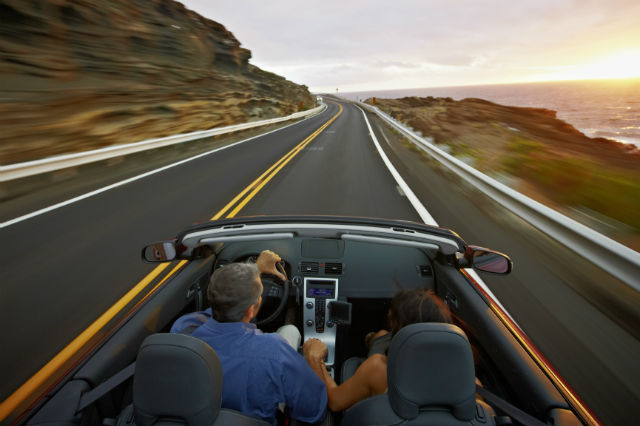
Catherine and John Devine of Norwalk, Conn., were looking for a new travel experience related to their Irish ancestry.
And since their daughter Kimberly was studying at the University of York in England for a semester abroad, a vacation in Ireland just made too much sense.
But a key question loomed: How should the three of them spend time together in the Emerald Isle? AAA travel agent Jennifer Kalotai blazed the trail by doing extensive research to help the Devines tailor a vacation to meet their multi-generational needs.
“Ireland appeals to all ages,” said Catherine. “And from start to finish, Jennifer kept us well informed.”
And so began the family’s nine-day Irish Gold tour with C-I-E Tours International.
Even though the spring weather didn’t always cooperate, the Devines made the most of of their time on the tour, shrugging off cold temperatures and rain to trace a rainbow from Dublin to Galway and back again.
“My husband and I particularly enjoyed seeing Clonmacnoise with its Celtic crosses and hearing the history of the settlement,” said Catherine.
But one spot had a special resonance for the Devines: The soaring heights and breathtaking ocean views at the Cliffs of Moher. Not only was the weather beautiful and the scenery breathtaking that day, the Cliffs offered a cinematically inspired moment the family won’t soon forget.
“It’s the site of a scene in one of our favorite family movies – the Cliffs of Insanity from the movie ‘The Princess Bride,'” said Devine. “Standing that high up with the gorgeous blue sky above and the blue waterway below was such a memorable moment for us.”
Jack Reed, the senior United States Senator from Rhode Island, sat down with Lloyd Albert, senior vice president of public and governmental affairs at AAA Northeast, for a wide-ranging discussion on transportation, infrastructure, the COVID-19 pandemic and the current state of America’s political process.
President Joe Biden has wasted little time pushing for an accelerated adoption of electric vehicles. (In January, he announced the government’s fleet vehicles will be replaced with electric cars.) The need for greener vehicles is one Senator Reed endorses and he is confident consumers’ demands will be the leading driver is this transition. “One of the things that’s encouraging is that it will be a market transformation. It won’t be some kind of command decision,” Reed said. “The automobile companies are looking ahead and they’re trying to maximize profit and cater to their consumers and they see this coming.”
It’s easy to get caught up in the benefits of green technology without fully considering the possible drawbacks, the senator reminded. “I’m told it takes fewer people to build an electric car and I’m told it takes fewer people to maintain an electric car. That falls over to a problem we have as government: ‘How do you replace those good jobs?’ As we’re looking at this electric revolution, we also have to look at some of the consequences.”
America’s crumbling roads and bridges have been a topic of conversation for years. The most recent analysis by the American Society of Civil Engineers gave these categories a D and C+, respectively. The need for a large infrastructure investment is evident and though such a package has been discussed repeatedly, it has yet to come to fruition. “We do have to have a big infrastructure package,” Reed said. “We’ve been working at it slowly but we do need a bigger, more intense program.”
The senator, a member of the Senate Appropriations Committee that writes legislation dictating how federal funds will be allocated, hope that recent events, including infrastructure failures in Texas, will spur on this vital work. “The appealing part about it is that everyone understands that it’s not a regional issue, it’s not an issue for the Northeast, it’s everywhere. “I think we’ll try to work off that common feeling and start delivering real solid progress. The other point in developing infrastructure is that it puts people to work and we’re concerned about keeping employment up particularly.”
Any legislation addressing these issues will likely require a significant amount of bipartisan approval, something that has been very difficult to come by in Washington in recent years. But, while admitting it’s too early to say for certain, Senator Reed is hopeful for a changing of the tide. “What I sense, and what I think we’re going to work toward, is that middle ground. We have to work for that middle ground,” he said. “It’s early. We’ll know more in a few weeks when we start tackling the big infrastructure program.”
It seems that with every passing week, another major auto manufacturer announces bold new plans for its line of electric vehicles. Most recently, the headlines have come from Toyota, the world’s leading automaker, and the luxury UK-based company Jaguar Land Rover.
Earlier this month, Toyota unveiled its plan to debut two battery electric vehicles (BEVs) by the end of 2021. These will be the first mass-market BEVs the company has sold in the United States. The Japanese marque is one of the last major car manufacturers to offer all-electric vehicles. Instead, Toyota has focused on, and dominated, the hybrid market beginning with the release of the Prius nearly 25 years ago. According to the company, it has over a 40% share of the total alternative fuel vehicle market, including a 75% share of the fuel cell market and a 64% share of hybrids and plug-ins.
“We continue to be leaders in electrification that began with our pioneering introduction of the Prius nearly 25 years ago,” said Bob Carter, TMNA executive vice president of sales. “Toyota’s new electrified product offerings will give customers multiple choices of powertrain that best suits their needs.”
Jaguar Land Rover, meanwhile, announced that its Jaguar lineup will be all electric by 2025. The automaker isn’t the first to make such an announcement but’s timeline is by far the most ambitious. Other car companies have given themselves an additional decade of time to make the all-electric transition. While Jaguar’s limited number of models will make the move easier, it currently only sells one BEV: the Jaguar I-Pace SUV.
It’s critical to know the rules of the road before you get behind the wheel of a car. But for most of us, it’s been a long time since we sat for our driver’s license exam. It’s likely we forget – or maybe never even learned – some of them. To see how well you know your driving laws, take our rules of the road quiz below and let us know how you do!
Unless otherwise stated, all questions refer to driving laws in the six states in AAA Northeast’s territory: Connecticut, Massachusetts, New Hampshire, New Jersey, New York and Rhode Island. Similarly, all mentions of the term “Northeast states” refer to the aforementioned six states.
*In New Jersey and Rhode Island, headlights are required to be on from sunset to sunrise. ^In New Hampshire, the age limit is 7 #New York has no such law while New Jersey’s ban only applies to those with a learner’s examination permit. All Northeast states ban handheld cell phones and texting while driving for ALL drivers. **In New Jersey, the property damage threshold is $500 ^^In New Jersey, the requirement is 20/50
Whether you’re just beginning your driving career or are a long-time driver looking to improve your skills, AAA has you covered. Learn more about our Driver Training program and Defensive Driving courses.
Fashion trends come and go, but some will be remembered for years to come. See if your favorite styles made it into our new crossword.
Here are some tips to help you get the most out of your puzzle playing experience. Good luck!
Since our members are the root of everything we do, your feedback is important to us. Let us know if you run into any issues while playing, or share your ideas for future puzzles by emailing us.
All grandparents want the best for their grandkids and a big part of that is ensuring they’re set up financially. But with various laws, regulations and taxes to consider, it’s not always as simple as writing a check.
Fortunately, there are numerous methods and tools for grandparents to give money to their grandkids. Learn about some of the most popular and discover which one is right for you.
Open a Savings Account
An easy and effective way to put money aside for your grandchild is funding a savings account for them. Putting money in an account when they’re still young allows the funds to grow for decades.
This is also a good way to teach your grandchild about saving, allowing them to watch the savings grow over the years.
Start a 529 plan
A 529 plan is a popular tool to assist in paying for a grandchild’s higher education. These savings accounts are opened in the child’s name but anyone can contribute to them.
The earnings in a 529 plan accumulate tax-free and no taxes are applied when the funds are withdrawn so long as the money is used for school expenses, such as tuition, fees, books and supplies. Additionally, a state tax credit or deduction is usually given to any individual who contributes to the plan.
Contribute to Their Retirement Plan
If your grandchild is older and has begun working, consider helping them out by padding their retirement account. Any person who’s earned income – even if it’s just a summer job – can open an individual retirement account. (If your grandchild is a minor, you’ll need to open a custodial IRA for them.)
You may also be interested in a Roth IRA. Funds are taxed as they are contributed to a Roth IRA, but once there, the money grows tax-free. Funding such an account when your grandchild is just entering the workforce could be an especially good idea. At this stage in their career, they’re likely not being taxed heavily and can allow the funds to grow for decades.
Utilize a UGMA/UTMA Account
The Uniform Gifts to Minors Act and Uniform Transfer to Minors Act allow individuals to give or transfer assets to underage beneficiaries. These are custodial accounts in which the assets are held in the minor’s name. This eliminates the cost and time that comes with establishing a traditional trust fund.
There are pros and cons that come with the UGMA/UTMA. Because these accounts are in the grandchild’s name, any contributions are irrevocable. Additionally, because the account is treated as the grandchild’s asset, it could impact their federal financial aid.
On the other hand, any earnings the account accumulates are tax-free up to a certain amount and while donors don’t receive a tax deduction, up to $15,000 can be given free of federal gift taxes per individual per year. Furthermore, unlike a 529 plan, there is no penalty if the funds are not used for schooling. Once handed over to the grandchild, the account’s assets can be used for anything.
Write Them Into Your Will
Although not the cheeriest task, writing a will is an effective tool for giving money to grandkids and the only way to ensure your assets go to the individuals you want to receive them. Without one, you’ll have no control over who gets what. The advantage of a will is that it won’t affect your retirement savings the way other accounts may. If you’ve put aside money for your grandchildren through other means and an unexpected cost comes up, you may not be able to get that money back without a penalty or at all.
A will also allows you to provide instructions on how the assets should be distributed. For example, you can state that your grandchild not receive an inheritance until they turn 18.
Introduce Them to a Financial Planner
If you don’t have the means to pass down money to your grandchildren – or even if you do – the best gift may be knowledge. They can learn a substantial amount in just a few hours of speaking with a professional financial advisor. Now your grandchildren know the best ways to save money themselves. This can give them a financial leg-up not just in the short-term, but the rest of their lives.
Car batteries rarely get much thought … until they die and your car won’t start. That might be why roughly 25% of roadside assistance calls AAA Northeast receives are for battery issues. But most of these issues can be avoided by being proactive about car battery maintenance. To learn how to do this, we asked our AAA car battery experts the important questions. Here are their answers.
How do you properly maintain your car battery?
Car batteries require regular maintenance to provide the longest life. This includes driving the vehicle several times per week in order to maintain a full state of charge. These should be longer trips with steady cruise speeds. “Short local trips are not optimal for longest battery life,” said Jason Carrara, AAA Northeast Technical Program Manager. “They don’t provide the complete recharging a battery needs after giving energy to start your car.”
What about battery terminals?
Battery terminals should be periodically removed and cleaned. This will ensure proper performance every time you turn the key or push the button to start your car. Electricity cannot flow properly, and your engine will not start, if terminals are corroded.
To clean battery terminals, use a memory saving device and the proper personal protective equipment and disconnect the car battery terminals from the battery posts with baking soda and water. (This valuable service can also be performed by AAA Approved Auto Repair facilities, your regular repair/maintenance shop, or AAA Mobile Battery Service.)
What happens if I accidentally drain my battery?
If you drain the battery, it needs to be recharged on a battery charger likely for several hours, sometimes even a whole day. Simply running the car for 30-60 minutes – as was a common remedy years ago – or going for a ride will usually not completely recover your battery and will shorten the life and performance ability of your battery.
“It is the cycling of a battery that causes a shortened life,” said AAA’s Car Doctor John Paul said. “If you let your vehicle battery die, such as by leaving the lights on, even after a full recharge the battery may not recover to 100 percent of its original capability.” When you get out of your vehicle lock the doors and make sure the lights are off.
How long do car batteries last?
The average battery life in the Northeast is between three to five years. As they age, batteries should be checked each year.
How do you test a car battery?
You can test the voltage with a tool called a voltmeter (buy here) to get an idea about the condition of your battery, although a voltmeter won’t give you the full picture of the overall battery condition.
You can also visit the nearest AAA Approved Auto Repair Facility for battery testing. It’s a simple check and you can even ask to have it done when you’re getting an oil change or other repair work.
How do you jump start a car battery?
If your battery dies and you need a jump start, you can always request roadside assistance. But should you need to do it yourself, here’s how:
Make sure that other vehicles are at a safe distance and that you’re in a spot that’s out of danger’s way.
Move both cars to face each other head-on about 18 inches apart (or as close to this as possible). Set the parking brakes, turn off the ignition and remove the keys.
Open the hoods of both cars and find the battery terminals. Usually, the terminals are red or black and you will see a + (red) and – (black) sign on the top.
Tightly attach the red, positive cable clamp to the red, positive terminal of the dead battery. Next, attach the opposite end of the red, positive cable to the working vehicle’s positive battery terminal.
Attach the black, negative clamp to the working car’s black, negative battery terminal but do not attach the negative clamp to the negative battery terminal of the dead battery. Instead, attach it to an unpainted metal part of the car like a bolt or the engine block. Dead batteries can produce hydrogen gas and if there’s a spark you want it away from the battery.
Start the engine of the working car and let it run a minute or two before trying to start the dead car. If the car won’t turn over at first, wait a few more minutes and give it another try.
Once the dead car is working again, remove the black, negative clamps and do not let them touch while the other cables are attached to the car. Then remove the red, positive clamps. Do not let the red and black cables touch. Close the hoods and stow your jumper cables. Take the car to a local repair shop and to have the battery fully charged and tested.
AAA Car Battery Services
AAA is your one-stop-shop for all your car battery needs. Members can use roadside assistance to have their battery tested. A technician will come to you, wherever you are, and test your battery and charging system with the latest equipment. If you need a replacement, the technician can install a new battery on the spot. All AAA car batteries come with a 6-year limited warranty and members receive a $25 discount.
AAA recycles every old battery that is replaced so you can be ensured that yours is disposed of in an environmentally friendly way.
Learn more about AAA’s car battery service or schedule a battery testing at AAA.com/BatteryService.
AAA members can save on automotive replacement parts and accessories at NAPA.
If you have a question about your battery or any car-care issue, ask our Car Doctor John Paul here.
The COVID-19 pandemic has caused a great deal of stress and anxiety in many people’s lives. But when we think about anxiety, it’s almost always in the context of how it affects the major aspects of an individual’s life – their mood, behavior, relationships, career. Very rarely do we consider how anxiety can disturb the routine elements of everyday life. Take, for example, driving.
It’s common for driving to cause anxiety even under the best of circumstances. COVID-19 has only made it more rampant, and in turn, made the roadways a little less safe.
According to Kristy Cuthbert, a Graduate Student Clinician with Boston University’s Center for Anxiety and Related Disorders, the effects of the pandemic manifest themselves in two major ways. Most notably, drivers may be mentally distracted by the stresses of the pandemic that they loose focus on the road, a condition known as rumination. “If you’re sitting in your car and you’re worried about how things are going to go when you get home, if your family is going to be okay, are you bringing COVID home to your family, you find yourself off on a train of thought and it’s easy to get distracted from the drive home,” Cuthbert says.
Second is the effect the pandemic has had on workers’ commutes. Many who normally take public transportation have chosen to drive, while people who had been forced to work from home likely haven’t been behind the wheel very much over the past 10 months. Those in either scenario are now driving everyday when they’re simply not accustomed to it. “When you’re first getting behind the wheel after a long time, there is a lot of anxiety involved with that.”
AAA Northeast’s Public Affairs Specialist, Joanna Frageorgia, hosts a discussion with Kristy Cuthbert, a Graduate Student Clinician with Boston University’s Center for Anxiety and Related Disorders. Cuthbert shares about how COVID-19 related anxiety can impact drivers.
Unfortunately, there is no quick fix for anxiety. But there are some tips and tricks to help alleviate your stress when driving Cuthbert recommends a practiceknown as “grounding.” This technique involves engaging your senses in order to distract you from unwanted thoughts. Since the main senses you use during driving are sight, hearing and touch, Cuthbert suggests making a mental note of things you can hear (the radio), see (the red of the stop sign), and touch (the warmth of the steering wheel). “This is a way of grounding you in the present by using your senses that brings you back to the task at hand.”
More than anything, if you’re experiencing anxiety in the car or out of it, it’s important to know that you’re not alone. “Everyone is experiencing increased stress and anxiety…Hopefully that gives a sense of community and maybe it allows a little bit of that self-judgment to fall away,” Cuthbert says. “You’re not alone in this. That’s really the key takeaway.”
To learn about Cuthbert’s work or to seek assistance go to bu.edu/card. You can discover more about AAA’s traffic safety programs and resources at AAA.com/Community.
Charlie Wiggins and the Gold and Glory Sweepstakes
In honor of Black History Month, learn how Charlie Wiggins became one of the country's great racecar drivers despite being barred from racing's biggest event.
The Indianapolis Speedway is the mecca of professional race car driving. But when Charlie Wiggins and other African-American drivers were barred from competing at the vaunted raceway, they took matters into their own hands.
Wiggins was born in Evansville, Ind., in 1897. He spent much of his childhood shining shoes outside an automobile repair shop. He eventually convinced the owner to take him on as an apprentice. Wiggins quickly became an expert mechanic. In 1922, he moved to Indianapolis, opened his own shop and began building a race car out of junkyard parts. Dubbed “the Wiggins Special,” it was his dream to drive the car in racing’s greatest event: the Indianapolis 500. Yet Wiggins was denied entry based solely on the color of his skin.
Undeterred, Wiggins and several other African-American drivers formed their own racing league, the Colored Speedway Association, which held competitions across the Midwest. Wiggins was outstanding in the new league. His exceptional driving ability coupled with the engineering knowledge to build top-notch cars propelled him to many victories and earned him the nickname “the Negro Speed King.”
The highlight of the Colored Speedway Association circuit was the annual Gold and Glory Sweepstakes, a 100-mile race on a 1-mile dirt track at the Indiana State Fairgrounds. Wiggins didn’t compete in the first event in 1924, which, according to the Historic Vehicle Association, drew a crowd of 12,000 and was the largest sporting event held for African Americans up to that point. However, over the next decade, Wiggins would win three sweepstakes championships.
Wiggins gained prominence across the racing world – and across racial lines. In 1934, well-known Indycar pilot Bill Cummings hired Wiggins to tune his car for the race. According to Road & Truck, Wiggins posed as a janitor in order to surreptitiously bypass Jim Crow laws. It worked and thanks to Wiggins’ skills, Cummings won the Indianapolis 500 and set a track record.
Two years later, Wiggins suffered a horrific accident in the Gold and Glory Sweepstakes, losing his right leg in a 13-car wreck. Afterward, he made himself a wooden leg and spent the next four decades building and repairing cars, and training mechanics. One of his proteges, Sumner “Red” Oliver, became the first official African-American mechanic in Indy 500 history as a member of the 1973 Patrick Racing Team. Unfortunately, Wiggins passed away in 1979, 12 years before Willy T. Ribbs became the first black driver to qualify for the Indy 500.
For more information on the Colored Speedway Association, pick up “For Gold & Glory” by Todd Gould, the definitive book on the African-American racing car circuit.
In “This Is Spinal Tap,” a character brags that their amplifiers go to “11” instead of just 10. That same philosophy applies to cars when automakers take performance to the next level.
If you’re going to drive a small high-performance car, outlandish spoilers and bulbous bodywork just go with the territory. Such is the case with the Honda Civic Type R.
This top-of-the-line variant of the familiar Civic hatchback has what may be the biggest, most convoluted rear wing ever put on a production car. Which strikes me as somehow fitting, as with a 306-horsepower, 2.0-liter turbocharged four-cylinder motor under the hood, this baby can really fly.
Acceleration is abundant in any of the six-speed manual transmission’s gears (sorry, not sorry: no automatic is offered), and faster speeds arrive almost without effort. Steering is precise, and the powerful red Brembo disc brakes produce “right now” stopping power.
One other thing you may expect from a performance-oriented model is rough ride quality – and you’ll get it in Sport mode. Flip the console-mounted switch to Comfort, however, and the Type R becomes a livable daily driver. Handling is always above reproach.
In this life, things are not always what they seem. Sometimes, like in the case of the all-new Toyota GR Supra, that’s not necessarily a bad thing.
You see, this fifth-generation of Toyota’s super coupe is actually a Japanese re-engineered version of BMW’s latest Z4 convertible. That means lots of German hardware, including its gutsy 382-horsepower, turbocharged 3.0-liter engine (a new base model for 2021 comes with a 255-horsepower turbo 2.0-liter four cylinder).
One downside to this technology transfer is the slightly confounding iDrive infotainment system that uses a large console-mounted knob to control everything from navigation to the radio station.
This car is both uniquely handsome and deceptively quick. The top model’s adaptive suspension delivers a smooth ride that contributes to this effect, as does the spot-on steering.
Add a high-quality interior and the latest tech features and you have a very modern muscle car.
Looking for a new ride? Check out more car reviews at AAA.com/TestDrive.
Whether it’s virtual meetings, virtual classes, online shopping or ordering takeout, it’s likely that at least some of your daily activities are taking place online.
We’ve all pivoted to this new virtual world, which is why AAA has created an easier and faster way for you to request roadside assistance. We know how important it is to get help as quickly as possible when you’re having an issue at the roadside, and our enhanced online system is the fastest way for you to request service.
To request roadside assistance with your laptop, tablet or smartphone:
Visit AAA.com and select “Roadside Assistance, Request Online”
Download our free mobile app to your phone or other device
When you need help, the online request system will pinpoint your precise location and guide you through a simple process to request assistance in less than two minutes. All you need is your membership number, and in a few easy steps you’ll be able to tell us the service you need – a dead battery, flat tire, locked out or out of gas, or even if you’re just stuck – confirm where you are, pick the car that needs help, and then we’ll take it from there. You’ll even be able to track your service provider’s progress, and you’ll be safely back on the road in no time.
Of course, you can still request assistance anytime by calling 800-222-4357. No matter which method you use, AAA Roadside Assistance is available 24 hours a day, seven days a week, 365 days a year.
No matter what happens, we’re always here for you.
With centuries upon centuries of history, stunning vistas, mountains and coastlines, and gastronomical goodies galore, Europe is a must-visit on many a traveler’s bucket list. But since much global travel is on hold (for now), we rounded up five U.S. spots that emulate the cultural richness and natural beauty of many of Europe’s most famous locales, no passport required.
Fresh powder in Lake Tahoe.
1. Lake Maggiore, Italy – Lake Tahoe
Nestled between northern Italy and Switzerland’s southern border, Lake Maggiore is a picturesque al-pine lake blessed with a mild Mediterranean climate and a stunning backdrop of the Alps. You’ll find its U.S. counterpart in Lake Tahoe, another alpine lake tucked into the Sierra Nevada range straddling Nevada and California. The four-sea-son playground features a plethora of watersports and beaches, superb ski resorts and charming hamlets. Try your luck at one of the area’s casinos, or visit Vikingsholm, a 38-room Scandinavian-style “summer home” on the shore of Emerald Bay.
Fun Fact: Both lakes are memorialized in works by two of America’s greatest writers: Lake Maggiore makes an appearance in Ernest Hemingway’s “A Farewell to Arms,” while Mark Twain wrote about the beauty of Lake Tahoe in “Roughing It.”
St. Louis Cathedral, New Orleans.
2. France – New Orleans
First founded as a French outpost in 1718, the city of New Orleans is still steeped in its Francophile roots. The sultry city – thanks in part to its blend of French, Spanish and Creole influence – has melded into a thriving epicenter of music, culture, history and Epicurean delights. Jazz fans will find their fix in any manner of clubs dotting famed Bourbon Street, while foodies can get their fill of po’-boys, gumbo, beignets washed down with strong chicory coffee, and jambalaya. Architecture lovers can revel in the staggering amount of building styles, from Creole cottages and stately townhouses to storied cathedrals and above-ground cemeteries.
Fun Fact: The mighty Mississippi River cuts a swath through the heart of the Big Easy, much like the Seine winds its way through the arrondissements of Paris.
River Street, Savannah, Ga.
3. Dublin – Savannah, Georgia
I know what you’re thinking: “Savannah? Really?” But hear me out.
Waves upon waves of Irish immigrants came to Savannah in the mid-1800s, drawn by the city’s booming economy and the famine sweeping their homeland. So much so that by 1860, Irish-born immigrants made up one in three white households in the city. Residents celebrate their Hibernian heritage every year, with celebrations, festivals and dances, culminating in the grand St. Patrick’s Day parade, second only to New York City’s in size.
Fun Fact: The city’s fountains are dyed green every St. Patrick’s Day.
Glacier Bay National Park.
4. Norwegian Fjords – Glacier Bay National Park, Alaska
Norway is home to more than 1,000 fjords, dramatic inlets ringed by steep cliffs and carved by glaciers. You can see similar seascapes at Glacier Bay National Park, 3.3 million acres of pristine land and sea tucked into The Last Frontier, untouched by human hands. Here you’ll find fjords dotted with massive glaciers that calve and tumble into the sea, snow-dusted mountains and acres upon acres of forest teeming with wildlife.
Fun Fact: The entire park, deemed a UNESCO World Heritage Site, is about the size of Connecticut.
Folly Beach, Charleston, S.C.
5. French Riviera – Charleston, South Carolina
What do you picture when you think of the French Riviera? Sun-soaked Mediterranean beaches, yachts, celebrities and palm trees? You can get the same vibes – at a fraction of the cost – in Charleston, S.C. Sixty miles of coastline? Check. Five distinct beach towns? Check. Cobblestone-lined historic byways and fresh low country cuisine? Check and check. The Holy City is also home to a thriving arts scene, with galleries sprinkled throughout aptly named Gallery Row, and tasty low-country cuisine.
Fun Fact: Charleston frequently makes the list of top American cities to visit.
Discover even more travel-related content at AAA.com/Travel.
Reverse mortgages are not something most people think about. After all, you are not eligible to receive this loan until you’ve reached 62. But if you’re coming close to retirement age and want to stay in your home for the rest of your life, it’s an option you might want to consider.
“It’s definitely something to learn about sooner rather than later,” said Steven Vieira, AAA Northeast’s director of mortgage operations and sales. “You don’t want to be in a jam where, at 78 years old, all your savings are gone, you have mounting medical bills, the house needs repairs, but you have no way of accessing the equity of your home anymore because you don’t qualify based on your income and credit situation.”
Here are a few of the benefits a reverse mortgage can provide to ensure you’re enjoying your golden years securely and comfortably.
Reverse Mortgages
A home equity conversion mortgage (HECM) is a mortgage that allows homeowners age 62 and up to gain access to the equity they have built up in their home in the form of tax-free loan proceeds.
Home equity is the difference between the value of the home and any debt owed on it from previous mortgages. For example, if your home is worth $500,000 and you owe $75,000 on the mortgage, you’ll have $425,000 of home equity.
With a traditional mortgage, you make monthly payments to pay down the debt until you no longer owe anything. But a reverse mortgage allows you to receive the equity of your home as payments, which you can choose to receive monthly, as a line of credit or as a lump sum.
A reverse mortgage will not need to be paid back until the homeowner dies or moves out of the home. When the house is sold, the proceeds are used to pay back the loan.
Financial Benefits
If you are on a fixed budget or under financial stress, a reverse mortgage can be a lifeline by ridding you of debt and increasing your monthly cash flow.
A reverse mortgage frees you from the burden of monthly payments. This can give you access to a significant amount of money each month. “Borrowers may be interested in supplementing their monthly income by setting up monthly direct deposits from their reverse mortgage,” says Julia Braun, a Reverse Mortgage Consultant for AAA. “They can customize the amount, term and even have the option of setting up a tenured monthly payment, which is guaranteed for life.”
Staying in Your Home
Many seniors want to remain in their homes for the rest of their lives. However, that’s not always possible and not just because of finances.
Some people with a reverse mortgages choose to spend a portion of the funds on updating their homes, such as renovating the kitchen or adding a patio. However, as you get older you may need to retrofit for your home to ensure you can move around safely.
The most common home improvements for seniors are installing a wheel chair ramp, adding a walk-in tub or shower, stair lift installation, widening entrances and hallways and adding handrails. Each of these jobs can cost thousands of dollars. It’d be very difficult to afford an adequate retrofit of your home on a retirement budget. But reverse mortgages remove the expensive monthly payment of a mortgage and put more funds in your own account. Now, improvements to your home are a much easier expense to pay for.
Regardless of how you may choose to have your reverse mortgage work for you, AAA is here to answer all of your questions.
Are you considering a reverse mortgage? AAA’s dedicated experts are here with trusted, and reliable step-by-step assistance along the way, all from the comfort of your own home.Speak with a AAA reverse mortgage consultant today.
Electric vehicle manufacturer Tesla announced on Monday that it has purchased $1.5 billion worth of bitcoin. The company stated in the same announcement that it would begin accepting the cryptocurrency has payment for its cars.
The news came via a filing with the Securities and Exchange Commission. “In January 2021, we updated our investment policy to provide us with more flexibility to further diversify and maximize returns on our cash that is not required to maintain adequate operating liquidity,” Tesla wrote. “Moreover, we expect to begin accepting bitcoin as a form of payment for our products in the near future, subject to applicable laws and initially on a limited basis, which we may or may not liquidate upon receipt.”
The move makes Tesla the first automaker to accept bitcoin as payment and one of the largest companies in any industry to do so.
Bitcoin is the best-known and most popular form of cryptocurrency. Cryptocurrencies are digital currencies that are secured through cryptography, or coding, and only exist on the internet. They’re not owned by any central government but rather their price is determined by the supply and demand of their market.
Most cryptocurrencies rely on blockchain technology, an online ledger of all transactions across peer-to-peer networks. Like the US dollar, cryptocurrencies are a medium of exchange designed to let you store, send and receive assets without any third parties such as banks or credit card companies.

Diamond Designation: Four Diamond (Upscale style and amenities with the right touch of service. Learn more about AAA Diamonds.)
Location: One Skytop, Skytop, Pa.
A stay at the Four Diamond Skytop Lodge can be as jam-packed or as restful as you please. Spread over 5,000 acres in the Pocono Mountains, the scenic luxury retreat is a nearby getaway with something for everyone. Whether dogsledding in winter, golfing in spring, hiking the grounds or indulging in a spa day at The Nest, you are going to get hungry.
Guests and locals alike can dine at one of several restaurants on the Skytop property to enjoy great service and artfully prepared dishes with special touches, like this versatile tomato confit. To confit, or to cook in fat or a sweetened base at a low temperature, is a great way to enhance vegetables. Skytop Executive Chef Chris Chludzinski uses confit tomatoes in fall and winter when peak tomato season is over, pairing them with warm Brussels sprout panzanella salad or as a side for chicken or steak.
Tomato Confit
15 to 20 Roma tomatoes (depending on their size)
Light syrup:
3 sprigs fresh thyme
1 teaspoon mustard seeds
2 teaspoons broken star anise
1 teaspoon anise seeds
1 teaspoon coriander seeds
2 bay leaves
½ teaspoon black peppercorns
½ bulb garlic, crushed
1½ liters white wine
1 cup sugar
To assemble and serve:
2 tablespoons poaching liquid
Sea salt and freshly ground black pepper
Butter
Peel the tomatoes by first scoring an “X” on bottom ends, removing the stem cores and submerging into boiling water for 10 to 15 seconds. Shock the tomatoes in an ice bath and remove at once when cool. Working over a bowl, halve the tomatoes from the top to bottom and remove the seeds without damaging the ribs. Strain the resulting tomato juice into a bowl and reserve.
To prepare the light syrup, put the thyme, mustard, star anise, anise seeds, coriander, bay leaves, peppercorns and garlic in a sachet. Put the wine, sugar, reserved tomato juice and sachet in a pot and bring to a boil; simmer for 10 minutes.
Transfer the tomato halves to a large sheet pan and cover with the light syrup and sachet. Cover the pan with foil and poach for 1 hour in a low oven or grill. Remove foil and transfer the contents to a fresh pan to cool. Tomatoes should maintain their shape when finished.
Once cooled, place the tomatoes in a sauté pan with 2 tablespoons poaching liquid. Season to taste with sea salt and pepper. Heat the tomatoes through and reduce the liquid to a glaze, adding a small nub of butter to bind the glaze. Use the tomatoes as a component or garnish to a dish.
One of the odd qualities of the human psyche is our attraction to both the old and familiar and the new and novel. Just like we’re equally drawn to opposite ends of the spectrum in the automotive world.
If there’s a small SUV model that feels like it’s been around forever, it would be the Honda CR-V.
There’s a reason for this compact crossover’s longevity – namely the way it just seems to do everything well. This fifth-generation version now sports a turbocharged 1.5-liter, four-cylinder under the hood, an engine that gives it lively performance. Better still, it does so while delivering above-average Environmental Protection Agency fuel-economy numbers.
The nicely tuned suspension does a good job of smoothing out bumps and handling winding roads with grace and composure. The brakes feel strong, although the automatic emergency braking tends to overreact.
Perhaps the CR-V’s strongest suit is its spacious interior, with generous room for four grown-ups and plenty of places to stash odds and ends.
Keeping things fresh is the debut of the CR-V Hybrid – EPA rated at 40 mpg city and 35 mpg highway – making the CR-V at once both novel and familiar.
As the all-new kid on the increasingly crowded crossover SUV block, you might think it’d be hard to stand out. And yet, the Kia Seltos manages to do just that.
Built on the same underpinnings as the funkier Soul, the subcompact Seltos has a notable advantage over its sibling. Namely an available all-wheel-drive system designed mainly for bad weather.
The standard 146 horsepower, 2.0-liter four-cylinder engine should suit most buyers, but those who find it underwhelming can opt for the 175 horsepower, turbocharged 1.6-liter like that propelling the top SX model I tested. On the road it gives the Seltos more than enough acceleration for confident passing and freeway merging.
Inside, the Seltos offers a surprisingly adult-friendly back seat as well as a good-size cargo hold.
Figure in a long list of advanced safety features and the Seltos stands out as an attractive choice in a jam-packed segment.
Looking for a new ride? Check out more car reviews at AAA.com/TestDrive.
Say what you will about the music of Prince, there’s no denying the man – all 5 feet, 3 inches of him – had style. Apply that same logic to automobiles and you’ll find you don’t need to drive something big to turn heads.
At some point in most everyone’s life they get a little tired of the same old thing and find themselves wanting something a little nicer. This is precisely where the Buick Encore GX comes in.
The reason is simple: This subcompact crossover SUV (not to be confused with the Encore, which is an entirely different vehicle) straddles the gap between commonplace models and those from pricier high-end brands.
Slip into the driver’s seat on an Essence trim level like the version I tested, and you’ll be greeted with a long list of standard features, including Apple CarPlay/Android Auto smartphone integration.
The Encore GX is more engaging than you might expect from a Buick. The available 155-horsepower, 1.3-liter turbocharged three-cylinder engine can be noisy but produces adequate acceleration and strong Environmental Protection Agency fuel economy estimates.
Ultimately, the Encore GX is a good choice for those who want just a little more out of life.
There are style-conscious people in the world, folks who notice everything from men’s wristwatches to women’s handbags. If you’re one of them, the Lexus UX 200 should make a big impression.
This littlest (and, shush!, least expensive) Lexus offers much of the brand’s upscale goodness, including a handsomely designed interior with quality materials in all the right places. The roster of advanced safety and convenience features is extensive.
One of the car’s most notable shortcomings is a frustrating center console-mounted touchpad that’s used to select items on the 7-inch screen above.
The Luxury trim level front-wheel drive UX 200 I tested delivered perfectly adequate, if somewhat uninspiring, performance from a 169-horsepower, 2.0-liter four-cylinder engine.
The good news in all this is that you don’t have to spend a fortune to impress the other style-conscious people in your life.
Looking for a new ride? Check out more car reviews at AAA.com/TestDrive.
In the future, cars with gasoline-powered engines will be replaced by those propelled by electric motors and battery packs. Here are two ways to get a feeling for that future today.
Some folks are naturally chatty. If you’re one of them and enjoy striking up conversations with complete strangers, it’s a safe bet you’ll like the BMW i3.
The reason is simple: This compact hatchback’s extraterrestrial golf cart styling is unique enough that even people who don’t know anything about cars are likely to comment on it.
BMW has poured some serious cutting-edge technology into it, starting with the body formed out of lightweight carbon fiber. Engine models include a choice between a battery-only powertrain and one with a tiny two-cylinder gasoline engine, referred to as a range-extender, that serves only to recharge the car’s batteries.
On the road, this combination of advanced materials and zippy electric drivetrain make the i3 more entertaining than you might expect.
While the BMW i3 is not a one-size-fits-all transportation solution, it makes a fine way to get around. Not to mention being a great icebreaker.
Ask most people about buying an all-electric car and you’re likely to hear a list of excuses. Well, the Chevrolet Bolt takes those arguments and negates them one-by-one.
First of all, they are not slow. The electric motor propelling this compact hatchback delivers power instantaneously the moment you step on the accelerator. It’s not a stretch to say the Bolt feels quick.
Driving range is another common anxiety. The Environmental Protection Agency lists range on a full charge at 259 miles, which should get most anybody through their day. Recharging takes about nine hours from a normal 240-volt household-style outlet, and a fraction of that time from Level 2 or 3 chargers.
The final hurdle for most people is the price tag. While the Bolt isn’t cheap, dealer incentives and government rebates can bring the price down.
All of which makes the Chevrolet Bolt a lot more attractive than you might have thought.
Looking for a new ride? Check out more car reviews at AAA.com/TestDrive.
Diamond Designation: Approved (Noteworthy by meeting the industry-leading standards of AAA inspections. Learn more about AAA Diamonds.)
Location: Six throughout New York .
Hatched as a mobile concession in 1983, Dinosaur Bar-B-Que grew into a quick-service joint in Syracuse, N.Y., and evolved into the seven-outpost barbecue haven that it is today, with locations in New York and New Jersey.
True to its roots as a biker joint where motorcyclists could fill up their bellies for the road, the tasty pit stop continues to be a welcome respite where anyone can unwind with a plate of comfort food.
Fried green tomatoes are one of Dinosaur’s signature appetizers, leading the way for a lineup of nationally acclaimed barbecue, including pit-smoked brisket, chicken, fall-off-the-bone ribs and juicy pulled pork accompanied by great sides and sauces.
Fried Green Tomatoes
4 green tomatoes
Cajun seasoning
2 eggs
Pinch plus 2 teaspoons black pepper
4 cups panko breadcrumbs
4 teaspoons kosher salt
½ teaspoon cayenne pepper
½ cup vegetable oil, plus more as needed
Pecorino-Romano cheese, grated and ranch dressing, for serving.
Core the tomatoes and cut off the ends. Slice them into ¼ rounds and dry between several layers of paper towels to get rid of the excess moisture. Sprinkle lightly with Cajun seasoning on both sides.
Whisk together the eggs and a pinch of black pepper in a shallow bowl. In another shallow bowl or plate, combine the panko breadcrumbs, salt, cayenne pepper and the remaining 2 teaspoons of black pepper. Dip the tomato slices in the egg mixture and then in the breadcrumbs, pressing to coat well on both sides and around the edges. Lift the coated pieces onto a rack set over a baking sheet. Pop them in the fridge for a half-hour to set the crumbs.
Grab a heavy 12-inch skillet and heat the oil over medium heat. When the oil is hot, slide in a few tomatoes without crowding the pan. They should sizzle and bubble around the edges. Cook for 2-3 minutes on each side until brown. Take them out of the pan, then add a bit more oil and get it hot before starting a second batch.
Drain the fried tomato slices on paper towels. Arrange them around the outside edge of a plate, sprinkle with grated pecorino Romano cheese and serve with ranch dressing for dipping.
Arctic temperatures and snow push many people inside their homes for the winter season. Not photographers! Many squeal in delight at the sight of a fresh snowfall or a frozen waterfall. While winter photography presents some unique obstacles, they can easily be overcome if you know what you are doing.
Thank You for Participating!
Thanks to all who shared a photo. Despite the freezing cold and short days of winter, the Northeast sure looks pretty dressed in a fresh coat of snow.
Historic St. John's Church, Cold Spring Harbor, N.Y. (Fred Greco)
A colorful winter. (Gregg Lentoni)
Winter serenity. (James Pappas)
Morning snow. (Katie Jordan)
Winter in NYC. (Kenny Shane)
Upside down snow. (Lorna Johnson)
Take a look at all of the submissions in the slideshow and don’t forget to check our social media channels, where we will be featuring some of our favorites. You may even see your photo in an upcoming issue of Your AAA magazine!
Six Tips for Winter Photography
Check Your Exposure
The brightness of snow can sometimes throw your camera’s meter off. You can end up with an image that is too bright or too gray depending on the light that day. Always check the back of your camera to make sure you have the correct exposure. Use your exposure compensation button to increase or decrease the light.
Fresh Is Best
Snow is best captured after a fresh snowfall. Look for snow that hasn’t been trampled by feet or vehicles. This may mean waking up before the rest of the world to capture it in its pristine beauty.
(Photo: Beth Mancuso)
Freeze Motion
If it is snowing outside and you want to capture the snowfall in action make sure you have a fast shutter speed. Anything over 1/300th of a second will freeze the motion. Use a telephoto lens and set it to your largest aperture value (ie: f/2.8 – f/4), then zoom in on your subject. Doing so will cause compression in your image which will bring the snowfall in the back and front of your image to be closer to the subject resulting in an image that shows more snowfall action.
Learn more about aperture, shutter speed and other camera settings.
(Photo: Beth Mancuso)
Show Motion
Waterfalls are really fun to photograph in the winter especially if you catch them before they completely freeze over or when they have started to melt. To show motion in the water you will need two things a slow shutter speed and a tripod to keep your camera steady. I recommend a shutter speed of 1/6th of a second or slower.
Heat It Up
Camera and phone batteries drain fast in cold temperatures. I recommend keeping your spare batteries and phone in an inner pocket of your coat.
Inside Out
Those who are not huge fans of the cold will argue that the ideal winter scene is the warm and cozy confines of their home. If it’s too freezing for you to venture outside, find inspiration around you. Try photographing your winter lifestyle indoors. Take pictures of the view from outside your window or capture the intricate details of frost as it forms on your window.
These days, whether you want to or not, we’ve all had to spend a lot of time indoors. The silver lining is that it’s a great time to begin a photography hobby. Look into getting a new camera, stock up on equipment or play around with taking photos with your phone. We have a bunch of photography tips right here on Your AAA to get you started.
(Photo: Beth Mancuso)
Check out past AAA Photo Sessionsand stay tuned for the next one, coming soon.
Beth Mancuso is a professional landscape and travel photographer.