How to Travel With Food Allergies

When 16-year-old Sophia Falk was in middle school, she had a fantastic opportunity: the chance to play in a soccer tournament in Japan. The young goalkeeper wasn’t thinking about how to travel with food allergies. She’d been diagnosed with a peanut allergy at age 2 but had not had a serious reaction in years. Still, she came out of an early game with trouble breathing.

Just before the game, Sophia had been playing cards with teammates who were having peanuts as a snack. “Either she got something on her hands from playing cards, or it might have been on the goalie gloves,” says Sophia’s mom, Rebecca Haggerty, who was on the trip with her. Benadryl didn’t help, so they used the epinephrine auto-injector Sophia carries, then went to the hospital – fortunately, with the help of a translator the team had hired.

Giving thought to how to travel to a different country, with food allergies, can help travelers avoid allergic reactions. The right tools can also give them the chance to safely enjoy some of the local cuisine.

‘She ate ice cream for three weeks’

James Ahlberg’s daughter has nut allergies, and, as a college student, took a trip to Europe. “I picked her up at the airport, and I said to her, ‘How’d you fare with three weeks with this allergy and unable to speak the language?’ ” Ahlberg said. “And she said mainly she ate ice cream for three weeks.”

These are examples of just one of the challenges those with food allergies face when traveling to other countries: translation. His daughter’s experience led Ahlberg to create SelectWisely, customized cards that travelers can carry with them to help explain a food allergy or other medical condition in the local language.

During his company’s 15 years creating these cards, now offered in more than 60 languages, Ahlberg and his colleagues have learned of lots of idiosyncrasies travelers with allergies might face.

“For example, in the Thai language, they don’t have a word for shellfish, and a lot of people are allergic to shellfish,” Ahlberg said. Some languages don’t have a word for “nuts,” meaning each individual nut must be described. And the word for “peanuts” is different in some Spanish-speaking countries than in others.

Dining out with a food allergy

SelectWisely cards are especially helpful at restaurants.

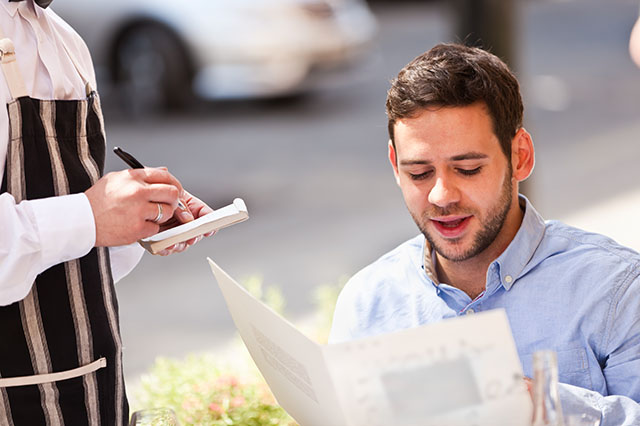
“It’s very important in restaurant eating to really declare your allergy and to instruct the restaurant a bit,” said Dr. Scott Sicherer, director of the Jaffe Food Allergy Institute at Mount Sinai Medical Center. “You have to be really good at making it clear that it’s an allergy, not just a taste or an intolerance, making it clear that a small amount could make you sick, making it clear that you’re worried about cross-contact and hidden ingredients and giving examples of those.”

For instance, picking the nuts off of a salad doesn’t make that salad safe for someone with a nut allergy and chicken grilled next to a cheeseburger could give someone with a dairy allergy a serious reaction.

A good restaurant strategy for those with food allergies is to order simple ingredients prepared simply, Sicherer said, staying away from sauces and dishes with multiple ingredients.

“If you know you’re not allergic to rice and you’re getting plain rice, you can see that they didn’t put sauce on it,” he said. Or if you want a baked potato, get a plain baked potato to save yourself from having to worry about other questionable ingredients.

how to travel with food allergies

So, when is it safe to travel with food allergies? Any time, as long as you are cautious and prepared.

Here are some additional tips on how to travel to a different country with food allergies.

  • Review your action plan with your allergist beforehand. Do you need extra EpiPens or other medications? Do you know when to use those medications? “When traveling, you might be more liberal in giving medication to yourself rather than waiting,” Sicherer said.
  • Think about where you’ll be staying. Does the hotel staff speak English? Should you bring some prepackaged foods with you? Will your room have a kitchenette where you could prepare allergy-safe food if needed? If you’re taking a cruise, where you’ll be dependent on on-board meals, can the kitchen assure you’ll be safe? Buffets are rife with cross-contact, Sicherer said, so those with food allergies should avoid them.
  • Make sure to let others know about your food allergy. Options include medical identification jewelry, though this might not be in the local language. There are also phone apps that will allow others to access essential medical information about you if you are unconscious or otherwise unable to communicate (such as Medical ID in the iPhone Health app or similar downloadable apps for Android devices.) And there are medical translation cards such as SelectWisely. Ahlberg says the company has even had travelers request cards in English because of the sense of authenticity. “They say that presenting that is better than just saying, ‘I can’t eat these foods,’ ” he said.

As with so many aspects of travel, the key to how to travel to a different country with food allergies is in planning ahead. Your allergy does not need to keep you at home, and you don’t have to spend your trip on a single-food diet. Talk with your allergist, gather some tools, and away you go.

Do you have food allergies and does it impact the way you travel? Share your tips for how to travel with food allergies in the comments. 

Subscribe to Your AAA Newsletter

Sign up and receive updates for all of the latest articles on automotive, travel, money, lifestyle and so much more!

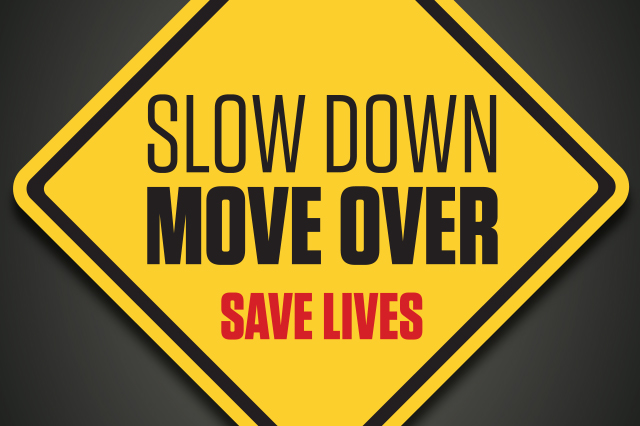
Slow Down, Move Over

Each year, more than 30 million calls for help come from AAA members like you. AAA Roadside Assistance technicians respond to every call, in many cases working on busy roads with shoulders no wider than 4 feet. Sadly, an average of two roadside service providers are killed each month while tending to disabled vehicles along America’s roadways. Many more are injured by a motorist who is impaired, distracted, unaware or unwilling to slow down and move over.

Since 2007 AAA has worked to pass “Slow Down, Move Over” laws, which require drivers to reduce their speed and switch lanes to give roadside responders safe clearance. The laws – versions of which exist in all 50 states – are simple. Whenever approaching an incident where police, firefighters, emergency medical service crews or tow operators are working, drivers should exercise caution, slow down and move over.

AAA has worked on educational and advocacy initiatives, creating public service announcements and reaching out to state legislative officials. But there is more work to be done. We are committed to raising awareness of the “Slow Down, Move Over” law and the dangers associated with working at the roadside.

To protect roadside workers, AAA offers these tips:

  • Stay alert. Avoid distractions and focus on the task of driving.
  • Watch for emergency or utility service vehicles, tow trucks or disabled vehicles stopped on the side of the road.
  • Slow down when approaching emergency vehicles with flashing lights stopped on the side of a two-lane roadway, unless otherwise directed by an emergency worker.
  • On multi-lane roadways, slow down when you see the flashing lights of an emergency vehicle at the roadside and, if possible, move over into an adjacent lane. If you are unable to switch lanes, slow down to a speed that is safe and reasonable.

Everyone deserves to get home safely. When you see flashing lights, slow down and move over.

For more information, visit AAA.com/SlowDown.

Subscribe to Your AAA Newsletter

Sign up and receive updates for all of the latest articles on automotive, travel, money, lifestyle and so much more!

Moroccan Roll

“I think I realized what Marrakech reminds me of.”

“What’s that?”

“The fragrance section of a department store, but as an entire city.”

I uttered this to my traveling companion, my girlfriend Sheila, as we walked through Marrakech’s Jemaa El-Fna square. Like many travelers, we had been drawn to Morocco after seeing pictures on social media that evoked the exotic image of Lawrence of Arabia.

Our itinerary included stops in Marrakech, the leather tanneries of Fez, a night under the stars in the Sahara, strolling through the cerulean buildings of Chefchaouen, and – of course – storied Casablanca.

Marrakech Express

The Medina Maze

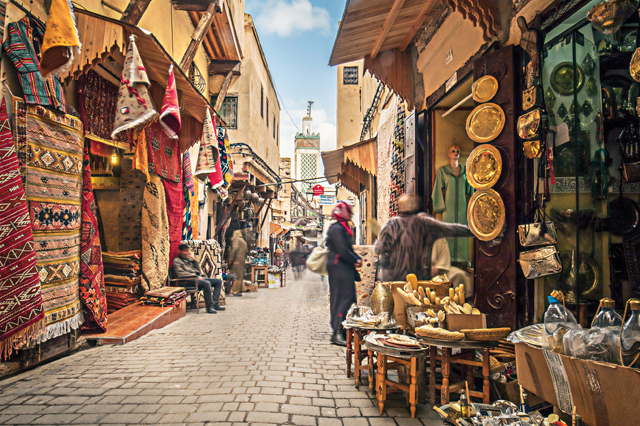
It was our first visit to Morocco, and we decided to make Marrakech our first stop. We planned to stay in traditional riad accommodations during our travels. Riads, traditional homes with many rooms and a central courtyard, are typically located in a medina, or old town. Although medinas evoke a feeling of history and authenticity, they’re extremely confusing to navigate. Lack of posted street signs or numbers – as well as twists and turns and numerous dead ends – makes it almost certain that visitors will lose their bearings at some point.

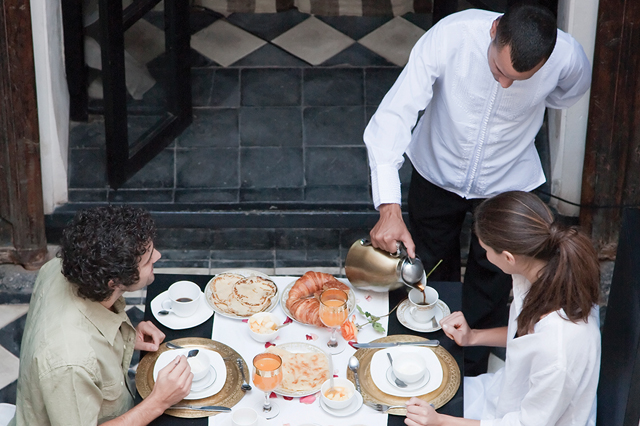
The payoff for all this directional hassle is an accommodation experience unlike any you’ve ever experienced. We were greeted in Marrakech by our host Zuhair, who, after ushering us in, presented us with a platter of olives, bread, nuts and the ever-present elixir of mint tea.

Riad hosts can be some of the best resources during a stay in Morocco, helping you find authentic activities and experiences, hiring trustworthy drivers to shuttle you around the sites, and finding a safe place for you to park a rental car overnight. In Fez, our host actually walked us to the tanneries and got us inside to one of the best viewing platforms, which we likely wouldn’t have been able to do without him.

The trade-off to the medina’s authentic experience is the abundance of people trying to separate you from your money in less-than-legitimate methods. Luckily, we were prepared, and by the end of our trip, they were more of an annoyance than anything else.

Marrakech Express

Ports, Camels and Wine

After the colorful Marrakech, we ventured out of the big cities looking for activities that would give us a glimpse into Moroccans’ daily lives. Our adventures included a day trip to the quiet port city of Essaouira, a cooking class where we prepared a traditional tagine, and discussing Berber culture over a fire after a Saharan camel ride.

We also ventured to Domaine De La Zouina, one of the few wineries in Morocco. In addition to enjoying a tasting and learning about wine production with our host, we discussed the challenges of working in the wine industry in a predominantly Muslim country. We also learned about topics ranging from politics to health care, which gave us so much insight about the inner workings of Morocco society.

Morocco is a destination that demands patience and an awareness of your surroundings from the first-time visitor. But it also offers some of the richest experiences and the most welcoming people if you’re willing to go out and find them.

Now if you’ll excuse me, I’m going to make myself some mint tea.

Contact a AAA travel agent to start planning your Morocco trip.

Massachusetts-based travel writer Chris Caswell and girlfriend Sheila travel the world and share their adventures on their blog

Subscribe to Your AAA Newsletter

Sign up and receive updates for all of the latest articles on automotive, travel, money, lifestyle and so much more!

Rethinking Road Trip Snacks

Nothing incites vacation excitement more than two words: road trip! Whether you’re darting away for a quick weekend or planning a week-long cross-country trek, there are a few important things to consider – what to see along the way, where to sleep at the end of the day and what road trip snacks to pack. You don’t want to find yourself  on a seemingly endless stretch of highway with nothing but stale chips to alleviate your hanger.

It’s easy to fall into the drive-thru rut, but with just a little planning, the right snacks will have you feeling your best when you arrive at your destination.

The Best Road Trip Snacks Are Filling, Healthy and Portable

Gas stations and rest stops provide a plethora of treats that would make anyone feel like a kid in a candy store. The truth is, they basically are candy stores. Chips, candy bars, sugary sodas and energy drinks may be tempting after hours in the car, but they are not the best fuel in the long run to ensure that you remain focused on the road.  When choosing your road trip snacks, consider the foods that will give you sustained energy (fruit, protein bars) and avoid those that will lead to the inevitable crash in a few hours (sugar and caffeine).

Think Charcuterie

If you’re a pro at putting together a charcuterie board for a party, use those skills to build a portable one for the road.  Sliced meats, cheese and smoked seafoods are great road trip snacks because they are high in protein and will help keep you fuller, longer. Adding in some olives, nuts and whole grain crackers will provide healthy fats and a little crunch, and leave you feeling satisfied. Make sure to have a cooler with plenty of ice to keep everything fresh.

Limit the Salt

It’s so tempting to grab a bag of chips or succumb to the lure of fast food french fries, but eating salt-laden snacks will leave you feeling sluggish, bloated and a little greasy around the edges. If you crave crunch, opt for something like baked pita chips, air popped popcorn or banana chips. Paired with hummus or peanut butter, you’ll have a tasty and filling snack that will leave you feeling fuller faster and less likely to mindlessly plow through a whole bag.

Eat the Rainbow

Cut up veggies such as carrots, celery, peppers and cucumbers make for the best road trip snacks. Not only are they healthy, but they also store extremely well in the cooler. Think vegetables are boring? Pack along a yogurt dip like tzatziki or salad dressing to give them a little more oomph.

If you’re looking for a bit of sweet to keep your mind on the road, reach for some fruit. Options like bananas, apples and oranges are great snacks for the road because they don’t require refrigeration, and they are a little sturdier to withstand the bumps and bruises and shuffling that accompany any car ride. Berries, cherries and grapes, while requiring a bit of chilling, are also good choices since they require no prep or peeling, are easy to eat and are perfect for the littlest passengers aboard.

Go for the Good Stuff

If you just can’t live without a little bit of something sweet or salty, don’t fret! Trail mix is a great road trip snack. The combination of nuts, dried fruit and a little bit of chocolate, will give you the sweet and salty combo you crave, with added protein and fat for sustainable energy. Be sure to opt for dark chocolate, which has proven health benefits. However, be careful with portion sizes when eating trail mix – it can be easy to get carried away.

road trip snacks

Hydrate

At the end of the day, water is always the best option to keep you hydrated, which is especially important if you’re sitting for long hours. Many times, if you’re looking for some mindless munching, you might just be thirsty!  Want bubbles in your beverage? Seltzer water is an excellent sugar and caffeine free alternative.

Packaged and Portable

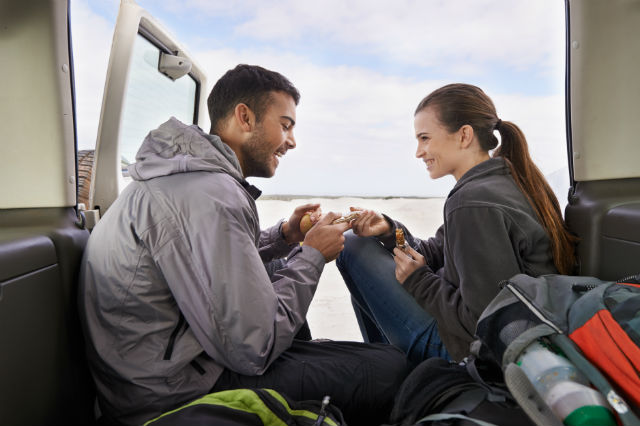
Don’t have the room or inclination to pack a cooler? That’s no problem! There are plenty of good-for-you, pre-packaged options that are satisfying enough to keep you away from the candy aisle. Luna and Bobo snack bars, beef, turkey or mushroom jerky or Justin’s single serving nut butters are all healthy options that are easy to grab and go.

Fast Food Friendly

Not all fast food is created equal, and sometimes a quick serve stop is necessary when a snack attack strikes. Stay away from heavier fried foods that will promptly induce a food coma, and instead opt for fresh salads or sandwiches, available at many fast food outlets along your route.

Road trip snacks often get a bad rap, but there are plenty of healthy, filling, portable options to fuel your hunger and keep you from running on empty. Take at look at these healthiest fast food options based on calories.

Head to AAA.com to find member savings on groceries and dining and to help you plan the perfect road trip.                                                               

What are some of your favorite road trip snacks? Share them with us in the comments.

Subscribe to Your AAA Newsletter

Sign up and receive updates for all of the latest articles on automotive, travel, money, lifestyle and so much more!

A Workout a Day in 2020

While many of us want to become healthier, squeezing a daily workout plan into a busy schedule can feel almost impossible. It often seems like there are never enough hours in the day, but if you are serious about getting fit, there’s always time to burn extra calories whether you have 10, 30 or 60 minutes to spare.

Making a Workout Plan

When you’re busy, sometimes the only way to get something done is to add it to your schedule. Putting exercise on your to-do list or allotting a set amount of time for working out can make it easier to accomplish. Luckily, workouts don’t have to be for an hour every day.

When making a workout plan, every little bit counts. Intensity can be more beneficial than duration, according to a study by the University of Utah. So if you’re really pressed for time, squeezing in some short bouts of higher-intensity activity between work, errands and other commitments can be just as rewarding.

For substantial health benefits, the U.S. Department of Health & Human Services recommends 150 minutes of moderate-intensity physical activity spread throughout the week. It’s up to you whether you want to break up your weekly 150 minutes into two 10-minute daily routines or knock out an hour and 15 minutes in two days. Shorter routines tend to offer a bit more flexibility while longer ones let you work out fewer days a week.

Set a Goal

Exercising should become a priority so it doesn’t fall by the wayside, and setting a goal can help you stay focused. Whether you aim to burn a certain number of calories per day, lose a few pounds or take an inch off your waistline, having a goal can be motivating.

Today’s technology makes keeping track of your accomplishments easier than ever. Smartwatches, wearable fitness trackers and apps can track miles walked, calories burned and more. Feeling and seeing the results can be reassuring and help you stick with your workout plan.

Do What Works For You…

It doesn’t matter if you are a beginner or an exercise aficionado, we are all different and have our own workout preferences. Some may need to be mindful of old injuries, while others face other limitations like having to stay home with the kids or not having a lot of space to workout.

Workout plans are not one-size-fits-all, and that’s okay. You can find what works for you by knowing yourself and trying different things. If you find an exercise routine you like, there’s no rule that says it has to be your only workout either. Mixing things up will keep exercising interesting and work different muscle groups too. From cycling to dance classes to workout videos you can follow in your living room, there are plenty of options to help you find what you like.

workout plan

When It Works For You

Once you figure out how and where you want to work out, there’s still the hurdle of finding the time to do it. Here’s where scrutinizing your schedule pays off.

One option is waking up early to exercise first thing in the morning — just make sure you’re still getting your eight hours of sleep. (Incidentally, the National Sleep Foundation says that getting more exercise during the day can help you sleep at night.)

Another option is exercising during your lunch break or at work. If you don’t want to get too sweaty, try simple activities like parking farther away, taking the stairs, going for a walk or simply stretching at your desk. Work-from-home or stay-at-home parents can work out with their kids by lifting them like free weights or using a jogging stroller.

If you can’t set aside a lot of time solely dedicated to exercise, you can always try to double-up by incorporating more movement into other, everyday activities. In this case, double tasking is key. Ask yourself if your commute can become time for exercise. Can you jog, run or bike to work?

10- to 20-Minute Workouts

If you’re exercising for bouts of 20 minutes or less, you’ll want your workout to be intense and give it everything you’ve got in order to really reap the benefits. During a 10-minute workout, you can focus on one part of your body or do more of a full-body workout packed with moves like push-ups, squats, lunges, etc. It’s all about making the most of this brief burst of movement.

Fun fact: Jumping rope for 10 minutes equals about a 45-minute run.

30-Minute Workouts

For a 30-minute workout, you could do a specific activity like yoga or steady cardio training one day and mix it up to work different muscle groups on other days. For more variety, you can break up a single 30-minute session even further by starting with a five-minute warm-up, doing 10 minutes of strength training and finishing with 15 minutes on the treadmill.

60-Minute Workouts

If you have an hour to spare, using the time for a fitness video isn’t a bad idea. AAA members can choose from over 800+ on-demand fitness videos and more for just $25 a month with the Active&Fit Direct.

Since you’ll be working out longer, this routine only has to be mid-intensity, like brisk walking or elliptical training. More intense workouts like kickboxing or kettle bells will help burn more calories. However, it’s important to ease into any new high-intensity exercise and know your limitations. You don’t want to over-exert and hurt yourself.

Even if your routine is all over the place or you can’t quite fit in the full 150 minutes a week, remember that doing something is better than doing nothing at all.

Do you have a daily workout plan? Tell us about it in the comments. 

AAA members can choose from over 10,000 participating fitness centers nationwide for just $25 a month with the Active&Fit Direct program. Learn more

Find these brands and more! Fitness center participation varies by location.

The Active&Fit Direct program is provided by American Specialty Health Fitness, Inc., a subsidiary of American Specialty Health Incorporated (ASH). Active&Fit Direct and the Active&Fit Direct logos are trademarks of ASH and used with permission herein. Other names or logos may be trademarks of their respective owners.

Subscribe to Your AAA Newsletter

Sign up and receive updates for all of the latest articles on automotive, travel, money, lifestyle and so much more!

International Travel Tips, Perks and Services

If you’re anything like my wife and I, the thrill of international travel starts with planning: poring over guidebooks, reading travel blogs, watching Rick Steves videos on YouTube and basically devouring any tidbit of info you can get your hands on regarding the amazing places you’re about to visit.

It was no different when we decided this year on an early summer trip to France and the Swiss Alps. Out came the lists, spreadsheets, maps and passport wallets. In fact, we found ourselves getting a bit overwhelmed at the information overload.

Luckily, we switched from an old insurance provider to AAA since we had last been to Europe, and we quickly made use of the incredible Triple A® travel services and benefits available to us with our membership. From tips on packing, info on car rentals and international driving permits (a must!), to super-convenient passport services and yes, free maps, our AAA membership was like having our own personal travel assistant at the ready 24/7. AAA travel agents are also available to plan your entire trip!

We ended up having the trip of a lifetime. And while it was relatively hassle-free, the journey didn’t come without a hiccup here and there. When we got back, I checked in with travel writer Jen Pellerito, who had just returned from Spain and Portugal with adventures of her own to chronicle. As it turns out, even the pros make silly mistakes when traveling in a foreign country, and it’s really not a “real” trip until you’ve had a couple of snafus.

Here’s where Jen and I landed on the top international travel trips to make your next journey abroad as smooth as can be.

Triple-Check Your Travel Docs

International travel often means buying airfare several months or even up to a year in advance of peak travel season. Check your travel documents every month or so to make sure departure and arrival times have not changed significantly, and always make sure your passport is valid. “It really is surprising how quickly passport rules can change, even in Europe,” Pellerito said. “As a rule of thumb, especially if you are on a longer, extended trip, be sure what your visa restrictions are and triple-check the expiration date of your passport.”

Get Ready to Drive

Although my wife and I travelled across Switzerland mostly by rail, Pellerito rented a car to explore the areas beyond Lisbon and Porto and also get off the beaten path in northern Spain. “I got an international driving permit through AAA and secured a car reservation before I left,” she said. “The permit is more widely recognized and particularly helpful in eastern Europe countries like Romania and Serbia that use a Cyrillic alphabet.”

Bottom line: Don’t depend on your driver’s license alone and make rental reservations in advance, particularly if you can’t drive a car with a manual transmissions, as automatics are less common abroad. Your local AAA branch can assist with everything from setting up car rentals to entire tour itineraries. Did you know that AAA members can save up to 20% on Hertz rentals at home and abroad?

Make Your Money Count

When it comes to currency exchange, be sure to get cash right away: AAA branches offer foreign currency for more than 70 countries. You can also get funds at the airport and from an ATM. Cash can immediately help you get a cab, a meal or forgotten sundries should your credit card fail you on day one. Pellerito and other travel experts agree that the bank-to-bank transfer via ATM cuts down on middleman fees at currency exchange counters.

Airport ATMs are also often most up-to-date on exchange rates. “My top currency hack is to open up a debit card before you leave that will reimburse you for fees incurred at the ATM, as it can save you quite a bit during the course of your trip,” Pellerito said. “And don’t withdraw a lot. It’s always better to carry less cash to cut down on risk and losses from pickpockets and the like.”

international travel
The author embraces local post-hike refreshments in the Swiss Alps at a cafe in Murren.

Embrace the Crowd, Avoid the Crowd

Although my wife and I had been to Paris before, it was in late summer when the Parisians are mostly on their own vacations and tourist traffic has died down, so we were surprised, in mid-June, to be amongst a throng of humanity visiting the city.

“When you go to a major sightseeing location like the Eiffel Tower it can be overwhelming and surprising to see thousands of other people who had the same idea on the same day as you, especially if it’s your first time traveling outside of the country in a long time,” Pellerito said. For creative crowd control, purchase tickets in advance to the big museums and sites, and schedule the rest of the day (before or after) as free time to just wander and explore without the pressure of commitments.

Let Yourself Be Different

Indeed, Pellerito says the key to having an authentically great travel experience is to try not to feel rushed and embrace the differences of other cultures rather than being annoyed by them. “The difference is one of the most rewarding aspects of travel,” she said. “Savor the opportunity to change up your routine temporarily to broaden your horizons and better understand the global community as a whole, and realize that it’s fun to pretend you’re an Italian for a day.”

And with that, my wife and I are already off to the library for books on our next trip to Venice and Rome. If I’m lucky, we might squeeze in some pizza tonight, too. Arrivederci! 

Share your best international travel tips in the comments below.

Book your next trip with AAA travel.

Subscribe to Your AAA Newsletter

Sign up and receive updates for all of the latest articles on automotive, travel, money, lifestyle and so much more!

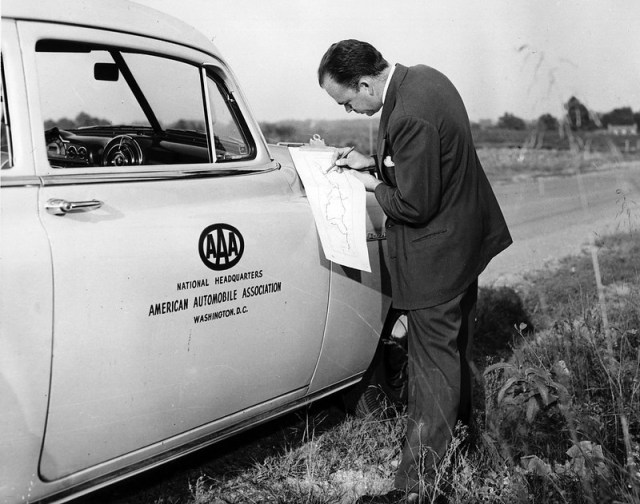
The Nation’s First Road Maps, Courtesy of AAA

AAA produced its first road map in 1905, a humble hand-drawn route on linen, depicting roads in Staten Island, N.Y.

Little did the cartographer know that this project would soon become a full-time position.

AAA expanded its horizons a year later, becoming the official sponsor of “The Official Automobile Blue Book.”

The book was the first collection of generalized road maps spanning Boston, New York, Baltimore, Washington and Philadelphia and was created by AAA Secretary Charles Howard Gillette.

AAA then established a Bureau of Touring Information in 1906, to supply members with all available data on roads, hotels, service facilities and motor vehicle laws.

The problem was, there wasn’t much information available. Most early maps were prepared for bicyclists and even the “Blue Book” was a generalized map, meaning it didn’t contain complete maps of every road.

So, AAA finished the job and soon began producing its own auto-oriented maps and road logs and, eventually, a series of Tour Book guides and camping directories.

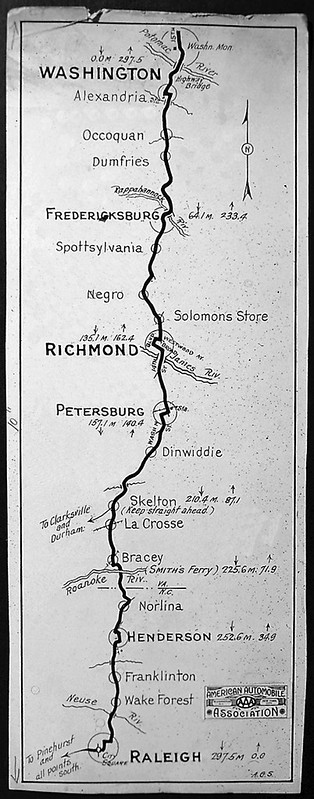
But it wasn’t until 1911 that the Club produced its first interstate map (right), “Trail to Sunset,” a booklet of strip maps detailing a route from New York to Jacksonville, Fla.

Today, a more sophisticated form of strip maps are combined to make what is known as Triple A® TripTik routings.

Subscribe to Your AAA Newsletter

Sign up and receive updates for all of the latest articles on automotive, travel, money, lifestyle and so much more!

Unique Holiday Traditions Around the World

The holiday season is finally here and millions of people all over the world will celebrate traditions that date back centuries. From dressing like a witch to enjoying a KFC feast on Christmas, these customs and holiday traditions around the world may surprise you.

KFC Christmas in Japan 

For almost 50 years, KFC has promoted fried chicken as a Japanese Christmas meal with its advertising campaign, “Kurisumasu ni wa kentakkii!” (Kentucky for Christmas!) More people continue to skip turkey and ham for chicken as an estimated 3.6 million Japanese families dine out annually for the holidays. Believe it or not, KFC has become so popular on Christmas that those who don’t preorder risk waiting in line for hours. For many, the tradition is more than the meal – it’s about being with family and friends.

St. Nicholas Day & Krampus

On the evening of Dec. 5, some children across Europe put shoes by the fireplace for St. Nicholas to fill with presents and treats. Unlike Santa, those on the naughty list don’t get a lump of coal – they’re visited by a beast-like creature called Krampus. Public celebrations in Austria feature kids dressed as angels and devils as well as an appearance by St. Nicholas and his frightening counterpart. The tradition has made its way to America, as some people have been celebrating Christmas dressed as Krampus.

Restaurant.com Certificates

Shop restaurants near you to get the best deal, every meal!

Shop Now

Pongal Festival in India

India is a land full of diverse cultures and traditions celebrated by over 1 billion people. From Jan. 15-18, India’s Hindu population celebrates Pongal, a four-day harvest festival that lauds the arrival of the sun in the northern hemisphere. During this time, people exchange gifts, place clay oil lamps on roofs to honor the sun and decorate mango and banana trees throughout their community. Each day of Pongal is observed differently with unique customs such as the third day, Mattu Pongal, which is marked by praying and decorating the local cattle. There’s even a special parade to honor the cows in hopes of having a better harvest season.

Italy’s La Befana

Before Santa, there was La Befana. On Jan. 6, parades of people dress as a witch-like woman with a long crooked nose and a broomstick. One of the oldest holiday traditions around the world, it dates back to the 13th century, with Italian folklore describing a witch who climbs down the chimney the night before, bringing gifts to children throughout Italy. Of course, being Italian, she much prefers food and wine over cookies and milk.

Finland’s Cemetery Tradition

During the darkest days of winter, it’s a tradition in Finland to light candles by the graves of relatives on Christmas Eve. As eerie as it may seem, the sight of the decorations glowing in the snow at sunset can be a moving experience. The century-old tradition also includes parades and street-lighting ceremonies as people gather for Christmas activities, including an appearance by Santa Claus, known in Finland by Joulupukki.

holiday traditions around the world

Australia’s Christmas Beach Party

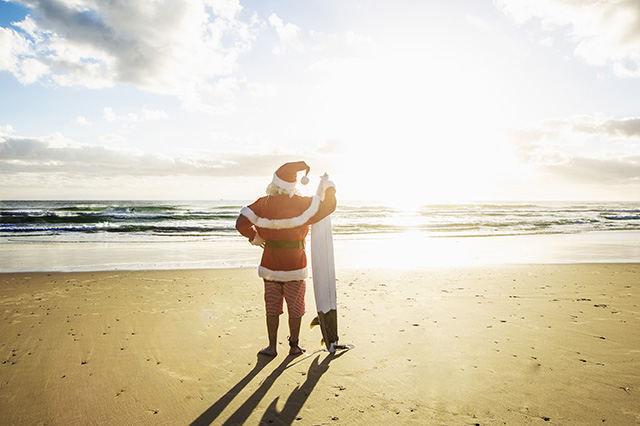
As much as we love a Northeast Christmas, this is one of those holiday traditions around the world that we could get used to. Since Christmas coincides with summer in the Land Down Under, residents ditch sweaters for sunscreen as the day is filled with festivities including barbecues, beach games and road trips. You’re more likely to see Santa surfing than someone making snow angels – it hardly ever snows there. Despite the different weather, Aussies have similar traditions as most spend the day celebrating with friends and family. The day after, known as Boxing Day, also closely resembles Black Friday as retailers promote big discounts.

Kwanzaa

Most Americans are familiar with Kwanzaa as it coincides with Christmas and Hanukkah, but many are unaware of why the holiday is celebrated. Derived from the Swahili phrase “matunda ya kwanza,” meaning “first fruits of the harvest,” Kwanzaa commemorates African American culture and heritage. The seven-day celebration begins on December 26 and involves a gathering of friends and family who exchange gifts and light a series of black, red and green candles, which serve to symbolize seven values of African American family life: unity, self-determination, collective work and responsibility, cooperative economics, purpose, creativity and faith.

Chinese New Year

Known as the Spring Festival in China, the Chinese New Year has been celebrated for over 4,000 years to mark the end of winter and the start of spring. Falling each year between Jan. 21 and Feb. 20, the 15-day holiday serves to bring as much good fortune for the new year. This season, the 2020 Chinese New Year is the beginning of the year of the rat, which starts Jan. 25. The main activities of the holiday include putting up decorations, eating a reunion dinner with family on New Year’s Eve, watching fireworks and giving red envelopes usually containing money and other gifts.

Want to experience any of these unique customs first-hand? Start planning your trip for next year with AAA Travel

Let us know in the comments section which of these holiday traditions around the world surprised you most. 

For more festive fun, play our holiday movie crossword puzzle

Subscribe to Your AAA Newsletter

Sign up and receive updates for all of the latest articles on automotive, travel, money, lifestyle and so much more!

Enjoy a Trip to the Caribbean This Winter

The Caribbean rivals any other tropical paradise location. The natural setting alone – white-sand beaches, crystal-blue waters, vibrant greenery – is enough to want to book a trip. But thanks to a host of world-class hotels and resorts, you can also enjoy experiences like taking your chances at the casino, enjoying a five-star meal and everything in between.

Your only real question is which island in the Caribbean to visit. To help, here are some of the region’s most popular destinations, as well as the resorts calling your name.

The Destinations

Aruba

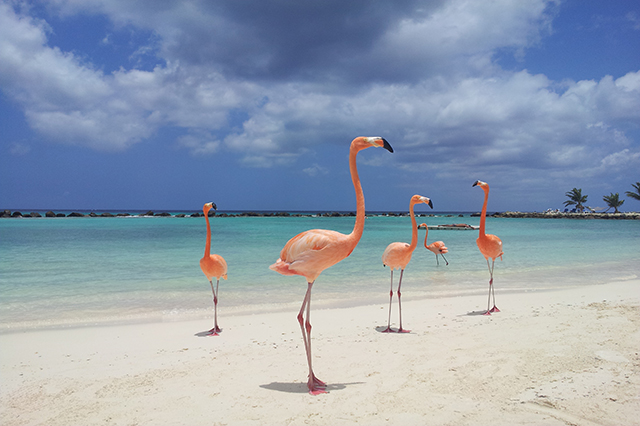
In the heart of the southern Caribbean, just north of the Venezuela coast, lies the island of Aruba. Although it’s just 19 miles long and 6 miles across, Aruba has more than enough pristine beaches, natural wonders, cultural destinations and nightlife spots to keep you busy.

But above all, it’s the weather you’ll enjoy most. According to the Aruba Tourism Authority, Aruba averages a balmy 82 degrees, with more sunny days than any other Caribbean island.

In the center of Aruba is Arikok National Park, which covers nearly 20% of the island. On the north side of the island, you’ll encounter rugged coastlines and limestone cliffs. On the southern end, hotels and resorts dot white-sand beaches.

Jamaica

Spanning more than 4,000 square miles, Jamaica is one of the Caribbean’s largest islands. It’s also the region’s fourth most-populated country, with just under 3 million people.

Although best known for reggae, jerk chicken and rum, there are a plethora of activities, experiences and events to fill your itinerary. And with a hot and humid tropical climate all year round, the weather is sure to cooperate.

Popular resort areas on Jamaica include Negril, Ocho Rios, Port Antonio and the South Coast. But the most in-demand destination is Montego Bay on the island’s northwest corner.

Caribbean Vacations

The best deals to warm up your winter. Reduced rates, FREE nights, resort credits and more.

Book Now

The Bahamas

The Bahamas encompass more than 700 islands covering 100,000 square miles of water just southeast of Florida. The idyllic country is a favorite vacation locale for many – and for good reason.

One of the most popular Bahaman isles is Paradise Island. This 685-acre spot of land has been developed almost exclusively to cater to tourists. It is jam-packed with resorts, hotels, restaurants, shops, nightlife, a golf course, an aquarium and a casino.

Paradise Island is connected via bridge to New Providence, home of the Bahamas’ capital city, Nassau. It is here where you will find the historic sites and cultural destinations that complete every trip to a distant land.

Another popular spot is Great Exuma, the largest of the Exuma archipelago’s 365 islands. Known for its crystal-clear blue waters, pristine beaches and exclusive resorts, Great Exuma is secluded bliss.

St. Lucia

St. Lucia is an island country on the eastern end of the Caribbean Sea. Although it covers just more than 200 square miles, St. Lucia offers something for just about everyone.

North St. Lucia is home to most of the island’s resorts. It has many of the top beaches as well as popular nightlife spots. For nature lovers, there is Pigeon Island National Park. The park offers hiking trails, as well as places for kayaking, snorkeling and swimming. If you want a break from the sun, try your luck at Treasure Bay Casino Saint Lucia.

The south side of the island has the white-sand beaches you would expect, but it is also one of St. Lucia’s most historic regions. The island’s central area is home to various forest reserves. Here you can enjoy streaming waterfalls or catch the view from a lookout.

St. Lucia

The Resorts

All Inclusive Collection/Hard Rock

Hard Rock’s five Caribbean locations offer something for everyone. Depending on your tastes, this might include enjoying a beachfront oasis, the largest casino in the region, tranquil spas, kids’ clubs or nightly entertainment.

AMResorts

AMResorts is one of North America’s fastest-growing luxury leisure resort company. It is a mainstay throughout the Caribbean, particularly in Jamaica, where it operates six resorts in the country’s Montego Bay region. The brand offers all-inclusive vacations, where everything is included. Guests can enjoy unlimited premium drinks, find dining, activities and entertainment, and world-class spas.

Blue Diamond Resorts

Blue Diamond owns 47 properties in 10 countries, including five in Jamaica and four in St. Lucia. Each of its brands cater to different clientele and experiences, such as family friendly, adults only, city destinations and boutique hotels. This ensures you’ll get just what you’re looking for out of your vacation.

Couples Resorts Jamaica

Couples Resorts operates exclusively in Jamaica. Its four resorts—two in Negril, two in Ocho Rios—are all-inclusive. As its name implies, the brand caters to couples looking for a romantic getaway. Couples prides itself on combining Caribbean culture, spectacular natural settings and first-rate amenities.

The Excellence Collection

Excellence Oyster Bay is a tropical paradise on Jamaica’s northern coast. The resort is located on its own private peninsula. Guests are treated to a welcome cocktail and cool towel, 10 bars and lounges, 3 swimming pools, 4 outdoor jacuzzis, water sports, nightly shows and much more.

Iberostar Hotels & Resorts

Iberostar operates three resorts in Montego Bay, Jamaica: Rose Hall Beach, Rose Hall Suites and Grand Rose Hall. The former two are open to families while the latter is adults only. All three are right on the beach, offering sunshine and relaxation just steps away from your room.

Palace Resorts

At Moon Palace Jamaica you’ll have your own five-star retreat. During the day, enjoy a swim with dolphins, paddleboarding or an exotic scuba tour. When hunger strikes, get a bite to eat at when one of the many dining options, with cuisine offerings including American, Jamaican, Italian, Pan-Asian and more.

Palladium Hotel Group

Palladium’s two Jamaican resorts are situated on the northeast coast, between two of the island’s most popular tourist towns. Their diverse facilities and coastal setting make it ideal for families, couples and groups. The Grand Palladium Jamaica has one of the largest pools in the Caribbean.

Playa Hotels & Resorts

Playa operates seven resorts in Jamaica including two adult-only locations. These beachfront hotels give you panoramic views of the beach and ocean. Amongst other amenities, guests can enjoy oceanfront dining, swim-up bars, live entertainment, aqua aerobics, Zumba and dance classes, and culinary classes and tastings.

Riu Hotels & Resorts

Riu hotels can be found throughout the Caribbean including Aruba, Jamaica and the Bahamas. The resorts’ culinary offerings include global dishes with traditional ingredients, international fusion cuisine and themed restaurants.

Sandals & Beaches Resorts

Sandals Resorts is a mainstay in the Caribbean with more than a dozen locations including two in the Bahamas, three in St. Lucia and six in Jamaica. Beaches, meanwhile, owns two Jamaican properties. Each destination features gourmet dining, unique bars, and land and water sports, plus complimentary green fees at its golf resorts and certified scuba diving.

Take advantage of special offers and exclusive member benefits on Caribbean vacations with AAA and Pleasant Holidays. 

Subscribe to Your AAA Newsletter

Sign up and receive updates for all of the latest articles on automotive, travel, money, lifestyle and so much more!

8 Fitness Classes to Try This Year

If you are looking to establish a workout schedule and a fitter, healthier lifestyle, monotonous machines and weights are not your only options at the gym. While there’s no doubt you will break a sweat and eventually see results with any faithful exercise routine, running or cycling in place can get old pretty fast, making it hard to enjoy – or stick to – your plan.

Fitness classes make working out more interesting. Between the motivation of the instructor and the energy of the group, classes are challenging and fun. We’re excited about these calorie-burning, sweat-inducing exercises that experts and fitness fanatics alike are loving.

Most gyms offer a variety of fitness classes included with memberships or offer them at a discounted rate. Try a few to find what you like best. Active&Fit Direct makes finding a place to workout even easier with over 10,000 fitness centers to choose from nationwide for just $25 a month.

HIIT Yoga

Yoga’s focus on breathing, posture and stretching helps to tone muscles while improving your balance, flexibility, circulatory health and much more. While there’s been just about every imaginable type of yoga, from hot yoga to goat yoga, high intensity interval training or HIIT yoga is an exciting addition. Compared to other forms of yoga, HIIT yoga is more active, having you alternate between intense bursts of movement and periods of cool down. This hybrid routine will help you sweat, stretch and burn calories.

Kickboxing 

Whether it’s due to the primal allure of punching and kicking or perhaps the satisfaction of working out your stress and frustrations by beating up a punching bag, kickboxing has a lot of fans. Kickboxing helps build strength while burning a whopping 750 to 900 calories an hour, according to Women’s Health. It also works muscles across your body, from arms to abs to glutes. What’s more, you don’t actually need any equipment to do the forms, so you can practice at home.

Pound 

Who wouldn’t want to try an exercise that makes you feel like a rock star? Pound classes offer a full body workout as you jam out to a soundtrack, making the experience all the more fun and energizing. Better yet, the only equipment you’ll need is a pair of drumsticks. While it’s obvious you’ll be working the muscles in your arms, this kind of workout also tones your legs and abs while improving your balance and cardio.

Dance Classes

Dancing is another fun way to exercise. While dance classes like Zumba have been popular the past few years, if you’re looking something a little less structured and technique-oriented, Group Groove or Bokwa could be a better fit for you. Both of these options offer a bit more room for creative expression, where attendees are free – and even encouraged – to incorporate their own dance moves when they feel the beat of the music.

fitness classes

Indoor Rowing 

While the rowing machine has been a common fixture in gyms for years, there’s been a recent spike in the popularity of rowing classes where groups row together toward a common goal. Rowing builds power and endurance, and according to a study from the English Institute of Sport, it works an astonishing 86% of your body’s muscles, including the arm, core and leg muscles. Despite being considered relatively low-impact compared to other cardio workouts – meaning it’s not as harsh on areas such as the ankles, knees and hips – it’s still intense, so take it slow if you are new to it.

Barre

Barre is a workout that takes the best aspects of ballet, Pilates and yoga to help improve flexibility and posture while building strength. Though a bar – hence the name  – is the essential piece of equipment for this kind of exercise, you’ll also use a mat, free weights and exercise balls and bands to get fit in this class. By using such a variety of techniques and equipment, you’ll be working a wide range of muscle groups, which include your arms, core, legs and glutes.

Kettlebell Classes

Strength training isn’t just for body builders. Kettlebells, which are cast iron weights with handles, are often used for team or group conditioning. The swinging motion used during kettlebell training – along with the accompanying dead lifts, squats and lunges – works various muscle groups, giving you a full body workout. The best part is you can burn a staggering 800 to 1200 calories per hour, according to Women’s Health.

Take a Class at Home

If you don’t have time to go to the gym as often as you’d like, at-home workouts are just as effective. Between all the apps, virtual trainers and streaming workouts, there are plenty of options. With Active&Fit Direct, you’ll have access to over 150 videos, articles and classes, included in your membership.

Finding the Right Class

Fitness classes are not one-size-fits-all. Everyone is different, and finding what works for your lifestyle, schedule and fitness preferences takes a bit of time, trial and error. Active&Fit lets you try different participating fitness centers with a guest pass. You can also change centers at any time and visit different ones while you’re traveling.

No matter which exercise, or combination of exercises, you decided to try, make sure you give your body time to rest and recover after, and drink plenty of water to stay hydrated. Eating a well-balanced diet will also help you feel healthier and give you the proper fuel for a successful workout.

Which of these fitness classes would you like to try? Tell us in the comments.

AAA members can choose from over 10,000 participating fitness centers nationwide for just $25 a month with the Active&Fit Direct program. Learn more

Subscribe to Your AAA Newsletter

Sign up and receive updates for all of the latest articles on automotive, travel, money, lifestyle and so much more!

The Times Square Ball Drop: What You Need to Know

The Times Square ball drop is a beloved New York tradition – and seeing it in person is a popular bucket list item. So popular, in fact, that an estimated 2 million people will attend. Or at least try to attend. You can see the ball drop from side streets or adjacent buildings if you’re lucky, but only about 120,000 people can actually fit on the ground in Times Square. So if you’re planning on going, you should go early.

The Times Square ball drop tradition began in December of 1907 atop One Times Square. The first ball was about five feet in diameter, made of iron and wood. To make it glow, it was covered in 100 incandescent light bulbs. They even had their own version of cheesy New Year’s Eve props – nearby restaurants passed out top hats adorned with tiny, battery-powered lightbulbs. When you turned the hats on, the lights read “1908.”

Since then, there have been 7 different versions of the Times Square ball. The 2007-2008 ball was only used once – to celebrate the 100-year anniversary of the ball drop.

As of 2019, the ball has been lowered 109 times. That’s every year except 1942 and 1943, when a wartime dimout was in effect. People still gathered in Times Square those years to greet the New Year in a moment of reverent silence, followed by the ringing of bells.

ball drop

The current ball rests atop One Times Square year-round. At 12 feet in diameter, it’s twice the size of the last ball. It’s also enormously heavy, weighing in at 11,875 pounds. The ball is actually a geodesic sphere, made up of interlocking triangles (think Disney’s Epcot ball). It’s covered in 2,688 custom Waterford crystals, which are attached to 675 LED modules. That’s 32,256 LEDs in total. With the LEDs, the ball can change colors and patterns, appearing almost like a giant kaleidoscope.

Over 1 billion people will watch the Times Square ball drop around the world, over television broadcasts or streaming services. It remains a New Year’s Eve tradition even to people who live in other time zones.

As mentioned earlier, it gets very crowded in and around Times Square on the day of the ball drop, so if you plan on attending, you should arrive as early as possible.

In recent years, security has tightened around the event. Attendees can enter Times Square through police-defined entry points, where they might be scanned with magnetometers or sniffed by explosive-detecting K-9 units. Afterward, they’ll be escorted to one of several pens throughout Times Square, where they will be expected to stay until after the ball drop. The event prohibits large bags, umbrellas and alcohol. The alcohol ban is probably for the best, since there are no Porta-Potties in Times Square. Don’t plan on sneaking into the Europa Cafe bathroom, either – Times Square storefronts are notoriously unwelcoming to New Year’s Eve revelers seeking potty breaks. Besides, you probably won’t be able to get back in your pen afterward.

Pack some snacks (you won’t be able to get food once you’re in your spot) and wear comfortable shoes. You will be standing for the entire event, since it’s against the rules to sit down on the ground. Bundle up in layers so that you’re prepared for any kind of weather. The 2017-2018 celebration was the second-coldest in the history of the ball drop, coming in at 9 degrees Fahrenheit (with a wind chill of -4).

If you don’t want to deal with the crazy crowds on the ground, then you can attend one of the many parties at the hotels and restaurants around Times Square. The Times Square website even has a schedule you can take a look at. Some (okay, MOST) of these parties are incredibly expensive. We’re talking $1000+ expensive.

After the ball drops, the confetti falls and the performers pack up, there’s over 50 tons of garbage left behind in Times Square. After 2017-2018, it took 294 sanitation workers to clean it up, and that was probably the cleanest Times Square looked all year.

Since the days of auld lang syne, the Times Square ball drop has remained a once-in-a-lifetime experience, and a beautiful New York tradition. Why don’t you see it for yourself this year?

Have you ever attended the Times Square ball drop? Do you want to? Let us know in the comments below!

Check out the AAA NYC travel guide for more fun things to see and do in the area. Start planning your next trip with AAA Travel today! 

Subscribe to Your AAA Newsletter

Sign up and receive updates for all of the latest articles on automotive, travel, money, lifestyle and so much more!

Where Did the First Road Signs Come From?

AAA played a key role in establishing our nation’s roads, supporting the formation of an early version of the Department of Transportation in 1903, and advocating for safe roads ever since.

But many of our nation’s early roads were unmarked. And what good is a road if you don’t know where it leads?

So, starting in 1906, regional AAA clubs began paying for and installing wooden signs to help motorists find their way.

The work was as voluminous as it was necessary. Unmarked roads stretched the length and breadth of the continental United States.

In 1914, AAA started a cohesive transcontinental signage project, installing more than 4,000 signs in one stretch between Los Angeles and Kansas City alone.

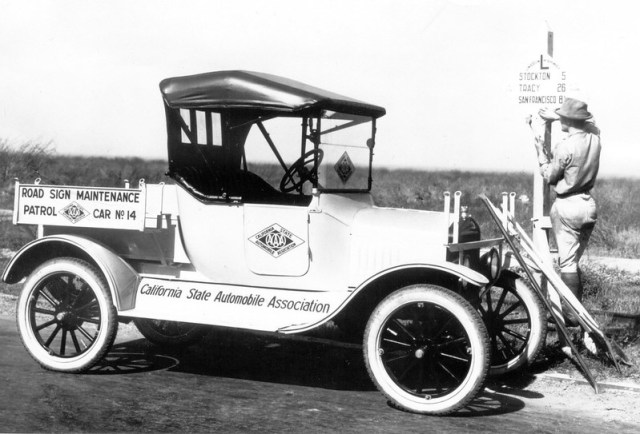
Above, a road sign maintenance patrolman from the California State Automobile Association installs a sign along the Lincoln Highway, which led from New York City to San Francisco.

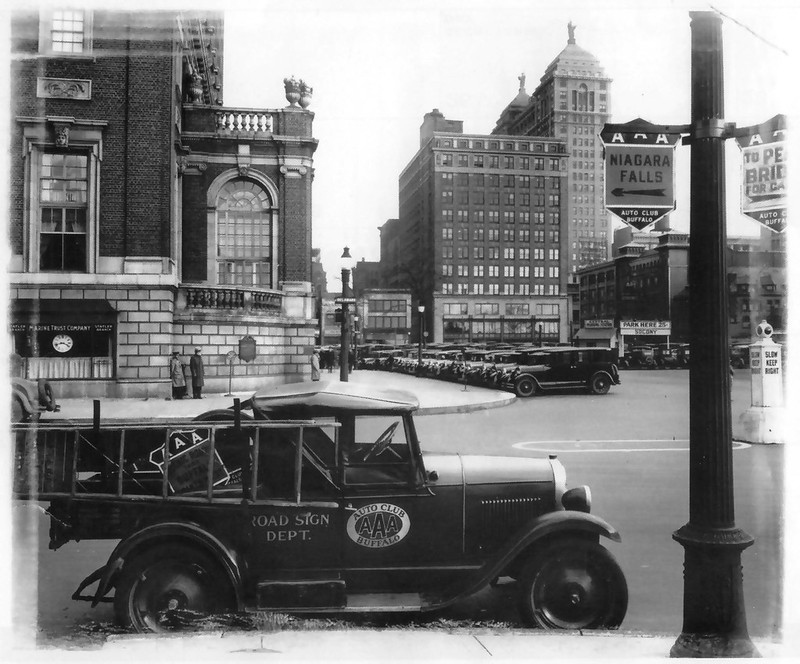
Above, a vehicle belonging to the road sign department of the Auto Club of Buffalo, N.Y., parks near a AAA sign pointing the way to Niagara Falls.

It’s another illustration of the association’s quiet but critical role in the development of our nation’s infrastructure – and combined with our history of cartography, travel planning and roadside assistance, we’ve been helping motorists find their way ever since.

Subscribe to Your AAA Newsletter

Sign up and receive updates for all of the latest articles on automotive, travel, money, lifestyle and so much more!

Compact Only in Size – Volkswagen Tiguan

The all-new Volkswagen Tiguan has grown over the years and is now one of the largest SUVs in the compact segment, and one of the few with three rows of seats.

The Tiguan is powered by a 2.0-liter turbocharged four-cylinder engine, with an eight-speed automatic transmission. On the road, the 184-horsepower engine feels powerful enough to get the job done. The overall ride seems slightly biased toward comfort than off-road performance. The steering has a nice feel, with good driver feedback at all speeds.

Like all Volkswagen products, the interior has the appearance of a much more expensive vehicle. The controls are generally easy to use and include smartphone integration with Apple CarPlay and Android Auto. The large touch screen works well, and there’s a nice mix of buttons to go with the digital display. The system isn’t perfect though; it’s easy to accidentally “swipe” the control panel and change a radio station.

The front seats are comfortable and supportive, with plenty of head and legroom. With all three rows in use, cargo storage is a tight 13 cubic feet but expands to 65 feet with all seats folded.

The Tiguan is a very competent SUV – while it doesn’t stand out in any one area, as an overall package it’s worth considering.

Looking for a new ride? Check out more car reviews at AAA.com/TestDrive.

Subscribe to Your AAA Newsletter

Sign up and receive updates for all of the latest articles on automotive, travel, money, lifestyle and so much more!

Little Italy Restaurant Guide

The Northeast’s little Italy restaurants and the neighborhoods they are a part of, exude a welcoming “La Dolce Vita” feeling, known in Italian as “the sweet life.” They are also synonymous with some of the best Italian-American food you’ll find anywhere.

From Sicilian-style pizza and heaping plates of pasta to bakeries with traditional pastries and every flavor of gelato you can imagine, eateries old and new, draw visitors from around the world to enjoy the traditional fare and gracious Italian hospitality,

Here’s a guide to the best Little Italy restaurants in the Northeast, from New York City and New Haven, Connecticut, to Boston and beyond. Grandma may have a contender for the best red sauce in town, but don’t tell her we said so!

New York City

Lower Manhattan’s Little Italy has gotten smaller over the years, but that hasn’t stopped a heavy stream of tourists from coming to sample endless plates of lasagna and meatballs.

There are plenty of Little Italy restaurants to choose from, but how can you resist one with a tagline of “America’s First Pizza”? Since 1905, AAA Diamond Rated Lombardi’s has been serving up coal-fired pizza to tourists and locals alike. Can’t decide between the margherita or white pizza? Insider tip: They will make you a pie that’s half-and-half, which isn’t on the menu.

Then there’s Gelso & Grand; recently opened, it has become a mainstay for fresh handmade pasta, like the brown butter gnocchi or cacio e pepe agnolotti. And Seamore’s, on the corner of Broome and Mulberry, serves up simple sustainable fish dishes with a perfect view of the iconic Little Italy sign.

For more tips on where to eat in Little Italy, sign up for the New York Cannoli Tour, where you’ll learn the history of the area, while making stops to taste things like cannoli, rice balls, pizza and cappanata at Polosud, Piccola Cucina and Caffé Palermo. Andiamo!

Providence, Rhode Island

Spaghetti, fettuccine, rigatoni, oh my! Find all of these types of pastas and more in the Federal Hill section.

DePasquale Square is the heart of the neighborhood and home to many cafes and restaurants, including Scialo Bros. Bakery, which serves up traditional biscotti in flavors like hazelnut, macadamia and almond. Then try an old-world Italian meal at Joe Marzilli’s Old Canteen; the classic spot opened in 1956 and is well-known for their chicken parmigiana and rosy pink dining room.

For a more casual dining experience, head to Anthony’s Italian Deli for The Godfather, their legendary sandwich overflowing with five kinds of Italian meat, provolone, hot peppers and all of the accouterments you can imagine.

little italy restaurants

Boston, Massachusetts  

The North End, Boston’s Little Italy, is jam packed with authentic Italian bakeries, pastry shops, coffeehouses, delis and exceptional restaurants, centered around Hanover Street.

Whether you opt for caprese salad, eggplant parmigiana or spaghetti Bolognese, do this neighborhood right and sample one or all of these famous Italian dishes at Cantina Italiana. Lucca is famed for their extensive wine list and dishes like their house-made beet purée and mascarpone ravioli. No wonder why they just opened another location in Boston’s Logan Airport.

Bricco’s late-night menu featuring zucchini flowers stuffed with truffled ricotta cheese, makes it hard to pass up.

New Haven, Connecticut

Even if you’ve never visited the area you’ve probably heard of New Haven-style pizza, a thin-crust, coal-fired Neapolitan pizza. Frank Pepe’s Pizzeria is one of the most famous establishments to serve this kind of pie.

Next door, Libby’s has every kind of Italian pastry you can imagine: cannoli, sfogliatella, napoleon, rum baba, tiramisu and the list goes on. Adriana’s, Goodfellas, L’Orcio, Brazi’s and Consiglios are among the best restaurants in this Little Italy, where people come for the food and stay for the food!

Save on restaurant gift certificates from Restaurant.com.

Tell us about your favorite Little Italy restaurants and foods in the comments. We’d love to hear!

Subscribe to Your AAA Newsletter

Sign up and receive updates for all of the latest articles on automotive, travel, money, lifestyle and so much more!

How to Review the Year’s Budget (And Plan for Next Year!)

At the turn of another year, it’s time to ask yourself, “How did I do on my savings goals?”

Creating a budget is just one piece of the pie. In order to successfully understand and manage your finances, the next step is to review your annual spending habits to see how well you stuck to your plan – or how far you’ve strayed – and make any changes needed.

If you’ve been keeping track of your expenses, good for you! If you haven’t, this is a perfect opportunity to start the groundwork for next year.

Budgeting Throughout the Year

Your budget is the path to a successful savings plan, and it can help you meet your financial goals. Do you want to lower your debt? Make a down payment on a house? Save up for a comfortable retirement? Establishing a clear budget goal can help you do just that.

To start setting up your savings plan, figure out your net income – not your gross income, since you’re not taking all of that home anyway. Your net income is what you bring home after expenses like taxes, health insurance and your 401(k) contribution. Then you get to measure out all your other expenses.

Fixed expenses are expenses like rent, mortgage, insurance, car payments, debt, groceries and the like. Variable expenses are expenses like vacations, entertainment, dining out and other costs that vary from month to month.

You can also split your budget into the 50/20/30 rule, which divides 50% into essentials (mostly fixed expenses), 20% into savings and 30% into non-essential spending (mostly variable expenses). Non-essential spending is easier to trim from your budget.

Sticking to It

Sticking to your budget is about balancing your wants against your needs, so you should try to cut down on impulse spending. Make compromises, but don’t live like a monk either. If you start to feel deprived, it can increase the chances of abandoning your budget altogether – and you don’t want to do that! Pad your budget with a little bit of fluff to allow for the occasional reward or indulgence. Saving money isn’t supposed to make you feel miserable. It’s supposed to put you in control of your financial life.

A great way to start budgeting is simply to track what you’re already spending money on. Bank account statements can help you track your spending, but you can also write down your expenses, or track them using a budgeting app. Many people even use Microsoft Excel sheets to log the way their money moves. Having this record of your spending habits and needs can be very helpful when you’re looking back on your budget at the end of the year. It’s not only how you hoped to spend your money – it’s a record of how you actually spent it.

budgeting

Budgeting and Debt

You should do your best to get rid of debt, but it’s easier said than done. Things like credit card debt, student loans and other overdue payments can pile up fast. That’s why it can sometimes be helpful to pay off your debt before building your savings. Since debt can build up in interest, getting rid of your debt as soon as possible can help you to save more money in the long run.

Meeting Your Goals

What are your financial goals? Are you thinking about your budget in the long term or the short term? Short term goals can be things like paying off loans, a new car, a vacation, a rainy day fund or home improvements. Long-term goals can consist of building a college fund for a loved one, buying a house or saving up for retirement. You can save for multiple reasons at once, but you need to have an idea of what your goals look like so that you can properly plan for them.

Tools, budgeting calendars and financial plans can also help you meet your goals. There is a plethora of financial apps out there, for instance – from apps that can help you track your spending to apps that can store away all your spare change. Banks and company’s like AAA offer savings products with added benefits like high yields designed to help you grow and effectively manage your assets. You don’t have to do everything on your own – there’s probably a tool or program out there that can help you.

Budget vs. Spending

At the end of the year, after you’ve made your budget and tracked all of your spending, you can finally look back on how well you met your annual savings goals. Compare and contrast how you did versus how you expected to do.

Evaluating your spending habits across different times of year can provide a clearer picture of the habits you need to change (or even hang onto). The difference between your annual spending and your annual budget can provide a accurate depiction of your financial habits.

Add up your total expenses to see what your lifestyle costs you. Evaluate where you are spending the most, as well as the areas in which you went over your budget. Then you can adjust your budget or lifestyle accordingly. Maybe you need to allocate a larger budget for these items, or maybe you need to minimize the amount you’re spending on them. Let’s say you spend too much money on entertainment. You could decide that it’s important to you to go to live events and make concessions elsewhere, or you could choose different, less expensive events to spend your money on.

Revisiting and evaluating your budget will help you figure out your weak points and build a stronger budget for the following year.

Subscribe to Your AAA Newsletter

Sign up and receive updates for all of the latest articles on automotive, travel, money, lifestyle and so much more!

10 Money Moves to Make Before the Year Ends

While finances are on our minds year-round and there are certain tasks to tackle throughout the year, many important financial deadlines arrive on December 31.

There’s no time like the present to review your assets. Regardless of where you are in your career, several money moves you make today can set you up for greater success.

The following suggestions are meant to be educational. Everyone’s financial situation is unique and any decisions should be tailored to your individual needs.

Evaluate Goals and Progress

You certainly don’t need to wait until the end of the year to do this, but it’s a good time to sit down and reevaluate your financial goals and where you are in reaching them.

There is a plethora of questions to ask yourself, all unique to your circumstances. Are you saving enough for retirement? Are you anticipating any major life changes (i.e. a new house, new job, relocation, marriage, etc.)? How well did you do this year financially? Did you save enough? Did you budget properly?

Figure out where you see your life going in the next few years and if you’re on the right track to get there. And if not, what adjustments can help you to catch up.

Add to Retirement Savings

Even if you contribute to your workplace retirement plan with every paycheck, you may want to contribute more in order to get to, or as close to, the max before Dec. 31. For 2019, the contribution limit for employees was raised from $18,500 to $19,000.

Putting as much money into your retirement serves two purposes. First, it means securing more money for your long-term future. Second, the increased funds taken out of your paycheck will reduce your taxable earned income, which could potentially save you thousands of dollars in taxes.

This works only if you have a regular 401(k), since contributions to that type of account are pre-tax. If you contribute to a Roth 401(k), you won’t get the tax break now, but you may still want to add to it so more money can grow and be withdrawn tax-free.

Consider Converting to Roth IRA

Depending on your short-term needs, converting any pretax retirement accounts to a Roth IRA may be a good idea. Roth funds get taxed now but not when they are withdrawn in retirement. Your current take-home pay will take a marginal hit. But if you can afford it, converting to a Roth IRA is the most tax-efficient in the long run.

Conversion is also a good idea if your taxable income is lower this year than usual, maybe from a gap of employment. If this is the case, you may be brought down to a lower tax rate. That means you’ll pay less taxes on any Roth IRA funds then you would have in a normal year.

The deadline for converting is Dec. 31.

Check for Better Interest Rates

Some top-yielding savings accounts have a much higher interest rate than the average savings account. You may also want to consider a certificate of deposit in order to get an even higher return. A CD works similarly to a savings account in that you put money into a bank, and it grows with interest. However, as opposed to a savings account, you cannot take the money out until the term length is completed without acquiring a penalty. The tradeoff is that CDs offer higher interest rates.

Make Preventative Health Care Appointments

If your health insurance plan comes with a deductible that you’ve already surpassed this calendar year, it would be a good idea to pencil in any preventive medical tests and doctor visits.

This is especially true if you have a high deductible that you may not meet each year. If any of those procedures could be done now, you’ll save money by having insurance cover it this year, rather than paying for all or most of it next year when your deductible resets.

fun money saving tips

Spend Your Flexible Savings Account Money

Unless your company allows for a grace period or rollover option, you will need to use the money in your flexible savings account by Dec. 31 or you will lose it. You can use these dollars on countless items including contact lenses and solutions, first-aid kits, pregnancy tests and many more.

Consider Donating to Charity

Aside from the obvious philanthropic aspect, if you itemize your taxes, charitable giving can be beneficial by reducing your tax bill. All donations must be made by Dec. 31.  If you pay a monetary gift by credit card before the end of the year, it will count for said year, even if you pay the bill after December 31.

Update Beneficiaries

Even if you haven’t experienced a major life change this year, it’s always a good idea to double check the beneficiaries listed on your retirement, savings and insurance accounts. Make sure the beneficiaries align with your estate documents. Many people assume their will overrides all other beneficiary designations. This is not the case. The person listed as the beneficiary on each account will get ownership, regardless of what your will says.

Take Your Required Minimum Distributions

Once you reach age 70½, you must withdraw your required minimum distributions each year. If you do not, the IRS can levy a 50% tax penalty on the amount not taken by the deadline. You do not need to wait until December of each year to take your RMD. Instead, calculate your RMD for the year, then decide how much you’d like to take at predetermined intervals throughout the year.

Review and Plan

Looking back on how you spent your money this year can help you make any changes for the following year and create a proper budget. Maybe you need better mechanisms, such as a separate savings account. Maybe you’re spending too much on your cellphone provider and you should look for another one with a lower cost. A good budgeting app can also help you create, and stick to, your budget.

Subscribe to Your AAA Newsletter

Sign up and receive updates for all of the latest articles on automotive, travel, money, lifestyle and so much more!

Diamond Dish: The Russian Tea Room

Diamond Designation: Three Diamond (Trendy food skillfully presented in a remarkable setting.) Learn more about AAA Diamonds.

Address: 150 West 57 Street, New York, N.Y.

Signature Dish: Beef Stroganoff

Get a taste for the high life at the Russian Tea Room. Known for its opulent modernist decor, it lends itself perfectly to date nights, celebratory dinners, pre- or post-theater dining and of course, afternoon tea.

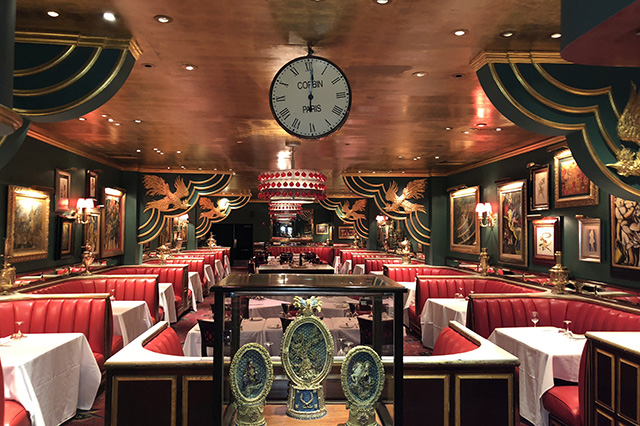
Founded by former Russian Imperial Ballet members in 1927, the iconic main dining room is sure to impress. Over-the-top in the best way, its gold leaf ceilings are offset by deep green walls gilded with firebirds, a gallery of paintings, red leather banquettes and samovars (Russian tea urns). It’s exactly where you might picture yourself with a tier of petits fours and tea, or if you’re really feeling fancy, Champagne and caviar.

Beef stroganoff has been on almost every Tea Room menu over the years in various forms. Today, it is prepared with tender beef short ribs, slow-braised in red wine and herbs and served over noodles with a creamy black truffle and mushroom sauce.

russian tea room
(Photo: The Russian Tea Room)

While you’ll find the stroganoff offered among a selection of continental-Russian fare on the lunch and dinner menus, high tea is also offered daily, featuring a variety of sandwiches and blinis, scones and small cakes. Children’s, vegetarian and gluten-free tea options are also available. Other indulgences include a selection of dozens of vodkas; order a flight to sample several kinds.

Located right next door to Carnegie Hall, The Russian Tea Room has hosted countless actors, politicians and other celebrities and dignitaries over the years. It’s not hard to imagine the days when Salvador Dali would sweep through its doors and into a booth. Dustin Hoffman filmed a scene for the movie “Tootsie” here, and before she was a Material Girl, Madonna worked as a coat check.

The floors above the main dining room are home to lavish private event venues that anyone would be lucky to catch a glimpse of, like the second floor Bear Lounge, where the showpieces include a golden tree of illuminated Fabergé-inspired Venetian glass eggs and a 15-foot revolving bear-shaped aquarium.

Although you can certainly splurge here if you want, for New York City dining, it’s not as expensive as it looks. The pre- and post-theater menu will get you two courses for $45 per person.

For more AAA-approved signature dishes, visit AAA.com/DiamondDish

Subscribe to Your AAA Newsletter

Sign up and receive updates for all of the latest articles on automotive, travel, money, lifestyle and so much more!

Things to Do on and Around the High Line in NYC

The hustle and bustle of NYC is exciting and full of energy. But sometimes with that energy comes the need to escape from the chaos.

The High Line, a 1.5-mile linear park built on an elevated freight line on Manhattan’s West Side, is the perfect spot. It’s scattered with greenery and gardens, art, performances and plenty of spots to sit and people-watch. Plus, there are tons of places to grab a drink or a bite to eat when you get peckish.

Entrances to the High Line

There are many ways to enter the park, which is completely wheelchair-accessible. Visit thehighline.org for a map.

On the High Line

Stop and explore the beautiful landscapes and art exhibits along the path.

The 14th Street Passage

Head to this partially closed passage at dusk to discover videos, curated series, new productions and more through the High Line’s Channel 14 program.

Diller – von Furstenberg Sundeck & Water Feature

Cool off and splash your feet in the water path where water used to accrue on its own back when the High Line was still an unused freight rail. You’ll find it between 14th and 15th streets.

Philip A. and Lisa Maria Falcone Flyover

Covered in giant leaf magnolia, towering trees and beautiful plants, this garden zone was designed to bring you face-to-face with the treetops and nature in all its glory. It’s between 25th and 27th streets.

Art

Every year, the leadership of the High Line commissions new works from artists. The artwork typically stays up for a year. Check out what’s currently on view.

the high line

Food and Drink

In the warm-weather months, you’ll find a bevy of food options along the High Line. These are just few worth seeking out.

Hearth on the High Line

The open cafe and wine bar with stunning views of the skyline and the Hudson River has a fantastic selection of beer and wines to complement the small-plates menu.

Doughnuttery

Follow your nose to these hot and fresh mini doughnuts!

La Newyorkina

A frozen treat to cool yourself off during a sweltering New York summer day is a must! Check out the frozen paletas (Mexican ice pops) in a range of beautiful colors and tasty flavors.

the high line

Near the High Line

Explore Chelsea Market

A must-hit location for foodies, there are countless vendors, artists, and vintage antiques for you to discover at Chelsea Market.

Visit the Whitney Museum of American Art

Pan through nearly 63,000 square feet of indoor and outdoor space filled with 20th-century and contemporary American art, with special attention paid to living artists.

Where to Stay

Executive Hotel Le Soleil

This AAA Four Diamond Designated hotel at 38 W. 36th St. is filled with colorful rooms and chic bathrooms perfect for relaxing after a day discovering the High Line. You’ll also be right in the action near Macy’s, midtown businesses and Fifth Avenue.

Dream Downtown

Close to quaint local shops, cafes and restaurants, you’ll find this stylish Four Diamond Designated hotel at 355 W. 16th St. The boutique loft rooms with round windows and unique decor match the charismatic neighborhood. Enjoy a cocktail on the rooftop nightclub or relax by the pool in a luxurious cabana.

Save with AAA! When planning your trip to NYC, make sure to take advantage of savings on local attractions, tours, activities and shows with AAA Tickets.

What’s your favorite thing to do when you visit the High Line? Share it with us in the comments. 

Subscribe to Your AAA Newsletter

Sign up and receive updates for all of the latest articles on automotive, travel, money, lifestyle and so much more!

AAA Asks: What Makes You Nostalgic?

We’re working on a story about places that don’t exist anymore, and we need your help.

Did you have a favorite restaurant, or chain of restaurants, that closed its doors? What about a beloved brick-and-mortar retail store that’s no more? Or maybe you had a favorite venue, arena or drive-in movie theater that’s gone to seed?

We’d love to hear your memories. Let us know in the comments below and we may just profile your favorite now-defunct places in an upcoming article.

Subscribe to Your AAA Newsletter

Sign up and receive updates for all of the latest articles on automotive, travel, money, lifestyle and so much more!

AAA Technicians Showcase Skills at National Level

AAA Northeast spirit shined bright in July as the region’s top 10 battery technicians competed against each other at a Battery Service Skills Challenge in Providence, R.I.

The three finalists, Joe Charbonneau, John Tart and Michelle Glifort, went on to match their battery mastery against AAA technicians from across the nation for a grand prize at the National Championship in Washington, D.C. in October.

The three technicians represented AAA Northeast after beating out over 600 regional competitors. After placing first at the preliminary event, Charbonneau went on to place fourth at the National Championship.

Greg LeFort, battery program manager at AAA Northeast, traveled to all of the regional events in Connecticut, Massachusetts, New Jersey, New York and Rhode Island and was impressed by what he saw.

“I thought all three techs had a great chance to place in the top three in Washington,” said LeFort.

Each contest was judged based on the battery replacement, testing time and how well the technician interacts with and explains the battery program to the member. This year, AAA Northeast introduced a new tester, B2Q, which dramatically improved the test time and accuracy of the diagnosis.

LeFort had added confidence in Michelle Gilfort, who participated in the national championship last year. While she didn’t place in the top three nationally, Gilfort said she was grateful for the opportunity and is happy to have a job she enjoys so much.

“Last year was a lot of fun,” she said. “It was definitely nerve-wracking, but the energy was great. There’s nothing better than getting together and realizing we’re all here for the same reason. We like what we do, which is helping people.”

Gilfort has been a Roadside Technician in the Bridgeport, Conn., fleet for three years, covering areas from North Haven to Roxbury. Like Gilfort, Charbonneau knew the competition was a chance to prove his skills on the national stage.

“I’ve never accomplished anything like this in my entire life,” he said. “There’s parts of me that could cry right now because I’ve never had an opportunity to prove to myself that I can do this.”

The three technicians received additional training on a weekly basis prior to the two-day event in October.

“When you get to the national event, most people are going to ace the score sheet, and it’s going to come down to the battery replacement,” LeFort said. “I just wanted them to enjoy themselves and do the best they can. Just getting there is a phenomenal accomplishment.”

Subscribe to Your AAA Newsletter

Sign up and receive updates for all of the latest articles on automotive, travel, money, lifestyle and so much more!