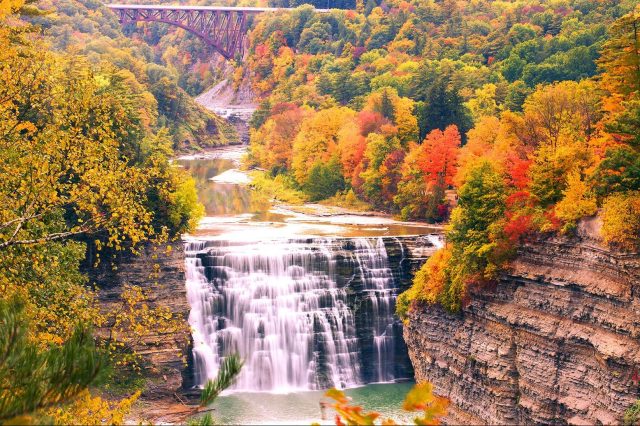
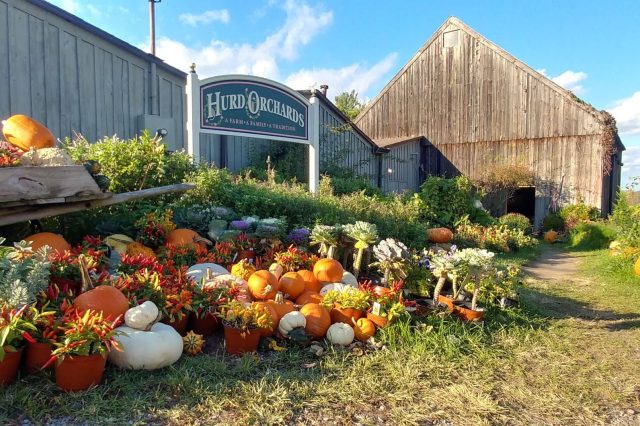
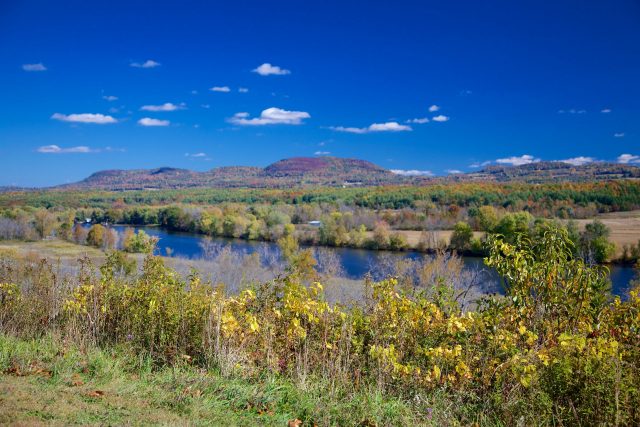
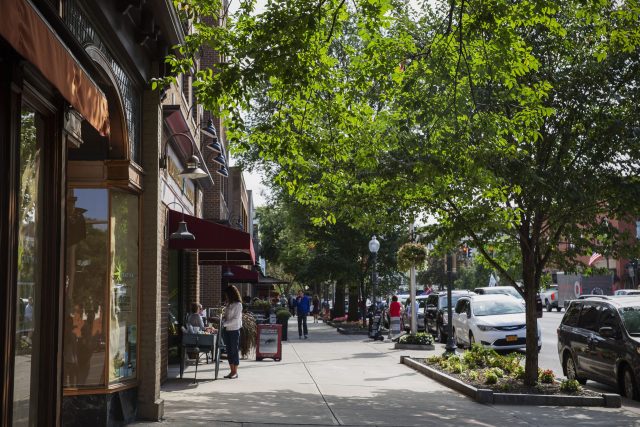
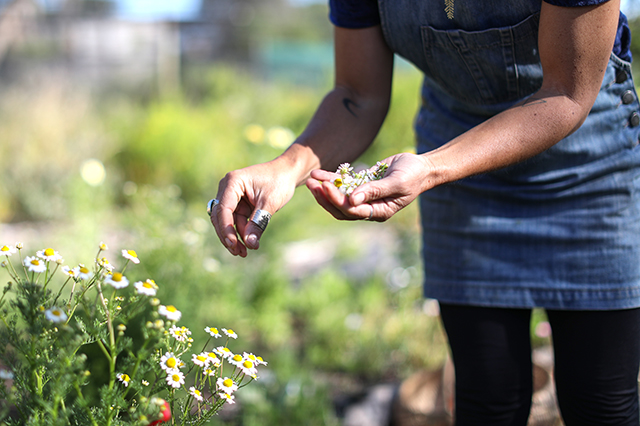
This season, chase the colors of autumn in Wyoming and Orleans Counties. In the Greater Niagara Region of New York, festive, fall-themed activities are plentiful, including hiking, cycling, paddling and world-class fishing. Local farms are offering a variety of autumn-inspired events, including apple picking, barn trails, farmers markets and more.
Discover things to do, where to stay and what to eat during your fall visit.
Located in Castile, N.Y., Pankow Farms is open every day, September through October, from 8 a.m. to dusk. Pankow U-Pick Orchards are home to several varieties of apples, touting Cortlands, Empire, Ida Red, MacIntosh, Northern Spy and Red Delicious, to name a few.
The Microtel Inn & Suites in Warsaw is pet-friendly with free breakfast, Wi-Fi and parking. For a more upscale feel, there’s the intimate boutique hotel, River Spring Lodge. Play mini or regular golf at Byrncliff Golf Resort & Banquets. For a rustic (but still comfortable) stay, there are cabins, tree tents and lakefront cottages at Silverlaken Glamping Resort. Browse places to stay in Wyoming County.
Where To Eat
Glen Iris Inn serves breakfast, lunch and dinner daily, along with picnics to-go. Grateful Grill has burgers, fries and drink specials. Lumberyard Restaurant offers prime rib and seafood, and it’s located minutes from Letchworth State Park. For wine, beer and spirits paired with meats, cheeses, desserts and more, there’s Ration Wine Bar.
In Orleans County, where you’ll find the Erie Canal, Lake Ontario and its tributaries, you have a little extra time to enjoy the fall colors. The foliage peak is weeks behind the rest of the state due to Lake Ontario moderating the temperatures.
Enjoy a scenic drive along quaint, rustic country roads following the Country Barn Quilt Trail of Western New York. Maps to the full trail are available at Partyka Farms in Kendall, N.Y. Try their oven-roasted pumpkin seeds while you’re there.
Where to Stay
You’ll find unique rooms at The Boutique Hotel at Bent’s Opera House, a newly restored 19th-century opera house. For a historic feel, there’s the Hart House Hotel (on the Haunted History Trail) and The Fair Haven Inn. The boutique hotel at Bald Eagle Marina on Lake Ontario and a variety of rental cottages and cabins offer spectacular views of sunsets over the water. Search lodging in Orleans County.
Where to Eat
Head to Harvest Restaurant at Bent’s Opera House for an exquisite farm-to-table experience. For great views, Zambistro has a rooftop dining area overlooking the Erie Canal, while Black North Inn is on Lake Ontario. Holley Falls Bar & Grill serves up seafood, burgers and more while being near the picturesque Holley Falls.
Isabel Stewart y Monica Ramirez tienen un deseo natural de ayudar a los hispanos a navegar por la sociedad mundial que hablan inglés. Se han desempeñado como intérpretes informales en sus comunidades y en sus carreras. Ahora, representarán a AAA Northeast como portavoces de los medios de comunicación bilingüe.
Stewart nació en Cuba y emigró a los Estados Unidos cuando era niña. Llegó a AAA hace cuatro años como supervisora en el centro de llamadas de asistencia en carretera, donde se convirtió en mentora y defensora de los consejeros de llamadas bilingües. Ahora trabaja como coordinadora de proyectos en operaciones de sucursales, donde trabaja en proyectos que brindan mayor accesibilidad para los miembros hispanos.
“Mis padres nunca aprendieron el idioma inglés. Tan pronto como pude hablar inglés, me convertí en su defensor de todo. Y con eso, fui testigo de la discriminación con la que tenían que lidiar con demasiada frecuencia, así como de las oportunidades perdidas por no saber el idioma”, dijo Stewart.
Como representante de seguro en Providence, Ramírez usa sus habilidades bilingües para monitorear un buzón de correo en español y llamar a los clientes que solicitan servicio.
“Emigré a los Estados Unidos desde la República Dominicana cuando tenía 13 años, puedo recordar muy vívidamente el día”, dijo. “Una vez que aprendí inglés, siempre me encontré traduciendo para alguien. Si puedo usar mis habilidades bilingües para ayudar a otros, lo haré, sin dudas”.
En su comunidad, Ramirez da un paso al frente por amigos y extraños. Ella ha traducido para las personas en la farmacia cuando tenían preguntas sobre sus medicamentos y, entre otras cosas, inscribió a un amigo en la clínica de vacunación COVID-19.
Stewart y Ramirez tienen un fuerte deseo de involucrar a la comunidad de habla hispana, razón por la cual fueron seleccionados para representar al club como portavoces de los medios bilingües, dijo Mary Maguire, Directora de Asuntos Públicos y Gubernamentales.
La profundidad del compromiso que demuestran Stewart y Ramirez las hace perfectas para el papel adicional, dijo Mary Maguire, directora de asuntos públicos y gubernamentales de AAA.
“Quedé muy impresionado con Isabel y Mónica durante sus entrevistas. Están claramente dedicadas a hacer que AAA sea accesible para una comunidad más diversa. Es algo que quieren hacer, no solo porque es divertido, sino porque es una pasión “, dijo Maguire Mary.
Ellas responderán a las solicitudes de los medios de comunicación en español en todas las formas: en cámara, por teléfono o en un comunicado escrito. Es probable que los temas principales sean la seguridad del tráfico, los precios de la gasolina, los viajes y el transporte. Las solicitudes de los medios en español están aumentando, al igual que la población hispana en todo el territorio AAA del noreste, dijo Mary. En el pasado, Asuntos Públicos ha respondido a través de traductores.
“Estoy muy orgullosa de que ahora podamos ofrecer una voz que pueden comunicarse directamente con una audiencia hispana”, dijo Maguireshe. “En mi opinión, a medida que los medios de comunicación sean cada vez más conscientes, recibiremos más solicitudes y esto fortalecerá nuestras relaciones”.
Stewart y Ramirez cubrirán principalmente las solicitudes de los medios en las áreas de Rhode Island y Massachusetts y ocasionalmente también ayudarán en otras regiones. Comparten el entusiasmo por la oportunidad.
“Espero concientizar a la comunidad latina sobre los productos y servicios que ofrecemos”, dijo Ramírez.
“Estoy ansiosa por representar a AAA y demostrar que somos una organización que hace mucho y está dispuesta a hacer mucho más por su comunidad”, dijo Stewart.
If you’re thinking of taking your studies out of the country, you’re not alone. After over a year of being on hold due to the pandemic, study abroad programs are starting to ramp up again and students are anxious for the opportunity. While there are extra challenges to navigate like travel restrictions and warnings from the Centers for Disease Prevention and Control, studying abroad is surely making a comeback.
Europe is consistently the most popular destination for U.S. students studying abroad with 44% choosing to go to Spain, Italy, the United Kingdom, France and Ireland, according to the most current data from the Institute of International Education’s Open DoorsReport and the U.S. Department of Education’s National Center for Education Statistics. Asia and Latin America are also top picks.
If you are looking for inspiration, here are some of the top spots to study abroad. And for those who want to explore a little closer to home, no worries. We’ve got you covered, too.
London is a heady mix of history, culture and unforgettable sights, including the Elizabeth Tower (which houses Big Ben), Buckingham Palace and Westminster Abbey. In your down time, you can check out various props, costumes and sets where all eight Harry Potter movies were filmed.
2. Rome
The food. The art. The historic surroundings. What’s not to love? U.S. students adore the Eternal City, too. Students spending time here can explore the treasures of the Vatican and the Basilica of St. Peter, the Colosseum, the Roman ruins and gorgeous works inside the Galleria Borghese.
3. Madrid
Artists, foodies and history buffs will find plenty to do in Spain’s capital city. The Prado Museum is home to works by Rembrandt, Titian and Rubens, while you can see Picasso’s masterpiece “Guernica” at the Reina Sofia Museum. A visit to the city wouldn’t be complete without sampling tapas and churros con chocolate in the La Latina district.
4. Paris
Thank goodness semesters last four months. Otherwise you’d run out of time trying to explore the City of Light. English and literature majors can see the haunts of ex-pats like Gertrude Stein, Ernest Hemingway and F. Scott Fitzgerald, while fans of impressionism will be entranced by the Musee d’Orsay. Of course, any visitor must set aside time to see the classic sites like the Eiffel Tower, the Louvre and Notre Dame.
5. Dublin
Spend some time in Ireland’s capital. The ancient city is home to Trinity College and the Book of Kells, while fans of James Joyce can view the sites that inspired “Ulysses” and “Dubliners.” After a visit to the Guinness Storehouse, browse the treasures inside the (free!) National Gallery of Ireland.
6. Florence
Art majors will lose their hearts in this Tuscan city. Michelangelo’s “David” is housed in the Galleria dell’Accademia, while Uffizi Gallery is full of Renaissance masterpieces, including Botticelli’s “Birth of Venus” and Titian’s “Venus of Urbino.” And for the best selfie ever, grab your phone and head west – the Leaning Tower of Pisa is just an hour’s drive away.
7. Sydney, Australia
At first glance, it’s easy to see why Australia’s largest city is a draw for U.S. students: the glorious beaches. But if you look closer, you’ll discover that it has a fascinating history, a burgeoning dining and nightlife scene and a plethora of outdoor activities to explore in your downtime, from touring the rugged coastline to exploring the wild Blue Mountains.
8. Venice
With more than 100 islands and miles of connecting canals, Venice is one of Italy’s most beautiful regions. Students here can explore the glass-making region of Murano to the city’s Grand Canal to the centrally located Piazza San Marco. Visit the Rialto market, where the locals gather to stock up on fresh fruits, vegetables and fish, to get a feel for daily life in the city.
9. Washington, D.C.
If you’d rather explore U.S. history, where better to begin than the nation’s capital. Here you can get up close with the Constitution, view the White House, U.S. Capitol and Supreme Court, and visit any number of memorials. Cash-strapped students, take heed: All of the Smithsonian’s D.C.- area museums, galleries – and even its zoo – are free.
10. Los Angeles
Inject some glamour into your studies by hitting the books in Tinseltown. You’ll never feel alone in the nation’s second-biggest city, with a population of 4 million. But L.A. is more than just Hollywood and sunny skies; you can discover the region’s natural beauty in the San Gabriel Mountains and the many beaches along the Pacific Coast.
After a great round of cardio exercise, the heart-pumping cool down is usually welcome. But do you know if it’s too much or too little?
Your heart rate is an indication.
If your heart rate is too high during exercise, you could be straining yourself, according to the American Heart Association. If it’s too low, you may not reach your fitness goals. Knowing how to calculate and monitor your target heart rate can help improve your overall fitness.
Calculating Your Target Heart Rate
First you must find your maximum heart rate. Do this by subtracting your age from 220. For example, a 20-year-old’s average maximum heart rate is 200 beats per minute. A 65-year-old’s is 155 beats per minute.
Your target heart rate should be 50 to 70% of your maximum heart rate during moderate exercise. Following the previous example, the average target heart rate of a 20-year-old would be 100 to 140 beats per minute, while a 65-year-old’s should be between 78 and 109 beats per minute.
Monitoring Your Heart Rate
Periodically check your pulse as you exercise. Place two fingers on your wrist closer to your thumb, over the blood vessels, and count your pulse for 10 seconds. Multiply that number by six to find your current heart rate.
If it’s higher than 50 to 85% of your maximum heart rate, you’re straining. If it’s lower, and the intensity of your exercise feels light, you may want to increase the intensity.
According to the American Heart Association, the more beats your heart has to take eventually takes a toll on its overall function. So, if you’re pushing yourself too hard as you exercise, your risk of developing cardiovascular disease increases.
Plus, if you monitor your heart rate, you’re more likely to notice a change in rate and regularity, which can be a sign of a heart condition.
Check with your doctor before beginning any new exercise routines.
What’s your cardio routine like? Tell us in the comments below.
For the second time in two years, AAA Northeast has helped to pass a rear seat belt law, this time in Connecticut.
Earlier this year, AAA Northeast’s Public Affairs team partnered with the Auto Club Alliance to push forward a bill that requires everyone in a vehicle to buckle up, even those in the backseat, regardless of age.
The new Connecticut seat belt law, which received bipartisan support and was signed by Governor Ned Lamont in July, goes into effect on Oct. 1, 2021. The goal behind the law is to save lives, reduce serious injuries and make the roadways in Connecticut safer for everyone.
Connecticut was one of the first states to pass a seat belt law, requiring seat belts to be worn by drivers and all front-seat passengers back in 1985. However, the state’s law only required back-seat passengers ages 16 and under to wear seat belts.
Safety belts can reduce the amount of serious traffic injuries by 50% and the number of fatalities by 60-70%, according to the Connecticut Department of Transportation.
What’s more, unbelted rear seat passengers are three times more likely to be killed and eight times more likely to be injured in a car accident compared to restrained passengers.
AAA Director of Public and Government Affairs, Alec Slatky, standing with Governor Ned Lamont, Conn. Highway Safety and others to announce the new rear seat belt law.
“Connecticut has taken a significant step to reduce serious injuries and fatalities involving unbelted rear seat passengers,” said Alec Slatky, AAA Northeast director of Public and Government Affairs. “Given the spike in roadway fatalities last year, passage of this lifesaving measure is cause for celebration.”
Discover more information about driving and transportation laws at Connecticut’s official state website, CT.gov.
Read the story about AAA Northeast’s role in New York’s new seat belt law, which took effect on Nov. 1, 2020.
Learn more about AAA-led safety initiatives in the community.
After water, tea is the second most consumed drink in the world, according to Statista. What’s more, a freshly brewed cup of tea can also pose some health benefits.
Whether you’re an avid tea drinker or just an occasional sipper, there are a wide variety of teas to explore.
Check out our guide to teas and their health benefits.
What Is Tea?
Tea comes from a subtropical, evergreen plant called Camellia sinensis, according to TeaClass by online gourmet tea retailer Adagio Teas. Camellia sinensis is native to Asia, but it is also grown in places across the globe today.
How the plant’s leaves are processed determines if it becomes black, green, oolong or white tea. Before ending up in your cup, tea leaves are generally picked and withered before being rolled. The leaves are then oxidized to varying degrees, which affects the flavor and sometimes the nutritional benefits, before finally being dried.
And though you may not need a guide to tea to tell you, it’s made into a beverage by pouring hot water over the dried buds, flowers and/or leaves of the tea plant and allowing them to steep for a specific amount of time.
The Health Benefits of Tea
“Tea contains substances linked to a lower risk for heart disease, cancer and diabetes,” according to Harvard Health Publishing. “The main health-promoting substances in tea are polyphenols, in particular catechins and epicatechins. Lab and animal studies say these molecules have anti-inflammatory and antioxidant properties. Harvard-led studies of large groups of people over time have found that tea or coffee drinkers are at lower risk for diabetes and possibly cardiovascular disease.”
Brewed tea is also low in calorie and good source of naturally occurring caffeine. Some research suggests caffeine can help prevent cognitive decline.
Guide to Tea: Varieties
You can choose your perfect cup of tea based on several factors, like flavor profile, aroma, caffeine content and more.
Darker teas typically have higher amounts of caffeine and bolder flavors compared to lighter ones. However, letting any tea steep longer will result in more flavor and caffeine to be released. Follow steeping instructions on packaging and add or subtract a minute or two to better suit your preference.
Black Tea
One if the stronger types of tea when it comes to flavor, steeped black teas can be a dark brown or reddish-brown color.
Black tea varieties include English and Irish breakfast, Earl Grey and chai. A cup of black tea typically has about 47 milligrams of caffeine – higher than a majority of other teas but generally less than a cup of coffee.
Some black teas can taste a bit astringent, which is why adding a splash of milk or a sweetener is common.
Green Tea
Fresh leaves are steamed or pan-fired in order to make green tea, according to TeaClass. Green tea is usually a pale green or yellow-green hue. Green teas can vary in flavor, tasting anything from fresh, grassy, earthy, toasty or smoky. A cup of green tea contains about 28 milligrams of caffeine.
Pro tip: You don’t want to over-steep green tea, as it can become bitter.
Matcha is a type of Japanese green tea made from powdered tea leaves. It has high levels of antioxidants and proponents claim it’s an especially healthy form of green tea.
White Tea
The least processed type of tea, white tea is also one of the most mild and delicate in flavor and aroma.
When steeped, white tea is often very pale green or yellow in color. White peony is one of the more popular types of white tea.
Oolong is a traditional Chinese tea. It is also one of the most time-consuming teas to create, according to TeaClass, since it requires repeated rolling and oxidization.
Somewhat of a mix between black and green tea, Oolang is known for being smooth. Notable richness and a floral or fruity taste are also common.
“A cup of brewed oolong tea contains small amounts of calcium, magnesium and potassium,” according to Healthline. “It also contains about 38 milligrams of caffeine.”
Pu-erh Tea
Another type of traditional Chinese tea, pu-erh is fermented.
“Depending on the type of pu’erh being made (either dark ‘ripe’ pu’erh or green ‘raw’ pu’erh), the aging process lasts anywhere from a few months to several years,” according to TeaClass.
Pu-erh tea usually comes as loose leaves or pressed shapes. This type of tea can have anywhere from 30 to 100 milligrams of caffeine, depending on the age.
Herbal Teas
Herbal teas are not made from the Camellia sinensis plant, but from dried herbs, flowers, fruits or spices.
Some popular herbal teas and their medicinal associations include:
Chamomile – sleep aid
Rooibos – anti-inflammatory
Echinacea – immune support
Ginger – nausea relief
Peppermint – digestion aid
Rosehip – vitamin C
Sage – brain health
Making Tea
There’s nothing like curling up with a warm mug of tea on a crisp morning, afternoon or evening. Discover your perfect cup of tea by trying different varieties and making them your own. Sweeteners like honey, sugar or agave nectar can help cut the acidity of certain brews.
Did you find this guide to tea helpful? If you are looking for more healthy beverages, you may also like our guide to nondairy milks.
Are you a tea drinker? Tell us your favorite kind of tea in the comments.
When’s the last time you looked at your grocery store receipt? Are your utility bills set to automatic payment so you don’t even have to think about them? The truth is, common expenses often get overlooked and disregarded. But you need to have a solid understanding of your expenses if you want to stay in a good financial position.
It may seem like the cost of something as inexpensive and readily available as a gallon of milk is inconsequential. But it’s precisely because these items are so common, and purchased so often, that even small changes can swing a budget one way or another over time. (Who knows — maybe after a review of your grocery expenses, you’ll find you can afford to upgrade to a fancy almond or oat milk.)
So, how much does a gallon of milk cost? How about internet service? We dug through the numbers to find the national average price of everyday goods and services. Take our quiz to see how well you know your prices.
How did you do? Let us know your results in the comments below!
What do you think about when you think about your legacy? Do you want to leave something behind for your children and grandchildren? How do you want people to remember you? How can you make a change in the world after you are gone?
Many people, when reflecting upon these questions, decide to leave a portion of their estate to charity. But how do you leave your estate to charity? Here’s our guide on how to leave a charitable bequest.
Choosing a Charity
If you decide to leave your estate to charity, you might have an idea in mind about what charity you should choose. Most people decide to leave money to charities for things that have touched their lives, or the lives of their loved ones. A cancer survivor might donate money toward cancer research, or a first-generation college student might donate money toward a scholarship fund.
Ask yourself what causes you care about, then do some research into the charities that support those causes. Consider the charity’s goals, mission statement and level of financial transparency before you make a choice.
A great resource for researching charities is the website CharityWatch, a watchdog group that determines a charity’s financial efficiency, accountability and fundraising tactics. You don’t want to leave all your money to a charity that might squander it. CharityWatch or other organizations like it can help you find an ethical and well-run charity. You can also consult your state consumer protection office or the Better Business Bureau.
Once you choose your charity, you can also name a back-up charity your bequest should go to if the original charity is no longer operating.
What to Leave Behind
If you plan to leave your entire estate to charity, that’s a very special and generous choice. However, most people will want to split their estate up between a charity and some loved ones. If you are only leaving some of your estate to charity, do not specify a specific dollar amount. It’s generally agreed upon that you should instead specify a percentage of your estate. This way, no matter how large or small your estate winds up being, your beneficiaries will still get the percentage that you planned for them.
Another option is to name a charity as the beneficiary of your life insurance plan, IRA or 401(k). A financial planner can help you update your plan’s beneficiary designation accordingly.
Remember that making a charitable bequest will also reduce the size of your estate – this leaves less money subject to estate taxes.
What assets would you like to leave to the charity? You can of course donate money, but you can also donate property (like real estate or some rare antiques) to the charity of your choice. Depending on the type of charity it is, the donation of property could be even more helpful than a monetary donation.
If you plan on donating property, make sure to contact the charity ahead of time and ask if there are any special arrangements that should be made.
Putting It in Writing
When you have decided on what you want to leave behind and to whom, the most important thing you can do is enlist the help of an estate planning attorney. They can make sure you do everything correctly, and don’t leave any unintentional loopholes behind. Your estate planning attorney will update (or create) your will or trust to include your bequest.
Make sure you get the correct name and address of the charity you plan on donating to. Many charities for similar causes have very similar names, and you don’t want a mix-up.
When making a charitable bequest, you can specify how you would like the money to be used. Donating to an aquarium? Maybe you want the money to go specifically to the jellyfish exhibit. Donating to a hospital? Maybe you want the money to find its way to the children’s wing. If you want to attach such strings to your donation, make sure you put that in writing in your will.
When Your Plans Are Made
After you have made all your plans and put them in writing, you don’t have to keep them to yourself. Contact the charity you plan on donating to and let them know! Many charities have legacy societies for people just like you, who plan to leave a charitable donation in their will.
This can also provide the opportunity to speak directly with the charity about how you want your money to be used, and even why you have chosen to donate in the first place. It’s a great way to get a glimpse at how your gift will impact the charity of your choice.
As an organization, AAA is an advocate for road safety and preventing impaired driving – whether it be a result of alcohol, marijuana or other illicit drug use.
According to a study by the AAA Foundation for Traffic Safety, younger drivers are more likely to say they think it is safe to drive after using marijuana.
In response to the continued legalization of recreational marijuana, AAA hopes the Shifting Gears program will deliver potentially life-saving information to teenagers and young adults.
The Start of Shifting Gears
After Shifting Gears first launched in 2019, AAA Northeast President and CEO John Galvin praised the program, citing early successes, open dialogue and largely positive reception.
“This program has far exceeded our expectations. Not only are we educating teens, but we’re also learning a lot,” said Galvin. “We’ve learned that teen attitudes around marijuana have shifted. Some students are very open about their drug use. Some believe marijuana is better for them than prescription drugs taken for anxiety or ADHD, because they consider it natural, even if the source is unknown and the dosage is uncontrolled.”
This year, AAA Northeast began working closely with the Rhode Island State Police’s Community, Equity and Diversity Unit. The Unit’s leader, Captain Kenneth Jones, is a 23-year veteran of the Rhode Island State Police.
Captain Jones committed Rhode Island troopers to speak in all of this year’s Shifting Gears programs, where they explain the risks of marijuana-impaired driving to high school health classes. When the COVID-19 pandemic required a pivot to virtual learning, troopers were able to join Zoom and Google Classroom sessions along with AAA Northeast educators.
Impacts of the Program
This partnership between AAA and the state police, which has since expanded to Massachusetts, has proven to be extremely successful. During the sessions, students ask great questions and troopers share first-hand experiences as well as strong reminders about current state laws and the impact of impaired driving.
What’s more, these young people’s attitudinal shifts toward impaired driving are measurably better. Students walk away with stronger opinions that marijuana impacts the necessary abilities to drive safely, such as reaction time. Additionally, pre and post-program surveys showed a positive shift in students’ plans to designate a driver if ever faced with such a scenario.
Looking Toward the Future
AAA Northeast’s relationship with the Rhode Island State Police’s Community, Equity and Diversity Unit will expand in September, incorporating child passenger safety programs to assist families with child car seats and booster seats.
For more traffic safety information from AAA, visit AAA.com/Community.
In September of 2007, it rained 28 out of 30 days in London. I know because I was there and I counted. I counted because I wanted to quantify my misery and stupidity, states induced by the hole in my rain boot.
It was a rookie mistake, really. I was studying abroad for the semester and was permitted to bring two suitcases. Of course, like every know-it-all college student in her early twenties, I knew exactly how to pack a suitcase efficiently (yeah, right.) Rain boots, I decided, would take up too much room and were too heavy.
So there I was, combating daily downpours and forever skirmishing against a seemingly permanent state of mist with my arsenal of eight cocktail dresses, eight coordinating pairs of heels – including the essential gold glitter pair – and a giant teddy bear named in honor of my stateside boyfriend.
With a less-than-favorable exchange rate and a shoe size that didn’t quite line up with a U.K. equivalent, I bummed a pair of galoshes off another American student with a sprung hole and cursed those glitter heels with every water-soaked step.
I spent the next six months traveling Europe, mastering the “weekend-getaway-in-a-purse” and “Mediterranean-cruise-in-a-duffle-bag” packing challenges. I discovered I could fit twice as many clothes into a suitcase when I rolled them instead of folded them, how to prevent (or at least contain) toiletry explosions, and that I really only needed two or three pairs of shoes. I like to think I mastered how to pack a suitcase.
I recently returned to London, traveling with my best friend, who laughed when I showed up to the airport wearing my rain boots. They were too heavy for my suitcase and took up too much room, but there was no way I was I leaving them behind this time.
Fortunately, you have the advantage of benefiting from my mistakes and my chronically wet right pinky toe circa 2007. Whether you’re traveling abroad, to a beach destination, waterpark or theme park or are headed out on a camping or road trip, we’ve put together a fool-proof list of dos and don’ts when it comes to how to pack your suitcase.
How to Pack a Suitcase for…
A Wilderness Adventure
If you’re headed into the great outdoors for a camping or hiking trip, you’ll have to make a few tweaks to your packing list. Make sure your clothing is quick-drying or wicking, switch out the fancy attire for rain gear and be sure to pack a warm hat and gloves. If you are traveling by plane, use your backpack as your carry-on and wear your hiking boots on the flight to save space and weight in your baggage.
The Beach or a Cruise
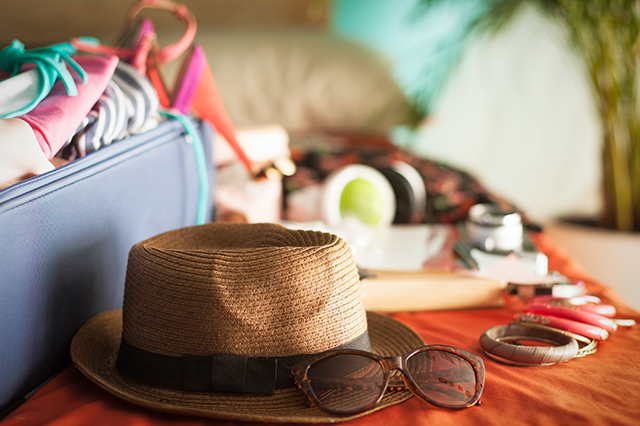
If you’re headed for a warm, sandy locale or are counting down the moments until you’ll be sunbathing on the deck of an ocean liner, you’ll definitely need a swim suit. Gentlemen should pack two to three pairs of trunks. Ladies can double the number of suits they bring by packing solid color tops and bottoms that can be mixed and matched. Choose a floppy hat that will fold in your suitcase versus a straw one, opt for the Kindle instead of a book (don’t forget the charger!) and pack lots of island white (it goes with everything!).
A Theme Park or Water Park
Heading out into the jungle of a Florida theme park is a completely different type of adventure and requires a unique form of preparation. Being ready for the unexpected is the name of the game. Tackle long days of walking and waiting on lines in the heat by bringing your own water bottles, sunblock, cool clothing and most importantly, comfy sneakers. When it comes to water rides and unexpected thunder storms, you’ll want to be ready with a poncho and maybe even a dry change of clothes for the little ones.
A Road Trip
Ward off road trip boredom by putting together a list of road games and making themed playlists for each leg of the journey before you go. Whenever traveling by car, it’s also important to have a properly stocked emergency kit with essentials like a first aid kit, flares, snacks, flashlights and blankets. Remember to download the AAA mobile app or have your card handy in case you need to request require roadside assistance.
Don’t Forget!
Double check that you have these essential items before walking out the door: phones, chargers, wallets, IDs and passports.
Now that you know the dos and dont’s of how to pack a suitcase, find hotels and book your next trip today at AAA.com/Travel.
What was your worst packing mistake that you will never repeat? Tell us in the comments.
Although thoroughbred racing in Saratoga has come to a close for the season, there is still so much to see and do in Saratoga, New York, in the fall. With a variety of dining, shopping and outdoor recreation opportunities, not to mention prime foliage views of the Adirondacks, it’s a road trip destination the whole family can enjoy. The area also happens to be a history buff’s dream, with historically significant sites, buildings and museums to explore. Here are a few you won’t want to miss.
Saratoga National Historical Park was a significant location during the American War for Independence. In 1777, American troops battled and defeated a British invasion during the Battles of Saratoga. Here you can visit the site of the first-ever British Army surrender and the turning point of the American Revolution.
Today, the park has nature trails to walk, hike and bike. Visitors can enjoy educational programs throughout the year, along with amazing natural views, gorgeous foliage and tons of wildlife to see.
While in the park, history lovers can also stop at the home of Major General Philip Schuyler. If you are a fan of the play “Hamilton” you may recognize the name from the Schuyler sisters; Hamilton married Schuyler’s daughter Elizabeth (Eliza). The house is currently closed due to ongoing restoration but can still be admired from the outside.
Located in Saratoga County, Grant Cottage is where General Ulysses S. Grant, Civil War commanding general of the U.S. Army and eighteenth President of the U.S., completed his memoirs mere days before passing away. Grant Cottage is a National Historic Landmark. Visitors can partake in guided tours of the downstairs cottage interior and explore the site grounds and visitor center exhibits.
The New York State Military Museum displays history dating from the Revolutionary War to the present. A substantial part of the museum’s collection contains items from the Civil War. The museum is home to a historic armory and more than 25,000 artifacts, including battlefield souvenirs, fine art, uniforms, weapons and more. There’s also the Veterans Research Center, which houses a 12,000-volume library with over 24,000 photographs, 2,500 oral histories of New York veterans and more.
The National Museum of Racing and Hall of Fame honors the history of thoroughbred racing in America along with the sport’s most accomplished participants. This museum is located in Saratoga Springs, which is also home to the oldest thoroughbred racetrack in America. Museum attractions include plenty of exhibits, a horse racing simulator and interactive Steeplechase Gallery.
These historical gardens are part of Yaddo Mansion. Dating back to 1899, the gardens were a gift from financier Spencer Trask to his wife Katrina. The couple wished for their estate to be used as a haven for artists, but that the 10-acre property stay free and open to the public. Visitors are invited to view the rock, rose and classical Italian gardens and can also enjoy docent-led or self-guided private group tours of the grounds.
Located less than 10 miles southwest of Saratoga Springs, the National Bottle Museum is home to a wide variety of bottles and items related to bottle-making, including bottles from around the U.S., uranium glass and a glass paperweight collection. There’s also the JRM Artists’ Space, a gallery for artists of diverse mediums to showcase their artwork.
Discover even more activities, attractions and history in Saratoga.
® I LOVE NEW YORK is a registered trademark and service mark of the New York State Department of Economic Development, used with permission.
Local flavor doesn’t get any more local than this.
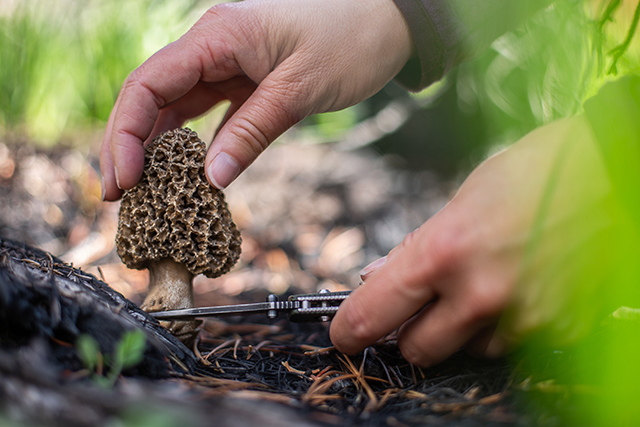
Many farm-to-table (also known as farm-to-fork and field-to-table) restaurants across the Northeast are enlisting the help of foragers to add diversity to their inventory of ingredients.
Foraging is the act of looking – or hunting – for fresh, in-season fruits, vegetables, greens, herbs and mushrooms from the wild. Professional foragers have the knowledge and trained eyes to identify a wide variety of plants, honing their abilities to tell the difference between delicious wild ingredients and potentially inedible lookalikes.
Incorporating fresh, local and seasonal ingredients foraged from nature – whether it be forests, mountains, valleys or anywhere in between – elevates any dining experience. And restaurants are increasingly adding wild plants to their menus for flavor as well as ethical and environmental reasons.
The Truth About Foraging
Tama Matsuoka Wong is a professional forager and cookbook author based in New Jersey. She defines foraging as “harvesting wild plants for food, although what is ‘wild’ and ‘not so wild’ is not always a hard line.”
“Being an ‘artisan’ forager does require skill, and only gets better the more experience you have. Some people call this ‘wildcrafting,'” said Wong. “The rewards are that the plants become more multifunctional and delicious, once you determine the best time and way to pick it as well as how to prepare/cook it.”
Wong has been foraging informally since she was young. She remembers picking wild mulberries for her mother as child – though she didn’t call it foraging at the time.
Today, she forages herbs, greens, vegetables, fruits, nuts and seeds for the renowned Restaurant Daniel along with retailers like Fresh Direct, Farm to People and Natoora, which are looking for more local plant-based items.
Wong’s advice to the foraging-curious public is to educate yourself and practice.
“Learn about the plants around you, in your backyard or garden. Many are healthy and delicious,” said Wong. “Foraging them is a great way to become more self-sufficient as well as a convenient way to ‘grocery shop’ – you just need to stop trashing them as ‘weeds.'”
Foraging in the Northeast
If you’re interested in sustainability and fresh, delicious food, check out this list of restaurants in the Northeast that source ingredients from local and in-house foragers.
Chef Bun Lai – whose mother opened Miya’s in 1982 – is a James Beard-nominated chef, an avid forager and sustainability activist, crafting seafood-, plant- and invasive species-based sushi and cuisine. While Miya’s Sushi brick and mortar location closed in 2020, it has “metamorphosed into an eatery in the woods where we hold intimate gatherings that foster a deeper connection between human beings and nature,” according to its website. “Additionally, Miya’s does pop-ups around the country and catering for special events.”
Harvest Wine Bar – Greenwich, New Haven, West Hartford and Westport
Harvest features modern American cuisine, including dishes with Asian, Latin and Mediterranean influences. The family-owned restaurant follows a “farm-to-fork” philosophy, supporting local and organic farms in order to serve fresh, seasonal and high-quality ingredients. Their mushrooms are sourced from a local mushroom forager located in Newtown, Conn.
Stone Row Kitchen + Bar serves “homegrown” food. The menu showcases ingredients sourced from regional farmers, foragers and fishers. Some menu highlights include duck fat fingerling potatoes, grilled asparagus Benedict and the grass roots burger. Check out chef Tyler May’s seasonally inspired menus.
Find more farm-to-fork eateries in Connecticut. Want to try foraging? Find a class or tour in Connecticut near you.
This farm-to-table neighborhood bistro relies on partnerships with local farmers, fishermen and foragers to deliver modern twists on classic dishes. Fresh, seasonal ingredients make up much of the menu. Popular dishes include the fiddleheads & mushrooms, “One Local Cheese” course and lemon cake. See Forage’s dine-in menu here.
Discover modern French cuisine at Deuxave, which sources quality ingredients from local farmers, fisherman and foragers. Chef/co-owner Christopher Coombs loves using seasonal, local ingredients – especially those from the Northeast. This is evident in menu items like the Rhode Island striped bass crudo, native lobster & spaetzle and spiced Long Island duck breast.
This neighborhood bistro and bar offers dishes for a variety of diets, including gluten free, vegan and vegetarian options. Chef/owner Evan Mallett is an experienced forager who named both his restaurant and book, “Black Trumpet,” after the popular edible fungi. Mallett’s menu is inspired by ingredients from New England’s eight distinct seasons (early and late periods of each season).
Greenleaf is a farm-to-table restaurant that sources its ingredients from local farms, foragers and fishmongers, including Northeast Family Fisheries, Three Rivers Farm Alliance and several farms. The menu takes inspiration from the seasons and local New England goods, with fare like the local cheese board and drinks like seasonally inspired cocktails and local craft beer.
Oak & Grain’s menu features local and sustainable fish, meat and produce that are sourced from regional fishers, foragers and over 20 farms. Chef Bryan Leary is a forager himself and brings eggs from his own chickens and uses herbs from the inn’s gardens.
Park Place is home to creative, modern dishes that highlight fresh, local and seasonal ingredients. The menu consists only of “the finest ingredients and wild foods we forage ourselves,” according to its website. Chef Phil Manganaro is a forager, and the restaurant also sources ingredients from local farmers and purveyors.
Dinning at Crystal Springs Resort is a celebration of local fare, since a wide variety of menu items are sourced from local foragers. Foraged ingredients range from ramp bulbs, plum blossoms and wild ginger to five different types of mushrooms. See a sample menu.
Elements features “Interpretive-American” cuisine by utilizing fresh, local ingredients. Executive chef/co-owner Scott Anderson and his team work with local farmers, foragers and butchers daily, prepping ingredients for the restaurant’s four-course tasting menu, nine-course chef’s tasting menu and a la carte options.
Home to some fantastic New York-inspired Korean food, Ssam Bar is part of the Momofuku Group, founded by chef David Chang. The menu features a mix of smaller dishes – ssam means “wrapped” – along with some larger fare and cocktails. Forager Evan Strusinski provides a variety of mushrooms, including black trumpet, maitake and yellow foot.
Foragers is a farm-to-fork style restaurant (in Chelsea), market (in DUMBO) and eatery and butcher’s counter (in Brooklyn) featuring clean, ethical food made from fresh, high-quality ingredients sourced from the Hudson Valley.
Anise hyssop is a perennial herb native to our region and easy to grow in a backyard garden. (Photo: Daniel)
This AAA Five Diamond French restaurant is based in Manhattan but sources its ingredients straight from nature. Resident forager Tama Matsuoka Wong supplies Executive Chef Eddy LeRoux with fresh, seasonal ingredients. The two also wrote “Foraged Flavor” together, a cookbook featuring wild plant recipes.
Hyper-local and seasonal ingredients are all part of the AAA Five Diamond experience at Ocean House, which boats its own in-house forager, Chef James McNamee.
Farm-to-table dinning at the AAA Four Diamond Weekapaug Inn features modern interpretations of New England coastal cuisine. Menu items are created using traditional native foraging, local produce and fresh off-the-boat seafood.
What’s in a name? According to Shakespeare, not much. But carmakers would disagree with the Bard.
Establishing a new car model name is serious business, one that involves input from every corner of the company: research and creative teams devise a list of potential options, marketing executives ensure the name has mass appeal, lawyers confirm the moniker doesn’t infringe on a trademark, etc. The end result is a vast array of car names – some that simply sound cool, others that tell much more, from a vehicle’s origin to its engine performance.
The inspiration behind many car model names is both obvious and intentional. The Greek titan Atlas held up the sky, making him the perfect namesake for Volkswagen’s first seven-passenger SUV. The Toyota Prius revolutionized electric vehicles and is aptly named after the Latin prefix meaning “to go before.” The Kia Sedona and Hyundai Santa Fe exhibit the same ruggedness defined by their eponymous Southwest cities.
While these titles may lack a creative backstory and the need for explanation, many car names do not. And though car companies have yet to agree on a uniformed naming system, a look around the current automobile market shows a few common themes.
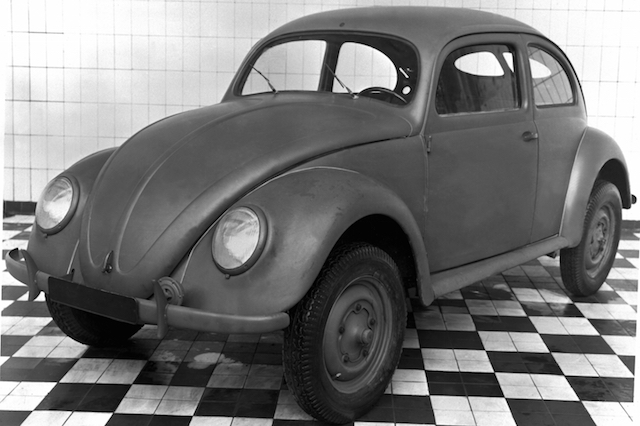
The original name of the Volkswagen Type 1, aka the Beetle, was KdF, or the Kraft-durch-Freude-Wagen.
Animals
Some of the most famous cars in history have been named after animals, none more well-known than the Volkswagen Beetle. The Beetle moniker’s origin story is unique in that it was not the car’s original name. When the vehicle first went into production, it was known as the KdF, short for Kraft-durch-Freude-Wagen, German for Strength-Through-Joy car, or more commonly, Volkswagen, meaning “people’s car.” In 1938, Germany held a ceremony marking the start of construction of the first Volkswagen. The event drew thousands of spectators and garnered international press. In its coverage, the New York Times predicted Germany’s autobahns would be inundated with “thousands of thousands of shiny little beetles.” Over time, Beetle went from a nickname to the official car model name.
On this side of the pond, the Ford Mustang is among the most legendary American car names. The title was the brainchild of one of the Mustang’s designers, John Najjar. As legend has it, Najjar had been reading about the P-51 Mustang airplanes flown during World War II and suggested the name to his boss, who promptly rejected it. Undeterred, Najjar pitched the Mustang moniker again, but this time associated it with a horse instead of a plane.
Ferruccio Lamborghini’s passion for bullfighting his astrological sign – Taurus – led to the car company’s famous bull logo. The name of its cars followed suit. The automaker’s current three-model lineup includes the Aventador and Huracán, named after famous Spanish fighting bulls, and the Urus, the name of the ancestor species of modern cattle.
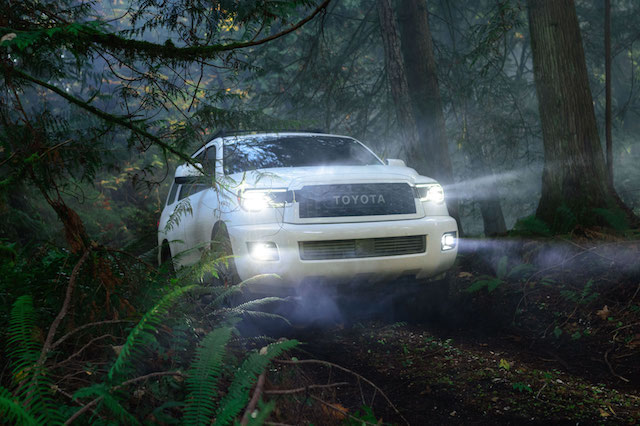
The Toyota Sequoia gets its moniker from the tree of the same name.
Nature
Several of the world’s largest automakers have taken their naming cues from Mother Nature, few more prominently than Toyota. Corolla refers to the crowning portion of a flower and Highlander to the Scottish Highlands. The Toyota Sequoia is named after the tree of the same name, while Tacoma is derived from the Salish Native American name for Mount Rainier.
In the 1970s, Volkswagen went through a phase of naming its new vehicles after different types of winds. Jetta is German for jet stream, Golf translates to gulf, referring to the Gulf Stream, and Passat is short for passatwinde, the German word for trade wind.
BMW has a rather straightforward way of naming its automobiles.
Numbers and Letters
Several carmakers have eschewed creative naming strategies and use a simple numbers-and-letters nomenclature instead, though the reasoning behind this method varies greatly.
If you’ve ever perused BMW’s lineup of cars you might think you need some sort of codebreaker to decipher the meaning of the model names, which consist of various numbers and letters. But the carmaker’s Strategic Naming and Vehicle Identification system is actually one of the most straightforward, if unexciting, naming conventions around.
All BMW sedans are assigned a three-digit number. They may seem random, but they’re not. The first digit signifies the segment or model series. The larger the number, the larger the car size. The next two numbers refer to the engine performance measured in kilowatts. (They used to indicate the displacement of the engine, 30 for a 3.0-liter engine, for example). The cars then have a lowercase “i” or “e.” These stand for injection, meaning gas-powered, and electric. If the vehicle has all-wheel drive, it has “xDrive” attached to its name.
On the lowbrow end of the numbers-and-letters spectrum is Tesla. The revolutionary Silicon Valley company’s CEO Elon Musk has sometimes been accused of juvenile behavior. The naming system he devised for the car company’s vehicles won’t help that reputation. Telsa’s four vehicle models have one-letter designations: S, 3, X and Y. Why? Because Musk wanted the brand’s lineup to spell “SEXY.” Unfortunately for him, Ford already owned the Model E trademark, so the company was forced to go with the number 3.
Mercedes G 63
Acronyms, Abbreviations and Amalgamations
Mercedes Benz’s G-Class SUVs derive their names from the German word Geländewagen, meaning off-road wagon. The Totoyta RAV4, meanwhile, stands for Recreational Active Vehicle with 4-wheel drive.
These may come as no surprise, but there are car model names you probably didn’t know were short for other terms. Hyundai is a fan of portmanteaus. The carmaker’s Ioniq model name is a combination of the words ion and unique, while its Veloster moniker is a mashup the words velocity and roadster. The Nissan LEAF’s name stands for Leading Environmentally Friendly Affordable Family. The Toyota Yaris is another amalgamation, this one of Greek and German origin. Charis was a symbol of beauty in Greek mythology, and ya is German for yes, a nod to Toyota’s anticipated reaction to the new car from the European market.
Made-Up Words
When all else fails, you can always just create a new word, right? At least that’s the thinking behind some car model names. The most famous example is the Camaro. When Chevrolet unveiled its debut pony car in 1966, the company claimed Camaro was a French slang term for friend. It quickly changed its story, instead stating a camaro was “a small, vicious animal that eats Mustangs.” (The Ford Mustang was the car’s chief competitor.) It was, in fact, neither, just a fictional word picked from a list of 2,000 potential names.
Did you know about the origins of any of these car model names? Did we forget any popular vehicle monikers? Let us know in the comments below!
New York is the city that never sleeps, but sometimes New Yorkers could sure use a rest. When the breakneck pace of the Big Apple has you caught up in a whirlwind, a trip out of town can be the best way to recalibrate. Fortunately, there are numerous road trip destinations that offer whatever you’re looking for. Nature, relaxation, culture – they’re all just a short drive away.
Greenport, N.Y.
The bucolic North Fork of Long Island is known as being the low-key alternative to its buzzier and busier sister Fork to the South. This is epitomized by the charming town of Greenport. Popular attractions at the seaside destination include a historic movie theater and antique carousel, as well as numerous museums, art galleries, restaurants, and, when it’s time to settle in, a host of inviting boutique hotels.
As delightful as Greenport is, the drive there is even better. You’ll be in the middle of Long Island’s wine country – acres upon acres of green dotted with one winery after another. If you plan to sample the fruits of the land on your tour, make sure to designate a driver.
Montauk, N.Y.
Should you instead opt for a trip to Long Island’s southern perch, don’t stop driving until you reach The End. While upscale hotels and restaurants have elevated Montauk from pure surfer-town to chic destination over the past several years, it is still decidedly more laid back than the rest of the Hamptons scene.
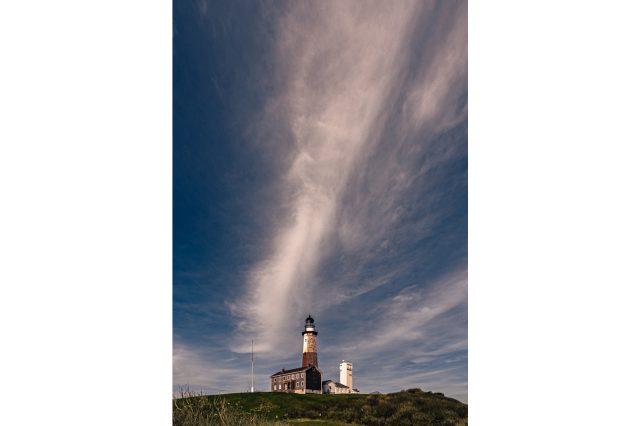
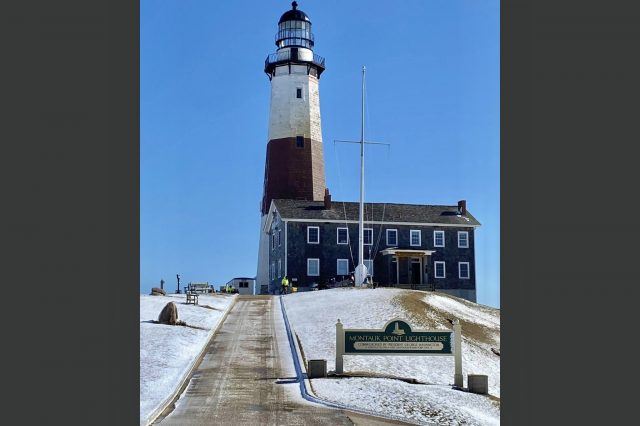
Visitors can relax at the town’s beautiful beaches and ocean fronts, go fishing, surfing and paddling, and enjoy the plethora of seafood restaurants, nature trails and festivals. Of course, a visit to the historic Montauk Point Lighthouse is always a must. And don’t avoid Montauk just because it’s the off-season. It’s a great place to visit year-round.
Newport, R.I.
Rhode Island’s popular seaside city is known for its opulent past. Visitors can tour the magnificent mansions that were once the summer retreats of the Astors and Vanderbilts. For a more modern experience, take a scenic boat ride around the harbor or a picturesque stroll along the Cliff Walk. Add in some incredible seafood and this Ocean State city becomes and ideal getaway locale.
The four-hour drive from New York City will take you along the Connecticut coast. Make a pit stop at one of the region’s many historic towns to enjoy a quintessential New England experience of picture-perfect scenery and exciting attractions.
The Catskills
Roughly three hours outside New York City, the Catskills are a verdant mountain region, ideal for any type of getaway.
The Catskills are famous for its extensive number of well-maintained hiking trails. There are 98 peaks, so you’ll have plenty of paths to choose from.
No matter the time of year, Windham Mountain Resort has something for everyone – skiing, golfing, live concerts, and relaxing spa treatments are just a few of your options. The region is also teeming with wineries and breweries in case you’re in the mood to imbibe.
Beacon, N.Y.
Just an hour north of Manhattan sits the quaint town of Beacon, smack dab in the middle of the Hudson Valley. The drive there, north along the Hudson River with picturesque views, doesn’t get much better. Once you arrive, you can choose between strolling Main Street’s mile-long drag of shops, cafes, or restaurants. Or, if you’re an outdoorsman, go for a hike or kayak down the Hudson.
One can’t-miss tourist attraction is Dia: Beacon. Opened in 2003 in a former Nabisco box printing factory, the museum presents the Dia Art Foundation’s collection of art from the 1960s to the present as well as special exhibitions and public programs. Depending on when you’re in town, you may also be able to catch a minor league baseball game.
Philadelphia, Pa.
If it’s not a change of pace you’re looking for but just a change of scenery, Philadelphia may be the little city you’re looking for. The City of Brotherly Love is unmatched in its historic pedigree. Must-see landmarks include Independence Hall, where both the Declaration of Independence and U.S. Constitution were signed, and the Liberty Bell.
The iconic “Rocky” steps beckon all to the Philadelphia Museum of Art, but don’t forget to go inside. The museum houses more than 200,000 pieces of art from Claude Monet, Georgia O’Keeffe, Andy Warhol and many others.
No trip to Philadelphia is complete without a proper cheesesteak. Head to Geno’s or Pat’s to get yours.
But there are plenty of things to do outside the walls of museums and auditoriums. Adventure parks, water sports, fishing, horseback riding, camping, biking, and hiking – including along the Appalachian Trail – are all available.
What’s your favorite Northeast road trip destination? Tell us in the comments below.
Need a ride? Learn about exclusive Hertz discounts for AAA members.
Si bien la mayoría de los sitios de herencia hispana se encuentran en el oeste y el sur de los Estados Unidos, la región del Noreste tiene algunos tesoros que vale la pena visitar.
Si bien la mayoría de los sitios de herencia hispana se encuentran en el oeste y el sur de los Estados Unidos, la región del Noreste tiene algunos tesoros que vale la pena visitar.
En los EE. UU., existen sitios con más de 500 años de herencia hispana para explorar, pero el Mes Nacional de la Herencia Hispana recién se oficializó en 1988.
Para honrar esta larga historia y las innumerables contribuciones que han hecho los latinos e hispanos, la celebración comienza el 15 de septiembre (el día de la independencia de Costa Rica, El Salvador, Guatemala, Honduras, Nicaragua, México y Chile, o alrededor de esa fecha) y finaliza el 15 de octubre (unos días después del Día de la Raza o el Día de Colón/Día de los Pueblos Indígenas).
Estos son algunos destinos emblemáticos para visitar y realizar su propio homenaje en cualquier momento del año.
Nueva York
Sociedad Hispánica de América
Fundada en 1904 por el filántropo Archer M. Huntington, la Sociedad Hispánica de América hoy alberga la colección más grande de objetos hispanos en los Estados Unidos. Estimulado por una pasión por las diversas culturas de España, Latinoamérica, Portugal y Filipinas, Huntington comenzó exhibiendo sus numerosas posesiones privadas, una colección que sigue creciendo en la actualidad.
El museo está abierto al público y presenta exhibiciones que abarcan desde pinturas de maestros como El Greco y Goya hasta fotografías, libros, artículos de cerámica, joyas y muebles. Como si este vasto tesoro no fuera suficiente para satisfacer la curiosidad de cada amante de la historia, este hito histórico nacional es una joya arquitectónica ubicada en el legendario distrito histórico Audubon Terrace del Upper Manhattan, un lugar incluido en la lista del Registro Nacional de Lugares Históricos.
El Museo de Barrio
No muy al sur de la Sociedad Hispánica, encontramos El Museo de Barrio. Fundado en los años sesenta por una gran comunidad de representantes de la cultura puertorriqueña, hoy alberga una colección permanente de más de 8,000 objetos, que abarcan más de 800 impactantes años de historia del arte de Latinoamérica y el Caribe. Además de una amplia variedad de eventos populares durante todo el año y exhibiciones temporales, sus colecciones permanentes se enfocan en el arte moderno, el arte gráfico, las tradiciones populares, y los objetos precolombinos y de la cultura taína. No deje de consultar el sitio web antes de ir a disfrutar de los últimos eventos familiares y comunitarios.
El Bronx también alberga una tienda de música impregnada de herencia hispana. Asimismo incluida en el Registro Nacional de Lugares Históricos, Casa Amadeo, antigua Casa Hernandez, es la tienda de música latina más antigua de la ciudad de Nueva York en funcionamiento ininterrumpido.
Inaugurada en 1941 por los hermanos Victoria y Rafael Hernandez, en 1969 pasó a manos del legendario músico y compositor Miguel Ángel “Mike” Amadeo, quien hoy, con casi 90 años, aún la posee y dirige. La encontrará en la planta baja de un hermoso edificio neorrenacentista de 1905 que ha sido administrado por la organización de viviendas comunitarias Banana Kelly desde los años setenta. Acérquese para descubrir la historia y las melodías, y recorra la zona para sentir una vibración única.
Nueva Jersey
Centros culturales hispanos fuera de la ciudad de Nueva York
Uno de cada cinco residentes de Nueva Jersey se identifica como latino o hispano, por lo que no es una sorpresa que a tan solo un paso de la ciudad de Nueva York haya algunos destinos destacados para sumergirse en la auténtica comida, cultura y herencia del mundo hispanohablante.
Havana on the Hudson, la segunda área latina/hispana más poblada de los EE. UU., ostenta con orgullo la siempre concurrida Bergenline Avenue. Es el tramo comercial más largo del estado y atraviesa las ciudades de minorías-mayorías de North Bergen, Guttenberg, West New York y Union City.
A tan solo 30 minutos hacia el noroeste, se encuentra el vecindario de Little Lima en Paterson. Este enclave peruano, digno de visitar por derecho propio, también linda con los chispeantes vecindarios italiano, puertorriqueño, dominicano y mexicano de la ciudad.
Si está buscando algo de herencia hispana que sea un poco más antigua, visite la ciudad más grande de Nueva Jersey, Newark. El Museo de Arte de Newark alberga una imponente colección de obras de arte y objetos latinoamericanos desde la era precolombina hasta la actualidad.
Blackstone River Valley (Corredor del Patrimonio Nacional)
Cuna de la Revolución Industrial estadounidense a mediados del siglo XIX, Blackstone River Valley estuvo repleto de fábricas textiles famosas en todo el mundo. Sin embargo, a comienzos de la década de los sesenta, la escasez de operarios de telares capacitados impulsó a Jay Giuttari, entonces dueño de una fábrica y luego el fabricante textil más grande de Latinoamérica, a comenzar a traer tejedores expertos de Colombia.
Muchas fábricas de la zona pronto siguieron sus pasos, lo que generó una nueva ola de inmigración de Sudamérica que garantizó la supervivencia de las antiguas fábricas durante algunas décadas más. De hecho, Lyon Silk Works de Giuttari funcionó hasta el 2020. Ahora designada Corredor del Patrimonio Nacional, esta región de 48 millas junto al río Blackstone abarca desde Pawtucket, Central Falls y Providence en Rhode Island hasta Worcester, Massachusetts. Estas ciudades aún son el hogar de diversas comunidades hispanas vibrantes, muchos de cuyos residentes colaboraron con la preservación de una parte valiosa de la historia estadounidense.
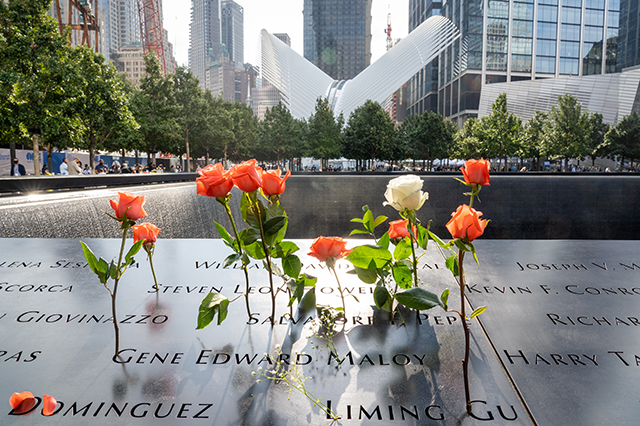
Sept. 11 Memorials in the Northeast Pay Homage to Lives Lost
As the 20th anniversary of Sept. 11 draws near, survivors, families and anyone who wants to pay tribute to the nearly 3,000 victims can find solace at these memorial sites.
Twenty years have passed since Sept. 11, 2001, but it’s still fresh in the memory of many. Nearly 3,000 lives were lost that day when terrorists crashed four commercial planes into the twin towers in New York City, the Pentagon in Washington, D.C., and a rural Pennsylvania field.
Memorials at these sites provide a poignant, spine-tingling moment of reflection and solace, and nearly 200 others coast-to-coast allow visitors to learn and pay tribute. Their exhibits highlight details from that fateful day, the names of the victims, and may include plane wreckage or steel from the buildings. All of them honor the events and people of 9/11.
Note: COVID-19 restrictions are in place for some memorials. Exhibitions may be closed, and masks may be required. Please check official websites for updates before your visit.
Foundation Hall, in the 9/11 Memorial & Museum in New York City, houses The Last Column: the last piece of steel removed from ground zero and decorated and signed by rescue and recovery workers.
9/11 Memorial & Museum
New York, N.Y.
The 9/11 Memorial & Museum’s message of healing, unity and renewal is evident the moment you approach the building’s massive glass facade. Just inside, two steel girders, representing the ill-fated north and south towers of the World Trade Center, stretch to the ceiling of the country’s primary institution for examining the events, aftermath and people of Sept. 11. It also pays homage to those killed in the February 1993 attack.
Descending underground, a ramp evokes the history of construction ramps at the site: one that built the original complex in the 1960s, and another installed during the post-9/11 recovery period to remove wreckage and allow victims’ families access to ground zero. Follow the Survivors’ Stairs, which led hundreds of fleeing survivors out of the buildings to safety.
Keep going, and you’ll experience two significant spaces. Memorial Hall, sited between the footprints of the original twin towers, features site-specific artwork. Foundation Hall contains the slurry wall, a concrete retaining wall that obstructed the Hudson River during 1960s construction, and remained intact during the destruction that occurred on 9/11. You can’t miss The Last Column: the last piece of steel removed from ground zero covered in inscriptions and mementoes from rescue and recovery workers.
A 20th anniversary commemoration ceremony for family members will be held beginning at 8:30 a.m. Sept. 11, where family members will read the names of those who lost their lives that day. At sundown, twin beams in the shape of the twin towers will illuminate the nighttime sky during the annual Tribute in Light. Cultural institutes throughout the city are also planning events that day to mark the anniversary.
The National 9/11 Pentagon Memorial
Washington, D.C.
The memorial is currently closed to visitors due to the COVID-19 pandemic, but its website features an audio tour, interactive map and biographies of the victims.
The names of the passengers and crew are etched onto 40 polished stones at the Flight 93 National Memorial’s Wall of Names in Shanksville, Pa.
Flight 93 National Memorial
Shanksville, Pa.
This expansive site offers a visitor center, Tower of Voices and memorial plaza to explore. Begin at the visitor center to learn about the events of 9/11 here and their context within the larger terrorist attack. A permanent interactive exhibit with maps and timelines recounts the story of the passengers and flight crew of United Airlines Flight 93, and the investigation after the crash.
The Tower of Voices is a 93-foot-tall instrument set among a field of wildflowers. Its 40 wind chimes represent the 40 lives lost at the site that day. Installed and dedicated in September 2020, there are no other chime structures like it in the world.
A memorial plaza holds the quarter-mile boundary of the crash site, featuring the Wall of Names, where 40 white polished stones are inscribed with the names of the passengers and crew.
The National Park Service will hold a memorial for family members Sept. 11 beginning at 9:45 a.m. It will also be streamed live on the site’s Facebook page.
Empty Sky Memorial
Jersey City, N.J.
There are more than 150 memorials across the Garden State, but the official memorial to the 749 state residents that lost their lives is erected at Liberty State Park. Flanking the Hudson River across from New York City, the Empty Sky Memorial features twin stainless steel walls crossing a gently sloped mound anchored by a granite path directed toward ground zero. The victims’ names names are inscribed upon the walls.
Other Sept. 11 Memorials
There are several other Sept. 11 memorial sites in the Northeast where people can pay their respects and share memories of that fateful day.
Connecticut
The 9/11 Memorial in Sherwood Island State Park in Westport features the names of 161 people who died that day, who either lived in Connecticut or had close family in the state. On a clear day, you can see the lower New York skyline from the park, which is on the shore of the Long Island Sound.
New Hampshire
A 9/11 Memorial in Hudson’s Benson Park is crafted from steel from the twin towers. It memorializes resident David Kovalcin, who was a passenger on Flight 11, as well as all those who lost their lives that day and U.S. military members serving their country.
Maine
In Portland, the 9/11 Memorial of the Cumberland County Sheriff’s Office features steel salvaged from the World Trade Center site. It honors all those lost on that day.
Massachusetts
The Logan Airport 9/11 Memorial features a glass cube, The Place of Remembrance, that honors the crew and passengers of American Airlines Flight 11 and United Airlines Flight 17. The flights left Boston for Los Angeles on Sept. 11, 2001, but were hijacked by terrorists and flown into the twin towers.
Click here for a list of other Bay State memorials.
Rhode Island
A memorial and plaque at the State House holds the names of nine Rhode Islanders who died in the attacks.
How do you honor the victims and heroes of Sept. 11? Let us know in the comments.
While man-made bridges, castles and gardens can be beautiful, there’s nothing quite like marveling at nature. From lush forests and flowing waterfalls to hike-worthy mountains and glimmering lakes, you will find breathtaking natural wonders in our corner of the country. Here are our picks for 10 of the most beautiful places in the Northeast.
Note: Due to the ever-changing nature of the COVID-19 pandemic, please see official websites before visiting to check for restrictions or closures.
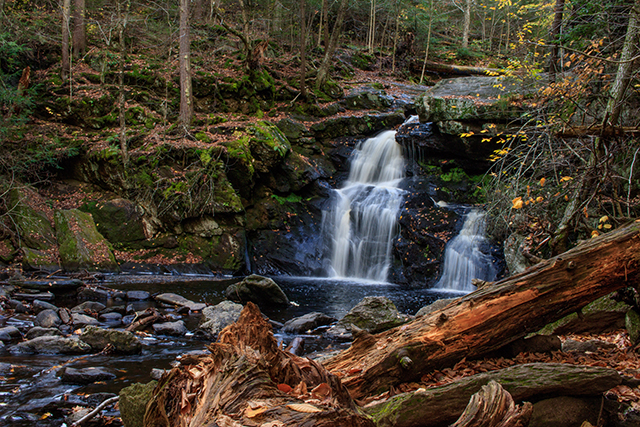
Enders State Forest in Granby, Conn. covers 1,500 acres of woodlands and is home to Enders Falls. Fed by Enders Brook, the falls feature cascades, horsetails, plunges and slides — the tallest of which features a 30-foot drop. Visiting Enders State Forest anytime between April and November will result in gorgeous views.
Located in Wellfleet, Mass., this 1.2-mile trail takes visitors through a striking oak and pine forest that looks like it could be straight out of a movie. A boardwalk leads through wetter areas of the Atlantic White Cedar Swamp, where you’ll find a lush wonderland.
“Bartholomew’s Cobble, MA” by angela n. is licensed under CC BY 2.0
Explore five miles of trails while viewing the fields, forests and rocky knolls of Bartholomew’s Cobble in Sheffield, Mass. With woodland flowers blooming in the spring and colorful foliage in the fall, this spot is truly one of the most beautiful places in the Northeast. It also has the greatest diversity of fern species in North America and one of the biggest Cottonwood trees in the state.
New Hampshire
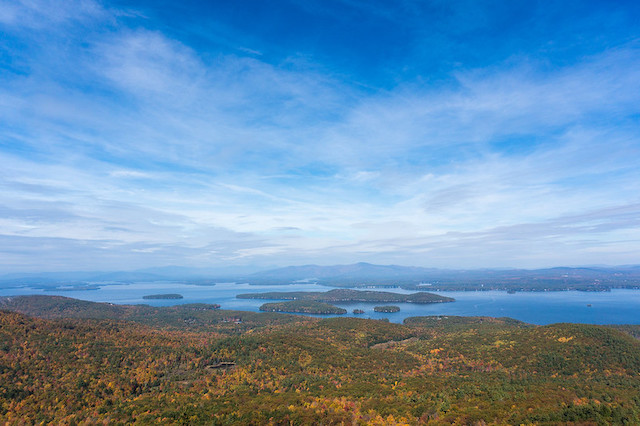
“Lake Winnipesaukee from Mount Major, New Hampshire” by rjshade is licensed under CC BY 2.0
Located toward the center of the state, the Lakes Region is home to the Squam Lakes and the largest lake in New Hampshire, Lake Winnipesaukee. Make the surrounding White Mountains a picturesque backdrop or explore the hiking trails around the Lakes Region area for some breathtaking views of the water from up above.
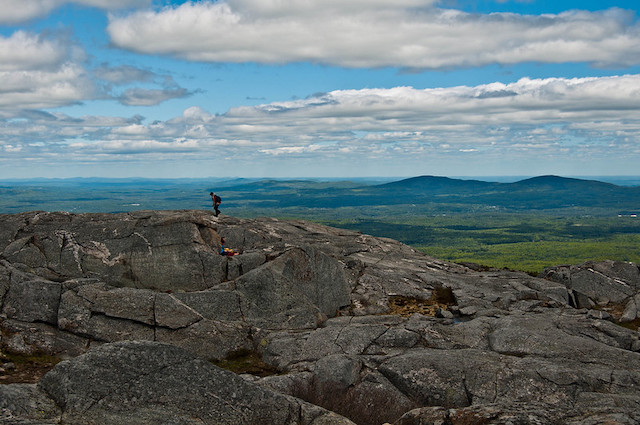
“Atop Mt Monadnock” by Dipanjan Nath is licensed under CC BY-SA 2.0
Located in southern New Hampshire, this 3,165-foot tall mount is surrounded by Monadnock State Park’s thousands of acres of lush forest. The area is great for camping, hiking and photographing foliage, rock structures and – once you reach a high enough spot – amazing panoramic views.
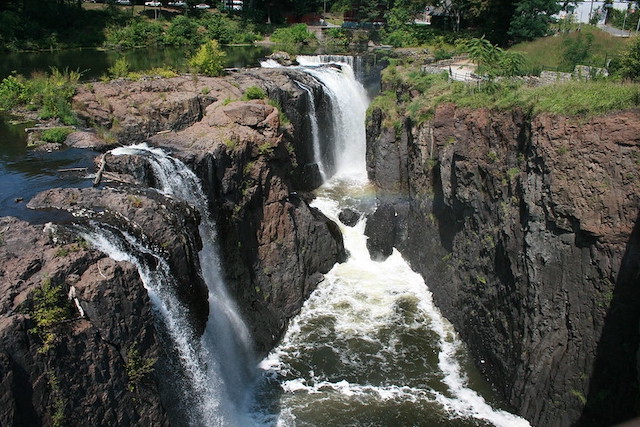
Fed by the Passaic River, the Great Falls are a 77-foot high waterway located in Paterson Great Falls National Historical Park. Surrounded by protected land, the falls are a sight to behold, being one of the largest waterfalls in the entire U.S.
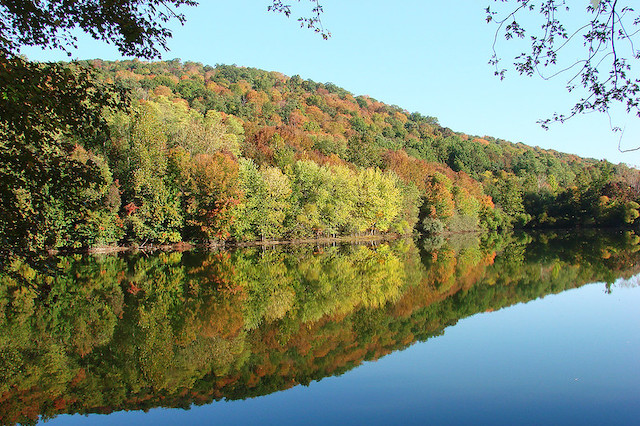
“Ramapo Reservation” by Billtacular is licensed under CC BY-NC-ND 2.0
Wander the trails of the Ramapo Valley County Reservation, located in Mahwah, N.J., to discover a pond, reservoir, waterfall and other scenic views. This 4,000-acre park also allows access to the Ramapo River for canoe, kayak and raft owners.
New York
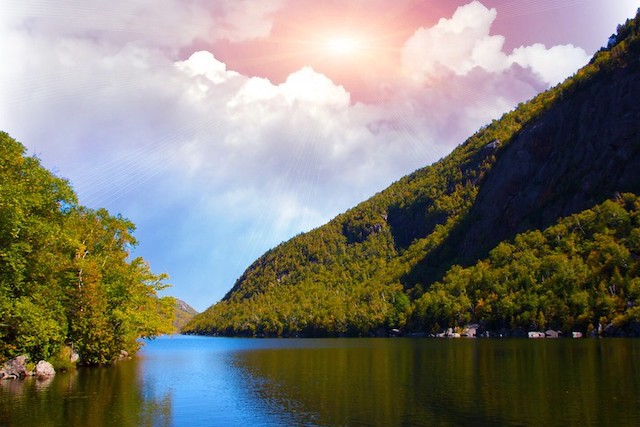
“Lake Placid New York ~ Sunset over Saranac River” by Onasill ~ Bill is licensed under CC BY-NC-SA 2.0
If you are planning a trip to upstate New York, you can’t miss the Adirondack Mountains and Adirondack Park. The area covers roughly 5,000 square miles, including some incredibly scenic spots, like Mount Arab, Mount Haystack, Kane Mountain, Hanging Spear Falls, Lake Placid and so much more. The Adirondacks are perfect for hiking, bird watching, nature photography and paddling across the area’s 3,000 lakes and ponds.
“Kaaterskill Falls” by Garrett Ziegler is licensed under CC BY-NC-ND 2.0
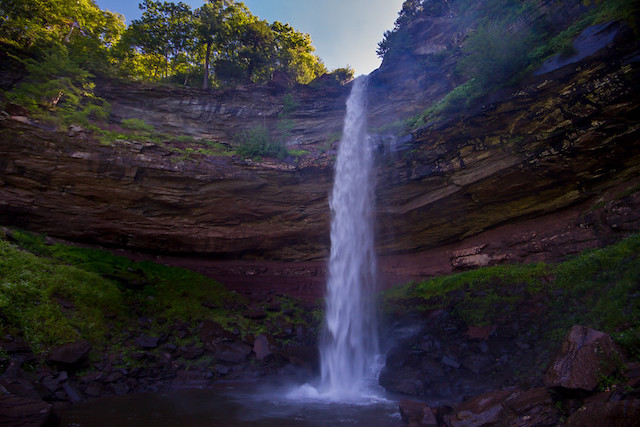
You’ll find many of the most beautiful places in the Northeast in the Catskills, including the Catskills Scenic Trail, Kaaterskill Falls and Panther Mountain Trail. The latter features eight scenic lookout spots and five ledges, including the Giant Ledge, which boasts amazing views.
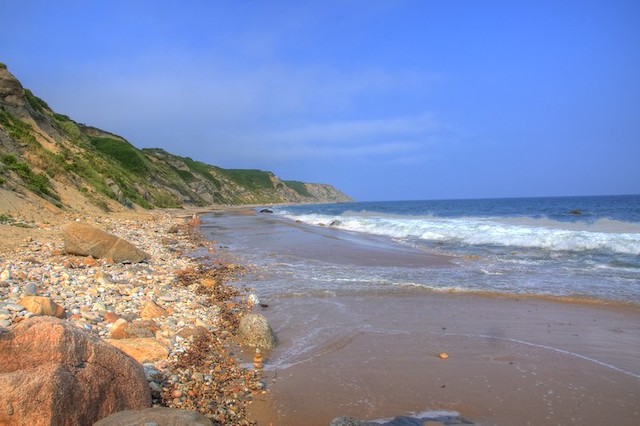
Located off the coast of Rhode Island, Block Island features gorgeous beaches and the Mohegan Bluffs. The pale, sandy beach and 200-foot tall bluffs are sights to behold. Make the climb to the top of these clay cliffs for some amazing views of the Atlantic Ocean.
What do you think are the most beautiful places in the Northeast? Tell us in the comments.
Shopping for car loans doesn’t tend to bring about the same joy as shopping for new cars. But finding the right loan is the first step to getting behind the wheel of the right car. After all, it’s likely the only way to know which vehicle you can afford. But how do you know which car fits into your budget?
Trying to calculate your monthly auto loan payment can be confusing when you’re forced to consider down payments, interest rates, trade-in value and term lengths. You don’t want to be at the dealership, completely unaware of what your monthly payment should be. This is an easy way to be locked into an auto loan that may not be the best loan available to you.
But don’t worry. As always, AAA is here to help! The auto loan payment calculator below can provide you with the estimated monthly payments of a new loan. Just plug in the amount of the loan you’re looking for, interest rate and term length. The auto loan payment calculator allows you to see the affect of changing the loan length and/or interest rate on your monthly payment.
This isn’t just for first-time loan shoppers, either. Those looking to refinance their current loan can also use this tool. Often, customers can save at least a few dollars on their monthly payments by refinancing. This may not sound like a lot, but over the course of the loan can add up to hundreds of dollars in savings.
Use our auto loan calculator to calculate terms of a new loan or to see if refinancing your current loan can save you money.
Note: Auto loan calculator results are an estimate. Actual loan rates vary due to a variety of individual factors, such as credit score, income and vehicle condition.
See how AAA Auto Loans can help you get a new car, including auto loans, refinancing and the AAA Car Buying Program.
Wildlife tourism is a massive industry, ranging from your local zoo to monthlong safaris across the savanna; it capitalizes on our desire to be one with nature, to see ourselves in the creatures with whom we share the planet. There are few things more awe-inspiring than a massive elephant, or the slinky strength of a tiger.
Some wildlife tourist attractions can be a net positive, according to a study by the Wildlife Conservation Research Unit at Oxford. Such attractions can provide job opportunities for the locals and help to conserve wildlife habitats. But wildlife tourism isn’t always ethical. In fact, it’s increasingly difficult to tell the difference between attractions that mistreat animals and those that provide them sanctuary. How can we identify ethical wildlife tourism? And how can we tell when things are wrong?
The Dark Side of Wildlife Tourism
In a 2019 article from National Geographic, “Suffering Unseen: The Dark Truth Behind Wildlife Tourism,” reporter Natasha Daly visited two different elephant attractions in Thailand. At Maetaman, in Chiang Mai, the elephants perform feats like playing the harmonica, giving people rides or painting pictures. They are constantly interacting with trainers, who – according to the story – prod them with sharp bullhooks. In between shows, they’re chained in small confinements. Afterward, Daly visits the nearby Elephant EcoValley, where tourists can feed elephants and even bathe them. The elephants can be seen grazing and bathing throughout the site, which includes a museum. But Elephant EcoValley and Maetaman are the same company. And they use the same elephants.
A similar strategy could be seen in the (now-closed) Tiger Temple, which operated as a religious site in Thailand. Tiger Temple was home to nearly 150 tigers, kept in concrete cages at night and drugged to interact with tourists by day, according to an article in Time. Why so many? Because tourists prefer to take pictures with cubs, and cubs grow up.
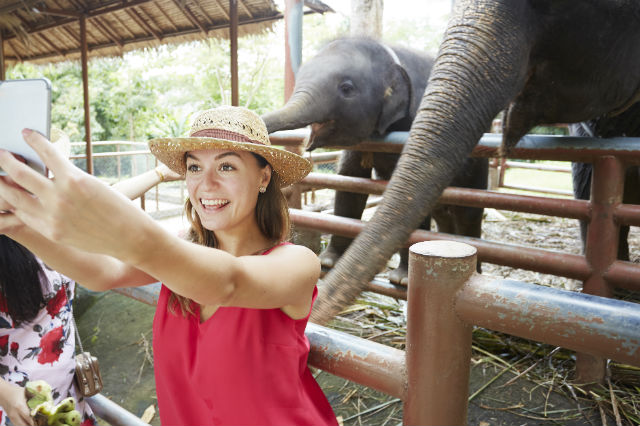
It would be disingenuous to only include examples from Thailand, because unethical wildlife tourism is a global issue. Its influence can even be seen on your social media feeds. Sites like Instagram routinely influence where travelers want to go and what they want to do. These sites are also full of pictures of people posing with non-domesticated animals in tourist traps. The problem is so big that Instagram discourages its users from searching hashtags like #slothselfie or #lionselfie (feel free to look at how many animal selfie tags have this warning – #lemurseflie, #tigerselfie, #elephantselfie, etc.) In 2017, Tinder begged its users to stop posting so many pictures of themselves lounging with tigers (I swipe left).
Wildlife Tourism Activities Done Right
When people post a picture with a frightened sloth or a toothless tiger, it’s not because they are bad or want to hurt animals. On the contrary, many of the wild animal selfie-takers write long captions about how they love animals and nature. The problem is that tourists routinely overestimate the wellness standards and conservation efforts of wildlife tourist attractions.
Animals are like us, but they’re not like us. It can be difficult to tell when an animal is frightened or in pain. Some of them even look like they’re smiling. How can we tell the difference between ethical and unethical wildlife tourism?
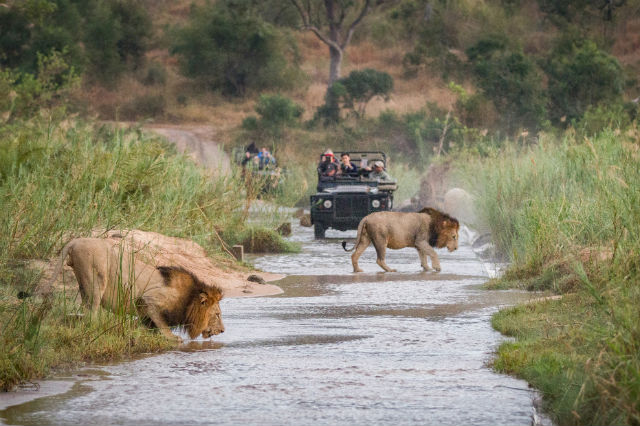
“Any facility that offers public interactions with wild animals, such as photo ops with tiger and bear cubs or primates, rides on wild animals, swim-with-the-dolphins, play sessions, or even public feeding can put both animals and the public at risk,” said Debbie Leahy, senior strategist of captive wildlife for the Humane Society of the United States. “In the interest of both animal welfare and public safety, responsible facilities do not offer close encounters with wild animals, including animals ranging from elephants and big cats to sloths and kangaroos. We recommend safaris and activities in which animals are seen in their natural wild environment, where they are free-roaming and free to express their natural behaviors.”
Leahy notes that the most ethical types of sanctuaries are those that house animals who cannot return to the wild, like those that are injured or have been rescued from captivity.
“Research a facility before visiting and beware of phony sanctuaries,” she said. “Some facilities claim to rescue animals, but breed animals and keep them in inhumane conditions, or use them for public contact. Many reputable sanctuaries are accredited by the Global Federation of Animal Sanctuaries.”
“Sadly, many vendors and operators will claim that their animals came from sustainable sources and are treated well. In the case of rescue/rehab centers and captive facilities, tourists can ask how many animals have been released back to their native habitats, if they allow breeding at their facility, if they allow physical interactions at their facilities (including bottle-feeding, petting, ride/walk/swim-with safaris, animal performances, displays and photo opportunities with captive wildlife), if they sell any wildlife products, or if the animals in their care are used for entertainment (bear-dancing, chimpanzee boxing, elephant painting, etc.)”
Sometimes it can be hard to accept these realities. Many of us daydream of the chance to snuggle a sloth or pose with an elephant. We don’t want to think about ethics and morals on vacation – that’s what regular life is for! But once you know about these things, you can’t turn it off. You can’t look away. And that’s for the best.
One of the best ways to see animals is in their natural habitat, like on safari. Seeing an exotic animal in the wild is truly a once-in-a-lifetime experience that you’ll remember forever. If you want to try it for yourself, talk to your AAA travel advisor about small group tours in Africa, where you can see magnificent wildlife in their natural habitat while also contributing to the local economy.
Tourist attractions are hugely influenced by consumer demand. If we are willing to dig deeper and ask tougher questions, there’s a real chance that they could change for the better. Instead of daydreaming of elephant selfies, now I dream of a sanctuary that contributes to the local community while treating the animals well. Where the tourists are content to see elephants from afar.
The Northeast is home to hundreds of lighthouses, each more iconic than the next. With their charming structures and idyllic surroundings, photographing these beacons is sure to produce incredible results.
Thank You for Participating!
Your lighthouse photos shine a light on your talent! Browse through all of the pictures we received for the August Photo Session in the slideshow below, and don’t forget to check our social media channels, where we will be sharing some of our favorites. Select photos may also be featured in an upcoming issue of Your AAA magazine
The Scituate Lighthouse by the water on a beautiful August afternoon. (Adam Figarsky)
Sandy Neck on a November afternoon. (Daniel Lupfer)
Morning light. (Danna Gaynor)
Portland Head Lighthouse in Cape Elizabeth, Maine. (David Delucia)
Stage Harbor Lighthouse in Chatham, Mass., as the sun is starting to set. (David Saias)
Bass Harbor Headlight in Acadia National Park. (David Weiss)
Orient Point Lighthouse at sunset. (Amy Smith)
Marshall Point Lighthouse (Anthony Cerino)
Snowy Sandy Hook (Arthur Crosta)
(Carol Cunningham)
Pemaquid Point Lighthouse, Bristol, Maine. (Caroline Calo)
Portland Head Light (Caroline Stella)
Old Scituate Light (Cindy Merrill)
Portland Head in Fog, July 2021. (Donna McWilliams)
Sunrise, Nubble Light, York, Maine. (Doug Beller)
Portland, Maine (Faye Neil)
Lighthouse, Cape May, N.J. (Gillian Furniss)
Little Gull Island Lighthouse (Gwendolyn G. Enstine)
Fort Williams Park, Cape Elizabeth, Maine. (Holly Lankowski)
Indian Island Lighthouse, Maine. (Janet Pumphrey Harper)
Fire Island Lighthouse, Fire Island, N.Y. (Janine Bender, AAA Employee)
Barnegat Lighthouse, N.J.(Janis Lee)
Scituate Lighthouse, sunset. (Jason Sheehan)
Maine lighthouse at sunset. (Jean Greenberg)
Lighthouse in Carmel, Calif. (Jeffrey Langford)
New Haven Harbor is safeguarded by the light at Lighthouse Point. (Joanne Ekstrom)
Montauk Point Lighthouse, Montauk, N.Y. (Joseph Kelly)
East Chop Lighthouse, Martha’s Vineyard. (Karen D'Auria)
Nubble Light (Kristina Wright)
(Lori Phillips)
Tranquility! (Maria Barcsle)
Cape Neddick Light/Nubble Light, York Beach, Maine. (Mark Bankoff)
(Mary Chin)
Working a few years ago at Boston Light maintenance. (Mathias Mulvey)
Little Red Lighthouse @ George Washington Bridge New York. (Mathilde Diaz)
Cape May (Rachael Constantine)
Nubble Lighthouse at night. (Reverend Robert Gill)
Pounce Inlet Lighthouse, Fla. (Robert Lagarenne)
Yaquina Bay Lighthouse, Ore. (Russell Henault)
Monhegan Island Light (Sharon Baraiola)
Brant Point proposal. (Stacey Cabral-Levesque)
Sunset on a quiet evening.(Susan Daly)
(Susan Eginton)
Yaquina Head Light Ore. (Taylor Donohe)
Tips for Great Lighthouse Photos
Lens Choice
When photographing lighthouses, it is best to capture the landscape surrounding the structure as well. Lighthouses are often surrounded by the most beautiful coastline. For the best results, I recommend a wide angle zoom lens. My go-to lens is a 17-28mm. For the wide shot, I would use a small aperture like f/22 to capture all the details in the scene. A telephoto lens can also be fun if you zoom in on only the lighthouse. Choose a vertical orientated photo for optimal results. Try using a large aperture here to isolate the lighthouse from it’s background, like f/2.8.
Watch the Horizon Line
A horizon line is where the sky and land meet. For a flawless composition, make sure the horizon line in your image is straight. Many cameras can turn on a grid within the live view; place your horizon along the lines of the grid.
Spring Point Ledge Lighthouse, South Portland, Maine. (Photo: Getty)
Add People
Instead of waiting for people to clear out of your shot, try taking a few where you include them. People standing near the lighthouse will help show the scale of the structure.
Starbursts
If the lighthouse is lit up, set your aperture to a small number to capture a starburst of the light rays. Start with your lens’s smallest number, typically f/22 or f/20. If you are shooting at dusk/dawn or the evening, you will want to have your ISO up high enough to capture the lighthouse. I would start at ISO 800 and increase as needed. A sturdy tripod is highly recommended for any low-light photography.
Fire Island Lighthouse, Fire Island, N.Y. (Photo: Getty)
Vary Your Shutter Speeds
If you are able to photograph water with the lighthouse in the same frame, try playing with different shutter speeds. If waves are crashing up on shore and you want to freeze that motion, use a fast shutter speed like 1/500th sec. If you want the water to be soft looking use a slower shutter speed like 1/10th of a second and below.
Check out past AAA Photo Sessions and stay tuned for the next one, coming soon.
Beth Mancuso is a professional landscape and travel photographer.