10 Truly New England Foods

Four hundred years is a long time to develop a style of cuisine, so it’s no wonder that New England foods are so well-established and beloved. Let’s dig into the many delicious foods that originated in our region.

The History of Traditional New England Food

Our style of cooking may have entered history when the colonists first arrived, but it borrowed heavily from the Native Americans who were already here and whose education in local foodways was vital to the survival of the colonies. A traditional Thanksgiving dinner that we’d eat today still has traces of that influence, as does a clam bake, which came straight from the Native American style of cooking along the coast of what would become Connecticut, Rhode Island, Massachusetts and Maine.

Lobster Roll

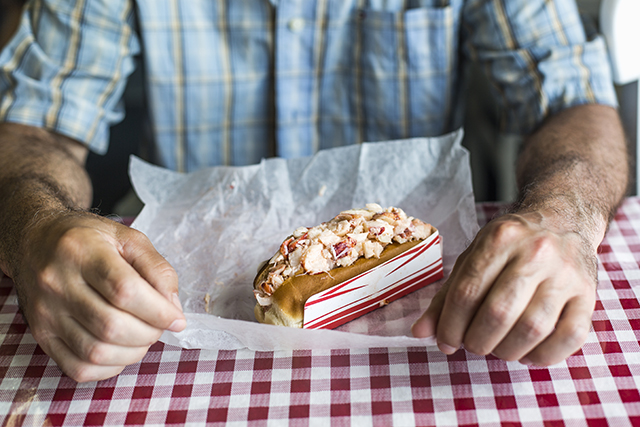
The lobster roll is a New England food icon. Depending on where you are from, there is some debate on the “right” way to prepare it. Some like it the traditional Maine way, chilled and dressed in mayonnaise, while others prefer Connecticut-style, served warm with melted butter. One thing we can all agree on? The best way to eat it is on a grilled, split-top hot dog bun, waterfront views optional.

Fried Clams

England is credited with inventing the seafood basket – usually fried fish, chips and coleslaw, but New England took the idea to the next level with the invention of fried clams in 1916 by Henry “Chubby” Woodman in Essex, Mass. Add in fried day-boat scallops and perfectly crispy cod, and you’ve got the kind of summer meal people travel thousands of miles for.

Indian Pudding

Back in the days when New England was still a group of British colonies, settlers adapted English-style pudding to local ingredients, namely, cornmeal, abundant in the area, and molasses, which was readily available because of its role in making rum. This slow-cooked pudding isn’t beautiful to look at – it’s basically a pile of brown goo – but add a scoop of vanilla ice cream and it is sweet and simple New England comfort food at its best.

Clam Cakes & Chowder

While every clam shack puts their own unique spin on it, New England clam chowder does not originate from New England. We may love it enough to eat it in every season, but the soup is believed to have come from French or Canadian settlers. Rhode Island clam chowder, made with a clear broth, is all ours. The same goes for clam cakes, invented in the early 1900s by Carrie Cooper, a Connecticut native who later moved to Rhode Island and opened Aunt Carrie’s restaurant in Narragansett to sell her seaside fare.

Johnnycakes

Another New England staple that owes a debt to the Native Americans johnnycakes are cornmeal pancakes that were once ubiquitous on local dinner tables. Cornmeal, and its various preparations, was one of the first foods shared by the Native Americans with the pilgrims when they landed in 1620.Johnnycakes (which have nothing to do with a man named John – the name is thought to have evolved from the Native American word for corn cake, janiken) are not as popular as they used to be, but there are still old-school diners around the region that serve them with eggs and bacon for breakfast.

new england food

Boston Baked Beans

How important is this iconic preparation of brown beans baked with molasses and salt pork to Boston? Well, the city is known as Beantown, after all. For maximum authenticity, enjoy with hearty brown bread, some New Englanders may insist, straight out of the B&M can. Inspired by their resemblance, sugar-coated peanuts are also known as Boston baked beans.

Boiled Dinner

Yankee pot roast, defined as such because it’s cooked with vegetables, has a hazy background. While it’s popular in New England, there’s some debate over whether the “Yankee” part comes from its origin or from a joke about the inexpensive dinner’s appeal to penny pinchers. The tradition of boiling corned meat, cabbage, potatoes and carrots came from the Irish, but in Ireland they typically used pork. Irish immigrants in Boston substituted beef, which was more affordable (in America), to create what has become known throughout the country as Irish Boiled Dinner – though truly, it’s a New England food.

Stuffies

Stuffed clams were brought to America by Italian immigrants, but the use of quahogs, and the addition of Portuguese sausage evolved the simple stuffed clam into something definitively New England. Another variation of the stuffed clam, clams casino was invented at the turn of the 20th century at a luxury seaside resort called the Narragansett Pier Casino in Rhode Island.

Boston Cream Pie

The Parker House Hotel in Boston – the first hotel in the city to have hot and cold running water and an elevator, is responsible for three iconic foods: Parker House rolls, baked scrod and Boston cream pie. The latter was invented as “Parker House pie” for the hotel’s opening in 1856, though if you’ve had it you know that the custard-filled, chocolate-topped confection is definitely a cake and not a pie. It’s still served (and shipped nationwide) by what is now the Omni Parker House.

Coffee Milk

Coffee milk is such an integral part of New England’s food traditions that it’s hard to imagine that the rest of the country has barely heard of the stuff. The drink, made with coffee syrup and milk, traces back to the 19th century population of Italian immigrants to Providence and their tradition of drinking sweet coffee with milk. Eclipse and Autocrat, the two most popular coffee syrups, are still made in Rhode Island.

More New England Foods

These foods didn’t quite make the list, but we still love them!

Whoopie pies: Famously made in Maine, the Pennsylvania Dutch also have a claim to this cream-filled sandwich cake.

Chocolate chip cookies: While invented in 1938 at the Toll House Inn in Whitman, MA, this cookie jar favorite is so ubiquitous that we can’t rightly call them unique to our region.

Marshmallow Fluff: Though it’s been made by Durkee Mower in Lynn, MA, for a century, similar marshmallow cremes existed before the factory opened. The fluffernutter, however, invented by a descendant of Paul Revere, is all New England’s.

Anadama Bread: This yeast-risen bread made with molasses and cornmeal was invented in the mid-1800s somewhere on the North Shore of Massachusetts. Despite a drop in popularity, it remains a New England gem.

Fried Calamari: The official state appetizer of Rhode Island is marked by the addition of hot peppers, but the dish itself originated in Europe and became popular in New York around the same time it did in New England. Scientists at MIT did invent the machine that made cleaning squid easier, and therefore more popular.

Del’s Lemonade: They might make the best frozen lemonade around, but they didn’t invent it.

The only thing better than eating New England food is debating which is best. This was a completely subjective list written by a lifelong New Englander. Add your opinions in the comments below!

Need more to satisfy your appetite for New England cuisine? Check out our lists of favorite Rhode Island and Boston foods.

Subscribe to Your AAA Newsletter

Sign up and receive updates for all of the latest articles on automotive, travel, money, lifestyle and so much more!

AAA Salutes Healthcare Workers

Colorful “thank you” messages to healthcare workers and first responders will soon be seen by motorists traveling throughout Massachusetts, New York and Rhode Island.

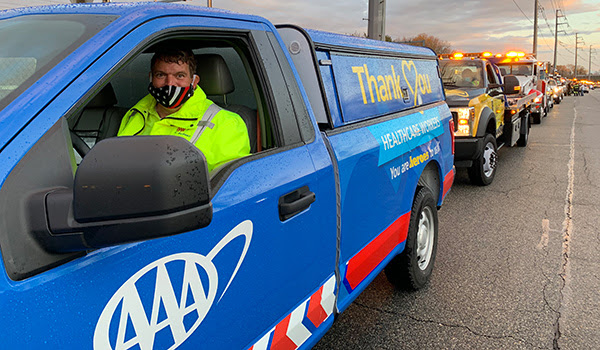
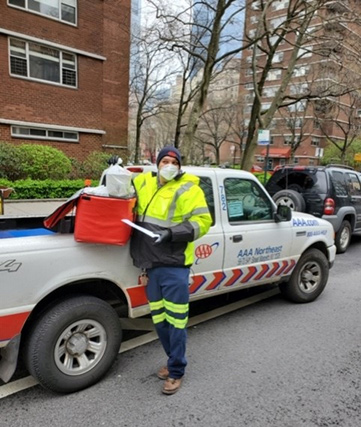
AAA Northeast recently outfitted one battery service truck in each of those states with an eye-catching blue vinyl wrap with bright yellow text that reads “Thank You Healthcare Workers.” It’s one of several ways the club has expressed its deep appreciation to healthcare workers who have risked their lives to help the community. The club plans to keep the new truck design for as long as the message is relevant during the pandemic.

“Wrapping our trucks was a way to demonstrate the club’s appreciation for all they’re doing to help us through these unprecedented times,” said John Nardolillo, Senior Vice President of Member Services. “Hopefully, every time someone sees our trucks, they will be reminded of the selfless work these extraordinary people are performing and that they will be a reminder to follow Centers for Disease Control and Prevention guidelines, so we can control the spread of the virus.”

The club will wrap another three trucks, one each in Massachusetts, Rhode Island and New York, with a “Thank You First Responders” message.

A Rolling Tribute

The Rhode Island and New York trucks were part of a of a rolling tribute to healthcare workers last week. Roadside service trucks from around southern New England formed a procession past Providence, R.I., hospitals in a show of support organized by the Rhode Island Towing Association.

Mike Krikorian, a driver for Jim’s Towing, played a large part in organizing the event and has since received a great deal of positive feedback. He is planning another event for May 15.

“I’ve gotten a lot of messages through social media from people I don’t even know,” Krikorian said. “Most of them were workers at hospitals who said they were grateful for what we did, and some were even in tears. I didn’t do it for any recognition. I did it for the front-line workers and for the people in the hospital dealing with this.”

AAA Involvement

When AAA manager Eric Richard first heard about the parade from roadside technician Bobby Silva, he thought it was an exciting opportunity to use the newly wrapped truck to show the club’s support and appreciation.

“If the truck puts a smile on the face of one healthcare worker, it’s worth it,” Richard said.

Eric Richard closed out the procession at Rhode Island Hospital.

Silva had the honor of driving the truck in the parade.

“I was extremely happy to be able to participate in the event,” Silva said. “Originally about 30 trucks were to attend, and over 80 trucks showed up!”

Service vehicles from tow companies all around southern New England – and one from New York – lined up for more than a half-mile. They ranged from standard-size pickups to absolutely enormous rigs in colors from black and white to purple, yellow and orange.

It was an impressive sight as the trucks took off from the staging area with yellow lights flashing and horns blaring on their way to Miriam Hospital. Watching them circle in front of Rhode Island Hospital and the adjacent Hasbro Children’s Hospital was even more spectacular.

Krikorian led the procession, and Richard, driving the AAA truck from New York, was last, in a fitting conclusion to the event.

Subscribe to Your AAA Newsletter

Sign up and receive updates for all of the latest articles on automotive, travel, money, lifestyle and so much more!

The Pursuit of Happiness

A Slice of Sunshine

Put fresh lemon into your water. It punches up the flavor and adds a dash of vitamin C!

Bird Is the Word

Bird-watching gets you closer to nature, keeps you mentally active and may even lower stress levels.

Sky’s the Limit

Stargazing can be peaceful and educational. Add some fun to your night by identifying various constellations.

Get Crafty

Always wanted to give jewelry making, scrapbooking or sewing a try? Now is the time to find a cool project and embrace your inner crafter.

Rise to the Occasion

Try out a new recipe. Baking is a creative and fun way to spend the afternoon – and the end result is deliciously rewarding. Need a new banana bread recipe?

Be a Kid Again

Embrace your inner child and play. Put up a tire swing, throw a ball around, blow some bubbles or hula-hoop – life is short, so have some fun.

DIY: Think Outside the Box

Take some time to upgrade or restore something in your home. A splash of paint and some creative thinking can go a long way.

Go With the Flow

A couple of simple yoga moves, such as Downward Facing Dog or Hero Pose, can help relax your mind, energize your body and increase flexibility. Take some time to flow through Sun Salutation for overall well-being.

Exercise…Your Brain!

Fun games like crosswords, word searches, jigsaws and other puzzles keep your mind occupied and focused, increasing concentration and reducing stress.

best news podcasts

Listen Up!

Whatever your interest, there’s a podcast that covers it. From history to sports, gardening and self-care, new episodes and shows keep cropping up to engage, educate and entertain you. Just explore, choose and listen.

How Sweet It Is

Indulge in dark chocolate. Studies suggest it may lower blood pressure and reduce your risk of heart disease and stroke – plus, it tastes good!

Find Your Green Thumb

From trees and flowers to your very own vegetable garden, planting is a great way to get fresh air and reduce stress. Research some ideas and come up with a plan – then go play in the dirt!

If You Want to Sing out, Sing Out

Singing releases endorphins, which makes you feel happier and more energized. So, pick your favorite song and give your vocal cords a thorough workout.

Breathe It In

Essential oils can bring out positive emotions! Lavender is calming, citrus is uplifting and peppermint is energizing. Dab on your wrist, or add a few drops to steaming water, the shower or a bath. Try a diffuser for your home or car.

LOLOLOL

Laughter relieves stress and benefits your mental health. Who doesn’t love a good chuckle? So, crack yourself (or someone else) up by cracking a joke. After all, laughter is the best medicine.

Escape With a Good Book

Try to fit reading into your daily routine. Reading can sharpen your vocabulary, lower stress levels and improve memory function. Curl up with a book and get lost in the story.

Oh, the Places You’ll Go!

Make a list of places you’ve seen, and the places you want to visit. You will be flooded with good memories of past trips, and excited at the prospect of future adventures.

Put Kindness on Repeat

Say something positive about yourself (and someone else) every day. Write a positive note and hang it somewhere you can see. Being kind can brighten your day and help you stay positive.

meditation tips

Serenity Now

Meditation, even for just five minutes a day, can greatly reduce stress and anxiety levels. Relax, close your eyes – and simply breathe.

Cut a Rug

Not only is dancing fun and easy, it is also good for you! Dance is a great workout and can improve your mood. Make up your own moves or find an online tutorial and learn a specific routine. Swing. Hip-hop. Ballet. The options are endless.

Let It Out

Breathing is a part of life – it’s also an ideal way to help us relax. Start with inhaling a deep breath through your nose, holding it for a few seconds, then exhaling slowly through your mouth. This takes very little time, and best of all, it’s free!

Get out…of the House

Spending just a little time outside every day (especially near greenery) can improve your well-being and mood. Simply walk out of the door for a breath of fresh air – no exercise required.

Take a Video Break

The web seems to offer an unlimited supply of quick, hilarious and cute videos, from pets to blooper reels. Take a few minutes to watch something uplifting or funny.

Get Inspired

Read something uplifting each day. Whether it be a quote, poem or short story, find something that inspires you. Feeling creative? Try your hand at writing a poem or story of your own.

Sit Down for Afternoon Tea

Take a cue from our friends across the pond and relax with a cup (or cuppa). Many herbal teas offer health benefits, including green tea, which contains antioxidants. Why not add a sandwich or scone?

Sound Effects

Choose a soothing sound (many are available for free online) and listen. A gentle stream, a rain shower, a crackling fire, singing birds or beach waves – close your eyes and visualize your happy place.

Put on the Ritz

Wear your favorite outfit with confidence, especially if it’s bright or fancy There’s just something about putting on a gown or tux! You don’t need a special event to feel and look good.

Become One…With the Sun

Watch a sunrise – or sunset. Enjoy the beauty of the “golden hour” (the hour after the sun rises or the hour before the sun sets) to see the sky transform into a marvelous shade of yellow and orange.

What makes you happy? Tell us in the comments. 

Subscribe to Your AAA Newsletter

Sign up and receive updates for all of the latest articles on automotive, travel, money, lifestyle and so much more!

Podcast Pulse: Find the Best Podcast for Your Road Trip

With my friends and family living all along the East Coast, my life has been filled with long road trips. Sometimes the road trips are fun – like a carefree, two-hour ride out to Montauk, NY. Sometimes the road trips are grueling – like a snow-barraged, eight-hour slog up to Rochester, NY, in the dark. But through thick and thin, podcasts have always been there for me. But can you find the best podcast for your own road trip?

The best podcast for a road trip is a story-driven podcast. The “three friends talking” podcast format, though dear to my heart, will definitely put the driver to sleep. A road trip podcast should be a self-contained story, almost like a miniseries. You don’t have to fiddle with your phone and pick new episodes every 30 minutes; you can just let the story play out.

Here’s my personal recommendation list for the best podcast to listen to during your road trip.

Dirty John

“Dirty John” is a limited-series podcast by the Los Angeles Times. Reported and hosted by Christopher Goffard, it tells the story of Debra Newell and John Meehan, the man of her dreams … or nightmares. The podcast, told over six episodes, is about five hours total; the perfect length for a weekend road trip. This bizarre story of one man taking over an entire family is mysterious and captivating. While listening to this podcast, I shouted “DON’T DO IT” out loud. Several times.

S-Town

“S-Town” is the red-headed stepsibling of “Serial,” the most popular podcast in the world. Both were produced by “This American Life” and hosted by TAL regulars, but “S-Town” is a podcast unlike any other. This podcast tells the story of reporter Brian Reed, who gets tangled up in the life of eccentric clockmaker John B. McLemore. The story that unfolds after their first meeting is at times gripping, unbelievable and strangely meditative. Although it’s a true story, “S-Town” feels particularly literary, almost like an audio version of “The Sound and the Fury.” As a whole, the podcast is about six and a half hours long.

Missing Richard Simmons

Richard Simmons is – you guessed it – missing. Or at least he’s retreated from public life. Can Dan Taberski, a former devotee, find him? This controversial, intrusive podcast is obviously a labor of love, and the story is full of twists and turns. Don’t know a lot about Richard Simmons? It doesn’t matter. “Missing Richard Simmons” is also about missing Richard Simmons – about his whole life story and what he has meant to people over the years. It’s a three-hour study of alienation, found families, mental health and aerobics.

best podcast road trip

Heaven’s Gate

Hosted by “Snap Judgement’s” Glynn Washington, “Heaven’s Gate” explores how formerly reasonable people can be led into a cult that demands the ultimate sacrifice. Washington’s childhood of growing up inside a cult gives him a special connection with the survivors and family members that he interviews. With 10 episodes, the story is about nine hours long. By the end of it, you’ll wish it was even longer.

The McElroy Brothers Will Be in Trolls 2

When Justin McElroy learns from his sister-in-law that “YouTube people got to be in ‘Trolls,’ ” he sets his sights on securing roles for podcasters in “Trolls 2” – namely himself and his brothers, Griffin and Travis. This podcast-in-progress chronicles their journey to (hopefully) voicing walk-on characters in “Trolls 2.” It also does an amazing job of parodying the very particular style of prestige podcasts. Their bizarre premise is framed by overly serious narration by Justin, and a reimagined rendition of “In the Hall of the Mountain King.”

Making Series: Making Oprah

“Making Oprah” is a deep dive into the origins of the Oprah Winfrey show and how it still affects our culture. The three-part podcast includes exclusive interviews with the woman herself. The best part of the podcast, however, is learning how the Oprah Winfrey show pulled off the iconic “You get a car!” episode. This is the first installment of the “Making” series, which can currently be found under the name of its current story, “Making Obama.”

Reply All: On the Inside

“Reply All’s” greatest series of episodes is “On the Inside,” parts I-IV, which tell the story of Paul Modrowski. Modrowski is an inmate in a maximum-security prison who somehow manages to run his own blog without any internet access. Imprisoned at 18, he’s been in jail for 23 years at the time of the recording. Reporter Sruthi Pinnamaneni digs deep into Modrowski’s past, trying to find out if he actually had anything to do with the grisly murder that put him behind bars all those years ago. The story is full of unbelievable twists and turns, and the palpable tension between Pinnamaneni and Modrowski will keep your attention glued to this 2½ hour series.

What do you think would be the best podcast for your road trip? Let us know in the comments below!

Subscribe to Your AAA Newsletter

Sign up and receive updates for all of the latest articles on automotive, travel, money, lifestyle and so much more!

Banana Bread Variations You’ll Find “A-Peeling”

Are you bananas for banana bread? Banana bread is easy, healthy(ish) and uses up those speckled brown bananas taking up space on your counter. If you’re looking to spice up your traditional recipe, check out these remixed banana bread variations from around the web.

For Chocolate Lovers

Nutella Banana Bread

Swirled with Nutella, this recipe from the blog Broma Bakery looks as delicious as it tastes. The secret to this ultra-moist banana bread is Greek yogurt.

Baker’s tip: If you really love chocolate hazelnut spread, slather onto a warm slice right before eating.

Triple Chocolate Banana Bread

Forget chocolate banana bread with just one times the chocolate, this triple chocolate banana bread recipe variation by Spend With Pennies is deliciously decadent and easy to make. With loads of cocoa, chocolate chips and drizzled with a melted chocolate topping, you really can’t go wrong.

Bakers tip: Be sure to check your chocolate banana bread at 45-50 minutes to make sure it doesn’t over bake. If you aren’t freezing your bread, you’ll want to store it sealed in the refrigerator.

Blackout Chocolate Banana Bread

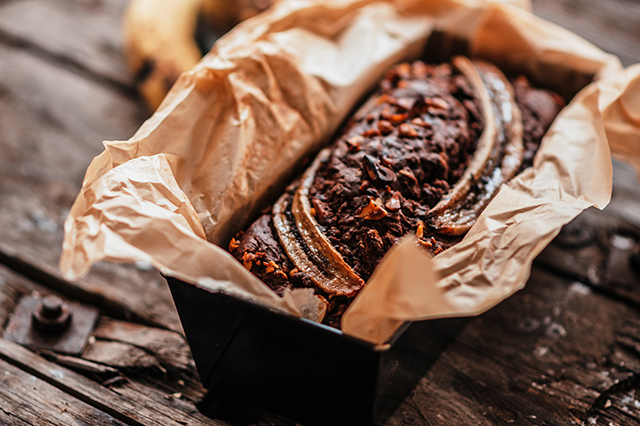
Described as a cross between your very favorite banana bread and a rich, fudgy blackout cake, Bon Appetit’s take on chocolate banana bread uses unique ingredients like whole wheat flour to amplify the flavor. Topping with lengthwise-sliced bananas makes for an impressive presentation.

Bakers tip: Line the bottom of the pan with parchment paper, leaving a generous overhang on the long sides for easy transfer after baking.

For Nut Lovers

Walnut Banana Bread

A Food.com community pick, this Moist & Delicious Banana Nut Bread has over 200 five star reviews. It’s super easy to make and you can substitute pecans for walnuts or simply add both.

Baker’s tip: For added sweetness, add two tablespoons of light brown sugar to sprinkle on top before placing in the oven.

Cinnamon Pecan Banana Bread

Crazy for Crust’s dairy-free cinnamon pecan banana bread recipe is so decadent you’d never know there was no butter. But who needs butter when you have chopped pecans, cinnamon and a delicious cinnamon glaze?

Baker’s tip: Start the banana bread in the blender for easy mixing.

Pecan Coconut Banana Bread

This recipe from Spend With Pennies, packs flavor and doesn’t contain a ton of butter and fat. The crumbly streusel topping is a knockout banana bread variation that takes this one over the top.

Baker’s tip: Make sure to combine until just moistened. Over mixing the ingredients causes a tough & chewy bread.

banana bread recipe variations

For Fruit Lovers

Triple Berry Banana Bread With Lemon Glaze Topping

My Baking Addiction’s Triple Berry Banana Bread is a fun, fruity twist bursting with blueberries, blackberries, raspberries and a simple lemon glaze.

Baker’s tip: Top with whipped cream and eat for breakfast.

Strawberry Banana Bread

Packed with fresh, juicy strawberries and mixed with bananas, The Recipe Critic’s Strawberry Banana Bread is sure to be a family favorite.

Baker’s tip: Let cool completely before removing from loaf pans.

Blueberry Banana Bread

Celebrity chef Giada De Laurentiis’ Blueberry Banana Bread recipe has over 100 five star reviews and is the perfect combination of banana bread and blueberry muffins.

Baker’s tip: Once warm, top with a little butter and enjoy.

If banana bread isn’t your thing check out these other tasty quick breads:

James Beard’s Zucchini Bread (Epicurious)

Louisiana Pecan Bacon Bread (Taste of Home)

Beer Bread (Food.com)

Pumpkin Bread (Once Upon a Chef)

Irish Soda Bread (All Recipes)

Cinnamon Swirl Bread (Taste of Home)

Lemon Bread (Crazy for Crust)

Key Lime Bread (Taste of Home)

Gluten-Free Coconut Bread (Epicurious)

Bacon Cheddar Quick Bread With Dried Pears (Epicurious)

For more easy meals you can make with what you have, check out these pantry recipes from around the globe.

Are you one of the many who have made banana bread or any other banana bread variations while in quarantine? Tell us about it in the comments.

Subscribe to Your AAA Newsletter

Sign up and receive updates for all of the latest articles on automotive, travel, money, lifestyle and so much more!

Why and How To Save That Tax Refund

Have you thought about what you’re going to do with your tax refund? According to a GOBankingRates survey, more than half of Americans plan to save and invest it, while only 10 percent want to use it for a vacation or luxury purchase.

Getting a large sum of money returned to you all at once might feel like a great excuse to treat yourself, but it could also be an opportunity to get ahead of your finances and caught up on debts.

Here’s why you should consider saving your tax return and how you can make it worth your while.

Why Save?

Simply put, it’s your money, so you shouldn’t be in a rush to give it away.

It’s tempting to view your tax refund as free money from the government, but the return is actually the government’s repayment of a no-interest loan you made. In other words, any extra money you’ve given the government via your paychecks is simply coming back to you at a later date. The more money withheld from you during the year, the larger your refund. The withheld amount depends partially on the number of allowances you entered on the W-4 document you submitted to your employer.

Whether your financial issues are big or small, when money that rightfully belongs to you comes back, saving it to pay off important bills or investing it so that it can grow is a more practical choice.

How You Can Save Your Tax Refund

There are all kinds of ways you can save and use your refund to grow financially.

Pay Off Debt

According to ValuePenguin, the Northeast and the West lead the nation in having the highest credit card debt average – over $8,000 worth. A different study shows New Jersey, New Hampshire and Connecticut among the states leading the nation in the amount of student loan debt per resident, ranging from $32,247 to $38,510 on average. Use your tax refund to make couple of payments and get that much closer to being debt-free.

Refinance Mortgage

If finances allow, you can save your tax refund to refinance and reduce the amount of interest owed on your mortgage loan. Just be sure that the amount you’ll save by refinancing exceeds what you would need to pay in closing costs.

Create an Emergency/Rainy Day Fund

According to a recent Bankrates survey, less than 40 percent of Americans would use their savings to deal with emergencies such as a hospital stay or unexpected car repair. More than a third of those surveyed mentioned that they would need to borrow the money, either through a loan, a credit card or family members and friends. The recommended amount to have saved for an emergency is anywhere from three to none months’ worth of wages.

If you don’t need to pay off any immediate debt and your emergency/rainy day fund needs a little padding or you need to create one, use your tax refund to give it a boost. Whether you want to create a separate account for this emergency fund, stash it in your savings or want to store the money some other way, the choice is yours.

save tax refund

Build up Savings Accounts

If you feel that you have your debt and emergency/rainy day fund taken care of, you can also use your tax refund to bolster your savings. Plus, as a AAA member, you have the option to open a savings account. There are several types of savings accounts in which you can invest and put your tax refund in.

Traditional Savings  – This type of online savings account is the most common. If you need to withdraw money quickly it is also the easiest as there are no penalties for early access.

Money Market Account – A high yielding savings account that also gives you the ability to access you funds by writing a check or using a debit card.

Certificate of Deposit – Because you can’t touch it until its maturity date, a CD is a smart way to meet financial goals over time. Use your tax refund as a starting point and watch it grow. CD terms are available from three to ten years.

Contribute to Your Retirement Fund

There are several ways you can contribute to your retirement with your tax refund.

Invest in an IRA

Individual retirement arrangements (IRAs) are ideal for those who don’t have huge credit card debt, already have a set emergency fund and are looking to grow their savings. And IRAs do, in fact, pay off. As you add more it will grow more, but if you withdraw from this fund before you’re 59 1/2 years old, generally you will have to pay a 10 percent penalty (although there are exceptions, per the IRS).

Invest in a Roth IRA

You can also use your tax refund and invest in a Roth IRA. The difference between a Roth IRA and a regular IRA is that a Roth IRA has no up-front tax deduction. The distributions are tax-free and you can access this IRA at any time with no penalty. This IRA makes more sense to use if you expect the tax rate to be higher when you retire than currently.

How do you plan on using your tax refund? Saving or spending? Tell us in the comments. 

Learn more about the ways AAA can help you handle your savings.

Subscribe to Your AAA Newsletter

Sign up and receive updates for all of the latest articles on automotive, travel, money, lifestyle and so much more!

How to Use Your Phone for Good

In times like these, everyone wants to do their part to help combat the spread of COVID-19. One of the biggest ways you can help out in these uncertain times is by staying home and social distancing. But how are you supposed to keep helping if you’re stuck at home? Well for starters, you can use your phone.

People who want to help those impacted by the COVID-19 pandemic can text to donate a one-time gift to a variety of organizations that are helping to keep us healthy and safe. It’s a quick and easy way to contribute.

Here are some of the organizations you can choose to donate to, and the codes that you can use to text them.

American Nurses Association – Text THANKS to 20222

You can text “THANKS” to 20222 to donate $10 to the American Nurses Association to provide direct financial aid to nurses affected by the virus, information deployment and psychological support. At this point in time, nurses are on the front lines in the fight against COVID-19, and they need all the support they can get. The American Nurses Association has created a Coronavirus Response Fund for Nurses to address the needs of nurses and other healthcare workers during the pandemic. Visit their coronavirus resources webpage for more information.

American Red Cross – Text GIVE to 90999

Text “GIVE” to 90999 to donate $10 to the American Red Cross to help those where it’s needed most. The American Red Cross is a humanitarian organization that provides emergency assistance and disaster relief. Right now, they’re focused on combatting COVID-19 by keeping up the volume of blood donations and participating in the COVID-19 Convalescent Plasma Program, in which fully recovered patients donate plasma to help those who are currently battling the virus.

Feeding America – Text DONATE to 50555

Text “DONATE” to 50555 to donate $25 to Feeding America, which provides meals to families in this time of need. With school closures and job disruptions, more people are turning to food banks. Feeding America’s response to the current crisis is to implement emergency food boxes, drive-through pantries and more long-term means of support. They have also launched a COVID-19 Response Fund, which raises both money and food supplies to support food banks and those in need. They’re also making sure that children who once relied on school meals still have access to food. In addition to food, Feeding America distributes household items like personal hygiene products, diapers and cleaning supplies.

Oxfam America – Text OXFAM to 20222

You can text “OXFAM” to 20222 to donate $20 to Oxfam America. In response to COVID-19, Oxfam America will be leveraging their expertise in water, sanitation and hygiene while advocating for the most vulnerable. Oxfam is working with their partners in over 50 countries (including the US) to limit the impact of COVID-19 on people and communities that are especially marginalized. Oxfam America works directly with these communities to help them access information, clean water and food assistance.

Save the Children – Text SAVE to 20222

Text “SAVE” to 20222 to donate $10 to Save the Children, which provides meals when schools are closed, supports mobile meal trucks, food banks and other community feeding programs. Save the Children also provides educational toys, books and worksheets to help kids cope with the added stress and make up for lost time in the classroom. With more than 1 billion children out of school worldwide (and over 30 million out of school in the US), children who rely on school as a safe place and a source of food are at risk. Supporting Save the Children can help alleviate the special ways that the pandemic affects the lives of children. Save the Children is training healthcare teams on how to protect themselves and others to prevent the spread of COVID-19. They are also supplying personal protective equipment to those on the front lines.

The World Central Kitchen – Text FOOD to 80100

You can text “FOOD” to 80100 to donate $10 to the World Central Kitchen to provide meals to families in this time of need. World Central Kitchen is dedicated to providing meals in the wake of natural disasters, collaborating with local chefs and food suppliers. In response to the COVID-19 crisis, World Central Kitchen launched #ChefsForAmerica to help both local communities and struggling restaurants. At time of writing, they’ve served more than 750,000 fresh and healthy meals to food-insecure communities, healthcare workers, children and the elderly. They even opened a “café” at the Mount Sinai field hospital to support frontline medical staff.

United Nations Foundation – Text WHO25 to 501501

Text “WHO25” to 501501 to donate $25 to the United Nations Foundation (in partnership with the World Health Organization) and the COVID-19 Solidarity Response Fund. The United Nations Foundation supports the United Nations’ causes in humanitarian activities. In partnership with the World Health Organization, the United Nations Foundation’s COVID-19 Solidarity Response Fund supports WHO as it coordinates efforts across the world to prevent, detect and respond to the virus. This includes equipping healthcare workers with personal protective equipment and accelerating efforts to develop vaccines and treatments.

If you have the ability to donate, consider some of the causes and organizations listed above. They are each, in their own way, doing their part to protect and support all of us. One short text on your phone could mean a mask for a healthcare worker, a hot meal for a child or access to water and soap for a vulnerable community. Besides, it’s an incredibly easy way to donate to a great cause.

Staying home and not breaking quarantine is half the battle. But if you want to help out even more, texting any one of these organizations to donate some money is a great start.

Which of these organizations interests you? Let us know in the comments below!

Subscribe to Your AAA Newsletter

Sign up and receive updates for all of the latest articles on automotive, travel, money, lifestyle and so much more!

Virtual Field Trips Bring the Northeast’s Best to You

Coronavirus has had ripple effects across the globe. If you’re in lockdown and dreaming of all of the local places you’d planned to visit soon, you’re not alone. Bring the sights, sounds and flavors of the Northeast to your home on a virtual field trip. 

Stream a Stage Show

While the lights are currently out on Broadway – and other stages across the region – innovative performers have put their work on the internet for people to watch.

Broadway HD is a streaming service with an extensive library of recent and historical shows. Play-PerView offers virtually ticketed, one-night-only livestreams of star-studded dramatic readings that benefit charity.

The Boston Symphony Orchestra is offering BSO at Home programming. Every week features a new theme, complete with playlists and historical performances, as well as youth and family concert lessons.

New York’s Metropolitan Opera and Jazz at Lincoln Center are also livestreaming performances nightly.

ACT of Connecticut is streaming a Friday evening Happy Hour that has live chats with Broadway stars.

In Rhode Island, The Wilbury Theatre Group (which won the 2018 National Theatre Company Award from the American Theatre Wing) is livestreaming dramatic readings and acting classes.  The Gamm Theatre is offering Brush Up Your Shakespeare classes with artistic director Tony Estrella.

Town Hall Theater, in Middlebury, Vt., is streaming “The Quarantine Sessions,” a series of short videos, as well as online classes for teens. 

See Iconic Attractions From Afar

While this is the time of year that the Mount Washington Cog Railway opens up for the season, those plans are on hold for the moment. You can still travel to the top of the Northeast’s tallest peak, though, on a virtual field trip to the Mount Washington Observatory, and experience a little bit of the country’s most extreme weather

You can watch this livestream of a covered bridge in Vermont’s Mad River Valley, or explore the farms that feed the state’s locavore movement from live cams and conversations with farmers. While Ben & Jerry’s factory tours are currently shut down, you can take a virtual tour of its Flavor Graveyard where the “dearly de-pinted” are remembered.

Take a virtual tour of New York’s Niagara Falls State Park, or this five-minute virtual tour of New York City that gives you the beginner’s highlights. If you want, you can take a deep dive of the city’s museums using Google Arts & Culture.

virtual field trips

Wild Virtual Field Trips

Just because we can’t visit right now doesn’t mean that the area’s zoos and aquariums have shut down. All of the marine biologists and zookeepers who care for the fish and wildlife in places like the New England Aquarium in Boston, Mystic Aquarium in Connecticut and Roger Williams Park Zoo in Providence, RI are still going to work every day.

Since we can’t go, these places are offering virtual field trips. New England Aquarium does a Facebook Live session with sea creatures every day at 11 a.m., as does Mystic, which has livestreams and also has live cameras in the penguin enclosure. Roger Williams Zoo hosts Zoo School every Tuesday and Thursday at 2 p.m. In New York, the Bronx Zoo website also has virtual visits with animals, and the Queens Zoo, Prospect Park Zoo and New York Aquarium all offer live cams.

Get a Taste of the Region

In a perfect world, we all would all be able to visit New Hampshire and Vermont for maple sugaring season, which is when the maple trees are tapped and millions of gallons of sap are cooked down into the best maple syrup you’ll ever taste. It happens every March and April, and it’s one of the most New England things you can experience.

While events like New Hampshire’s Maple Sugaring Month were canceled due to COVID-19, you can still order freshly made maple syrup from places like Fadden’s General Store and Maple Sugarhouse in North Woodstock, NH; Brower Road Sugar House in Gloversville, NY; Hilltop Boilers in Newfield, Maine; and Moose Mountain Maple in Underhill, VT, which is aged in rum barrels.

There are lots of other ways to bring the Northeast’s signature flavors home too. Vena’s Fizz House, a cocktail supply shop in Portland, Maine, has recipes online and ships its products, like Vena’s Maine Pine Syrup, so you can make libations at home. Red Apple Farm in Phillipston, MA ships its fresh cider doughnuts to order. Champlin’s Seafood in Narragansett, RI does the same with live lobsters and clam boils. Zeb’s General Store in North Conway, NH will mail you its own specialty foods, like jams and pancake mixes, as well as New Hampshire pine incense if you really want to recreate the atmosphere of the White Mountains. And if you check Goldbelly, you’ll be able to find New York City’s signature foods, like bagels from Russ & Daughters and pastrami from Katz’s Delicatessen.

While you’re exploring, check out these virtual tours that will take you even farther.

And remember, when it’s time to start planning real trips again, AAA Travel is here to help.

Tell us which of these virtual field trips you’ll be taking in the comments below. 

Subscribe to Your AAA Newsletter

Sign up and receive updates for all of the latest articles on automotive, travel, money, lifestyle and so much more!

Crossword: The History of Auto Racing

Subscribe to Your AAA Newsletter

Sign up and receive updates for all of the latest articles on automotive, travel, money, lifestyle and so much more!

10 Fun Family Board Games

Nothing quite beats a good old-fashioned board game. Although these tabletop games may not be as popular in today’s digital world as they were before, they can actually be even more appealing as an unplugged respite from the deluge of phones, televisions and tablets. During times like these, fun family board games can be great ways to spend quality time with loved ones. It also doesn’t hurt that they’re great entertainment when stuck indoors.

These 10 board games are bound to provide endless hours of fun for all members of the family.

Monopoly

It’s a well-known fact that Monopoly never gets old. And if you have kids, there’s never a bad time to introduce your kids to the game. If you’re really looking for a time-killer, try Monopoly Longest Game Ever. This version has more properties than any other Monopoly game and has multiple features that make it difficult for players to run out of money.

If you don’t think your kids have the attention stamina for such a feat, go the opposite direction with Monopoly Speed. Hasbro claims it can be played in under 10 minutes.

Scrabble

Looking for a more highbrow board game that is as educational as it is entertaining? Try the world’s most popular word game. Take turns forming the highest-scoring words you can find and then tally up the points at the end.

The game is suitable for children age eight and older. But like most classic board games, there is a junior version.

Operation

Cavity Sam needs your help! In this fun family game players take turns using tweezers to remove funny ailments including a charlie horse, funny bone and butterflies in the stomach. You collect the money if you can take the ailment piece out without getting buzzed. The player with the most money at the end wins.

Operation may not lead your children to a medical degree but it will keep them engaged and maybe even improve their fine motor skills.

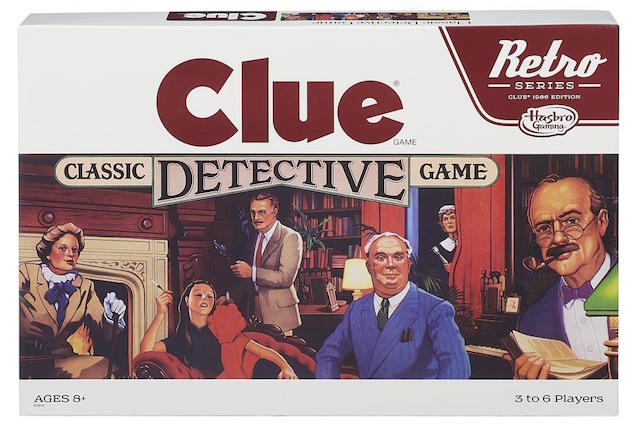
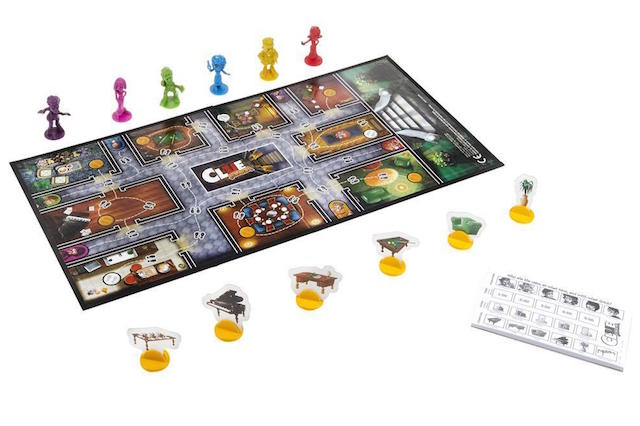
Clue

Colonel Mustard in the dining room with the candlestick.

With endless possible outcomes, the classic “whodunit” game never gets old. The fun family board game has been updated with new rooms, weapons and guests. But you can always just stick to the classic original version.

If the idea of having your child try to solve a fictitious murder isn’t appetizing, try Clue Junior where players are on a mission to solve the case of the missing cake.

(Courtesy of Hasbro)

Mouse Trap

If you’re hoping to get your children interested in the sciences, give them some first-hand engineering experience with Mouse Trap. The game revolves around the eponymous Rube Goldberg machine. Players race around the board trying to collect cheese wedges, all while avoiding getting trapped.

The game is suited for two to four players and children age six and up.

Guess Who?

In this classic guessing game, players choose a mystery character and then use yes or no questions to try to determine their opponent’s character. After each question, you can knock down the eliminated characters on your board. When you believe you know the identity, you can take a guess. But be careful – if you guess wrong, your opponent automatically wins.

Guess Who? is a two-player game so if playing with the whole family you might want to consider creating teams.

Courtesy of Mattel

Apples to Apples Junior

Apples to Apples is a hilarious card game of crazy comparisons. In each round, one player (the judge) plays a green, adjective card. The other players then select a red, noun card that best suits that adjective. The judge decides which pair is best fitting (or funniest, or crowd-pleasing). It can be as serious or as silly as you like.

The junior version is suitable for children ages nine and up. There’s also Apples to Apples Kids if you’re playing with an even younger crowd.

Spontuneous

Who doesn’t love bursting into song? In this fun family board game, all players write down a series of random words. In Spontuneous, players take turns announcing one of their words. The rest of the group then has to belt out a line of a song that uses that particular word. First player to do so wins that round.

The game can accommodate up to 10 players, so it’s a great choice for a large group. And don’t worry – singing talent is not required.

What games has your family been playing lately? Let us know in the comments below?

Codenames

In Codenames, players are split into two teams and 25 cards, each with a different code name, are laid out on the table. All the cards belong to one of the two teams. One player on each team, the “spymaster,” knows which codenames belong to their team. The spymasters take turns giving one-word clues to their teammates to try to get them to guess the right codenames.

Not only is the game fun, it’s played quickly so you can play many rounds in one game night.

Busytown Eye Found It

If you’ve got little ones around (ages three and up), we’ve got you covered. Busytown is based off the animated world of the same name created by children’s author Richard Scurry. In this game, players race around the big, colorful game board searching for hidden objects.

Looking for a different kind of family fun? Try these coloring pages.

Subscribe to Your AAA Newsletter

Sign up and receive updates for all of the latest articles on automotive, travel, money, lifestyle and so much more!

Car 101: Manual vs. Automatic Transmission

For a lot of drivers, picking sides in the manual vs. automatic transmission debate is an easy call.

The domestic auto market has skewed heavily toward automatic transmissions in recent decades. Many drivers prefer the ease of driving vehicles with automatic transmissions, and the fuel economy ratings of automatic transmissions have caught up with those of manual transmission vehicles.

But there are those who still enjoy the experience of driving a standard. It’s why so many high-end sports cars come with a stick.

“It’s just more fun to drive standard. To make a perfect shift without missing a step, it’s Zen-like,” said John Paul, AAA Northeast’s Car Doctor.

Here’s a look at manual vs. automatic transmissions.

What’s a transmission?

Both manual and automatic transmissions connect a vehicle’s wheels with power generated in the engine. A transmission houses several gears in a gearbox. These gears leverage engine power based on need. Whether it’s driving uphill at low speed or on flat terrain at high speed, a transmission uses a gear configuration to maintain a safe, functional engine speed.

It’s the same principal as any multi-geared bicycle.

What do you mean by engine speed?

Engine speed is judged by revolutions per minute. It refers to the rate at which the engine crankshaft is moving. You can track RPM by looking at the tachometer. It’s the gauge on a vehicle’s dashboard that isn’t the speedometer. Take the number the needle indicates and multiply it by 1,000 to get an idea of how hard your engine is working.

Are certain RPM better than others?

Yes. There is a reason the top numbers of rpm gauges are highlighted in red. Operating an engine at such speeds – sometimes referred to as redline speeds – for extended periods of time is dangerous, and can lead to engine failure. The ideal operating range for most engines is about 2,000 to 3,500 RPM, or somewhere above two and below four on your gauge.

What does this have to do with transmissions?

A transmission maximizes your vehicle’s performance without forcing your engine to operate at unnecessarily high rpms.

Does my car have an automatic transmission?

Does your vehicle have a clutch pedal to the left of the brake?

No.

Then yes, you have an automatic transmission.

And what exactly does that mean?

Drivers don’t shift the vehicle’s gears. It’s done automatically through a (very) complex process. For introductory purposes – this is Car 101, after all – automatic transmissions are controlled primarily through hydraulic pressure and, in most vehicle models 10 years old or younger, a computer.

manual vs. automatic transmission

What’s a manual transmission?

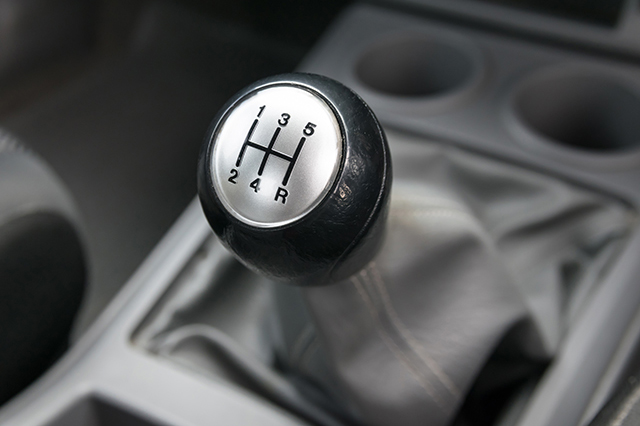
Manual transmissions require drivers to shift gears with a clutch pedal and shifter. As a vehicle’s rpm rise, drivers facilitate a gear switch by stepping off the gas pedal, pressing down on the clutch and shifting one gear up or down before reapplying the accelerator and simultaneously disengaging the clutch.

Sounds complicated.

It’s not so bad once you get used to it, though convenience is one of the biggest reasons automatic transmissions have come to dominate the domestic auto market.

Is it as complicated to explain as automatic transmissions?

It’s simpler. Here’s a quick explanation.

A vehicle with a manual transmission has a flywheel connected to its crankshaft. It also has a clutch disc, which rotates with the flywheel when pressed against it.

The clutch disk is connected to the transmission’s gearbox through a gearbox shaft.

When the flywheel and clutch disk are connected, spinning together, the gearbox shaft does so as well.

When the clutch is pressed, however, a pressure disc disengages the gearbox shaft from the flywheel and clutch disc, cutting off the flow of energy from the engine to the transmission.

This temporary disengagement allows drivers to change gears using the shifter.
Once the clutch is disengaged, the pressure disc allows the gearbox shaft to reconnect with the clutch disk, but energy must be ready to turn the mechanism, which is why you must simultaneously reengage the accelerator when disengaging the clutch.

Are there any types of vehicles that are more likely to have a manual vs. automatic transmission?

High-end sports cars are where you’ll most likely find manual transmissions these days, though they remain quite popular across makes and models in Europe. If you’re traveling abroad and plan to rent a car, it’s a good idea to find out before you travel if your vehicle is a standard.

I know someone who had to get his vehicle’s clutch replaced. Is that rare?

Nope. It’s common, and something about the manual vs. automatic transmission debate worth noting. A clutch is a wear and tear item and its life depends on how a driver treats it. Someone who regularly brakes hard will wear down a brake pad more quickly than someone who gently applies the brakes. Someone who is constantly missing gears while shifting will likely need a clutch replacement at some point in a vehicle’s life while more experienced drivers who operate smoothly may never need a replacement.

My vehicle has a shifter but I don’t have to use it.

You’re talking about a direct shift gearbox, also known as a DSG transmission or, in some cases, a manumatic, and another part of the manual vs. automatic transmission discussion. In place of a clutch pedal, vehicles with such DSG transmission use an electronically controlled dual clutch.

By dual clutch, you mean two clutches?

Yep. Dual clutches have two clutches that are activated based on whether you’re in an even- or odd-numbered gear.

Why would I use a shifter if I don’t have to?

Some drivers prefer DSG because it enables quicker shifting. Drivers looking to maximize fuel long held manual transmissions in high regard. In recent years, however, fuel economy ranges have moved closer.

So there’s manual, standard and DSG transmissions. Anything else?

Yes. Continuously variable transmissions, or CVT. These are automatic transmissions that use belts and pulleys. They’re popular in Nissans, and increasingly popular in Subarus. The idea of CVT is that there is an infinite number of positions that can be leveraged to ensure ongoing performance while limiting engine stress.

What does transmission fluid do?

In an automatic transmission, transmission fluid is used for lubrication and generating hydraulic pressure that helps signal when it’s time for a gear change. In CVT and manual transmissions, fluid is primarily used for lubrication.

Do I need to get my transmission fluid replaced?

Like any fluid, you should follow your owner’s manual suggestion on the best time to get your fluid replaced.

I’ve heard transmission work can be expensive.

It’s true. No matter manual or automatic transmission, transmissions can be hard to reach and the systems contain many parts. It’s not unusual to see transmission repairs costing $1,500 or more, depending on the issue.

Any other questions about the difference between manual and automatic transmissions? Let us know in the comments.

Learn more about AAA’s automotive services

Subscribe to Your AAA Newsletter

Sign up and receive updates for all of the latest articles on automotive, travel, money, lifestyle and so much more!

AAA Northeast Delivers Food and Supplies During COVID-19 Crisis

When Thermaxx began producing personal protective gowns instead of insulation jackets at its West Haven, Conn., plant, in response to the coronavirus crisis, AAA Northeast saw an opportunity to pitch in. Thermaxx needed help distributing to first responders and medical personnel, and AAA had vehicles and staff to get the job done.

“When we learned about Thermaxx’s need to quickly get their protective gowns in the hands of first responders and members of the health care community, we knew we had to help,” said President and CEO John Galvin. “AAA has a long history of helping the communities we serve, so this became a perfect partnership with Thermaxx to assist front-line responders in their battle against this virus.”

Thermaxx first became involved at the request of a local fire department in need of disposable protective gear that is in short supply during the nationwide coronavirus crisis. Thermaxx rapidly converted all its production lines to make disposable gowns to be donated to first responders and medical personnel across Connecticut. While Thermaxx gowns have not undergone FDA testing and approval to be designated as personal protective equipment, they are designed as an improvement to alternatives recommended by the Centers for Disease Control and Prevention. Click here to learn more about Thermaxx gowns.

Thermaxx began fulfilling requests from firefighters, first responders and medical professionals across Connecticut on March 25. More than 250 organizations submitted requests to pick up gowns at Thermaxx in the first two weeks. The immediate demand was more than the company could handle alone, but others joined the effort after hearing the call for help.

AAA Northeast volunteered its roadside assistance fleet.

“Converting our factory was difficult, but doable. Building out a distribution model almost seemed impossible,” said Tom Salagaj, vice president of manufacturing and engineering at Thermaxx. “Having AAA Northeast step up to handle our distribution not only gave first responders valuable hours of their day back, but it also allowed Thermaxx to focus on manufacturing.”

For the past few weeks, Crystal Davila, a battery technician in AAA’s Connecticut fleet, has been happily bringing supplies to those who need them in Fairfield, Litchfield and New Haven counties in western Connecticut. She appreciates the ability to make a difference during the crisis and enjoys the enthusiastic – and grateful – response she receives on her stops.

She was surprised when members of Echo Hose Ambulance in Shelton, Conn., asked her to pose for a photo.

“As first responders, we help people every day. During this pandemic, we are busy helping those that need us most. Words can’t express enough gratitude and appreciation we have from our local businesses such a Thermaxx and AAA for providing us the much-needed protective equipment and services we rely on each day to keep our crews safe.”

Davila is glad for the opportunity.

“We all play a part in helping slow the virus and helping those who are out there helping us,” Crystal said. “Standing at the front line brings humility.”

Manhattan Meals on Wheels delivery
AAA’s Matt Zebracki delivers for Meals on Wheels in downtown Manhattan, N.Y.

Meals on Wheels

With stay-at-home orders across the northeast, volunteer delivery people are in short supply for some organizations – and people – that rely on them. Meals on Wheels makes a difference for elderly citizens living in isolation, bringing them prepared food and a brief interaction with a caring person.

Matt Zebracki, a tow technician in AAA’s New York fleet, has spent a few of his shifts providing this service to people in downtown Manhattan.

“It’s a pleasure doing it. It’s nice to see the smiles on seniors’ faces,” he said. “Some people are surprised to see my uniform and see that AAA is giving back to the community. I tell them that we always do.”

Donna Marques, a AAA driving instructor in Cranston, R.I., has been on the Meals on Wheels circuit in Rhode Island. She says the most rewarding aspect is the human contact.

“I’m delivering food, but also making sure everyone is OK,” she said.

Learn more about how AAA Northeast employees are helping our communities – and how you can too. 

Subscribe to Your AAA Newsletter

Sign up and receive updates for all of the latest articles on automotive, travel, money, lifestyle and so much more!

How to Set Up a Budget and Stick to Your Savings Plan

If your spending is out of control and your debt is increasing each month, it’s time to get back to the basics of budgeting.

Does even the mention of the word “budget” stifle your lifestyle? Keep an open mind because sticking to a budget doesn’t have to be an anxiety-ridden experience. Think of it this way: A novice baker wouldn’t attempt to whip up a souffle without first consulting a recipe. Your budget is your recipe for a successful savings plan.

Before you start cooking up money making schemes to earn fast cash, learn about how you can set up and stick to a budget even in the face of temptation.

Listen to Our Podcast

Pay off your debt and get your finances in check.  Listen to Episode 10 of our podcast, Merging Into Life: Budgeting 101.

Tune In

Setting up Your Savings Plan

Creating a budget in the most generic terms comes down figuring out your net income minus your expenses. How much money do you have coming into your household after taxes and other deductions, including your health insurance and 401(k) contribution? Subtract that amount by your fixed and variable expenses.

Fixed expenses are your rent, mortgage, real estate taxes, insurance, car payments and debt. Cutting back on these expenses is trickier than budgeting your discretionary bills. But, in theory, you could rent a cheaper apartment or refinance your home loan, so it’s not impossible to reduce fixed expenses.

Variable expenses include groceries, vacations, entertainment, dining out and other bills that vary in cost from month-to-month. These expenses are easier to trim, provided you have the willpower to cut back.

Budgeting Goals

After you’ve ironed out your income and expenses, identify your financial goal. Why are you budgeting? Maybe you want to lower your debt. Eliminating debt should be a priority considering the interest you incur.

Establish a clear budget goal with a deadline to achieve it. Let’s say you want to pay off your student loans. How much of your discretionary spending do you need to cut to have extra cash to pay off your student loans within two years? Having a clear goal will enable you to keep focused on your savings plan when impulses to spend arise.

You may also want to reconsider refinancing your loans. This could help you save money over the lifetime of the loan if you are able to secure a lower interest rate. Or you could simply restructure the loan in a way that lowers your monthly payments, freeing up cash to put elsewhere.

To help you stick to a set budget and savings plan, track everything you buy. Bank account statements are useful to evaluate where you’re overspending. Write down your expenses, type them in an Excel sheet or use any other method that will keep you accountable to you savings goal. There’s also the budget app Mint, which is like having money manager with you to pay your bills and track your cash.

savings plan
It can be difficult to resist the temptation to spend money.

Sticking to It

You’ve set up your budget, now how do you stick to it and avoid dipping into your savings or using credit cards? On the journey to saving money there will be temptations. One night you may be invited to an expensive restaurant with friends when you’ve already budgeted to eat leftovers at home. What do you do? Another night your favorite rock band is reuniting at Madison Square Garden and the only available tickets are $1,500. Or suppose you’re invited to a destination wedding in Mexico. You could say adios and use credit cards or pull cash from your emergency savings. But short-term gratification is just that: short term.

Budgeting is about sacrifices and deciding between your wants versus your needs. This means eliminating impulse spending. You want to enjoy a meal at a ritzy restaurant with your friends, but your budget doesn’t allow for it. Make compromises. Skip paying for pricey appetizers, dinner, drinks and dessert with your friends. Instead stop by early just for drinks or ask your buddies to make dinner at your place on another night. As for that rock concert, watch a show on TV and put the money toward your debt.

Declining a wedding RSVP can be complicated, especially if it’s a close friend or family member. Weigh your finances carefully. How long will it take you to pay off the trip? Will it be worth it a year later when you’re still paying it off? When in doubt, always make smart decisions that benefit your savings goal.

Resist Temptation

It’s easy to get sidetracked from your budget when you feel deprived. Sticking to a budget means getting out of debt and ultimately having more freedom. So reward yourself along the way to keep up your spirits. Pad your budget to allow for little rewards like a reasonably-priced dinner, a morning coffee or a movie night. You risk failing completely if you’re extremely frugal. A sustainable budget, much like a diet, has to be a slow lifestyle change.

To further resist temptations, unsubscribe from retailer newsletters and emails. Being bombarded with enticing advertisements for new shoes, jewelry clothes and vacations can deter you from your goals.

Do you have any budgeting tips for your fellow AAA members? Let us know what works for you in the comments section below.

Subscribe to Your AAA Newsletter

Sign up and receive updates for all of the latest articles on automotive, travel, money, lifestyle and so much more!

Keep It Clean: Expert Tips on How to Sanitize

Is it clean? This is the question most of us are asking ourselves on the few occasions we now leave the house (gloved and face masked), and about anything we bring home.

With cases of COVID-19 circulating since the beginning of March, we’re all battling an invisible enemy.

The advice we keep hearing from the CDC and other health officials is to practice social distancing and stay home as much as possible, keep at least 6 feet away from others, use a cloth face cover and wash hands frequently. But maybe that doesn’t seem like quite enough.

Samara Geller, a senior research and database analyst who manages the healthy cleaners database for Environmental Working Group, offers a few extra pointers.

When it comes to knowing how to sanitize and disinfect, not all surfaces are created equal. The granite countertop in your kitchen, for instance, is much easier to subject to thorough sanitizing than that box of cereal on the shelf at the grocery store or the handle of the pump at the gas station.

How to Sanitize Your Hands

“For most surfaces you encounter on the go, it may be more practical to employ thorough hand sanitizing and hand washing strategies than to effectively sanitize or disinfect nonporous surfaces with antimicrobial cleaning wipes or travel-size sprays,” Geller says. “This is because sanitizers and disinfectants are only fully effective when used in a manner consistent with their labeling. This may be easier said than done.”

So, glove up, do your shopping, pump your gas and keep your hands strictly away from your face while you do it. “If you’re worried about the transfer of germs from frequently touched surfaces to your face, and if you can’t wait until you arrive home or get to a public restroom to wash your hands with soap and water, hand sanitizer works in a pinch,” says Geller.

Thoroughly wet and rub your hands with a hand sanitizer that contains a minimum of 60 percent ethyl alcohol, also known as ethanol, and let them air dry. If you’re out and about, sanitize before getting into your car and touching the steering wheel.

The gold standard, which you can employ when you get home, is to wash your hands (for at least 20 seconds or two “Happy Birthday” choruses). Those groceries, by the way, don’t need to be sanitized as long as you’re washing your hands. The U.S. Food & Drug Administration’s guidelines on food safety and COVID-19 state that food packaging is considered a low-risk source of transmission.

how to sanitize

How to Sanitize Surfaces

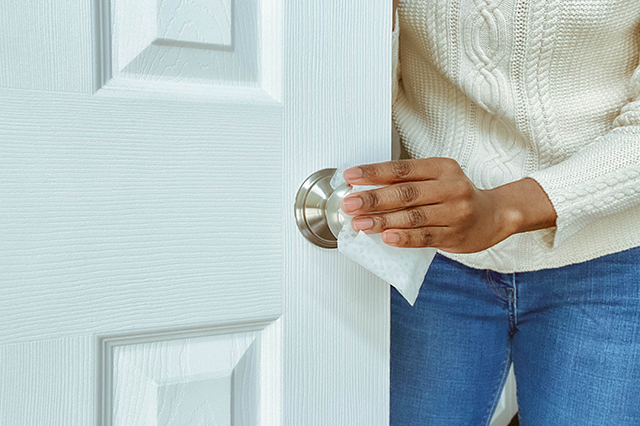
In your home, focus on sanitizing surfaces you come in frequent contact with, including doorknobs, handrails, faucets and light switches. When you are ready to tackle those (and that countertop), do it right. “Selecting the right product and observing the adequate level of surface saturation and contact time with the surface, are critical — and often overlooked — steps to achieving proper effectiveness,” Geller says.

EWG has you covered on the “right product” score, as it recently published a list of 16 safe and effective products to guard against coronavirus. These are all U.S. Environmental Protection Agency-registered disinfectants that have research to back up their pathogen-killing claims. Geller advises looking for an EPA registration number on cleaning products you purchase. Active ingredients that are preferred include hydrogen peroxide, ethyl alcohol (ethanol), citric acid, L-lactic acid, caprylic acid (octanoic acid) and thymol.

How to Disinfect Surfaces

While sanitizing reduces the amount of germs on a surface, disinfecting kills them.

When you’re ready to disinfect a surface, first thoroughly read the label on your disinfectant. Make sure the product is safe to use on the surface you have in mind, and wear gloves if that’s indicated. Open windows or doors so there is good ventilation in the area where you’re working.

First, clean the surface with soap and water to remove visible dirt or grease. Next, spray or sponge on the disinfectant so that the surface is thoroughly wet, and make sure it stays visibly wet for the length of time indicated on the product label’s directions for use before you rinse or wipe the area dry. This could mean anywhere from 30 seconds to 10 minutes, depending on the product. It could take multiple sprays or wipe-downs to keep the surface wet long enough.

If your product of choice is a disinfecting wipe, do not be tempted to re-use it. Geller says this could be dangerous. To keep your wipes as effective as possible, be sure to reseal the package after each use, and store the wipes in a cool place out of direct sunlight.

Note that wipes are considered a safe way to sanitize your smartphone – which might just be the most frequently touched surface in your world. Apple says on its website that you can use disinfecting wipes on its phones. Other companies recommend spraying a nonabrasive, alcohol-based (at least 70% isopropyl alcohol, and never straight rubbing alchohol) cleaner on a microfiber cloth to clean your phone.

With the right disinfecting products and techniques, you can make sure that while you’re safer at home, your home is clean and safe.

For more ways to stay germ-free and healthy, check out our tips on how to sanitize your car and clean your suitcase.

Subscribe to Your AAA Newsletter

Sign up and receive updates for all of the latest articles on automotive, travel, money, lifestyle and so much more!

10 Indoor Workouts to Stay Fit and Boost Immunity

As many of us undergo self-isolation to prevent the spread of COVID-19, daily exercise is seemingly less feasible than ever.

It’s important to always create a fitness plan that fits your goals and schedule, and right now most of our schedules are jam-packed with a whole lot of time inside the house. Luckily, there are plenty of indoor workouts you can do while social distancing.

Exercising is not just a productive time killer, it’s a great way to boost your immune system, which is especially important during these times.

Learn more about what you should be eating to boost your immune system. 

Gyms and exercise studios may be closed, but that’s no excuse to skip your workout. During these times of self quarantine, brands such as Corepower YogaNike Training ClubPelotonPlanet FitnessRumbleSoulcycle and FitOn are extending their free trial periods or waiving their fees entirely to encourage everyone to stay home and do indoor workouts.

The truth is, you don’t need a fancy home gym to get or stay in shape. In fact, you can burn calories and build muscle without any equipment. According to Weight Watchers, body weight workouts can double as cardio and work almost every muscle in your body, especially when you increase the intensity.

Daily exercise is essential for optimizing health. To get you started, we’ve listed a full-body indoor workout that will improve your endurance, strength, balance and flexibility. Create some space and prepare to sweat! Share it with your family and friends to encourage them to stay fit while staying safe.

via GIPHY

Squats

Squatting is perhaps the most effective lower-body exercise to improve flexibility and strengthen your core. If you’re new to the motion, start slow and ensure your form is correct to avoid any injury. Rather than using equipment, the squat uses your weight and gravity as the resistance. Be sure to master the basic form before adding weight or trying new variations, such as jump squats and split squats.

1. Start by standing straight with your feet about shoulder-width apart and your toes pointing slightly outward.

2. Place your hands together in a “prayer position” and bend your knees as much as feels comfortable until your hips sink below your knees.

3. Stand back up to your original position.

4. Focus on maintaining balance while keeping your head up and back straight.

5. Complete three sets of 20 reps.

via GIPHY

Lunges

Lunges are a perfect indoor workout because you can do them anywhere and they don’t require equipment. Unfortunately, they’re also a bit difficult to get used to. However, if you consider all the benefits, lunges are worth the unpleasantness. Like squats, lunges are easy to learn and work all your leg muscles to cut down fat and tone your lower body. Since the exercise targets your glutes, hamstrings thighs and quads, it’s an ideal workout for people with back pain. This well-rounded exercise is a must for any indoor workout routine and can be performed in many variations.

1. Start by standing with your feet shoulder-width apart and arms down at your sides.

2. Take a step forward with your right leg and bend your right knee as you do so, stopping when your thigh is parallel to the ground. Ensure that your right knee doesn’t extend past your right foot.

3. Push up off your right foot and return to the starting position. Repeat with your left leg.

4. This is one rep. Complete three sets of 10 reps.

via GIPHY

Planks

Planks are one of the most fundamental exercises that work all the major abdominal muscles to help you develop better core strength and stability. A proper plank will not only increase your balance and strength, over time the exercise can help reduce back pain and improve posture. So whether or not you’re going for six-pack abs, you should be planking as much as possible to get the most out of this beneficial exercise.

1. Place your forearms firms on the ground with your elbows aligned below your shoulders and your feet hip-width apart.

2. Keep your back straight and your hips at the same level as your head.

3. Hold the position without allowing your hips to sag.

4. Do this for as long as possible and repeat up to five times.

via GIPHY

Pushups

When it comes to upper body workouts, the pushup is perhaps the most basic yet effective exercise that suits both beginners and advanced trainers. They are frequently used in the fitness world to measure upper body strength and stamina. While not everyone can support their full body weight at first, there are many options for performing pushups. If you’re looking to target specific muscles, hand positioning is key. For instance, a wider hand placement will use more chest muscles while narrow hand placement targets your tricep muscle. Learn more about different types of pushups.

1. Start in a plank position with your hands slightly wider than your shoulders.

2. Bend your elbows and lower your body until your chest nearly touches the floor.

3. Pause, then push yourself back up, keeping your elbows close to your body during the movement.

3. Complete three sets of as many reps as possible.

via GIPHY

Dips

While pushups engage several upper body muscle groups, dips target your chest and triceps. In addition to building arm strength, tricep dips also work your shoulders, back and activate your core as you hold your hips off the ground. This exercise is easy to perform at home using a chair or another sturdy surface, such as a stair, railing or coffee table.

1. Sit on the edge of the chair and grip both sides of the seat next to your hips. You should be facing forward with your chin up, legs extended and your heels touching the ground.

2. Lift yourself and slide your body forward enough that your behind clears the edge of the chair.

3. Slowly lower your body downward until your elbows are bent between 45 and 90 degrees.

4. Push yourself back up to the start position and repeat.

5. Complete three sets of 10 reps.

via GIPHY

Bridges

Your glutes are the largest muscle group in your body that make it possible for you to walk upright, move and swivel your hips. This is why strengthening your glutes improves every activity you do from running to dancing, according to Healthline.com. The glute bridge exercise is key to increasing your entire posterior chain strength and power, which isn’t only good for you, it also improves your balance.

1. Lie on your back with your knees bent, feet flat on the ground and arms straight at your sides with your palms facing down.

2. Pushing through your heels, squeeze your glutes and lift your hips off the floor until your body forms a straight line. Your upper back and shoulders should still be in contact with the ground.

3. Pause at the top before lowering back down to the starting position

4. Complete three sets of 12 reps.

via GIPHY

Crunches

It’s no coincidence why crunches have been the staple of ab workouts for decades. The exercise engages your core muscles but primarily stresses the lower abs. While the exercise is fairly basic, people make the mistake of rushing through the motion with improper form, says Jacquelyn Brennan, a personal trainer, and co-founder of Pilates + Coffee in Chicago. Crunches are key for developing core muscles. Try to include them in your indoor workout.

1. Lie flat on your back with your knees bent and your hands placed behind your head or across your chest.

2. Squeeze your abs and inhale.

3. Exhale and slowly contract your abs as you lift your back a few inches off the floor.

4. Return to the start position in a fluid motion.

5. Complete three sets of 20 reps.

via GIPHY

Supermans

No, this exercise will not turn you into a superhero, but it will strengthen your lower back and build support and stability for the spine. The glutes and lower back are the primary muscle groups that engaged in the superman exercise. Perfecting this movement will help you better perform any movement that requires bending over or sitting.

1. Lie face down on your stomach with both your arms and legs extended. Keep your neck in a neutral position.

2. Keeping your arms and legs straight, engage your lower back and glutes as to raise your hands and feet roughly six inches above the ground.

3. Hold for two to five seconds before lowering back down to the starting position.

4. Repeat this 10 times.

via GIPHY

Burpee

Burpees have a notorious reputation for a reason – they are tough! You may hate them, but they are one of the few equipment-free exercises that work your full body. Burpees are an effective way to build muscle, burn fat and improve your cardio endurance. If you’re looking to burn calories fast, you’ll learn to love to hate doing burpees.

1. Start by standing upright with your feet shoulder-width apart and your arms down at your sides.

2. With your hands out in front of you, start to squat down. When your hands reach the ground, pop your legs straight back into a pushup position.

3. Do a pushup.

4. Come back up to the starting pushup position and jump your feet up to your palms by hinging at the waist. Get your feet as close to your hands as you can get, landing them outside your hands if necessary.

5. Stand up straight, bringing your arms above your head and jump.

6. This is one rep. Complete three sets of 10 reps.

Stairs

You may never look at the stairs in your house the same way again. Believe it or not, climbing stairs burns more calories than jogging. Unlike walking or running, with stair climbing, your muscles are forced to resist gravity and move in a vertical pattern, according to RunSociety. The beauty of stair workouts is they’re a great excuse to go outside if you’re feeling trapped inside. Feel free to incorporate squats and lunges at the base of the stairs in between exercises.

1. Take a few jogs up and down your stairs for roughly 10 minutes.

2. Decide on a number to reach if you’re able to track the number of steps you take.

More Exercises

A Workout a Day in 2020

Find Your Flow With Varied Yoga Styles

Workout Routines You’ll Actually Enjoy

Good Workout Plans for Warm Weather

Whether you’re a beginner or a seasoned gym rat, give these indoor workouts a try and see how you feel. Always remember to check with your doctor before starting a new exercise program. Drink plenty of water to stay hydrated and make sure to give your body time to rest and recover afterwards.

Let us know how you’ve been staying healthy in the comments below. 

Subscribe to Your AAA Newsletter

Sign up and receive updates for all of the latest articles on automotive, travel, money, lifestyle and so much more!

Camera Settings Cheat Sheet

I can still remember the overwhelmed feeling I had when I got my first DSLR camera. I was coming from a point-and-shoot, where all I had to do was click one button. In comparison, my DSLR was massive with countless dials and buttons, interchangeable lenses and all new settings I had never heard of. What the f-stop?!

If you have a new camera and are also stumped by all the different terms, buttons and icons, I have compiled this camera settings cheat sheet to help you learn the basics.

Manual Camera Settings

Aperture: Aperture is the hole in your lens through which light passes. You can control the size of the lens opening by adjusting the aperture. Aperture is measured in f-stops.

F-stop: F-stop is the number your camera shows you when you change the size of the lens aperture. The lower the f-stop number, the larger the aperture/lens opening and therefore the larger the exposure. The higher the f-stop number, the smaller the aperture and exposure. It seems backwards, until you understand depth of field. 

Depth of Field: This refers to how much of your image is in focus. Because it is the smallest lens opening, a large aperture of f/1.8 will give you small depth of field, focusing only on your decided focal point and blurring the background. With a small aperture of f/22, your lens will be wider, giving you a bigger depth of field and all of your image will be in focus. Large apertures are used in portraits and close-ups. Small apertures are mostly used for landscapes.

Large aperture example (f/4)
Small aperture example (f/14)

Automatic Modes

Most entry-level cameras have automatic modes in which the camera determines all of the settings based on what or when you are shooting. Automatic modes typically include Portrait, Auto, Macro, Sports, Landscape and Nighttime. 

Camera Shooting Modes

Cameras have various shooting modes, some more than others. The modes vary from automatic to semi-automatic to full manual control.

Aperture Priority Mode (A/AV): In this mode, you choose the aperture for your exposure and the camera chooses your ISO and shutter speed. 

Manual Mode (M): In manual, you have full creative control over your exposures settings. You will be choosing the aperture, shutter speed and ISO. 

Program Mode (P): This mode is very similar to auto but you can still adjust your white balance and use exposure compensation. 

Shutter Priority Mode (S/TV): You choose the shutter speed of your exposure and the camera chooses your aperture and ISO. 

Exposure

Exposure refers to how light or dark your image is.

Exposure Compensation: Some cameras have a dedicated button or dial for exposure compensation. It is usually denoted by a + and – sign or a dial with numbers ranging from -3 to +3. When you adjust your exposure compensation, you are either adding or subtracting light from your image. I find exposure compensation incredibly useful in the semi-automatic modes like Aperture Priority.

Exposure Triangle: A picture’s exposure is made up of three elements – aperture, ISO and shutter speed. Where these three elements intersect is the exposure of your image.

ISO: This refers to your camera’s sensitivity to light. A low number (100) means your camera is not as sensitive, while a high number (1200) means it is more sensitive. You want to use a low number in bright daylight, and higher numbers at dusk or at night. 

camera settings cheat sheet
Slow shutter example (1/4 second).

Shutter Speed: This refers to how fast your shutter opens and closes. A fast shutter speed like 1/300 second will freeze motion, whereas a slow shutter speed like 10 seconds will show motion.

White Balance: You adjust white balance to accurately portray the colors in your images. There are several pre-set options within your camera. These are usually Auto, Daylight, Tungsten, Cloudy, Fluorescent, Flash and Shade. Auto usually does a great job, but if you are struggling to get your colors right under difficult lighting you may want to adjust to one of the other pre-set modes. There is also Kelvin white balance, which allows you to manually adjust the temperature yourself. It ranges from 1500k to 10000k; the smaller numbers are warmer and the larger numbers are cooler.

Focus

You probably don’t need a camera settings cheat sheet for this one. Focus is what is responsible for a sharp image versus a blurry image. 

camera setting cheat sheet
Shot in continuous mode.

Focus Modes

Most cameras have four focus modes. 

Single Shot: Camera takes just one image.

Continuous: Camera takes several images in rapid succession. Very useful for action shots. 

Automatic: This mode detects the subject and determines Single or Continuous focus based on movement.

Manual: Requires the user to manually adjust the aperture ring of the lens to put an image into focus.

I hope this little camera setting cheat sheet helped shine some light on the functions and buttons of your camera. If you ever find yourself confused or unsure about something, I highly recommend referring to your camera’s manual. Happy snapping!

For the month of April, Nikon has opened up its online school for free!

Beth Mancuso is a professional photographer. All photos are hers. 

Subscribe to Your AAA Newsletter

Sign up and receive updates for all of the latest articles on automotive, travel, money, lifestyle and so much more!

How to Clean Your Suitcase

We often return with treasures from our travels, but one thing we don’t want to bring home is the number of germs we pick up along the way, especially on our trusty sidekicks – our suitcases.

We wheel our luggage through airports and security scanners and down unclean streets. As COVID-19 keeps us home and curtails travel, it’s the perfect time to give your case a little TLC.

Here you can learn how to clean your suitcase inside and out. Grab your cleaning supplies and let’s get down to business!

Cleaning the Exterior of Your Suitcase

Check the manufacturer’s instructions for all acceptable cleaning and sanitizing products, especially if your suitcase is under warranty. These are usually listed on the brand’s website and will guide you through what cleaning products you can and can’t use on the different materials of your suitcase.

Hard-Shell Exterior

Start with the outside of your luggage. If you have a hard case suitcase, you can use a variety of products to clean and disinfect, from wipes and sprays to a mixture of soap or 70% alcohol and hot water.

First, clean any dirt and build-up on the outside of your suitcase by scrubbing it with the cleaner of your choice. I use Dr. Bronner’s castile soap mixed with water. You can simply mix one-quarter cup of any mild soap with a quart of warm water in a spray bottle and wipe down the hard-sided exterior shell of your suitcase with a soft towel or microfiber cloth. Pay attention to germ hot spots like handles, locks, luggage tags, wheels (swivel them around to get every inch) and the bottom of the suitcase.

After you fully clean the outside of your suitcase with soap and water, take a sanitizer spray and wipe the entire suitcase down with a cloth. Again, focus on areas that encounter the most germs. I make my own spray by mixing two parts of rubbing alcohol to one part of water in a spray bottle. You can also use store bought sanitizing sprays or wipes.

Use gloves or be sure to wash your hands right after you’ve completed this deep cleaning session, as not to spread germs to other services of your home.

Soft-Shell Exterior

If your suitcase has a soft-shell exterior made of fabric, you can still follow the instructions for the hard-shell exterior but skip the sanitizing step as this can damage or discolor the fabric. If there are stains on the luggage, try using an upholstery shampoo. Companies always recommend testing the product on an inconspicuous area like the bottom to prevent staining. Make sure that you air-dry the bag before storing it, so it doesn’t develop a musty smell.

real id driver's license

Cleaning the Inside of Your Suitcase

The inside of your suitcase is your home away from home on the road and has carried your precious possessions and adored souvenirs all around the world. Show it some love in the form of cleaning.

Detach any liners or laundry bags that can be removed and launder them in warm water. As always, check the manufacturer’s guidance and wash any material in accordance to the instructions.

Vacuum the inside of the suitcase to get rid of any dirt and debris you’ve accumulated along your journey – we’re looking at you, sand! Use your vacuum’s upholstery attachment to get into all of the nooks and crannies, including pockets. Then, wipe the inside of the suitcase with the mild soap and warm water mixture that was used to clean the exterior. If you’ve had a spill inside your suitcase, you can use upholstery shampoo.

More Tips on How to Clean Your Suitcase From AAA Travel

  • Double bag any liquids or gels to prevent spilling or consider switching to bar soaps, shampoos and conditioners when possible.
  • Use packing cubes to keep any germ-ridden items from touching the inside of your case. Hello, dirty shoes!
  • Spray hand sanitizer directly on your suitcase handle after picking it up from the luggage claim or anytime someone else might have handled it to prevent any germy situations.

Storing Your Luggage

A lot of suitcases come with a dust bag for storage; if you don’t have one or want to buy new, they are an inexpensive investment. Make sure that your luggage is completely dry from your deep-cleaning session and simply slip the dust bag over your suitcase before storing.

Now it’s time to start dreaming about your next trip. When it comes time to plan, AAA Travel is here for you.

Do you have any tips on how to sanitize your suitcase? Share them with us in the comments.

Subscribe to Your AAA Newsletter

Sign up and receive updates for all of the latest articles on automotive, travel, money, lifestyle and so much more!

What to Watch Right Now

Looking for something to watch while you stay inside? In the era of streaming television, you have a lot to choose from – but sometimes that’s the problem! When there’s so much content, it can be difficult to separate the worthwhile from the wish-I-never-saw-it.

Check out this list of what to watch on the top streaming platforms.

What to Watch on Netflix

Tiger King

Tiger King is a docuseries about Joe Exotic, the extremely eccentric owner of a roadside zoo. Joe doesn’t have the most ethical practices, however. And when a big cat rescuer calls him out, one of the wildest rivalries in the world is born. If you want to learn more about this bizarre story after the show is over, check out the podcasts Joe Exotic: Tiger King and Cat People.

The Circle

The Circle is a reality show in which the contestants never actually meet (until they’re voted out, at least). They communicate solely through a social network called the Circle, and compete to see which of them can become the most popular of the group. With quirky contestants and more than a few catfish, it’s a great way to spend an afternoon.

I Think You Should Leave

This sketch show by comedian Tim Robinson will worm its way into your brain and never let go. I admit that I’ve watched the whole thing more than twice. It defies description.

Cheer

Cheer is a docuseries about the fiercely-competetive Navarro College cheer squad, led by the exacting Monica Aldama. It’s the best mix of a sports documentary and a dance documentary, with high emotions, crushing defeats and personal triumphs. Three cheers!

Queer Eye

Odds are, you’ve heard of Queer Eye, the modern reboot of the makeover show Queer Eye for the Straight Guy. It’s good. It’s great. It’s more than a makeover – this show is like a warm bath for the soul.

Mindhunter

Mindhunter isn’t a show about catching the criminal, it’s about understanding them. This period piece about early FBI profilers is filled with amazing performances on both sides of the law.

Dirty John

Another show that has a follow-up podcast! Dirty John is based on the podcast of the same name – a true story about an online date gone disastrously wrong. The show is cheesy at times, but it’s never boring

Tuca and Bertie

Tuca and Bertie is an animated show for adults created by Lisa Hanawalt, who you might know from her work on BoJack Horseman. Best friends Tuca (a toucan) and Bertie (a songbird) navigate their lives in Bird Town, dealing with boyfriends, creepy bosses, patronizing aunts and trains made of giant slugs. Tuca and Bertie is one of the few adult animated shows that takes their audiences seriously, giving them a perfect mix of cartoon nonsense and poignant characterization.

What to Watch on Hulu

Little Fires Everywhere

Based on the novel by Celeste Ng, Little Fires Everywhere begins with arson. Then it immediately flashes back to four months earlier, to investigate how it happened. Reese Witherspoon and Kerry Washington give amazing performances as co-leads as they butt heads throughout the series.

Devs

Devs takes place in a near-future Silicon Valley, which sits in the shadow of Amaya, a powerful tech company working on a mysterious project. When her boyfriend goes missing after getting a promotion at Amaya, computer engineer Lily Chan takes it upon herself to investigate.

Fargo

Fargo is an anthology series in the spirit of the original Coen brothers film of the same name. Each season is a story of folly and murder in the snowy Midwest. While all the seasons are great, the first season is some of the best television of recent memory.

The Act

Based on a horrifying true story, The Act is about Dee Dee Blanchard and her ailing daughter, Gypsy Rose. But is Gypsy sick at all? For more on this story, see the HBO documentary Mommy Dead and Dearest.

Community

Community is a genuinely funny sitcom about a study group at a community college. If anything can make you laugh in these times, it’s Community.

Atlanta

Atlanta is the brainchild of Donald Glover (who was on Community!), about two cousins trying to make their way in the Atlanta rap scene. Atlanta is a weird and wonderful show, and every character is either fully fleshed-out or purposefully bizarre. Most of the time, they’re both.

The Handmaid’s Tale

The Handmaid’s Tale is Hulu’s most successful series, and there’s a reason for that. It’s an incredibly well-made show with some of the best acting out there. The first season is a standout, and not to be missed.

achieving work life balance

What to Watch on Prime

Making the Cut

Making the Cut is a reality competition show about fashion design, hosted by Tim Gunn and Heidi Klum. It’s the grad school to Project Runway’s undergrad.

The Marvelous Mrs. Maisel

The Marvelous Mrs. Maisel is about a recent divorcee in the early 1960s, trying to make her way in the world of stand-up comedy. The show is colorful and charming, almost like a musical with jokes instead of songs.

Good Omens

Based on the book by Neil Gaiman and Terry Pratchett, Good Omens is the story of a demon, an angel, the antichrist, and the end of the world. But it’s funny! David Tennant and Michael Sheen make star turns as the demon Crowley and the angel Aziraphale.

Lorena

Produced by Jordan Peele, Lorena is a docuseries that revisits the infamous case of Lorena Bobbitt. Even if you remember the case (and who doesn’t), it’s not to be missed.

What to Watch on HBO Go and HBO Now

McMillions

McMillions is a docuseries that tells the story of how the McDonald’s Monopoly game promotion was infiltrated and rigged for years. It’s a romp, as much as a true crime docuseries can be a romp.

The Plot Against America

The Plot Against America, based on the book by Philip Roth, takes place in an alternate history in which Charles Lindbergh defeated FDR and became president of the United States in 1940. The show follows a Jewish family living in New Jersey as they navigate the increasingly tense and frightening political landscape.

Westworld

Westworld is a delightful mix of a wild west show and a sci-fi meditation on the meaning of life. What’s not to like? There are cowboys and robots.

Watchmen

Watchmen picks up where the comic series by Alan Moore and Dave Gibbons left off, in a world marked by the presence of superheroes and masked vigilantes. And also a giant squid. If you’re going to watch the Watchmen, I highly recommend you read the comic first. It’s worth it.

Chernobyl

Chernobyl is the terrifying true story of the Chernobyl nuclear disaster and the heroes who helped to contain it. Be warned – the series is about radiation, so it’s full of body horror. But if you can handle that kind of thing, it’s one of the best miniseries in recent memory.

The Sopranos

It’s time to rewatch The Sopranos, one of the best television shows of all time. Wait, you haven’t seen The Sopranos? Well then, it’s the perfect time to watch The Sopranos for the first time. Nobody needs to know. After this, you can act like you’ve always seen The Sopranos.

Game of Thrones

If you’re one of the two people in the world who hasn’t seen Game of Thrones, now’s the time to do it! It’s no Sopranos, though.

Need more suggestions? Check out what Your AAA editors are watching, reading and listening to these days.

What are you watching right now? Tell us in the comments. 

Subscribe to Your AAA Newsletter

Sign up and receive updates for all of the latest articles on automotive, travel, money, lifestyle and so much more!

Doing Good Deeds From Home

Just because you’re stuck at home doesn’t mean you have to have to feel disconnected from your community and the rest of the world. During times of crisis, the positive effects of reaching out and doing good deeds goes even further.  

Generosity not only helps others; it can help you feel better, too. This is especially true during stressful times – like if you’re starting to feel a little stir-crazy from self-quarantining or social distancing. 

You can still make a difference from the comfort and safety of your home. Discover how with this list.

Virtual Volunteering

Put all the extra time you suddenly have on your hands to good use. All you need is an internet connection and a phone, tablet or computer and you can start volunteering from home. 

Just like remote work, digital volunteering allows for more flexibility and the ability to choose from a wide range of opportunities. Nonprofits are always looking for help, especially during times of crisis. You can become a virtual volunteer and work for an organization you care about or discover something new. 

Whether you’re passionate about education, language, science or social issues – or you’re a creative looking for some design, writing/editing or video creation opportunities – there are plenty of virtual volunteering options. 

Organizations like the Smithsonian, ZooniverseProject Gutenberg and Translators Without Borders all have digital volunteering opportunities for people willing to help. You can also use websites like DoSomething.org, Catchafire or VolunteerMatch to find opportunities.

You can always make a monetary donation to charities in need, too. Just be sure to make sure any organization you’re contributing to is legitimate 

Be a Good Neighbor 

Nearly half of all Americans are under stay-at-home orders. So if you’re home, it’s likely your neighbors are as well. While checking in with friends and family is a bit of a no brainer, extending that concern to others isn’t a bad idea either.

Take some time to reach out. Call your neighbors, especially the elderly and those who live alone, to make sure they’re doing OK. Having a conversation and connecting with others can help ease some feelings of isolation.

You can extend your reach even further by writing letters to people in nursing homes and retirement communities, since many residents can’t have visitors right now due to the risk.

good deeds

Adopt or Foster Animals

Adopting or fostering an animal could be just what you need to flourish while social distancing.

Taking care of a furry friend will help keep you busy, and spending time with a companion animal can improve your mood. If you have kids at home, adopting a pet can become a great lesson in responsibility.

According to the Centers for Disease Control and Prevention, “there is no evidence that companion animals, including pets, can spread COVID-19 or that they might be a source of infection in the United States.” 

There are many cats, dogs and other animals in need, and fostering or adoption can help. If you see yourself only having time for a pet during quarantine, and can’t offer a forever home, fostering may be the better option for you.

Due to nonessential business restrictions, many animal shelters are operating with a smaller staff. Be sure to call your local pet shelter in advance to ask about fostering/adopting, as they may be by appointment only.

Be Greener 

Taking time to help the planet is always a noble cause. There’s always something we can do to be green.

First, try to cut back on waste, specifically food waste. Go through your cabinets, pantry and fridge to take inventory of what you have. Then, be sure to use it – meal planning makes this easier. Perishables should be used first: Vegetables can go into soups or stews that can be frozen, while ripe fruit can be used for baking (like in banana bread, muffins and hand pies). Donate any unexpired food you don’t see yourself using.

Next, be sure to reuse or recycle food containers. If you already recycle, keep up with it. If you don’t, now is a great time to start. To cut back on waste, you could also try composting. There are plenty of online resources to show you how.

Finally, you can be greener by planting something. Start a garden outside, add more greenery to your outdoor space or start growing herbs inside. Growing your own ingredients will not only give you something to do, it could also lead to fewer trips to the grocery store.

If you have spare time on your hands due to social distancing or self-quarantining, you can put that time to good use. Acts like virtual volunteering, fostering animals and being green are all good deeds that can be done from home.

How have you been helping your community? Tell us about your good deeds in the comments. 

Subscribe to Your AAA Newsletter

Sign up and receive updates for all of the latest articles on automotive, travel, money, lifestyle and so much more!

Pro Tips on Taking Family Vacation Photos

Author Og Mandino said, “The greatest legacy we can leave our children is childhood memories.” Nothing makes for fonder memories than travel, which is why documenting your trips with family vacation photos is so important.

Recording these moments doesn’t have to be stressful nor does it require a fancy camera to do so. These photo tips will help you capture all those important memories.

family vacation photos

Start With the Journey

How will you be traveling? By plane, train or automobile? Whatever method you choose, make sure to snap a few pictures of your crew en route. These spaces are often limited so I recommend a wide-angle lens for these types of shots. For a camera lens, I would use a focal length anywhere between 12-18mm. If you are using your phone check out these detachable lenses and choose the wide or fisheye lens. 

Roadside Attractions

If you are traveling by car look for roadside attraction photo ops. Roadside attractions can make for some pretty hilarious family vacation photos. I like to check the website Roadside America to see if there will be any attractions on our routes. I mean, who doesn’t want their picture taken with a giant sea serpent or the largest ear of corn? 

Lodging

Remember to take a couple of pictures of where you stayed. Whether it is a hotel, tipi, camper or cruise ship, make sure to document it. Where you rest your head at night is part of the adventure. I like to line the family up in front of where we are staying and take a group picture. Capture the exterior, the interior and the view (if there is one).

Tips: To get the whole family in the shot ask a stranger to snap a picture. If there is no one around, you can set your camera or phone on a timer and take a shot that way. I recommend using a tripod or propping your camera up on something. 

family vacation photos

Tourist Attractions

It wouldn’t be a family vacation if you didn’t hit up at least one of the big tourist attractions in the area. I scout these out beforehand. Look for attractions that are kid-friendly. If you’ll be visiting somewhere that requires a lot of walking like a zoo or amusement park, I recommend packing lightly. If you plan to bring your camera, only bring the lens attached to the body. My favorite focal length for this type of place is 24mm or 35mm. 

Tips: Try to capture your children’s sense of wonder and awe at these places. Instead of asking them to smile and look at the camera, photograph them from a distance as they take in their surroundings. For some added fun in your images buy some of the nostalgic foods like cotton candy, snow cones or lollipops. Also look for balloons, swords or silly hats to dress up your images.

family vacation photos

Ready, Set, Action

Family travels are often jam-packed with action and activities. Whether you are swimming, skiing, boating, horseback riding or out for a hike make sure you capture it. 

Tips: To freeze motion you will want your shutter speed to be above 1/300th of a second, to show motion you will want to be below 1/50th of a second. Also, try to vary your angles; get high and get low for different perspectives. And if your activity involves water, get underwater housing for your camera or phone to capture some really unique images. These phone bags produce great results.

family vacation photos

It’s All in the Details

Don’t forget the little details that make up your travel experience. Here are some you shouldn’t miss. 

Food

From trying a new cuisine to cooking around the campfire, make sure to snap a couple of pictures of your eats.

Wildlife

When you visit new places you’ll often encounter birds, reptiles, insects and other mammals that you don’t see back home. Use a fast shutter speed to capture creatures, anything above 1/300th second should freeze the action.

Landscape/Flora

Capture flowers, plants and trees. Use a wide-angle lens to capture the whole picture of the landscape. 

Culture

If you traveled to a place that has a unique culture, make sure to document it. Snap some pictures of the locals and their customs. Always ask permission before taking a picture.

family vacation photos

Emotions and Bonding

The most important family vacation photos document the emotions and joy that come with exploring a new place, and the bond that your family shares. I recommend using a zoom lens so that you can quietly observe from a distance. If your kids don’t know that you are photographing them, the more likely you are to capture genuine moments. Take out your camera when you know they are about to have a new experience. To capture bonding moments send a parent in to sneak a hug or start a tickle fight. Both are sure to elicit a connection between the child and parent. 

family vacation photos

Remember to get yourself in the frame and to only leave behind footprints and memories.  Happy travels!

Beth Mancuso is a professional photographer. All photos are hers. 

Subscribe to Your AAA Newsletter

Sign up and receive updates for all of the latest articles on automotive, travel, money, lifestyle and so much more!