Home security is an essential aspect of maintaining a safe and secure environment for you and your family. While there is no foolproof way to ensure complete security, there are several measures that homeowners can take to protect their property and deter intruders.
It can happen to anyone.
First and foremost, homeowners need to understand that burglaries and home invasions can happen to anyone, regardless of where they live or the perceived safety of their neighborhood. This means that it’s crucial to take proactive steps to secure your home, including installing sturdy locks on all doors and windows, using motion-activated lights and security cameras and investing in a reliable alarm system.
Choose the right home security features.
These top-rated DIY security products have you covered.
Ring Alarm Home Security System: Ring is a popular brand that offers a comprehensive home security system that includes door and window sensors, motion detectors and a base station that connects to the cloud. It also offers mobile access and control through a smartphone app.
Nest Cam Indoor Security Camera: Nest offers high-quality indoor security cameras that provide 24/7 live streaming, advanced motion detection and two-way audio. It also has a mobile app that allows users to monitor their home from anywhere.
Arlo Pro 4 Spotlight Security Camera: Arlo’s wireless security cameras feature 2K video quality, advanced night vision and motion detection. It also offers a mobile app that allows users to view live footage and receive alerts on their smartphone.
August Smart Lock Pro: August’s smart lock allows users to control access to their home from anywhere through a mobile app. It also features advanced encryption and tamper-proof technology to ensure maximum security.
Philips Hue Smart Light Bulbs: While not a traditional home security product, Philips Hue’s smart light bulbs can help deter intruders by simulating occupancy while the homeowner is away. It can be controlled through a mobile app and can be integrated with other smart home devices.
Take note of vulnerabilities.
Another important aspect of home security is ensuring that you are aware of any potential weaknesses on your property. This may include overgrown bushes or trees that provide cover for intruders, poorly lit areas or outdated locks that are easy to pick. By identifying and addressing these liabilities, you can significantly reduce the risk of a break-in.
Be aware of how intruders get in.
It’s important to be aware of common tactics that burglars use to gain access to homes. For example, many burglars will pose as salespeople, delivery drivers or even law enforcement officers to gain entry into a home. Always verify the identity of anyone who comes to your door before allowing them inside, and never hesitate to call the police if you feel uncomfortable or suspicious.
Have a plan.
Finally, homeowners should be prepared to take action in the event of a break-in or home invasion. This means having a plan in place for how to respond, such as calling the police and safely exiting the home if necessary. It’s also a good idea to keep emergency supplies on hand, such as a first aid kit, flashlight and cell phone charger.
Home security is a vital aspect of maintaining a safe and secure living environment. By taking proactive measures to secure your property, identifying potential vulnerabilities, being aware of common tactics used by burglars and being prepared to respond in the event of a break-in, you can significantly reduce the risk of becoming a victim of crime. Remember, it’s always better to be safe than sorry when it comes to protecting your home and family.
Tip: Many companies offer homeowners insurance discounts for properties with security systems. Systems that can notify local safety officials usually lead to larger discounts than unmonitored systems that only send text alerts. To speak to a AAA insurance agent or get a quote, visit AAA.com/Insurance.
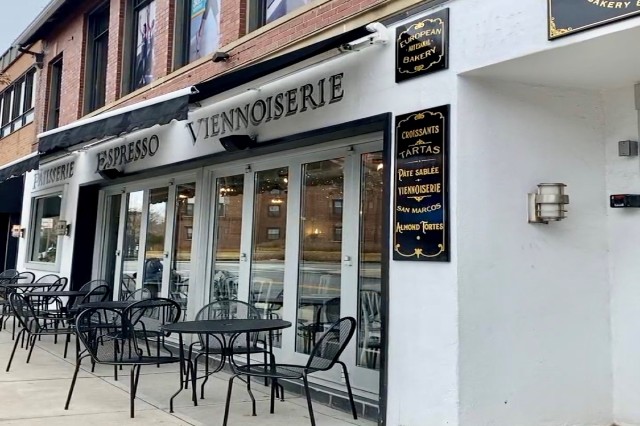
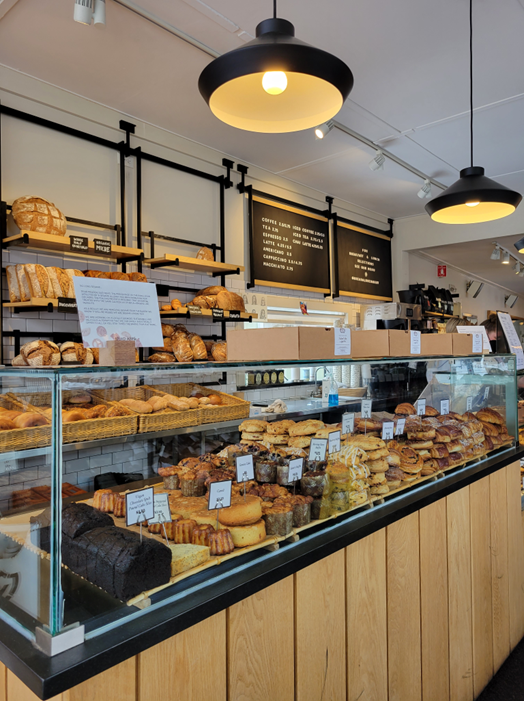
Stepping into Madrid European Bakery has the same feeling of stepping off a plane and into the city itself – and that’s just the point. Owners Sergio Mendoza and Hercilia Corona have made their space on Wayland Avenue into a feast for the senses, from the decor to the heavenly aromas to the gorgeous (and delectable) pastries.
As Madrid’s sole baker, Mendoza expertly crafts every morsel of deliciousness served at the bakery, including custard tarts, eclairs, costrada and creme brulee croissants. If sitting inside, you could see him hard at work right from your seat, kneading and folding the next batch of goodies. And speaking of seats, the marble-topped cafe tables are the perfect touch to make your experience truly feel like a little piece of European heaven.
No sweet is complete without a coffee and Madrid has you covered there, too. Pair your pastry with a variety options like Americano, cappuccino, cortado, espresso or latte. Not a huge coffee person? No worries. There’s matcha, chai and even hot chocolate, too!
Our suggestion: The strawberry and cream-filled croissant rendered us completely speechless. So, that.
With their attractive blend of cutting-edge design, advanced technology and energy efficiency, electric vehicles are taking center stage in more auto showrooms nationwide. And now, the new 2023 AAA Car Guide is here to help consumers navigate this evolving automotive marketplace by ranking and rating the newest vehicles, including EVs. The Guide provides consumers with reviews, based on testing by AAA Engineers, highlighting how many advanced driver assistance systems (ADAS) are included in the vehicle, along with other criteria and information.
Announced at the New York International Auto Show, the 2022 BMW iX xDrive50 earned the overall top score for the 2023 edition of the AAA Car Guide. All but one of the category winners for 2023 is electric – the gasoline-powered Kia Carnival SX took the minivan category. Meanwhile, tiny Rivian Automotive placed two models in the top five – the R1T Adventure pickup and the R1S Launch Edition SUV.
Last year was notable for soaring gas prices, with the national average for a gallon of gas hitting a record $5.01 in June. Consumers responded by purchasing more than 760,000 EVs, a 65% increase from 2021. Of the 71 vehicles reviewed for the 2023 AAA Car Guide, 19 are pure electric.
The 2023 AAA Car Guide includes comprehensive reviews of each vehicle based on 13 criteria, including the number of ADAS safety features, fuel efficiency, emissions, braking, handling, ride quality and acceleration. These vehicles are tested, scored and placed in one of six vehicle type categories by the Automotive Research Center of the Automobile Club of Southern California, a member of the AAA federation of motor clubs. Additionally, there are three categories based on price.
“EV sales gain more traction each year, but we know that consumers still have a lot of questions about them, such as battery life and ease of charging,” said AAA’s Megan McKernan, manager of the Automotive Research Center. “That’s where the AAA Car Guide comes in handy. It’s an easy-to-understand resource that takes some of the stress and guesswork out of car-shopping by providing the vital information consumers need to make the right choice.”
For those in the market for newer used vehicles, the online AAA Car Guide website also contains links to the two prior editions in 2022 and 2021.
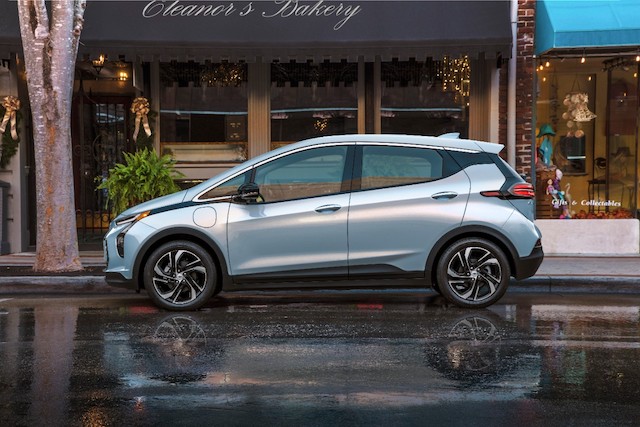
2022 Chevrolet Bolt EV
AAA Car Guide Winners By Category
Each of the 2023 AAA Car Guide winners has numerous ADAS safety features and achieves high fuel efficiency. The highest scoring ranked by category are:
Category
Vehicle
Overall
2022 BMW iX xDrive50 (electric)
Small
2022 Chevrolet Bolt EV 2LT (electric)
Midsize
2022 BMW i4 M50 (electric)
Large
2022 Mercedes-Benz EQS 580 4MATIC Sedan (electric)
Pickup
2022 Rivian R1T Adventure (electric)
SUV
2022 BMW iX xDrive50 (electric)
Minivan
2022 Kia Carnival SX (gasoline)
Best Under $35K
2023 Toyota Camry Hybrid SE Nightshade (hybrid)
Best $35K – $50K
2022 Kia Carnival SX (gasoline)
Best Over $50K
2022 BMW iX xDrive50 (electric)
You’ll find these vehicles and more on display at the New York International Auto Show, taking place April 7-16. Get discounted tickets here!
If you’re driving through New England, you’re bound to find more than a few covered bridges along your route – and you’ll be glad you did. They serve as a picturesque reminder of olden times.
Yes, they’re beautiful, but when most covered bridges were built back in the mid-1800s, they were all about being practical. The roofs kept rain and snow off the wood and prevented decay, thus keeping the structure safe. Sadly, the number of covered bridges is dwindling.
Here are some of the best covered bridges still dotting the New England landscape.
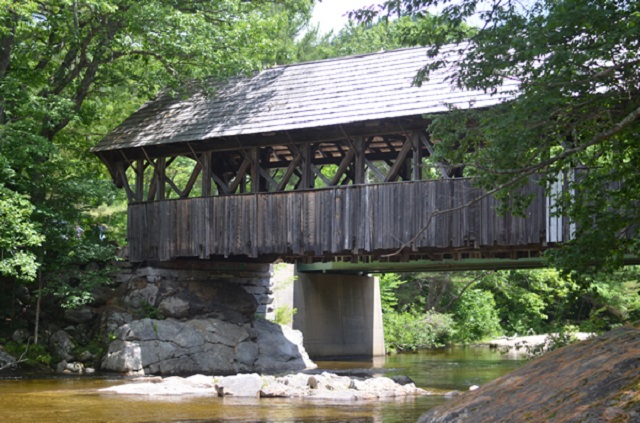
Built in 1872, this covered bridge was originally named the Sunday River Bridge for – you guessed it – the river that it spans. The origins of its nickname are up for debate. Some say it earned the name for being one of the most photographed and painted covered bridges in Maine. Others say this 87-foot long bridge got its nickname because impressionist painter John Enneking often painted in the spot. Either way, it’s a beautiful structure that’s on the National Register of Historic Places. You can no longer drive across the bridge, but it is open to foot traffic.
This covered bridge spans the Kenduskeag Stream in a section of Corinth known as Robyville Village. It’s 73-feet long and was designated as a Maine Historic Engineering Landmark in 2002. Built in 1876, the Robyville Bridge is most notable for being the only completely shingled covered bridge in Maine. The structure was reinforced as part of a major rehabilitation in 1984, so you can drive your car over it just horses and buggies once did.
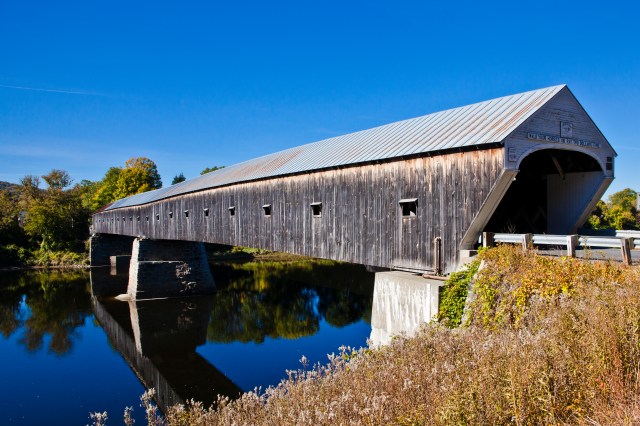
There are over 60 covered bridges in New Hampshire. The longest and most impressive of the lot is the Cornish-Windsor covered bridge, which runs across the Connecticut River into Vermont. At 449.5 feet in length, this is the longest wooden bridge in the country. It’s also the longest two-span covered bridge in the world, so it’s not to be missed.
The Albay Covered Bridge was constructed back in 1858 and is arguably one of the most scenic bridges in New Hampshire. It’s located in the White Mountains along the Kancamagus Highway, one of the most scenic roads in the Northeast. This bridge closes during the winter but is open to foot traffic all year long.
Measuring 100-feet long and open to pedestrians and cyclists, the Arthur A. Smith Bridge is the only Burr arch truss bridge in Massachusetts and the last covered bridge in the town of Colrain, which once boasted 12 covered bridges. Originally built in 1869 and named for a then-prominent local resident, flood damage saw it largely abandoned until the town voted to rebuild and move the bridge to its current location in 1896.
This covered bridge was built in 1886 and has been closed and refurbished several times throughout the years. It was listed on the National Register of Historic Places in 1986 and is one of the few 19th-century covered bridges still in existence in the Bay State. It measures 137 feet long and is open to traffic, although it can only manage a single lane of cars at a time.
(Credit: Joe Nelson; Courtesy of Vermont Covered Bridge Society)
Pulp Mill is one of the oldest covered bridges in Vermont. Its exact year of construction is unknown, but it has a history of repairs and refurbishments dating back to 1860. It is also one of the state’s few double-barrel bridges. Instead of one opening for traffic, there are two so each direction has its own lane, making the entrance look a bit like a double-barrel shotgun.
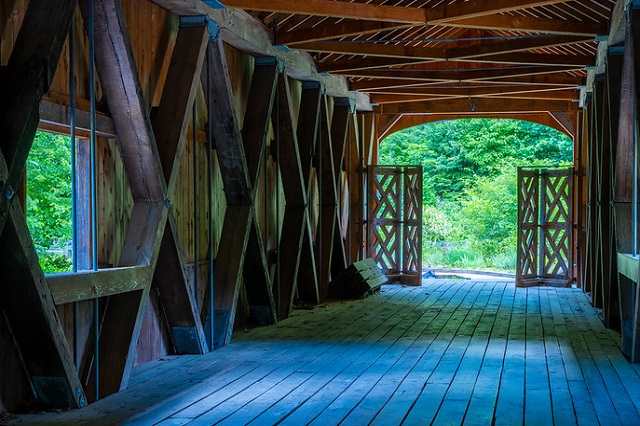
Measuring 280 feet long, West Dummerston is the longest covered bridge located entirely within in the state of Vermont. It was built in 1872 by Caleb Lamson, a master builder of his time, to span the West River. The bridge’s intricate woodworking includes town lattice trusses and diamond-shaped openings that look beautiful from the outside and add light to the inside.
This is the only covered bridge on a public road in Rhode Island and it’s also rather new. It was devised of in 1986 to celebrate the state’s 350th anniversary. The work was done by volunteers and intended to replicate 19th-century styling. Shortly after opening in 1992, the bridge was burned by arsonists, but volunteers immediately came right back out to rebuild. The current 40-foot bridge was dedicated in 1994 and is open to traffic.
The Comstock Bridge was built in 1785 as an uncovered bridge but received an upgrade with a roof in 1873. It needed significant reinforcements in the 1930s since it wasn’t originally built with a roof in mind. The bridge got its name from the town’s first postmaster and still has much of the original wood mixed in with the newer pieces that were added over the years.
This covered bridge is 109 feet long and spans the Housatonic River. It’s tucked away in a beautiful, wooded area with ample trails for hiking and exploring. It’s one of only three public highway covered bridges in Connecticut, and one of only two that accept vehicular traffic. A bridge has spanned this spot in the river since the mid-1700s with the current bridge dating back to 1842.
If guided travel tours make you think of long bus rides and crowded groups shuffling from one tourist attraction to the next, it’s time to update your perspective.
AAA Travel advisor Wendy Marley answers our questions about guided travel, separating old truths from new realities and proving that today’s tours are better than ever.
For all your travel questions and trip-planning needs, schedule an appointment with one of our trusted travel advisors.
How has guided travel evolved?
A lot has changed in the last 10 or so years. Guided tours used to be strictly scheduled and focused on ticketed sites, but now there’s more flexibility, as well as more time to be immersed in the local culture and getting to know the destination and the people. You can go off the beaten path for unique experiences and visit the top spots, too. There are also more options than ever, including different group sizes, themed tours and many budget ranges.
What are some of the most common myths about guided travel?
There are so many guided travel myths to dispel. One of the biggest misconceptions is that you’ll be on a coach bus all day. Tour operators are exploring places in new ways now, so there’s less time on a bus and more time at your destination. There are also different modes of transportation, from dog sleds and trains, to tuk tuks (motorized rickshaws), trolleys and jeeps. And you’re not just staying in hotels anymore, either – there’s igloos, treehouses, manors, castles and chateaus!
Another myth is that it is more expensive to go with a guide, and that is simply not true; there are plenty of examples where the all-inclusive pricing of a tour is much less expensive than piecing together an itinerary and adding meals. Not to mention the added value a guide brings, or the time travelers save.
What are some other perks of guided travel?
Traveling with a guide makes all the difference; they provide background on the destination and heaps of information you wouldn’t receive traveling alone, such as local knowledge and tips on the best places to shop and eat.
It’s all about the storytelling. Your guide is going to share stories with you that you wouldn’t get anywhere else. Those stories are what you will remember and bring back to share with others. It isn’t only about getting the best picture!
Another perk of booking a tour is having all the details of your trip done for you in advance, so you know you will have reliable accommodations and transportation and a day-to-day outlined itinerary. There are also opportunities for free time and customizing your trip with additional excursions and pre- and post-trip city stays.
The amount of time – and stress – saved by not having to plan or figure out how to get around, and skipping the line for museum entrances and planned activities is endless. You can relax with your family and friends instead of worrying about logistics.
What are all the ways AAA members can go guided?
It is important to think about what is important to you. What do you want to see and how do you want to see it? There’s a guided tour for every age, interest and budget. You can explore options for various group sizes, food tours, photography tours, themes for families, active traveler itineraries and more.
Our preferred tour partner AAA Member Choice Vacations®, offers bucket list trips to all continents with great accommodations and optional add-ons.
Looking for something more high-end? Insight Vacations and Luxury Gold are the 4- and 5-star answers, providing amazing hotel stays, upgraded transport and additional inclusions.
And if you have your sights set on Ireland, Brendan Vacations will lead your Celtic journeys.
What are a few places you think are best experienced by guided tour?
Really anywhere, but especially any place you haven’t been before and want to immerse yourself in the local culture. This is especially true if it’s a destination where the language or culture is different from your own, or getting around is difficult (like driving on the other side of the road in the U.K.!).
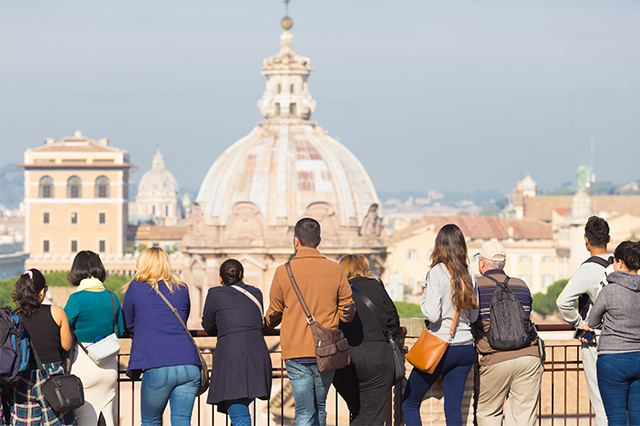
Ireland is one of my favorite tour destinations, with castle stays and beautiful scenery along the drives. Italy is another example where you can experience so much more in a short amount of time with a guided tour, from Cinque Terre to the Amalfi Coast.
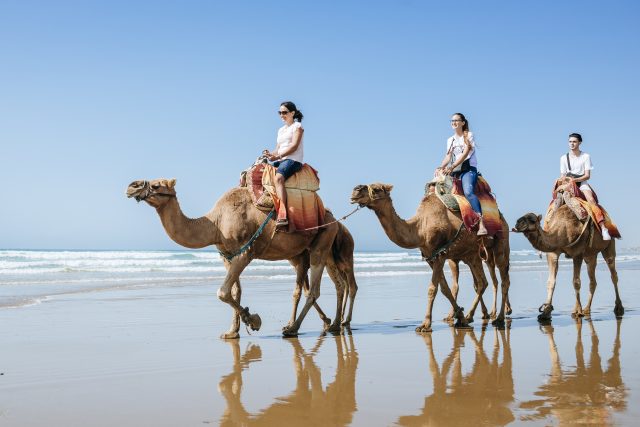
Exotic destinations like Morocco are a personal favorite, where I got to ride a camel in the desert and shop for textiles in the winding medinas of Marrakech.
The last trip I did was to Iceland with Member Choice Vacations, and I was so glad to be on a guided trip, especially when visiting some of the more remote areas like glaciers and lava fields. Our guide knew where to stop for food and breaks when there wasn’t a gas station in sight!
Trending destinations right now are the three I’s – Italy, Iceland and Ireland. Greece has also been very popular, as well as Spain, Portugal and Croatia.
And don’t forget, going guided is not only about traveling to Europe or internationally. There are amazing, guided experiences right here in North America, such as national parks, Hawaii, the California Coast and the Rocky Mountains.
Booking travel can be confusing, and it seems like the prices are always changing. How can you get the best deal?
With summer vacation right around the corner, all signs point to booking now, especially if you plan on traveling internationally. You can get personalized advice and trip planning by scheduling an appointment with one of our travel advisors here.
European river cruises and cities are among the most popular destinations for summer 2023, according to AAA Northeast travel booking data. From flights to rental cars to hotels, reservations are filling up fast and prices are up across the board.
“It is going to be another busy domestic summer season. With that, we are seeing Europe taking the top spot week after week. River cruises are filling up fast, and top tours to the hottest destinations are nearly sold out for some of our partners … Ireland, Italy, Spain and Portugal are topping the list,” said Chuck Nardozza, AAA Northeast’s managing director of travel sales. “Don’t get me wrong, there are still some deals to be had, but they are going to be far and few between. That’s why working with a trusted travel advisor is our best advice. In some cases it is cheaper to cross the Atlantic than it is to go across the country! I can’t say it enough, book ASAP, don’t miss out!”
Here are more top tips from AAA Travel experts for finding the best time to book your next flight, hotel room, cruise or tour.
When Is the Best Time to Book a Flight?
Ray Hourani, director of travel air operations at AAA Northeast, shares pointers on how to best fly the friendly skies.
What do travelers need to know about the current price of air travel?
Hourani has seen air rates for both Europe and domestic flights steadily increase since early January. In addition to inflation and other economic factors, price hikes can be attributed to continued staffing shortages.
“Airlines are struggling to get back to staffing levels that they were back in 2019 especially for pilots,” Hourani said. And as pilots negotiate higher contracts, air fares will rise to meet them. The Federal Aviation Administration is also having trouble hiring air traffic controllers, asking airlines to cut summer capacity as a result, especially in the New York City area. Naturally, less capacity equals higher cost.
Those looking to travel to Asia, however, can still find savings. “Asian countries were late in reopening [during the pandemic], so there are still some lower air rates available to Japan and Southeast Asia,” Hourani said.
In general, does the time you book a flight matter?
Yes and no. “There are certain times when prices do drop,” said Hourani. There’s usually a fair dip in prices between the end of January through the first week of March, so you may want to use this time to take advantage of international summer flights.
“The days of the week when you’re traveling matter also,” Hourani said. “There could be a surcharge of $50 to $80 for round-trip flights on weekends. If you’re traveling on a Tuesday or a Wednesday, it’s going to be a lot cheaper.” The fares tend to be lower than on a Friday or Sunday, which are peak travel days, especially for international flights. Still, Hourani noted that there is often less choice and availability of flights when searching for the best deal.
Flight prices can also fluctuate around holidays – especially big holidays like Thanksgiving or Christmas.
“If you’re traveling on that Wednesday and coming back on that Sunday, you’re going to be charged a relatively high price for that airfare,” Hourani said of the Thanksgiving holiday. “If you travel on Monday and come back the Saturday after Thanksgiving, the fares will be a little cheaper.”
When is the best time to book a flight if you want something specific?
Let’s say you need to get out on a certain day, certain time of day or even just want your choice of seating. What do you do?
“If you want specific flight dates, times and seats, book early,” said Hourani. “That’s a rule of thumb. Sometimes airlines charge more for choice seats, but there will still be more availability during an earlier timeframe. The choice seats and choice times won’t get you the best fares, but from a peace-of-mind standpoint it could be worth it.”
What happens when you book a flight closer to the day you’re leaving?
For live events like concerts, last-minute tickets are usually cheaper, since ticket sellers are trying to get them off their hands. But that’s not so for airlines.
“Years ago, that used to be the case,” Hourani said. “There were a lot of empty seats, there were empty 747s flying across the Atlantic and transcontinental. But the airlines have become very sophisticated in managing their inventory.” Modern-day airlines now set their prices using airline revenue management systems to determine demand. This leads to dynamic price changes in real time, which can often be confusing for passengers trying to snag deals.
Almost all the flights now are full, so if you’re trying to fly last minute, that’s actually when they’re going to charge you the most. Hourani recommends booking airfare at least 120 days before departure.
Any other tips for booking flights?
Hourani suggests prospective flyers keep an eye on fluctuating ticket prices before committing to a purchase.
“Watch the flights you want. If you’re not in a rush, look at it every other day to check the pricing and availability. An airline can change their pricing a good 150 times a day depending on the demand, so you want to keep an eye on it. When you see the fare isn’t really fluctuating any more, it isn’t going up or going down, then you can book.”
If you don’t have the time to refresh a webpage, you can find a few different apps and websites that specifically track changing airfare prices.
When Is the Best Time to Book a Hotel?
One of the most important parts of a vacation is booking your hotel. Your hotel room can be your home base, a luxurious retreat or just a place to crash at the end of a busy day.
But when is the best time to book a hotel? You don’t want to be caught out in the cold or be forced to pay exorbitant fees for a last-minute place to stay. The timing of when you book your hotel room can affect both the price of your room and the quality of the place you wind up staying.
Joanne Monahan, director of travel for AAA Northeast and a Certified Travel Industry Executive, offers some guidance.
How far in advance should you book your hotel room?
It depends on when you plan to travel. Monahan said demand for rooms is usually higher on the holidays and during school vacations.
“Even on long weekends, the demand is high,” Monahan said. “Usually, for those times, it’s best to book it weeks or months in advance to make sure you get the hotel you want. And if demand is high, the price is going to go up.”
When it comes to booking during other periods, though, things can change.
“Sometimes, if you’re not booking during a high-demand time, closer booking may save you money,” Monahan said. “But in other times, it’s really a gamble if you wait. It’s always good to have a backup in case you don’t get what you want.”
For domestic travel, try to book at least a month in advance. That’s usually when it is cheapest to book a hotel and will give you the most room choices. For international travel, Monahan recommends planning a bit further in advance. “A lot of times, hotel rooms – especially in Europe – are different than they are here in the states. For example, it can be hard to get rooms with an occupancy of three or four people, like for a family traveling together. It’s really important to schedule that as much in advance as you can, so you get what you need.”
How does hotel pricing work?
Hotel prices can also fluctuate depending on the day of the week. For example, Sunday-to-Sunday booking can usually turn out to be cheaper than making the first day of your stay a Friday or Saturday. Traveling during the area’s offseason may save you money as well. Summer hot spots can turn into ghost towns in the fall and winter – and the pricing of the hotel rooms reflects that.
“Pricing depends on their inventory,” Monahan said. “It’s a gamble, you know. There’s no guarantee. Sometimes, when rooms are getting close to being sold out, hotels may even raise their rates. But if they have a lot of inventory available, they may keep their rates lower so that they’ll sell more rooms.”
Monahan recommends keeping an eye on any important local festivities or events, as they can affect the price of hotel rooms as well.
“Those nearby hotels are going to sell out, and they’re going to go higher if more people want them around the time when there’s an activity going on.”
The law of supply and demand continues to be a good rule of thumb when it comes to predicting prices.
How do you get your money’s worth?
When it comes time to book your travel, booking through a third-party agency like AAA can help you save even more money by bundling the purchase of your flight and your hotel room. Sometimes, rates for AAA Members can be even cheaper than the hotel chain’sownmember-only rates.
“It’s always good to contact AAA for your hotel reservations,” Monahan said. “We’ll get you the best deals out there, and make sure you get your member benefits for saving even more.”
When to Book a Cruise
Cruising is a great vacation for the whole family with itineraries and events for almost every type of traveler. Whether you’re headed to the Caribbean, the rivers of Europe or the icy waters of Alaska, you can find a cruise that fits you.
The time that you book a cruise and when your ship sets sail can affect how much your vacation is going to cost – big time. You don’t want to make the wrong move and get stuck with a pricey stay in the smallest cabin aboard. Knowing the best time to book a cruise will make sure you don’t miss out on any perks, like getting a room with a balcony. Nothing is worse than deciding to go on a trip only to be blocked out by other people who got there first.
“We always recommend booking with a trusted travel advisor,” Nardozza adds. We will help you find the right destination, the best ship for your needs, the best cabin type, ensure you are booked for the activities/excursions you want, and most importantly, you can take advantage of all the deals.”
When you book with AAA, you can stack your member benefits with other offers running in the marketplace and take advantage of any additional AAA promotions.
When should you book a cruise?
The best time to book a cruise is generally early. Cruises want to make sure they can fill up their ships far in advance, and they reward earlier bookings with special incentives.
While booking a cruise as soon as possible can often get you a better price, you can still find good rates if you wait. Occasionally, cruises won’t sell enough to fill up a full ship, and you might be able to find last-minute deals.
According to Marie Kwash, travel advisor and cruise enthusiast, location and the type of cruise you are looking for make a big difference. For example, river cruising has grown tremendously in popularity. Those ships can fill up a year in advance, so you’ll want to book early!
It all depends on how you prioritize your preferences. Availability is limited, so if you’re particular about your cabin or your placement aboard the ship, you should book further out. If you’re flexible, you can wait to book a little closer to the trip.
“Here in the Northeast we have three homeports (Boston, Bayonne, New Jersey, and New York City) that allow you to simply drive a couple of hours and get onboard,” Kwash said. “So, if you are looking for a quick getaway or reducing some of the travel expense, homeport cruising is for you!”
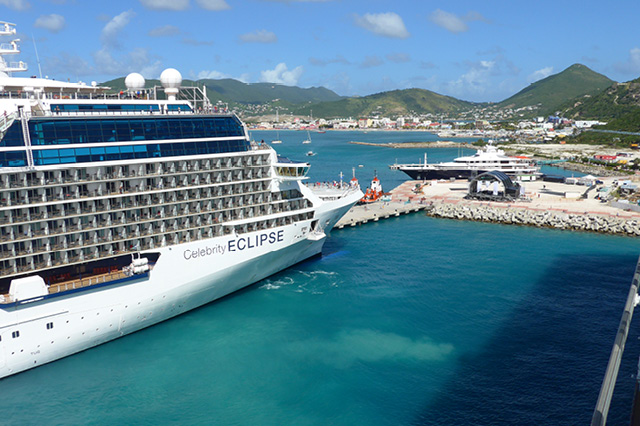
The Celebrity Eclipse in the Caribbean. (Photo: Celebrity Cruises Inc.)
When should you sail?
Of course, the best time to book a cruise also depends on the time of year you plan to set sail. As with many other types of vacations, cruise prices are lowest when school is in session. You’ll get hit with the highest prices on holidays and school breaks (especially spring break).
Hurricane season can sometimes affect when you should book your cruise, though it’s pretty difficult to avoid since it stretches from June through November.
You can cruise any time of year. Wintertime is perfect for tropical escapes, but summer is great for heading north to Alaska or Europe. Depending on where you go, there will usually be specific travel seasons for that area.
Months that are more cost-effective are January and February, October and November and the sliver between Thanksgiving and Christmas breaks. Early spring months like April and May can also have some more reasonably priced cruises.
What are repositioning cruises?
Those looking for the best time to book a cruise should take advantage of the unique characteristics of the cruising world. Whenever these huge ships have to travel, it benefits the cruise line to put passengers on them. A lesser-known cruising tip is to look at repositioning cruises, which are when a cruise line wants to move their ship to another region.
One-way repositioning cruises are a great way to use the cruising ecosystem to your advantage. Most cruise ships have special itineraries and events for repositioning cruises, meaning you’ll get to travel farther than you would have on a more common round-trip cruise, and they usually have special deals to boot.
There’s nothing quite like a guided tour vacation. When you travel on your own, you have to do mountains of research to make sure you see and do and eat everything you should. On a guided tour, someone else has already taken care of all that for you – that’s one of the reasons they are so popular!
When should you book guided tours?
If you’re traveling on your own, consider the popularity of the tour and your desired departure date. Sometimes, you can book a solo trip as close as a few weeks prior to departure, but that can be a bit of a gamble. Some tour operators cancel dates that don’t sell, or the tour could sell out before you get a chance to buy your ticket. If you definitely want to go on a tour, typically eight to 10 months prior is an ideal time to put down a deposit.
If you’re traveling with a group of people, like family and friends, booking can be a little different. Some tour providers can do private groups for as few as 10 people. If you want a private tour for your group, you should plan at least 10 months to a year prior to departure. With groups, you want to make sure that everyone gets a spot on the tour and that all of your pick-up and departure dates are in order. The gift of time makes that process a whole lot easier.
Is there any benefit to booking closer to the tour date?
Does booking closer to the date of your tour mean there will be deals or discounts? Potentially. Some tour operators might offer discounts to fill up tours that haven’t booked up yet. Booking closer to the tour date can pay off, but it is risky. There’s not always a guarantee that there will be spots left. But if you’re willing to wing it, last-minute bookings can be a great way to travel cheap, or at least cheaper than usual.
Do some guided tours fill up more quickly than others?
Tour groups travel all over the world, and some guided tours are bound to be a little more popular than others. Different destinations attract people because they’re especially beautiful or historic, or because travelers want to retrace the steps of their ancestors. Places like Italy or Ireland are perennially popular. Other bestsellers include Iceland, Peru, Greece, Costa Rica and Morocco. If you want to travel to one of these destinations, it’s best to book your tour sooner rather than later.
Is there a time of year that’s best for guided tours?
When you’re traveling, it’s all about seasonality. You can save money when you go on a tour during a destination’s shoulder season or offseason. It will also be less crowded. Instead of going to Europe during the summer when it’s hot, expensive and crowded, try going in the spring or fall. You could even tour Europe during the winter, when you can go to things like their famous Christmas markets and visit the Alpine countries. If you want to save money, it pays to think outside of the box when it comes to choosing your tour dates.
For more information or to start planning a trip, visit AAA.com/Travel.
When do you make your travel plans? Do you have any tips for booking flights, hotels, cruises or tours? Let us know in the comments below.
It’s common to feel blue about leaving your dog or cat behind on vacation. But what if your furry family member could come along? The good news is that many national hotel brands now welcome pets, including more than 1,200 Best Western properties throughout the US.
Where to Find Pet-Friendly Lodging
Before choosing a hotel for you and your four-legged companions, it’s essential to consider which animals are welcome. Hundreds of Best Western properties welcome dogs, but many also open their doors to cats, birds and other small pets. When in doubt, call and ask the hotel directly about their pet policy.
When you’re ready, book online or through a AAA travel advisor. Saving on hotel stays is one of the top benefits consistently noted by AAA members.
Here are just a few tips to make you and your four-legged companion comfortable and happy throughout your stay.
Pack thoughtfully. Remember, you’re packing for yourself and Fido or Fluffy. You’ll need eating and drinking bowls, a pooper scooper, plastic bags, a collar and special treats or toys to help your pet feel at home.
Get some fresh air. Dogs especially need exercise after long travel days. Why not take your furry friend on a long walk to scope the property after arrival?
Create a comfortable sleeping space. Whether you bring a well-loved blanket from home or use one of the new pet blankets provided by some Best Western properties, your pet will appreciate a cozy corner for napping or nighttime snoozing.
Take advantage of your discounted AAA member rate and any available special promotions at Best Western-branded properties across North America.Book now.
Are you ready to enter the Grid? TRON Lightcycle / Run officially opens at Walt Disney World on April 4, 2023.
First announced at the 2017 D23 Expo, TRON Lightcycle / Run has been one of the most long-awaited Disney rides in recent memory. The first version of the ride, TRON Lightcycle Power Run, opened at Shanghai Disneyland in 2016.
Will the coaster hold up to fan expectations after six or seven years of anticipation?
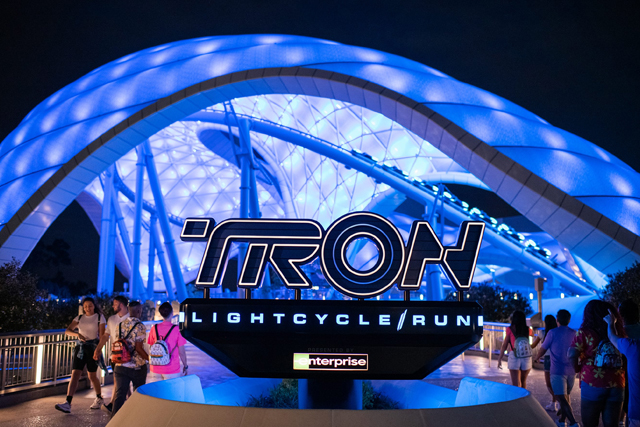
TRON Lightcycle / Run is based on the TRON franchise, which takes place in the digital universe of the Grid. The coaster sits in Tomorrowland at the Magic Kingdom, wrapped in a curving white canopy that glows with neon blue light. The track is partially outdoors, under the canopy, and indoors.
Riders, known in-universe as “users,” are assigned to Team Blue and tasked with defeating Team Orange in a lightcycle race. Think you’ve got what it takes to beat a team full of computer programs?
Before you hop on your lightcycle, you need to store anything larger than a cellphone in the provided lockers. You can access your locker with your MagicBand or park ticket and retrieve your valuables after the ride.
Though the ride is open all day long, it might be worth it to see if you can ride at night – the Grid comes alive when it’s completely in the dark.
There’s also a viewing area beneath the coaster, where you can watch for your friends and family or just enjoy the atmosphere.
Courtesy of Walt Disney World Resort
The Lightcycles
TRON Lightcycle / Run is a rollercoaster with motorcycle-style vehicles. That means riders have to straddle their seats as though they’re riding a bike (or, in this case, a lightcycle). The seat is reminiscent of the seats on Avatar Flight of Passage in Animal Kingdom. The safety harness forces the rider to lean forward while riding, and their legs are pinned into place on either side of the lightcycle with additional safety devices.
As a result of this unique design, some taller or larger riders have not been able to safely fit on the lightcycle seats. Fortunately, there are accessible seating options on some of the ride vehicles, so riders who can’t use the lightcycles can still experience the coaster. If you’re able to ride Avatar Flight of Passage, you might be able to ride TRON, but the seats are not exactly the same.
If you’re concerned about fitting on the lightcycle, you can try one of the test seats in front of the ride (and get a cool photo-op while you’re at it).
Courtesy of Walt Disney World Resort
The Queue
The Grid isn’t the only thing that’s virtual – there’s no traditional standby queue for TRON Lightcycle / Run at this time. That means if you want to “wait,” you’ll have to do it virtually. To join the virtual queue, you have to use the My Disney Experience app to reserve a spot. Most new Disney attractions have been utilizing this feature to cut down on time spent waiting in lines, but reservations are known to get snatched up in seconds.
Queue reservations are released in batches at 7 a.m. and 1 p.m. every day. You’ll need a reservation for Magic Kingdom to get a place in the queue, and you need to be in the park if you’re trying for the 1 p.m. group.
Want to skip the queue entirely? TRON Lightcycle / Run is also offering an a la carte Lightning Lane option. Pricing and availability will vary, but since it’s a new ride, it will probably sell out fast. A Disney hotel reservation can help you get early access to Lightning Lane options.
Disney100 at Walt Disney World
Disney is marking the company’s 100th anniversary in 2023, which means that all the parks are celebrating. Walt Disney World is just finishing up an important milestone of its own, as it wrapped up its 50th anniversary celebration on March 31. And, as always, there are some changes coming to the parks.
Fan-favorite nighttime spectacular Happily Ever After is returning to the Magic Kingdom on April 3, the night before TRON opens. Epcot will also see the return of the nighttime spectacular Epcot Forever on the same night.
That’s not all for Epcot, though. This year, Epcot will be the home of the Disney100 celebration in Walt Disney World, which means it’s going to be getting an all-new nighttime spectacular sometime later in 2023. Guests will also be able to meet Mickey and Minnie at Epcot, dressed in platinum outfits for the anniversary.
Announcements for more Disney100 celebrations at Walt Disney World are sure to come soon.
Are you planning a trip to ride TRON Lightcycle / Run? Think it can measure up to your favorite roller coaster? Let us know in the comments below.
Looking for savings on theme park fun? You can save up to 40% at theme parks, concerts, museums, attractions and more! Go to AAA.com/Tickets.
Featured image: Courtesy of Walt Disney World Resort
Florida has multigenerational appeal from one end of the peninsula to the other. Here are a few of the state’s best destinations for kids, parents and grandparents to enjoy together.
Soak Up the Magic of Orlando
With world-famous theme parks and attractions, Orlando is made for family getaways. While the big parks always impress, little ones will also love the Exotic Animal Experience, Orlando Science Center and the 400-foot observation wheel at ICON Park.
Of course, Orlando can be exciting for the grown-ups too. Check out cool cocktails at ICEBAR Orlando or high-adrenaline adventures like jet skiing and skydiving.
Discover the Rich Heritage of Miami
From shopping for souvenirs at the family-owned shops of Coconut Grove to exploring the charming beach community of Surfside, Miami is a picture-perfect place to introduce kids to a variety of cultures, foods and old-fashioned beach fun.
A vacation to the Florida Keys is sure to be filled with sun and fun. Visit the rehabilitated marine life at Marathon’s Turtle Hospital, take an Old Town Trolley to the Key West Aquarium or snorkel North America’s only coral reef. Whether you prefer waterfront relaxation or wildlife adventures, you’ll find it in the Keys.
Explore the Tampa Bay Area
The Gulf Coast of Florida is known for it’s beautiful beaches, clear waters and sunny weather.
In Tampa, you’ll find the perfect mix of culture, urban style and outdoor adventure. Kids and adults alike will love a day of thrills at Busch Gardens or its Adventure Island water park. But one of the best ways to experience the city is on the Riverwalk, a 2.6-mile path along the Hillsborough River, which leads to green spaces, playgrounds, splash pads, paddling, restaurants, shopping and museums, including the Glazer Children’s Museum. At night, colorful lights bring the walkway to life.
Across the Sunshine Skyway Bridge, about a 30-minute drive away, discover St. Petersburg and Clearwater. Get surreal at the Dali Museum or enjoy history and natural wonders at Fort De Soto Park in St. Pete. Visit one of the many stunning beaches in Clearwater or have an unforgettable dolphin or marine life experience at Clearwater Marine Aquarium, where you can make a salad for a sea turtle, feed a stingray or have a VIP photo shoot with rescued dolphins in a safe and ethical environment.
Chill Out in Pensacola
Playtime here strikes the perfect blend of safe and exciting. Pensacola‘s protected Gulf coastline includes Quietwater Beach, known for its shallow, calm water. There’s also the Pensacola Beach Boardwalk, where you’ll find ice cream, cafes and plenty of free entertainment.
Although the number is steadily increasing, many Americans have never tried cruising. Are old cruise myths holding you back?
Cruise lines are enticing travelers with new and refurbished ships, private islands, more ports and incredible onboard attractions, and it seems to be working for some. A 2023 cruise industry update report by the Cruise Lines International Association found 73% of Gen X and Millennials who never cruised are now considering it. Still, old mind worms – like cruises being only for the “newlywed and nearly dead” – may be keeping potential seafarers from getting on board.
We bust five myths about cruising that might be standing in the way of you and your slice of seafaring heaven.
Mother Nature rules, but tech-savvy ships with stabilizers and weather-avoidance systems take most of the motion out of the ocean, especially on voyages through the calm wash of the Caribbean Sea or the silky waters of Alaska’s Inside Passage. If you’re still leery, pick a port-intensive itinerary and select a mid-deck cabin. Big boats are better, too, unless you’re eyeing an ever-stable river cruise.
Insider tips and hacks to make your first (or next) cruise totally stress-free. Listen to Episode 21 of our podcast, Merging Into Life: Tips for Cruising
AAA travel advisor Tina Hill, who has traveled extensively but only recently set sail for the first time, says she was surprised to feel almost no motion aboard Royal Caribbean’s Oasis of the Seas, one of the largest ships afloat. “I was not affected at all,” Hill said. “That really shocked me. Because I’ve experienced motion sickness before, I brought medication, but I didn’t use it.”
And, to debunk another myth: cruise ships are not “floating petri dishes.” You’ll find hand sanitizer stations everywhere, and cruise lines strictly enforce health protocols. It’s also worth noting that ships are equipped with facilities for medical emergencies.
Cruise Myth No. 2: ‘I can’t afford it.‘
Remember, cruise vacations are value deals that cover food, lodging, transportation and entertainment, including supervised children’s programs. However, unless you pick an ultra-luxe line, you should expect fees for gratuities as well as optional specialty dining and beverages. Spa services and shore excursions cost extra as well.
Consider pre-booking to avoid unanticipated bills and look for package discounts. Also, many specialty restaurants offer sea-day savings, while spas conversely promote port-day specials.
Cabin selection provides even greater savings potential. Identical cabins are priced differently depending on deck location. Plus, did you know some economical inside cabins offer views? Royal Caribbean’s largest boats have cabins that overlook public spaces, while others boast “virtual balconies” via LED screens. Likewise, Disney’s Dream and Fantasy tout “magical portholes” for real-time views that come along with character cameos. So, although private balconies are blissful, it’s another cruise myth to think they’re a must.
And, while we’re doubling down on the myth-busting, you can also ditch the belief that sailing solo is a no-go for budget-conscious travelers. Norwegian Cruise Line reimagined accommodations for single passengers, devising “studio” cabins with shared access to a dedicated lounge. The latest ships from Royal Caribbean, Celebrity and Holland America feature remarkable solo staterooms, too.
Finally, repositioning cruises and off-season Caribbean itineraries can make staying home seem more expensive than going away, especially when sailing from no-fly Northeast homeports. (Yes, not all cruises depart from Florida – yet another myth!)
Sky diving simulator aboard Royal Caribbean’s Anthem of the Seas, which sails from New Jersey.
Cruise Myth No. 3: ‘I’ll be bored.‘
If you fear feeling boxed-in and bored, think again. Sure, shuffleboard always awaits, but there’s so much more. Carnival, Norwegian and Royal Caribbean sail city-size ships with active vibes. Leviathans from the latter actually contain “neighborhoods” to explore. Adorned with foliage and alfresco eateries, one desirable enclave celebrates Central Park, while another boasts a boardwalk complete with a hand-carved carousel.
These megaships also sport ziplines, rock-climbing walls, surfing pools and ice-skating rinks. Royal Caribbean’s Anthem of the Seas, which has homeport sailings from New Jersey, carries a skydiving simulator, bumper cars and an observation pod that dangles passengers over the sea. Norwegian Prima, which debuted in 2022 and has homeport sailings from New York, promises infinity pools with breathtaking views, the fastest drop-slide afloat and a go-kart track. Want more? Both ships stage Broadway shows.
Sailing from New York starting this spring, Carnival Venezia brings an Italian flair with its piazza, a huge casino and a marquee comedy club.
Those seeking refinement, can marvel over jaw-dropping art collections and interior designs that draw inspiration from exquisite musical instruments aboard Holland America’s latest ships, Koningsdam and Nieuw Statendam. Fittingly, they present stellar entertainment in partnership with Lincoln Center, Rolling Stone, Billboard and B.B. King’s Blues Club.
Cunard beckons with a guest lecturer program curated to tickle your brain, and its Queen Mary 2 guarantees stargazing with a planetarium. Plus, the hands-on culinary centers aboard ships from Oceania and Regent are floating nirvanas for foodies.
A light, gourmet dining option aboard Norwegian Escape.
Cruise Myth No. 4: ‘I’ll eat poorly and gain weight.‘
Shipboard dining has sailed beyond its buffetpalooza reputation. To plump up or pump up is a choice on ships that offer fine food and sprawling fitness facilities. Yoga, Pilates, boxing, spin classes and even health seminars abound. Plus, multideck boats provide a natural workout if you forgo elevators!
Almost every ship has a rejuvenating spa. Celebrity Cruises leans into the wellness trend with dedicated spa staterooms and clean-cuisine restaurants, while Royal Caribbean’s Vitality Cafe dispenses healthy snacks, fresh-pressed juices and custom smoothies.
Alliances with lauded chefs – think Curtis Stone, Jamie Oliver and Thomas Keller – have upped the ante on creativity and spurred a food revolution afloat. On Carnival’s ships you can even bite into gourmet burgers and barbecue, courtesy of Guy Fieri.
And, don’t assume it’s just specialty restaurants chasing culinary excellence. The main dining room earned high marks on Hill’s trip aboard Oasis: “They’re preparing for thousands of people and the menu changed every day, which impressed me. It was really good food.”
At the right time of day, the infinity pool on Norwegian Prima could be your own private oasis.
Cruise Myth No. 5: ‘Cruises are crowded.‘
Size does matter. Choosing a smaller ship allays concerns, but don’t dismiss larger boats. It’s all about flow and passenger-to-space ratio. They’re designed to handle more people and support diverse activities simultaneously. On one deck a packed pool party might be underway, while another hosts an intimate wine tasting.
Most ships have low-key observation lounges and private perches to discover. Princess Cruises provides an adults-only retreat on its ships, aptly dubbed the Sanctuary. Other lines have carved out similar spaces. High atop Norwegian’s boats, the Haven amounts to a ship-within-a-ship scenario, delivering enhanced accommodations and access to a slew of exclusive amenities.
The bottom line for skeptical neophytes – especially those uncertain of their sailing style – is larger ships literally offer more room to test your sea legs.
Still on the fence about cruising? Read about one AAA employee’s first cruise experience.
The Catskill Mountains of New York have long provided a respite for weary city dwellers in need of an escape from the fast-paced grind and congested streets.
Although it’s just a few hours’ drive from New York City, the region feels far off into the country. All seasons offer inspiring natural beauty, whether it is the fresh-blooming flowers in spring, swimming holes in summer, colorful foliage in autumn or snow-filled ski slopes in winter. And it’s a perfect stopping point for road trips to farther locations like Rochester and Buffalo, N.Y., or Montreal.
Perhaps lesser known is the Catskills food scene, which focuses on local ingredients and pulls from a variety of cultures and cuisines. Whether you’re just passing through or staying a while, here’s a sampling of great restaurants in the Catskills to try, curated from my own adventures in the mountains.
Albergo Allegria is a beautiful bed-and-breakfast in the Northern Catskills with food options available to both guests and the public. Fill up on a big breakfast before hitting Windham’s slopes for the day or nestling in Albergo Allegria’s dreamy, storybook setting. Order a Western Sammi, Albergo Allegria’s take on a western omelet in sandwich form, stacked with prosciutto, provolone cheese, bell peppers, baked eggs and caramelized onions.
Patrons from outside the Catskills may recognize the business name from their packaged bread sold throughout the state, but the brick-and-mortar bakery is its own experience. The aroma of freshly baked bread and pastries hits you upon entering this popular breakfast spot. The full menu of breakfast and lunch items includes a variety of sandwiches, burritos and salads. My advice: order a bacon, egg and cheese sandwich on a brioche bun and all will be right with the world. Grab a slice of lemon poppy bread for the road to quell the late morning hunger pangs.
Chef Sohail Zandi and his wife Sara have created an experience that feels like a family celebration at this restaurant in the Catskills. Offering a nightly single sitting with a multicourse menu that changes weekly, their goal was to bring people together in the way that 19th century eating houses brought local diners and travelers together under the same roof. The pair host a Persian feast once every month that you will need reservations for far in advance.
Catskill Brewery’s taproom offers quality beer in a relaxed setting. The brewery uses local ingredients and emphasizes sustainability when making their “honest hardworking beer.” This might not matter much to consumers if the beer didn’t also taste good, but fortunately Catskill Brewery has a diverse variety of delicious beers. I prefer a simple take on beer, and their Ball Lighting Pilsner satisfies my taste for a cold one. However, Catskill Brewery has a full arsenal of IPAs for beer connoisseurs like their Milkshake IPA and citrus-flavored Grass Wagon IPA.
Momos are Tibetan, Indian or Nepali hand-wrapped dumplings stuffed with meat or vegetables and served alongside savory or sweet dipping sauces. They are best fresh from the steamer or the pan, so I recommend you grab a table and stretch your legs for a while. Catskill Momos has savory beef momos, as well as vegetarian and vegan options, and noodle soups with beef or tofu. Tibetan culture came to the region in the 1970s with the founding of the Karma Triyana Dharmachakra monastery in Woodstock, which is a wonderful place to learn about Buddhism or to spend time in silent reflection.
Chef Antonio Mora, aka Tiny, transforms the general stores of my youth into breakfast and lunch counters that serve classic sandwiches like New York City’s chop cheese and Chicago’s Italian beef. My first experience with Antonio’s cooking was at Russel’s General Store in Bovina Center, which he transformed into a similar must-stop haven for incredible sandwiches. At Hamden General store, you get all the comfort and nostalgia of Brooklyn’s bodega sandwiches, greatly enhanced by the chef’s skilled hand.
Peekamoose serves a rotating menu of American fare with a focus on seasonal, local ingredients. The restaurant is set against a backdrop of lush, green mountains, and its interior is much like a rustic cabin dining room. The menu features hearty dishes – the kind of meals well-earned by a day of hiking trails or working long hours. The fishermen’s stew brought me back to life on a bone-chilling winter evening. Packed with Prince Edward Island mussels, arctic char and octopus, it reminded me of my travels in Western Ireland, where fishermen’s stew was my favorite nightly ritual.
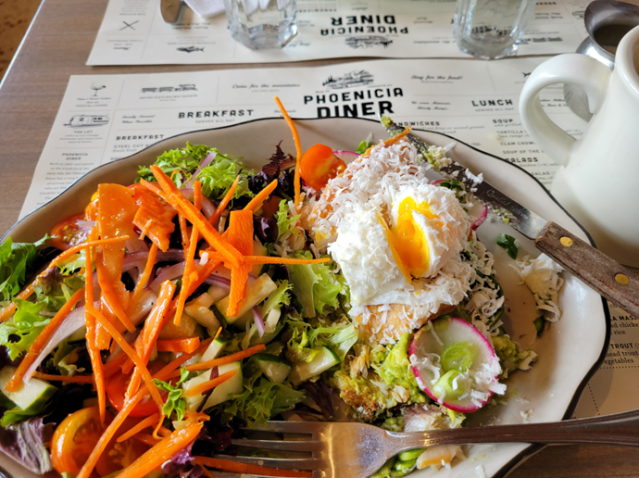
The Phoenicia Diner is a popular location for locals and weekenders, serving traditional diner favorites from skillful chefs who source local ingredients. Think: roadside greasy spoon meets the farm-to-table movement. Massive portions of comfort food will keep you fueled for a day of hiking in the mountains or for the long ride to the next stop on your road trip.
I’m a sucker for trout when I’m in the Catskills, and Phoenicia Diner’s Catskills Po’boy with cornmeal-crusted trout and all the fixings on a French baguette hits the spot. Wash it down with a bourbon milkshake and worry about counting calories some other day.
Both a general store and a restaurant, Rosie looks much like an antique store you might find on a country road. The shelves are packed with local, fresh products like pickled red onions, homemade hot sauces, local cheeses and a variety of snacks. They also serve delicious breakfast and lunch options, like the smoked trout pate on sourdough bread and mashed avocado with olive oil and tomato on a homemade bialy, as well as fresh-baked breads, cakes and cookies. Although it often draws a crowd, I promise it is well worth the wait for a seat. If I lived in Kingston, I would become a permanent fixture at Rosie.
Rough Draft Bar and Books is an independent bookstore with a cafe and bar. Come grab a drink while you are killing time, meeting with friends or reading a book in the warmth of the natural light that pours in through a wall of windows. The bar serves beer, wine and cider, as well as pastries and snacks. Follow their social media feed for popup events like pizza night or community-based events.
The first thing you notice when entering Silvia is the large open kitchen and wood-fired grill. Once you’re hit with the aroma of sauteing garlic and bread charring on the grill, you know you’re in for a fantastic meal. Silvia sources from local producers and serves pasture-raised chicken as well as grass-fed and finished beef. Their kitchen is GMO-free and ticks all the boxes of conscious eaters, but it’s also simply delicious.
I got the Local Mushroom and Pasta Rags, which came served in a bowl packed with broad pasta noodles, asparagus, black garlic butter, thyme and Parmigiano-Reggiano. It was salty and cheesy, and left me scraping every drop of flavor out of the bowl.
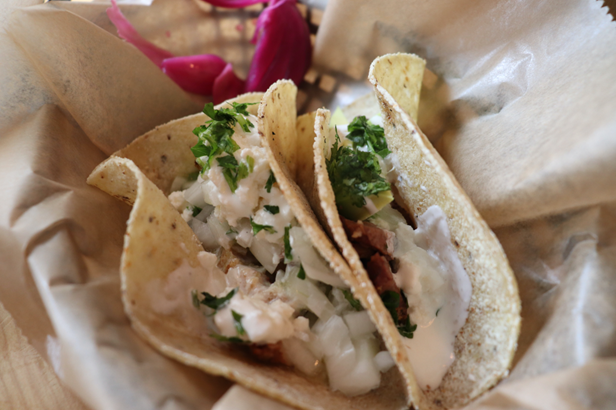
I popped into Tinker Taco for a quick snack while checking out Woodstock’s many unique shops along Tinker Street. It is true that their prices are on the steeper side, but my tacos were fresh, delicious and well worth the price point. Tinker Taco makes its tortillas from scratch each morning, which is evident in the taste. My selection of tacos – lengua, barbacoa and carnitas – were packed with meat, cilantro, onions, queso fresca and crema.
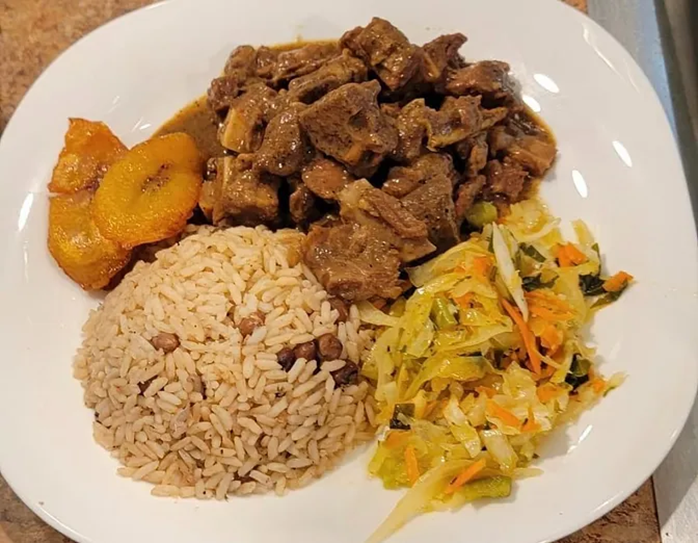
Kingston shares its name with the capital of Jamaica, so it feels fitting that there would be fantastic Jamaican food in town. Here they serve large portions of jerk chicken, curry goat or oxtails with rice and peas, plantains and veggie slaw, and the stewed meat options are tender, savory and packed with flavor. It may seem small and unassuming from the outside, but hungry travelers know that these are often the best places to grab a meal. This is filling, stick-to-your-ribs fare that will have you itching to come back.
True to its name, Van Smokey is a smoked meats shop as well as restaurant and hangout. Their menu is full of sandwiches, burgers and tacos that use the variety of meats they smoke. The house-made pastrami sandwich is worth the drive from any location. As sacrilegious as it may sound, it rivals the pastrami of New York City’s greatest delis.
What are your favorite restaurants in the Catskills? Share with us in the comments.
As the law-abiding citizens we are, we make it a point to stay abreast of all the rules of the road. It turns out, however, that’s easier said than done sometimes.
You see, individual states and towns have their own traffic rules and regulations. The vast majority of these laws are similar from place to place and, most would agree, rules that should indeed be on the books. But every so often there’s a driving law that stands out. Whether it’s oddly specific, mindbogglingly random, painfully archaic or just downright silly, they all can be categorized as bizarre traffic laws.
Let’s take a cruise around the country to see what bizarre laws about driving that states have come up with, starting in our neck of the woods.
It is illegal to travel on a roadway with a sleigh or sled drawn by a horse, unless there are at least three bells attached to some part of the harness.
New Hampshire
It’s against the law to inhale car fumes with the intent of inducing euphoria.
Like in Massachusetts, you can’t drive a horse-drawn sleigh on a highway unless there are a sufficient number of bells attached to the horse’s harness.
Rhode Island
Section 11-22-11 of Rhode Island law saysit’s illegal to ride a horse on a highway for the purpose of racing or testing the speed of the horse. Doing so could cost you $20.
It’s illegal to drive in circles in Westminster, or, more specifically, to drive “past a traffic control point three times in the same direction within any three-hour period.”
Georgia
In Marietta, it’s illegal to spit from a car or bus. Spitting from a truck, however, is perfectly fine.
Illinois
You can claim roadkill, so long as you don’t owe child support.
Iowa
In Tiffin, you’re prohibited from throwing stones, bricks, or missiles of any kind into the street – unless you get written permission first.
Maryland
You cannot use profanity on any street, highway or sidewalk. Doing so will cost you up to $100.
Social Security is a program we all know about, but few are likely aware of how it actually works. Fortunately, there are a number of Social Security resources available to help us better understand the details and what we can expect once we start receiving benefits.
Browse through the resources below and then take our Social Security quiz to test your knowledge!
What is Social Security?
Social Security is a federal program that provides financial benefits to those who are eligible. It is funded through a payroll tax levied on both employers and employees.
The taxes you pay now fund Social Security benefits for those who are currently retired. Once you choose to receive Social Security, your benefits will be funded by the taxes of those still in the workforce.
Social Security is meant to replace some, but not all, of your pre-retirement income. According to the federal government Social Security benefits account for roughly 30% of senior citizens’ income.
How much will you get from Social Security?
Social Security is not an individual investment program. That is, the amount of taxes you pay into the program is not necessarily the amount you’ll receive. There are several factors that affect your benefit total, including how much you earned during your career and at what age you retire.
A great resource you can use to get an estimate of your monthly benefit is the Social Security Administration’s benefit calculator.
What is your Social Security retirement age?
Figuring out your full retirement age, when you become eligible for your full benefit, can be a little bit confusing. It wasn’t always this way. For many years, the full retirement age was 65. But people began living longer lives than they did when Social Security was enacted in the 1930s. So in 1983, Congress passed a new law that allowed for a gradual increase in age for collecting the full benefit.
The full retirement age increases by a few months for every birth year after 1938 until 1960. For those born in 1960 or later, the full retirement age is 67.
To find your full retirement age, use the Social Security Administration’s retirement calculator.
How can I apply for Social Security?
Applying for Social Security benefits can most easily be done online. Just visit the Social Security Administration’sapplication page.
Make sure you have the necessary information and paperwork available, including, but not limited to, your birth certificate, tax forms, military papers, and bank information.
An estimated one to two million collisions between vehicles and wildlife occur every year in the United States, according to the Federal Highway Administration. In most of these crashes, the animal dies immediately or shortly after. The result is an abundance of roadkill strewn across American roadways.
Roadkill is more than just an eyesore. Animal carcasses in the street can pose a serious driving hazard for motorists. Therefore, if you come across roadkill, you should act. Here’s what to do.
Call the Professionals
Roadkill should be cleared from the road as quickly as possible. Not only do the carcasses pose a danger to drivers who may be forced to swerve around them, their smell attracts scavenging animals who will descend upon the road looking for their next meal. This creates more potential driving hazards and roadkill.
Your safest bet for getting roadkill removed is to contact the proper authorities. If you can safely pull over to the side of the road to make the call, do so. If not, make a mental note of the animal’s location and then contact authorities once you’ve reached your destination.
Figuring out who you should direct your call to can be a little tricky, as towns and cities designate this task to different departments. Most often, it’s the responsibility of the local department of sanitation, street maintenance, public works, animal control or wildlife management. You should be able to find the appropriate agency to call with a quick internet search. If not, call your local government’s helpline and ask to be connected. Workers from one of these government agencies will come to the site to remove the carcass.
If you stopped to report the roadkill, feel free to continue on your way after making the call. You do not need to remain at the location for the crew to arrive.
Moving roadkill yourself is usually not the best course of action. It can be dangerous to park your car on the side of the road, let alone walk into the middle of it. This is especially true if you’re traveling along a busy street or highway.
Furthermore, dead animals pose a serious health risk to humans. During decomposition, disease-causing bacteria normally contained inside the animal’s body can be released, exposing those in close proximity of the carcass. Dead animals also attract fleas, ticks and maggots, all of which can transmit their own set of diseases.
If the roadkill is in front of your house or on a quiet street and you feel compelled to move it yourself, make sure to do it safely and properly. First gather the necessary tools, including thick gloves, a shovel, heavy-duty garbage bag and some sort of face covering to protect your nose and mouth. Use the shovel to move the carcass off the road and/or into the garbage bag. Never make direct contact with the dead animal. Secure the bag and dispose of it properly, which usually means having it hauled to a local landfill.
Finally, you’ll want to make sure to clean the area. Start by hosing or wiping down the spot. Then use a disinfectant to eliminate any hazardous bacteria that could still be present.
Can You Salvage Roadkill?
Sport hunters may be happy to know that many states allow citizens to take roadkill home with them to salvage the meat for consumption. Most, however, have some restrictions and/or regulations, which usually include reporting the roadkill to authorities and obtaining a permit. In Massachusetts, for example, deer carcasses taken into possession must be brought to state authorities within 24 hours to be tagged and recorded. In New Jersey, only deer roadkill may be salvaged and only by obtaining a permit from local police.
It’s very important to note that roadkill is not always safe for human consumption, especially if it’s been exposed to the elements for an extended period of time. Although it certainly can be done (and is PETA’s preferred option if you choose to eat meat), make sure it’s safe to eat before bringing it home for dinner.
Deer are one of the most common large animals to be involved in vehicle-wildlife collisions. Here’s how to avoid them.
Have you noticed an increase in roadkill? Leave your thoughts and comments below.
For as long as there's been professional race car driving, there have been female race car drivers. Take a look through history at some of the most influential female race car drivers and pioneers.
Race car driving has always been seen as a stereotypically male sport. But men aren’t the only people who love fast cars and the smell of burnt rubber. For as long as there’s been professional race car driving, there have been female race car drivers. Racing is actually one of the few professional sports in which men and women are allowed to compete with (and against) one another.
From the first NASCAR race ever to the many active drivers today, women have always been a part of racing as a sport and as a culture. To celebrate Women’s History Month, we’ve compiled some of our favorite and most influential female race car drivers and pioneers.
Sara Christian
Sarah Christian was the first female NASCAR driver of all time. She competed in NASCAR’s first race on June 19, 1949 at Charlotte Speedway. Though she competed in just seven races over the course of her career, she opened the door to racing for generations of women to come.
Janet Guthrie
Janet Guthrie was the first woman to compete in the Indianapolis 500, the Daytona 500 and the NASCAR Winston Cup Superspeedway race. She holds the best finish by a woman in a top-tier NASCAR race for her sixth-place finish at Bristol in 1977 (she’s tied with Danica Patrick’s finish in 2014).
Janet Guthrie was one of the first people inducted into the International Women’s Sports Hall of Fame. She has also been inducted into the International Motorsports Hall of Fame and the Automotive Hall of Fame.
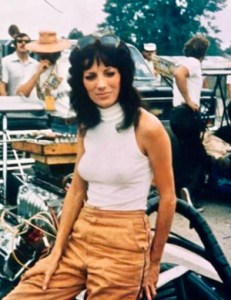
Shirley Shahan
Nicknamed the “Drag-On Lady,” Shirley Shahan became the first woman to win a National Hot Rod Association pro event in 1966. As the daughter of a race car driver, she learned to drive at only 10 years old, and eventually became her father’s mechanic. She first started racing in the 1950s, and she won the first March Meet in 1959. A series of wins followed. After her 1966 Super Stock win at the Winternationals, she became a racing celebrity.
Shirley Shahan has been inducted into the International Motorsports Hall of Fame, the Super Stock Magazine Hall of Fame and the Drag Racing Hall of Fame.
Shirley Muldowney
Also known as “Cha Cha” and “The First Lady of Drag Racing,” Shirley Muldowney was the first woman to get a license from the NHRA to drive a Top Fuel dragster. Shirley Muldowney has won a total of 18 NHRA national events.
She won the NHRA Top Fuel championship in 1977, 1980 and 1982, making her the first person to have won two (and then three!) Top Fuel Championships.
Named among the “Top-100 Women Athletes of the Century” by Sports Illustrated, Lyn St. James was the first woman to win the Indianapolis 500 Rookie of the Year award. She specialized in endurance racing, and won two class victories at the 24 Hours of Daytona and the GTO Class at 12 Hours of Sebring.
Lyn St. James was also the first woman to reach over 200 mph on a race track. She was president of the Women’s Sports Foundation from 1990-1993, and she has served as a panelist on NASCAR’s National Motorsports Appeals Panel since 2015.
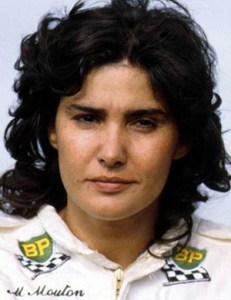
Michele Mouton
As a French rally driver, Michele Mouton competed in the World Rally Championship from 1974 to 1986. She’s one of the only women to ever compete in that series. In 1981, she began driving for the Audi factory team and won her first event.
During her years with Audi, she won four victories and finished runner-up in the drivers’ world championship. As a driver for Peugeot, she became the first female to win a major rallying championship. Michele Mouton became the first president of the FIA’s Women & Motor Sport Commission in 2010.
Danica Patrick
Danica Patrick is one of the most famous race car drivers alive, and the most successful woman in U.S. open-wheel racing. She started racing go-karts at age 10, and never slowed down. Danica Patrick holds the only women’s victory in an IndyCar Series race for her 2008 victory at the Indy Japan 300.
She became the first female race car driver to win a Cup Series pole position when she set the fastest qualifying lap for the 2013 Daytona 500. In 2015, she broke Janet Guthrie’s record for most top-10 finishes by a woman in the Sprint Cup Series.
Erica Enders
Erica Enders is one of the most successful female drag racers. She started racing as a Junior Dragster when she was only 8 years old. In 2000 (when she was just 16) she became the youngest NHRA national event finalist. Erica Enders has won five NHRA Pro Stock championships.
In 2015, Erica Enders broke Shirley Muldowney’s record for the most NHRA national event wins by a female driver. In 2022, she became one of only five Pro Stock drivers with five or more titles.
Looking for more women in automotive history? See our post about the most influential female inventors and engineers in the world of cars and driving.
Who is your favorite female race car driver? Tell us in the comments below.
There are almost an overwhelming number of river cruises in Europe that vacationers have to choose from when planning a trip. All the best cruise lines offer itineraries along picturesque rivers in Europe, with castles, wineries, historic sites and much more, just minutes away from your ship.
Here’s an overview of what would-be cruisers can expect to experience when traveling on a river cruise in Europe. Once you narrow down which region is most appealing to you, researching the best cruise line for you is the next step. Which river would you like to travel on first?
Sailing through Provence and Burgundy along the Rhone River is one of the best European cruises for food lovers and oenophiles, as every river cruise highlights the region’s rich wine heritage with plenty of tastings and visits to vineyards. A typical itinerary takes passengers between Lyon to Arles or Avignon.
Highlights include visits to Avignon; Beaune, the wine capital of Burgundy; Vienne, home to the remains of a 14,000-seat amphitheater and a temple built in 25 B.C.; and an excursion to Arles, where Vincent van Gogh lived and painted.
Seine
The busy Seine, running north through Paris into Normandy into the English Channel at Le Havre, offers a wealth of fascinating places to visit, including the Normandy D-Day beaches; Rouen, where Joan of Arc was burned at the stake; and Giverny, where Claude Monet lived for almost four decades.
The itinerary for most cruise lines is the same, sailing from Paris between Rouen or Caudebec. In Rouen, the capital of the Normandy region, tours to its historic cathedral, built between the 13th and 16th centuries and landmarks relating to Joan of Arc, are a must. All Seine cruises offer full-day excursions to the Normandy Landing Beaches, including Omaha Beach, plus visits to the Point du Hoc monument and the American Cemetery.
The 776-mile Rhine River, which runs through Switzerland, Liechtenstein, Austria, Germany, France and the Netherlands, is known for being one of the best European cruises, famous for its castles and stunning scenery.
On a typical seven-night cruise from Amsterdam, ports and excursions include Basel, Cologne, Koblenz, the Rhine Gorge, Rudesheim, Mannheim and Strasbourg. There are a lot of variations, of course, with different starting points and stops, which offers cruisers plenty of interesting options.
Danube
The Danube, Europe’s second longest river, flows through 10 different countries and is, of course, famously named in Austrian composer Johann Strauss’ famous waltz, “On the Beautiful Blue Danube.” All cruisers on the Danube will hear it played at least once on a trip!
Common itineraries are sailings between Budapest, Hungary and Passau, Germany. Highlights include Vienna, once the center of the Habsburg Empire, with visits to the Hofburg Palace, the Vienna Opera House, and Ring Boulevard; Salzburg, the birthplace of Mozart; and Melk home to the stunning Benedictine Abbey.
Elbe
Running from the Czech Republic through Germany, most river cruises on the Elbe River run between Prague and Hamburg. Cities on an Elbe cruise include Dresden, Meissen, Worlitz, Wittenberg and Magdeburg. In Dresden, nicknamed “Florence on the Elbe,” passengers will visit Zwinger Palace, the Semper Opera House and the Frauenkirche (Cathedral of Our Lady) with its unique bell-shaped dome that survived World War II bombings, but collapsed the following day, and then was rebuilt.
Meissen is famous for its fine porcelain and Wittenberg is where Martin Luther nailed his thesis to the door of Castle Church and triggered the Protestant Reformation.
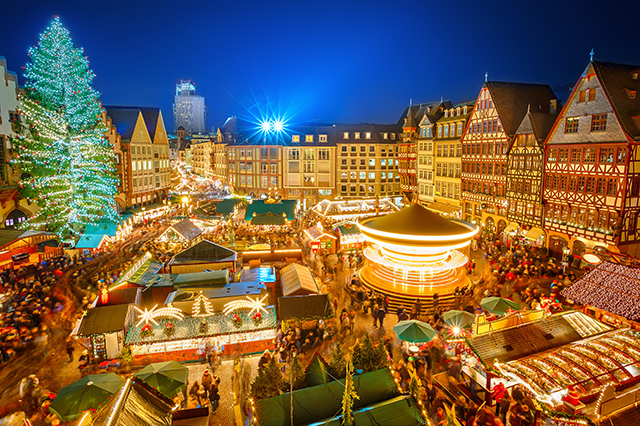
Christmas market in Frankfurt, Germany.
Christmas Markets
While virtually all river cruises in Europe operate in the warmer months, the one exception is Christmas market cruises, which most river cruise lines offer. Christmas markets are a centuries-old tradition in European cities and cruising is a novel way to enjoy more than one.
Feel the enchantment of the holidays at markets in Germany, Austria, Hungary, France and Switzerland while you sip warm mulled wine and browse stalls of homemade toys and decorations, surrounded by twinkling lights and the smell of gingerbread and roasted chestnuts.
Main
Running across Central Germany, the Main River is formed by the joining of the Red Main and the White Main, meeting the Rhine River at the town of Mainz. Cruises on the Main are usually combined with Danube River cruises; since1992, the Main-Danube canal connected the two rivers with a total of 16 locks. On a Main cruise, running between Frankfurt and Nuremberg, ships stop in Heidelberg, Wertheim, Wurzburg and Bamberg.
Highlights include a visit to Johann Wolfgang von Goethe’s home in Frankfurt, and the town of Bamberg, a UNESCO site, which dates from 902 A.D., making it one the most impressive river cruises in Europe.
Moselle
Flowing through France, Luxembourg and Germany, the Moselle River is known for its medieval architecture and excellent white wines. The climate, soil and topography along the Moselle create an ideal environment for the cultivation of grapes. On any cruise, the region’s celebrated wines will be a highlight.
Stops along the picturesque river include Metz, France; Remich, Luxembourg; and several places in Germany, including Trier, the oldest settlement in Germany.
Douro
Lisbon to Porto (or the reverse) is a common itinerary on the Douro River in Portugal. The Douro River Valley is the world’s oldest demarcated wine region and a UNESCO World Heritage Site. Most cruises begin or end with an overnight stay in the UNESCO World Heritage city of Porto, with ample time to explore.
Highlights along the route include seeing the world’s deepest lock, Carrapatelo, with its 115-foot-tall walls; excursions to Lamego to visit the 18th-century Sanctuary of Our Lady of Remedies pilgrimage church; and a full-day excursion to Salamanca in Spain. All along the way, passengers will get the chance to enjoy Portugal’s national beverage, port.
Tulip cruises
Another immensely popular themed river cruise in Europe is a voyage to take in the Netherlands and Belgium’s famous tulips. These are often called “Dutch Waterways” cruises, since ships go through a network of small rivers, inland seas and canals which are referred to as the Dutch Waterways. These mid-spring trips typically start and end in Amsterdam, and travel to Antwerp, Arnhem, Ghent, Rotterdam.
A visit to the Keukenhof Gardens, the world’s largest floral park, is of course, a highlight. Almost all cruise lines offer some version of a tulip tour.
What are the river cruises in Europe that you would like to explore? Tell us in the comments.
In the Northeast, many of us just can’t wait to get our hands in the dirt and play in the garden when spring rolls around. But landscaping and gardening are activities that can be done throughout the year, from planting annuals in the spring to making sure your shrubs are secure for the chilly winter months.
Whether you’re the kind of gardener who starts with seeds or you just dabble in the occasional potted plant, we’ve got great gardening resources to help you cultivate your green thumb all year through.
Landscaping and Gardening Websites
One of our best virtual landscaping and gardening friends is the Vermont-based Gardener’s Supply Company. The site is packed with tons of articles about organic gardening and landscaping, controlling pests naturally, composting and planning a garden.
Connecticut-based White Flower Farm is another great resource. Sign up for a free catalog and you’ll be tempted year-round. The site sells and gives advice on perennials, annuals, flowering shrubs – including more than 40 varieties of hydrangeas – roses, bulbs and vegetables.
Visit HGTV’s website for project ideas that can be completed in just a few hours or a few days. The site breaks down gardening and landscaping projects into steps, so you can clearly see what kind of commitment you’re getting yourself into. Ever wanted to build a potting bench? You’ll find it here, as well as a guide to what to plant in the fall, how to make a raised garden bed and much, much more.
Having a beautiful garden doesn’t have to be a seasonal endeavor in the Northeast.
If you swoon when the latest issue of Better Homes & Gardens hits your mailbox, the website is just as inspiring, filled with tips, plans and projects that you can tackle on your own. The site’s garden plans feature is especially useful. You’ll find hundreds of illustrated gardens for every scenario – shady, long-blooming and beginner gardens, for example – as well as a list of plants you’ll need and a handy chart showing where they should go. It’s sort of like paint-by-numbers, but with plants!
Every gardener in the Northeast should be acquainted with the name Henry Homeyer. The self-proclaimed “Gardening Guy” – an organic gardener and author who lives in Cornish Flat, N.H. – is known for his weekly gardening columns that run in newspapers throughout New England. If you want practical, down-home tips about when to prune your rose bushes, plant those daffodil bulbs and make the most of your tomato harvest, Henry’s your man.
Landscaping and Gardening Apps
The Home Outside app is an amazing landscaping and gardening resource that can help bring your dream backyard to life. You can drop and drag more than 700 outdoor elements onto a map or photo of your property, so you can see what your designs will look like. Free, but currently only available on iOS.
Is there a beautiful tree, shrub or plant in your neighborhood that you’d love to see on your lawn, but you don’t know what kind it is? LeafSnap uses AI technology to identify it. Just take a picture and the free app will tell you what it is, plus details like peak season, how much sun and water it needs to thrive and more.
New and seasoned gardeners alike can benefit from a garden managing app. From care instructions and reminders to watering schedules, Planta supplies the tools you need to keep every kind of plant alive. The app is free to download but a range of upgrades are available for purchase.
Specifically for vegetable gardens, From Seed to Spoon is another free app you can use to plan and track your garden’s growth, providing planting dates, pest identifiers, tips, how-to videos and even recipes to make with your homegrown harvest.
Have any other landscaping or gardening tips you’d like to add? Share it with us in the comments!
Tucked away from bustling Thayer Street, Ceremony offers a reprieve from the everyday, in more ways than one. Especially popular among students (the prestigious Brown University is within walking distance), the minimally decorated café and tea house feels like a canvas upon entry, where the bold and colorful lattes are the art.
Owner Michelle Cheng opened the original Ceremony café in 2019 to huge success. Assistant Manager Amelie Zhou first fell in love with Ceremony as a patron of their Thayer Street location. “I wasn’t really looking for a job, but I found Ceremony and thought, ‘Oh my gosh, I want to work here immediately!’” Because of its quick popularity, Cheng moved the business to a new, bigger location and expanded Ceremony’s offerings to include coffee, espresso, sake and more.
All tea used at Ceremony is sourced directly from farmers in China, Japan and Taiwan and are all organic and handmade. You can even experience an authentic tea ceremony by booking the private tasting room that accommodates groups as big as six. During the ceremony, tea is steeped at least six times to taste different portfolios, and every steep is at a different temperature and ratio. Best of all, each tea is paired with a snack.
Before you go, don’t forget to peek at the well-stocked retail section full of treats from tea brewing kits to mochi ice cream and even beautiful hand-painted pottery.
Our suggestion: Add a matcha, espresso or strawberry-flavored teddy bear onto any iced drink (try the perfectly purple ube latte) for the sweetest little photogenic addition.
Thanks for spending a moment with us at Ceremony! Which of their treats would you like to try?
Featured image: Top your iced drink with an adorable (and yummy) matcha teddy at Ceremony.
Embark on a virtual trip to seven of the hottest cities in the world. Known for their unbearably high temperatures, these places could easily make even the most enthusiastic warm-weather lover long for the chill of winter in the Northeast.
Average High: 107 degrees Record High: 124 degrees
It’s normally hot in the Southwest, especially in Arizona where ordinary summer heat makes much of the state sizzle. But no city is as extreme as Yuma. With its desert climate, extremely hot summers, hot winters and often less than 10 inches of precipitation per year, it’s fair to say Yuma is definitely one of the hottest cities in the world! The average July high temperature can hit a scorching 107 degrees, making it one of the steamiest cities in the United States behind Phoenix. In 1995, Yuma reached its all-time high at 124 degrees. The high temperature isn’t the only standout trait of Yuma. The city set a world record for being the sunniest city on earth, averaging 4,050 of the possible 4,456 hours of daylight annually. That means the sun is shining a little more than 90% of the time in Yuma. Pack extra sunscreen.
Death Valley, California
Average High: 120 degrees Record High: 134 degrees
It’s not called Death Valley for nothing! As one of the hottest and driest places in North America, the summers scorch around 120 degrees, but can even reach an unbearable 125. On one July day in 1913, the temperature hit 134, the official highest temperature in the Western Hemisphere. Death Valley is a long, narrow basin that is 282 feet below sea level and walled by high and steep mountain ranges. The dry air and bare plant cover allow sunlight to heat the desert surface and become trapped in the valley’s depths. In 1917, Death Valley recorded 43 consecutive days with temperatures over 120 degrees. Don’t expect much relief during summer evenings; overnight lows only dip into the mid-90s.
From fan bracelets to “ice” necklaces, stay cool in hot locations with these wearable cooling devices.
Hottest Cities in the World
Ahvaz, Iran
Average High: 116 degrees Record High: 129 degrees
Even though it’s located in the Middle East, Iran has four seasons like many other countries. The city of Ahvaz – situated in southwestern Iran – has a desert climate and is known for its long, hot summers and mild, short winters. The summer heat is accompanied by high humidity, sandstorms and dust storms. The summer temperature tops off at around 116 degrees, but the soaring humidity and near-continuous sunshine make it one of the hottest cities in the world in July and August. From 1970 to 2000, Ahvaz reached 125 degrees or more than three days each year. The city set a temperature record on July 15, 1967 when it hit a stifling 129.
Dallol, Ethiopia
Average High: 118 degrees Record High: Over 130 degrees
In terms of extreme heat, no place holds a candle to Dallol, the hottest place on earth. Located in the sizzling Danakil Depression (a geological landform sunken below the surrounding area), it can reach a boiling 145 degrees in the sun. Dallol has areas that are more than 328 feet below sea level, featuring hot yellow sulfur fields and craters amid sparkling salt beds – the result of a volcanic eruption in 1926. It gets worse: Dallol currently holds the record high temperature for an inhabited location on earth, where an average annual temperature of 94 degrees was recorded during 1960 and 1966. Dallol is also one of the most remote places on earth – there are no roads and the only regular transport service is provided by camel caravans that travel to the area to collect salt. According to the Central Statistical Agency of Ethiopia, Dallol has a total population of 83,930.
El Azizia, Libya
Average High: 132 degrees Record High: 136 degrees
Any state located in close proximity to the equator will experience extremely warm conditions – but one African city in particular is record-breaking hot. The world’s highest official temperature of 136 degrees was recorded in El Azizia on Sept. 13, 1922. This isn’t a place you’re likely to hang outside for long. It’s located in one of the most hot and arid places on earth – the Libyan Desert – where rainfall seldom happens. Summer highs can reach anywhere from 125 to an intolerable 135 degrees. To make matters worse, a hot, dry, dust-bearing desert wind called a ghibli can raise the temperature 20 degrees in just a few hours.
Oodnadatta, Australia
Average High: 99 degrees Record High: 123 degrees
The climate in Australia is as broad as the country itself. The interior is characterized as having a hot, dry climate; while northern, southern and coastal cities are considered tropical. The Tropic of Capricorn runs through much of the country. However, Oodnadatta, an exotic and desolate town in the Outback, hit 123 degrees in January 1960. On average, the weather tops off at between 97 to 99 degrees from December through February. Considerably cooler than the city’s record high, yet still stifling. It also receives about 10 hours of sunshine per day in December and averages 6.5 inches of rainfall per year. Oodnadatta is a quiet settlement inhabited mostly by indigenous Australians. As of 2021, the census reported a population of 318
Kuwait City, Kuwait
Average High: 112 degrees Record High: 126 degrees
With more than 2 million residents, Kuwait City is the most densely populated metropolitan city that suffers from record-breaking heat. The city has an arid climate with hot summers and hardly any rain. The average summer temperature ranges from 102 to 112 degrees, but a heat wave can bring temperatures up to a scorching 122 degrees. The city has even had months with daily maximum temperatures averaging above 115. Depending on the specific location in Kuwait City, there can also be a degree of humidity to go along with the sweltering temperatures.
To plan a trip to any of these destinations, get in touch with a AAA travel counselor at AAA.com/Travel.
Which of the hottest cities in the world would you visit? Tell us in the comments!
Lake Placid may be known as a top ski resort, but spring has its perks, too.
As the weather warms up, and the days get longer, the streets and slopes become a little quieter, making it feel as though you have the whole place to yourself, at times.
With premium lodging at great rates, indoor and outdoor recreation to keep you busy (who says ski season is over?) and award-winning spas to recover and rejuvenate from the gray days of winter, Lake Placid is the perfect spring retreat you never thought of – until now.
Beat cabin fever and finally get some fresh air! Take the whole family spring skiing at Whiteface Mountain. Soft snow is great for learning, and experienced skiers love to make the most of “corn” season, when all the melting and refreezing makes the snow look like kernels of unpopped popcorn.
For those looking to discover more of nature’s beauty in the region, Lake Placid offers hikes for all experience levels, many of which lead to stunning waterfalls.
And if the weather is still a little too chilly, you can feed your sense of adventure indoor rock climbing at Mt. Van Hoevenburg Olympic sports complex.
For Rest and Relaxation
With so many opportunities for adventure, you may not realize that Lake Placid is also known as a relaxation destination. Treat yourself to any number of wellness services at one of the area’s full-service spas and return home feeling refreshed.
To keep your trip low-key and breezy, take in simple pleasures like enjoying a meal with a great view, shopping on Main Street and exploring the art scene.
You can purchase an original piece of local artwork at The Curious Otter wildlife gallery or Gallery 49, part of the Lake Placid Center for the Arts, which also presents regular classes, exhibits, galleries and musical and theatrical performances.
Those are just some of the ways you can make the most of a quick mid-week or weekend getaway in Lake Placid.
Explore more and start planning your Lake Placid vacation today.