48 States in 48 Days

“It’s the journey, not the destination.” These simple words found at the Route 66 Museum in Clinton, Okla., summed up the road trip of a lifetime I took in fall 2020. In the middle of the pandemic, I drove all of the “lower 48” in as many days. I took the trip to celebrate my retirement.

The idea came to me 20 years ago, when retirement seemed as far away as Seattle. Some influences were books: Bill Bryson’s “The Lost Continent: Travels in Small-Town America,” Charles Kuralt’s “America” and John Steinbeck’s “Travels with Charley.” I thought, “I need a trip with purpose.” I was confident I could hit all 48 states in 48 days. At least it’d be a challenge. In the end, I knew that I’d enjoy it, if I followed my mother’s rule of travel, “If you don’t have fun, it’s your own fault.”

Negative comments from friends and family ranged from “Can that even be done?” – the mildest – to “Why on Earth would anyone do that?” – which was the harshest. I admit the why is the harder question. The how was easy.

I shelved the trip for decades, but when our daughter went off to college and I retired, I decided “I’m going to do this.”

A simple rule: spend one night and only one night in each state. But the rule was hard to implement. I studied maps and traced my way through the United States, calculating mileage, and the few sites I had to see – or at least thought I had to see. I listed calculated mileage between towns from state to state to crank out a plan. The pre-trip version of the plan? The longest day would clock in at 600 miles. The total trip would come in at 12,000 miles.

The Plan
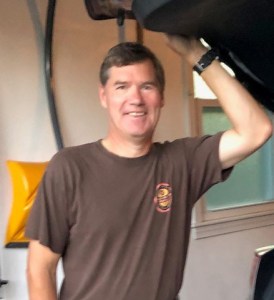
Nate Williams ready to go
Getting ready to close the tailgate on the RAV4 just before leaving.

I gave myself a 50% chance of pulling it off when I retired in July. This was the year of COVID-19, and I was not going to be reckless. By the end of August, case numbers were coming down, and interstate travel was not prohibited. I decided to do it, and of course, I could always turn around if the pandemic made it unsafe.

I would leave after Labor Day to avoid summer crowds, hit the northern states before the snow and complete the southern states after the worst of the hurricane season. On Sept. 8, I hit the road.

From my home outside of Boston, I headed north to Maine. From there, it was across the North, dipping as far south as St. Louis, Mo., before heading west and north again (like Lewis and Clark, but in a Toyota RAV4). When I hit the Northwest, I turned around and headed home.

I fell into a rhythm. Get to the hotel for the night, write a blog post to keep my friends and family up to date, go to dinner, then plan my next day. In addition to my old-school Rand-McNally road atlas, I had two excellent resources, “1,000 Places to See in North America Before You Die” and “50 States 5000 ideas.” The internet is better at many things, but old-school maps and guidebooks still have a place on a road trip.

I booked hotels only three nights in advance, choosing mostly inexpensive brand name hotels (using my AAA discount). A silver lining to traveling during the pandemic? Empty hotels, low gas prices and no traffic. Downsides? Some museums and key sites closed, and I couldn’t hang out in bars to talk with locals and fellow travelers. Most nights I ate takeout in my room, or if lucky, found an empty place with outdoor dining. I embraced being an introvert and closed attractions reinforced the philosophy tacked up on a wall in Oklahoma. It was about the journey.

Bethlehem Steel's abandoned stacks
Bethlehem Steel Stacks

My car climbed Mount Washington in New Hampshire; I saw where Woodstock happened in Bethel, N.Y.; I went on a Rust Belt tour through Bethlehem, Pa.; Youngstown, Ohio; Flint, Mich.; and Gary, Ind. I spent a lot of time near the mighty Mississippi, winding my way back and forth across that waterway through Wisconsin, Minnesota, Iowa and Missouri, and later, between Memphis, Tenn., and New Orleans, La. I hit bucket list items: See the Badlands and stand in front of Mount Rushmore in South Dakota and visit the Columbia River Gorge in Oregon. More often than not, though, it was the unexpected sites that left a lasting impression.

The Unexpected

I learned that Indiana has sand dunes; outside Lincoln, Neb., there is an unbelievably good museum of flight; Bismarck, N.D., has green spaces; and Oklahoma City has fantastic restaurants by canals.

Planes on display at the Aerospace Museum
Strategic Air Command & Aerospace Museum

I listened to books on my iPhone – everything from Teddy Roosevelt and the National Park System, “The Johnstown Flood,” by David McCullough, books on racism in America and “Bury My Heart at Wounded Knee.” I incorporated what I read and saw many of the sites discussed in person. I listened to a lot of Bruce Springsteen, and then visited Bruce’s hometown in New Jersey and the club where he became not just Bruce, but “The Boss.”

These visits were not planned; they just came about, which made them even more rewarding.

It was about two weeks into the trip when I woke up one morning with a realization: What a gift I was giving myself. I was so excited about whatever might come next. All I had to do was hit the road and drive toward the next destination, with nothing to worry about, knowing whatever was ahead would be extraordinary. It’s a rare opportunity to have nothing to worry about but the road ahead.

The Unmasked

Due to the pandemic, I didn’t see a lot of people until I got to the Badlands. My first busy bar. A bartender and a waitress in the tiny town of Hill City told me it was much busier than usual, and they were unprepared. I was surprised at the lack of people wearing masks in the Dakotas, even in the wake of the Sturgis Motorcycle rally, which was identified as a superspreader event.

Throughout my trip, I noticed a wide variety of mask usage. Hotels and national restaurant chains were pretty consistent, but gas stations and convenience stores were really different, not even state-to-state but county-to–county. A bartender in the panhandle of Florida told me no one was wearing masks because they think they all had COVID in fall 2019. Despite the lack of masks, I never felt strange wearing mine, and my out-of-state plates never drew unwanted attention.

America the Beautiful
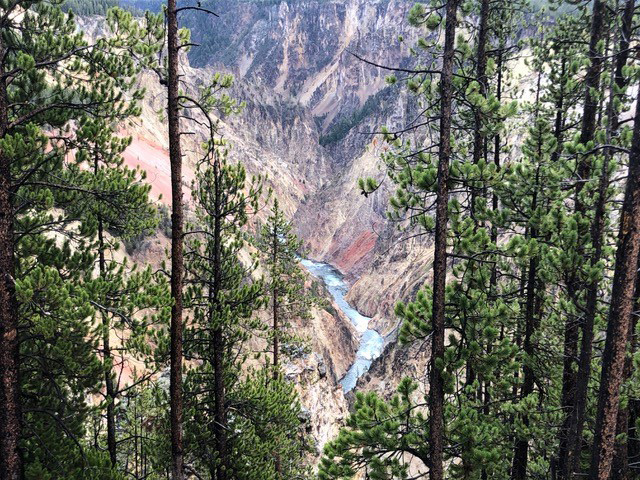
Yellowstone National Park

By the time I left the Dakotas, I really began to appreciate the beauty of the United States. On previous trips across the country, I saw America from the interstate. On this trip, I drove state roads across the land. Iowa, Kansas and Nebraska became interesting, not just places to get through. I gave a lot of thought to the landscape and the people who lived in the heartland year-round. In many ways, they were some of the best places I’ve seen.

After my trip, people would often ask what was my favorite part was. I usually respond that the section from Livingston, Mont., down through Yellowstone National Park, over to Boise, Idaho, and then up into Washington state and down the Columbia River Gorge to the Oregon coast was the prettiest part of the journey.
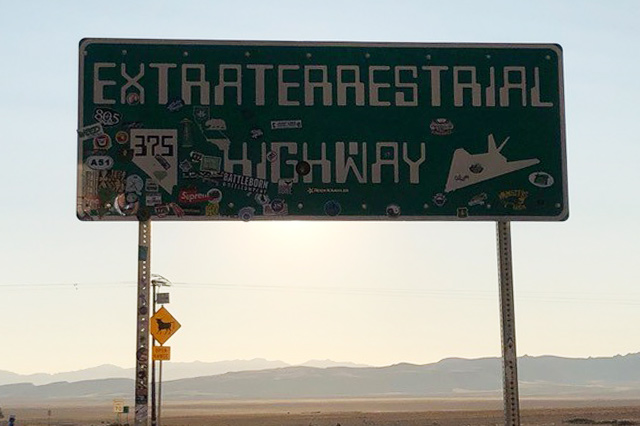
Sign for the Extraterrestrial Highway

But I also found the Great Plains and my 200 miles on the Extraterrestrial Highway through the Nevada desert beautiful. In truth, my favorite part was what I talked about earlier – the feeling of being excited for whatever might come next.

For the most part, the trip went as planned. On the coast of Oregon, I had to divert from my plan to see the Redwoods because of forest fires. Later, I had to change my route because of a hurricane. Despite such diversions, I lived the rule. I visited every state and spent only one night in each.

Other personal highlights: I stood on a street corner in Winslow, Ariz.; I visited my old apartment outside of Chicago and where I lived for a time in college in Durango, Colo. In Memphis, I saw Graceland, but also the wonderful Civil Rights Museum, which sits on the grounds of the Lorraine Motel where Dr. Martin Luther King Jr. was assassinated. The Civil Rights Museum was meaningful and memorable. I was able to head south down the Blues Highway (named for all of the Mississippi Delta blues singers that traveled this road north to Memphis and Chicago) and north on the Country Music Highway which passes the birthplaces of country music stars like the “Coal Miner’s Daughter,” Lorretta Lynn.
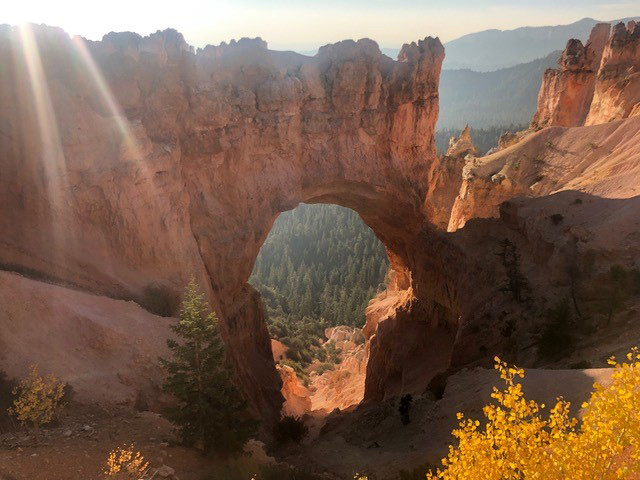
Bryce Canyon, Utah
Bryce Canyon, Utah

From New Orleans to the panhandle of Florida, I saw the aftermath of recent hurricanes, and soon after, drove the Blue Ridge Parkway and viewed spectacular fall scenery. I couldn’t drive the whole country without stopping in Washington, D.C., even if it was just for a quick tour around the National Mall. I did not sleep in the capital as it is not a state. Yet.

I switched up my mode of transportation in Delaware. I found a ferry to take me over to Cape May, N.J. On a beautiful fall day, it was hard to beat the trip across the Delaware Sound. And Cape May is not the New Jersey I’m used to seeing from the turnpike.

Going the Extra Miles

In many ways, I was lucky. I kept safe from the virus that was soon going to spike again, safe from really bad weather that would soon lead to heavy snow in the West and safe driving a trip that turned out to be 15,000 miles instead of the planned 12,000 miles.

What was America like from the road during the pandemic and a difficult political time? America is still America. Sure, the wearing of masks varied from county to county and political billboards dotted the countryside, but Americans will still be pleasant to an outsider. As good as it felt to accomplish a challenge, I had been working on for 20 years, in the end, I came home with a deeper appreciation for what a great and varied country we live in. I can’t think of anywhere else in the world where I could see so much, so easily. The feeling of waking up and just being excited about what might come next is something that will stay with me for a long time. I think I made Mom proud.

So, what’s next for me? I still haven’t been to Alaska or driven across Canada.
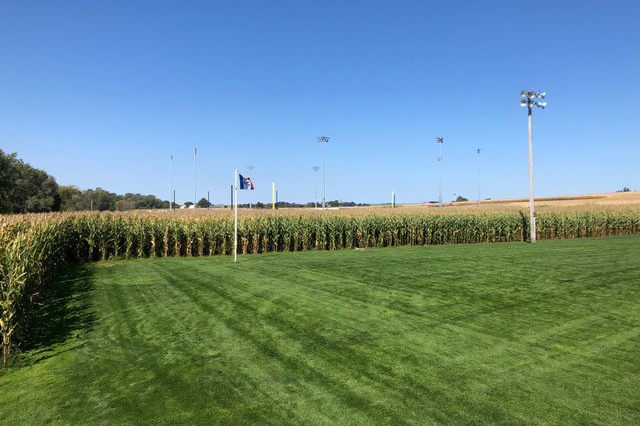
Field of Dreams ball field surrounded by corn
Field of Dreams ballpark

If You Go

Read
  • “1,000 Places to See Before You Die,” Patricia Schultz, Workman Publishing, New York, 2007
  • “50 States 5000 Ideas,” Joe Yogerst, National Geographic, Washington D.C., 2017
See

Nate Williams is a AAA member from Massachusetts.

Feeling inspired to take a road trip? Tell us about it in the comments.

Subscribe to Your AAA Newsletter

Sign up and receive updates for all of the latest articles on automotive, travel, money, lifestyle and so much more!

Top Places to Visit in the U.S. Right Now 

A lot of pent-up wanderlust is about to be unleashed.

Online traffic and bookings have significantly increased of late, particularly for hotels and car rentals, according to a recent internal survey by AAA Travel. With 40% of the U.S. population now fully vaccinated against COVID-19, Americans are demonstrating increased confidence to travel as we head into summer.

This trend comes fresh on the heels of the Centers for Disease Control and Prevention’s updated travel guidance that fully vaccinated people can travel at low risk to themselves, and can forgo masks in most settings. 

AAA Travel advisors are fielding numerous travel inquiries from people who are planning trips after a year at home. Booking data reveals that domestic travel and road trips remain the biggest drivers of travel recovery in the near term.  

Here are the top places to visit in the U.S. right now, based on AAA member interest and bookings. 

Note: Due to the ever-changing nature of the COVID-19 pandemic, please see official websites before visiting to check for restrictions or closures. 

Scallop Diving on Florida's Adventure Coast

Discover the adventure of scallop diving; an underwater scavenger hunt for all ages to enjoy!

Go Scalloping!

Orlando, Fla.  

Yes, the land of the Mouse House and Universal Orlando Resort is right at the top of the list of places to visit in the U.S., and it’s no surprise. The parks are open, with increased safety measures and some new procedures, and families are ready to add an element of fun and magic back into their lives. At Walt Disney Worldguests must have both a park reservation and valid admission for the same park on the same date, while Universal advises that its parks may reach capacity levels during the summer due to limited attendance numbers. The basics: Plan ahead if you’re traveling to the parks and make reservations and book theme park tickets in advance. 

Las Vegas 

Gourmet food, glamorous gaming, outdoor fun and even – yes – family-friendly fun is just some of what you’ll find in Las VegasNew spots are always opening upAfter filling up up on aesthetic art and creative joy at Area15 and Meow Wolf’s Omega Mart, head to the Downtown Container Park for trendy eats and shops – and a 40-foot metallic fire-breathing praying mantis that serves as the park’s mascot of sorts.  

Alaska  

If you’ve ever dreamed of taking aAlaskan cruise, now might be the time to book. President Joe Biden is expected to sign a bill into law Monday that would allow cruise ships to return to Alaska this summer. In addition to seeing wildlife like puffins and orca and humpback whales from your cabin, you can also see bears, moose, wolves and caribou – and exquisite panoramas – if you explore Denali National Park.  

Fort Myers, Fla.  

Perhaps best known in these parts for being home to Fenway South, the Boston Red Sox’s spring training facility, Fort Myers is also known for its historic sites, sandy stretches of beach, great seafood and outdoor activities like fishing, biking and paddlingYou can also check out the winter estates of Thomas Edison and Henry Ford, if you’re so inclined. The area is also home to Sanibel Island, a beach paradise known for its spectacular sunsets and seashell-combing.  

Hawaii 

Always one of the top places to visit in the U.S., the ultimate tropical paradise also has good news for travelers: Gov. David Ige wants to open up the islands to tourists by the July 4th holiday. By then, vaccinated travelers would not need to take a COVID-19 test to be able to visit.  

Key West, Fla.  

Florida’s southernmost point is surrounded by warm Atlantic waters on all sides, with plenty of historic architecture, water sports and fishing opportunities, and the chance to see where literary legends like Ernest Hemingway, Robert Frost and Tennessee Williams lived and worked. (Of course, make sure to get a slice of Key lime pie while you’re there. They’re especially good dipped in chocolate and served frozen on a stick.) 

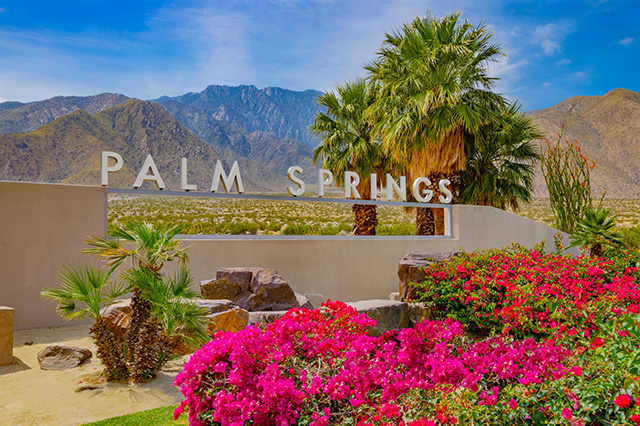
Palm Springs, Calif.  

Midcentury-modern architecture, hot springs, beautiful weather and vintage boutiques all call Palm Springs home. The former playground Hollywood stars and starlets, today’s Palm Springs beckons those with a taste for style, glamour and relaxation with its many fine restaurants, gorgeous landscapes, tasteful shopping and many hiking and biking trails that thread through the desert to explore.

Need a ride? AAA members can save up to 20% on Hertz rentals

Where are you looking forward to traveling? Tell us in the comments below! And check out AAA.com/Travel for all of your travel-planning needs.

Subscribe to Your AAA Newsletter

Sign up and receive updates for all of the latest articles on automotive, travel, money, lifestyle and so much more!

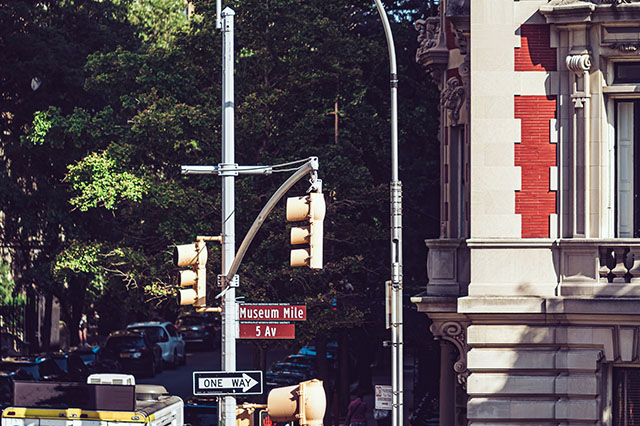
The Best Museums in New York City

Museums are great spots to hit up on a road trip or vacation. But with so many places to visit so close, how are you supposed to choose? Just check out our list of the best museums in New York City.

Note: Due to the ever-changing nature of the COVID-19 crisis, please check official websites before visiting to check for restrictions or closures.

NYC Museums


View this post on Instagram


A post shared by Guggenheim Museum (@guggenheim)

Guggenheim Museum

The Guggenheim Museum in Manhattan is a landmark institution, showcasing works from the 20th century and beyond. The iconic building was designed by none other than Frank Lloyd Wright. In addition to the vast collections of modern and contemporary art, the Guggenheim also hosts many special exhibitions and events. It’s not only one of the best museums in New York City – it’s one of the best museums in the world. Get $3 off admission with your AAA card.

The Metropolitan Museum of Art

One of the world’s most famous – and largest – museums, the Met is a favorite of both visitors and locals alike. Find yourself in the company of artworks from some of the world’s masters, spanning 5,000 years. If you’re a fan of medieval art, the Met Cloisters – which houses the museum’s medieval collection of art, manuscripts and tapestries, including the famed Unicorn Tapestries – is not to be missed.

American Museum of Natural History

Another one of the best museums in New York is the American Museum of Natural History. The museum has just about everything within its walls – and it should, considering it’s the largest natural history museum in the world at over 2 million square feet. The museum is a catalog of ecological history, animal species, human culture, architecture, geology and astronomy. Coming in February 2021, the all-new Allison and Roberto Mignone Halls of Gems and Minerals, promises a brilliant showcase of specimens, including some of the largest amethyst geodes on public display. The dinosaurs are also always a visitor favorite. It’s a great trip for the whole family.

Museum of Jewish Heritage

The Museum of Jewish Heritage – A Living Memorial to the Holocaust is dedicated to educating visitors about Jewish life before, during and after the Holocaust. The museum houses recorded testimonies from Holocaust survivors, liberators, protectors and others, and hosts various programs, events and classes.

The Museum of Modern Art

MoMA is an unforgettable place where thought-provoking creativity and contemporary artwork is all around. Explore the galleries and collections, then head outside to enjoy the Rockefeller Sculpture Garden or grab a bite in one their outdoor restaurant spaces. Be sure to pick up something unique in the gift shop before you leave.

If you love modern art, you’ll also want to check out MoMA PS1 in Queens. A former abandoned public school building, it now features works from an ever-changing roster of diverse artists, often addressing current social, cultural and political issues.

New York Hall of Science

During a typical year, NYSCI welcomes droves of  students, teachers and families. With over 450 exhibits, events, and workshops for all ages,  the museum practices the “Design-Make-Play” method to educate visitors in the STEM subjects of science, technology, engineering and math.

Although NYSCI hasn’t yet set a reopening date, it’s celebrating summer and a bygone slice of Americana with a special Queens Drive-In experience. It’s showing open-air movies outside its building in Flushing Meadows Corona Park, with guests appropriately socially distanced inside their cars. Vendors from the Queens Night Market will be on hand selling snacks, and guests can bring their own snacks and nonalcoholic beverages as well.

9/11 Memorial & Museum

Two memorial pools outside pay homage to the 2,977 people killed in the terror attacks on Sept. 11, 2001, and the six who died in the 1993 World Trade Center bombing. The museum holds more than 70,000 artifacts, as well news archives, video footage and first-person testimonies of the events of that day within its 110,000 square feet.

There are so many great museums in New York City! Which one do you think is the best museum in New York City? Will you be visiting any when they reopen? Let us know in the comments below.

Find AAA Discounts on museums and attractions throughout the Northeast.  

Subscribe to Your AAA Newsletter

Sign up and receive updates for all of the latest articles on automotive, travel, money, lifestyle and so much more!

The 10 Most Vegetarian-Friendly US Cities

A recent study by Nestpick revealed the top 10 most vegetarian-friendly cities in America, with New York City coming in at No. 3.

Criteria used to judge each city included the affordability of fruits, vegetables and plant-based protein products along with the number, quality and menu prices of vegetarian restaurants, as well as the number of locally held vegetarian festivals and events.

If you’re looking for tasty vegetarian fare or vegetarian-friendly accommodations, check out this list of the 10 most vegetarian cities in the U.S.

1. Los Angeles

L.A. is the most vegetarian-friendly city in America, according Nestpick’s Vegetarian Cities Index. It scores highly for the affordability of plant-based meat alternatives as well as the number of vegetarian festivals and events. It also has a decent number of vegetarian-friendly restaurants, and restaurant prices aren’t too bad, either. It doesn’t have as many vegan-friendly restaurants.

Los Angeles scores 96.60 out of 100.

2. San Francisco

San Francisco also scores highly for the affordability of plant-based protein products. It doesn’t have as many festivals or events compared to L.A. but scored second-best of the U.S. cities for the number of vegetarian-friendly restaurants per person.

San Francisco scores 96.21 out of 100.

3. New York City

NYC is home to the most vegetarian- and vegan-friendly restaurants of any U.S. city. It also ranks No. 1 for most vegetarian festivals and events, beating out Chicago and L.A. One con is the total average cost of vegetarian food, which was the highest of the U.S. cities listed.

The Big Apple scores 96.08 out of 100.

4. Atlanta

Atlanta scores well for its number of vegetarian festivals and events as well as the affordability of fruits, vegetables and plant-based protein products. Atlanta falls short when it comes to the average rank of its top 10 vegetarian and vegan restaurants, scoring fifth-worst in this category compared to other U.S. cities.

Atlanta scores 94.85 out of 100.

5. Miami

Miami features a decent number of vegetarian events and festivals. The local affordability of plant-based protein products scored well too; however, the total average price of vegetarian food was the fourth-highest of the U.S. cities.

Miami scores 94.65 out of 100.

6. Pittsburgh, Pa.

The price of plant-based protein products is pretty affordable in Pittsburgh, Pa. The availability of affordable vegetarian restaurants in the city and the average rank of the top 10 vegetarian restaurants are decent. It may just be a little difficult to find these restaurants. Pittsburgh ranks fifth-worst of the U.S. cities when it comes to number of vegetarian-friendly restaurants adjusted for population.

Pittsburgh scores 93.90 out of 100.

7. Oklahoma City

Oklahoma City received the best score of any ranked U.S. city when it comes to the availability of affordable vegetarian restaurants. The cost of fruits, vegetables and plant-based protein alternatives are relatively affordable, too. Vegan-friendly restaurants are limited, though; it’s home to the fifth-lowest amount of vegan-friendly restaurants of the ranked U.S. cities.

The capital of Oklahoma scores 93.81 out of 100.

8. Washington, D.C.

You’ll find a decent number of vegetarian-friendly restaurants in the nation’s capital. It scores as the second best U.S. city for the number of vegetarian restaurants as a share of all its restaurants. One con is the total average price level for vegetarian food, which was the fifth-highest of the U.S. cities listed.

Washington scores 93.46 out of 100.

9. Seattle

Seattle had the fifth-highest score of any U.S. city when it comes to the number of vegetarian- and vegan-themed events and festivals. Its vegetarian restaurant affordability score was decent as well. Seattle has the second-worst score of U.S. cities when it comes to the total price average of vegetarian food – falling right behind NYC in this category.

Seattle scores 93.18 out of 100.

10. Houston

Houston scored the highest of any U.S. city when it comes to the affordability of fruits and vegetables along with third-best for the affordability of plant-based protein products. Houston has the lowest scores when it comes to the number of vegan- and vegetarian-friendly restaurants, as a share of all the city’s restaurants.

Houston scores 92.95 out of 100.

Boston, Denver, Chicago, Minneapolis and Dallas round out the top 15 vegetarian-friendly cities.

Looking to make more vegetarian food at home? Check out this story on how to build a better salad or this guide to plant-based meat alternatives. Learn how to grow your own vegetable garden here.

Which vegetarian-friendly city would you like to visit the most? Tell us in the comments.

Subscribe to Your AAA Newsletter

Sign up and receive updates for all of the latest articles on automotive, travel, money, lifestyle and so much more!

The Best Outdoor Workouts

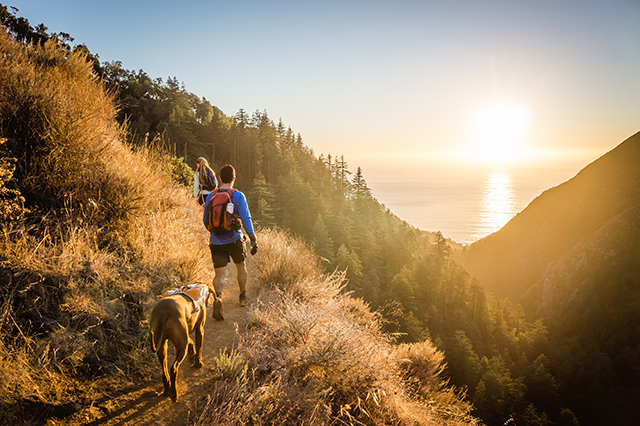
When it comes to working out, why not head outside?

After a gray, gloomy and uniquely isolating winter, we’re all looking forward to exploring the great outdoors again. Now that the weather is warm – and more and more people are getting vaccinated – heading outside for a fun, free workout is an excellent choice.

These are some of the best outdoor workouts. Try one, or all, this spring, summer and fall.

Note: Due to the ever-changing nature of the COVID-19 pandemic, please see official websites before visiting to check for restrictions or closures.

Benefits of Outdoor Workouts

Adults should do about 150 minutes, or 2.5 hours, of moderate to intense aerobic activity per week, according to the American Heart Association. This can also be broken down as 30 minutes of exercise five days a week.

Right now, exercising outdoors is safer than going to the gym, according to the Centers for Disease Control and Prevention, and it saves money, too.

Exercising outside also allows for access to fresh air and sunshine. While you don’t want to spend too much time in the sun’s harmful UV rays, some sunshine in moderation is good for you. Vitamin D can help your sleep cycle and mood as well as lower your risk of Alzheimer’s disease, multiple sclerosis, and pancreatic and breast cancer, according to Hartford HealthCare.

Activities that raise your heart rate are good for your body, but there’s something to be said about the mental and emotional boost that results from getting out of the house as well.

There is also more variety outdoors, as different locations allow for different types of exercises to help you reach your goals. If you are looking for the best outdoor workouts for weight loss, you can get an idea of how many calories different types of activities can burn with this chart from the Mayo Clinic.

Walking/Jogging

Going for a walk or jog is one of the easiest forms of outdoor exercise.

Walking can help lower your cholesterol, blood pressure, risk of diabetes, obesity, vascular stiffness, inflammation and mental stress, according to Harvard Health Publishing.

Keep things interesting by listening to music/podcasts or mixing in some walking lunges, butt kicks and/or going backwards.

You can always carry weights or include hilly terrain to burn more calories.

Find walking trails near you or scenic running trails in Boston and NYC.

Hiking

Hiking gets your heart pumping. It can also help reduce your risk of hearth disease, hypertension, diabetes, obesity, anxiety, osteoporosis and arthritis, according to the American Hiking Society.

From the Appalachian trail to Long Island, the Northeast is home to a plethora of hiking trails that vary in length and difficulty – meaning there’s a hiking trail for every experience level.

The psychical benefits of hiking are rewarding – as are the mental and emotional benefits of being in the great outdoors and working your way toward scenic views.

If you’re new to hiking, check out this list of essential hiking supplies. Then, find a nearby hiking trail.

Biking

Like other aerobic workouts, biking is good for your heart and muscles. What’s more, cycling is easy on your joints, can help improve balance and the resistance of pedaling strengthens bones, according to Harvard Health Publishing.

Whether you prefer a peaceful cruise around your community, a scenic bike tour or some exhilarating mountain biking, there are plenty of options to explore in the northeast.

If you’re new to biking, look into the different types of bikes and choose the right one for you. Start easy and work your way up to more challenging trails to burn more calories.

AAA Northeast members receive free bicycle service along with their 24-hour roadside assistance. If your bicycle breaks down while you’re out for a ride, call 1-800-AAA-HELP.

Find bike trails and paths near you.

Outdoor Yoga

Many people enjoy yoga for its relaxing and mood-boosting benefits. The deep breathing and meditative practices of yoga can even aid in coping with anxiety and depression, according to Harvard Health Publishing.

When it comes to physical health, yoga helps improve balance, flexibility and strength, too.

If you are interested in outdoor workout classes, yoga is a great option. Check for outdoor, socially distanced yoga classes near you. To try outdoor yoga on your own, simply roll out your yoga mat on the back porch or a flat area on the lawn and follow an instructional video on your preferred device.

Choose from 2,500 workout videos with the Active&Fit Direct ™ Program

best outdoor workouts

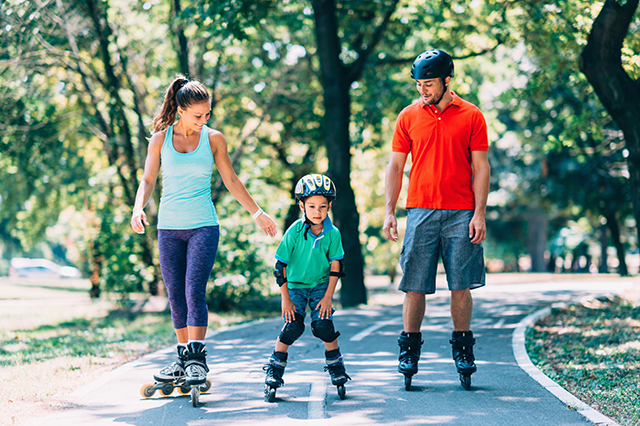
Inline Skating/Rollerblading

Exercise outside and feel like a kid again by strapping on a pair of skates.

Rollerblading strengthens your core, glutes and legs while burning a decent amount of calories – 600 calories per hour, according to Roller Skating Association International. It’s also less jarring to your joints compared to running.

Don’t forget to wear a helmet and knee pads. Consider wrist pads as well if you’re new to skating or it’s been a while since you rollerbladed last.

Inline skating is permitted on a number of paved walking trails.

Water Sports

If you live near a river, lake or ocean, there’s an opportunity to exercise on the water as well.

Canoeing, kayaking and rowing are good workouts for your arms and back muscles while stand-up paddle boarding and surfing are great for your core strength and balance.

Swimming is a full-body workout that burns a lot of calories. “A gentle swim can burn over 200 calories in just half an hour, more than double that of walking,” according to Swimming.org. It’s also gentle on your joints and a fun, relaxing activity for many.

Beach Workouts

Some may argue that the best outdoor workouts are at the beach.

Running on the beach, or doing sand sprints, can be more effective than running on hard surfaces.

“Studies have shown that running on the beach – especially on soft, dry sand that’s typically found farther from the water’s edge – will likely lower your odds of impact-associated overuse injuries,” according to Runner’s World. Also, “running on sand forces your body to work at least 10% harder than it does on grass.”

One drawback is the risk of ankle sprains and tendinopathy, so keep your limitations in mind.

You can also try yoga, stretches and other activates on the beach for a change of scenery.

With the Kids

Focusing on play makes exercise feel like less of a chore. It’s also a great way to keep yourself and the kids active, especially when school is out for the summer

Make an obstacle course or plan a scavenger hunt that requires different stretches and exercises, like a mix of burpees, crunches, long jumps, lunges, push-ups, squats, etc.

Play sports and other outside games, such as throwing around a ball/frisbee, jumping rope and playing tag. Find more fun games to play with kids, here.

Or, head to a park or playground to exercise. Some parks, like these around NYC, offer outdoor workout equipment.

Need new workout gear? AAA members can get exclusive discounts at Reebok Outlet stores

Other Considerations

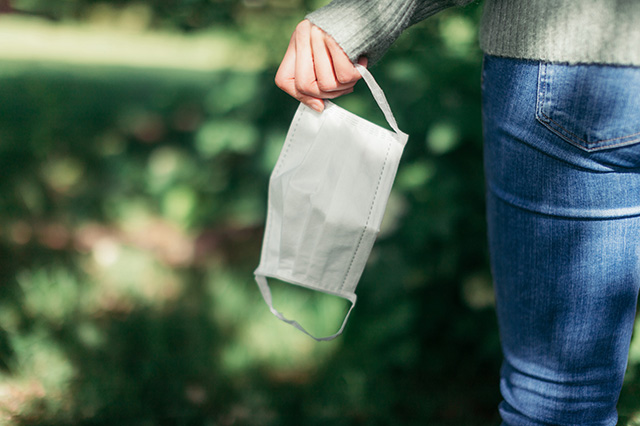
Make sure to stay extra hydrated when exercising outside, especially on hot days. Also, consider sun protection for your skin and eyes along with pest repellant if you’re prone to bug bites. When exercising outdoors, bring a spare mask in case you come across crowds on trails, at a park or the beach.

The major drawback to outdoor workouts is the chance of inclement weather. If you can’t get outside to exercise, check out these 10 Indoor Workouts to Stay Fit and Boost Immunity and these 8 Easy Indoor Senior Workouts.

If you’re working from home, you can try Pilates at your desk. Don’t have spare time to fit in a workout? Check out these everyday activities that burn the most calories.

No matter what type of exercise you prefer or have time for, you can track your fitness with wearables and apps.

What’s your favorite outdoor workout? Tell us in the comments.

Any new exercise routines should be approached with caution. Consider your physical limitations and always consult your doctor(s).

Subscribe to Your AAA Newsletter

Sign up and receive updates for all of the latest articles on automotive, travel, money, lifestyle and so much more!

Which Northeast States Are Adopting the CDC’s Mask Guidelines?

The Centers for Disease Control and Prevention has updated its public health guidelines, saying that people fully vaccinated against COVID-19 don’t have to wear masks or observe social-distancing guidelines in any setting. 

But at least one state in the Northeast – New Jersey – has opted not to adopt the guidance, instead requiring people to continue to wear masks in indoor public spaces.  

Masks will still be required on planes, trains, buses and other public transportation and transportation hubs, and where required by federal, state, local, tribal, or territorial laws, rules and regulations, including local businesses and workplaces. Masks are also mandatory in most health care settings, including doctors’ offices, hospitals and nursing homes. 

The CDC recommends unvaccinated people still wear masks in most situations and to observe social-distancing measures.  

Most Northeast states are following the CDC’s guidance, except for New Jersey. You can find links to all the states’ requirements below. 

What do you think about the new mask guidelines? Tell us in the comments.


Subscribe to Your AAA Newsletter

Sign up and receive updates for all of the latest articles on automotive, travel, money, lifestyle and so much more!

What to Know About Charging Electric Vehicles at Home

There’s little arguing that electric vehicles are the cars of the future. In fact, between automakers pledging to transition to all zero-emission lineups and states banning gas-powered cars, it’s looking more and more like EVs will soon be car owners’ only option. With that in mind, it’s becoming imperative to better understand how to operate these green vehicles – particularly, how to charge them. Since most charging is done at home, this means understanding how EV home charging stations work.

Although EV home charging can be as simple as plugging your car’s battery in an outlet, there are a lot of factors to take into consideration, including charging efficiency, installation and cost.

EV Home Charging

Most electric vehicle owners charge their cars at home. In fact, according to the U.S. Department of Energy, more than 80% of EV charging is done at an owner’s residence. This is obviously the most convenient option – you can charge the car when you’re sleeping and it’s ready to go in the morning – and it’s also the cheapest. Single-family homes generally have low and stable electricity rates.

Charging your EV at home certainly isn’t free but it costs substantially less than paying for gas and is usually cheaper than using a public charging station. The Department of Energy estimates that fully charging an all-electric vehicle with a 100-mile range would cost the equivalent of running air conditioning for six hours. Because they have smaller batteries, plug-in hybrid EVs would cost even less.

When you compare this to the cost of gasoline, you can see how the savings pile up. Over the past few years, gas prices have fluctuated between $1.50 and $4, meaning a person could be spending as much as $1,500 per car each year.

Charging Levels

There are two levels of charging available to you when using your home’s electricity: level 1 and level 2.

If you plug your vehicle into a standard 120-volt wall outlet, you’re using level 1. This is the simplest charging method but also the least efficient. Level 1 charging takes time, adding roughly 3 to 5 miles of range per hour. If you don’t usually drive long distances, this may be more than enough.

Some drivers, however, need to get more miles out of their vehicles on a regular basis. That’s why many EV owners opt to upgrade to level 2, which delivers 240 volts and, depending on the amperage or electrical current, can add anywhere from 10 to 60 miles of range in one hour. The typical level 2 charging station can fully charge an EV overnight.

ev home charging station

EV Charging Station Installation Cost

Level 2 charging isn’t a matter of flipping a switch or purchasing a different power cord. Instead, special charging equipment must be installed in your house. These units, known electric vehicle supply equipment, can range in price from a few hundred dollars for an EV charging cable that plugs into a 240-volt, 20-amp outlet to a couple thousand for hard-wired internet-connected smart charger.

You will need to get an electrician to install the charging station or power to supply the station, which will also cost money. A typical installation could cost as little as $300, but there are several factors that could bump up the price, including if your house needs an electrical upgrade or a remodel to allow the unit to connect to the house’s electrical supply. Some states offer charging station rebates and incentives to help defer cost.

Outdoor Home EV Charging

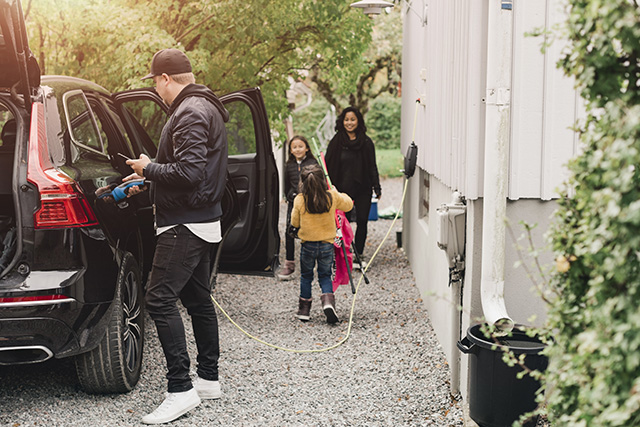
Most owners charge their EVs from the garage, but both level 1 and 2 charging can also be done outside. The only consideration with outdoor level 1 is the length of the power cord. Most EVs come with their own cord but you may need to invest in a longer one that can reach from your home to the vehicle.

You can follow the same process with outdoor level 2 charging, simply running an extended power from your vehicle to the indoor charging station. However, you can also install the charging station itself outside. If you choose this option, install the unit in a location where the wires can be run safely. You’ll also want to choose your charging station wisely. Some are better suited to deal with outdoor elements than others.

Visit AAA’s Electric Vehicle platform for more information on these cars of the future.

Subscribe to Your AAA Newsletter

Sign up and receive updates for all of the latest articles on automotive, travel, money, lifestyle and so much more!

Top Long Island Wineries and Tasting Rooms

Every proper Long Island wine tour includes a stop at Bedell Cellars, Paumanok, Pindar, Duck Walk or Wölffer Estate. If you’ve ever traveled through the East End and its many vineyard-lined streets, chances are you’ve at least heard of one of them. Grand in size, quality and popularity, these top Long Island wineries have each played a part in shaping the island’s wine industry and vineyard experience.

Bedell Cellars
36225 Main Road, Cutchogue, NY
631-734-7537

Bedell Cellars is known for making some of the finest wines on the East Coast of Long Island. As one of the most well-established Long Island wineries, they have received much critical acclaim and recognition, including having their wine served at the 2013 U.S. Presidential Inauguration.

Pioneers in the Long Island wine industry, Kip and Susan Bedell planted their grapes on the North Fork in 1980, only several years after Hargrave Vineyards (now Castello di Borghese) launched the wine industry in the area. Kip, a self-taught winemaker, focused on Cabernet Sauvignon and Merlot, eventually earning a name for the winery as one of the top red wine producers in the region and himself the nickname of “Mr. Merlot” by Wine Spectator magazine.

In 2000, Kip sold the winery to film executive Michael Lynne, president of New Line Cinema, but the focus remains on quality. Bedell Cellers continues to hand-craft their wines in small batches as they have always done and are certified sustainable by Long Island Sustainable Winemaking.

The tasting room rests within a refurbished historic barn that was built in 1919. While you are there you must try their famous Merlot for a taste of some of Long Island’s best, although all of their varieties are well-received by critics. If you like bubbles, pop a bottle of Blanc de Blancs. And be sure to take note of their artist series bottles, which feature works of renowned contemporary artists.

Paumanok Vineyards
1074 Main Road, Aquebogue, NY
631-722-8800

Fittingly named for the Native American word used to describe Long Island, Paumanok wines are an excellent representation of the quality that the land is capable of producing. In fact, their wines have been representing the region quiet prominently, recently earning them the distinction of “Winery of the Year” at the 2015 New York Wine & Food Classic; it is the second time they have won the honor.

Charles and Ursula Massoud founded Paumanok Vineyards in 1983. The 127-acre former potato farm is entirely owned and managed by the couple and their three sons. Only state-grown grapes are used to make their wines, which are grown using traditional dense planting, resulting in more concentrated fruit. The quality grown in the vineyard is maintained in the bottle by limiting production to fewer than 12,000 cases a year.

Try a glass or two during a visit to their winery and tasting room in Aquebogue. Summer and fall are great times to enjoy the scenic vineyard view out on the deck.

long island wineries

Pindar
37645 Main Road (Route 25), Peconic, NY
631-734-6200

Late Pindar founder Dr. Herodotus “Dan” Damianos was a big player among those who helped to form Long Island wine country into what it is today. From the early 1980’s he worked with his family to make Pindar one of the largest and most recognizable wine labels on Long Island. With over 500 acres of land, Pindar produces 70,000 cases a year of about 23 different varietals and blends.

Over the years, the Damianos name has made its mark on the East End at Pindar and beyond. Dr. Dan’s sons Alexander and Jason own and operate nearby Duck Walk Vineyards (more on that below) and Jason’s Vineyard respectively, while his son Pindar manages the vines at the vineyard of his namesake.

Inside the Pindar tasting room, artwork and Tiffany-style lamps surround a tasting bar where the wine is always flowing. During the warmer months, the covered deck out back is an ideal spot to take in the view and live music (weekends). U-pick sunflowers are also available while in season.

During your visit, be sure to try the Sunflower Field and Peacock Chardonnays, one of their popular sparkling wines, or the palate-pleasing red blend, Pythagoras, named “Best U.S. Red Blend” by the Beverage Testing Institute in Chicago. For a quieter experience, visit Pindar’s Port Jefferson Wine Store, which also has a full tasting bar.

Duck Walk
Duck Walk North: 44535 Main Road, Southold, NY /  631-765-3500
Duck Walk South: 231 Montauk Highway (Route 27), Water Mill, NY / 631-726-7555 x4

Pindar’s cousin winery, Duck Walk was founded by Dr. Dan Damianos and his son Alexander in 1994. Like Pindar, it has become one of the best-known Long Island wineries. Altogether, their vineyard encompasses 140 acres and produces about 35,000 cases of wine a year.

Duck Walk has two beautiful locations. In addition to their impressive flagship winery, housed within a Normandy Chateau-style building in Southampton, they claimed their spot along the wine trail on the North Fork in 2007, which quickly rose in popularity. Designed to accommodate large groups, both tasting rooms are large and airy with scenic outdoor areas to enjoy live music and wine and cheese pairings. Leashed dogs are also welcome.

Duck Walk wines are consistently recognized in national competitions. Tastings not to be missed include the Vidal Ice Wine dessert wine, made from grapes frozen on the vine, and Blueberry Port, made from wild Maine blueberries (served with a piece of chocolate).

Wölffer Estate Vineyard
139 Sagg Road, Sagaponack, NY
631-537-5106

The stylish Wölffer Estate Vineyard is a European escape in the Hamptons. Once a potato farm, the beautiful South Fork winery was the vision of late Hamburg-born businessman Christian Wölffer, who transformed the land and founded the vineyard in 1987. It also doubles as an equestrian center with the largest indoor riding ring on the East Coast.

Visiting the tasting room at Wölffer Estate is like going to a friend’s home who loves to entertain (and has a really nice house). The elevated Tuscan-style building offers pristine views of the vines and features old-world European accents including a hand-crafted bar made from reclaimed wood, stained glass doors and a stone terrace. It is the heart of the vineyard’s many events such as their Twilight Thursdays in the spring and fall and Candlelight Fridays in the winter, both of which feature live music and wines by the glass. Their nearby wine stand is also a hot spot for tastings and Sunset Fridays and Saturdays in the summer.

Winemaker and partner Roman Roth produces a diverse array of wines with food pairing and longevity in mind. All of the wines are made from estate grown and sustainably farmed grapes from Wölffer’s 55 acre vineyard and from locally-sourced fruit. They are certified sustainable by Long Island Sustainable Winemaking.

Must-taste wines: Grapes of Roth Merlot and Riesling; Summer in a Bottle rosé and white, which exactly as the name implies, are fruity sippers that capture the spirit of Long Island in the summer; and their dry white and rosé ciders, made exclusively from New York State apples. Try them at the tasting room or with dinner at Wölffer Kitchen in Sag Harbor or Amagansett, the first winery-owned restaurant in the Hamptons.

Have you been to any of these Long Island wineries? Tell us in the comments.

Plan your next trip with AAA

Subscribe to Your AAA Newsletter

Sign up and receive updates for all of the latest articles on automotive, travel, money, lifestyle and so much more!

What Being Asian-American Means to Me

I came to the U.S. from India when I was 9 and for my parents, the decision was largely driven by education.

My father looked at what it would take to put me and my three siblings through college in India, based on the salary of his government job. And he knew that if he stayed in India, he would come up short.

He thought, if I go to the U.S., there will be better opportunities for my career, and for my children to get educated. Otherwise, he’d have been forced to make the painful choice of which of us went to college and which didn’t.

My father had a degree in horticulture and at the time, there weren’t a lot of people in America with his expertise. So he always worked. But that doesn’t mean anything came easily for him or my mom. Or their four children for that matter.

To say that the move from New Delhi, India, to Queens, N.Y., was a culture shock would be a huge understatement.

I didn’t speak the language. I looked different than most of the people in my class – in my entire graduating class, I could count the number of brown people on one hand. There weren’t any Asian-Americans that looked like me.

If you wanted anything Indian, there were two shops on Main Street in Flushing, Queens, that were your only go-tos back then. Now there are dozens!

So as a child of the 1980s, my goal was just to quickly fit in, to adopt the American holidays and assimilate. Basically, I didn’t want to stand out.

It may sound odd but when I was growing up my parents never really celebrated Indian holidays with us.

My father and mother worked all time, six or seven days a week; my mother had never worked like that until she came to America. And my siblings and I all started working the moment we were old enough to do so because we understood that everybody had to chip in. College is expensive.

There were no family vacations or traveling to fancy destinations; everybody worked. My father was 15 and my mother was 12 when they were married, and my mother didn’t have much education. They never really had a childhood themselves.

So for them, the goal from day one was our education. No matter how hard they had to work to make it a reality, they would see all four of their children through college.

And college is where my culture opened up to me. I didn’t start to own my heritage until I was an undergrad at Baruch College, studying for my bachelor’s in business administration. In every class, I met people from all over the world, all ages, all of this cultural diversity. I remember reading that there were more than 150 different nationalities represented by the student body there. It was a real wake-up moment.

I wound up taking an Indian history course as an undergrad because I wanted to educate myself about the culture I’d been disconnected from since my early years. And it was around then that I traveled back to India for the first time, reconnecting with my extended family.  Soon after returning from that that trip, I met my wife who had emigrated from India much later in life and helped me learn so much more about my heritage.

The last year has been another type of wake-up call for me, as anti-Asian sentiments entered the national stage. It’s not as though this kind of discrimination is a new thing. I faced it growing up. And there are times — like explaining to my 10-year-old son why a group of teenagers called him a derogatory name because of the color of his skin — that make you think, ‘Maybe things haven’t changed that much.’”

But in other ways, things have changed a lot. Today, I love introducing my children to our culture. We recently celebrated Holi, an ancient Hindu springtime festival characterized by people throwing colored chalk on each other, and they loved it and wanted to know all about it.

Now, when an Indian holiday comes, we’ll take the day off, make sure we dress up and exchange gifts. It gets them curious, and that’s how you discover your heritage.

And now that my parents are retired, they love nothing more than spending time with their grandkids, especially during all of those holidays that they never had a chance to celebrate once upon a time.

Rahul Chand is vice president of membership marketing at AAA Northeast. 

Subscribe to Your AAA Newsletter

Sign up and receive updates for all of the latest articles on automotive, travel, money, lifestyle and so much more!

8 Amazing Chinese Food Regions

When planning a trip or vacation to China around food, remember that China is a big country. Food can vary noticeably from village to village, but there are eight major Chinese food regions to remember: Cantonese, Sichuan, Anhui, Shandong, Fujian, Jiangsu, Hunan and Zhejiang.

Each of these Chinese regional cuisines is steeped in a history that plays a role in how they are prepared, with geography and available resources deeply impacting the final results, but they are all delicious in their own right.

Looking to plan your next vacation? Be sure to consult a knowledgeable AAA travel agent to help guide you through the rapidly changing travel landscape.

Cantonese

When you think of authentic Chinese food – which is vastly different than American-Chinese food – you’re probably thinking of Cantonese cuisine. In general, chefs trained in Cantonese kitchens can find work throughout China and abroad.

The flavors of Cantonese food are balanced, relying heavily on ingredients selected and used at peak freshness. Despite the reliance on freshness, fresh herbs are rarely used in the dishes, though exceptions are made for garlic, chives and coriander leaves.

Beef, pork, chicken and seafood are staples in Cantonese cuisine. Both Guangdong Province and Hong Kong are home to excellent Cantonese seafood dishes served with rice. If you’re enjoying an Asian holiday in this region, don’t be surprised to find chicken feet, offal, duck’s tongue, snail, anteater or snake in your dish as well.

A number of sauces are popular in the region, such as plum sauce (sweet and sour), hoisin (sweet and salty) and oyster sauce (sweet, salty and a little “oystery”).

Sichuan

Even if you’ve never been to China, the name Sichuan probably rings a bell. Known for its hot and spicy flavors, this Chinese food region has a reputation for variation in seasoning and cooking methods.

The intense flavors from Sichuan Province – in contrast to Cantonese cuisine – rely on Sichuan pepper, black pepper, chili, broad bean chili paste, shallots, ginger and garlic.

Some of the most famous dishes are Kung Pao chicken, diced chicken with dry red pepper and peanuts; Fuqi feipian, thinly sliced beef seasoned with chili oil; and Sichuan hot pot, a tongue-numbing spicy dish. If you get the hot pot, be prepared to sample sea cucumber and unusual meats.

Anhui

The landlocked province of Anhui provides the wildest of Chinese regional cuisine, as locals forage the mountainsides for herbs, berries, fungi and game. Anyone whose Asia vacation takes them to this region will notice the lack of frying and stir-frying, as locals tend to favor stews and braised meats.

Local farms produce bayberry, tea leaves, bamboo shoots and dates, while wild mountain herbs are selected and added to dishes for both aroma and medicinal effects.

If you’re feeling bold or in need of protein, steamed stone frog is one of the several famous regional dishes. For those lighter of heart, there is Luzhou roast duck, Li Hongzhang stew and egg dumplings.

asia vacation
Fujian stir fried rice.

Shandon

Found along the northeast coast of China, Shandon cuisine, also known as Lu cuisine, is characterized by flash-fried seafood and vegetable dishes that aren’t too oily.

Like in Cantonese cooking, Shandon chefs focus on using spices and herbs to add subtle complexity to flavors rather than dominate the dish. Green onions, garlic, ginger and a dash of red pepper are often found in these dishes.

Shandon does not use some of the heavier sauces found in Cantonese cuisine, relying instead on vinegar and lots of salt.

Fujian

This Chinese food region is another that relies heavily on local delicacies, such as fish, turtles, indigenous mushrooms and bamboo shoots. Also known as Min cuisine or Hokkien cuisine, these dishes are often prepared to emphasize umami – the tantalizing fifth flavor for our palates.

If you’re a soup person, this province is a must-visit. Fresh seafood soups gain richness with exotic, wild ingredients brought down from the mountains.

Jiangsu

A wealthier region of China, Jiangsu errs on the side of gourmet, rather than partaking in the tradition of the hearty mountain peasant food you’ll find in Anhui province. Chefs create richly aromatic and refined meals with a heavy focus on presentation.

As a coastal province, it’s no surprise that seafood and sea vegetables play heavily into the region’s cuisine.

Hunan

Food from Hunan province is perhaps even hotter than Sichuan cuisine, but a little less so because they don’t incorporate the Sichuan peppercorns.

If you like Sichuan, it’s safe to say you’ll probably like Hunan cuisine. However, a mix of vinegar-chili and locally produced citrus allows dishes to evolve beyond simply spicy.

Zhejiang

Once home to the capital of the southern Song Dynasty, this region serves up elegant, refined dishes that feature quality ingredients. The cuisine shares a philosophy with Japanese food as they both incorporate raw or almost-raw ingredients.

There are three styles of Zhejiang cuisine: Ningbo is known for salty seafood dishes, fully utilizing brines during preparation; inland, Shaoxing uses less seafood, focusing instead on poultry and freshwater fish; and Hangzhou seems to include bamboo shoots in nearly every other dish.

Did we forget your favorite Chinese regional cuisine or dish? Tell us about it in the comments below!

Plan your next Asia vacation with AAA Travel.

This story was originally published in 2018 and has been updated.

Subscribe to Your AAA Newsletter

Sign up and receive updates for all of the latest articles on automotive, travel, money, lifestyle and so much more!

The Best Podcasts About the Internet

Podcasts wouldn’t exist without the internet, and many podcasts are produced by extremely online people. These top podcasts about the internet prove that some of the most interesting stories can come from the far-reaching corners of the wild World Wide Web. Be warned, though, just like the internet, some of these podcasts can get a little strange.

ICYMI

“ICYMI,” which is internet slang for “in case you missed it,” is a Slate podcast hosted by writers Madison Malone Kircher and Rachelle Hampton. Like the title would suggest, this twice-weekly podcast is all about what you might have missed on the internet lately. News moves fast online, and it’s easy to fall behind. Kircher and Hampton make sure that you’re updated on all the latest memes, callouts, meltdowns and cringe content. Even if you’re not as online as the hosts, you’re sure to enjoy their hilarious analysis.

Recommended episodes: A Vaccine is Not a Personality, Will You Accept This SponCon?, Every Generation Has Is Cringe

Cancel Me, Daddy

If you’re on the internet or even know people who are on the internet, you’ve probably heard of cancel culture. But what even is cancel culture? Is it even real? On “Cancel Me, Daddy,” journalists Katelyn Burns and Oliver-Ash Kleine deconstruct recent “cancellations,” public outcries, bad takes and free speech squabbles. It’s one of the most interesting new podcasts about the internet out there, as Burns and Kleine try to navigate the changing mores of the online world (and how that affects the offline world).

Recommended episodes: A Recycled Moral Panic, The Substack Bros & Teen Vogue, Sia’s Snafu & The Manadalorian Mess

Rabbit Hole

“Rabbit Hole” is a podcast from the New York Times chronicling how the internet can change people’s minds and lives – sometimes for the worse. From algorithms that point people toward more and more polarizing content to forums that stoke conspiracy theories, “Rabbit Hole” is true to its name. The podcast asks, “What is the internet doing to us?” Columnist Kevin Reese tries to find out. Whether you’re an internet expert or an online newbie, “Rabbit Hole” will shock you.

Recommended episodes: Listen from beginning to end.

podcasts about the internet

Reply All

“Reply All” is a podcast about the bizarre things that happen when internet culture intersects with real life. It has episodes about things like rat-based performance art, inmates posting from behind bars, websites listening through phone microphones, conspiracy theories and public shaming. Recently, after their controversial series The Test Kitchen was abandoned after two episodes, “Reply All” has undergone some behind-the-scenes changes. We won’t know how these changes will effect the show until they start posting episodes regularly again, but it will certainly be interesting to see their transformation.

Recommended episodes: #169 The Confetti Cannon, #167 America’s Hottest Talkline, #158 The Case of the Missing Hit, #109 Is Facebook Spying on You?, #70 Stolen Valor, #64 On the Inside, #56 Zardulu, #18 Silence and Respect

Baby Geniuses

Comedian Emily Heller and cartoonist Lisa Hanawalt are on a mission to know everything, and they have decided to learn it from increasingly obscure Wikipedia pages. From strange internet articles, to guest experts, to updates from Martha Stewart’s Instagram, “Baby Geniuses” has everything you never knew you needed. Heller and Hanawalt’s friendship makes the irreverent and bizarre podcast feel like a series of secret handshakes and inside jokes (like Lisa Hanawalt’s childhood as a horse girl). Though they both have a similar sense of humor, the hosts bring two completely different energies to the podcast – from Heller’s brash, stand-up style to Hanawalt’s soft-spoken, arty absurdism.

Recommended Episodes: Loveland Frog, McDonald’s Characters, Table Manners, Learned Pig, Wikipedia Long Term Abuse, Mariko Aoki Phenomenon, List of Gestures

You’re Wrong About

What if the most widely-accepted version of the story, the story you’ve been hearing your whole life, just isn’t true? “You’re Wrong About” is a podcast about common misconceptions and the way stories get warped in the public eye. Hosts Michael Hobbs and Sarah Marshall take turns telling each other about things like the satanic panic, Y2K, anti-vaxxers, stranger danger and so much more. They’ve currently also started doing multi-episode deep dives on books covering infamous celebrities and events. “You’re Wrong About” is not specifically about the internet, but the nature of online misinformation has led to them covering many internet-related stories.

Recommended Episodes: “Political Correctness”, The Anti-Vaccine Movement, Halloween Special: Creepy Encounters, Wayfair and Human Trafficking Statistics, The Y2K Bug, The Wardrobe Malfunction

Looking for even more podcasts? Check out our list of the best new podcasts of 2021 and the most bingeworthy podcasts!

Subscribe to Your AAA Newsletter

Sign up and receive updates for all of the latest articles on automotive, travel, money, lifestyle and so much more!

What Is Your Financial IQ?

Only 57% of American adults are financially literate, according to a survey by Standard & Poor’s. Without a basic understanding of financial concepts, people are far more likely to make poor decisions regarding their money.

This knowledge is arguably more valuable than ever, as tools and products that can significantly improve your financial situation are so easily accessible. Yet without a proper understanding of how they work, let alone that they exist, they’re rather useless.

To gauge your knowledge of all things money, we put together a quiz that asks: What is your financial IQ?

Between securing a loan, buying a car, saving for retirement, and much more, AAA is here to help you with all your financial needs. Learn more about all the products and services available to members.

So, what is your financial IQ? Share your quiz results in the comments. 

Subscribe to Your AAA Newsletter

Sign up and receive updates for all of the latest articles on automotive, travel, money, lifestyle and so much more!

The Fastest-Growing States in America

The COVID-19 pandemic made many Americans reconsider the importance of family, work-life balance and the comforts of home. A buzzed-about trend of 2020 focused on people leaving overpopulated cites for more rural and suburban areas, opting for larger homes with more breathing room.

How much of an impact did the migrations trends of last year have? Which states are now the most and least populated? See how regional populations have changed, according to the latest U.S. Census, including the fastest- and slowest-growing states.

U.S. Population Shifts 

As a whole, the country saw a decent population increase over the past decade.

In 2020, the resident population of the United States was 331,449,281, an increase of 7.4% over the 2010 Census, according to the United States Census Bureau. Although the overall population has increased, population growth can vary greatly from state to state, as Americans favor certain locations over others.

The Big Population “Winners”

From 2010 to 2020, a handful of states saw an increase in population twice the average U.S. percent change. These states included Utah (+18.4%), Idaho (+17.3%) Texas (+15.9%), North Dakota (+15.8%) and Nevada (+15%).

Places like Colorado (+14.8%), Florida (+14.6%), Washington (+14.6%) and the District of Columbia (+14.6%) all saw decent increases as well.

Overall, the fastest growing state is Utah, followed by Idaho and Texas.

Populations in the Northeast

The Northeast area – from Maine (+2.6%), Vermont (+2.8%) and New Hampshire (+4.6%), to Massachusetts (+7.4%), Connecticut (+0.9%), Rhode Island (+4.3%) New York (+4.2%) and New Jersey (+5.7) – saw slight resident population increases.

New York still has the highest population in the Northeast, with a resident population of over 20.2 million, but it ranks as the fourth most populated state in the country. More people call California (39.5 million), Texas (29 million) and Florida (21.5 million) home.

The Population “Losers”

From 2010 to 2020, populations dropped the most in West Virginia (-3.2%), Mississippi (-0.2%) and Illinois (-0.1%). Puerto Rico saw the largest drop in resident population at -11.8%.

The slowest-growing states are Connecticut, Michigan, Ohio, Wyoming and Pennsylvania, according the the Census Bureau.

Wyoming is also home to the least amount of people (576,851) in the country, followed by Vermont (643,077) and Alaska (733,391).

What’s the Significance?

Knowing which states’ populations are growing, along with the overall state population count, can help you decide where you might want to move.

What’s more, population shifts affect each state’s allotment in the U.S. House of Representatives. After each census, the results are used to calculate the number of House seats to which each state is entitled. Each state is entitled to at least one seat.

Seven House seats will shift due to the results of the latest numbers. Texas will gain two seats, while Colorado, Florida, Montana, North Carolina and Oregon will each gain one. States losing a seat include New York, California, Illinois, Michigan, Ohio, Pennsylvania and West Virginia.

What do you think about the U.S. population changes? Tell us in the comments. 

Subscribe to Your AAA Newsletter

Sign up and receive updates for all of the latest articles on automotive, travel, money, lifestyle and so much more!

Freshwater Fun in North Central Massachusetts

Though it’s beautiful and worth a visit year-round, there’s something to be said about traveling to North Central Massachusetts in the summer. This is the time of year when its freshwater beaches, ponds and lakes truly shine.  Perfect for fishing, swimming and fun water sports like canoeing and kayaking with the family, freshwater provides a quiet, relaxing calm that’s different than the ocean.

Check out this list of lakes and freshwater beaches in North Central Massachusetts and start planning your trip today.

Note: Due to the ever-changing nature of the COVID-19 crisis, please see official websites before visiting to check for restrictions or closures.

Lake Dennison

1366 Main Street, Winchendon, Mass.

Part of the Lake Dennison State Recreation Area, this transit-friendly spot is home to 150 campsites and a family-friendly beach. Lake Dennison Beach is open from late-May to early-September, Sunday to Saturday, from 10 a.m. and 8 p.m. No dogs are allowed on the beach.

You can swim in the lake, drop a fishing line or hop in a canoe, kayak or non-motorized boat. Visitors also have access to grills, a (car top) boat ramp, pavilion, picnic areas, restrooms, showers and trailer/RV dumping. There are also 50 miles of surrounding trails and an annual triathlon.

Camping at Lake Dennison is $17 per night for Massachusetts residents and $54 per night for non-residents. Residency is determined by the vehicle’s license plate.

Barret Park

40 Barrett Pkwy, Leominster, Mass.

Barret Park’s 8.9-acre pond is great for fishing, as it’s seasonally stocked with trout for fishing. There are also paddle boat rentals in the summer. Swimming is not allowed due to water turbidity.

The pond is surrounded by 2.9 miles of public trails that you can hike or mountain bike. Other attractions include an area with playground equipment for children ages 5 to 12, a picnic area and a pavilion.

north central mass dunn pond
Dunn Pond (Photo: John Burk)

Dunn Pond

289 Pearl Street, Gardner, Mass.

Part of Dunn State Park, Dunn pond is a great spot for a variety of outdoor activities. Use the boat ramp and take a canoe, kayak or non-motorized boat out on Dunn Pond and fish from your boat or the shoreline.

Visitors will also find a beach, fishing piers, pavilions (which can be rented/reserved), a picnic area and restrooms – all of which are wheelchair accessible. There’s also two small playgrounds.

Then you can hit the trails, like the .75-mile Woodland Trail designed for wheelchair accessibility and/or the 1.1-mile Dunn Pond State Park Loop. Keep an eye out for wildlife like ducks, gulls and turtles around the pond and birds, chipmunks and squirrels in wooded areas. Dogs are welcome but must be on-leash.

Discover Your Next Adventure

North Central Massachusetts is home to stunning mountain trails, sparkling lakes and vast orchards.

Learn More

Nashua River

Pepperell and Groton, Mass.

Although it begins in New Hampshire, the southern half of the Nashua River stretches across North Central Massachusetts – Groton and Pepperell, to be exact.

For some exciting river fun, check out the Nashoba Paddler in Groton, Mass. Old Town canoe, kayak and stand-up paddleboard rentals are available from May 1 through October. Phone reservations are required this season.

Otter River State Forest 

86 Winchendon Road, Baldwinville, Mass.

Otter River State Forest is home to 70+ campsites, including cabins, four yurts and three group sites available for reservation.

Popular activities include camping (accessible camping available), fishing, hiking, mountain biking and swimming in Beaman Pond. Swimming is allowed from 10 a.m. to 8 p.m. Additional facilities include an athletic field, pavilion (reservations cost $65), picnic area, restrooms, showers and grills.

If you’d like a nice hike, Wilder-Mckenzie Nature Trail is an easy, 2.5-mile trail. If you’re an experienced paddler, there’s the Otter River Paddle. Its distance is 5.5 miles and difficulty is moderate.

Only one vehicle may be parked at each campsite, and so there’s an overflow lot located near Contact Station. Walk-in campsite reservations are allowed, but calling ahead is recommended to check availability.

Pearl Hill State Forest

New Fitchburg Road, West Townsend, Mass.

This 1,000-acre park is lush with pine trees. Visitors can enjoy biking, camping and hiking along with fishing and swimming in Pearl Hill Brook Pond.

There are 50 campsites, which are served by a bathhouse, along with the moderately difficult, 2.5-mile Friends’ Pearl Hill Loop trail.

Visitors will also find grills, a group day-use area, picnic areas, wheelchair-accessible restrooms and showers. You can reserve a group picnic area for $50. Dogs are welcome but must remain on-leash.

north central mass leominster state forest
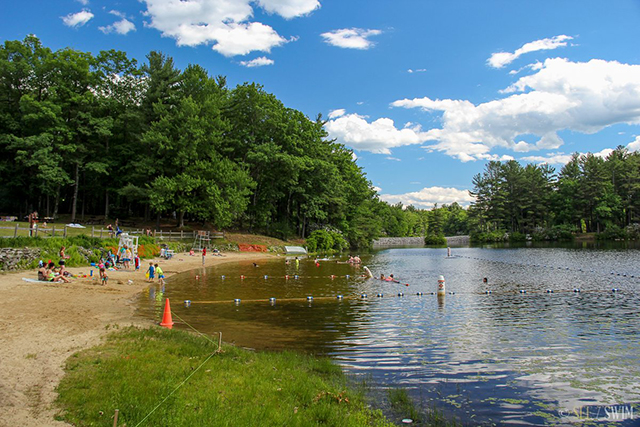
Leominster State Forest (Photo: See/Swim)

Leominster State Forest

90 Fitchburg Road, Westminster, Mass.

There are plenty of outdoor activities to enjoy at Leominster State Forest, from horseback riding, non-motorized boating and swimming to mountain biking, rock climbing and hiking.

The Rocky Pond hike is 2.5 miles in length and moderate in difficulty. Forest Road Loop is 3.8 miles long but easier. Experienced cyclists will like Leominster’s Rocky ride; difficulty is strenuous and the distance varies.

After you’ve worked up a sweat, cool down with a dip in Crow Hill Pond, which – despite its name – is actually a swimmable lake. For those who like fishing, Crow Hill Pond is stocked with trout by Mass Fisheries and Wildlife. There’s also Paradise Pond, which is not swimmable, but that makes it a great spot for warm water fishing.

There are also grills and a scenic viewing area for visitors to enjoy.

Willard Brook

Route 119, Ashby & Townsend, Mass.

Spanning an impressive 2,597 acres, Willard Brook State Forest is a great location for camping, fishing, hiking, horseback riding, mountain biking and swimming.

For experienced hikers, there’s the Friends Trail (Orange Loop), which is 5.2 miles in length and connects Willard Brook with Pearl Hill State Park. Hikers should plan for at least a 3-hour trek.

Those looking to chill for the day can enjoy picnic views and outdoor grills along with access to restrooms. The campgrounds include accessible camping in the form of a yurt with a ramp. Dogs are not allowed at yurt campsites but are allowed elsewhere as long as they remain on-leash.

Before You Go

Massachusetts state parks are typically open from sunrise to sunset but swim and office times vary. Parking generally costs $8 for residents and $30 for non-residents. Look into individual locations for rules on parking, whether pets are allowed, etc.

In Massachusetts, bike riders ages 16 and under must wear a helmet. If you choose to go boating, a Personal Flotation Device (PFD) or life preserver must be worn by boaters age 12 and under as well as canoeists and kayakers from Sept. 15 to May 15.

Which of North Central Massachusetts’ freshwater beaches would you like to visit? Tell us in the comments. 

Funded by the Massachusetts Office of Travel & Tourism.

Subscribe to Your AAA Newsletter

Sign up and receive updates for all of the latest articles on automotive, travel, money, lifestyle and so much more!

The Unique History of Bumper Stickers

Bumper stickers. Some people love them, some people loathe them. But nobody can argue that they’re everywhere.

So how did these ubiquitous pieces of advertising come about? And how have they managed to last the test of time? Let’s take a look.

The Bumper

The idea of using a vehicle for advertisement was around before the automobile was even invented. In the horse-and-buggy days, it was common for people to adorn horsefly nets with advertising slogans.

The trend continued when automobiles came around. But almost all early cars lacked bumpers. The safety feature wasn’t widely adopted until 1927, when Ford released the Model A. Drivers decorated their bumpers with homemade signs. But these were usually made of cardboard or metal and attached using wire. Needless to say, they didn’t last very long.

The Sticker

The bumper sticker as we know it today can be traced back to a screen printer in Kansas City, Mo. named Forrest P. Gill. In the 1940s, Gill found himself with a surplus of two wartime technologies: adhesive-backed paper and fluorescent paint. He combined the two and the bumper sticker was born. His new creation was a significant improvement over handmade signs that fell off cars or easily wore down.

The first early adopters of bumper stickers were tourist sites. Instead of having a single sign on the side of the road, destinations now had countless ads traveling across the country. Gill’s first large volume request was 25,000 bumper stickers for Marine Gardens in Clearwater, Fl. (The company Gill founded is still around today and still selling bumper stickers.)

The popularity of bumper stickers took a major step forward during the 1952 presidential election between Dwight Eisenhower and Adlai Stevenson. It was the first election to include the use of bumper stickers as advertising materials. They have since been used in every U.S. presidential election. To this day, political advertising remains a mainstay use of bumper stickers.

Bumper Stickers Today

Bumper stickers have evolved over the years to include decals and placards. The most famous of the latter is the “Baby on Board” sign. Interestingly enough, the ubiquitous sign was developed and sold by a man without children.

In 1984, Massachusetts businessman Michael Lerner was asked by a friend for advice on how to market the signs. Lerner wasn’t a father but he had recently endured a harrowing experience driving his young nephew. “People were tailgating me and cutting me off,” he told the Wall Street Journal. “For the first time, I felt like a parent feels when they have a kid in the car.”

Lerner tweaked the design, creating the now-famous black-and-yellow diamond sign. “Baby on Board” was an immediate hit. Less than a year after hitting the market, Lerner had sold 3 million signs.

“Baby on Board” isn’t the only popular sign or sticker to last the test of time. Others are religious (the ichthys, “Coexist”), familial (“My Child is an Honor Student,” the stick figure family), and safety related (“Slow Down, Move Over,” “School’s Open – Drive Carefully”).

Bumper sticker
Kelly Sims / CC BY-NC-ND 2.0

No Laughing Matter

As innocent as bumper stickers can be, they have not been without their fair share of controversy. In fact, in 1991, they were the topic of a legal case that reached the Georgia Supreme Court.

In Cunningham v. the State, a Georgia resident had been caught having a bumper sticker on his car that contained an expletive. He was charged with violating a state law that prohibited car owners from attaching “any sticker, decal, emblem, or other device containing profane or lewd words.” The owner argued this law was unconstitutional. The court agreed, stating that the law violated the 1st and 14th Amendments. Thus, the humble bumper sticker became protected by freedom of speech.

A 2008 study by Colorado State University found that car owners with bumper stickers or window decals tend to be more aggressive drivers. Researchers also discovered the message of the sticker was irrelevant. A driver with a “Peace and Love” sticker was as likely to be an aggressive driver than one with a more hostile sticker.

Which bumper stickers do you see most often? Which ones do you like and which are you tired of? Let us know in the comments below!

Subscribe to Your AAA Newsletter

Sign up and receive updates for all of the latest articles on automotive, travel, money, lifestyle and so much more!

Blazing a Trail Through History in Kyoto, Japan

I had been looking forward to visiting Kyoto during my entire tour of Japan.

The former imperial capital of Japan is now considered the country’s cultural capital. Throughout the years, Kyoto has tried to preserve its incredible historical heritage while, at the same time, growing into a modern and vibrant city. I was ready to explore that contrast – the balance between the modern and the historical – as soon as I stepped off the train.

Kyoto is bright, clean and inviting, like almost every location in Japan. It looks very much like Tokyo, even if the buildings don’t reach quite as high into the sky. Our tour manager told us that just under the surface ancient tradition could be found, and so I set out to find it.

Looking to plan your next vacation? Be sure to consult a knowledgeable AAA travel agent to help guide you through the rapidly changing travel landscape.

Nijo Castle

The first stop was Nijo Castle. Not only is this sprawling fortress the home of the first shogun, it’s also one of 17 historic monuments of ancient Kyoto. All are UNESCO World Heritage Sites, which means they are regarded as special places in the world and therefore carefully protected and preserved. Nijo is unique because it is the only castle among them; the rest are shrines and temples.

It’s also unique because of its nightingale floors, the legendary architectural marvel that kept the shogun safe while he slept. You can’t cross the floors without making the floorboards squeak, or sing like a nightingale, and so no one could sneak up on the sleeping shogun, whose bed was squarely in the center of the wide floor.

Kiyomizu-dera Temple

After Nijo Castle, we left the city for a temple. Growing up in New England, I thought I knew the beauty of autumn since I had seen so many crisp, colorful falls. Standing on the wooden deck of the Kiyomizu-dera Temple, looking out over Kyoto, I realized how wrong I was. I felt like I had never seen reds, yellows and oranges this vibrant in all my life.

Kiyomizu-dera Temple sits atop a hill, and from its balconies you can see over the colorful sea of treetops and take in all of Kyoto at once. It’s an awe-inspiring sight, magnified by the shimmering colors of the changing leaves.

Fushimi Inari-taisha Shrine
“Fushimi Inari-taisha Shrine” by john.gillespie is licensed under CC BY-SA 2.0

Fushimi Inari Taisha Shrine

We left Kiyomizu for the Fushimi Inari Taisha Shrine. There, I found something vibrant enough to rival the fiery oranges of the autumn leaves: the crimson-colored torii gates that line the path through the forest to the inner temple. Stone fox statues crouched everywhere around the shrine. We found out later that foxes were thought to be messengers for the gods.

Walking through the mountain paths, under the torii gates, I discovered a smaller shrine. This was a sub-shrine, I found out later, and there were three more scattered across the mountain. Some were so far away that the hike there would have taken two hours, and the sun was already dipping down behind the trees. I decided heading to the base of the mountain was the smartest course of action.

Hiroshima

The next morning, I took a train to Hiroshima and explored the Peace Memorial Museum before returning to Kyoto. After the modern ride in a bullet train to Hiroshima and back, coming back to Kyoto felt like traveling in time. The city is so quiet, filled with shrines and temples and gardens, that you can’t help but let the tranquility wash over you. It’s easy to find a bench and watch the falling Japanese maple leaves swirl in the wind.

Noodles and dumplings in Kyoto

I had the evening free, so I decided to just walk the streets of Kyoto and simply follow wherever my feet took me. I thought I was following my feet, but I ended up following my nose, instead. The savory scent of ramen led me into a small noddle shop, where I sat and ate delicious pork and noodles in broth, along with some tasty dumplings. It was a crisp, cool evening, and the steaming ramen warmed me up.

The backstreets of the Gion district (Kyoto, Japan)
“The backstreets of the Gion district (Kyoto, Japan)” by THINKGlobalSchool is licensed under CC BY-NC-ND 2.0

The Gion District and geisha

The Gion District was magical, watching traditionally dressed geisha meander down the cobblestone streets under paper lanterns. Every narrow alleyway seemed to hold a secret teahouse, and every park seemed to hold an ancient shrine. There was a weight of history, tradition and culture everywhere.

The geisha that walked the streets, however, weren’t geisha at all. Some were maiko, geisha-in-training who are learning the craft of being one of the elite entertainers. Some are simply women in costumes, posing with tourists. Kyoto has the highest concentration of geisha in Japan, but there are less than 100 in the whole city, and they almost never walk the streets. Instead, they play instruments and sing in quiet, personal ceremonies.

The Nihonmatsu Lantern Festival

As night fell, I heard drumming and shouting. The 300-year-old Nihonmatsu Lantern Festival had begun, with torch-bearing men marching down the street, singing and chanting to the beat of drums. As it got darker, I saw the lantern floats: huge wooden structures lit with hundreds of paper lamps that slowly sailed down the streets as the drums thundered on. The floats spun as dancers jumped wildly atop them. I watched in awe as the party – one of Japan’s largest lantern festivals – continued into the night.

Japan Through the Seasons

Each season in Japan has a special flair all its own. In fall, the vivid landscape and cooler temperatures beckon. You can watch the snow fall gently outside while taking part in a tea ceremony in the winter, or walk through the parks in spring as cherry blossoms swirl and blanket the ground in a pink-hued carpet. In the summer, you can catch the world-famous parade of the Gion Matsuri Festival as people pack the sunny streets.

There’s always something to do in the Land of the Rising Sun. I was already mentally planning for my next trip to Japan, and I hadn’t even left yet.

Start planning your Japan vacation with AAA Travel

This story was originally published in 2017 and has been updated.

Subscribe to Your AAA Newsletter

Sign up and receive updates for all of the latest articles on automotive, travel, money, lifestyle and so much more!

A Road Trip With Mom: Mother’s Day Road Trips for All Ages

Mother’s Day doesn’t have to be about breakfast in bed and lounging around the house. What better way to spend time with the mom on your list than with a road trip? Well, OK, breakfast in bed and then a road trip. This collection of local sites and attractions will help you plan the perfect Mother’s Day trip.

Before you go anywhere with Mom, remember to save with AAA Tickets. You can get savings of up to 40% at concerts, theme parks, virtual events, museums, attractions and more!

Note: Due to the ever-changing nature of the COVID-19 crisis, please see official websites before visiting to check for restrictions or closures.

Kids

Kids and moms alike will love local zoos and aquariums like Roger Williams Park Zoo (Providence, R.I.), Mystic Aquarium (Mystic, Conn.), the Bronx Zoo, Franklin Park Zoo (Boston, Mass.) and Beardsley Zoo (Bridgeport, Conn.). The kids will love seeing how the animals are celebrating Mother’s Day with their mamas, from the possums with babies on their backs to little elephants clinging onto their moms’ tails.

Check out our list of New England Zoos and Aquariums.

If the zoo isn’t for you, head to a children’s museum instead. One of the best children’s museums in the Northeast is The Strong National Museum of Play in Rochester, the only collections-based museum in the world devoted solely to the study of play. It’s also the second-largest children’s museum in the country.

Kids might also enjoy the Museum of Firefighting in Hudson, New York. You may need them to rescue you from a burning building one day, and they need all the training they can get. Also, kids like firetrucks.

If that macaroni card isn’t cutting it for you, put the kids to work in the Herkimer Diamond Mines instead in Herkimer, N.Y. Herkimer diamonds are actually double-terminated quartz crystals, some of which are millions of years old. Visitors can explore the mines and find crystals. Make sure to bring safety goggles and chisels of your own, though!

Teens   

Peel your teen off the couch this Mother’s Day for their own road trip with mom. Not even teenagers are too cool for the Northeast’s many natural wonders.

At Niagara Falls, you can take the Cave of the Winds Tour and get up close and personal with nature on the Maid of the Mist boat tour. Or go to the top of Mount Washington in New Hampshire. It’s the highest peak in the Northeast, with breathtaking panoramic views. Take the 30-40-minute drive up to the summit via the Mount Washington Auto Road, or hop on the Cog. Just be sure to bring a winter jacket – it’s cold up there (and often snowing)!

Adventurous teens will also like Sky High Adventure Park in EllicottvilleN.Y., which features an aerial park, a climbing forest and a mountain coaster. Afterward, you can all go to Sky High Adventure Park’s Oasis Spa to unwind. A little something for them, and a little something for you – everybody wins. Teens might also enjoy the Newport Cliff Walk, a 3.5-mile scenic path that follows the Newport, R.I., shoreline. While most of the trail is easily walkable, there are a few sections that will test your limits (and your fear of heights).

Some teenagers prefer the strange and unusual to the adventurous – and they deserve a road trip with Mom too! Goth and quirky teens will love places like the Batsto Village Ghost Town in New Jersey, an abandoned company town in the middle of the Wharton State Forest pine barrens. Batsto is spooky, but it’s also incredibly preserved, and makes for a fascinating history tour.

Another quirky Northeast landmark is the Museum of Everyday Life, a “self-service museum” in a dilapidated white barn on the side of the road in Glover, Vt. The museum is really an ongoing art piece celebrating the mundanities of everyday life, complete with interactive exhibits on things like dust, pencils, matches, safety pins and toothbrushes.

road trip with mom

Grown-ups

You might be a mother looking for something to do with your grown children, or an adult child looking for something to do with your mother. Either way, these destinations make for a great road trip. One easy way to celebrate Mother’s Day is by going to a local city, like New York or Boston. Even smaller cities like Portland, Maine, will have fun Mother’s Day things to do.

Rather than heading to the city, you might want to go to a charming small town together. Mystic, Conn., is a picturesque seaside town complete with museums, B&Bs, restaurants and lots of adorable boutiques and shops. Down in Pennsylvania is Lancaster County, the home of Amish Country. You’ll be able to tour wineries, breweries and charming covered bridges. You can learn about the Amish way of life and even purchase one of their hand crafted or hand grown goods.

If you like to shop ‘til you drop, check out one of the many outlet centers we have in the Northeast! You can get your fix at Tanger Outlets, VF Factory Outlets and Manchester Designer Outlets for starters. If you’re headed to Tanger Outlets, don’t forget that AAA members receive a free coupon book at Tanger.

Another great way to spend Mother’s Day is out east in Long Island’s wine country. Check out the Long Island Wine Trail for a selection of wineries and vineyards to visit. You could also go from one vineyard to another by bike on tours like East End Bike Tours and Pour & Pedal.

There’s no gift better than a shared experience. Make this a road trip with mom that you’ll never forget.

Need a ride? AAA members can save up to 20% on Hertz rentals

What are you doing for your road trip with mom (or with kids)? Let us know in the comments below!

Subscribe to Your AAA Newsletter

Sign up and receive updates for all of the latest articles on automotive, travel, money, lifestyle and so much more!

Create an Uncrackable Code: Password Tips and Tools

If you’re a seasoned internet surfer, chances are you have more online passwords than you can keep track of. We create accounts for business, social media, email, online banking, shopping, gaming, streaming music and so on, each requiring a password.

Are your passwords strong enough to guard from hackers?

Now more than ever, people are relying on online shopping and services to get the things they need. Don’t put your identity at risk. Keep your info secure with these password tips.

Rookie Mistakes

Reusing Passwords

Keeping track of every password can be difficult but avoid the temptation to assign the same password to multiple accounts. If a hacker discovers your password for one account, your other accounts become vulnerable to breaches as well. It’s best to use different passwords for every account that you create to keep a leg up against those seeking to steal information.

Simple Passwords

While simple passwords may not require a lot of brain power to create and remember, avoid common combinations like “123456,” “qwerty” and the often joked about “password.” These are easy for hackers to guess and aren’t strong enough to securely protect your information. Also avoid using personal information. Birthdays, names of family members and nicknames are usually easy to find on websites like Facebook and Twitter. Avoiding patterns and creating more complicated passwords will help keep hackers at bay. The more complex, the better.

Saving Passwords to Computer Browsers

After logging into an account your browser may show you a pop up window asking if you would like the browser to remember your username and password every time you visit the site. While convenient, this feature also makes your information vulnerable. Anyone with remote or in-person access to your device can visit a website and access your information.

Building a Better Password

A strong, well-crafted password is the first line of defense against cybercriminals. Cybersecurity company McAfee recommends using at least eight characters in your passwords, with a combination of uppercase and lowercase letters, numbers and symbols. The more characters there are, the harder it is for hackers to guess.

Here’s a good password tip: Consider playing around with different character options to create short phrases. For example, a phrase like “I love my car” can be changed into a secure password with a few changes like “i<3mYCaR!” Play around with different letters and try some nonsensical sentences for your next password. You can also use password generators like LastPass for secure randomly generated passwords or to rate the strength of your own passwords.

Keeping Your Smartphone Secure

Setting passcodes and PIN numbers for your smartphone is just as important as creating strong passwords for online accounts. With a weak passcode, your contacts, apps, financial information and more are at risk of being stolen if you lose your phone.

Choose a passcode that is difficult to guess. Avoid using common sequences like “123456” or “246810” and repetitive numbers like “111111.” Never use birthdays or digits of your phone number. More recent devices offer fingerprint identification from the lock screen, and some even utilize facial recognition.

Be sure to download software and app updates often to avoid data breaches. It’s a password tip that often goes overlooked but putting off updates can lead to system vulnerabilities, inviting hackers in. Turning on the automatic updates setting on your smartphone ensures that software will be updated as soon as a new version is released. And never download apps from third party app stores, and stick to stores like Google Play and Apple’s App Store to avoid data breaches and malware downloads.

For additional security, use two-factor authentication whenever you can. After entering a password, you’ll receive a code via text to enter for access to your account. Although the extra step may seem tedious, it will make all the difference in protecting your information.

password tips

Using a Password Manager

If you’re worried about remembering all of your passwords, try a password manager. With this tool, you can collect and store every password and sort them according to their respective accounts.

As mentioned earlier, password managers can also generate secure passwords for you at random to ensure your information isn’t hacked. These systems also keep track of three-digit CVV codes, PIN numbers, answers to security questions, credit card numbers and more. They are completely secure, utilizing password encryption and multi-factor login on every visit to keep your information safe.

Here are some of the most popular password managers, all with free trials available.

1Password

As with all password managers, you only need to memorize one password to access all of your other information, hence the system’s well-fitting name. Passwords are stored in password vaults for optimal security from hackers and cyber thieves. Vaults are unlocked with a special encryption key that lives on your personal device. No one without access to your device can unlock your information and no data can be decrypted without the encryption key.

LastPass

With LastPass, you can a login to any website requiring a password with the system’s autofill function. It can automatically save your account credentials for any recently created account. LastPass also has the ability to autofill online forms to make your experience more efficient. With fingerprint identification and facial recognition, you can count on this system’s security.

Keeper

Like 1Password, Keeper stores your passwords in an encrypted vault to protect them from cybercriminals. The system allows you to log into websites and mobile apps with facial recognition and fingerprint authentication as well. The KeeperFill function acts as a password generator, producing strong passwords for you to use in new account creation and autofilling them each time you visit the website. The system also allows you to register an emergency contact to activate your information in case of an emergency.

Did you find these password tips helpful? Let us know in the comments. 

Keep your personal information safe with ProtectMyID identity theft protection from AAA and Experian. ProtectMyID Essential is FREE for AAA members. Learn more

Subscribe to Your AAA Newsletter

Sign up and receive updates for all of the latest articles on automotive, travel, money, lifestyle and so much more!

The Disney Wish Sets Sail in 2022

On Thursday, April 29, Disney unveiled the first look at the Disney Wish. Setting sail from Port Canaveral, Fla., in summer 2022, the Disney Wish promises a wide variety of adventures and delights for the whole family.

From Captain Minnie at the helm to a golden Cinderella statue in the Grand Hall, the whole ship is packed with Disney magic. On the upper deck, you can experience the first ever Disney attraction at sea – the AquaMouse. With show scenes, lighting and special effects, you and your family can enter the Mickey Mouse cartoon “Scuba Scramble.” This water attraction spans 760 feet around the upper deck, and is sure to be a family favorite.

That’s not the only thing the kids will love, though. The Disney Wish features a reimagined Disney’s Oceaneer Club, with a secret slide for kids to enter from the Grand Hall. In the Oceaneer Club, kids can discover their powers at the Marvel Super Hero Academy, flex their creative muscles at Fairytale Hall and become inventors at the Walt Disney Imagineering Lab.

The Disney Wish also features brand new experiences for grown-ups, like the immersive Star Wars Hyperspace Lounge, where you can order drinks while gazing at views from a galaxy far, far away. Grown-ups will also love the trio of Beauty and the Beast themed dining experiences: the Rose lounge, the Cogsworth-themed Palo Steakhouse, and the Lumiere-themed Enchante.

Arendelle Dining
Arendelle: A Frozen Dining Adventure features Elsa and Anna from “Frozen.”

Kids get hungry too, though, and there are plenty of experiences for a family to choose from. The Disney Wish offers three new family restaurants. 1923 is a restaurant inspired by old Hollywood, featuring California-inspired foods and decorated with animation pencil sketches. At Arendelle: A Frozen Dining Adventure, you can dine on a menu infused with Nordic influences while being serenaded by Anna, Elsa, Kristoff and even Olaf. At Worlds of Marvel, you and your family will experience an immersive, cinematic dining adventure inspired by the Marvel universe.

We’ve only gotten a sneak peek at all the new experiences waiting aboard the Disney Wish, but it’s already enough to be excited about. Want to make sure you can sail with Captain Minnie in 2022? Bookings open on May 27, 2021.

Contact a AAA travel advisor to learn more!

What would your dream cruise be like? Let us know in the comments below!

Subscribe to Your AAA Newsletter

Sign up and receive updates for all of the latest articles on automotive, travel, money, lifestyle and so much more!

Top 10 Craziest TSA Stories and Finds

Since its founding in 2001, the Transportation Security Administration has become known for its agents finding bizarre items during the screening process. To better inform the public, the TSA created an Instagram account in 2013, which recently reached 1 million followers. The page features personal accounts of unusual experiences and hilarious pictures. Many of these wild stories and photos have surfaced on the internet in recent years.

For your enjoyment, we compiled a list of the 10 craziest TSA stories.

Flamingo Fiasco

Those who plan to travel with an inflatable item can learn a lesson or two from this story. The TSA agents at the Dallas/Fort Worth International Airport had to screen the large pink object with a great deal of care. According to TSA, this particular flamingo was not traveling. It was on its way to work at a display in one of the concourses.

Snakes on a Plane 

It doesn’t just happen in the movies. The TSA has HAD IT with people trying to smuggle exotic pets on planes. In 2011, a Brazil-bound man was apprehended at Miami International Airport with some unusual baggage. The passenger attempted to go through security with seven exotic snakes and three tortoises held in nylon bags that were concealed under his pants. Thanks to the latest technology, the TSA agents caught the man who was later arrested and charged with violating the Lacey Act, which deals with imports of exotic animals.

“While snakes and tortoises may not pose a threat to aviation, non-metallic weapons and explosives concealed beneath clothing remain a concern for security personnel and this discovery demonstrates again the effectiveness of advanced imaging technology,” said TSA spokesman Jon Allen.

Chinese Birds

Animals have a history of passing through airports in extremely strange ways. During a routine screening at the Los Angeles International Airport in 2011, a TSA agent discovered a woman had taped two birds wrapped in socks to her leg and chest. She was apparently attempting to take them to China. Instead, the woman was arrested by the U.S. Fish and Wildlife Service on suspicion of smuggling endangered animals out of the country. Thankfully, the birds made it out alive.

“It was just one of those weird things that happens at our checkpoints,” a TSA spokesperson said.

No Seahorses Allowed

Bringing a bottle of alcohol through security is a bad idea – it will quickly be confiscated. Passengers routinely attempt this, but TSA agents at the Detroit Metropolitan Airport were surprised to find five endangered seahorses in an oversized brandy bottle back in 2012. They were spotted in a traveler’s carry-on bag. The passenger was later arrested and the seahorses (which, sadly, did not make it) were handed over to Michigan wildlife officials.

Enchilada Mishap

A great way to ruin a delicious batch of enchiladas is by hiding a large knife in it, especially while traveling through airport security. In 2014, a passenger flying out of Sonoma County Airport left TSA in disbelief after officials found an 8-inch long knife inside an enchilada in her carry-on bag. The woman, who was on her way to catch an Alaska Airlines flight, admitted she forgot about the knife.

She was cleared after officials learned she just wanted to eat her meal on the plane. “There’s no word on if the enchilada made the trip,” said a TSA spokesperson.

Chainsaw-Free Zone 

Most air travelers know that knives, guns and other weapons are strictly prohibited. A traveler in 2014 tried to test the rules by bringing a chainsaw through the checkpoint at the Albany International Airport. The chainsaw was ultimately surrendered from the passenger’s carry-on. TSA posted a photo online with a caption stating chainsaws must be packed as a checked item as long as there’s no trace of fuel or fumes.

Catch of the Day 

TSA officials were in for quite a surprise when they stopped an unexpected passenger traveling through Logan International Airport in Boston. A 20-pound live lobster tucked inside a checked bag caught agents’ attention during the screening process. According to TSA’s online security screening guide, “A live lobster is allowed through security and must be transported in a clear, plastic, spill-proof container.”

Dying to Get on a Flight 

TSA agents at the Hartsfield-Jackson Atlanta International Airport in Georgia had caused quite the scare when Nubbins, a movie prop corpse from “The Texas Chainsaw Massacre 2,” went through the line. Luckily for Nubbins, the realistic-looking corpse didn’t have to take off his shoes during screening. Hopefully no one was stuck sitting next to him on the flight.

When Ducks Fly

Service animals have long been a topic of discussion among the flying public. After the TSA shared a photo of a mallard going through security at Charleston International Airport in South Carolina, the debate of allowing animals on board resurfaced online. According to the TSA, the duck was a passenger’s service animal, flying with its owner aboard a recent flight.

Cut. It. Out.

A giant pair of ceremonial ribbon-cutting scissors was found at the Nashville International Airport in Tennessee. Unfortunately for the passenger, the scissors were not allowed on the flight. According to TSA guidelines, “If packed in carry-on, they must be less than 4 inches from the pivot point. Any sharp objects in checked bags should be sheathed or securely wrapped to prevent injury to baggage handlers and inspectors.”


Have you ever seen anything unusual at the TSA checkpoint? Were you ever stopped for trying to bring something out of the ordinary onto a plane? Tell us your craziest TSA stories in the comments below. 

Book your next trip with AAA Travel

Subscribe to Your AAA Newsletter

Sign up and receive updates for all of the latest articles on automotive, travel, money, lifestyle and so much more!